

Aletterto Race Volunteers
What possesses someone who does not race, who may not even run, to get up at silly hours of the morning to stand outside, in the dark, sometimes in extreme heat but more often in wicked cold, for hour after boring hour, and offer assistance to people who are so involved in what they’re doing that they may not even notice you, let alone offer thanks, is beyond the limits of my small imagination. But nevertheless, at each race I enter, there you are, handing out cups of water, offering up Oreos, encouraging and supporting and cheering. I worship you. I wish I could offer you my first-born child. Or maybe bake you cookies. But I have no children and I can’t bake.
The race director is responsible for explaining your duties, but race directing is about as easy as wrangling cockroaches. So I wanted to take some time first to thank you for your service and then to pass on some comments from runners about how you can be great race volunteers, have fun, and hope to help you understand that runners aren’t as obnoxious as they may seem when they’re out there on the course.
Many years ago I had a nonrunning friend who volunteered to work at a 5K race. That was the last time he ever signed up to help. The runners, he said, were asshats. (Well, he didn’t say that because it was before that word was coined, but it is the perfect word for what he was describing.) They got mad if you didn’t hand them water fast enough, or in the right way. They got mad if you didn’t call out the time. They got mad if someone in front of them stopped for water and they had to pass them. You get the idea. Asshats.
Here’s the thing. Unlike people who run for fun and fitness (and stress relief and social contact and to make the barter between ice cream and a flat belly), those of us who enter races take this stuff seriously. Probably too seriously for it to be healthy. Even if we’re not fast, we tend to care a whole lot about our times, though we may seem to be lollygagging at the back of the pack. The energy and focus required to train we bring to the line on race day, and often that creates a
narrowness of vision, and sometimes that leads to less than gracious behavior. Most runners are good people. Many, in fact, are excellent people, people you would be happy to sit and chat with, get to know, help, even. Many will slobber thanks on you even after they’ve run more miles than most people drive in a day. But there will be those who don’t speak the gratitude they feel; that doesn’t mean they don’t feel it. It just means that when you’re running a gazillion miles, sometimes you get distracted. Here are some things that may be useful for you to know to enjoy the time you have so generously offered up to work in an aid station.
Treat Runners Like Toddlers. You might be tucked away in some clearing, or at the bottom of a big hill, or who knows where. You could get lucky and be able to drive to it, or you may have to hike in a ways. It should be set up with tables, chairs, and plenty of supplies. You should have lots of time not only before the first runners come through but between runners as well. Though like bad luck and dog hair under the bed, runners tend to clump up at times.
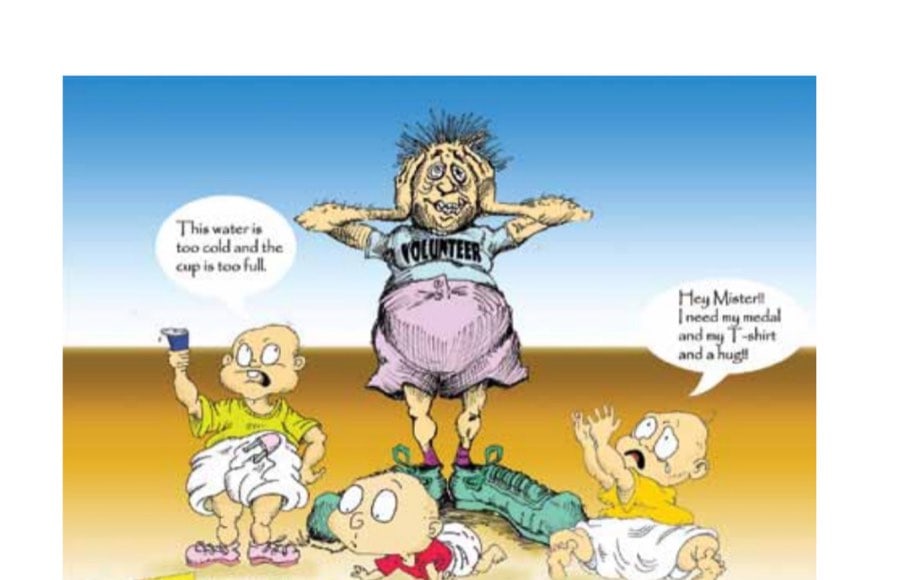
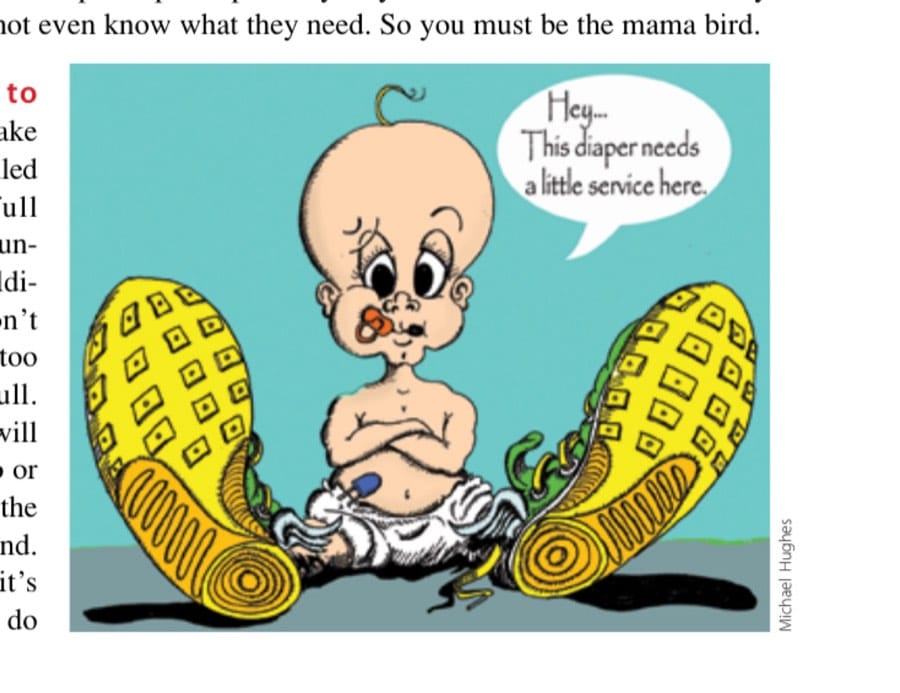
Greeting the incoming runners as they get to the aid station should be the fun part. Think of each one as a visiting dignitary, even if the runner’s behavior is less than diplomatic. But before you go and start thinking of yourself as an ambassador, what you have to understand is that things will go best if you treat runners like toddlers. While they may be out there running 30, 50, or even 100 miles, and that may seem like a big tough thing to be able to do, when they get to your aid station, they’re helpless. Think of them as little chicks with their beaks wide open going “Cheep cheep cheep.” They may not be able to ask for what they need; they may not even know what they need. So you must be the mama bird.
Michael Hughes
Be Prepared to Help. Please make sure the table is filled with already full cups of water. Runners are like Goldilocks. They won’t like cups that are too empty or too full. Often, runners will down one or two or three and throw the cups on the ground. Tell them that it’s OK for them to do
this. You can have a big garbage bag ready, but you should be prepared to hunt down the flung cups. They’re not being rude or litterbugs. They’re just concerned about the seconds it might take to place their rubbish in an appropriate receptacle. Toddlers.
Sometimes runners will enter your aid station, thrust their own water bottles at you, and start snarfing up all the food. They are speaking to you in a secret language. Here, in exact translation, is what they are saying: You are so wonderful. Thank you so much for being out here. Are you having fun? I really like your hair that way. Do you think—I mean, would you be so kind as to possibly uncap my bottles, read my mind about what I want in there (electrolyte fluid? Plain water? Flat Coke?), fill them up, put the tops back on, and hand them to me? I would be so grateful to you. I will love you forever. Thank you so much. Thank you so very, very much.
Just Do It. Instead of waiting, ask if you can fill bottles. And then ask them what they want. Sometimes they will have to do yoga to remove their hydration packs, and you will have to do some physics to figure out how to get the goods in there without spilling everything. You might take a look at one of the packs before the race starts. Here’s the thing to remember: this is a race. Even in a 100-mile race, sometimes the difference between the top runners can be less than a minute. Every second lost at an aid station counts. You are the pit crew for NASCAR stars, only instead of changing high-performance tires and topping off gasoline, you’re peddling Oreos, Band-Aids, and energy drinks. And, as is the case for pit crews, the Army, and soccer moms, it’s always going to be “Hurry up and wait.” But even the slow folks at the back of the pack should be treated as if they’re sports cars. They’ve been out there for a long time; do what you can to make their time in the aid station easy. Keep Making Offers. Everything you have at the aid station should be available and visible on the table. But runners don’t often know what they want to eat in the later stages of a race. They need to eat, even though sometimes they don’t want to. It’s helpful for you to make suggestions that may be received with vigorous head-shaking. Pretzels? [Head shake NO]. Oreos? [Big head shake NOOOOOOOOO.] PB & J? [Earth-rumbling head shake NOOOOOOOOOOOO.] Boiled potato? [pause] Boiled potato sound good? [Tiny little yes.] Toddlers, people. Remember to treat them like toddlers. Open packages before they get there. Fine motor skills, like being able to tear open an energy gel or unscrew a jar of peanut butter, deteriorate with the miles. Go Fetch. If chairs are available around the aid station, leave them for the runners. They may want to sit down and take off their shoes. If drop bags are at your aid station, ask the runner for her number and then go fetch the bags for her. While
she may act like she expects this from you, she’s silently saying, “Oh, thank you so much, you good and kind person.” He may expect you to help him take off his shoes, and even his socks. He may want to smear Vaseline all over his naughty bits. I hope, oh dear lord I hope, that no one ever asks you to do this for him, but when runners are 87 miles into a 100-mile race, you just never know what you’re going to get. Ask if they have any trash they want to shed. Ask if they need anything. Then make sure you know what you have, in case it’s something weird. I once ran with a guy who spent about 11 miles fantasizing about Hawaiian Punch. Then we got to an aid station and, on a far table, I saw, much to my surprise, a jug of Hawaiian Punch. Who would have thought?
Be the Invisible Hand. Stay out of the way. Things can get hairy when a number of runners come in together. They may be all too aware of just how much time it’s taking for them to get what they need and get out ahead of the person they’re trying to stay ahead of. You don’t want to be collateral damage. Keeping a table between you and them could be a smart tactical move if there are a lot of people. On the other hand, just standing behind a table and waiting like a barista to take an order won’t help much. Or talking to each other. Don’t get so involved in conversation with fellow aid station workers that you forget why you are there. You are there for the runners. It’s all about them. A literal pat on the back—an arm to prop up tired and unsteady legs—can make runners feel human and cared for. Know Where You Are. An important thing for you to know, if you’re out in the middle of nowhere, is what mile your aid station is at. That information should be available to you (ask the race director or look on the map). If you remember it and can tell runners as they’re coming in, they will appreciate it. What they’ll appreciate even more is letting them know how far it is to the next aid station. If you can tell them that, and then direct them to the trail out (sometimes it’s not apparent, especially in the later miles), they will love you forever. Say something
ad
like, “You’re at mile 34 and it’s another four and a half miles to the next aid station, which is at mile 38.5.” Even if they don’t ask, they won’t be mad at you for telling them this. The ability to do simple arithmetic is one of the first things to go (after peanut butter jar opening). Then sentences. Then words. They may grunt, or nod, or not even acknowledge you. But as they’re running out, they’ll think, Wow. Good to know. What a great volunteer. I have to remember to track her down after the race and thank her. Even if she forgets to do this, know that she intended to.
There’s a Race Going On. Now, here’s something else. Nuttiness and speed sometimes go together like chocolate and peanut butter. The people in the front pack are going to be the most, um, focused. It’s not your job to keep track of the race. But if you want to win the Best Volunteer in the History of the World Award, you might consider paying attention to who comes in when. After the first man comes in, note his time. When the next runner appears, you can let him know that the first dude is less than three minutes in the lead. If I were working an aid station and wanted to win the Best Volunteer in the Universe Award—and there were plenty of other people there helping—I might even keep a list of the first five runners with their times in. Actually, There’s More Than One. But then you have to remember that there are always two races going on. I have wanted to give a first-born child or a body
part to volunteers who keep track of the women’s race and tell me where I stand. Knowing that you’re the third woman can be a big motivator. Knowing that the first chick was only a minute ahead and looking haggard—or was 15 minutes and was skipping and singing—is useful. If you can keep count of the first few men and women, you will be a rock-star volunteer. You won’t know who the age-group runners are, and it’s probably not a great idea to say, “Hey! You’re the first old guy!”
They Can’t Take All Day. Things can also be stressful for those at the back of the pack. Most races have time cutoffs. Runners need to know where they are relative to the cutoff. Make sure you have this information. If you have to tell a runner that he or she is too late to continue on the trail, make sure you have a big, strong, scary-looking person nearby. Maybe a muzzle. And a tranquilizer dart. I hope you never have to do this. Most people who are running close to the cutoff times know it. Shake Your Pom Poms. Everyone likes encouragement, but everyone likes it in different ways. Some runners love hearing, “You look great.” Other people are like, “I know I look like dog poop. Stop looking at me.” Some people will actually look like dog poop. But remember: this is what we do for fun. We pay money to do this. We train for months for this one day. Even if it feels hard in the moment, it’s not your place to remind them that they choose to put themselves through this misery. Sarcasm requires a level playing field. Men often seem ill at ease telling other men that they look great, or even that they’re doing well, and instead will try to make jokes that are rarely funny. This is not the time to try your stand-up act or bring the focus around to what you’re doing. When you’re volunteering to help runners during a race, it’s all about them. Know That You Are Appreciated. If you jump to every request, don’t expect to be thanked, and don’t expect runners to engage in conversations like humans. Don’t expect, in that moment, for anyone to even notice you’re there, but understand this: you will in fact be a hero. Everyone who pins on a number knows that we couldn’t do what we do without you and that you probably have far better things to do with your time. Even if we don’t always appear grateful, we are. We really, really are.
This article originally appeared in Marathon & Beyond, Vol. 18, No. 2 (2014).
← Browse the full M&B ArchiveMore like this
1,000+ stories from 19 years of Marathon & Beyond
The complete archive of the legendary long-distance journal — digitized and free to read.
