

America The Beautiful
You know what to do, I told myself as I toed the line before the start of the 2010 Des Moines Marathon. “You have done it before and can do it again. Just don’t go out too fast. Try to relax and pace yourself. Treat it like any other race.” For me, however, this was no ordinary race. A few hours from now, if all went well, I would have completed a marathon in all 50 states. For any marathoner, this represents a significant commitment of time, toil, and money, and especially so for a non-American who would also have to contend with the rigors of considerable additional traveling.
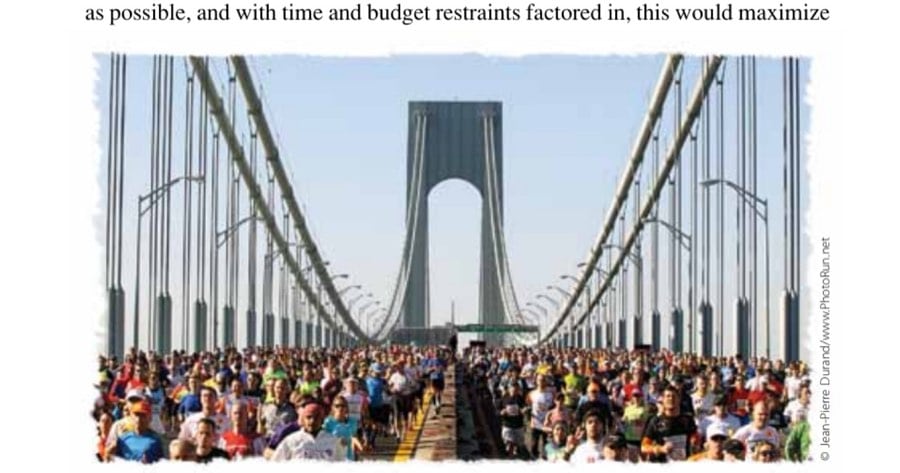
My mind wandered back to the time of my first marathon. Sunday, November 1, 1992, dawned cold in New York City, and I felt singularly unprepared to face what was to come. I had flown in from my home in Bermuda the previous Friday, picked up my bib number, ate my fill of pasta, and drunk numerous bottles of water. Frequent visits to the world’s longest latrine confirmed that I was not only well hydrated but also cold and nervous. Eventually, I shuffled in the company of thousands of others onto the Verrazano-Narrows Bridge and waited for the sound of the cannon that would release me down a path that I am still traveling. Little did I know then that for the next 18 years, I would be flying to and competing in marathons all across this mighty nation.
That first marathon did not go quite as well as I had hoped. Looking back, perhaps my preparation was more wishful thinking than proper planning, for I certainly made my share of mistakes. I had set myself an ambitious target and was dismayed to find myself waiting for 15 minutes after the gun went off before I could even begin my personal adventure. (There was no chip-timing back then, so the gun time would be all I had as an official record of my effort.)
Having wasted considerable nervous energy, I then immediately proceeded to try to make up for lost time. This folly was exacerbated by having to go around the throngs of runners who had their own paces and agendas. Further frustration was the order of the day when I had to wait at water stops. More energy was
expended, and we were not even through Brooklyn yet. Needless to say, it was a long day, and my target time was not met. But for all that, I was smitten. The excitement of completing a marathon in the company of Fred Lebow and Grete Waitz left me wanting to do another. Next time will be different, I told myself.
First up was Portland, Oregon, in 1993, which went a little better and was followed in 1994 by Boston, the Holy Grail to many—me included. As with New York, I was bused out to the start hours before the race, and once again it was a cold morning. This time, I was dressed warmer and used the time waiting for the start in focusing on positive thoughts of finishing inside my target time. While Boston is technically a downhill course, I would not go out too fast in readiness for the Newton Hills around mile 17. The noise from the Wellesley students rang in my ears and spurred me on and up Heartbreak Hill and along Commonwealth Avenue to the finish off Boylston Street, breasting the tape—figuratively speaking, for it had long since been removed—two minutes under my goal.
Pittsburgh, San Antonio, and Disney World were experienced, and over the ensuing years I entered several more marathons and even progressed to doing some ultras along the way, but it was not until the turn of the century that I considered tackling the challenge of completing the 50 states.
Modus operandi
© Jean-Pierre Durand/www.PhotoRun.net
From the outset, I had determined not to repeat a race. By giving myself only one chance, I reasoned, I would be motivated to train properly, and there would be no excuse for failing. Besides, I was desirous of seeing as much of the country as possible, and with time and budget restraints factored in, this would maximize
▲ The Verrazano-Narrows Bridge: the start of something big.
my adventures. Each trip would last typically a minimum of four days: a day for traveling, a day for visiting the expo, race day, and another day to travel back home. Even this would severely limit the amount of sightseeing that I could accomplish while consuming much of my precious vacation time.
For some trips, especially those at or near Bermuda’s airport gateways on the Eastern Seaboard, I could fly in and register on the same day, but flight schedules—and delays—often conspired to work against such a tight deadline. The hub-and-spoke system that most major airlines adopt is no doubt efficient and economic, but as a means of getting from point a to point b, it can often leave something to be desired. Spoke to hub to hub to spoke has made for many a long day, and every connection increases exponentially the chance of delays.
In order to get my money’s worth, I followed the example of fellow 50 staters and tried doing two marathons in a weekend. It was one thing getting through the Andrew Jackson Marathon on day 1 and, after the stiffness was coaxed out of my legs, the Vulcan Run on day 2, but driving the 222 miles between the two events was altogether harder to accomplish. (It did not help that you drive on the wrong side of the road—although admittedly my perspective on this is different from yours.)
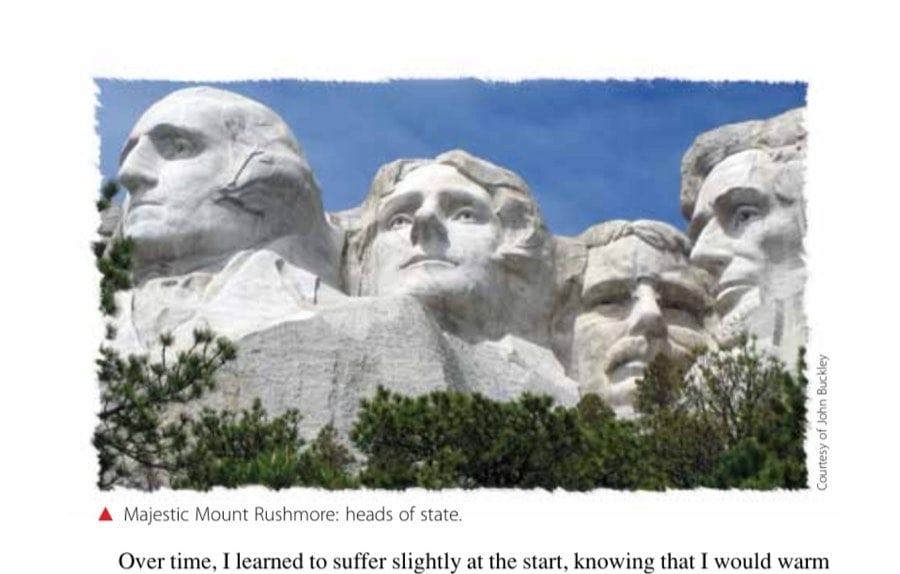
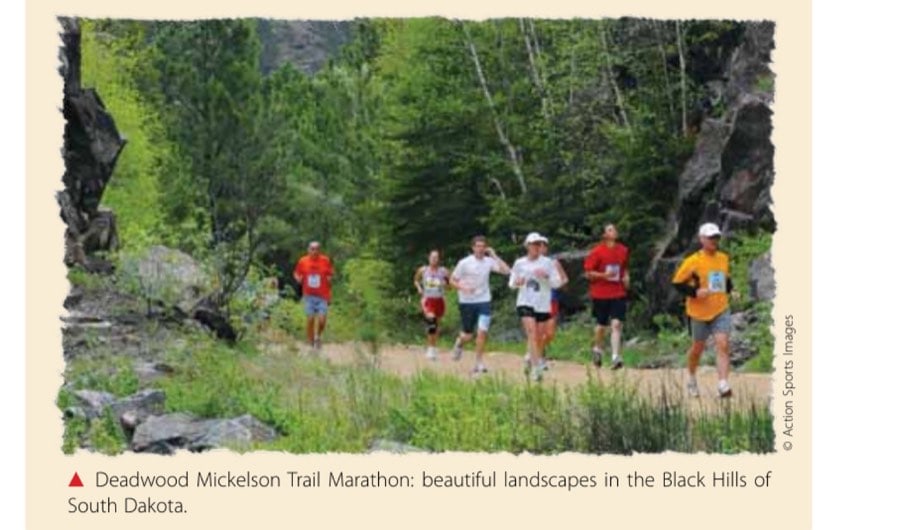
Later, with the onset of retirement, the length of each trip became less an issue, and I settled on an alternative approach whereby I raced two successive weekends and used the time in between to explore. I shall long remember one such trip whereby after the Deadwood Mickelson Trail Marathon, I toured the magnificent Black Hills of South Dakota, taking in such sights as Mount Rushmore, Crazy Horse Memorial, and Custer State Park. After that, it was over to the Yellowstone and Teton national parks and the Mesa Falls before tackling the Teton Dam Marathon in Rexburg, Idaho. Coming face to face with a wolf early one morning was sheer exhilaration for me, if not for White Fang who, after a moment’s scrutiny, turned away imperiously and strode off through the undergrowth. I guess once you’ve seen one tourist, you’ve seen them all.
One of the many joys of living in Bermuda is the weather. The temperature is not likely to vary much in any 24-hour period, so I can get up in the morning and leave for my training workout knowing that a T-shirt and shorts is all the clothing I need. (Of course, this does not apply if a hurricane is blowing, in which case it is best to stay home.) Racing in the United States, however, is an altogether different proposition. While meteorologists are very professional, I have learned that a general weather forecast issued before I fly out may bear no relation to the local conditions on race day. Temperatures can and do vary so much during the course of a single day that reading that the forecast high will be 80 degrees is not much help when the low at the start will often be in the 40s. I am not fond of the cold, so I tend to bring a copious amount of clothing and then agonize over how much to wear on race morning.
Courtesy of John Buckley
▲ Majestic Mount Rushmore: heads of state.
Over time, I learned to suffer slightly at the start, knowing that I would warm up. Mind over matter became the mantra, and there are few conditions that I have not raced in. Some of the more memorable include a thunder and lightning show at Carrollton, 50-mile-per-hour winds in Las Vegas that kicked up a sandstorm that left grit in my eyes for three days, fog in Seattle, 2 inches of rain at the start of the LA Marathon, and a similar story in St. Louis where even the Clydesdales looked bedraggled.
Almost there As the years went by, the total number of states completed slowly climbed. Eventually, I reached the 40 mark and could begin the countdown to the finish. I had started out tackling some of those marathons that were the easiest to reach, which usually meant either the Eastern Seaboard or the West Coast. Now was the time to fill in the middle “flyover” states. Trips were planned to the likes of Utah, the Dakotas, Idaho, Wyoming, and Montana. I shall not say I left the least interesting to last, for there was every bit as much to see and enjoy in these outof-the-way places as there had been when I hit Manhattan all those years ago. Take marathon #49, for example.
The city of Green River is not shown in many an atlas, and it is probably not high on the average tourist’s list of must-see places. Had I not needed a race in Wyoming, it is therefore unlikely that I would find myself deliberately planning a trip to this part of the country. It was no harder to reach, in fact, than many other places: just the usual three flights and then a short drive from Rock Springs on Interstate 80. The marathon is tied in with an arts festival (fine Western art was the
© MarathonFoto
order of the day), which serves to attract a good percentage of the area’s 11,628 citizens to Expedition Island, where the action takes place. I soon learned that Expedition Island is a national historic site on account of the fact that it was here that Major John Wesley Powell began his trips down the Green and Colorado Rivers in 1869 and 1871, thus completing the exploration of the last, large, unknown land area in the continental United States. (Powell and those other intrepid explorers, Lewis and Clark, certainly have these states sewn up. Their mothers would have been proud of them, for everywhere you look today, there is a street or site associated with them—and for which many a chamber of commerce is surely indebted.) The race itself takes the runner along the Wild Horse Loop up to White Mountain on a gravel road and sees participants climb from 6,100 feet to 7,500 feet before turning around and heading back to town.
The scenery is beautiful in a rugged, stark sort of way. The vistas are reminiscent of those early, grainy shots of the lunar landscape, and this is reinforced by the support team passing us on its ATVs, which served to resemble somewhat the robots used on the moon. Don’t expect large crowds, for there were none. Indeed, the only person I saw, other than the volunteers, was a lady who was being walked by her dog, which took a brief interest in biting my leg for breakfast before finding richer pickings elsewhere. High temperatures and altitude combine to make it a challenging course and explain why there was no time limit. (“It goes on forever,” said one runner.) In going out conservatively, one has every chance of recording a negative split. By the same token, you could achieve a personal worst. Or indeed, both.
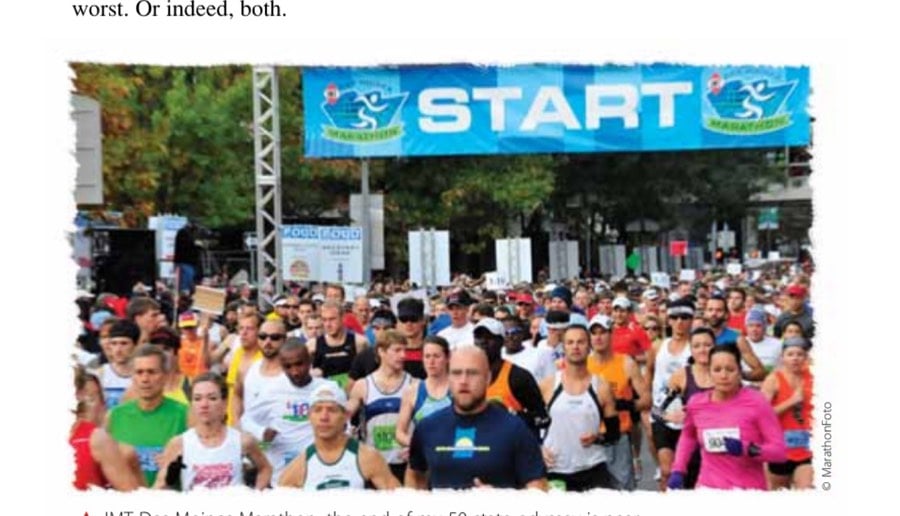
▲ IMT Des Moines Marathon: the end of my 50-state odyssey is near.
And so it was on to Des Moines. Travel writer Bill Bryson commences one of his books by stating that he “ . . . came from Des Moines, well somebody had to . . .” Bryson has a wonderful sense of humor, and despite some slightly derogatory remarks, one cannot help but believe that he actually liked the city. I know that I came away with good feelings, no doubt helped by the successful completion of my goal. It is near the center of North America, and that alone seemed reason enough to finish my quest there. The race itself is a well-managed event with a scenic course, nice perks, and friendly people who seemed genuinely pleased, if somewhat surprised, that I ended my journey in their home state.
The human race While I have been fortunate in combining my marathon adventures with seeing many landmarks and sights across the nation, another thrill has been meeting some remarkable people along the way. I have raced with leprechauns, Superman, and Santa Claus. I have caught sight of Elvis on eight separate occasions (remarkably, all since 1992). Of course, all marathoners share a common interest, and this facilitates an instant bonding—even for a Bermudian with a strange accent and even stranger gait.
I am indebted to Henry, who invites me to stay in his apartment whenever races take me to the Chicago area. It was Henry who, along with Paul (sadly no longer with us), encouraged me to embark on my 50-state odyssey, and it is Henry who keeps raising the bar with his own marathon conquests (700 and counting).
There are Steve and Paula, who, when they are not racing or directing, somehow find time to help others such as I. Then there are Jonathan and Kathleen, two marathoners who had befriended me and who were in Des Moines to greet me and help celebrate my personal accomplishment—even if it was before the race. They are nearing their own 50-state completions, and I hope one day to return the favor. Kudos also to those race directors who surely put more into our sport than they take out of it and in particular Chris Burch, who treated me like an elite athlete in Des Moines even though I finished hours after others who go by that description.
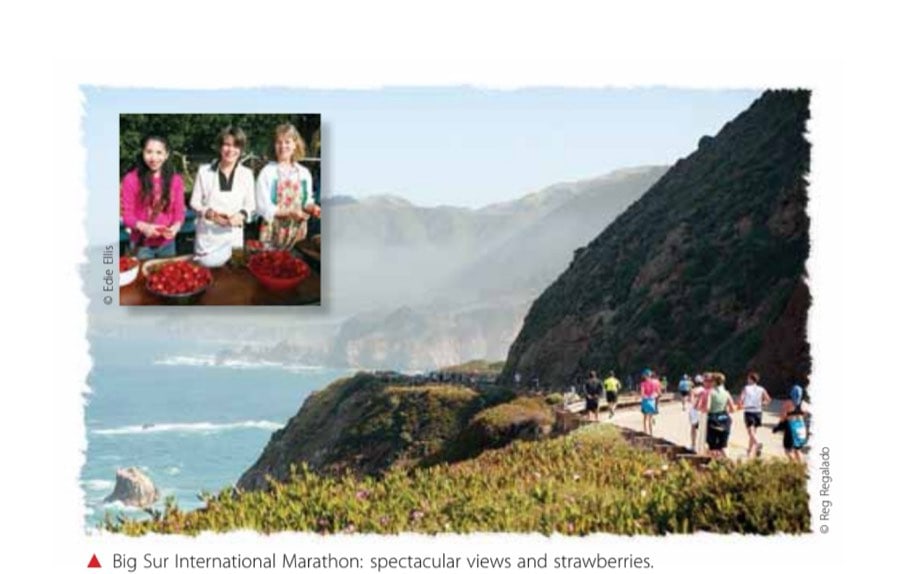
Spectators have also enriched my marathon experience, whether by their words of encouragement or their acts of kindness. The fresh strawberries offered during Big Sur or watermelon on another occasion was just the fillip needed when spirits and energy levels were low. Perhaps the most memorable comment was “good looking” made during one race. All marathoners are used to such expressions as “nearly there,” “you’ve got it,” “way to go,” and “looking good,” but at one race (no, not in Arizona), the spectator whose first language was not English (not even American, come to that) managed to reverse the words, which of course rather changed the expression’s meaning. By no stretch of the imagination was I “good
© Reg Regalado
© Edie Ellis
▲ Big Sur International Marathon: spectacular views and strawberries.
looking” when I staggered past the bystander, but in his own way he brought a smile to my lips and helped me pick up my pace if only for a moment. Thank you, my foreign friend.
A foreigner’s perspective Reports suggest that in 2009 there were more marathons in the United States (397) and more finishers (468,000) than ever before, all of which augurs well for the sport. Many changes have taken place on the marathon landscape since I started visiting in 1992, and entering a marathon usually guarantees a high-quality experience. We now have chip-timing, which provides accurate times for all and should—but often does not—eliminate the need for many a runner to scramble to congregate on the start line with our elite brethren. Operations have become more professional from the race expo to the marshaling to the aid stations.
One aspect that I particularly support and hope will grow is the raising of funds for charities. Philanthropy and volunteerism has long been part of the American way of life, and it is good that runners play their part in helping others. It was heartwarming to read that some 800 runners taking part in the charity-pledge program organized by the major sponsor of the Boston Marathon, John Hancock, raised $4.2 million at the 2010 race. I applaud all associated with this gesture. Let us not forget that while staging a marathon does result in some economic benefits to certain sectors of the community, it also causes some inconvenience to others. Motorists are delayed and may have to take alternate routes to wherever
they have to go; high-quality family time may be disrupted as police, fire, and ambulance staff and others are co-opted into duty. All the more reason, then, that runners show consideration to others and strive to give something back to the hosting community.
One change that I would like to see take hold is to display kilometer signs on the course. The official distance for our race is 42.195 kilometers, which translates to 26 miles and 385 yards. We no longer run 100- and 220-yard dashes, and even the historic mile is now a relative rarity left over from a bygone age. The mile is the only nonmetric distance still officially recognized by the International Association of Athletics Federation, and that is run infrequently these days. By all means keep mileposts in any transition period, but it is surely time to come into line with the majority of the world and display kilometer signs. Almost all American marathoners run 5K and 10K races as part of their training routine, so the kilometer as a unit of measurement is not unknown. Indeed, there is nothing better when competing in a marathon than to come across a kilometer sign so soon after the last one!
Stars and stripes I have raced in marathons celebrating your Patriots’ Day as well as New Year’s Day. I have raced in marathons named in honor of Presidents Lincoln, Jackson, and Kennedy. I have started on bridges and school parking lots and raced over the White Sands Missile Range, in state parks, on the Appalachian and Ice Age Trails, across mighty rivers, through a Magic Kingdom, and around Churchill Downs. I have passed by the Alamo and Arlington Cemetery and have finished at many a stadium, including the Superdome, Notre Dame, and Florida State University. I have raced in the Cotton, Rust, and Bible Belts. I have witnessed the fall colors in New England and experienced the beauty of Big Sur on the left coast and Acadia National Park on the right. I consider myself truly fortunate to have witnessed these and many other such sights.
Many major nonrunning events have taken place in the United States since my first marathon, and while I am only a visitor, I have been affected also by these events, both good and bad. I watched in horror as those demonic events unfolded on September 11, 2001. I have suffered with you through the worst recession since the 1930s. I have also celebrated your successes, such as the historic election (regardless of your political affiliation) of the first African American to the office of president. While I shall never be able to hold myself out to be an American, I can—and do—salute you, America. Truly, you are the land of the free and the home of the brave. It is my sincere hope that I am able to participate in more of your marathons and see more of your wonderful country in the years ahead.
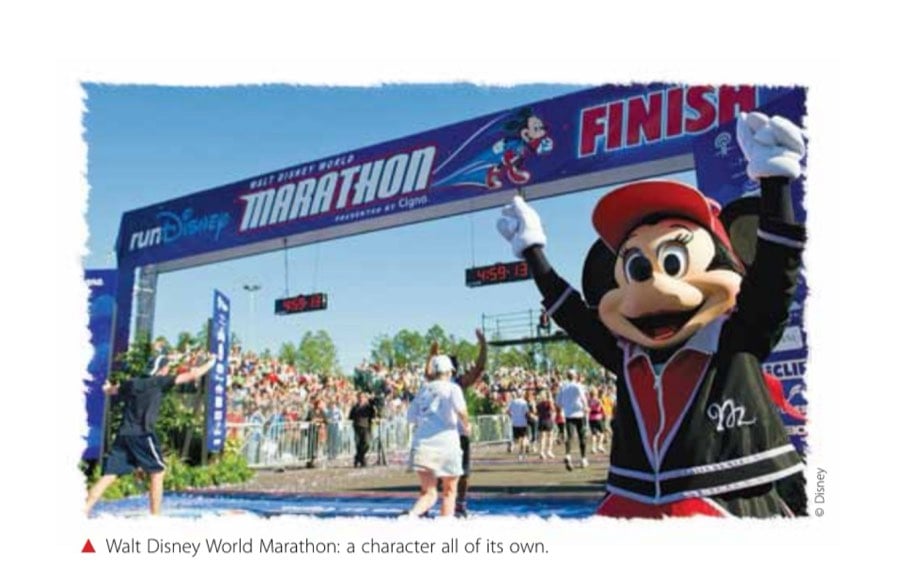
© Disney
▲ Walt Disney World Marathon: a character all of its own.
My 10 Most Memorable Sites 1. Verrazano-Narrows Bridge This is where my personal marathon adventure began. Standing on this double-decker suspension bridge in the company of some 25,000 other athletes, seeing the New York City skyline in the background, and know
ing that I had to get myself there was an unforgettable moment. 2. The Alamo Passing this historic structure had me recalling tales of Davy Crockett and his heroic comrades in their stand against the Mexican army. Perhaps
the most striking feature for me was seeing how small the garrison was and realizing how fierce the close-up fighting must have been. 3. Honoapiilani Highway This road serves as the route for much of a certain Maui Marathon. The
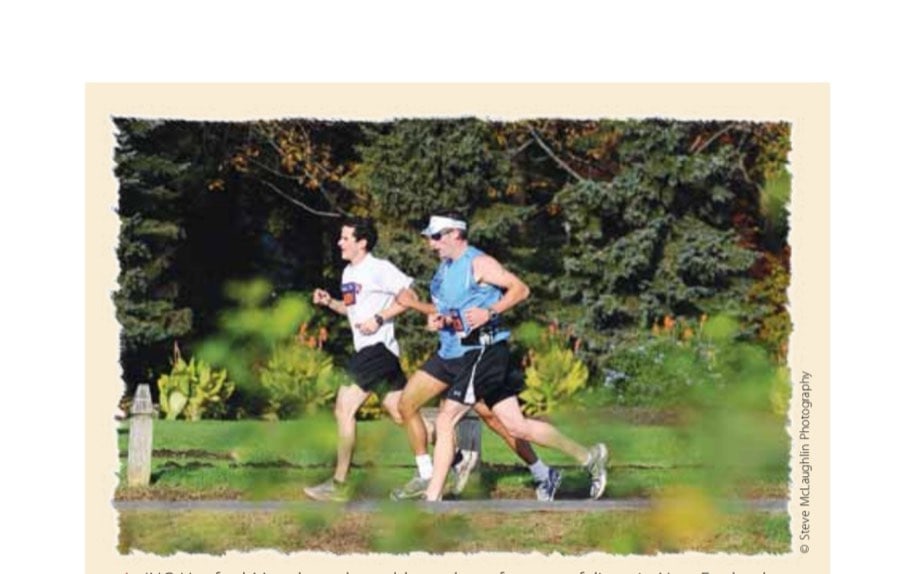
section after Maalea Bay hugs the Pacific Coast and affords athletes breathtaking vistas—not that one has much breath left by then. 4. Fall in New England The golden colors of the autumn foliage in New England provide a per
fect setting for any marathon. I have been fortunate to have completed
© Steve McLaughlin Photography
▲ ING Hartford Marathon: the golden colors of autumn foliage in New England.
October races in four of the six New England states, and in the other two I contented myself with spring conditions (or so the calendar said).
5. Ice Age Trail While most of my marathons have been on the road, some of the most enjoyable have been on trails. For some people, it is the softer surface that appeals. For me, it is being closer to nature. The pristine rural scenery found on the trails has a beauty and serenity unmatched in the urban landscape and perhaps none more so than in Kettle Moraine State Park, Wisconsin, where the mix of evergreen forest, prairies, and water makes for an idyllic setting. 6. White Sands Meeting the Bataan Death March survivors out in the high desert terrain of White Sands Missile Range surely must be a moving moment for anyone. The Second World War may no longer resonate with today’s generation the way it does for mine, but no one can come away unaffected by such an experience. 7. Churchill Downs Traversing the infield of Churchill Downs and seeing the iconic twin spires of the grandstand was anther unforgettable moment. I could almost sense
Secretariat and other great horses galloping by as I envisaged sipping a mint julep and counting my winnings. Then it was time to focus on the remaining 18 miles of my own race.
8. Washington, DC Nothing beats a marathon in Washington, DC, for a free tour of some of the country’s most famous buildings. From the Pentagon to Lincoln Memorial to the Washington Monument to the Capitol to the Jefferson Memorial and Arlington Cemetery, to name but a few, a veritable kaleidoscope of images forever will remain. 9. Hurricane Point For spectacular scenery, it is difficult to beat the views from often-windy Hurricane Point. Enjoy the magnificent Big Sur coastline to one side and Bixby Bridge ahead as one travels on Highway 1.
© Action Sports Images
10. The George S. Mickelson Trail This trail takes one through some of the Black Hills of South Dakota’s most beautiful landscapes. The former railway route is now a crushed limestone-and-gravel pathway that meanders through gorgeous meadows and pine forests.
▲ Deadwood Mickelson Trail Marathon: beautiful landscapes in the Black Hills of South Dakota.
This article originally appeared in Marathon & Beyond, Vol. 16, No. 2 (2012).
← Browse the full M&B ArchiveMore like this
1,000+ stories from 19 years of Marathon & Beyond
The complete archive of the legendary long-distance journal — digitized and free to read.
