

An African Adventure
It all began with a shirt, a shirt I had never seen but one that I was convinced would be the ultimate souvenir of my Peace Corps adventures in West Africa. As I now run through the foothill trails in Boise, Idaho, in preparation for another marathon, I am reminded of that shirt and how it was my motivation to try my first marathon.
The idea to run the Milo Marathon was illogically raised by my friend Becky in July 1997 while drinking and smoking outside a Peace Corps suboffice in Kumasi, Ghana. Anyone else? I wanted to jump up out of my seat, raising and waving my hand while loudly calling “Me, me, me” as I had done as a child. My mind raced. What a crazy concept! An African marathon run by a female abruni (literally “white man,” this term was used to refer to all foreigners no matter what their race, color, or sex)—I mean, who runs marathons in Africa, let alone their first? OK, so maybe it was a pretty big leap to try to train for a marathon in only two months, especially since I had not even run more than 10 miles at any one time in my life. But I was full of the optimism of youth, the hunger for adventure abroad, and a desperate desire for more structure in my daily African routine.
At the forefront of my mind, though, was the “prize”—an African marathon shirt. How cool would I be sporting such a shirt back in the United States? There would be nothing like it. A pact to run made, Becky and I began planning the marathon mix tape we would make to listen to (it was never made) and the many trips we would take to visit one another in order to run together (the actual marathon was the only time we ever ran together). We also declared a temporary end to the consumption of cigarettes and alcohol (only a decrease was accomplished).
We returned to our respective villages and started training. I lived in an extremely rural village called Dompofie, where the best option for running routes was on paths that the locals used to get to their farms or to travel between villages. During my training runs in hot West African temperatures, I wore black running tights and loose, long-sleeve shirts. Despite this attempt at cultural sensitivity, I
shocked the heck out of people heading to and from their fields on deserted farm paths and created a lot of gossip in the community.
Rumors of a foreigner
Courtesy of Maureen Welcker
Where was the abruni going? And why was she running? Was somebody after her? Why would she run when she could walk? Wasn’t running in the sun going to darken her skin? Wouldn’t running make her hungry and require her to eat more? It definitely was not going to help fatten her up. (In the area that I was living in, lighter skin and being “fat” were both signs of wealth. Producing and affording enough food to feed one’s family were constant struggles.)
My long explanation to the few villagers who actually asked me these questions directly was interpreted and shortened in translation to the simple statement that I was “in training.” But that only created more confusion. I was not going to play football (American soccer). I most certainly was not capable of winning the marathon and collecting the prize money. The gossip wheels were spinning
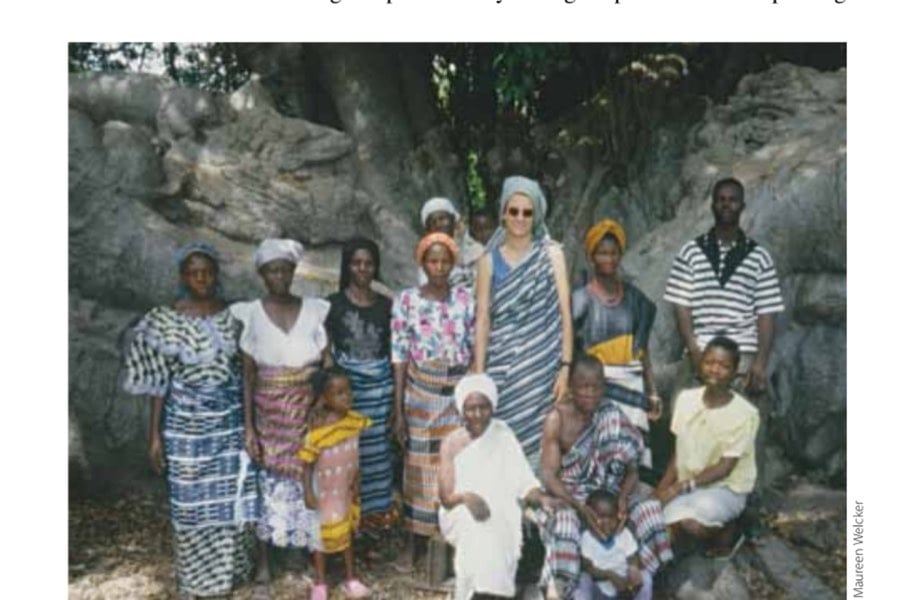
▲ Here I am dressed in traditional Ghanaian clothing along with others from my village.
at high speed and I was confirming what they had previously assumed—white people really are crazy! That is, until I was bitten by a dog in a neighboring village during one of my training runs. No matter how I tried to downplay the incident, I was officially transformed from lunatic to victim. The incident resulted in a full day’s journey to the capital for rabies shots for me, a long quarantine for the dog, and multiple surrounding villages in a gossip uproar. In the end, I felt sorriest for the dog’s owner. Within an hour of the incident, he arrived at my door with an official apology, accompanied by four village chiefs and his entire extended family, all dressed in their most formal and official attire and carrying “please forgive me” gifts of fruit and yams. Dompofie’s chief, elders, and my local counterpart managed to come just in time to help me formally accept the apology.
Finally, the race day arrived. I had traveled to the capital (Accra) the day before, met up with Becky, and spent the night in a hotel. I awoke at 4:00 a.m., took a quick shower, ate some peanuts and a rare apple, and drank a water/rehydration salt mix (used for diarrhea patients and part of the medical kits we had been issued as volunteers prior to heading to our villages for the first time). Becky and I then hailed a taxi to the race start. We arrived at 5:50 a.m., very anxious, nervous, and late—the race was supposed to start in 10 minutes! We jumped into a long line of runners (of which we were in the minority—out of the 1,000-plus runners we saw only 30 or so women, about 20 white runners, and only three other white women runners) to hand in our registration forms and get our T-shirt.
The coveted T-shirt ended up being a tight green-and-white thin tank top with weak, crooked seams and faded lettering. My spirits took a tumble. But I did not have time to dwell on the shirt’s imperfections as I was quickly distracted by activities surrounding me. Some talk in line had led runners to believe the race organizers might run out of the shirts, and with that knowledge, the line soon became a shoving, pushing, arguing mob scene. In the end we all got a shirt.
An unconventional start Close to 7:00 a.m., someone with a megaphone told the crowd to follow a lead car to the starting point (supposedly one kilometer away). But the majority of runners were a little too anxious to start the race. So people began to run to the start. The driver of the lead car yelled out, “Stop running! Save your energy!” but his recommendations went unheeded—that is, until they were informed by shouts within the crowd that everyone needed to move to another location to have their thumbs pressed into inkpads to prove they had started the race in the right place. (This idea did not meet the desired result. Ink shows up better on light skin than it does on dark skin, and my own thumb lost all of its ink halfway through the
race from sweat.) A new form of mayhem arose as some runners pushed forward to find the starting line and others pushed backward to get to the inkpads. Finally the entire crowd, both inked and non-inked, was reunited in a dash to what they thought was the starting point. The lead car raced up to the leaders, managed to stop their forward progress, and moved them backward to the correct starting point. Meanwhile, a few police and other officials were making an effort to block Saturday-morning traffic. Accra on any given day just about anywhere in the city can be jammed up with stop-and-go traffic, and people can be short tempered and very vocal when it gets any worse than normal. Drivers and passengers were anxious for the race to begin so they could move on their way.
But we were far from being ready to begin. This time the crowd had once again moved up ahead of the starting point by about 200 meters. At this point Becky and I were still at the back, trying to avoid the huge crowd and periodically laughing as we took in the chaos. Race officials finally decided that it would be easier to move the starting point than it would be to move the crowd. So a few officials and racers picked up the little platform for the starting officials to stand on and moved it to the front of the crowd.
We were off! It was now 7:30 a.m. (an hour and a half later than the scheduled start). I immediately felt like the tortoise in the race against the hare. Either I was that slow or someone had misinformed the marathon runners about the length of the race because most of the participants broke into a sprint as though they were competing in a 100-meter dash. In the back, Becky and I took up the paces we hoped to maintain throughout the run. Five minutes into the race we began to encounter three unanticipated problems.
Traffic Streets had been cordoned off for the lead runners but not for us. The traffic could not be held up for the whole group because vehicles were lined up for miles. And since we were at the end of the race, we had to deal not only with bumper-tobumper traffic but also with angry drivers who had been idling in the heat for a long time. These vehicles gave new meaning to the need for emission testing. And can you imagine what attention we received as two white, foreign women running at a slow pace wearing tight, sleeveless tank tops? What a sight we were! We greeted crowded tro-tros (buses) whose gawking passengers were all hanging out the window with “Maachi” (good morning), said no, we were not tired yet, and did our best to ignore all the laughter.
Water After 30 minutes we reached the first refreshment stand only to find that everything was “finished.” We were still at the end of the line, and everyone ahead
of us had drunk the race’s water supplies. In fact, in the entire race I drank only one small cup of water from a race refreshment stand. The worst encounter with this problem was when Becky and I arrived at a refreshment station that had just been taken apart and we ended up, based on our paces and the speed of traffic, having to run behind the truck that had collected the water barrels as it spewed exhaust in our faces. Luckily, we had planned relatively well and had brought along coins to buy “ice” water (water bagged in plastic sandwich bags and tied at the top that is sold along the roads; to drink you merely bite off the corner and suck it as if it were a bottle, a form of “refreshment” we had been encouraged by the Peace Corps not to partake of), and there were other volunteers at various locations with water and rehydration drinks.
Passing No one likes being passed, and our fellow marathoners were no exception. After 40 minutes into the race, a significant number of the early sprinters were now walking. But as soon as the female abrunis passed them, these walkers would sprint ahead, walk again until we caught up with them, and then sprint again. This pattern was repeated what seemed like 1,000 times. It did not take long before this got annoying, and it did not help that the bored drivers and passengers of stopped vehicles egged them on.
As we began to approach the center of Accra, we witnessed a new trick to marathon running. Three racers jumped into the back of a pickup truck and received a short ride until the driver realized that he had picked up a few passengers, stopped the truck in the middle of the street, and climbed out and chased them away. Throughout the race we saw participants jumping in and out of tro-tros, taxis, and private vehicles.
About one-third of the way into the race, I picked up a running partner who had been walking but just could not bear to let me pass him. We were in a construction area and running on a rough dirt road. My new partner was running barefoot. He was carrying his running shoes—which he told me were too heavy to run in—around his neck. He did mention to me more than once that his feet were “paining him.” There were hundreds of other runners like him—running barefoot or perhaps worse in charlie watties (plastic flip-flop sandals) that were sometimes tied to their feet with coarse string. I also saw people running in hiking boots, canvas loafers, and other unlikely footwear.
Picking a trainer from the crowd When I had about eight miles to go, a bystander who had been cheering on another runner started running alongside of me and comically urging me to “try harder” and “keep trying.” I would have yelled at him had I the energy, but as it was I only
▲
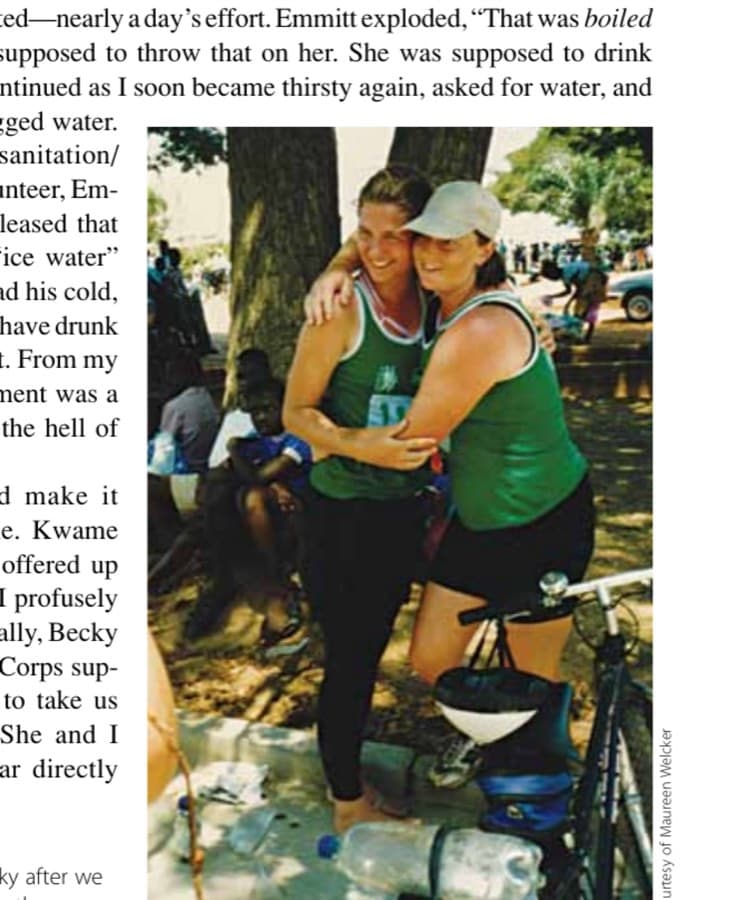
Celebrating with Becky after we completed the Milo Marathon.
Courtesy of Maureen Welcker
looked over at him. Something in my expression and/or body language spoke to this 20-something. He stopped being annoying and asked if he could help. I told him brokenly that I was very tired and encouraged him to talk to me. He called a few friends to keep up with us. Kwame, as I came to know him, became my trainer. He ran alongside me and urged me onward with “go” and “little by little” uttered at an almost military beat in time with my running pace. I handed over the supply of coins that I had brought to purchase ice water to Kwame while he and his friends kept me abreast of the route ahead. When I called out for water, one of them would race ahead and buy me some.
With less than five miles to go, Kwame and I ran by a fellow volunteer named Emmitt who was riding his bicycle to a drumming lesson. Kwame saw a large water bottle attached to Emmitt’s bike and requested it for me. Emmitt gave it to him and my trainer immediately threw the ice-cold water down my shoulders and back. It felt wonderful but Emmitt was furious! The water had been boiled, filtered, and refrigerated—nearly a day’s effort. Emmitt exploded, “That was boiled water. You weren’t supposed to throw that on her. She was supposed to drink it!” The argument continued as I soon became thirsty again, asked for water, and had to be bought bagged water. As a fellow water/sanitation/ health education volunteer, Emmitt was less than pleased that I was subjected to “ice water” when I could have had his cold, boiled water. I would have drunk anything at that point. From my standpoint, the argument was a nice diversion from the hell of running.
I eventually did make it across the finish line. Kwame and I hugged as he offered up congratulations and I profusely thanked him. Eventually, Becky and I and our Peace Corps supporters hired a taxi to take us back to the hotel. She and I hobbled from the car directly
© Paula Perry
to the pool and slid ourselves in, fully clothed. Several hours later, after a hot shower, a meat lover’s pizza, a lot of aspirin, and a number of beers, I was much recovered. The next day Becky and I began the trek back to our respective villages. We walked funny and were badly sunburned and chaffed, but we were African marathoners!
My first marathon story has been told over and over again, often in the midst of long runs. Thoughts of it have helped me make it up long hills, run extended distances, finish races . . . I still repeat Kwame’s words of encouragement set to the beat of my running pace in my head when I am going up tough hills or struggling to get to the end of a run.
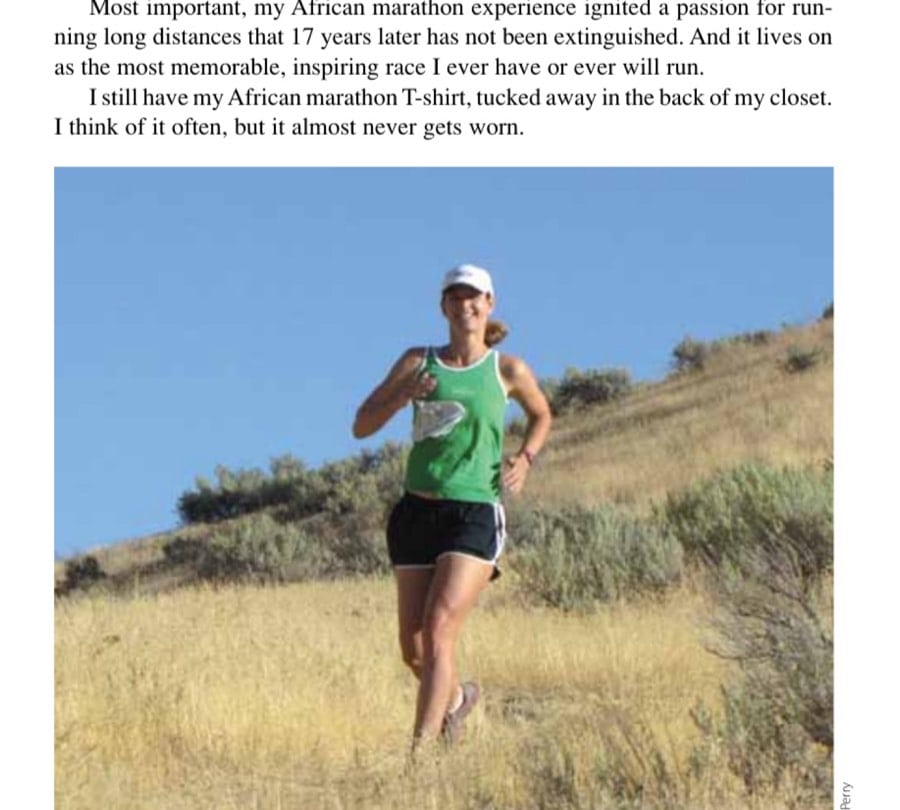
Most important, my African marathon experience ignited a passion for running long distances that 17 years later has not been extinguished. And it lives on as the most memorable, inspiring race I ever have or ever will run.
I still have my African marathon T-shirt, tucked away in the back of my closet. I think of it often, but it almost never gets worn.
▲ Seventeen years later, my Milo Marathon race shirt is still with me, here in the foothills of Boise.
This article originally appeared in Marathon & Beyond, Vol. 18, No. 6 (2014).
← Browse the full M&B ArchiveMore like this
1,000+ stories from 19 years of Marathon & Beyond
The complete archive of the legendary long-distance journal — digitized and free to read.
