

An Italian Double
Runners are a simple folk. Whatever the rest of the world may believe, all we really want is a road to run on and time enough to run it. On occasion, we like to gather with like-minded folk and run a race to challenge ourselves and see where all that running has taken us. For those who have figured out these simple needs, living with a runner becomes a very manageable proposition.
My wife, Stephanie, is one of these understanding people. When we got married, my elder sister, who understood these things about me, pulled Stephanie aside and gave her some valuable advice. “If you ever want to travel anywhere,” she said, “just find the race.” Which, of course, is exactly right. While spouses of other runners might get annoyed that every vacation has to involve a race, my wife has learned to work this situation to her advantage. So when she recently started jonesing to return to Italy, which she hadn’t seen in almost a decade, she went online, not to search for hotels and flights—at least, not yet—but instead to look for marathons. Smart gal, my wife.
Perhaps too smart, though. A quick Web search revealed over 30 marathons in Italy, past and present, from Naples up to Turin. Even after weeding out those marathons that failed to survive the test of time, there was still a smorgasbord of races to choose from. Venice, Rome, Pisa: they all sounded so wonderful. How were we to decide? But our schedule required us to take our vacation in late fall, so we slowly began the process of elimination. The Rome Marathon was in March, and the Venice Marathon was in May, so those were cast aside. Eventually, the list was winnowed down to Florence in late November and Milan a week later in December—the epicenter of the great Italian Renaissance and the glitzy ground zero for the modern fashion world. It had come down to a choice between these two.
That’s when it hit me: why choose between them? They were only a week apart, so I might as well make the most of our trip and get two for the price of one. After all, as I told my wife when I proposed this idea to her, it’s not as though we go to Italy every year. Although her expression seemed to acknowledge that we would somehow be crossing the Rubicon if she endorsed my scheme, she saw the
logic of it, as well as the shopping potential, so she agreed. That’s how my Italian double was born. Now all I had to do was see if I could actually do it.
An Italian Jewel Box To me, Italy has always seemed both mythic and strange. Spouting from a mysterious, ancient people called the Etruscans and progressing through the Roman Empire and the genius of the Renaissance, Italy has a breadth of history and culture that can be overwhelming to an outsider. Even the legendarily intense Italian temperament can be a lot to handle. As we made our arrangements, we found ourselves e-mailing with the manager of some properties for short-term rent in Florence. We inquired—reasonably, I thought—whether there was ample hot water and whether he could offer any references for us to check, since we had had some bad rental experiences in the past. The response was swift and indignant. “Do you think we are in Botswana?” he thundered online. “I cannot rent to you!”
Clearly, there was a trick to this. It would take a little getting used to. Eventually, with little more trauma and drama, we managed to make all the necessary arrangements, and we soon found ourselves standing in front of Florence’s small international airport, luggage in tow, waiting to board a bus to the city center. The adventure had now truly begun.
On paper, Florence can appear to be a massive city, but as we walked the streets after checking into our hotel, I realized that it was actually a very small, densely packed place. It seemed as if all of the art and architecture of an entire country had been pushed together into museums piled together along both sides of the Arno River. But within this compact city center was a richness of art that would take a lifetime to fully explore. We had only five days, so there was no time to waste. That meant I had to give up any thought of resting before the race, but running a few minutes slower in the marathon would be a small price to pay to see some of Western culture’s greatest achievements, not to mention keeping my wife happy.
I began by delving into Florence’s history. Rising up in the 12th century, I learned, Florence blossomed on the strength of its textile trade and banking. The Medici family, as the bankers to the papacy, emerged as the most powerful among Florence’s business families and ruled as kings. Florence reached its apex during the late-15th-century reign of Lorenzo the Magnificent, who brought to Florence the world’s greatest poets, artists, philosophers, architects, and musicians. The Renaissance was on, marked by a return to naturalism and logic.
Too Much of a Good Thing The fruit of this era can be seen everywhere in Florence. Its winding streets are crammed with sculpture-filled piazzas, museums, and historic churches that
Courtesy of the Florence Marathon
would each be the centerpiece of any lesser city, but which in Florence become yet one more destination to consider. There is the 14th-century Ponte Vecchio, that jewelry bazaar masquerading as a bridge, and the Bargello Museum, home to Donatello’s famous sculpture of David as well as Michelangelo’s astonishingly animated sculpture of Dionysus. And the Uffizi, a former royal residence turned into a magnificent art museum, as well as the Piazza della Signoria, a virtual outdoor sculpture garden of some of the greatest works of Western civilization. In the center of it all was the city’s masterpiece and symbol, the structure that dominates the city skyline: the Duomo, the dome that rises above the Cathedral of Santa Maria del Fiore.
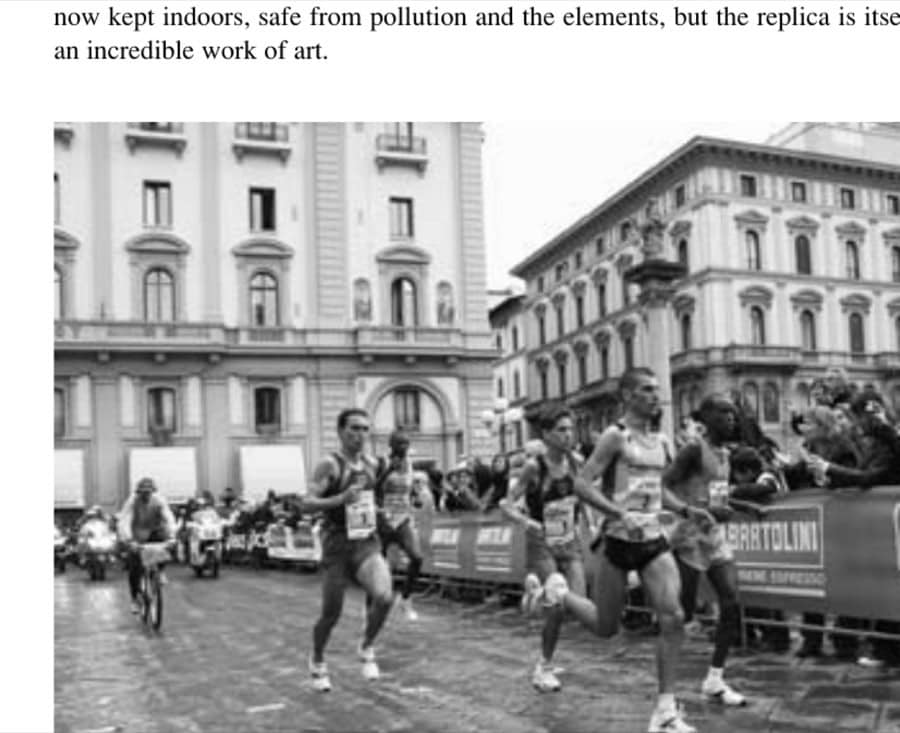
Clad in pink, green, and white Tuscan marble, the cathedral is a beautiful house of worship. It dominates an enormous piazza, facing a small baptistry on which hangs a replica of Lorenzo Ghiberti’s North Doors. Depicting biblical scenes in relief on its 10 bronze panels, the work is so wonderful that Michelangelo himself described them as the “Gates of Paradise,” a name that stuck. The original is now kept indoors, safe from pollution and the elements, but the replica is itself an incredible work of art.
The winding streets of the Florence Marathon are crammed with sculpture-filled piazzas, museums, and historic churches.
And then there is the dome. It is a miracle of Renaissance genius, a huge dome that was designed by Filippo Brunelleschi to be built without the aid of supporting scaffolding and supports, a feat that was, at the time, considered impossible. Today, visitors can ascend the dome along an internal staircase that first lets out at the bottom inside rim of the dome, giving a close-up view of the fresco of the Last Judgment by Vasari, and then continuing upward between the inner and outer walls of the dome to its very zenith, giving breathtaking views of the city. Above all else, making this climb was on my Florence must-do list. But for me, the question was when to do it? Should I go up before the marathon and risk tiring out my legs or plan to go the day after the marathon and hope that climbing the 463 steps to the top wouldn’t feel like an assault on Mount Everest? I decided to do the climb after the marathon. After all, no one would be timing me on that event.
As it turned out, a great many things ended up on my must-see list, but we learned that it doesn’t help to just rush out the door as soon as you arrive. There is a pace to sightseeing in Florence that takes some getting used to. First, there is the rush of trying to see all the sights, which requires the precision and planning of a military expedition, as so many of them close by 5 p.m. or earlier. After the guards escort you out of the last museum or church on your day’s itinerary, a marathoner’s thoughts turn from the mind to that other organ held most dear, the stomach. But restaurants don’t open for business in Florence until 7 p.m. That creates a two-hour gastronomic dilemma. What’s a hungry runner to do?
The Joys of Gelato The answer, I discovered, is in one simple word: gelato. Sometimes translated as Italian for ice cream, it resembles that frozen dessert as much as their church frescoes resemble wallpaper. I ordered some peanut butter gelato, expecting to taste a shadowlike facsimile, a peanut butter flavoring. Instead, I was treated to an intense distillation of peanut butter that exploded in my mouth. Then I understood why espresso is everywhere in Italy, while regular American coffee is hard to find. These are people who take their food seriously. And a good thing, too, because I was ready to fuel up.
Finding a place to eat in Italy turned out to be a more complicated affair than I thought. There weren’t just restaurants; there were trattorias, osterias, rosticcerias, spaghetterias, ristorantes, pizzerias, and tavola caldas. I was told that the differences had to do with price and level of extravagance, although I saw that you could eat cheaply at a ristorante, which is usually a higher-end establishment, and also, as I saw one couple do later in our trip, drop several hundred dollars on dinner at a trattoria, which is supposed to feature more casual, cheaper dining. Go figure.
After consulting our guidebook and wandering around for an hour or so, studying menus plastered on restaurant windows—not an entirely disagreeable way to spend time in Florence, actually—we settled on a little place that was, as it turned out, nearby to where we started. We weren’t disappointed. At dinner that night, I discovered ribollita. It’s a simple dish, a stew, really, made up of bread and vegetables and some spices. Maybe it was our hunger or the chill in the November air, but as I dug into it, I was sure that I had found the most delicious food on earth. As I discovered over the coming days, different restaurants would have their own slightly different versions of it, but it was always wonderful.
After the ribollita, I scanned the menu for the pasta I really wanted: ravioli with a pumpkin filling. I had read about it somewhere, and for some unknown reason, it had embedded itself in my imagination. But the more I wanted it, the harder it was to find; it wasn’t on the menu at that restaurant, or at a different restaurant the next night, or the next. There were other pastas, to be sure, but not my tortellini. Apparently, that would have to wait. My wife was also disappointed not to see risotto on the menu; that was the dish she was looking forward to digging into. How could we be in Italy and not be able to get risotto? Since it’s considered more of a northern Italian dish, we realized that we might have to wait for Milan for that. But still, there was delicious lasagna, and pici, a thick noodle favored by the working class. I was even daring enough to try a little piece of salame di cinghiale, a strong salami made from wild boar. I didn’t try Florence’s signature dish, however—the bistecca alla fiorentina, the famous Florentine steak. I was willing to push the gastronomic rules a little bit in the days before my marathon, but eating a huge, Flintstone-like hunk of oiled, herbed, and grilled meat would, I was sure, be tempting fate too much, delicious though it might be.
The following morning—the day before the race—was occupied by more sightseeing and then a trek out to the New Athletic Stadium for the packet pickup. We negotiated the local bus system and found ourselves in a small room with a few tables. I picked up my race packet, somewhat disappointed at the lack of vendors or even a race T-shirt. It turned out that the expo was actually in an adjacent hall, and it was everything I was expecting it to be. There would indeed be a runner’s premium in this race. In fact, there would be two: a red long-sleeve technical shirt and a pair of blue-and-white running tights. The shirt, however, bore the cryptic slogan “Run like a D.J.,” which, I was told, was a reference to a local radio station. I didn’t get the connection, but no matter; I was getting an entire running outfit, and I was very happy. That evening we had a simple meal of spaghetti and salad and went to bed early. Even in Florence, a marathon is not a race to be taken lightly, and the basic rules still apply.
I was hoping that the race director felt the same way. Years earlier, I had run the Rome Marathon, and although it was a beautiful race, it was a sloppy affair, at least by American standards. The start was chaotic, with no clear signal given to indicate
Courtesy of the Florence Marathon
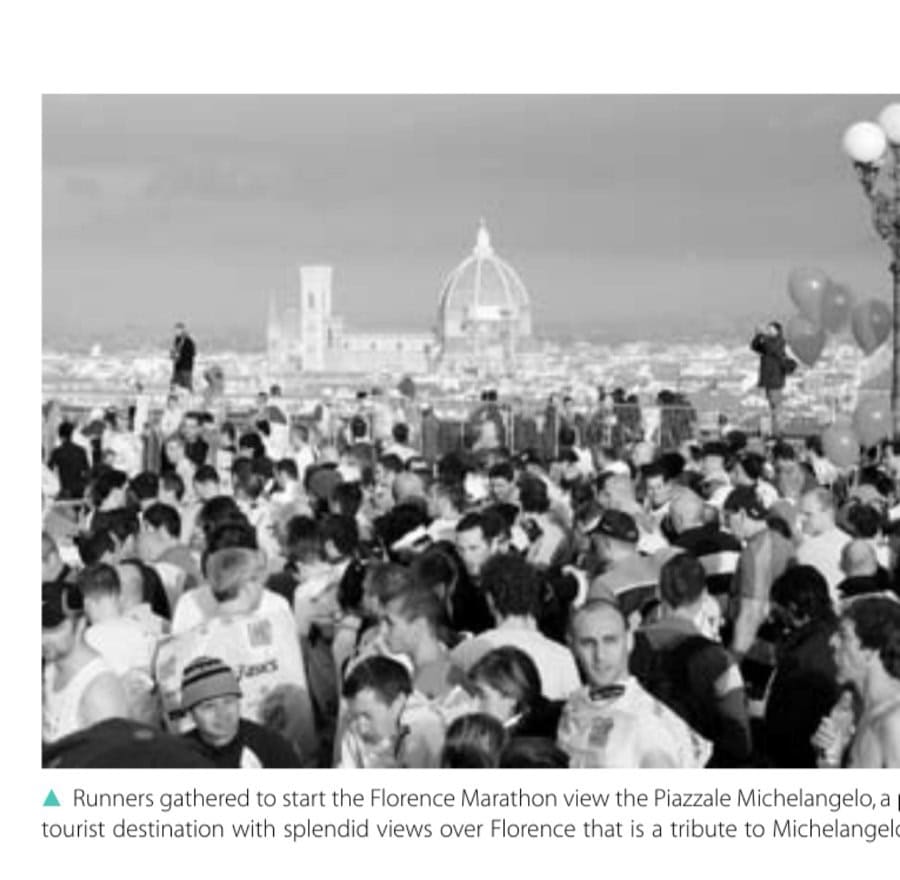
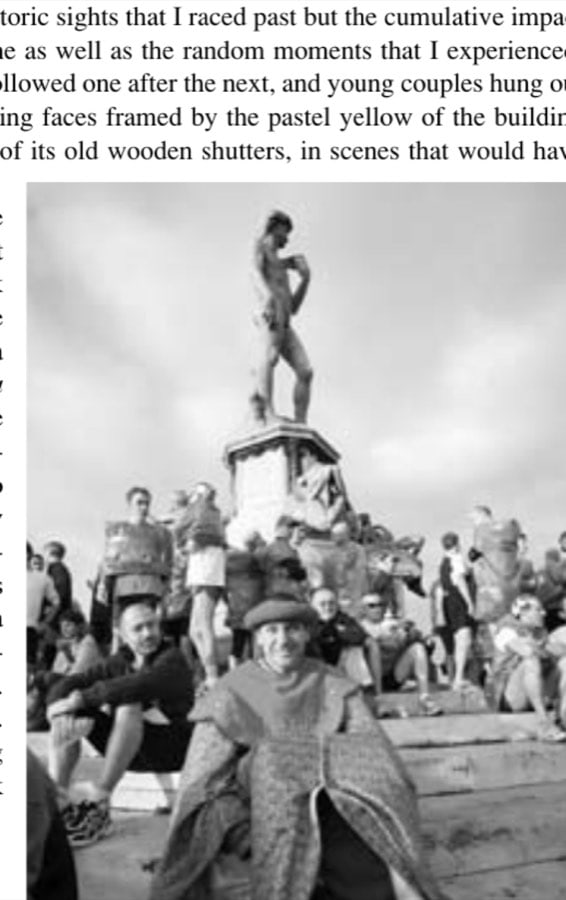
Runners gathered to start the Florence Marathon view the Piazzale Michelangelo, a popular tourist destination with splendid views over Florence that is a tribute to Michelangelo.
that the race had begun, and the water stops were not all ready, despite the fact that it was to be a hot, sunny day. Later, a runner who had run quite a few European races told me that my Rome Marathon experience was typical of Italian races. I was now hoping that in the years since that marathon, things had changed.
The Florence Marathon, Finally Race morning was cool and overcast, perfect conditions for a marathon. Shuttle buses brought runners from near the city center to Oltrarno—literally, the other side of the Arno River—up to the Piazzale Michelangelo. Once there, I found what was perhaps the most beautiful race start that I had ever seen. From the walled edge of the plaza, runners were treated to breathtaking views of Florence, and in the center of the plaza was a looming bronze copy of Michelangelo’s David.
Almost as welcome was the row of port-a-johns and the pastries and drinks being handed out by volunteers. So far, things were looking good. Soon, it was time to line up for the start. Around me were just over 7,000 runners from 51 countries. The announcer sent us on our way clearly, if not exactly on time. And what a nice beginning it was: after exiting the piazzale, the course wound gently downhill for three kilometers on a tree-lined road. As promised, the
Runners rest and enjoy the breathtaking views near the bronze copy of Michelangelo’s famous sculpture, David.
Courtesy of the Florence Marathon
first aid station came at the 5K mark, and it was well stocked with water, warm tea, and sports drink. Just 2 1/2 kilometers later I saw signs for spugnaggio—sponges. The refreshment stations and sponge stations would continue to alternate like clockwork every 2 1/2 kilometers for the rest of the race, with first aid stations and sports gel stations available as well. Arrivederci, Roma! This was turning out to be the kind of race support an American runner could be very happy with.
After completing the early downhill, the course meandered through a residential area and then, at the 8K mark, took us out along the river embankment to San Frediano, an old and beautiful neighborhood filled with quaint shops and trattorias. What struck me most there, and for miles afterward, was not just the individual piazzas and historic sights that I raced past but the cumulative impact that these vistas left on me as well as the random moments that I experienced. Centuries-old buildings followed one after the next, and young couples hung out open windows, their smiling faces framed by the pastel yellow of the building walls and the dark green of its old wooden shutters, in scenes that would have made perfect postcards.
And then there was the cheering. I had read that it’s considered bad luck in Italy to offer someone best wishes, so instead, a person would say bocca al lupo!—You are in the mouth of the wolf! In response, you are supposed to reply crepi il lupo!—May the wolf die! I was skeptical about whether this was true, but I actually heard a spectator initiate that calland-response as I ran past. A bit melodramatic? Sure. But still, it beats just yelling “Good job!” as we do back in the States.
Courtesy of the Florence Marathon
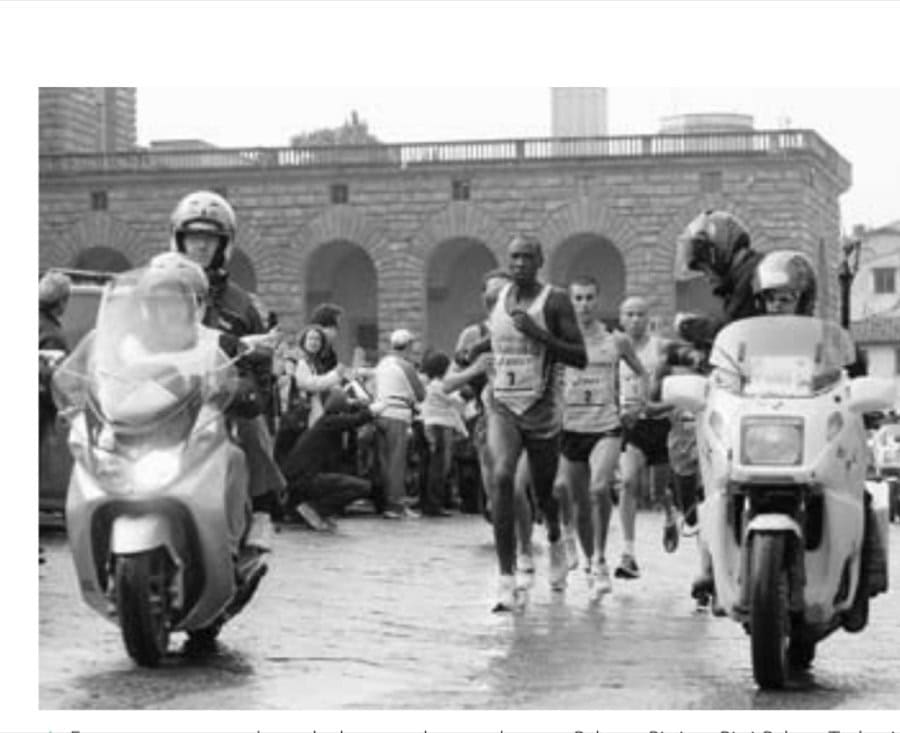
Front-runners race through the crowds near the vast Palazzo Pitti, or Pitti Palace. Today it houses one of Italy’s largest art galleries.
Past the 10K mark, the course took a sharp turn and raced past the Palazzo Pitti, that grand monument to one man’s vast ego. In 1457, Luca Pitti, a banker who was determined to outshine the rival Medici clan, began work on a monumentally grand palace. Luca didn’t live to see its completion; his heirs dutifully finished the job, but in the end, the building finished them. Bankrupt, they sold it, ironically, to the Medici family, who made it their main residence in 1550. Today, it is yet another glorious art museum in a city that appears to be infested with them. I was pretty sure that the story of the Pitti family seemed to hold some kind of lesson in humility and perspective, but I didn’t have time to think about it. I had a race to run.
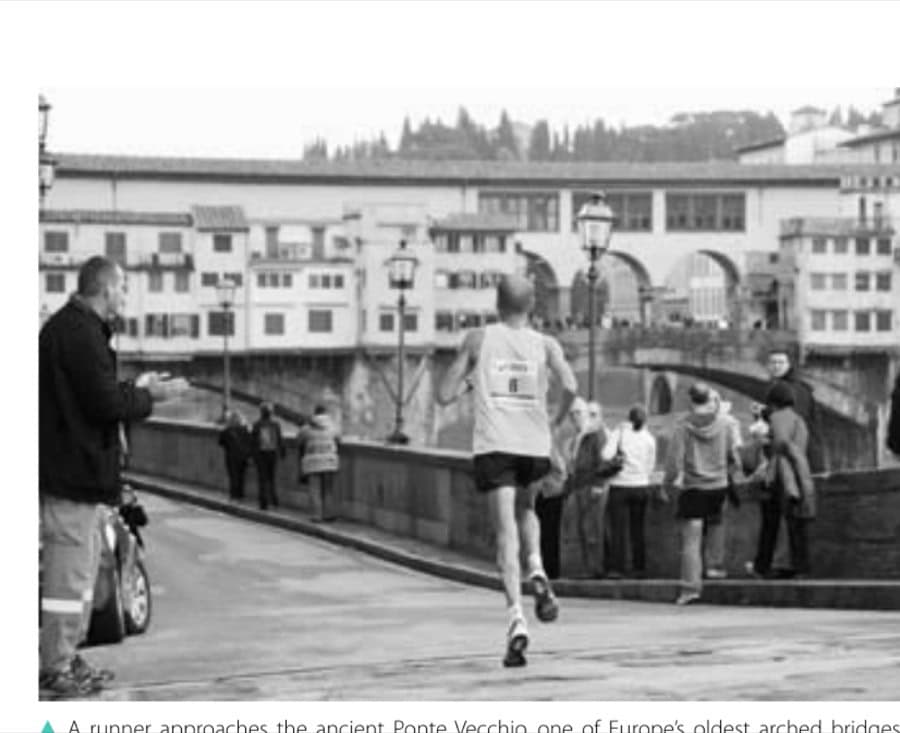
The course then led back to the Arno and turned right at the Ponte Vecchio, the city’s most famous bridge, to continue along the Arno’s embankment. Gazing to my left across the river, I could see the Uffizi directly opposite. One of the most famous art museums in the world, this former administrative building now houses some of the greatest works of the 15th through 17th centuries. Walking through there, as we would do the next day, was like being back in art history class.
After finally crossing the Arno a short time later, the race continued west along the river to the 16K mark, when it turned inland. There were no grand art museums around us now; this was where Florence lived, simple and unadorned.
Courtesy of the Florence Marathon
A runner approaches the ancient Ponte Vecchio, one of Europe’s oldest arched bridges, which crosses the Arno River.
It was a part of the city that I would bet most visitors don’t get to see. We passed the halfway point, looped around the New Athletic Stadium, where the race expo had been held, and then crested the only hill on the course, an overpass over some railroad tracks. Then it was back to the city center, where we ran through piazza after piazza, rich in sculptures and history.
In the Neighborhood of Familiar Names Soon, the course brought us away from all this and took us out for a change of scenery: a pleasant run through Cascine Park, a greensward stretching along the Arno. It had once been home to the Grand Ducal families but was opened to the public in the 1700s and continues to be a popular destination for sports, festivals, and pleasant strolls.
It was all lovely, but as the 32K marker appeared—mile 20 to us North Americans—I was ready to wrap this one up and get back to sightseeing and eating. Still, it was odd to see some reminders of home as I ran along—the Piazzales Jefferson and Kennedy and the Viales Washington and Lincoln. Those surnames, so familiar, seemed dry and ponderous in this land, where every name sounds like a song—something to think about, perhaps, but not right now. There was only 5K to go. I was tiring and needed to concentrate.
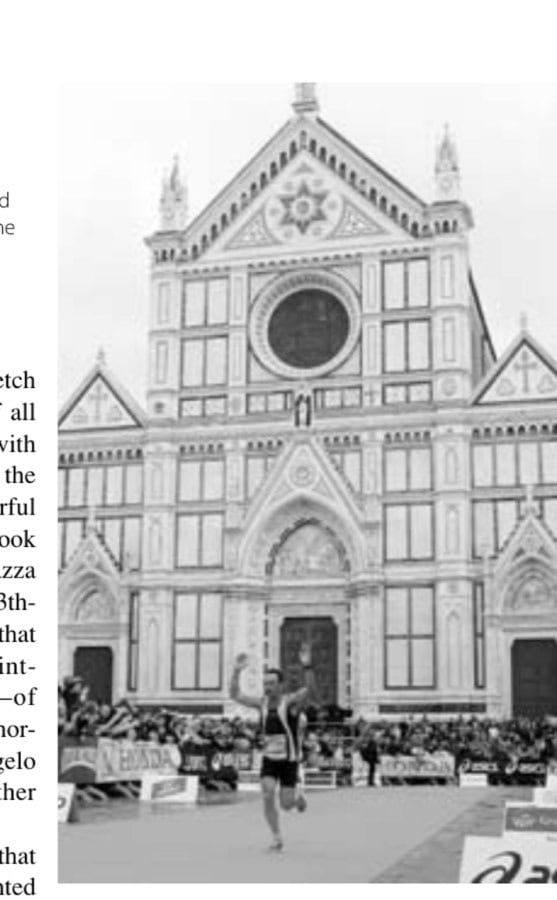
The final home stretch was like a summary of all that had gone before, with more views of the Arno, the Duomo, and the wonderful piazzas as the course took us to our final stop, Piazza Santa Croce, home to a 13thcentury Gothic church that contains beautiful paintings and sculptures—of course!—as well as the mortal remains of Michelangelo and Galileo, among other famous Florentines.
But I would see all that later. For now, all I wanted was my finisher’s medal. After crossing the finisher’s line, I was handed a ribboned medallion, and I saw that it was worth the effort it took to earn it. Sixth in a series of medals depicting famous sights in the city, this year’s medal was dedicated to Benvenuto Cellini’s sculpture of Perseus with the head of Medusa, sculpted in the mid 16th century. It had been commissioned by the Medici to represent their political victories, but as I gazed on its image embossed on the medal while I walked slowly toward the refreshments tables, I wasn’t sure whether I identified more at that moment with the hero or the Gorgon.
A hot shower and a satisfying meal refreshed my body and spirit, and I began to think about my next marathon, just a week away. Knowing that I could get little benefit from training during the scant few days I had left before my next marathon, I planned to skip formal training and put all my energy into sightseeing, hoping that the hours on my feet wouldn’t impede my recovery. I was interested in seeing whether this little experiment of mine would work; I felt like I was both the scientist and the lab rat.
Courtesy of the Florence Marathon
Runners approach the square near the Basilica di Santa Croce, the historical Franciscan church where Michelangelo, Donatello, and other famous artists from the Renaissance are buried.
Courtesy of the Florence Marathon
The next day, we rose early and went to the Cathedral of Santa Maria del Fiore to buy our tickets to the Duomo. I needn’t have worried so much about the ascent—it was the descent that I should have been thinking about! Still, my legs held up well, and although the city happened to be cloaked in mist at that time that obscured the views from atop the dome, we agreed that it was a journey worth taking.
We packed our bags and checked out of our hotel, ready to move on to our next adventure, but we still had one more task: seeing Michelangelo’s David at the Gallerie dell’Accademia. Sculpted in 1504, the statue was even better than its hype. Miraculously, Michelangelo had transformed the hard stone into warm, supple flesh, but what captured my attention was David’s face. I had always believed that the statue depicted David moments before entering into battle, but now I read that it actually showed him moments after having defeated the giant Goliath. I was wrong, then, in my assumption that his expression reflected apprehension over the task before him. Instead, it now appeared to me that the strong set of his jaw and the focus of his eyes showed that he had instantly realized how his victory had changed him. He was, I believed, contemplating what would now be expected of him and what he would now expect of himself. In his face, I thought
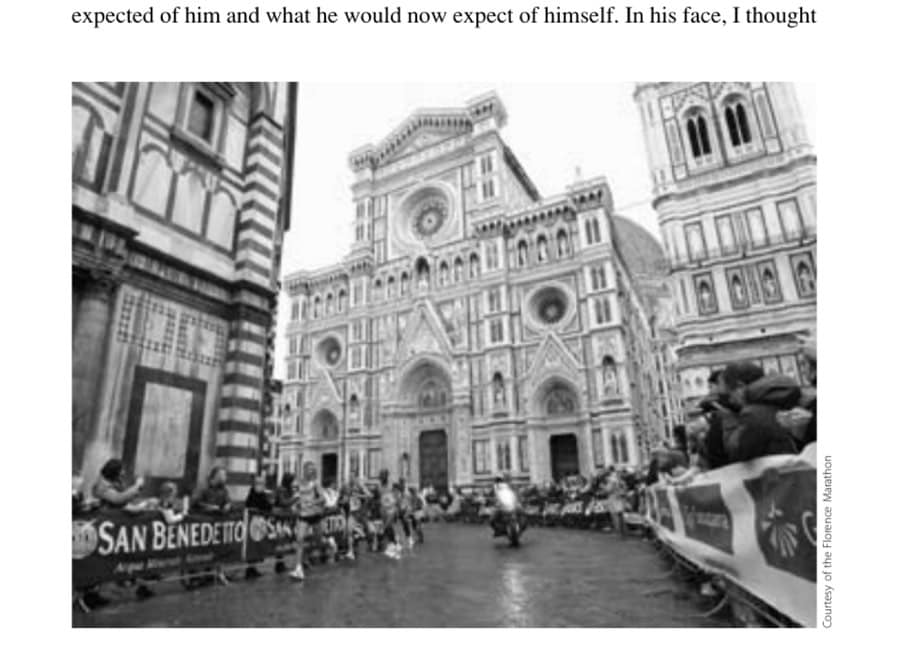
Marathoners cruise through the piazza (del Duomo) in front of the Giotto Tower, a masterpiece of Florentine Gothic architecture.
I saw a realization that the future was a burden he wasn’t entirely sure he could shoulder, but which he was determined to throw himself against. I knew how he felt.
On the Road, Italian Style Shortly after checking out of our hotel, we found ourselves sitting in our rented Fiat, gazing at a map of Italy. We were ready to leave Florence, but where to go next? Planning an itinerary in Italy is like filling a plate at a postrace buffet: there is so much to choose from, but only so much plate. We had spent weeks considering different routes, and we were disappointed to realize that there were so many places that we wouldn’t be able to visit—the medieval towers of San Gimignano, the canals of Venice, the harrowing drive along the Amalfi Coast. We were comforted, though, by the thought that whatever we did choose would be perfect, because there could be no wrong choice among so many wonderful destinations.
We had decided to first drive west toward Pisa. Seeing its famously flawed tower was a bit strange, since it was so well known as to be nearly more legend than reality. Standing before it was almost like finding out that there really is a Santa Claus and meeting him at a dinner party. Climbing it on sore legs was a completely different matter, though. Even on the best of days—meaning, when walking on legs that don’t feel like they’ve been beaten with baseball bats—the odd shifting of body weight experienced when climbing up the tower’s spiral staircase can make people feel as if they are walking a ship’s deck in a storm. But the climb was worth it. As is often the case in these ancient Italian towns, the view was breathtaking.
Once we were back safely on the ground, there was time for one more gelato—there is always time for gelato, of course—before we began to head south to Siena, a medieval walled city. Friends of ours had named their daughter Siena after having honeymooned there, and we soon understood why. Exploring Siena was like unwrapping a gift, as each of its narrow, winding, rolling streets was an adventure unto itself. At its center was the beautiful Piazza del Campo, site of an annual festival, including, hard as it was to imagine, a horse race. And, of course, yet another tower. I was starting to sense a theme here: always a piazza to cross and always a tower to climb. I was starting to feel glad about my decision not to do any running during this week.
After spending several days in Siena, we drove though the Chianti region, with its grapevine-covered hills, stopping in little villages along the way to sample food and wine. Then it was time to head out onto the autostrada for the long drive north to Milan. We had been a little apprehensive about taking the highway, having been warned about the reckless way that Italians drive, but once we were on it, I saw that things were actually quite orderly. Sure, the Italians drove their small
cars incredibly fast, but they were also quick to give other drivers the right of way if someone sped up behind them and flashed the high beams. After an hour on the road, I fell into the swing of things and was able to keep pace with other drivers, pushing our little Fiat up in the mid-90 mile per hour range. At one point, I even pulled up behind another driver and flashed my lights, prompting him to pull aside to let me pass. My wife looked over to me. “You really got a thrill out of doing that, didn’t you?” I just smiled. Whether on a run or on the highway, ruling the passing lane is always a kick.
And Now for Something Completely Different . . . Milan! Milan’s history is as rich and varied as any of the ancient cities of Italy. With roots stretching back over 2,000 years, it flourished as an independent state from the late 13th to the 16th centuries, but its central location, just below the Alps and close to three major rivers, made it a target for conquest. Over the centuries, it seems that just about everyone took a crack at ruling it, from the Goths, Romans, and Gauls to (more recently) the French and the Austrians.
Not that visitors would guess any of this when they arrived. As I steered our car off the highway and drove toward the city center, I didn’t see any vestiges of Milan’s history. It looked like almost any other city you might think of, with apartment buildings, storefronts, and the occasional hotel. Forget the Renaissance, I thought. This was no jewel box of a city; it was a modern, working metropolis, with over 1 million residents, making it Italy’s second-largest city, after Rome.
It didn’t take long to find out what had happened to all of the ancient architecture; I read that after every major conflict, most recently World War II, most of the city had been leveled. Over the centuries, much of Milan’s history had been reduced to rubble again and again. I considered this and realized that the marathon here promised to be a very different race from the one I had experienced a week before.
Our hotel was in the city center, close to both packet pickup and the race start and finish. Early Saturday morning, I went for a short run to loosen up and then headed over to get my race number and chip. The race headquarters and expo were set up in the central piazza in an L-shaped tent. It was colder in the north than it had been in Tuscany, and I folded my arms in close to my body as I stood in line waiting to get in. Looking about me, I had to admit that despite the dreariness of what I had seen so far in Milan, this piazza was absolutely magnificent. On my left was the huge Duomo, a high-Gothic cathedral begun in 1386 and not fully completed until nearly 450 years later. It was intricately carved, with highly decorated flying buttresses and arches, and adorned with 135 marble spires and 2,245 marble statues. Visitors were welcome to climb the steps up to its roof, which was said to offer great views of the piazza as well as the surrounding city. It was a climb that I wanted very much to make, but as in Florence, it would be a
question of timing for me: do I climb it before or after the race? As in Florence, I decided to save my legs for the race and keep the climb for later. The line moved a little and then stopped. I turned around and looked toward the Galleria Vittorio Emanuele. Built in the late 1800s, it was on the one hand simply a shopping mall, but on the other hand, oh, what a mall! It was a glassdomed, barrel-vaulted belle époque beauty, laid out in a cross-shaped floor plan with a magnificent triumphal arch entryway facing the piazza. I had no doubt that the shops and restaurants within were tourist traps—even McDonald’s somehow made its home there—but it was still quite a sight to behold.
The line moved a bit more. I looked to my right, toward an equestrian statue in the center of the piazza and toward the grand boulevards that branched off from the square, on which ran antique-looking trolley cars. I knew that the famous opera house, La Scala, was within a few blocks of this spot as well. I decided that despite the cold, this wasn’t such a bad place to be.
The Marathons are Worth the Premiums I finally inched my way into the tent and picked up my race packet. I also received a fancy shoulder bag that was given to all the runners, along with a heavy, bright
ad
orange, long-sleeve technical shirt. I wasted no time in putting it on for the cold walk back to the hotel, thinking along the way that if Florence and Milan are typical of Italian marathons, Italian race premiums are a runner’s dream come true.
Stephanie and I spent the rest of the morning walking along those boulevards leading off the piazza and then hunted for a small, out-of-the-way restaurant that was, we had been told, one of the best, lesser-known traditional lunch spots in the city. When we got there, we were led to a large back room, which was packed with customers happily eating and drinking. We were seated next to a few young men wolfing down risotto. Looking past my wife, I saw another woman eating risotto, and then I saw another. Things were looking promising for Stephanie. We gazed at the menu but were hardly able to translate the names of any of the dishes. Our waitress came over, eyes wide from the stress of the lunchtime crush. My wife ordered the risotto. ”
I’m sorry,” the waitress said in Italian. “We’re all out.” I looked toward the men sitting next to me and the woman across from us. ”All out?” my wife asked, disbelieving. ”Yes, I’m sorry.” I thought I saw tears welling in my wife’s eyes. I wondered whether I would be able to barter some risotto away from the table next to us. The waitress shifted her weight impatiently, snapping me back to attention, and we tried to resume ordering. We asked the waitress what else was good. She pointed to a few dishes on the menu. “Sure,” we said. “Why not. We’ll take those.” It wouldn’t be risotto, but as long as it wasn’t liver, we could live with it. As my wife, my family, and most of my friends know, I can eat just about anything, but I can’t stand liver. I hate its taste, its smell, its texture, and its color. I even hate its name. I hate liver.
My dish arrived. It was, of course, liver. I couldn’t believe it. We had only two rules coming into the restaurant: we wanted risotto, and I could not have liver. I’m not a religious man, but this seemed to be more than just a coincidence; we must have made some god really angry.
Stephanie, who doesn’t share my aversion to liver, gamely offered to trade dishes with me, and we managed to get through lunch. Afterward, we held each other for support and stumbled back out into the street. We had only a few more meals left to get this right.
The Milano City Marathon Race morning was cool and damp as I made my way to Sempione Park, home to the Piazza Castello and the imposing Sforzesco Castle. Begun in the 14th century, the castle was rebuilt a century later and then remodeled again and again by Spanish and Austrian invaders before being restored in 1893 to its original design. Now home to several museums, it provided an impressive backdrop to the thousands of runners milling around before the race start.
I settled into place in the mob and looked around me. Back in the States, it was an unwritten rule that it was bad form—if not bad luck—to wear a race shirt to the race in which you received it, but here in Milan that rule apparently had not gained any traction. Of the 4,000-plus runners around me, many were wearing the bright orange race shirt. Could they really not know the rule? I crossed my fingers for them and hoped for the best.
And then we were off, my second marathon start in a week. The course skirted along Sempione Park before turning north and then turned east toward the Giardini Pubblici, passing the 3K mark before heading back toward the city center along the scenic Corso Vittorio Emanuele. The course then took us for a loop of the Piazza Duomo to gaze up at the glorious cathedral. Then it was back out the way we had come in, toward the Corso Venezia and the city’s shopping district. So far, I thought, it’s a more scenic run than I thought it would be.
That’s how I jinxed the race. From that point on, there would be no more breathtaking sights on the course. Somewhere near the 10K mark, we left the city center for a big clockwise loop of the city, along easily forgotten streets. Not an ugly route, really, but just not anything special. In the race program, the editor in chief of La Gazzetta dello Sport had written that “this year [the Milan Marathon] is to come of age and challenge the great marathons of the rest of the world . . . on the streets of a city worth rediscovering, a city that is much, much more beautiful than people say.” I applaud his enthusiasm and agree that the race seemed as organized and well supported as any marathon I had ever run, with warm tea, sports drink, and water alternating with sponges along a flat course. But beautiful? Sorry. I had run Florence, and this wasn’t any Florence—which is not to say that I didn’t enjoy the race.
It was a fast course, and the kilometers stacked up until I began the countdown toward the final few. We were heading back toward Sempione Park, where the finish line was located, though on the side opposite from where we started. In the last kilometer, I passed the Arco della Pace, the triumphal arch dedicated to peace. It had been proposed by one conqueror, Napoleon, but completed by a different conqueror, Ferdinand I of Austria. Really, then, the arch was a summary of Milan’s fluctuating fortunes, a metaphor, perhaps, for the fickleness of destiny and man’s ambitions. Not that I was mulling those thoughts over as I passed it by; instead, I focused entirely on the finish line only a few dozen yards ahead. History might be a confusing maze of facts open to interpretation, but there is nothing ambiguous about a finisher’s medal. Every one of them represents a personal triumph, and I happily accepted this latest one.
At Last, Some Risotto? After moving away from the finish line, I followed the other finishers toward the runners village and baggage claim where I discovered a risotto tent. The wet
The author sports his medals and his Milan Marathon race shirt earned during his memorable Italian double.
and cold were starting to seep into my bones, and a bowl of that hot rice porridge sounded perfect to me then. I stepped in line, just barely in the tent, and saw a half-dozen cooks working behind a row of serving tables. One
cook was ladling the steaming risotto from a huge pot as several others worked over a second huge pot behind him, preparing the next batch. I was making good progress toward the tables when the line suddenly stopped
moving. The one pot was empty, and the batch in the second one wasn’t yet ready. I started to shiver as I stood waiting and silently urged the cooks to speed up their work. Other runners in the line behind me were not so quiet. They directed catcalls and whistles to the workers, urging them to hurry up and serve the food. An older man whom I took to be the head chef looked at the crowd, peered into the simmering pot, shrugged his shoulders, and then directed the other cooks to start ladling out the pot’s contents, ready or not, to the waiting runners. After getting my portion, I held the bowl to my lips and greedily shoveled the soupy, half-cooked contents into my mouth. I felt like Oliver Twist, but the food was hot and filling, and if it tasted more like gruel than risotto, we runners had no one but ourselves and our impatience to blame. My fellow runners must have been thinking much the same thing, because I heard no complaints. A quick subway ride back to our hotel and a long soak in a hot bath helped remove the last of my chill.
The next morning, I cleaned myself up and dressed for the last bit of sightseeing on our list. First, we had our climb up to the cathedral roof, which was everything we hoped it would be, even if I was a bit slow once again on the descent. That was followed by a visit to the Church of Santa Maria delle Grazie to see da Vinci’s masterpiece, The Last Supper. The famous fresco has barely survived centuries of abuse and neglect, and after years of restoration, it has been raised from being almost destroyed to just being in simply awful condition. But we never got a chance to judge its merits for ourselves, because the only way to see the painting—or what is left of it—is to reserve tickets months in advance. Besides, as we found out, the church was closed on Mondays. We were out of luck. We
should have been disappointed, I suppose, but we weren’t. After all of the art that we had seen over the past two weeks, we had no reason to complain—except for the matter of our own last supper. We still hadn’t tried the food we had been longing for, and this was our last chance. The day before, I had spied the menu from a restaurant not far from our hotel that offered seven kinds of risotto as well as pumpkin-and-sage-filled ravioli. Things looked promising, but I was braced for the worst when a waiter came over to take our order. We ordered one of the risottos, a polenta, osso buco—a flavorful cut of veal shank—and my ravioli. Then I braced myself for the bad news. Instead, the waiter only smiled and said, “Very good.”
And it was. One delicious bite followed another until we had sated ourselves on food and wine, and when we came to dessert, we hadn’t even left any room for gelato. We were satisfied at last.
And in the End . . . So, what did I learn from all this? First, that it’s possible to run marathons on consecutive weekends. Second, that there are Italian marathons that are PR friendly and worth every euro of their registration fee.
ad
Third, that you should never automatically trust your waitress. Fourth, that it’s possible to gain weight while on vacation even if you run two marathons. And fifth, that no matter how much time you take for your Italian trip, and no matter how many miles you manage to run while you’re there, you’ll come back wishing that you had spent more time there and run more races. But there’s always next year.
If You Go . . . In the months before we left for Italy, every report of the dollar’s decline filled us with panic, but we discovered that there are still bargains to be had. One of the biggest expenses in European travel is lodging, and we found some great
deals on luxury hotels on the online auction sites. Try www.skyauction.com. As for eating, in Florence, try Trattoria Marione, on the Via della Spada. It’s simple, relatively inexpensive, and wonderful. In Milan, visit the Princi Bakery on the
Via Speronari for some of the best artisanal breads you will find anywhere, as well as pizza and lasagna. As for sightseeing, our experience in trying to see The Last Supper taught us that it’s important to book tickets in advance to certain venues to ensure that
you don’t get shut out. Late fall is the off-season for tourism, and you might get lucky and get into the museums you want to see just as a walk-up, but if your time is limited, as was ours, it’s not worth the risk. Book very early to see
The Last Supper in Milan, and in Florence, book a few days in advance to see the Uffizi and the Gallerie dell’Accademia. You can have the concierge in your hotel make the arrangements or do it yourself online at the museum Web sites:
For the Uffizi: http://www.uffizi.com/online-ticket-booking-uffizi-gallery.asp For the Gallerie dell’Accademia (Michelangelo’s David): http://www.gallerieaccademia.org For the Church of Santa Maria delle Grazie (da Vinci’s The Last Supper): http://
www.italy.artviva.com/museum_reservations/church_of_santa_maria_della_grazie Finally, regarding race gear, I like to bring everything I might possibly need when I travel to race, but if you should forget anything, both the Florence and
Milan race expos offered all the major necessities. In Milan, there was also the Decathlon Sports Mega-Store, an international sporting goods store that was well stocked with running gear.
This article originally appeared in Marathon & Beyond, Vol. 12, No. 5 (2008).
← Browse the full M&B ArchiveMore like this
1,000+ stories from 19 years of Marathon & Beyond
The complete archive of the legendary long-distance journal — digitized and free to read.
