

Ancient Footprints
“It is not the critic who counts; not the man who points out how the strong man stumbles or where the doer of deeds could have done better. The credit belongs to the man who is actually in the arena, whose face is marred by dust and sweat and blood, who strives valiantly . . . ” — Theodore Roosevelt
When I first heard Bob Dylan’s lines, “The streets of Rome/ are filled with rubble/ ancient footprints are everywhere . . . ,” I thought I knew what he meant. I have always loved that line, that sense of things past, here with us in the present, being part of, informing, and driving the creation of our own art, our own lives.
I was 14 when I saw my first marathon. I watched it on an old black-and-white Dumont TV in the dining room of the house where I grew up. It was the 1960 Olympic marathon in Rome where Abebe Bikila, an Ethiopian policeman—a palace guard in the service of the Emperor Haile Selassie—won while running in his bare feet. The race was run at 5:30 in the evening to lessen the effects of the heat of the day during the Roman summer. The organizers lit the route with hundreds of torches. I remember the black-and-white screen, the light of torchbearers beside the road, the barefoot African running past the ruins of the Coliseum, arms low by his side, running easily, relentlessly, seeming in my teenage imagination to be bringing the smell of the desert and the far-off Serengeti into the dimly lit dining room, cleansing the earth and sky, leaving in my memory a hint of stories past, of dreams of glory, of escape, of the seductive mystery of some other place.
I also remember that in my confused teenage night—weren’t we all confused in those years?—I began to dream that I would go to Rome. And run. Maybe I would get there for the marathon as an event, or maybe it was just an idea, an attitude that I was after. I imagined cruising past the Coliseum, running free and easy, everything that troubled me in the rearview mirror.
It seems this early morning that it will come to pass, that with Dylan’s lines in my head, his song on the iPod, I will line up after sunrise to run a marathon through the streets of Rome.
Bikila’s Long Shadow Bikila’s accomplishments are legendary. He won 12 of the 14 marathons he ran. He was the first African to win gold at a modern Olympics and the first to repeat a marathon victory in consecutive Olympics when he won again in Tokyo in 1964. Even this morning, as I read the marathon magazine for tomorrow’s race, his name is included not only as the winner of the marathon all those years ago, but as a symbol of what the miles can come to represent for any of us, for all of us who put in the miles and show up on the day. He is a hero to this day in Ethiopia and wherever runners gather. For me this early morning, he is still present, graceful, outlined in courage, glorious, unfathomable—a freeze frame carried forward from that long-ago night.
It is a few hours before the race, and I am slowly going into the place where I go before an event. It is a quiet place, sometimes sad, often melancholic, visited by the memories of what it has cost in miles, in obstacles overcome, in absent friends, in the time gone by to get here. There is a slow building of clarity of purpose, respect for the journey, and a sense of connection to the people I have met along the way.
Eventually, as it must if you are to do this uncommon thing, it seems like everything that has come before is gone, that there is only now. I like what James Shapiro says in Meditations in the Breakdown Lane, his story of running across America. “Past life is gone, future life will never come, so there is only the doing,” he wrote. “I could talk for 10,000 years, but it wouldn’t carry me one inch closer.” For me, that would be something about reading 10,000 running books or training programs, but like Shapiro, it brings me not one inch closer.
I open the patio doors in the hotel room and watch the night sky slowly fade. There is mist in the trees; the seven hills are stark in the distance, the streets oddly quiet for a city that rarely sleeps. There is the smell of bread baking and
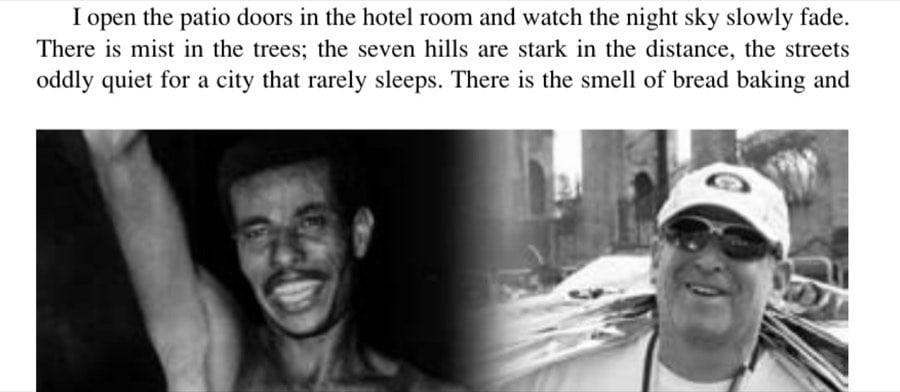
Abebe Bikila and the author in Rome: 44 years and 26.2 miles later, they are both still smiling.
the far-off sounds of barking dogs. So many hours to go before the run. I have laid out my clothes, checked all the pockets in my RaceReady shorts for GU and the requisite ibuprofen. I have done it 10 times tonight, maybe 20, if I’ve done it once. I can’t figure out the time difference from Rome to Ottawa, where my daughter is, so I can’t call her; nor can I call my son, who is playing poker in Vegas. So now it is time to put on my headphones, dial up Bob Marley, Bob Dylan, and Eric Clapton, drink some espresso prepared by the gracious night porter, and get inside what’s coming. The Bobs and Eric and I are getting it together, “… knockin’ on heaven’s door.” I have never figured out why that song or why the ritual, but I guess I don’t have to.
Pacing at Heaven’s Door The race begins at 9:00 a.m., which is normally too late in the day for me to start a long run. My habit is to be out before daylight and run into the sunrise. I go down to the hotel lobby after several hours of sky watching and begin to pace. I talk with Jeremy and Julie, who are still up, with Erin’s brother Anthony, who will run the race in a time of four hours. Together we watch as the support crew begins to filter in. John and Ginger; Kristi and Erin; the various Susans; Tom and Louise, who are parents to several of the group, all here for the trip to Rome, their first to Europe: here for the sights and sounds and later for the food and wine of Tuscany, but before all that, here for the marathon support thing.
Mark and Erin and I share a cab to the start. The city is deserted, the streets empty, resonant. The locals say that it is the only time, the best time, to see Rome, on marathon day when the center is closed for the race. Can’t argue with that. It is still dark when we arrive at the starting area at the Coliseum. I am overwhelmed by the sight: the Coliseum, the Forum in the distance, runners slowly gathering, the sun rising fiery over the ancient walls, and, of course, the blue porta-potties. It seems incredible to me that I’m here. This being Europe, there is also a low, ancient, level wall where apparently it is required that all men pee in some nod to tradition or, more likely, the fact that there are not very many porta-potties.
The organization seemed particularly quirky, the staging area separated from the course in a serpentine gate system, the buses for the bags parked in a long line, men to the front, women way to the back, protected from the crowd by a long fence. It all works out, runners figuring out, as they always do, what they need, but it is very different from the sometimes-obsessive organization of U.S. events. The race begins with hand waving and shouting, cheering sections from the roadway above; 10,000 runners, we are off to circle the Coliseum and head into the town. I know almost immediately that this isn’t my day. The foot pain that has become a neuroma and that normally holds off until 20-plus miles starts by the end of mile one. With the cobblestones, the heat, and the extra weight I’m
carrying, I am doomed, it seems, to forever carry (sigh) the pain as it becomes a constant companion. I swore to myself after the run at Avenue of the Giants last May that I would never run a city marathon again. Something about the primeval redwoods going all the way to heaven and the silence that surrounds every footfall in the deep forest. But here I am in the ancient/modern streets of Rome, where there are buildings as old as the redwoods that I ran through and the silence is in cobblestone roadways underfoot. The sightlines, some unchanged since Caesar’s armies marched through the hills to the city, are riveting, breathtaking. For centuries the soldiers came, bearing news of victories in far-off lands, telling tales of great valor and lost heroes, of comrades left in foreign soil, there always, a piece of Eternal Rome. (This, with apologies to Rupert Brooke, I’m thinking as I run past the Coliseum and the Forum.)
Ancient Footprints Everywhere After the conquering heroes came the vanquished armies running from the Goths and the Mongolian Khans, the decadent centuries, Constantine and the burgeoning church, the marauding crusaders, the Knights Templar, the relentless pursuit of art and commerce, daVinci, Caravaggio, the Borgias, and later, Mussolini, the Eighth Army, pizza, and eventually Abebe Bikila. Everywhere along the route are the remnants of that astonishing parade of days.
Brass bands in traditional Italian costume announce our passage as we circle the Coliseum. We head out past Michelangelo’s Campidiglio, an enormous plaza. Once the seat of government and religion in Rome, it is “one of the most significant contributions ever made in the history of urban planning. The hill’s importance as a sacred site in antiquity had been largely forgotten . . . ” says one writer of the Campidiglio. Not so, I think. The sacred feeling of it remains, palpable in the rising heat of the morning, backlit by the sun. On to the Circo Massimo, Circus Maximus, built in the time of the Etruscan kings, enlarged by the Romans, restored by Constantine, and now a public garden, misted, glowing on this morning, peaceful now, where there were once 200,000 spectators watching the chariots race.
Past the gardens, then a turn up along the Tiber and past the Sinagoga. It was built from 1897 to 1904 by architects Asvaldo Armanni and Vincenzo Costa, or so I am told by one of the runners passing me by. Of more interest to me is that on the wall facing the Tiber, the big memorial tablets remind me of the martyrdom of Roman Jews in Nazi concentration camps. So much blood in this city, not all of it ancient, but so much of it remembered, honored, part of the eternal struggle that has been waged here for the souls of men. My own struggle seems inconsequential, quixotic, but even so, the continuing on is a part of the fabric of
this city, a tiny part of the seeking out of what is best in me under the knowing gaze of those who came before. We cross the river and wind our way past St. Peter’s Basilica, past the Sistine Chapel, not yet filled with worshippers, empty, waiting, poignant with an ineffable sense of grace.
Down the streets and along the river, we run past the Foro Italico, a grand, imperial complex that survived Mussolini and became part of the Olympic Stadium Village. It is hotter now, and the cobblestones have done their work. My foot, which was uncomfortable in mile one, is now very painful, and my unplanned run/walk strategy is no longer a matter of choice. Run a little, walk until the pain subsides. Run some more.
A Hand at My Back
Jeremy Fratkin et. al.
At one of the water stops, I feel a hand in my back, shoving me out of the way. I get furious in an instant and turn on the culprit, who it turns out is older than I am, speaks no English, and has a delightful smile in the face of my unconscionable rage. This has never happened to me in a race before, and it leaves me very
Sightseeing in Rome is easy;running a marathon through the streets of Rome—now that’s a different story altogether.
uncomfortable. A little while later, a couple of guys come up to me and, by means of gesture and much effort at speaking English, tell me that it is nothing—that the old man didn’t mean anything by it, that he stumbled, that he is from Germany as they are and is running in Rome to get ready to run in America. In New York, they say. I apologize for my attitude, telling them that I am from New York, which causes much laughing, especially when they tell the old man. All’s well, and we run together for several miles.
By the half, I have decided to quit, but I keep running anyway. Just to the next kilometer sign, I say to myself. I’ll quit then. After a couple of more “next kilometer” promises, I begin to realize that I love the kilometer signs since they come more quickly than the mile signs, and it seems much more impressive to have run 20 of something rather than 12 of something. This has become a long day.
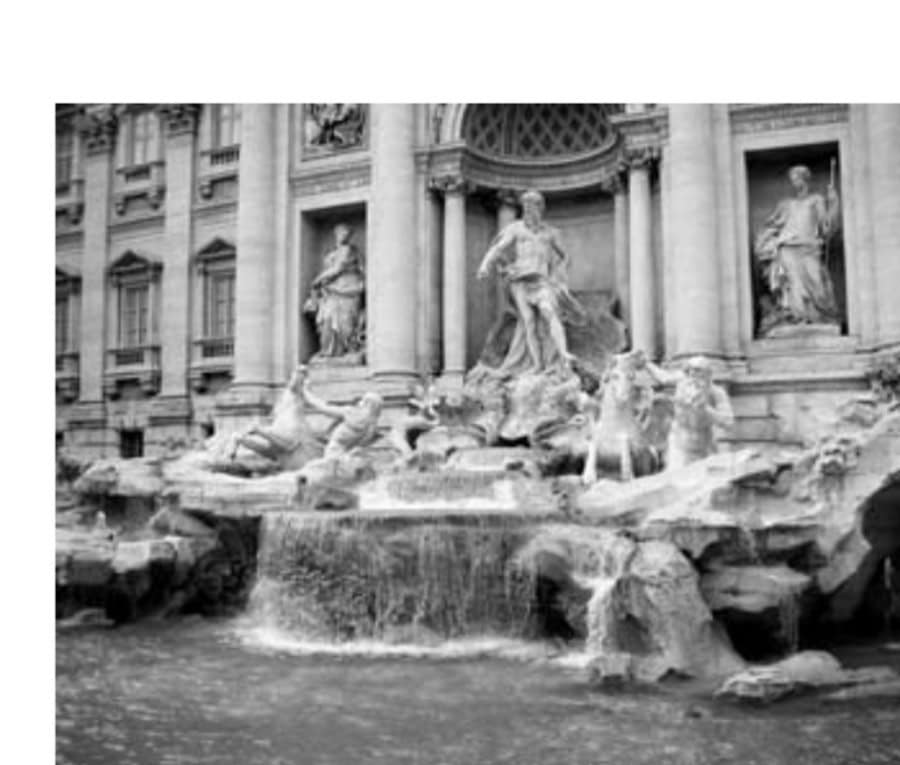
The course heads back to the city center, and we pass the Belle Arti, the Piazza Navona, and eventually the Piazza di Spagna, home to Lord Byron and Keats. The Spanish Steps are crowded with tourists but no less inspiring for that. I remember, as I run by oh, so slowly, going there the night before, the stairs awash in the moonlight, the crowds gone, the words beneath the stones for all time, there for the lovers and the dreamers of any time, of any age. The Sunday-morning streets are overflowing with pedestrians who quite rightfully believe that Sunday is for espresso and fresh bread at the cafes and then some sightseeing, some shopping. We, however, are still running. It is an odd feeling, somehow consistent, that in this most complex of places, life and sport are interwoven, not as metaphor but as “get out of my way, I’m running here.” To which the response is, in Italian, “hey, want an espresso? Relax!” The Trevi Fountain is sparkling in the noon sun, mocking me with its tranquility, its ease. The crowds are lively, and sometimes they even get out of the way. This is less of a problem if you are a front-runner, but if you are me, a back-of-the-pack runner, it has its moments, to be sure.
Past the Campidiglio again, and there we are at 35K. The road widens out and heads away from the Coliseum, a tease if ever there was one. Down the road, past the water stop, when suddenly there are Kristi and Erin, water in hand, looking great, falling in step, saying all the right things. Across the way, Mark is still running, his son Jeremy running alongside, taking pictures, being there. I don’t see Erin, Mark’s wife, but I am told that she is still moving, still running. Mark hurt his ankle before we got to Rome, and this has been a hellacious day. I can see it from across the roadway. It is in his face, in his stride. He keeps going, the finish line just out of sight. The day belongs to those who stay in the arena, who contend, who do what they can with what they have.
More is Revealed For reasons that are obvious to me, if to no one else, I can’t help but put Erin and Kristi into Leonard Cohen’s song, “Sisters of Mercy.” It begins with “The
Jeremy Fratkin et. al.
The marathon course goes by the Trevi Fountain. What you don’t see as the author runs by is all the tourists laughing and saying, “Come on in; the water is fine.”
sisters of mercy they are not/ departed or gone/ they were waiting for me/ when I thought that I just can’t go on . . . ”; and so it was at 35K and 36 and so on. I always thought that Cohen was saying that these strangers knew him, saw him clearly, that he was revealed to them, that he was set free by their knowledge of him, all his artifice gone. So it was for me, nothing left to hide, no ability to hide it, a necessary part of the leaving behind, of the cleansing and clarity that all such effort brings. We are all of us revealed in the last miles of a marathon. Ask anyone who has stood at the finish and watched the faces of the finishers.
Down to the turnaround and back to the Coliseum ever closer, 39K, 40, 41, and over the last rise and down the hill to home. Much of the crowd has dispersed, but no matter. There are John and Ginger, soon to be married; hands full of drinks and food, smiles and something like admiration mixed with a sense of “what is wrong with you people?” in their eyes. Tom and Louise are there, Tom’s white hair a complement to a smile that gladdens my heart. The run is done, the finisher’s medal around my neck, the pain and soreness to come. But for now, briefly, there are private tears; it has been a long, long journey from the old black and white in the dining room, down so many wrong roads, past all the empty mornings, a life
lived in addiction, lost somewhere under a jagged rainbow, a personal metaphor for the promise and the failure inside the journey to the marathon. All that is long gone; the boy inside the man has lived to run his far-off dream.
The Rome Marathon was for me the culmination of a lifetime of dreaming of a way out and, ultimately, a way in. I knew again that day that in the running, there is something that lives on levels well beyond my ability to articulate. It feels like connection. In the pain and beauty of the miles, both on race day and in the preparation, the continuity/community/solitude of the journey dissolves the barriers between us as people.
We look at the other runners and see everyone we ever knew, and beyond our imagining, on levels we rarely touch, we love them, we forgive them their sins, as we begin to forgive our own. We, all of us, know something of value about the other, something of what we have been through, possibly even what we dream of being. The run is solitary, the victory entirely personal, but the community exists in the effort put out, in the inhalation of the moment, in the exhalation of a million breaths, woven together in the light of the day. Our day. We have shared life itself in some intangible form as we endure. We overcome our worst fears as we embrace our greatest aspirations, the best parts of who we are. We are reassured of our place in the world at that moment and of our connection to the forces of the spirit that make us holy, that make us altogether human.
Jeremy Fratkin et. al.
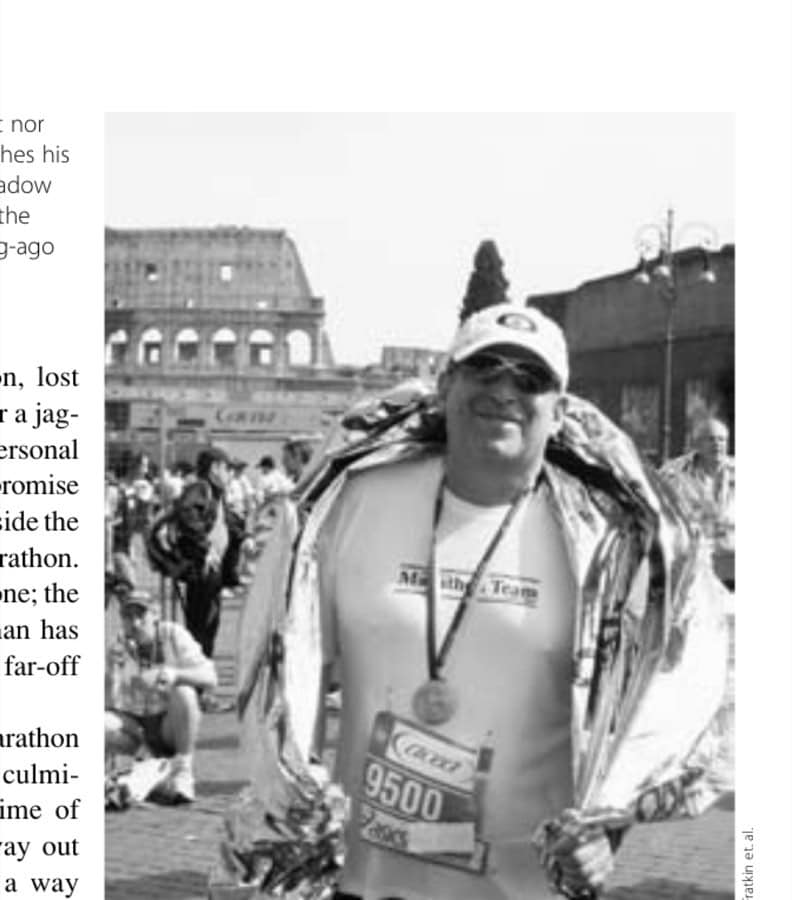
Neither barefoot nor fast, the author finishes his marathon in the shadow of the Coliseum, in the footsteps of his long-ago hero, Abebe Bikila.
This article originally appeared in Marathon & Beyond, Vol. 12, No. 5 (2008).
← Browse the full M&B ArchiveMore like this
1,000+ stories from 19 years of Marathon & Beyond
The complete archive of the legendary long-distance journal — digitized and free to read.
