

And It Ends With A Wedding
Courtesy of Max Brodsky
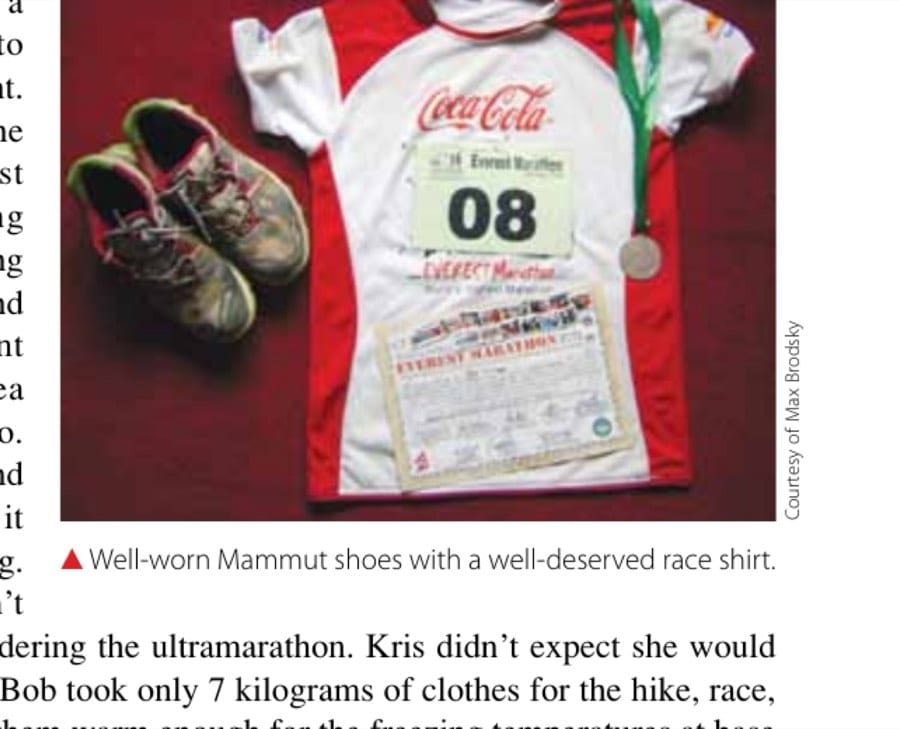
Ican think of no other races that involve a two-week trek just to get to the starting point. When I chose to do the Tenzing-Hilary Everest Marathon—celebrating the 60 years since Tenzing Norgay and Sir Edmund Hillary climbed Mount Everest—I had no idea what I was getting into. After the long trek up and the eight-hour marathon, it all ended with a wedding. ▲ Well-worn Mammut shoes with a well-deserved race shirt.
Bob’s loved one didn’t know that he was considering the ultramarathon. Kris didn’t expect she would have to sleep in a cave. Bob took only 7 kilograms of clothes for the hike, race, and relaxation, none of them warm enough for the freezing temperatures at base camp. Sigfried’s trek bag missed the plane. Kris made a blanket out of plastic bags she found on the trail. Patrik was nursing a sore knee from training. Bob’s health would decline as we moved farther up. Sigfried suffered through the race and still crossed the finishing line with a smile.
I arrived at the Hotel Shanker on the outskirts of Thamel, Nepal, to find my roommate—Patrik, 38, from Sweden—had already arrived and was waiting in the room. Covered with sweat and exhausted from travel, we set off to explore part of the tourist city. Patrik and I shared living space for the entirety of the
expedition, from the five-star hotel in Kathmandu to our tent at base camp. I have seen more meat on a butcher’s pencil than I saw on him—he was all lean, runner’s muscle. It would take the entirety of the trip for Patrik to boast about his 2:36 marathons, though on our practice runs during our off days he proved to be exceptionally capable.
At the dinner before we set off for Lukla, I found myself sitting at a wonderfully excited table. Awkward as I was, I was perplexed by the abundance of forks set before me so I asked my fellow dinner companions. The woman on my left sat with distinction, holding herself with respect and good humor, and told me start from the outside and move in, “At least that’s the military etiquette.” Even more perplexed by her mention of the military, I swallowed the hook and asked about her life, aside from the race. “I’m a colonel in the Canadian Army, but I started as a nurse.” I tried to maintain my composure but was startled. I have a few friends in the American military, but I never knew their ranks, so to be sitting next to someone with a highly respected rank was quite the shock. Over the course of the expedition I would come to find Kris to be one of the easiest people to talk to and one of the toughest people I have had the privilege to know.
Getting to know the gang My first interaction with Sigfried was because we both were wearing the same CamelBak mule pack. He smiled and said that we must make sure we don’t grab the other’s by mistake. Sigfried, framed like a brick, is a good-humored South African, even when his bag went missing—not because we shared the same daypack. Mike is a hard-working middle-aged man with a growing bald spot who showed romance at Namche Bazaar. Bob’s extroverted personality made him an excellent companion and brought levity during even the heaviest of moments. At the time of the race, I was 23 years old and excited after working as an English teacher in South Korea for the previous 18 months.
The next morning the majority of this year’s competitors set off for Lukla by plane. Lukla happens to be one of the world’s most dangerous airports, not because of crime or violence but because of the severity of the mountains and the necessity of at least a thousand-foot ceiling. The airport was filled with people and the collective excitement would make the Energizer bunny overload. Our bags were loaded, and we boarded the planes, albeit timidly because of the stories about the airport. Taking off is always the easy part; I was only worried about the landing. Thankfully, my concerns were overwrought and all went well, though a few prayers didn’t hurt. While the flight went well, lost luggage is a global problem. Sigfried’s trek bag was left at the airport in Kathmandu.
Thankfully, Sigfried’s luggage arrived during our rest day at Dingboche a few days later while everyone went exploring the course loop to Bibre. While on the
Courtesy of Max Brodsky
hike, Bob left his running bag at the turnaround point so he and Sigfried could jog farther up the trail, across a river, and up the moraine. Running out of water, Sigfried drank from a local stream while Bob forced himself to continue. When
they returned, Bob wandered down to the lodge where everyone was retrieving their race numbers, grabbed his number, rushed out the door, and threw up everywhere. Bob spent the night awake, in pain, and in the bathroom. The race doctor gave
him a bottle of what looked—and tasted—like yak piss. He was unable to drink it down. There was nothing that we could do for him, much to our collective despair. At lunch I sat at the window and watched as Bob crutched his way down the trail,
and as he arrived, he collapsed. After we finished eating, Bob decided to hike to Thugla at his own pace. Bob would walk 66 steps (corresponding to his age) and then collapse on the ground, regardless of the trail conditions.
On our rest day before the marathon, I was able to catch up with this year’s race organizer, Shikhar Pandey. Amid phone calls, complaints, a work force of more than 150, and managing European-Nepali relations, Shikhar was in good spirits when
we spoke. During the three years that Shikhar has managed the Tenzing-Hilary Everest Marathon, international participation has doubled, and as it turned out, Shikhar became a runner because of the marathon. Shikhar
loves hearing from people that being able to go to Everest Base Camp and running a marathon down is a dream come true. So, when a 71-yearold man celebrated his birthday at Everest Base Camp, was struggling with his breath, and everyone thought that he
▲
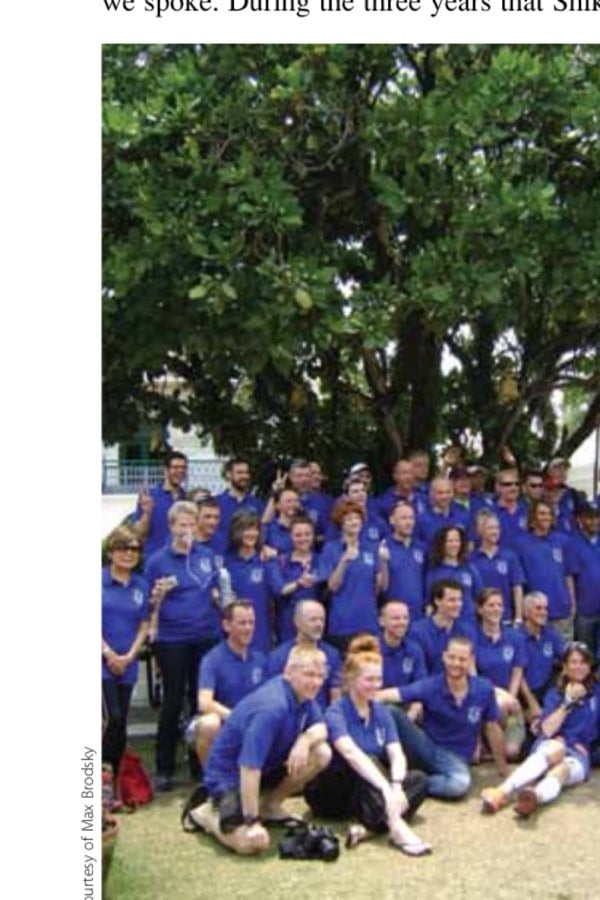
2013 Tenzing-Hilary Everest Marathon runners.
Courtesy of Max Brodsky
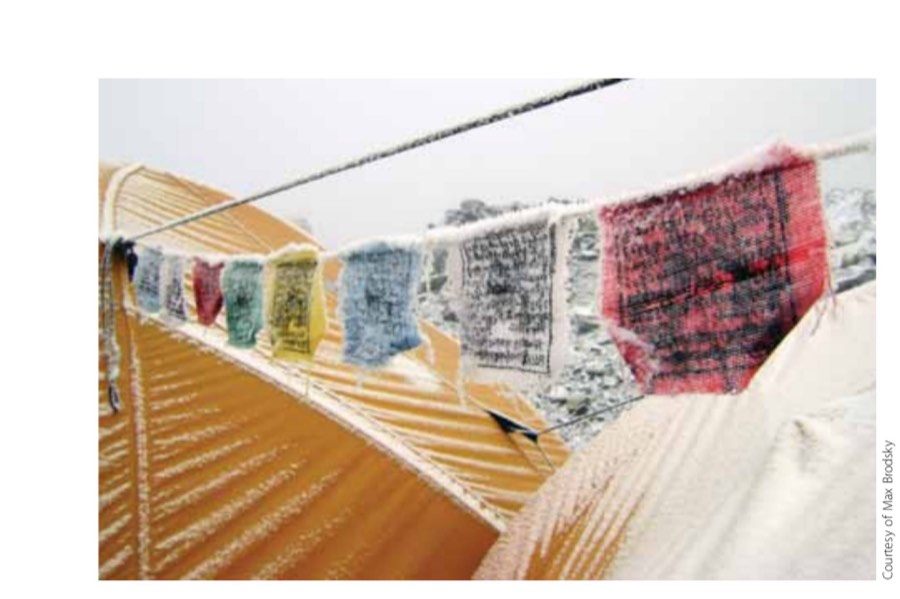
▲ Frozen prayer flags at Everest Base Camp.
couldn’t (or shouldn’t) participate in the race, Shikhar organized a Sherpa guide and a porter to make sure that he got down safely, which he did after 13 hours, 8 minutes, and 17 seconds. With our youthful excitement, Shikhar and I made a bet about who would finish first. Shikhar’s advantage: living in Nepal, training at altitude on the course, and having been to 6,000 meters before. My advantage: more experience with endurance events (I used to be a junior bicycling racer in Colorado), the desire to beat a Nepali, and an overabundant burden of youth. The day before the marathon we awoke to find our tent covered with 3 centimeters of snow and more falling. While playing cards, I overheard complaints that Ever
est Base Camp was too cold. The base-camp cook made us chicken curry and cake for dinner while the race organizers handed out two chocolate bars for the marathon runners and three for the ultramarathon runners. As we ate, none of us could imagine what was to come the following day or really how long it was going to take—most people doubled or tripled their marathon times; since this was my first marathon, I was just hoping to get in before sunset.
The start of something big I rolled over and wiped the sleep from my eyes to see Patrik packing the few belongings he brought to base camp in our bag. It was 4:30 a.m., and he looked
determined and ready. I twisted and turned in my sleeping bag, too scared to get out and get myself ready. I didn’t ask Patrik how he was feeling or what time he was aiming for, rather, “Good morning” and “How is it outside?” Patrik pleasantly said, “Good morning. It’s not too bad outside.” We shook hands as he left to grab the last substantial thing he would eat until Namche.
In the next tent I heard Kristina and Michelle talking before the race. Something Kris ate wasn’t agreeing with her, and she was unable to keep anything down. Michelle tried to comfort her while preparing for her own 60-kilometer adventure. Offering her support and well wishes, Michelle said good-bye and that she would see Kris in Namche.
Across, Mike was awake and out the door early. He had been up since 4:00 a.m. Sue, his wife, after a cold night sleeping on the ice, was awake and finished getting the bags packed and ready to be sent to Namche. Concerned for Mike’s safety, she gave him a reassuring kiss and said to be careful. Mike and Sigfried planned on arriving at Namche by 6:00 p.m.
Sigfried slept and snored throughout the night and was gone before I woke up. Dressed in everything he had brought and some borrowed clothes, Bob had been awake most of the night. After battling a serious stomach bug days before the race, Bob was preparing for a long day ahead. He packed several bars and GUs into his bag, along with a liter of water. With some hope, Bob planned on making it back before the first day’s 7:00 p.m. cutoff.
Finally, I left the warmth of my sleeping bag and double-checked my CamelBak: three PowerBars, one Snickers, one chocolate bar, one packet of electrolytes, and 3 liters of water. While enjoying my breakfast of porridge and muesli, I heard the whistle signaling the start of the ultramarathon. The local Nepali runners were in the lead, followed closely by Patrik and Lizzy Hawker. Not far behind was Michelle, leading the remaining runners off the ice fall while Bob took his time at the back of the group. “
Just a walk in the park,” said Mike, as they raced past us. After they left we made our way to the starting line. The minutes ticked away like rain on glass windows leaving long trails for us to remember them by. Before I realized it, I heard the countdown. “
Five . . . four . . . three . . . two . . . go!” The Nepali runners took a commanding lead. I tried to avoid the bottleneck at the ice fall and rushed to the front group of international runners. I scrambled along the rocks and ice, trying hard to keep my balance and not fall into the glacier stream below. As I passed the breakfast tent, I saw Nabin, our 21-year-old Sherpa guide, cheering us on. My hopes were lifted so I pushed harder.
Coming over a hill off the Kumbu, I saw Kris kneeling on the side cheering us on; I grabbed her hands and wished her luck.
Running on (literally) empty Staying awake the whole night losing nutrients from both ends, Kris decided that it would be best if she missed the official start time and competed in the marathon at her own speed-walking pace. Shikhar gave Kris a porter guide to take her to Namche Bazaar. After all the racers had taken off, she began adventure disguised as a marathon. With nothing in her stomach and fear of expelling anything that she would put in it, Kris stuck to only clear liquids along the trail.
During the first nine kilometers, I moved from the ice fall at Everest Base Camp (5,364 meters) through the rock fall of Gorakshep (5,140 meters), and down the valley to Lobuche (4,930m). Before me was the blue shirt of an ultramarathon runner. They started an hour ahead of us, and I couldn’t have been moving that fast, but Bob was right there.
I was on the verge of tears. I had run the first nine kilometers too fast. I stayed with Bob for a while so I could calm down and gather my strength. We chatted and he told me he was feeling strong, still thinking he would reach Namche before the cutoff.
I left Bob and ran down the long hill to Thugla (4,620 meters), along with some other runners. At Dingboche I decided to take a risk and left my pack at the base of the loop. Carrying only a small bottle, I started up the loop alone.
With the urging of the porter, Kris was able to continue on. She figured that her insurance wouldn’t cover a helicopter evacuation so her only choice was to finish. Still avoiding solid foods, Kris stopped at various stands along the way and bought Sprite in addition to her water. When she reached the loop her porter stopped. Asked why he stopped, he said that he had to go a different way1. Weakened by her lack of food, Kris was resigned to continuing on alone, hopeful that she would be able to stay on the trail.
Along the course, Mike and Sigfried stayed together until after the ultramarathon/marathon split. What was said to be a 10-kilometer section from Pangboche to Nala was really a 13-kilometer section without aid stations. Sigfried began to cramp and was unable to stay with his running partner. Sigfried forged ahead up the never-ending hills and single-track trails alone.
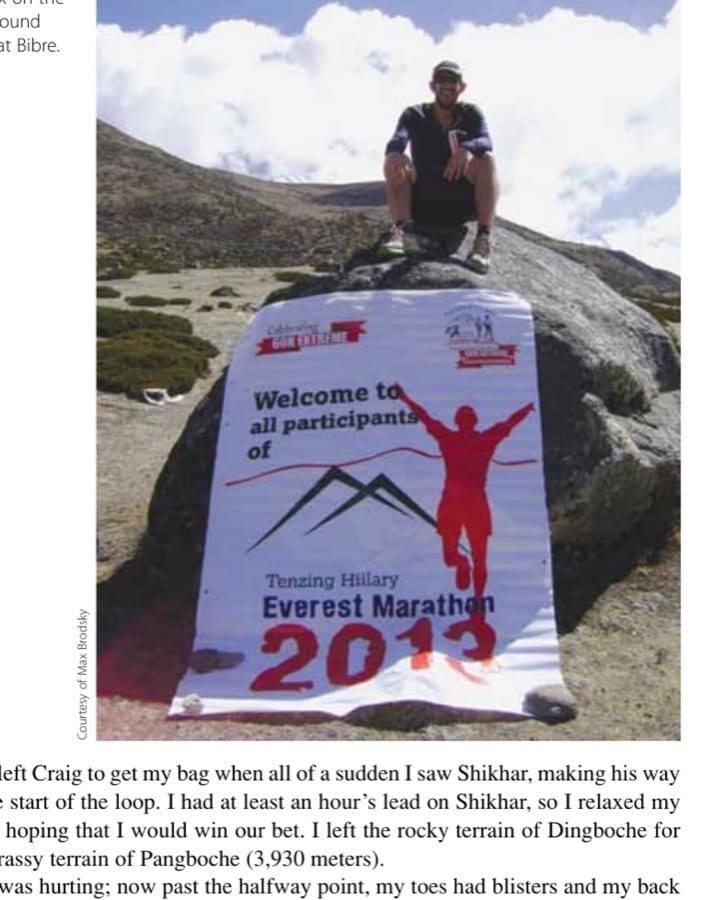
Craig, one of the ultramarathon runners, was sitting at the turnaround at Bibre. Knowing that I needed to tape the blisters on my toes, I sat with him for a few minutes and learned that he was suffering from an electrolyte imbalance. He decided to wait and get better at the turnaround before setting off again. When he was ready, Craig and I set off from Bibre back to Dingboche. 1 What happened with the porter was that since the runners left their excess clothing at Everest Base Camp, the porters were forced to participate in their own marathon but without any aid stations and to do so with 30-kilogram packs. One of the locals thought it would be advantageous to take these porters hostage and ransom back them and the gear to the racers. Kris’s porter did not abandon her—as everyone thought—rather he was stopped and was unable to continue with her.
Courtesy of Max Brodsky
▲
Max on the turnaround mark at Bibre.
I left Craig to get my bag when all of a sudden I saw Shikhar, making his way to the start of the loop. I had at least an hour’s lead on Shikhar, so I relaxed my pace, hoping that I would win our bet. I left the rocky terrain of Dingboche for the grassy terrain of Pangboche (3,930 meters). I was hurting; now past the halfway point, my toes had blisters and my back was sore. A fellow runner, Stephen, caught up with me and would be my running companion the rest of the way. Those countless switchbacks between Pangboche and the monastery were starting to take their toll on our legs, so at the bottom we chose to walk.
Detour for the yaks We entered the rhododendron forests of Tyangboche Monastery (3,860 meters), where we met a group of yaks on the trail. After being charged by a yak a week
prior, I was timid around these beasts of burden and backed away as fast as I could. Picking a small trail that went around them, I continued on the run. As the day grew longer and with nothing of substance in her stomach, Kris pushed past the halfway mark when the clouds and mist settled over. Pulling out her head torch, she continued on her way, able to see only a few feet in front of her. Sadly, marathon runners are notorious litterbugs, and since it was protected land and the trail markings were sparse, her best bet was the garbage left behind. Following the garbage, Kris turned and proceeded down a trail. The light was fading fast and the rain was getting worse.
The candy-wrapper markings had taken Kris off trail down a hill. Unwilling to hike back out, Kris knew that she had no choice but to stay the night, so she looked for shelter. Making sure that there were no signs of living creatures, she made camp inside a cave. Laying down pine needles and a discarded porter’s basket, she crafted a bed. With the skills of Odysseus, she broke thick, fresh tree branches and fabricated a makeshift door to the cave to block the wind. Thinking of survival and her husband, she lay down and tried to rest. Keeping time with her watch, she woke up every 40 minutes to blow her safety whistle. The marathon sweeper thought that he had brought the last runners in, so no one was looking for her.
Ten hours passed and the clouds moved over the course, covering the remaining runners like children being tucked in before bed, when Sigfried realized that he wasn’t going to be able to finish on the first day. The race organizers figured the ultramarathon could take two days, so if any runners were still out by 7:00 p.m., they should stop, find shelter at the nearest lodge, and continue the next morning.
Remembering his old army days, Sigfried looked for shelter and came upon a hut. It had three walls with a partially constructed fourth, a thatch roof, a curtain divider between where the yak herder would sleep and his herd, and an old iron fireplace to keep them warm during the cold nights.
Because he was still recovering from being sick, Bob would walk most of the course and run-jog only on the parts that were flat and easily runable. With water and energy bars, Bob competed at a fast walk for the majority of the race. When the two courses split, Bob was faced with the arduous hill to Nala, and he realized that he wasn’t going to be able to make it in time. “It was a blur of survival,” Bob later told me.
If it wasn’t for the sweeper, Bob might not have made it back. The sweeper caught up to Bob on the way to Nala and found them a place to rest. They discovered a small shelter and inquired about spending the night. While the sweeper chatted with the owner, Bob took a look around when he saw, sitting in the corner, huddled near the oven with a cup of tea in his hands, Sigfried. While Sigfried and Bob exchanged stories about the race so far, the sweeper and yak herder were busy making dinner for the weary runners.
Mike spent the night with Craig in a Nepali-style hunting lodge, complete with stuffed yak heads and a stuffed flying squirrel above the mantle.
Starting day two
Courtesy of Max Brodsky
Like spoons in a drawer, Sigfried, Bob, and the sweeper slept the night. At 5:00 a.m. the sweeper made breakfast, and by 6:00 a.m. they were off again. Sigfried and the sweeper continued on together while Bob continued on his own.
At the stupa (monument), dedicated to Tenzing Norgay, Stepehen and I stopped and hugged each other since the finish was just around the bend. During the last few hundred meters, the blisters on my toes, the pain I was going through, and the exhaustion disappeared. Stephen and I crossed the finish line arm in arm and celebrated our 44-kilometer, 8 hours, 8 minutes, and 1 second run with a welldeserved Everest Beer. Shikhar would arrive two and a half hours later.
When night passed, Kris was up by 5:00 a.m., deconstructed her camp—not without taking a few photos—and started the climb up the hill. Hiking back to the main trail took almost an hour. Barely an hour passed as she speed-walked to the finish line. Kris later told me that the whole thing only added to the adventure. Kris’s largest worry was that she would be disqualified from the race because she went off course. Luckily, she wasn’t.
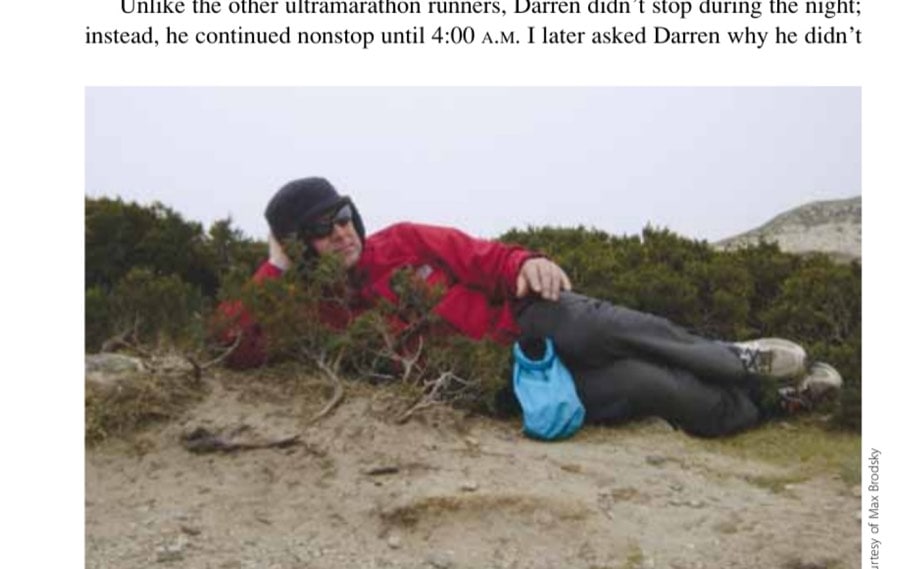
Unlike the other ultramarathon runners, Darren didn’t stop during the night; instead, he continued nonstop until 4:00 a.m. I later asked Darren why he didn’t
▲ Sigfried enjoying the shrubbery.
Courtesy of Max Brodsky
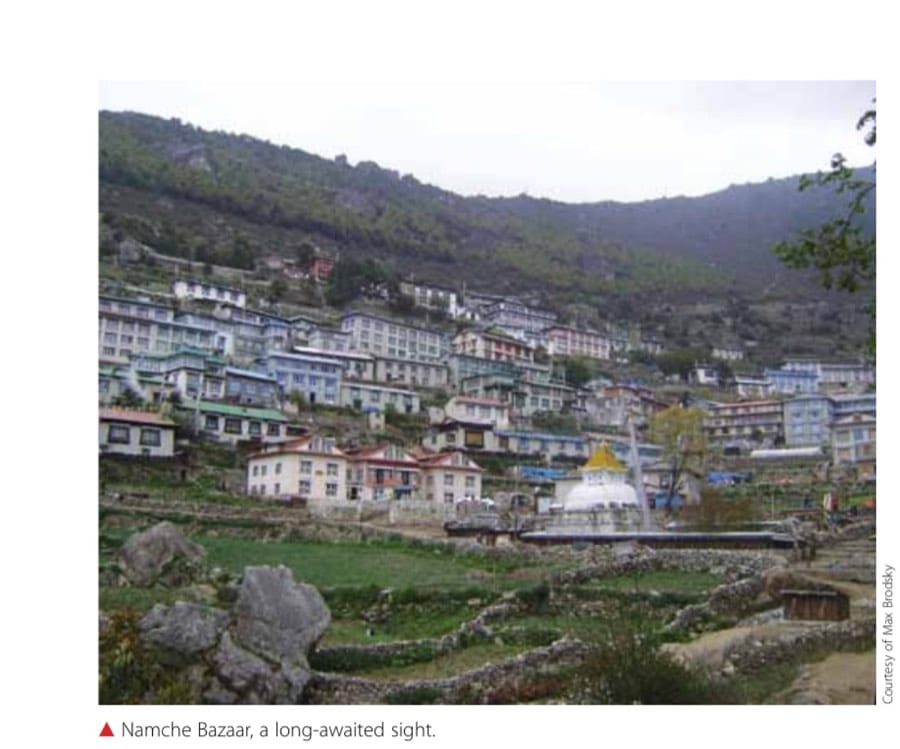
▲ Namche Bazaar, a long-awaited sight.
stop and rest. With an Australian smile he responded, “Why not? I don’t know, just something to do.” When Sigfried reached Namche Bazaar, he had just enough time to change and then rushed off with everyone.
Sadly, Bob finished while everyone was out. After spending the night in the lodge, Mike continued on and ran a halfmarathon to Namche Bazaar. Triumphantly, he walked back into the lodge to a chorus of cheers and questions about whether it was still “a walk in the park.” Mike turned to Susan and asked if she would renew their vows. Shocked by his sudden romantic gesture, she of course said, “Yes.”
Sitting in Namche’s Buddhist community center, we listened to the monk chant for peace and joy. Mike and Susan were undergoing a costume change for the ceremony. Mike dressed in a dark robe with a large pelt hat while his blushing (re)bride-to-be wore a matching hat and a lighter robe. Chants and sweet rice filled the room, a runner’s high unlike any ever felt before, sitting with a monk in the fabled mountains many people only dream about. Now, sitting back and reflecting, I still have pleasant dreams of running in the Everest Marathon.
This article originally appeared in Marathon & Beyond, Vol. 18, No. 4 (2014).
← Browse the full M&B ArchiveMore like this
1,000+ stories from 19 years of Marathon & Beyond
The complete archive of the legendary long-distance journal — digitized and free to read.
