

Aristotle, Friendship, And The Successful Life
One of the best things about the 2004 Athens Olympics for me wasn’t just the edge-of-the-seat excitement of both marathons and the spectacular performances of Deena Kastor and Meb Keflezighi. It also provided all of us ancient history and philosophy junkies the chance to hear almost daily the great stories of ancient Greece. Those of us who are distance runners were finally able to relate with renewed attention to the fable of Pheidippides’s legendary trek from Marathon to Athens, and it was thrilling to see many great marathoners 2,500 years later make the same trek and receive the glory of the race well run on a much larger stage.
Even though the 2004 Olympic participants are putting away their training logs, organizing their scrapbooks, and, for some, planning for Beijing 2008, the spark created by Athens, the legendary marathons, and the focus on ancient Greece has compelled me to look back at my own scrapbook and my bookshelves to revisit some of my old, ancient Greek friends. Even though lots of attention has been on Pheidippides and the ancient Olympians, I have reacquainted myself with my old philosopher friend Aristotle, who had a lot to say about so many things that his work continues to be the bane of many undergrads who are forced to study and write about him and the joy of generations of literature, classics, and philosophy majors who still think his work is relevant for us today. As I’ve looked at him again, I can see more and more ways in which Aristotle can be relevant to those of us who are not only ethics buffs but runners, too.
As an undergrad at a Catholic women’s college in the late 1970s and as the current bookstore director of the same college, I have always loved the Greeks in general and Aristotle in particular. In classic Catholic liberal arts fashion, not only did we read Aristotle in literature and philosophy, but we received a liberal dose of him in our theology courses because so much Christian moral theology is based on the ethics of Aristotle. My Nicomachean Ethics (NE) was well highlighted at my graduation from St. Catherine (aka St. Kate’s) and always remained on my
bookshelf. In the last 25 years, I’ve picked up the NE periodically whenever I’ve needed a dose of well-reasoned writing in my life.
THE TWO CONSTANTS IN LIFE Twenty-five years later, I’ve done many things. Marriage, two children, travel, and a long and rewarding career in both the trade and college bookstore industry have enriched my life tremendously. Two things, however, have been constant: my love of reading good literature and running. Shortly after I finished college in 1980, I started to run and have been running ever since. I’ve never been any good at it, but I’ve loved the peace of predawn training runs for the 5K to the marathon, the joy of running toward a finish line, and the blessing of health to be able to continue putting one foot in front of the other going down the road or track. I’ve collected hundreds of T-shirts and 17 marathon finisher’s medals through the years, and I’ve cherished each run and every race. When I’m not working and running, I’m reading, and lately, I’ve been reading more and more of my old friend Aristotle.
This past summer, I’ve been able to delve more deeply into both. After much encouragement from some of the theology professors whom I’ve come to know by their visits to the bookstore, I decided to enroll in a graduate program in theology at St. Kate’s. After being away from school for so many years, I thought that I needed to brush up, and I spent the summer rereading the A boys: Aristotle, Augustine, and Aquinas, as I plan to concentrate my study on virtue ethics. These three prominent classical writers are at the forefront of all study of Christian morality.
By now you are probably wondering where I’m going with this. What does Aristotle, a guy who wrote about 2,300 years ago, have to do with running long distances and why should we care? Well, as I studied the NE and reflected on his work during my training runs for marathons during the summer and fall of 2004 and winter of 2005 (Grandma’s, Twin Cities, Marine Corps, and Med-City), I discovered some things about both of my loves, running and Aristotle, that have related to each other poignantly and beautifully. Maybe you, too, can find how the other things that you love in your life connect to that other love of your life, running. And as we runners know, running can be connected to just about anything else that we experience in life.
Aristotle talks a lot in his work on ethics about how all humans work toward the higher good, which in Greek is called eudaimonia, which is a “sort of living well and doing well in action” (1098b21-23). In order to have eudaimonia, which has also been translated to mean “happiness or success,” we need to do certain things as human beings. We need to do good things many times. Doing them often makes us do them well, and this leads to success. This is where Aristotle has a lot
to say to us as humans trying to live good, successful lives. As runners striving to find joy and success in our one-foot-in-front-of-the-other pursuits, getting out there and doing it makes us do it well.
IN THE PURSUIT OF EXCELLENCE As we look more deeply into how to obtain happiness or success, Aristotle provides us with a brilliant instruction manual, almost like a training log. For us to be good, we need to do well or participate in what Aristotle calls “virtuous” activities. He gives us the example in NE about a harpist: “We have found, then, that the human function is the soul’s activity that expresses or requires reason. Now the function of a harpist is to play the harp, so we say the function of an excellent harpist is to do it well. . . . Therefore, the human good turns out to be the soul’s activity that expresses virtue” (1098a10-20). Aristotle’s classical harpist sees that playing the harp is an activity with value, and the more time and energy the harpist devotes to practicing, even when at times it may be difficult, painful, or boring, the better a player she becomes. As runners, we train in extreme conditions while sometimes feeling that the run is too hard, too hot, too long, too physically painful, or too fast. Yet most of us somewhere deep inside not only want to be runners—that is our function—we want to be excellent runners. That is our excellent function, whatever excellence means for us. Excellence can be winning an Olympic medal with a record time or finishing a jog around the block without collapsing.
If we continue to dig into Aristotle and his connection to running, he tells us that there are two kinds of virtue: virtues of thought, such as wisdom, comprehension, and intelligence; and virtues of character, such as generosity, temperance, prudence, and courage. “Virtue of thought arises and grows mostly from teaching, and hence needs experience and time. Virtue of character results from ethos, or habit” (1103a10-20). Many of us can certainly look to our running selves in illustrating what Aristotle means by these distinctions. Some of us have more talents in the sciences, so we naturally work hard to become engineers and physicians; some of us are more talented in the arts and become dancers, painters, and actors—also through talent and hard work. Likewise, some of us, more naturally than others, are more gifted with fast-twitch muscles and better running genes and get better and proper coaching. And some of us are able to put these together intelligently along with making proper training choices, with running wisely for the conditions, and with strategically going with a smart plan during the run or race. Most times the run or race is excellent. Many of us can recite our own favorite legends of our sport who exemplify the highest Aristotelian virtue of intelligence when it comes to running: Rodgers, Beardsley, Samuelson, Shorter, Salazar, Waitz, Ndereba, Radcliffe, and joining the club, Kastor and Keflezighi. Not only their astounding talent but the intelligence and care they have taken in using their talent put them at the top of my list.
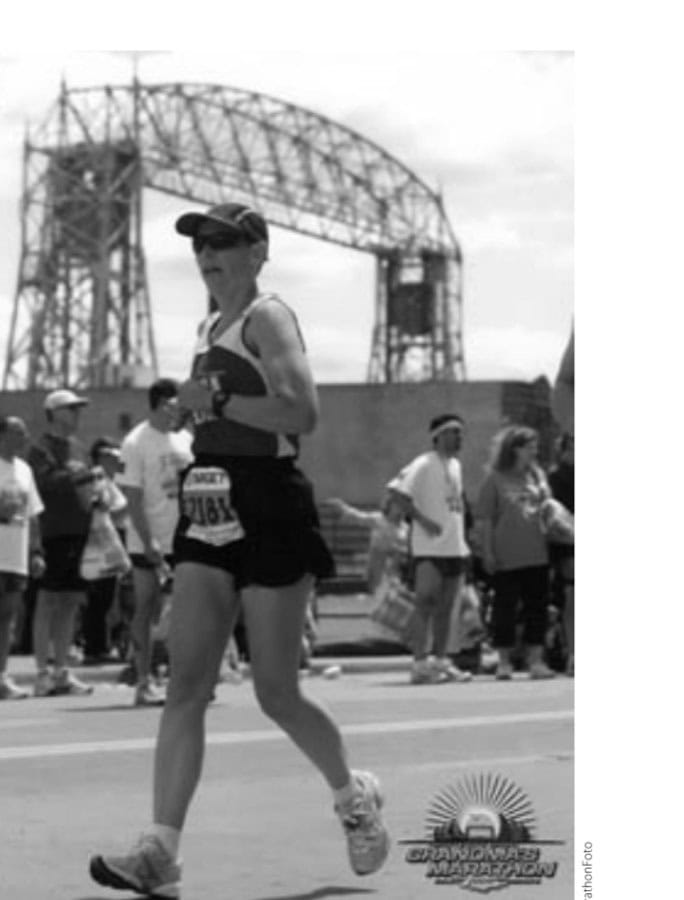
However, it is the Aristotelian virtue of character, along with intelligence, that we all look toward in being a success in running and in life. In my many years of running, I’ve strived to be the best runner I can be. (That’s something, as I’m a five-hour marathoner. If you saw me on the street shuffling along, you would probably wonder about my own personal meaning of success.) Sports weren’t available to me as an uncoordinated, shy teenager growing up in the 1970s. My worst grade in school was a D+ in gym class, where I spent most of my time chasing balls I couldn’t see.
When I started college, St. Kate’s had this wonderful program called intramurals. I always liked to swim, Nordic ski, and ice skate, and I loved participating in these fun, stress-free sports. In fact, as a women’s college, we had a flag football league. With my new confidence in physical abilities, I joined readily and had a great time. My younger sisters attended St. Kate’s and played football, too. In fact, my dad proudly told all his friends that each of his three daughters played four years of college football.
After college, few of us go on to professional sports. The NFL certainly wasn’t knocking at my door. Like the Aristotelian virtues of wisdom, where we know we need to keep moving to stay healthy, we have to find something else within us to keep us fit and happy. Likewise, this is where our stories of courage, prudence,
MarathonFoto
▲
Running can be connected to just about anything else that we experience in life—even the teachings of Aristotle.
temperance, and keeping at it—what I take to mean the Aristotelian habit—are all unique yet similar to each other in striving for excellence.
THE LAST SHALL BE . . . LAST As a beginner, I was just as good a runner as I was a football player—pretty awful. In fact, in my early days, acquaintances used to stop and offer me a ride home while I was on a training run because I must have looked so horrible out there, shuffling along, sweat streaming down my face. When I finally had the courage to enter a 10K race with my sister, also a beginning runner but much more gifted, we almost dropped out when the last guy, who was way behind, passed us at mile three strongly and beautifully, and we couldn’t catch him. He had a motor control condition and was about 60 years older than we. Don’t believe anyone who says that somebody who has never run more than 10 feet, smokes four packs of cigarettes a day, is dressed in a hippopotamus costume, or is 110 years old will finish behind you so you won’t be last. I’ve trained hard and still have finished dead last in a few races.
This, for me, is where Aristotle’s character virtue of prudence comes in strong. Even though I was so bad at running, something in me wanted to not throw in the sweat-soaked towel. I kept at it, thinking that continued work would make me better. Twenty-five years later, I’m still slow, still look like a duck when I run, and still have never won an age-group award, even in races with eight participants and awards three deep. I still find success in running and thank God each day that I can lace up my shoes and head out the door, not that I’m personally the poster child of character virtue. Since I love to run, the habit is easy for me to keep up because I simply could not imagine my life without my daily run.
If we go back to Aristotle, one area that I refocused on this fall with the help of my Christian ethics class was Aristotle’s view of eudiamonia and how friendship helps the human being become a successful person. One of our texts for the class, written by a moral theologian at the University of Iowa, gave me the idea to write about the Olympics, Aristotle, and running. Dr. Diana Cates’s book Choosing to Feel is a fine training manual on how those like Aristotle and Aquinas can help us learn how to live good, successful human lives. Besides her part on Aquinas, which is a subject for another article (probably not in a running publication, but maybe), I especially liked what she has to say about Aristotle’s view of friendship, another area of Aristotle’s ethics that is relevant for those who love to run.
Simply, Aristotle thinks that we can become the best that we can be by hanging out with others who are already good. Cates explains it pretty well: “Aristotle defines friendship as a relationship between separate beings (116b28) consisting in affection and well-wishing (1155b20) where this affection and well-wishing are reciprocal” (1155a33).
“. . . friendship is a relationship of mutually known and reciprocated affection and well-wishing in which each person wishes and does good to the other for the other’s own sake” (Cates, 50).
THE BEST KIND OF FRIENDSHIPS Aristotle differentiates between the kinds of friendships that humans can have. Cates helps us by describing Aristotle’s distinctions. What she calls advantage friendships and pleasure friendships mostly give benefit and pleasure to an individual; therefore they are incomplete. This is when we hang out with the gang from work or the neighborhood and share a drink and laughter after a long day. We have fun being with these friends, but spending time with them, while enjoyable, doesn’t really enrich our lives or make us better ourselves. Although we don’t wish harm to our drinking buddies, our relationship with them doesn’t contribute to our own human flourishing. Rather, the best kinds of friendship and the ones that Aristotle deems the most important are character friendships. These are more virtuous because the friendships not only benefit and give pleasure, but they make the friends better people because the foundation of the friendship is built on wishing each other well (Cates, 51).
If we apply this to our running lives, we can see for ourselves countless examples of where training with, competing with, eating with, suffering with, and just being with other runners enhance our lives and help us to flourish. And we want our training partners and running friends to flourish in running and in life, too. Most of us can say that our running friendships are not only very rewarding for us but that knowing and being with other runners many times not only makes us better runners but makes us better people too. Our running friends many times are character friends.
If we have been running long enough, we know of many examples of running/ character friendships in our own running careers. I bet most of us could honestly say that doing a hot, hilly 20 with our training buddies, racing to the finish with our closest competition, helping a person we just met get through a rough patch during the last painful miles of a marathon, or mourning with a friend who has fallen short of a hard-fought goal has not only made us better runners ourselves but has also helped us in our journey to being good people. In my own running career, sometimes I’ve had difficulty finding training partners because I like to run long, but run slowly. Most I know who run long are too fast for me, so more times than not, I’ve found myself alone on my training runs. My husband, Chris, who also runs long most of the year, trains faster, so we don’t run together often during training. Most of the time, I enjoy running by myself. I cherish the time to mull over difficulties and to solve problems. If I have a problem at work or at home that is bugging me, my long run usually
provides time to consider the options and decide which direction to take. Every run, I pray. I pray for health for those who are sick, companionship and love for those who are lonely, and hope for those who are discouraged. As many poets, philosophers, and theologians have said, nature provides the most perfect church, and I’ve discovered that my best times with God are during runs in one of the many great parks, trails, and paths in the Twin Cities.
Mostly I’ve enjoyed solitary running. However, during the last year, my beloved father was diagnosed with advanced cancer and died within a few months of his diagnosis. For the first time, I craved companionship, as I felt so lonely. A month or so after my father’s death, I was running long and a miracle happened (or prayers were answered). I stopped at the local gas station to refill a water bottle, and I ran into a woman whom I had seen at the 2004 Las Vegas Marathon. We laughed about struggling through the gale-force winds in Vegas and decided then and there to finish the last five miles of our training run together. They were the fastest, most fun miles I had run in a long time. Aristotle dropped a characterfriend right down next to me, as Stacey is one of the best things that happened to me during a difficult year.
MY VERY OWN CHARACTER-FRIEND Stacey Millett is a few years older and a few minutes a mile faster than I, but she slows down enough for our weekly Saturday long runs. I’ve never enjoyed 20-milers more than those I run with Stacey. Also, we can all relate to times when life seems dark and lonely and a blessing comes right into our lives just when we need it. Stacey has been such a blessing to me. Not only is she an early-morning runner, like me, but she is just about the most positive, joyous person I’ve ever met. The woman is never down
Chris Balamut
▲
The kind of friendships that Aristotle deems the most important are character-friendships like Julie has with Stacey Millett, shown here before the 2005 Twin Cities Marathon.
or depressed about anything! This is even more remarkable considering the fact that she works for a poverty-fighting foundation here in St. Paul and sees firsthand, every day, what it is like to be poor and oppressed in the United States. When we begin our training runs, she immediately tells me about all the good things that have happened to her during the week and how wonderful life is to her. We all should have a Stacey in our lives because by the end of the training run with her, I hardly feel I’ve worked because I’m usually laughing over some funny thing that one of Stacey’s two children has done or I’m thoughtfully considering advice Stacey has given me about a particular problem I’m stuck on. Stacey recently decided to take a refresher math course, even though she has two master’s degrees already, because she always has felt uncomfortable with her math skills. Her determination to put to rest a personal demon has given me the courage to take on a difficult New Testament text course even though I’m terrified of biblical interpretation. We’ve entered some races together, and even though she races and finishes well before me, I love having her pass me whenever we run a loop course because she yells and encourages me.
We both entered Twin Cities 2004, and it was great wondering how she was doing during the race. It took my mind off the nausea that hit me at mile 15. Neither of us did as well as we wanted, but as Stacey has also completed 16 marathons, she understood how disappointing a bad marathon is and also helped me understand that the reason we keep doing them is that when you think you finally have it figured out, the next race can sometimes chew you up and spit you right back out into the street. As Stacey has said, “If you ran the perfect race your first time, you never would have to do another, and what would be the fun of just doing one? And besides, how else can you meet so many wonderful friends if you ran only one? And of course, your one T-shirt would wear out.”
Since I’ve started training with Stacey, I’ve run a PR in every distance except the 5K, and after taking Stacey’s advice, I’ve been able to solve some work problems that have been haunting me. I look forward to 5:30 A.M. on Saturday because I know that it will probably provide my earliest and best laugh of the day. Getting to know Stacey—and sharing our lives as women, mothers, daughters, and runners—has made me not only a better runner but also, I suspect, a better person. As Diana Cates says about Aristotle, “
We choose to spend time with people who are good in themselves, because it is naturally the good, or the apparent good, that humans find lovable (1155b18-27). We also choose to spend time with people who are good for us, people who are likely, particularly in sharing with us a conception of eudiamonia, deliberations, choices, pleasures, and pains, to encourage and participate in our own flourishing” (Cates, 75). By running with Stacey, I have flourished, because I want to be better at the good things I do, and Stacey is always there to encourage me to do and be my best.
AND THEN THERE’S MY PARTNER
Sally Rubenstein
I’m also lucky that I have a runner husband. Chris has helped me flourish not only as a person, but as a runner, too. After I did my first marathon, Grandma’s in 1999, and Chris decided that it looked intriguing and did one himself the next year, running as a shared activity in our lives has enhanced our partnership immeasurably. Even though we seldom run together because he is faster, the one time that we did, at Grandma’s 2004, will remain a highlight not only of my running life but of my whole life. Chris decided that he would slow down, run with me the whole race, and see if we could cross the finish line together in under five hours. And we did: my best by about 10 minutes. Chris gave up his marathon to run with me. As Cates says, “To love an adult character-friend as ‘another oneself’ is to wish for, do, and delight in the good of someone with whom one chooses to share a life” (Cates, 74). Chris is the love of my life, and I’m now a better person for having him as my partner for so many years. He is always behind me, encouraging me in everything I do, from beginning graduate school at the age of 46 to daring to dream about a sub-5:00 marathon. Chris and I have enjoyed our running lives together. We have traveled to places we never thought we would go and met and befriended people we never would have had the opportunity to meet except through running. Those of us who have partners who run with us or share our running challenges and joys are lucky indeed.
Our closest competitors can be our character friends, too. Since I compete only with myself, I don’t have another that I test myself with through competition.
▲ Julie and Chris celebrate after the 2004 Grandma’s Marathon.
However, I’m reminded of a story I learned from the U.S. Olympic Marathon Trials in 1972. Jeff Galloway, a runner I’ve always admired because of the tireless work he does on behalf of all who want to run a marathon with his run-walk program, found himself in third place and a sure spot on the U.S. team. He learned that his friend and training partner, Jack Bachelor, was a short distance behind him. As Jeff already had qualified for the Olympics in the 10,000, he slowed so his friend could make the Olympic team. When I recently contacted Jeff about this incident, he told me he got more satisfaction from helping his friend Jack than from any of his competitive accomplishments. This incident perfectly illustrates what Aristotle talks about when he describes character friendship, because Jeff Galloway put aside his own desires in order to contribute to the flourishing of his good friend, and they both benefited by Jeff’s selfless act.
Like my encounter with my friend Stacey that is a blessing in my life, the run at the Marathon Trials for the 1972 Games brought out the best in two runners. I suspect this remains a blessing to each of them, and their continued support of each other in the ensuing years has probably enriched each of them in more ways than they can measure. If we train well with good friends, compete with those who push us to our limits (whom we then consider friends), enjoy the company of running friends, and wish well for and help each other in our pursuits, as Aristotle tells us, we have been blessed with character friendships that enrich our own lives.
ad
Each of us has countless stories of the times we’ve shared victory and defeat on the road and when one of the gang becomes a dear friend.
THE FRIENDSHIP OF MANY This past year, my husband was not the only one who shared my greatest running joy, a long-awaited PR for the marathon. What also made this sweet for me was that other running friends were at the finish line jumping up and down, cheering, and hugging us. Dave, Kris, Joe, and Kiki, marathoners themselves, knew how hard I had worked in the past five years to break five hours, and they experienced our joy at a race well run. Dave Coyne, especially, has always encouraged me to keep trying, knowing that when it finally happened, the sub-5:00 would be sweet indeed. It was a joy made greater by the sharing with close friends. A few months later, when I struggled through nausea at Twin Cities, Dave was on the road at mile 24, encouraging me to just forge ahead because it was almost over. He was compassionate when he saw my distress and said just the right thing. Other friends were at that finish line, cheering just as loudly for me, knowing how difficult it is to sometimes fall short of a goal or not have the race you had planned. And Chris’s first words to me, after he himself had run a PR just an hour before, were, “All that matters, Julie, is that you finished this one!”

Knowing and running with Stacey, Chris, Dave, and the rest of my friends encourages me to be the best I can be in all aspects of my life. For them, I’m grateful. In the 1972 Olympic Trials, two fine runners had great races because each pushed the other to places neither probably could have gone on his own. Their story inspires us to turn to our friends to find our own excellence in our running and in our lives. Because of the Athens Olympics, I was able to reflect on my love of running and the constant striving to achieve success in my own life that mirrors what my ancient Greek friend Aristotle so eloquently talks about. In our own running friendships, whether they be with a new friend just met in the final miles of a marathon, a beloved partner who shares our love for running and knows exactly how we feel, or a competitor who takes us places that we never thought possible, our close friendships with other runners help us flourish and go wonderful places on the road of life that we never imagined.
REFERENCES Aristotle. 1985. Nicomachean Ethics. Trans. Terence Irwin. Indianapolis, IN: Hackett Publishing Company. 1-53, 207-266. Cates, Diana Fritz. 1997. Choosing to Feel: Virtue, Friendship, and Compassion for Friends. Notre Dame, IN: University of Notre Dame Press. 5-15, 49-90. Thanks also to William McDonough, S.T.L., Ph.D., S.T.D.; David Coyne, M.A., J. D.; and Carol Tauer, Ph.D.
This article originally appeared in Marathon & Beyond, Vol. 11, No. 2 (2007).
← Browse the full M&B ArchiveMore like this
1,000+ stories from 19 years of Marathon & Beyond
The complete archive of the legendary long-distance journal — digitized and free to read.
