

Arun Through Boston
Aperennially popular event during Boston Marathon week is the Runner’s World “breakfast of champions,” where the attendees get to see and listen to former winners of the most prestigious marathon in the world.
At the 2014 breakfast, past winners gave us encouragement, suggestions to improve our race, and pragmatic advice. Sara Mae Berman, the unofficial women’s winner in 1969, 1970, and 1971— unofficial because women were not allowed to officially participate during that era—declared “finish because you can.” Jacqueline Hansen, the official women’s winner in 1973, encouraged us all to “finish because we deserved it.” Geoff Smith, winner in 1984 and 1985, gave practical advice: “Trim your toenails.” Amby Burfoot, 1968 winner, recommended we “savor the moments, don’t get caught up with your time, and focus on just finishing.” Greg Meyer, 1983 winner, urged us to “make friends along the course.”
The night before the race, I trimmed my toenails to avoid the infamous black toe. Geoff has had personal experience with this painful condition in which your toenails fall off during the race. I also took out Jacqueline’s inspiring book, A Long Time Coming, and read uplifting excerpts and quotes: “To understand the heart and mind of a person, look not at what he has already achieved but at what he aspires to do.”—Kahlil Gibran.
I made my first friends on the bus ride over. As I was high-fiving my way down the narrow aisle in my purple-and-pink pajamas, one perky runner cackled, “Those are the best warm-ups I’ve ever seen!” Suddenly, I was in a friendly contest with a lady who had alternating blue-and-yellow nail polish on her fingernails and the words “Boston Strong” written across her fingers. I yelled out, “It’s no contest, she wins, hands down!” The roar of laughter discharged the nervous energy and people settled into relaxed conversations with their seatmates for the duration of the 40-minute ride to the start area in picturesque, suburban Hopkinton.
Runners from Hawaii have a very special and unique benefit located just a few steps from the marathon’s start. For the past several years, Pete Thalmann
© Rich Garcia
▲
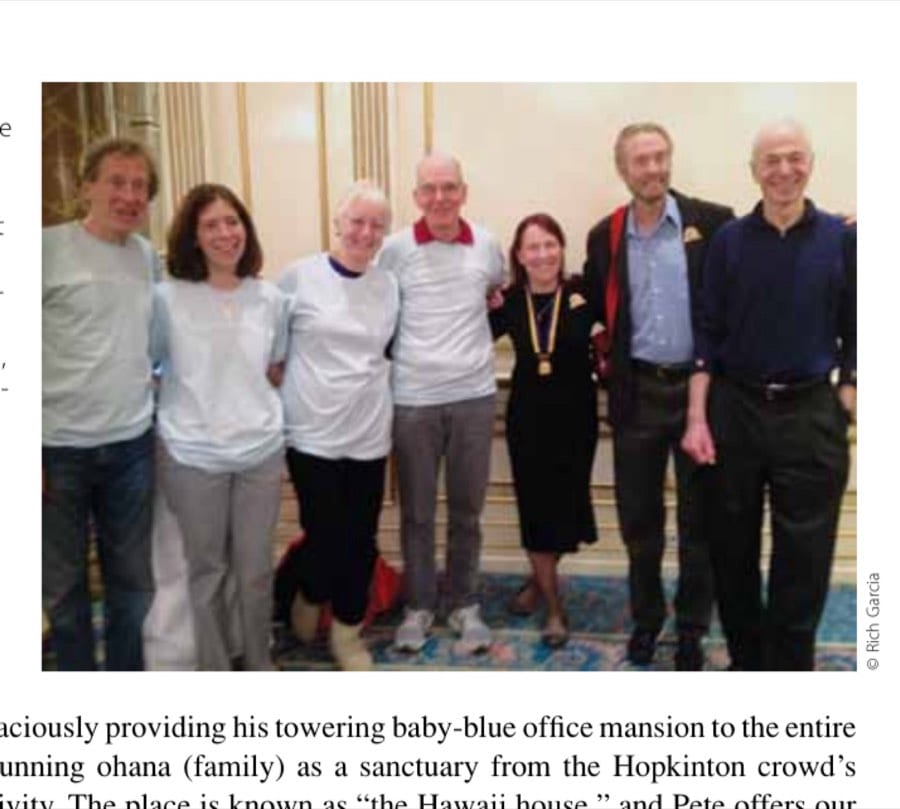
Heartfelt reunion at the Breakfast of Champions, including, left to right: Bill Rodgers, Cristina Negron, Margie Smith, Kit Smith, Jacqueline Hansen, Amby Burfoot, and George Hirsch.
has been graciously providing his towering baby-blue office mansion to the entire Hawaiian running ohana (family) as a sanctuary from the Hopkinton crowd’s frenetic activity. The place is known as “the Hawaii house,” and Pete offers our group warm, clean bathrooms with no waiting lines and, most important, “aloha” to fuel us through the race.
This year I didn’t get to hang out with most of my Hawaii friends because I was in the last wave of runners, but I was able to give hugs to my friends Vicki, Michele, and Kit as they made their way to the start line. As a token of my deep appreciation for his years of hospitality, I gave Pete the handmade scarf I received the day before from the International Scarf Project. The scarves are individually knitted by people around the world in tribute to the marathon and are much coveted by all. Of course, they are blue and yellow, the colors of the Boston Marathon.
New friends along the way During the first few miles, I made friends with Billy from Canada. He was notified just three weeks ago that he could enter and run the race. His qualifications? Billy is a stage-4 throat-cancer patient. Between breaths, he told me that five years ago he weighed 200 pounds more than he does today and that running saved his life. When doctors estimated that he had only a few weeks to live, he changed everything about his lifestyle. He replaced his former addictions with healthy activities, and when he was able to, he started to run. He has certainly given cancer a run, having beaten the odds at every turn for five years. He wasn’t sure he could physically finish the race, but he said he was going to give it everything he had. I told him: “I have no doubts. You will finish!”
By mile six I made friends with Jo from Boston. Her third of four sons, Timmy, succumbed to leukemia when he was 8 years old. We held hands and cried together. I told her about my mentor, Team In Training buddy, and fellow Oahuan,
Kit Smith. Thirty-three years ago, Kit and his wife, Margie lost their middle daughter, Patty, to leukemia. She was only 19. Kit was the reason I started running for the Leukemia & Lymphoma Society, and he’s the person who encouraged
me to run Boston. Kit has run more than 50 marathons and he was somewhere miles ahead of me, most certainly on pace and smiling at the unending ribbon of cheering faces. And by the way, Kit is 80 years old. Jo is deeply thankful that
TNT is helping in the fight against leukemia. As we said good-bye, she emotionally implored, “Hold your boys close.” The faces, sounds, smells, and activities of my two children, Diego and Santi, coalesced into a vision-feeling, and I felt
empowered by their presence in my life. As you may know, the Boston Marathon is run on Patriots’ Day. Having participated in many road races around the world, I remain astounded at the number of people, friends, and families lining the length of the course, every inch of
the 26.2 miles. They were cheering, playing, grilling, smiling, and taking in the day—the event—as a confirmation of the city’s determination and dedication to one another. This day demonstrated our natural endeavor to help make life better for others,
whether they were friends, families, causes, or charities. Runners and spectators stood as one, together, to show the world that we have a lasting bond that can never be broken. We call that bond “community.”
My next friend, John from DC, was running his seventh marathon, and he was halfway through his quest to finish the six World Majors. He has completed Chicago and New York City and was now on mile 10 of Boston. “Time to go
international,” he grinned and then recited his itinerary to run London, Berlin, and then Tokyo. His wife dreamed of traveling the world via the majors, but when breast cancer interrupted her plan, John promised to complete her dream for her.
© Rich Garcia
▲
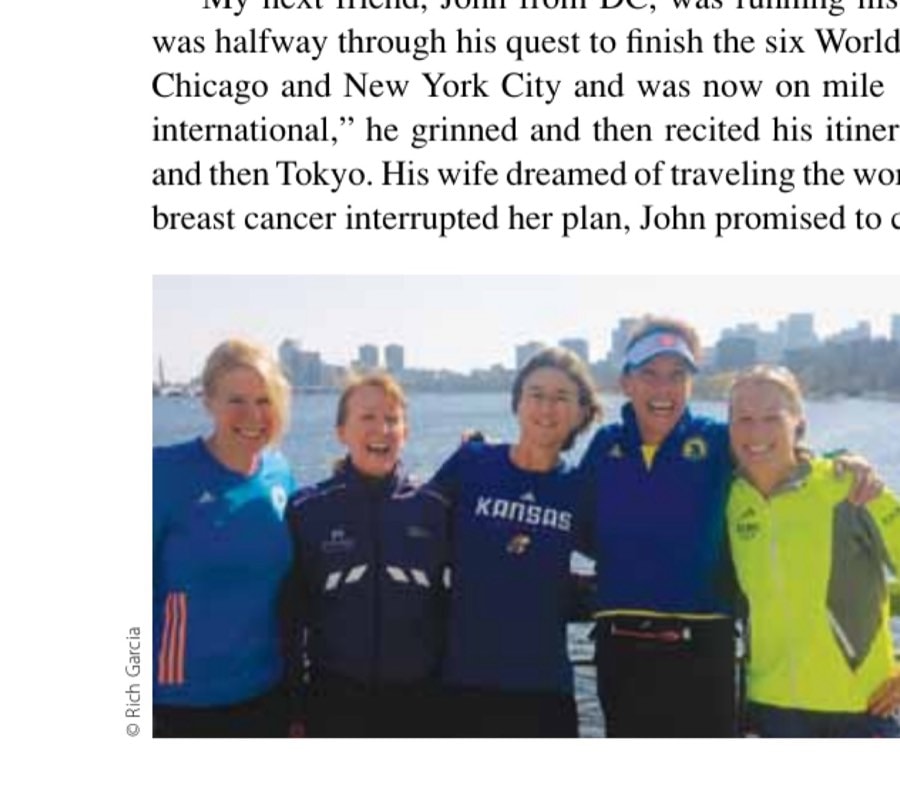
Left to right: Karen Peesker, Joy Gayter, Vicki Vossler, the author, and Michele Tritt enjoying Boston Marathon weekend.
No upper end to the decibels You could hear the yells, howls, and shrieks more than a mile away. I knew what was coming up: Wellesley, the two-mile scream tunnel. At this location last year, I literally ran into my friend Chris, who had paused to hug his daughter, a senior at Wellesley, and take some family photos to capture the precious occasion. This year, I too paused, and continued the long tradition of acting upon the girls’ “kiss me” signs: Kiss me . . . I’m from Kansas City . . . I’m from Minnesota . . . I’m from Korea. Kiss me . . . because I’m getting married . . . I’m a vegan . . . I’m in the math department. Kiss me . . . I’m Irish . . . I’m waiting for you . . . I’m available . . . I’m 21. Kiss me . . . because I want to make her jealous . . . I want the record for the most kisses . . . I want you to finish . . . I want to be a princess. Kiss me . . . I won’t tell your wife . . . I majored in kissing . . . I want to get kissed by sweaty strangers. A hundred-thousand kisses concentrated in space-time.
My legs felt the miles, but my cheeks were on fire! The constant puckering and smiling and laughing provided an incredible maxillofacial workout. I highly recommend it! I recovered with first-time marathoner Pat, a bleached-blond 60-something Southie (a resident of South Boston), running like a rhinoceros, with purpose and power. When I asked her why she was running, her accent, forged from the proud heritage of South Boston, gave her free-flowing expletives an undeniable gravity: “Because I’m wicked strong and no one f—s with me. No one’s going to f— with us, with Bwaston. Who the f— they think theyuh messin’ with?” She raised three boys and three girls. They, along with her 17 grandchildren, came out to cheer her on. “What’s the key to raising kids?” I asked. “Luv ’em, teach ’em to give more than they get, and let ’em f— up, but be there when they fall, no mattuh f—in what!”
There’s a particular sound the Boston Marathon crowd makes when the beloved duo known as Team Hoyt runs by. I know this because I experienced the sensation last year while running Heartbreak Hill. This year I heard that special sound at the beginning of the Newton Hills. Team Hoyt is more than just 73-yearold Dick supplying the forward momentum for the custom-racing wheelchair occupied by his 52-year-old son, Rick, who was born with celebral palsy. Team Hoyt is courage, pain, tenderness, sweat, devotion, achievement, collaboration, community, awareness, and inspiration. Team Hoyt is the manifestation of love. Together, they’ve finished more than 70 marathons and 1,000 endurance events, and created their own category in sports. Running next to Team Hoyt, enveloped by the positive vibrations from the adoring crowd, is an unequalled experience in my life.
Cresting Heartbreak Hill, I hear my name shouted at the top of someone’s lungs. Then I see my name in bold capital letters on a sign in the crowd. I look closer and I see Buzz! Buzz is one of my best friends; we’ve known each other
© Victah/www.PhotoRun.net
▲
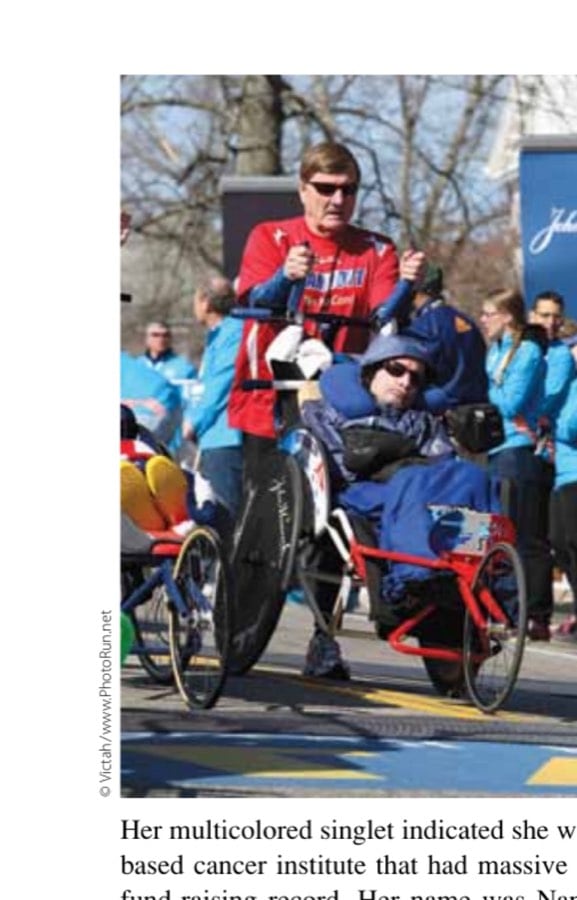
Team Hoyt continues to inspire.
for more than 25 years. She brought her entourage down from Vermont just to cheer me on. I ran toward her and we collided in a heartfelt embrace. Next I gave sweaty hugs to her sister and her wife, and several
other friends. We didn’t need words. After handing me some pretzel bites and a bottle of water, they ushered me back onto the course with an abundance of smiles and love. My emotional tank was totally refilled.
At mile-marker 20, I see a woman raise her hands as far as they could reach into the sky while she shouted, “Allison!” Her multicolored singlet indicated she was with Team Dana-Farber, the Bostonbased cancer institute that had massive numbers of runners and an impressive
fund-raising record. Her name was Nancy and she was from New York. She looked tired, as would anyone at this point in the course, but she also showed fierce determination. She told me it had been a particularly harsh winter for her.
In addition to the vortexes that disrupted training throughout the Northeast, she lost her running mate, her best friend, her sister, to cancer. They had planned on running Boston together. I joined Nancy as we all yelled out, “Allison!” at mile 21.
Good temps for spectators Temperatures soared into the 70s, adding another discomforting layer to the burn permeating the back of my arms, legs, and neck. Up ahead, I saw what looked like a small refreshment station, but I knew there was a good chance it was just a
mirage. As I got closer, I imagined there were mountains of cold, juicy, succulent oranges. Deciding to test my perception of reality, I lunged for the glistening slices and ran into a very real person, a Frenchman in fact. Of all the wedges spread
across the table, Henri and I reached for the same ones, bumped each other, and awoke from our mile-22 stupor. Looking into each other’s eyes, we laughed at the precision of our mutual nutrient needs. Grabbing a different set of oranges, we
stuck them in our mouths, sucked down the tangy liquid, and then grinned, revealing a smile of bright, dimpled peel. The crowd loved it. My French skills are so rusty that I didn’t understand a lot of what Henri was saying, but it didn’t matter. In broken French-Spanish I exclaimed, “Tu eres increíble!” (you are incredible!) and “Je suis pamplemousse!” (I am a gratefruit!) We laughed so hard my sides started to cramp. Henri gave me a double-cheek kiss and then continued to blow kisses at me as he ran ahead. Even now, as I reflect on that magical moment, it seems too good to be true. I wonder, did it really happen?
At Boston College, the topless boys/men chanted my name and pumped out beer from their trusty keg. I chugged it down. A few miles to go: left foot, right foot. As I do when I’m racing my boys at the go-kart track, I looked for the apex of every curve and hugged the line in order to run as efficiently and economically as possible. On a straightaway, I caught the fleeting flash of an almost-smile from a police officer. I had just enough time— and strength—to say, “Thank you,” and hold my hand up to give him a high-five as I had done with almost every police officer, military person, and firefighter I saw along the way. I witnessed many gestures of appreciation for the thousands of police, military, medical, and other personnel, all of them vigilant in their task of keeping us safe. To the multitude of enthusiastically screaming Bostonians on both sides of the course, we shouted, “We love you, Boston!” It was amazing to be part of this energy, this pride, this affirmation of life.
When I saw the Citgo sign, I knew I was close to the finish. This was also the place where I was swept up into the chaos and mayhem of last year’s race, but that’s a separate story. Around me, runners began to falter, sway, and kneel on the asphalt, “hitting the Wall,” with the emotional rigors of running for 25 miles. I know the feeling, and it hurts because your brain doesn’t quite know how to process the unfamiliar, unreasonable signals it’s receiving from your body. I helped a few runners to their feet, sharing their fatigue, offering hushed words of encouragement or emphatic phrases of motivation so that together we could launch into our own rally.
A group of five of us turned the corner onto Boylston Street. The finish line was in sight. We grabbed arms and let our remaining electrolytes seep from our eyes. I was surprised at being overcome; my breathing became labored, painful, and deliberate.
The last quarter mile, 1,320 feet to go, aching, but savoring every step, I blew kisses to the spectators who relentlessly cheered us on. Just in front of the finish line, I stopped, raised both arms, and shaped my hands into shakas, a symbolic Hawaiian gesture of the hand. Then I crossed the finish mat and thanked everyone I could think of in that moment—my remarkable husband, Rich, my parents, my family, and my friends, especially the ones who joined me on this journey last year and this year.
Following the advice of the champions I did exactly what the champions at the breakfast said I should do. I made my Boston Marathon the best experience possible, making friends and memories that I’ll never forget. I used to run to get the fastest time, but as Amby refreshingly
reminded me: been there, done that. My coach and best friend, Jacqueline Hansen, has been with me over many years and many hurdles, including my bid for the 1996 Olympic Trials Marathon where I ruptured my plantaris tendon around
mile six and came up short but able to finish in 3:09. In that race, I suffered more than I had in childbirth and felt almost as proud. Jacqueline always said I was in sub-2:50 shape for a good portion of my fastest years, but unfortunately, I didn’t
prove it in races often enough. At 52 years old, I now know that I can prove that every race is a great race, no matter your time. Jacqueline continues to remind me to just run what I can, where and when I can. I will always run for the survivors, the fighters, the taken. I deserve
to finish, as Jacqueline the champion said. We all deserve to finish. Epilogue: I run to refresh my body and soul. I run because it brings me to life. I run to be the best version of myself. I remember
those who can’t run and what they would give to have this gift. There is no such thing as a bad run because every day is a blessing, and I am proud of every run I do. And as it proclaims on the back of my TNT
singlet, I run for those who cannot run for themselves. © Rich Garcia
▲
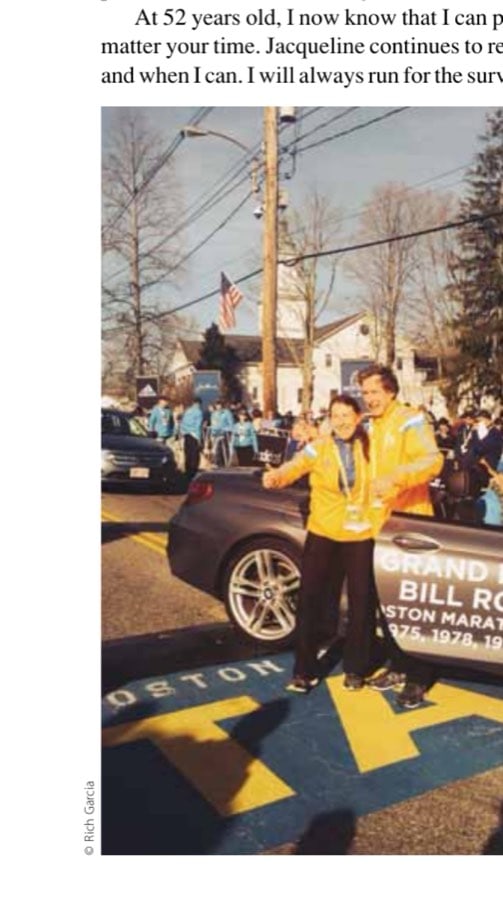
Boston champions Jacqueline Hansen and Bill Rodgers galvanize the start.
This article originally appeared in Marathon & Beyond, Vol. 18, No. 5 (2014).
← Browse the full M&B ArchiveMore like this
1,000+ stories from 19 years of Marathon & Beyond
The complete archive of the legendary long-distance journal — digitized and free to read.
