

Beating The Heat In Boston
Weather reports weren’t looking good. Forecasts called for the temperature to hit almost 90 degrees in Boston on Patriots’ Day 2012, just in time for the 116th running of the Boston Marathon. This was not a welcome forecast for the nearly 27,000 runners expected to race. It was particularly bad news for me. To say the least, I don’t run well when it’s hot.
In the 2005 Boston Marathon, when temperatures hit only 66 degrees, I struggled mightily. My slow time of 4:48 at that race put me in danger of missing my afternoon flight. As a result, I ran through the finish line eating no food and drinking no water so I could get to my hotel ASAP to pick up my luggage, catch a cab, and make my flight. When I arrived at the security line at Logan Airport, I suddenly felt faint. Next thing I knew, I was in a wheelchair, and a stranger was holding a Gatorade bottle to my lips. It was all somewhat disconcerting, especially since I’d never fainted before. On the positive side, I was whisked through the security line and caught my scheduled flight.
When I got back home and told my running friends about my experience in Boston’s heat, I was severely chastised. “How could you not hydrate?” they would ask. “You skipped taking in some food at the end? You’re such a numbskull.”
While my friends were obviously not very sympathetic with the demands of my flight schedule, their candor proved a point. So I chalked up my experience at Boston as a lesson to be filed away with all the other things I’ve learned on the myriad paths of multiple marathons.
That is what’s interesting about the sport of marathoning. While the aging process and the relentless breakdown of cells over time invariably means slowing down and finally giving up on besting PRs, age begets experience and experience begets wisdom. The wise runner knows that a marathon is more than just speed—it’s also about endurance and knowing how to adjust to different conditions, including heat.
Running the 2012 Boston Marathon in 80- to 90-degree temperatures suggests all kinds of strategies. One strategy, of course, would have been to take the Boston Athletic Association’s kind, thoughtful, and unprecedented offer of a come-back-next-year deferral to runners who picked up their bibs but chose not to run. In making this offer, race organizers expected up to 2,000 deferrals. The actual number was far less. After all, this is Boston. Most of the runners here likely see the heat as an interesting test of their endurance skills.
In fact, the high temperatures turned out to be a sort of test for me as well. It was a test that pitted one theory of running against another. Those contrasting theories were debated over a magnifico carboloading dinner I had with a running friend at Mama Maria’s in the North End of Boston, where we split orders of rabbit pasta and wild mushroom pasta . . . mm.
My dinner companion had qualified for Boston with a PR of just over three hours. In spite of the forecasted heat, he was hoping to break his three-hour mark and set a PR. Although I thought to myself, This guy’s bonkers, I more diplomatically reminded him that the heat should force him to plan a slower marathon—not a faster one. When I outlined my race plan, he gave me the sort of smirk that Steve McQueen often used in The Great Escape—a smirk that registers loud and clear, “You run your race, and I’ll run mine.”
Going to the book for plans So what was my plan? I qualified for Boston at the California International Marathon in Sacramento in December 2010 with a time of 3:58:41, a pace of 9:07. After my fainting experience at the 2005 Boston Marathon, I had done some research on proper pacing when running in the heat. In his book Training Plans, Jeff Galloway recommends running 30 seconds per mile slower for each 5 degrees of temperature increase above 60 degrees.
Weather reports indicated a range of 83 to 88 degrees on race day in Boston. Assuming an average of 85 degrees (25 degrees greater than 60 degrees), that suggests slowing down 2 1/2 minutes (five times 30 seconds = 150 seconds) per mile. For me, it meant slowing from my qualifying pace of about 9:00 to 11:30, which would increase my finish time from about four to five hours. That is a big comedown, at least in terms of speed. But if endurance was my principal goal, slowing my pace was the only plan that would allow me to adapt to the likely conditions on race day.
There was one other strategy I used. It came from a tip I got at the race expo. While waiting in line to buy some Boston memorabilia, I sidled up to a fellow wizened sexagenarian runner and started talking about various tricks to beat the heat.
This man of experience told me something he learned not on the racecourse but in the jungles of Vietnam. The trick he used was to wrap a cold, wet towel
Courtesy of James L. Doti
▲
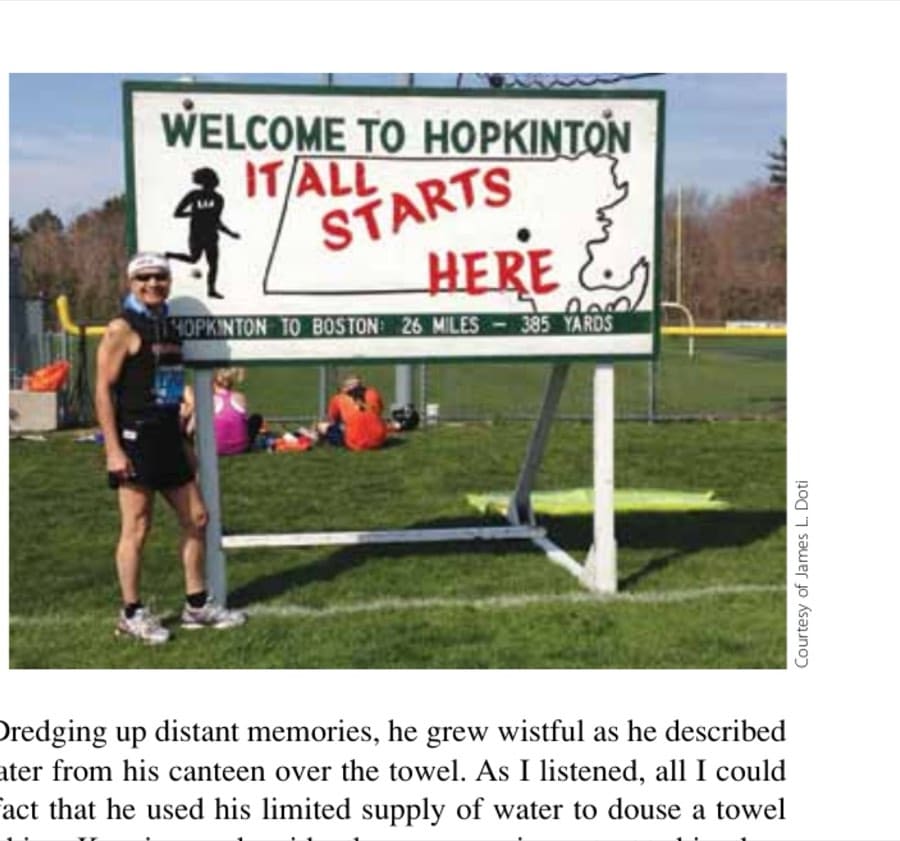
A picture at this sign is a rite of passage for all Boston Marathon runners.
around his neck. Dredging up distant memories, he grew wistful as he described how he poured water from his canteen over the towel. As I listened, all I could think of was the fact that he used his limited supply of water to douse a towel rather than for drinking. Keeping cool, evidently, was more important to him than quenching his thirst.
That clinched it for me. I bought a blue terry-cloth towel and cut it down to a manageable size. On race day, as we lined up in the corrals, I felt somewhat strange having a towel draped around my neck. One guy shouted as he walked past me, “Hey, I like the ascot!” Since I didn’t have a comeback for that one (and still don’t), all I could think of was how he would be looking at me enviously after about an hour of running in oppressive heat.
Another reason to be mindful of Boston’s unusual April heat is that runners haven’t had any summer training to help acclimate their bodies to hot-weather running. That means they will be particularly vulnerable to the heat unless, of course, they hail from the Southern Hemisphere.
No early start At the race’s start in Hopkinton (10:30 a.m. for me), it was pretty obvious that the temperature was going to be as high as or even higher than all the predictions. While I later learned that it was about 80 degrees at start time, it felt even hotter in Boston’s sweltering humidity. The heat wafting up from the asphalt pavement didn’t help. The gun sounded and we were off. As almost everyone knows, the first half of the Boston Marathon is rolling but mostly downhill. From the start to mile
Courtesy of James L. Doti
13, there is a net drop of about 300 feet. That is one of the tricks Boston plays on you. Not only is there all the release of pent-up excitement, but the downhill also seduces you to run faster in those early miles.
I’ve been seduced before, but not this time. I ran at a pace of around 11:00, figuring a quarter-mile walk through the aid stations at a pace of around 15:00 would keep me close to my 11:30 goal pace. The walk would also force me to take the time to hydrate by drinking enough water and energy drink. Wearing my trusty and now vintage Garmin Forerunner 201 GPS, I carefully monitored my current as well as lap pace to keep close to my planned goals.
Even in the first few miles, my “Vietnam jungle” towel seemed to be working, but only as long as it stayed wet and cool. Thankfully, the Boston Athletic Association had planned well. Because of the forecast heat, the aid stations were supplied with extra water, allowing me to rewet my towel as well as my white hat every few miles. Even better, there were good Samaritans passing out ice along the route. Improvising, I placed a few cubes in the center of the towel and rolled it up like a sausage. The steady dripping of melting ice enhanced the towel’s cooling effect.
When it has been hot in other marathons I’ve run (never as hot as this one), I would eventually reach the point where my head felt like it was ready to explode. Not this time. While I can’t say that I felt cool and comfy, my head didn’t feel like it would detonate at any second.
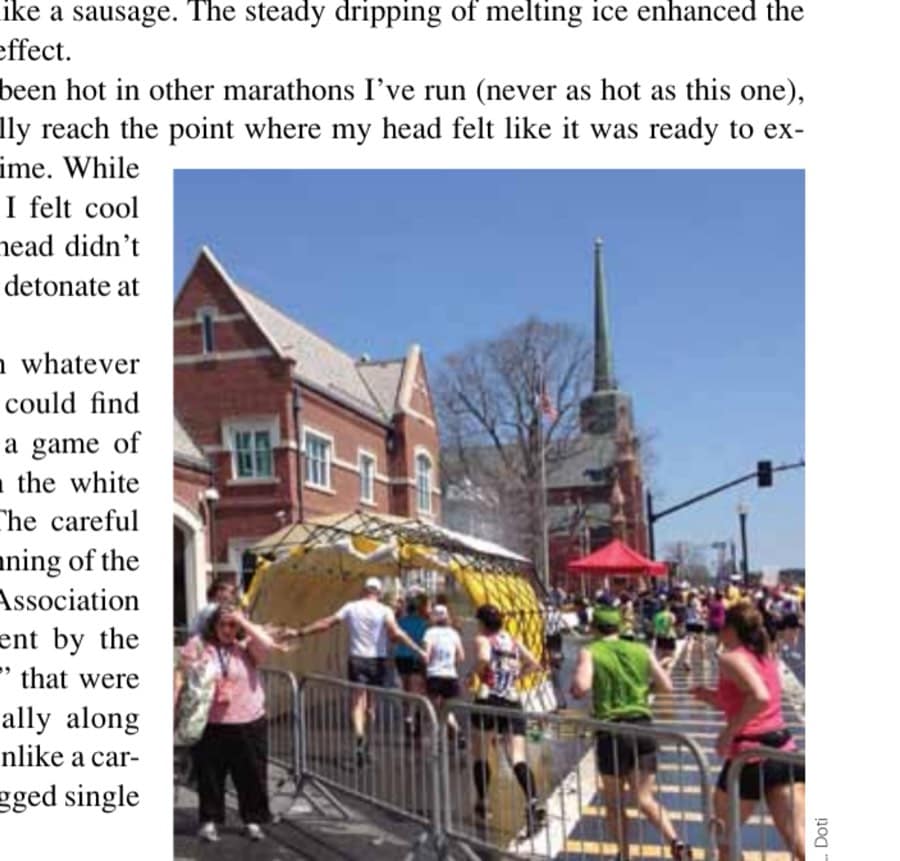
I also ran in whatever limited shade I could find and even made a game of trying to run on the white median strips. The careful contingency planning of the Boston Athletic Association was made evident by the “shower tunnels” that were placed periodically along the course. Not unlike a carwash, runners jogged single
▲
The refreshing shower tunnels were a welcome addition to the 2012 race.
file through these tunnels and received a cooling spray of water coming from all sides. More good Samaritans brought their garden hoses to the street side and seemed to enjoy spraying the passing runners.
By the time I neared the halfway point and started hearing the shrill sound of the screaming Wellesley coeds, I was feeling OK . . . not great, but I wasn’t losing it. When runners go out too fast, their body temperature eventually rises to the point where the muscles aren’t getting the oxygen they need. Instead of the blood fueling the muscles, more and more of it is demanded by the body’s cooling system. With so many parts of the body craving oxygenated blood, the heart has to go into overdrive by beating harder. And the problem is compounded as fluids are lost through sweat and the blood thickens.
Then there were the hills The fact that I was in good spirits while high-fiving the Wellesley women suggested that I wasn’t putting undue pressure on my heart. But I still had a half-marathon to go, so I wasn’t quite out of the woods. Mile 16 also marks the start of a series of stepped hills ending with the infamous Heartbreak Hill at mile 21. The net rise in elevation from mile 16 to the top of Heartbreak Hill is only about 250 feet, but after you run the first half of Boston, mostly downhill, your quads start to rebel.
Uphills are particularly tough to take at elevated temperatures, so attacking the hills in the heat would not be the right strategy—at least, not for me. My strategy involved shifting most of the quarter-mile walk breaks I was taking at aid stations to the hills.
No way, though, was I walking up Heartbreak. Heat or no heat, I attacked the venerable hill. The fact that I could do so was yet one more indication that my pacing plan was still working. My Garmin also indicated that my pace was holding steady and on track.
After Heartbreak, there is a sudden drop of about 150 feet through Boston College before the last four miles of flats that bring runners to Boylston Street. Figuring that I was nearing the marathon’s end, I picked up my pace and stopped taking walk breaks. It seemed, though, that it was getting hotter, and in fact, I later learned that the temperature was pushing 90 degrees. Maybe that’s why I was feeling a little faint. The last thing I needed after getting this far was to blow it all in the final stretch. My faintness, though, didn’t seem like the onset of hyperthermia. It was more akin to the feeling that follows skipping a meal or two.
Suddenly, I realized that I had forgotten to take any gels. Even though I alternate H2O and energy drinks at aid stations, my marathon regimen always includes a gel at mile nine and another at mile 16. Maybe because of the effects of the heat, but more likely because my mind was focused on trying literally and figuratively to keep my cool, I didn’t put down any gels.
Although, by this point, it was too late for it to have much of an effect, I frantically consumed a gel as quickly as I could. The funny thing was that my strength seemed to magically return. My sudden recovery was probably purely psychological, since it seemed to coincide with my long-anticipated sighting of the huge Citgo sign near Fenway Park. That well-known beacon of hope for runners was my signal that I had nailed it.
As I turned the corner to enter Boylston Street, I felt chills, not from the onset of hypothermia but from the screaming crowds that made me feel like I was entering an Olympic stadium not as an also-ran but as a gold medalist. I picked up my pace and gave it my all for that last half mile or so. Crossing the finish line, I hit the “end” button on my Garmin and saw my finish time of 5:03:23, an average pace of 11:35.
A Boston Marathon time over five hours does not immediately strike you as something to write home about, let alone to write about in Marathon & Beyond. These seemingly sobering race results, however, did not get me down. Quite the contrary, I felt somewhat elated. While I didn’t beat the clock, I beat the elements. To me, that was something.
My postrace e-mail exchange with my carboloading pasta friend made it even better than “something.” Carboloading Pasta Friend:
Wow. That was rough. I should have trained in the heat. First half in 1:30. Second half—I had nothing left. Ended up at 3:55. How are you? Me:
I did the opposite. Started slow and finished strong with negative split. That neck towel idea I told you about really helped. Total time was 5:03, which put me in top 50% in 65-69 bracket. Of my 40 marathons, this was easily the hottest. Carboloading Pasta Friend: Courtesy of James L. Doti
You were right. I should have started slower from the gate. ▲
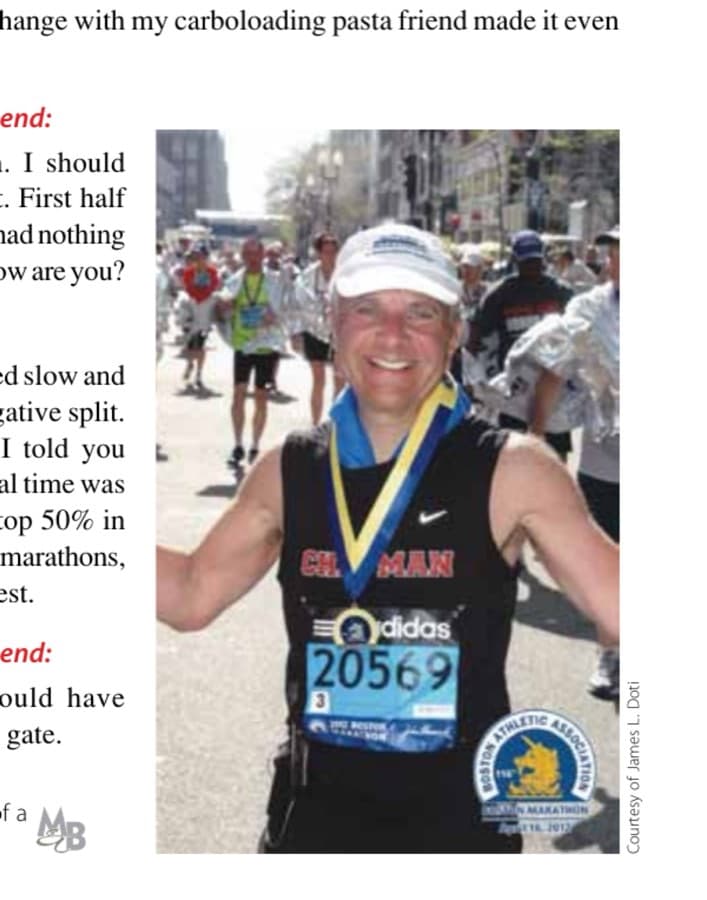
The author, with the smile of a happy survivor.
This article originally appeared in Marathon & Beyond, Vol. 17, No. 2 (2013).
← Browse the full M&B ArchiveMore like this
1,000+ stories from 19 years of Marathon & Beyond
The complete archive of the legendary long-distance journal — digitized and free to read.
