

Bee Mcleod
INTRODUCTION
As a high school and collegiate wrestler in the 1950s trying to lose weight, I would run five to six miles along the path atop the 30-foot embankment containing the Susquehanna River in northeast Pennsylvania. Nary another like-minded soul was to be seen. Now when I return about once every five years or so and take a reminiscence run, dozens of runners are taking in the wonderful views. Running in the United States, of course, has boomed over the course of the past 50 years, and at the heart of that expansion has been the Road Runners Club of America (RRCA).
In the late 1950s, Browning Ross, an Olympic runner, proposed the creation of an organization for American distance runners. Several sympathetic runners agreed, and on February 22, 1958, the RRCA was born. Ross served as an acting provisional president, and over the years numerous other leaders, such as Ted Corbitt, Gar Williams, Jeff Darman, Henley Gabeau, Harold Tinsley, and Don Kardong, helped to expand the influence of the RRCA in running for health and fitness as well as in competitive long-distance racing. However, at the turn of the 21st century, the RRCA found itself in dire financial straits, attributed primarily to excessive publication costs and convention overruns, leading to the secession of a number of member clubs and the formation of a new organization that had, as one of its goals, the eventual restoration of the RRCA to its previous predominance in long-distance running. Several individuals played key roles in this process, and one was Bee McLeod.
YOUTH To Bee or not to Bee. Actually, Bee had little choice. She was born Helen Elizabeth McLeod to Alan and Marian McLeod on November 15, 1962, in Lock Haven, Pennsylvania, where her father was an English professor at Lock Haven State Teachers College. When she came home from the hospital her brother, Ross,
called her “baby,” pronouncing it “Bee-Bee,” and she has been Bee since even before she can remember. When Bee was 3, her family moved to Trenton, New Jersey, where her father assumed a position as professor in the Department of English at Rider College (now Rider University) in Trenton; her mother also took a position as professor of Speech and Theater at Trenton State College. Both of her parents have doctorates in their specialties, and thus Bee has inherited some great intellectual genes. She also may have inherited some excellent longevity genes as well, as her physically active maternal grandfather recently turned 101. And somewhere along the way, she also inherited some super-athletic genes.
Courtesy of Bee McLeod
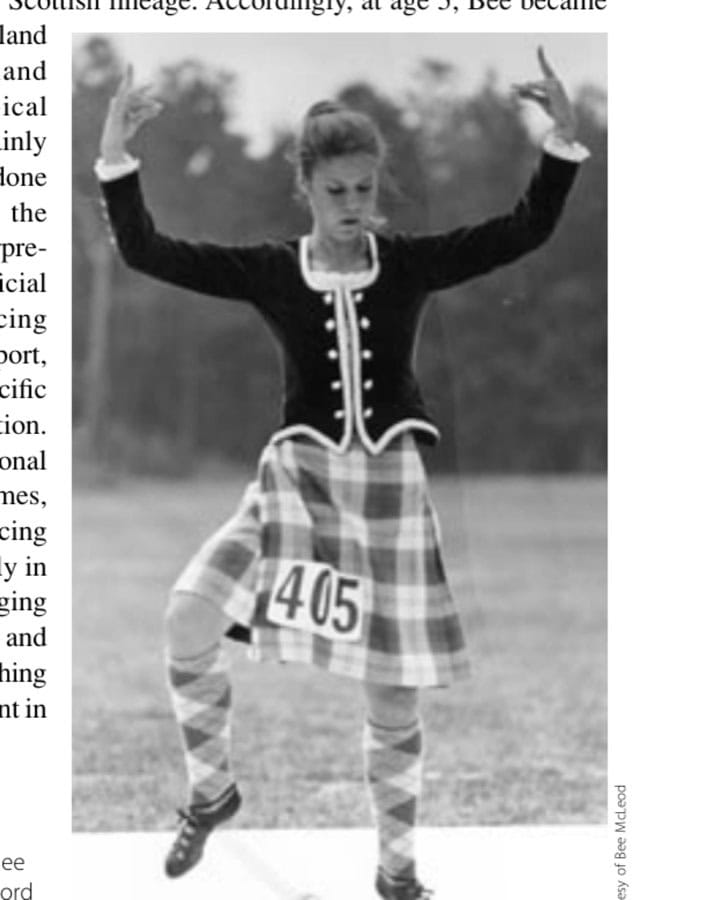
Scottish Highland Dancing Bee’s parents both have Scottish blood. Her paternal grandparents were born in Glasgow and Edinburgh and moved in 1912 to Australia, where her father was born; her mother is also of Scottish lineage. Accordingly, at age 5, Bee became involved in Scottish Highland dancing. Scottish Highland dancing is not your typical ballroom dance but is mainly a rigorous athletic dance done solo, dancing mainly on the balls of the feet. One interpretation of the Scottish Official Board of Highland Dancing generally regards it as a sport, a dance sport with sport-specific specifications for competition. Competition is held at regional and national Highland Games, and a World Highland Dancing competition is held annually in Scotland. Performance judging involves timing, technique, and artistic interpretation, something comparable to the floor event in competitive gymnastics. ▲
Competing in a Scottish Highland dance competition, Bee McLeod does her signature Sword Dance.
As a youngster, Bee and her father would hop in the car very early on Saturday mornings and drive for six hours to Williamsburg, Virginia, where her instructor lived. Bee would practice dancing for three to four hours while her father napped, and then they would hop back in the car for the return trip to New Jersey. The practice paid off. Over the years, Bee has earned numerous regional and national titles. At the world championships in Troon, Scotland, in 1975, at the age of 12, Bee placed fourth in her age group (12 and under) in the Sword Dance. Bee has also been certified as an associate teacher in Scottish Highland Dancing. She continued to train and competed until age 22.
Running Her brother, Ross, competed in high school cross-country and motivated Bee to get involved in running. Because of the athletic nature of Highland dancing, Bee thought it would be good cross-training. At the time, she skipped seventh grade and entered Notre Dame High School in Lawrence, New Jersey, at age 12. However, there was no cross-country for girls at Notre Dame High, so Bee ran on the boy’s team. The next year, Notre Dame initiated cross-country, winter track, and outdoor track for girls, and Bee was off and running. Her events included the mile, the two-mile, and the anchor leg in the mile relay. Although she did not break a six-minute mile her first year of running, she eventually ran in the low 5:00s.
COLLEGE AND EARLY PROFESSIONAL LIFE Bee was accepted at several universities and chose William and Mary, mainly because her dance teacher still lived in Williamsburg. She entered William and Mary at age 16, where she ran one year as a walk-on with the cross-country team. Her primary focus remained training for Scottish Highland Dancing competition. However, she continued to run on a recreational basis, jogging up and down Duke of Gloucester Street, or DOG Street as the students called it, on a regular basis. On a whim, she entered the Colonial Half-Marathon in Williamsburg and finished in the vicinity of 1:42.
In 1983, at age 20, Bee graduated with a bachelor’s degree in business administration. She took a job in advertising and sales with the Virginian-Pilot, the local newspaper, and spent the next 16 years in various operational positions with its parent company in the Norfolk/Virginia Beach area. Along the way she earned her M.B.A. at William and Mary, graduating with honors.
RUNNING SERIOUSLY Soon after graduation, Bee married her college sweetheart and for the next 20 years raced as either Elizabeth or Bee Andrews. During the mid-1980s, Bee continued running for fitness, eventually joining the local RRCA running club, the
Courtesy of Bee McLeod
Tidewater Striders, and became involved in the local road racing scene. Along the way, she met a group of neighborhood soon-to-be masters runners, all of whom were accomplished marathoners, and was encouraged to train for and run the Shamrock Marathon in Virginia Beach. She finished with a time of 3:14, good for 10th woman overall.
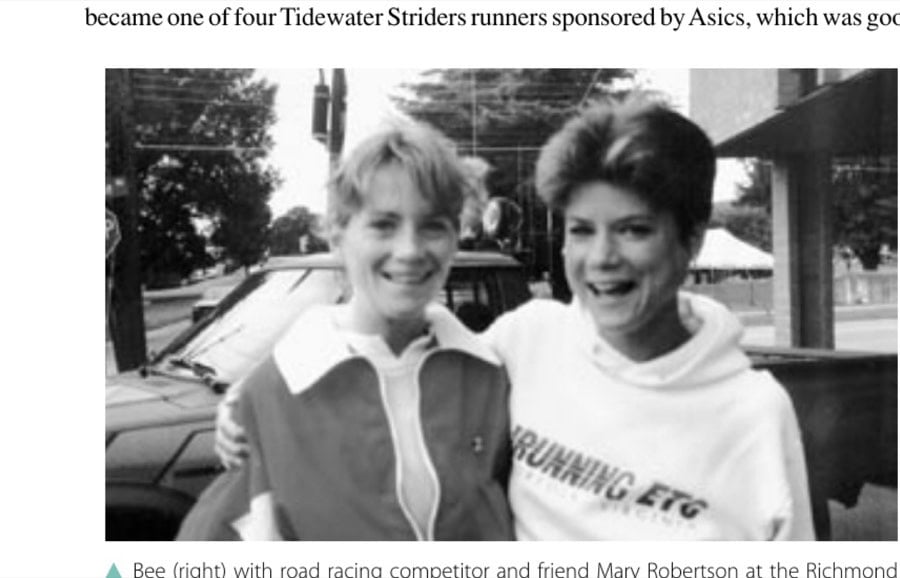
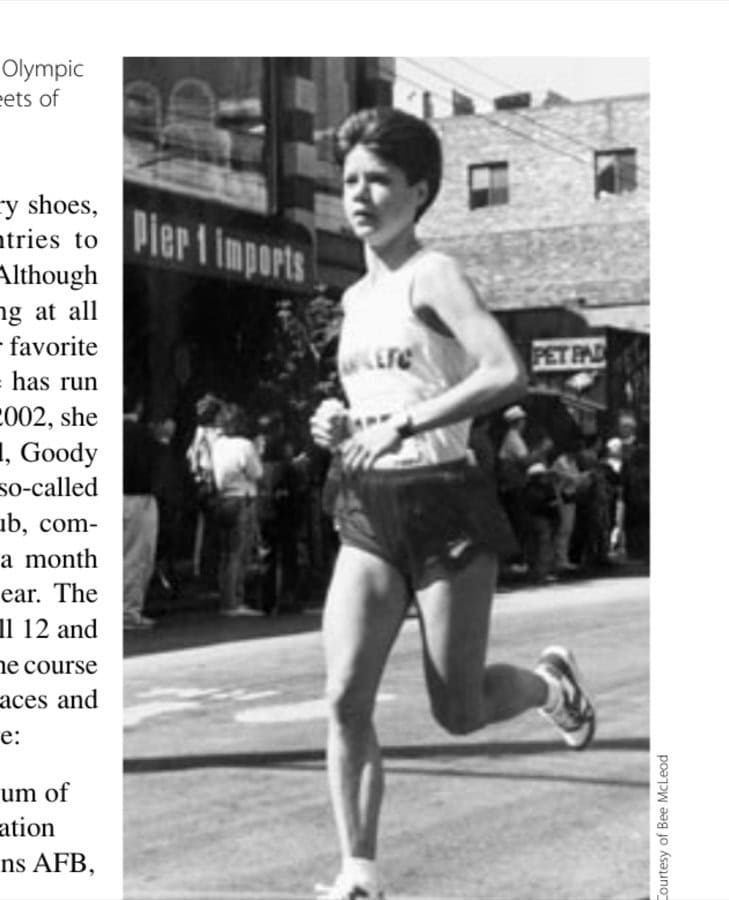
In the spring of 1987, Bee began training with a group of competitive male runners, yours truly included. Our Saturday or Sunday 20-mile runs were done at about 6:15 to 6:30 pace, usually finishing the last 3.5 miles on the main trail of Seashore State Park (now First Landing State Park) at a pace of 6:00 or better. This strong summer of training through the heat and humidity of the Tidewater area prepared her for some fast autumn running. She ran the Philadelphia Distance Run in September, finishing the half-marathon with a time of 1:19:07. Using the marathon time prediction formula of 2.1 times your half-marathon time, her projected marathon time was approximately 2:46. Bee entered the Marine Corps Marathon that fall, finishing third woman overall with a time of 2:47:51. Interestingly, the winner of that race was Mary Robertson, who ran 2:44:36. Bee and Mary became friendly road racing competitors, trading honors in marathons and half-marathons over a few years of racing. Mary, now Mary Wittenberg, is currently the president and chief executive officer of the New York Road Runners and director of the New York City Marathon. Bee’s Marine Corps Marathon time qualified her for the 1988 Olympic Marathon Trials, which she ran in Pittsburgh. Bee continued to improve to the point that she became one of four Tidewater Striders runners sponsored by Asics, which was good
▲ Bee (right) with road racing competitor and friend Mary Robertson at the Richmond Marathon/Half-Marathon in the mid-1980s.
▲
Bee racing in the 1988 Olympic Marathon Trials on the streets of Pittsburgh.
• January—Museum of Aviation Foundation Marathon. Robins AFB, GA (3:39) • February—Mardi Gras Marathon. New Orleans, LA (3:29) • March—Shamrock Sportsfest Marathon. Virginia Beach, VA (3:39) • April—Boston Marathon. Boston, MA (3:39) •
May—Buffalo Marathon. Buffalo, NY (3:27) • June—Cellcom Green Bay Marathon. Green Bay, WI (3:43) • July—The Chronicle Marathon. San Francisco, CA (3:28) • August—Marathon des Deux Rives. Quebec City, Canada (3:41) •
September—Berlin Marathon. Berlin, Germany (3:40) • October—Chesapeake Bay Bridge Marathon. Virginia Beach, VA (3:32) • November—Montgomery County Marathon in the Parks. Bethesda, MD (3:41) • December—Honolulu Marathon. Honolulu, HI (4:23) Note: In order to
celebrate both of them completing a marathon each month, Bee and her future husband ran this last marathon of the series together.
Courtesy of Bee McLeod
for some complimentary shoes, running gear, and entries to Asics-sponsored races. Although Bee enjoyed competing at all road race distances, her favorite was the marathon. She has run 56 marathons. During 2002, she and her future husband, Goody Tyler, decided to form a so-called Marathon-a-Month Club, completing one marathon a month during one calendar year. The goal was to complete all 12 and remain healthy during the course of the challenge. The races and times are presented here:
DUATHLON AND TRIATHLON In 1988, Ross started to do triathlons, and lo and behold, Bee was not far behind. He invited Bee out to Columbus, Ohio, to do the Wendy’s Triathlon. Bee was looking to introduce some cross-training into her fitness program. Of the three sports in the triathlon, Bee’s strength was running, but she also displayed some talent in cycling. Swimming was her weak link, something akin to what Paul Stookey of Peter, Paul, and Mary says in “Paultalk” that “swimming” is “staying alive in the water.” Bee eventually became somewhat skilled in swimming and completed the Lake Placid Ironman in 2001.
However, the duathlon—running and cycling, but no swimming—was right up her alley. She won her age group (35-39) in the 2000 USA Duathlon Southeast Regional Championship at Powerman, Alabama. This placing earned her a slot on the U.S. team that competed at the world championship held later that year in Calais, France. Her next stop was the national duathlon championship, held in Sartell, Minnesota, where she placed second in her age group.
THE BERMUDA TRIANGLE OF WOUNDED KNEES In the early 2000s, a surprising number of Tidewater runners experienced knee pain that eventually required meniscus surgery and rehabilitation. Bee was one of them. She also experienced some problems with sciatica that weren’t sufficient to curtail her training but may have forced Bee to change her running biomechanics. Eventually she developed some knee pain that would not go away, not even with rest.
Thus, on a cold Monday morning in January 2004, Bee had magnetic resonance imaging (MRI) of her knee. The MRI was read on Tuesday, with a diagnosis of a meniscus tear that should be easy to repair. On Wednesday, she had surgery and expected a fast and full recovery. However, the arthroscopy revealed much more damage, and thus the surgeon needed to perforate the bones to promote the formation of scar tissue to encourage healing of the cartilage defect. When Bee came out of the anesthesia, she asked: “How did it go?” The surgeon answered: “Not so good.” His advice was that if you try to run, you are going to need a knee replacement—not quite what Bee wanted to hear.
THE POLITICS OF RUNNING During the mid- to late 1980s, Bee became involved in the politics of running when she was elected to the board of directors of the Tidewater Striders Running Club. Bee served as secretary of the board, and everything seemed to be running smoothly. The club had an executive director, the sponsored number of races was increasing, more runners were coming to club races, club membership was
▲
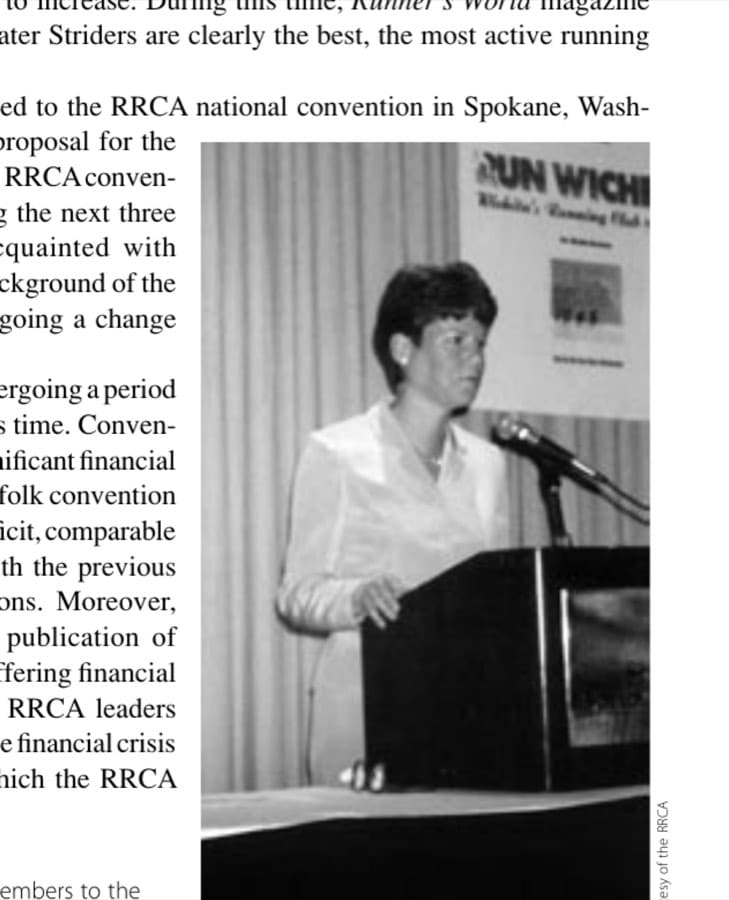
Bee welcomes RRCA members to the 2002 RRCA Convention in Norfolk, Virginia.
Courtesy of the RRCA
growing, and the club treasury had a nice balance. All of a sudden, the club was bankrupt. It seems the club treasurer had a gambling problem, and approximately $24,000 of club funds somehow disappeared in slots or gaming tables from the Caribbean to Las Vegas. Fortunately, the director of the Shamrock Marathon at the time, Jerry Bocrie, provided a grant to help the club continue operations, and eventually most of the stolen money was returned to the club by the former treasurer’s family. Nevertheless, these were trying times for the board of directors as it managed to run the club without money.
After taking a hiatus from the board for about 10 years, Bee decided to run for election again and become more active in promoting the club and running in the local area. She was elected in 1999, becoming the vice president and then serving as president for the next four years. The club continued to expand during her tenure. Membership increased to about 2,000 members, one of the top five membership clubs in the RRCA. The number of club-sponsored or club-supported races continued to increase. During this time, Runner’s World magazine stated that “The Tidewater Striders are clearly the best, the most active running club in the country.”
In 1999, Bee traveled to the RRCA national convention in Spokane, Washington, to present the proposal for the Striders to host the 2002 RRCA convention in Norfolk. During the next three years, she became acquainted with some of the political background of the RRCA as it was undergoing a change in leadership.
The RRCA was undergoing a period of financial crisis at this time. Conventions were suffering significant financial losses. Hosting the Norfolk convention resulted in a $70,000 deficit, comparable to losses associated with the previous two national conventions. Moreover, FootNotes, the major publication of the RRCA, was also suffering financial losses. Several former RRCA leaders were concerned about the financial crisis and the direction in which the RRCA
was moving. Seeing little improvement, they decided to form a comparable national organization to promote long-distance running. Experiencing various problems with the RRCA in hosting the Norfolk convention, Bee, with the strong encouragement of Jeff Darman, became actively involved in this movement.
The outcome was the formation of the American Association of Running Clubs (AARC) in December 2002, with several former key RRCA leaders in executive positions. An interim board was formed. Jeff Darman and Harold Tinsley, former presidents of the RRCA, were copresidents; Julia Emmons, then executive director of the Atlanta Track Club and Peachtree Road Race director, was vice president; Anna Berdahl, former RRCA deputy executive director, was secretary; and Bee, president of the Tidewater Striders, was treasurer. Don Kardong, also a former RRCA president, was a member of this interim AARC Board of Directors.
The AARC was off to a good start. By February 2003, it already had 47 member clubs, representing more than 26,000 members. The first membership meeting was held in Atlanta, the location of the AARC headquarters, in June 2003, and Bee was elected secretary. The two basic goals of the AARC were to provide member clubs with affordable liability insurance for race participants and club officers and to qualify for nonprofit, group tax-exempt status from the Internal Revenue Service. Both were attained during the first month of operation. However, another major underlying goal of the AARC since its inception had been a merger with the RRCA, but only after the RRCA undertook significant reforms including its finances, board governance, and staff leadership.
In the spring of 2003, while a member of the AARC board, Bee was also elected to a two-year at-large position on the RRCA Board during its convention in Arlington, Virginia. Thus, Bee was serving both organizations and was in a key spot to help the two organizations resolve their differences and merge into a single organization to promote running. In the meantime, the AARC increased to 63 clubs with 31,000 members, plus seven major race events with 114,000 participants.
Meetings between the two groups began to produce some positive results. In March 2004, the AARC and RRCA agreed to jointly sponsor the Roads Scholar Program to benefit scholar athletes. In May, after serving only one year on the board, Bee was elected RRCA president at its national convention in Lake Tahoe. A week later, during its second annual meeting in Philadelphia, the AARC approved a letter of agreement with the RRCA, laying out the groundwork for a merger of the two organizations. The merger was to take effect on January 1, 2005. In a press release from the Running Network, Jeff Darman, president of the AARC, was quoted: “It has been an arduous and challenging 18 months with many ups and downs, but through the hard work of the task force and dedicated key representatives from both organizations, we are on the path to rejuvenating the RRCA. The result, I believe, will be a strong, united RRCA that incorporates the
best elements of the AARC into the RRCA.” In her dual roles, Bee was certainly one of those key representatives. Bee was reelected in 2006 to her second two-year term as president at the annual meeting of the RRCA membership in Houston. During the four years of her presidency, the RRCA has continued to do what it has done in past years: to help member chapters organize races and training runs, to provide safety guidelines, and to promote children’s and masters fitness running programs. The RRCA now has over 800 clubs, the largest number ever, having averaged an increase of about 40 clubs a year over the past four years. The RRCA is in a financially solid position, and in 2006, the RRCA Board of Directors created a $100,000 reserve fund to ensure its financial stability. This is a far cry from the sizable deficit the organization faced in 2000. The last four RRCA conventions have netted profits for the host running clubs. Funds have become available to help RRCA state representatives travel to national conventions for training and networking. During Bee’s tenure, over $120,000 have been awarded through the Roads Scholar program. A feasibility study and a business analysis were conducted to determine the fate of FootNotes, resulting in a change to a Web-based e-magazine instead of a print version. The RRCA has a strong national office staff as well as strong programs and its dedicated network of state representatives. Old ties have been resurrected. Jeff Darman serves as the appointed RRCA liaison to the board of directors of USA Track & Field.
FUTURE Bee’s attitude is “Once a runner, always a runner.” On a personal level, although running is currently out of the picture, Bee has become an avid walker and continues to cycle. Along with her husband, Goody (an accomplished runner who has completed 27 marathons and several 50K trail runs as well as the Lake Placid Ironman), she recently walked the Lake Tahoe 50K trail race, the RRCA national ultra championship.
On a professional level, Bee’s focus is on promoting running in as many ways as possible, to share in the enjoyment that others get through running. She will continue to support the RRCA following her presidency, which is limited to four years. Her goal is to establish the RRCA as the key source of information about running. The RRCA has developed new programs for runners, such as its Kids Run the Nation program, which provides funds to member clubs, events, and schools that sponsor running programs for children. Thanks to the leadership of Bee and many other RRCA supporters, the future of the organization as the leader in distance running in the United States seems to be assured.
This article originally appeared in Marathon & Beyond, Vol. 12, No. 1 (2008).
← Browse the full M&B ArchiveMore like this
1,000+ stories from 19 years of Marathon & Beyond
The complete archive of the legendary long-distance journal — digitized and free to read.
