

Behind The Scenes At The Boston Marathon
It’s always one of the greatest sights in marathoning—the front row of the starting line. Stretched across the start at any major-city marathon are some of the most talented, energized, fit runners in the world. It takes a great deal of training, planning, hours, and people to get those athletes on that line in the best possible shape.
Although everything involved in the months leading up to a race is largely in the hands of the athlete, the immediate weeks and days preceding a major marathon like Boston are bestowed upon an equally gifted army.
Neatly tucked away in a corner of the Hub, in the shadow of the John Hancock Tower just blocks from the Boston Marathon finish line, is a 64-room, eight-story building that for a few weeks every April houses the world’s finest marathon athletes. From the unimposing double-glass front doors to the nonstop personal services offered inside, the 86-year-old, 18th-century Adam-style hotel and conference center with its intended connection between its brick and stone exterior and its interior design is transformed into the John Hancock Elite Athlete Village—a home and a security fortress for its 90-plus international tenants.
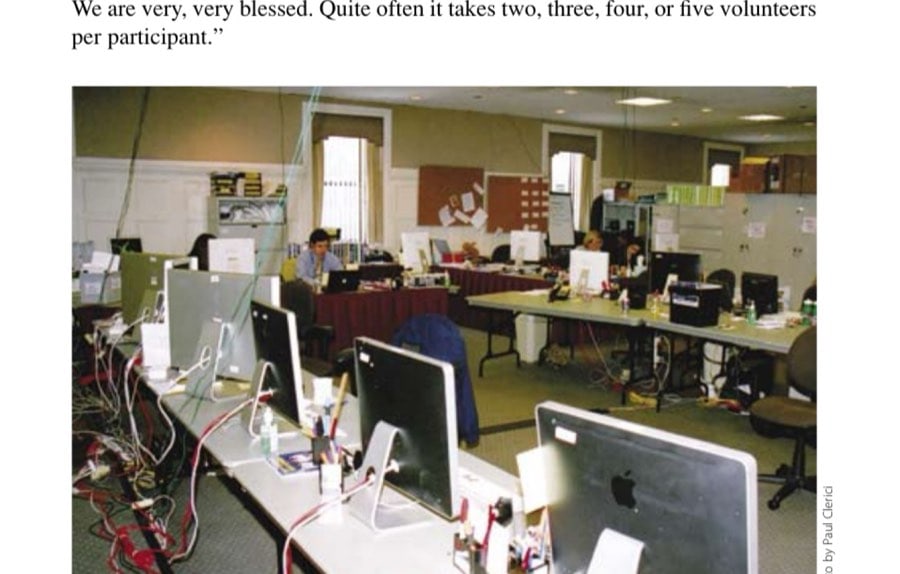
Boiler Room For those entrusted with the well-being of more than 150 staff members, federation officials, coaches, agents, family members, support people, and the athletes themselves, it all begins in the heart of the building on the third floor in what is referred to as the Boiler Room. A large enclosed and secluded conference-size room, it is the last of three connected adjacent rooms of activity that begins with the Athlete Processing Room and continues with the Hosts Room in the middle. The Boiler Room contains all the vital information on each athlete, including arrival and departure times, entourage lists, appearance schedules, food and
Computer system To accommodate all of this data and to ensure its safety and applicability, a customized computer-software system was created by Treseler’s son, Fred Treseler IV, the TRACS account manager for key accounts, and Lisa Plesko, the account manager for emerging elites, both of whom also created a complementary Web site that agents can access for immediate information, schedules, and requests.
Photo by Paul Clerici
medical requirements, training and religious necessities, list of assigned living quarters, and anything else involved in their safety and comfort. That also includes whatever assistance they may require in relation to visas, passports, forms, and applications. “
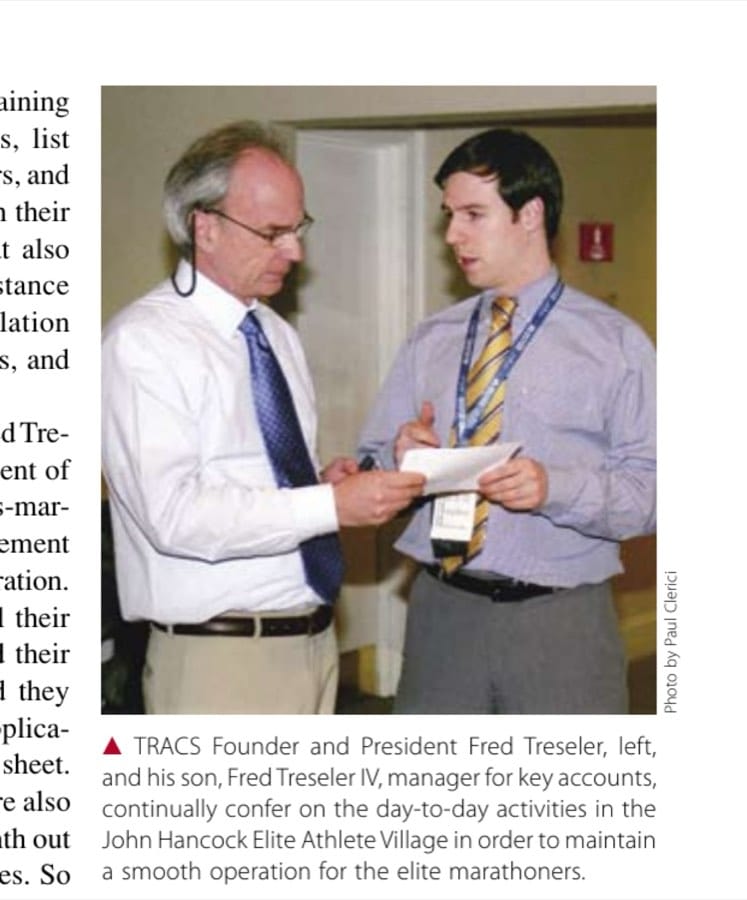
It’s all here,” said Fred Treseler, founder and president of TRACS, the global sports-marketing and event-management firm that oversees the operation. “We sit down and do all their tax forms with them and their prize-money forms. And they have to sign their race applica▲
TRACS Founder and President Fred Treseler, left, tion and an information sheet. and his son, Fred Treseler IV, manager for key accounts, Forms and schedules were also continually confer on the day-to-day activities in the sent to their agents a month out John Hancock Elite Athlete Village in order to maintain to share with their athletes. So a smooth operation for the elite marathoners. they know what’s going on in case they want to set up something with their shoe company, for example—they’ll know about their commitments. We also send them a copy of the menu in case they have any dietary requests, because we can handle that as well. “
We coordinate with the catering service; we coordinate with the limousine company; we coordinate with the management of the hotel and conference center and the other hotels where some of the athletes stay; we work on flight-departure confirmations when they arrive—all of this on behalf of John Hancock,” he added of the main sponsor. “We also have their actual water bottles and bib numbers and the forms they will turn in with their water bottles for the race. It’s pretty extensive.”
Photo by Paul Clerici
“If we need to generate a report, like a race-day credential report, we can instantly call up these types of reports, and we can tell that these official staff passes have been issued for race day, and here are all the numbers on the back of the passes,” Treseler said. “We set up a very clean, systematic operation.”
For example, with athletes departing from anywhere in the United States on airlines such as American, Delta, and Alaska or from other countries on airlines including Air France, KLM Royal Dutch, and Lufthansa, schedules and logistics can get convoluted if not for a streamlined system. “
We built this from the ground up,” said Treseler IV. “We had 12 different tables on the old system, and now we have two. On this system we can sort flights, arrivals— international, domestic, or arrivals on a specific date—gates, and even all the agents. We have 17 agents for 29 athletes and over 200 flights—in and out—because people are coming from different locations at different times.”
Added Treseler, “For the people that manage this whole thing, it’s a real act of love. They don’t get a ton of interaction with the athletes. This is all the strength and the business power of making this all run behind the scenes. Like any major sporting event, you need to have tremendous volunteers behind the organization. We are very, very blessed. Quite often it takes two, three, four, or five volunteers per participant.”
▲ Seemingly dwarfed by the walls of technical equipment required to properly run the ship, Fred Treseler IV, Jamie Redmond, and Bethany Allard, from left, constantly monitor every aspect of operations from deep within the secured Boiler Room.
Setup In addition to its staff, the heart includes trucked-in computers, long tables, file cabinets, bulletin boards, connecting wires, wet/dry erasable presentation boards, wall dividers, chairs and sofas, a private meeting area, and many other office supplies such as fax machines, copy machines, and notebooks. And it takes nearly a week to fully set up the rooms. “
After we get all the computers and tables and things set up, we also dress up the building so it looks like an athletic venue in carrying the brand of the sponsor and the image of the event,” Treseler said. “And we have training sessions, too, for the volunteers and the hosts.”
Setup is nonstop once the doors open nearly two weeks before race day. Everything must adhere to a tight schedule because athlete arrivals are not dependent upon completion. People will come regardless of whether the computer lines, marathon banners, or buffet tables are ready. In 2009, for instance, Easter Sunday occurred the week before the marathon, and people still came to work throughout the day because that Sunday is always a busy one despite being eight days before marathon Monday. “
The intent is to try to provide an environment—particularly for the elite athletes who do this for a living and take it obviously real seriously, and they only have one or two of these in them a year—to give them an opportunity to relax, eat properly, to just be in an environment where come race day they’ll be able to perform to their highest level,” said Boston Marathon Race Director Dave McGillivray. “We recognize that, and we want to take it to the nth degree. I think we do that here. Other races do it, but I think we do it as well as anybody.”
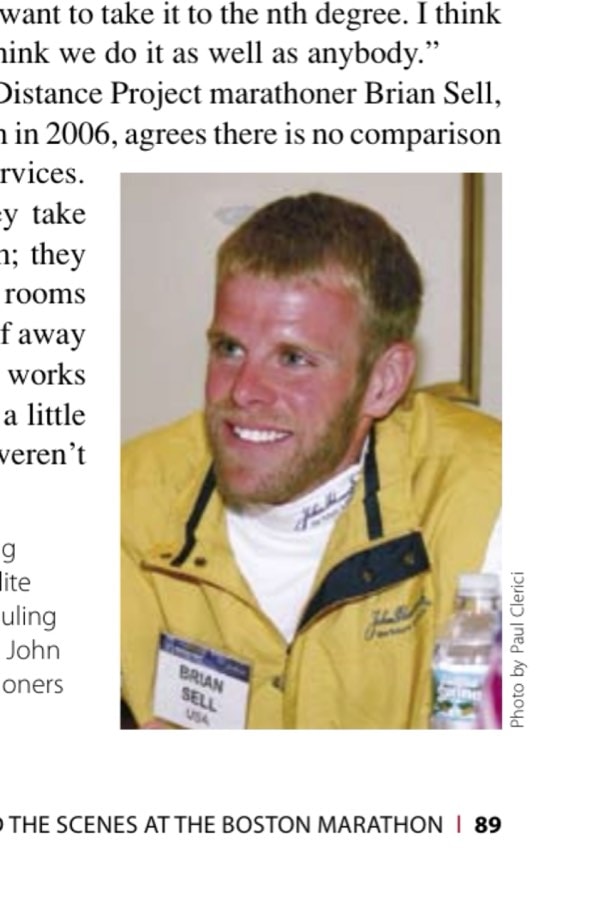
U.S. Olympian and Hansons-Brooks Distance Project marathoner Brian Sell, who was 14th at Boston in 2009 and fourth in 2006, agrees there is no comparison with regard to the provided hospitality services. “
It’s second to none,” he said. “They take care of us; they tell us where to be when; they provide the meals and everything. The rooms are nice—they’re quiet and they’re kind of away from the epicenter of everything. It just works out really great. [In 2009] I honestly felt a little guilty because I had five teammates that weren’t
Photo by Paul Clerici
▲
“I think all the runners really appreciate having that all set up and done for us already,” noted elite marathoner Brian Sell, in reference to the scheduling and logistics being handled by the hosts of the John Hancock Elite Athlete Village so that the marathoners can relax and concentrate on the race.
in the Hancock program, and I always felt bad because they’re the guys that were out there running the same miles and workouts that I was. But I got a little extra, better treatment than they did. But I’ll take it when I can get it.”
Arriving
Photo by Paul Clerici
The journey begins for most of the runners just four miles northeast at the Logan International Airport. Waiting for the domestic and international arrivals is a continuous stream of drivers and hosts who on a regular basis greet and pick up runners, coaches, agents, physicians, family members—anyone associated with runners whose involvement provides any kind of comfort during their time in Boston. “
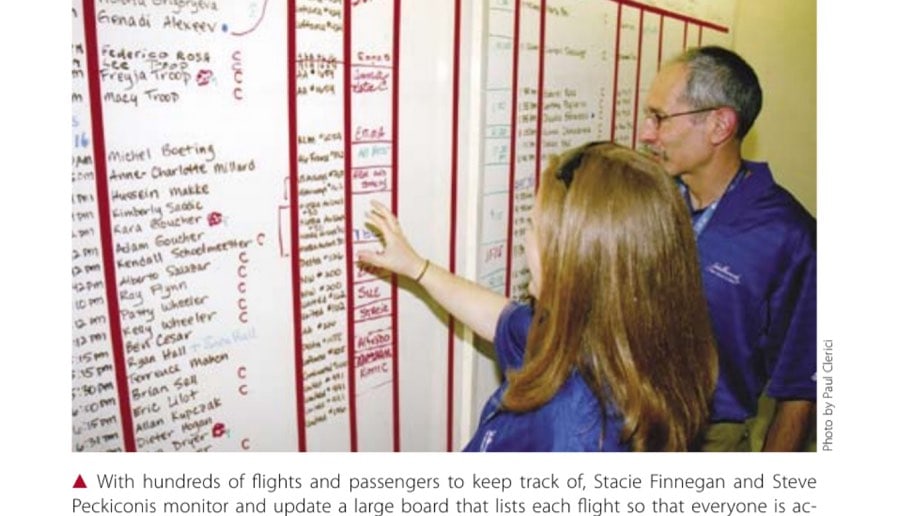
We have large boards in the Boiler Room and the Hosts Room that list the names of all the runners, their airlines, flights, arrivals, gates, and the hosts and their cell phone numbers,” said Treseler. “We send out a driver and a host, and the host is responsible if there are any delays or side trips, not the driver—the driver drives. Our host’s job is to make the connection, even if an athlete wants to go shopping. The host will reconnect with the driver.”
Based on the information on the boards, a host will know when, where, and whom to pick up. The board also lists any children who would require a child seat in the limo and any other pertinent details.
▲ With hundreds of flights and passengers to keep track of, Stacie Finnegan and Steve Peckiconis monitor and update a large board that lists each flight so that everyone is accounted for and picked up at the right time and the correct gate.
“Also on the board are flower symbols for the women athletes that are coming in, and we take flowers to them when the hosts go to the airport,” said longtime veteran village host Pat Lodigiani. “The host has a laminated sign with the individual’s name on it—because they’re expecting someone to meet them—and the hosts also have a packet of material for the athlete. And there are two different times next to an athlete’s name on the board: the time that the flight is expected and the time we send the host so they have enough time to get to the airport, check in through airport security, which is new, and get to the terminal where the athlete is expecting us to be.”
Upon welcoming athletes, the hosts tend to the luggage, accompany them to the limousine, and call in that the connection has been made and that they’re returning. The calls ensure there are no questions regarding airport pickups. “
We’re in constant contact,” Lodigiani said. “We had an occasion when an athlete brought their own physical therapist who was not on the list. The host is instructed not to bring anybody unless they’re on the list, so that host called us from the airport. Everything is checked because of the security issue. And because we are a curious society,” she said with a smile, “hosts do not answer any questions on who they’re meeting, where they’re going to stay, or any of that information, because you never know who’s asking, and it’s basically no one else’s business. Also, when they’re about five minutes away, the host calls so we can get our processing people ready for when they arrive.”
All arrivals, delays, changes, and eventual departures are constantly monitored and checked on those large conference boards. The goal is to be proactive and to anticipate. If there is a flight delay, for example, the driver and host want to be there before the athlete, not the other way around. A worst-case scenario would be to have a foreign, non-English-speaking elite athlete seeking direction amid the chaos in one of the busiest airports in the country.
When things go smoothly, athletes arrive at the entrance of their temporary home less than 20 minutes after leaving Logan. The building is closed to the public while the athletes are there, and the entrance is where, on race day, they will depart on comfortable coach buses to the start in Hopkinton.
Two-time U.S. Olympian Elva Dryer, who came in 12th at Boston in 2009, is particularly grateful for the hospitality services she received prior to that race. “Eliminating any chaos or any type of thing that you might come across, like when my flight was delayed and we came in late,” she said. “I just called my agent to let him know to let whoever know that my flight was late. And somebody was there [waiting at Logan]. They stayed up. Perhaps at another race I’d have to find my way—not always, but at some races. So it’s nice to have someone there to guide you along the way.”
At other races there are times when no one will be waiting for you at the airport, said Sell. “Some marathons you have to get your own cab from the airport,
but generally you get reimbursed,” he said. “But this was nice [in Boston]. As soon as I got off the airplane there’s a guy waiting with my name on the board. I hopped in a big Chevy Suburban, all leather and everything, and I felt like a celebrity. It’s definitely a step above what most other races do, for sure.”
New Zealand native and 1984 Boston winner Lorraine Moller, a four-time Olympian who won the marathon bronze medal at the 1992 Barcelona Games, has experienced marathon accommodations at both ends of the spectrum. “
In Boston I was always treated very well. The hospitality was wonderful. I started to get used to that. It was very nice. It was like being royalty,” she said. “But my first marathon, in Minnesota, I went with my boyfriend and we drove up the night before, and I wasn’t even entered. We ended up knocking on the door of the race director after some frantic phone calls and picking up a number at 10 o’clock the night before. It was a lot more low level than what I got introduced to later on. Once I started going to the Avon marathons, and there was a lot more money behind it, it was like heaven. When you got a free hotel room and somebody paid your airfare, it was like we were made.”
Athlete processing Upon entering the building after their trip from the airport, still accompanied by their hosts, runners are directed upstairs to the Athlete Processing Room, where registration takes place, credentials are issued, and any questions are answered. “
The building is locked at night, so all of our guests, all of our staff, and all of the athletes get a specific credential that John Hancock security created for us,” said Treseler. “The credential gets you in through the front doors, and then you go to security, so there’s a double layer of security there.”
At registration, athletes can also inquire about and sign up for course tours by longtime track and marathon coach Bill Squires, transportation requests, tourist sites, and massages, all of which are funneled through the Boiler Room. “
It’s quite a setup for the athletes,” said Bill Morris, lead massage therapist and head of the medical and massage area, who administers massages on property, at the finish line Elite Athlete Recovery tent, and also the day after the marathon, if required or requested. “One of the interesting things here is that you’ve got guys and gals that have come off 16, 18 weeks of training in altitude, and most coaches will put them on the track two weeks before. And I can’t tell you the number of elite athletes who have needed me to work on their feet. They’re 100-percent fit going straight, but going on a track—the knees, hips, feet! “
I’ve had guys that have been crippled after a week and a half, but you keep working on them every day and see how their runs go,” he continued. “The next thing you know, you see the guy winning. It’s really a valuable experience for me. Doesn’t happen all the time. But it’s neat. And one of the keys to the dining
hall is I get to see everybody walk in and walk out, and I can see gaits, I can see limps, especially if I’ve worked with an athlete before.”
Dining hall Occupying a large conference meeting room and stage on the second floor is the dining hall, with dozens of round tables dressed with tablecloths, cheerful centerpieces, bottles of sports drinks, marathon banners and other Boston-related signs, buffet tables, a big video screen that shows the Boston course and previous races, and plenty of race talk in a variety of languages and dialects. “
They do a phenomenal job here,” said Treseler. “From the color scheme to the setup and, of course, the catering. On the Saturday before the race we’ll feed over 300 people. And with the food, everything is labeled. But they also in some instances put pictures with the food. For example, in the morning, if there’s turkey or pork sausages, they’ll have a picture of a turkey or a pig so any religious concerns are addressed. And we’ve refined the menu over many, many years.”
Located near the dining hall on the second floor is a stadium-seating conference room that doubles as a hotbed of nonrunning sports activity for the athletes, thanks in large part to Squires (when he isn’t conducting the course tours or answering questions about a certain stretch of 26.2 miles).
For relaxation and fun, the most popular game for the elite athletes is the ever-expanding miniature golf course, where participants putt a golf ball from the conference room, out the door to the hallway, down the stairs via plastic tubing, through the downstairs lobby, into the elevator, and wherever else Squires has designed the course.
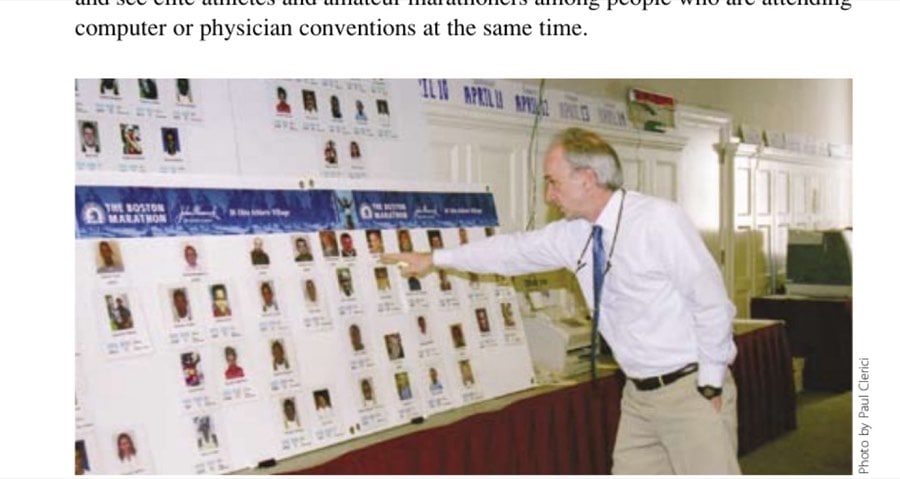
The hosts Sandwiched between the Athlete Processing Room and the secured Boiler Room is the Hosts Room, where the volunteer hosts begin their day by checking in for their shift. Responsibilities include any number of athlete assignments such as the airport trips, press conferences, public appearances, training locations, and tourist excursions. Hosts can also refer to a separate board that features a color copy of each athlete’s credentials, picture, and name, to ensure proper connections. “
We have a good system working where they even learn about their airport runs a day or two in advance. In case they’re tied up at work, they know they can call in and make plans,” Treseler explained. “We even have flashcards like you had in school where hosts can learn all of the athletes’ names, which are on the back of the photos. They have a contest at night, trying to figure out who can out-flashcard the others. We kind of make it fun.”
Hosts also make sure each individual room is ready, which includes a vase of flowers in each female’s room, a course description on every nightstand, and
showing athletes how to work the thermometer so they can adjust the room to their personal preference, since the athletes live in different climates around the world. “This one’s certainly in a league of its own as far as hospitality and just see
ing that every athlete’s needs are met. Everything’s so convenient,” said Dryer, a five-time U.S. national champion. “Basically, you just tell them what you need, and somehow they come through. It’s one less thing to think about when you have
to get ready for an event like this, even dealing with the little stuff like getting a refrigerator in my room because my husband’s insulin dependent. I just made a phone call and it showed up. And having water on each floor—you just have to
walk out of your door and there it is. Having a schedule, letting you know where to be at a certain time, rather than having to search for that information, having people guiding you through the whole process—for somebody like me, I like that.
And I’m even a bit of a control freak.” Ryan Hall, the 2008 Olympic Marathon Trials winner who was third at Boston in 2009, treasures what is provided at the John Hancock Elite Athlete Village. “Having the accommodations by John Hancock is huge. It allows you to basi
cally have a home in Boston, which is always the best environment to run out of. That’s why back home is such a powerful place because it’s where you get your nutrients from, it’s where you get your power from,” he said. “So to have a safe
haven in Boston and not get hounded all the time and be able to relax, and it’s quiet, the food is good, it’s healthy, it’s right there and it’s easy—it gives you the opportunity to be at the highest level that you possibly can.”
More amenities The third floor, which includes no sleeping quarters, also houses the private enclosed massage room and a makeshift lobby that features plenty of healthy snacks, fruit, and even an ice cream and yogurt machine. “That’s the best part,” Sell said with a chuckle. “I had a bowl. It was frozen yogurt, so it’s healthy.” In addition, there is also an open livingroom-style place where people can read or
Photo by Paul Clerici
▲
Elite marathoner Ryan Hall, shown here at one of the Boston Marathon press conferences, arrives and departs from such events as all the athletes do—with an assigned host who ensures he is on time with his scheduled appointments and interviews.
watch television, including videos of old races, and smaller conference rooms in which to meet with coaches, agents, or visitors. “These are places outside their room where they can relax,” said Treseler. “It’s a place where they don’t have to deal with the public or the press. They’re in a secured area. And no matter when people come in during the day or night, and if they’re a little bit out of cycle with their dietary situation, there is always something available for them.”
For a runner as high profile as Hall, the seclusion is welcome. “It’s great to interact with the people and the thousands that will be out there running, but you just have to do it at the right time,” he said. “So every time you go to your room, to have it take 20 minutes to go through the hotel lobby can be exhausting sometimes [at other venues]. That’s what’s so nice about the John Hancock Center.”
Transportation Anytime that athletes or someone with them request transportation to a press conference or public appearance or for a personal matter, it is coordinated through the Boiler Room to the Transportation Office, which is inside the front of the building, between the front door and security. “
Anything that has to do with moving the athletes or staff through John Hancock, we do through this office,” said Marc Schpilner, head of transportation. “When the host comes down from upstairs to get them at the airport, we do all the flight checks, we get the hosts to the airport, we get them situated at the airport, we get them checked in properly with a greeter pass to walk into the terminal. We then meet them [hosts and guests] curbside, load them in, and bring them back to the facility.”
Most days every vehicle can be in use at the same time, especially when course tours, press conferences, public appearances, and shopping visits either coincide or partially overlap. “They’ve done a very good job in centralizing requests through one desk,” said Schpilner. “We’ve kind of centralized it over the years to flow through one location filtered down to us. There could be a hundred different scenarios that could go wrong— no host, no vehicle, an athlete was supposed to be at a press event and they decided to go shopping. They’ve done a really good job monitoring and managing how the athletes are moved.”
Prior to such elite door-to-door service, when 1974 winner and two-time Irish Olympian Neil Cusack traveled to Boston that year, he arrived with less assistance and fanfare. “I came up from East Tennessee State University with a friend of mine, and I stayed at their house for about three days where I trained,” said Cusack, an ETSU Buccaneer at the time. “I came in to Boston the night before, and I stayed at a
hotel. It was just me. I got up the next morning about six o’clock and ran about two miles—you’re always freer the second run of the day. I had the usual toast and something light, and then I got the bus out to Hopkinton—one of the yellow buses! Stayed in the gym and just limbered up, got ready, and we were called down to the start line.”
Village layout
Photo by Paul Clerici
The overall design, especially the third floor, grew organically through Treseler’s firm, which, he says, was involved from the very beginning of John Hancock’s sponsorship. TRACS was originally hired to create a national running and fitness program for schools that featured athletes under contract with John Hancock to run the Boston Marathon. Within the first dozen or so years, they visited more than 90,000 schoolchildren in 32 states. “
We took the athletes into middle schools, grammar schools, and high schools, and we did different activities with the students to promote running and fitness,” Treseler said. “And after the 1988 Boston Marathon we were asked to take over the hospitality part of the event on behalf of John Hancock.”
Most major-city marathons feature a host hotel in which the elite-athlete hospitality services are housed. The hotel also usually hosts the bib-number pickup, runners’ expo, and pasta dinner for all the runners, along with the hotel’s other unrelated business events. It is not uncommon to walk into a race host hotel and see elite athletes and amateur marathoners among people who are attending computer or physician conventions at the same time.
▲ Fred Treseler points to the boards that feature every official photo ID and name so hosts can make sure there are no mistaken identities when picking up and directing guests, who include athletes, agents, managers, and family members.
“We were lucky enough to discover this building existed,” Treseler said. “We were very blessed that John Hancock owns this building two blocks from the finish line, and it has hotel space and wonderful meeting space. Initially, we didn’t use all of the space the same way we do now. It has really evolved since 1989. Each year we work harder and harder to make it even better and to see how to best utilize the space. We do a big debrief after each year’s event, and we take all that feedback from the athletes, coaches, volunteers, hosts, and staff, and we see how we can make it better.”
End result “This is a lot of fun for everybody because it’s very, very different,” said Treseler. “This is just a different setup. There’s no place, to my knowledge, that does it anywhere like this. We were asked to get involved with this component to try to make it the best in the world.”
It boggles the mind to see what is involved to set up, maintain, and dismantle this makeshift village. It is unlike any other. And it’s all for the elite athletes, the best of the world’s best. “The whole idea is that all their energy goes into when the gun fires, not before the gun fires,” said McGillivray. “And it benefits us for them to run well, too. One may look at it as being an unselfish thing on our part to provide that opportunity to them, but in reality it’s also selfish, but in a positive manner, because we, too, want them to perform extremely well. It makes all of us look good.”
Added Sell about the hospitality services, “It’s very important before a big marathon. We train three, four months, and this is it. We don’t have another race next week to go out and redeem ourselves if we have a bad one here. It’s very important. I think all the runners really appreciate having that all set up and done for us already. It makes our job that much easier—to just focus on the race and not worry about anything else.”
This article originally appeared in Marathon & Beyond, Vol. 15, No. 2 (2011).
← Browse the full M&B ArchiveMore like this
1,000+ stories from 19 years of Marathon & Beyond
The complete archive of the legendary long-distance journal — digitized and free to read.
