

Being Brad Hudson
The athlete A native of Summit, New Jersey, and the son of a longshoreman, Brad first began running at age 9 when he joined a “run for fun” program designed to get kids involved in cross-country. The program’s coach, fresh out of high school at the time, was Mark Wetmore, and the program eventually became the Mine Mountain Road Department. Here, Hudson was exposed to training that would develop into the workouts that Wetmore used to coach runners like Adam Goucher and Dathan Ritzenhein.
© Anna Heintz
An energetic blend of Spanish, Irish, and Italian, and with the boisterous personality to match, Brad Hudson is one of the top distance coaches in the running network. The message boards on letsrun.com cannot seem to leave him alone. Yet most customers who walk into the Eugene Running Company in Eugene, Oregon, have no idea the stout, gray-haired man fitting them for running shoes is a former marathon champion, has set high school cross-country records, and coaches elite runners.
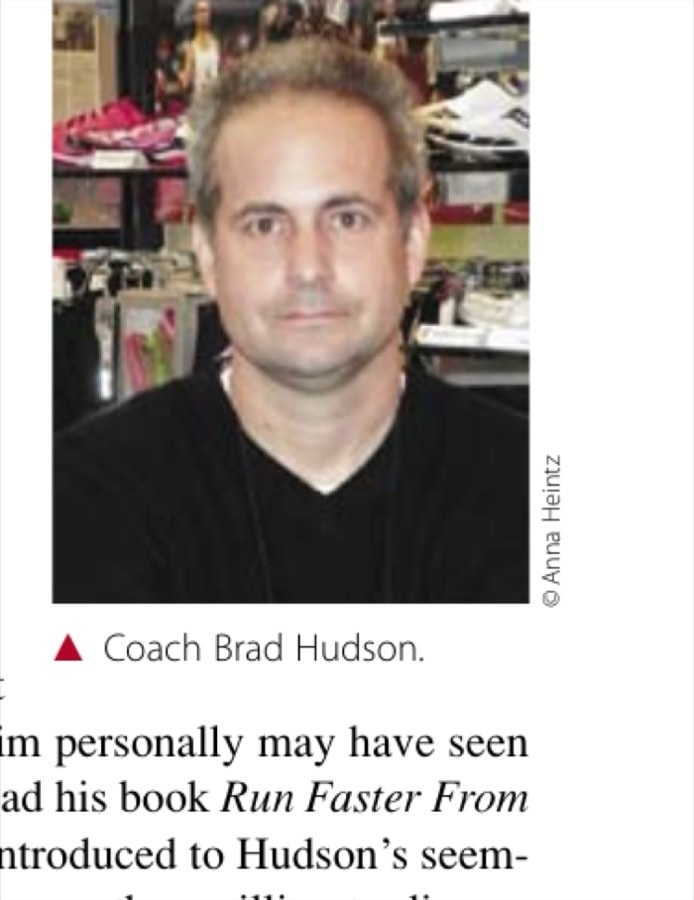
Hudson’s running has changed over the years; after thousands of miles and a back-wrenching bike ▲ Coach Brad Hudson. accident, he is learning to run all over again, albeit at a much slower pace. Those who have not met him personally may have seen one of his articles in Running Times magazine or read his
book Run Faster From the 5K to the Marathon. Now it is your turn to be introduced to Hudson’s seemingly infinite knowledge of the marathon. He was more than willing to discuss his running history, his coaching strategies, and the fundamentals he uses to train elite marathoners.
▲
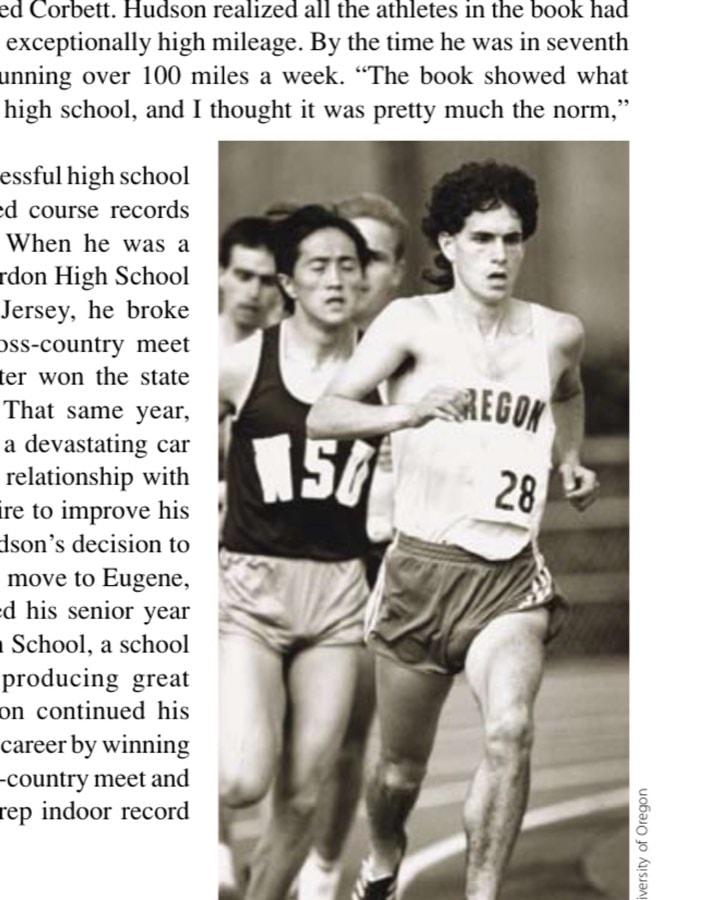
Hudson (#28) learned a lot about coaching from legendary coach Bill Dellinger while running at the University of Oregon.
© John Giustina, University of Oregon
Hudson’s first exposure to the marathon came in 1976, when he watched the Olympic Marathon in Montreal, Canada, and witnessed American Frank Shorter win the silver medal. One year later, he was a spectator at the New York City Marathon and watched Bill Rodgers win in 2:11. Hudson recalls buying his first Runner’s World magazine featuring Bill Rodgers on the cover soon after. Those exceptionally gifted runners sealed Hudson’s fate. Someday he would run a marathon.
Hudson started to work early on his goal of becoming an elite marathon runner. Before he entered high school, he read the book How They Train: Long Distances by Fred Wilt. The book contained workouts used by running greats like Gerry Lindgren and Ted Corbett. Hudson realized all the athletes in the book had one thing in common: exceptionally high mileage. By the time he was in seventh grade, Hudson was running over 100 miles a week. “The book showed what people were doing in high school, and I thought it was pretty much the norm,” says Hudson.
Hudson had a successful high school career, which included course records and championships. When he was a junior at North Hunterdon High School in Annandale, New Jersey, he broke the Van Cortland cross-country meet course record and later won the state cross-country meet. That same year, he lost his mother in a devastating car accident. His severed relationship with his father and his desire to improve his running solidified Hudson’s decision to leave New Jersey and move to Eugene, Oregon. He completed his senior year at South Eugene High School, a school with a tradition of producing great runners. Here, Hudson continued his decorated high school career by winning the Oregon state cross-country meet and setting the national prep indoor record in the 5,000 meters.
After graduation, Hudson took a year off from academics to focus on his long-time goal, the marathon. Hudson did not alter his training much, as he was already running over 100 miles a week. In the fall of 1985, he ran the Chicago Marathon in a time of 2:17, which was the third-fastest all-time World Junior time. In 1986, Hudson entered the University of Oregon as a freshman. Under the guidance of head coach Bill Dellinger, Hudson was an All-American in the 10,000 meters in 1987, was Pac-10 cross-country champion in 1988, and took ninth place in the NCAA Cross-Country Championships in 1989.
After college, Hudson returned to marathoning. He was initially sponsored by Adidas and later by Reebok. His marathon achievements include a second-place finish at the 1990 California International Marathon, where he ran a career-best 2:13:24, and wins in the 1992 and 1993 Columbus, Ohio, Marathon and the 1997 Detroit Marathon. While training during this time, Hudson averaged 110 to 125 miles a week. His staple workout was a weekly 10-mile marathon-pace run. The high mileage did not come without a price, though. He was repeatedly injured, went through many different coaches, and tried every type of training technique to improve his performance. In 2004, Hudson officially ended his professional running career, although he says it really ended in 2000. All of the mileage he ran as a kid left his 38-year-old body in run-down shape, and he never reached his goal of 2:11. “The mistake I made was doing a lot of the same type of training and not mixing it up,” recalls Hudson. “I made my easy days a little too moderate and my hard days not hard enough; 85 percent of running is just being healthy.”
The coach In retrospect, Hudson saw his mistakes and knew he could have been a better runner if he had trained smarter. He wanted to share this knowledge with others, so he began coaching in 2003. Unlike most coaches, who start at the high school or college level, Hudson has coached only elite runners. One of his first notable athletes was Shayne Culpepper, the 2004 Olympic Trials 5,000-meter champion.
When Culpepper came to Hudson, she had just had a baby and was trying to get back in shape for the Trials. Hudson looked over the last four years of her training and picked up on a common mistake many runners make. Her training consisted mainly of moderate aerobic training and speed work but lacked specific endurance workouts. Hudson introduced her to longer intervals and threshold runs to give her the speed endurance she needed for the 5,000 meters. In 2004, Culpepper won the 3,000 meters at the USA Indoor Championships and the 5,000 meters at the Olympic Trials.
After Culpepper’s success under Hudson’s program, he began gaining recognition as a coach and his athletes grew in number. In 2006, he started coaching a group in Boulder, Colorado, that eventually became Marathon Performance. He
has coached athletes such as Dathan Ritzenhein, Ed and Jorge Torres, Tera Moody, James Carney, and Boaz Cheboiywo. He currently has athletes in Colorado, New York, Michigan, and New Jersey. He hopes to eventu
ally coach 50 to 100 athletes through training camps. Hudson keeps close tabs on each individual despite being thousands of miles away from most of them. “The main thing about coaching elites is adapting to who you are coaching. Motivations are so different,” says Hudson.
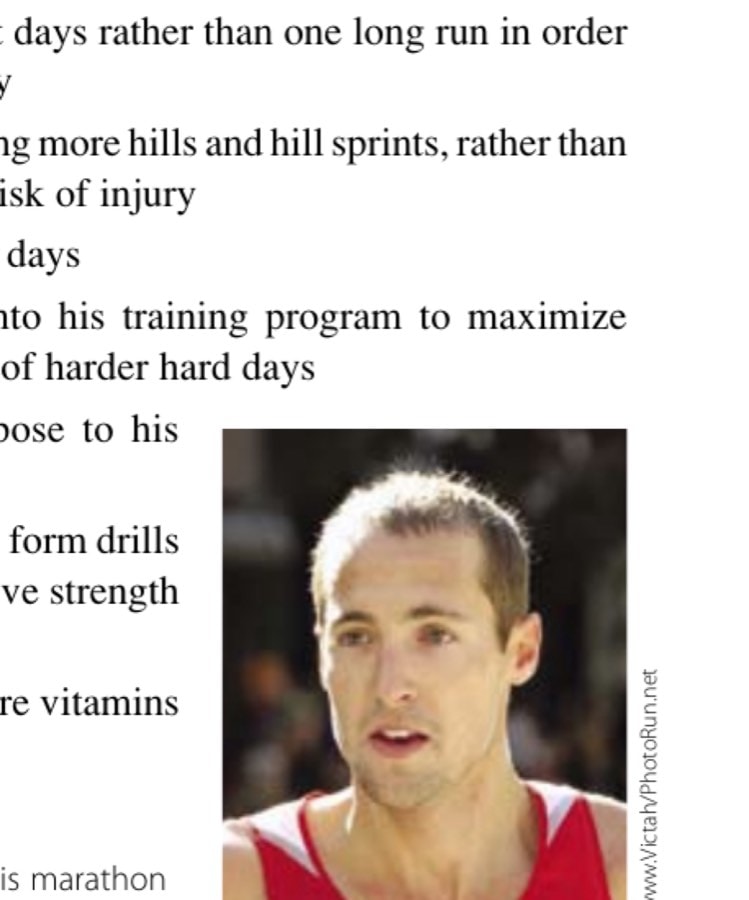
Hudson’s most notable athlete was probably Dathan Ritzenhein, whom he began coaching after the 2004 Olympics. Ritzenhein had been plagued with injuries and limped his way onto the Olympic team that year. Hudson changed
several things about Ritzenhein’s training to help him become stronger and faster and to reduce his chance of injury. The changes included: • Running two short workouts most days rather than one long run in order
to emphasize quality over quantity • Improving strength by incorporating more hills and hill sprints, rather than weight training, to minimize the risk of injury • Running on soft surfaces on most days •
Incorporating easier easy days into his training program to maximize recovery and improve the quality of harder hard days • Adding mileage and giving purpose to his runs • Incorporating more core work and form drills
into his training program to improve strength and efficiency • Improving his diet and adding more vitamins for better health and fitness ▲
Hudson helped Dathan Ritzenhein achieve his marathon PR of 2:10.
© www.Victah/PhotoRun.net
© www.Victah/PhotoRun.net
▲
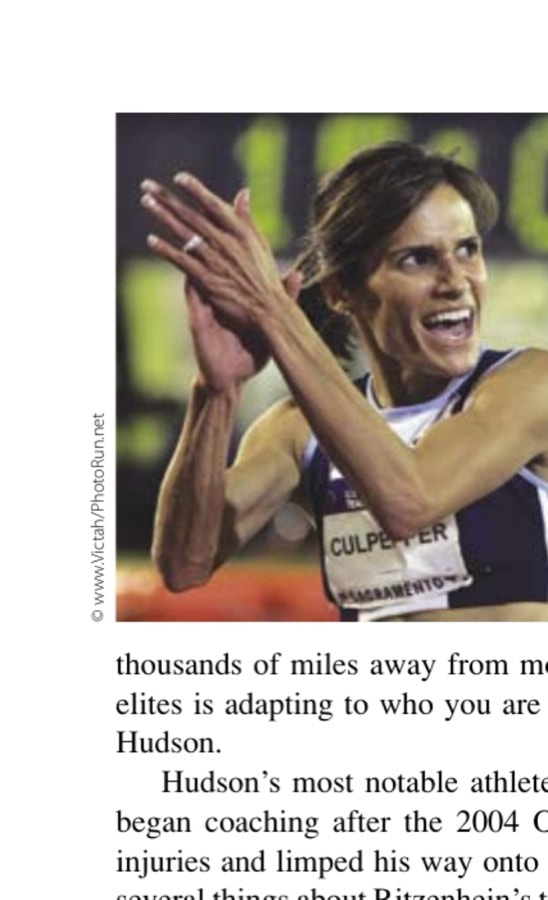
Under Hudson’s guidance, Shayne Culpepper made a huge running comeback after her pregnancy.
Hudson also recognized that his athletes needed to develop their aerobic systems further to be prepared to compete with the Kenyan and Ethiopian elites. Most elite U.S. runners enter the professional circle with eight years of aerobic development under their belts (assuming they competed in high school and college), whereas most Kenyan and Ethiopian elites have been running their entire lives, giving them a much more developed and solid aerobic base. To put his athletes on the same level as the Africans, Hudson tries to move them up to the marathon early in their careers. This helps them to develop their aerobic systems much faster. Hudson did this with Ritzenhein, putting him in the 2006 New York City Marathon, where he qualified for the Olympic Trials in a time of 2:14. Ritzenhein competed in the Trials and made the 2008 Olympic team in a time of 2:11. He placed ninth at the Beijing Olympics and followed up with a 2:10 in the 2009 London Marathon. The following May, Ritzenhein and Hudson parted ways, after Ritzenhein decided to join Alberto Salazar’s Nike Oregon Project in Portland. Two months after leaving Hudson, Ritzenhein broke the 5,000-meter American record.
Hudson’s marathon tips Novice and experienced marathoners alike can benefit from Brad Hudson’s performance marathon program. Whether you just want to finish your first marathon or to qualify for Boston, here are a few tips for training for your next marathon. Tip 1: Hudson suggests breaking down the marathon into four parts:
1. Miles one to eight should be run five to 10 seconds per mile slower than goal pace. 2. Miles nine to 13 should be run two to three seconds per mile slower than goal pace. 3. Miles 14 to 20 should be run at goal pace.
4. Miles 21 to 26.2 should be run under goal pace. The premise behind Hudson’s theory is that energy stores in the body should have enough reserves to run the last part of the race fast enough to make up for the slower pace at the beginning. The mistake many marathoners make is going out too hard in the first miles of the marathon and then becoming fatigued and cramped toward the end because the body prematurely burned its energy stores. If elite runners trained and raced this way, they would never have the energy to carry out those famous duels at the end of marathon races. “The number one problem for all marathoners is that they don’t know what they can and can’t run for the marathon, so they start too briskly and just run into problems. You can have the
▲
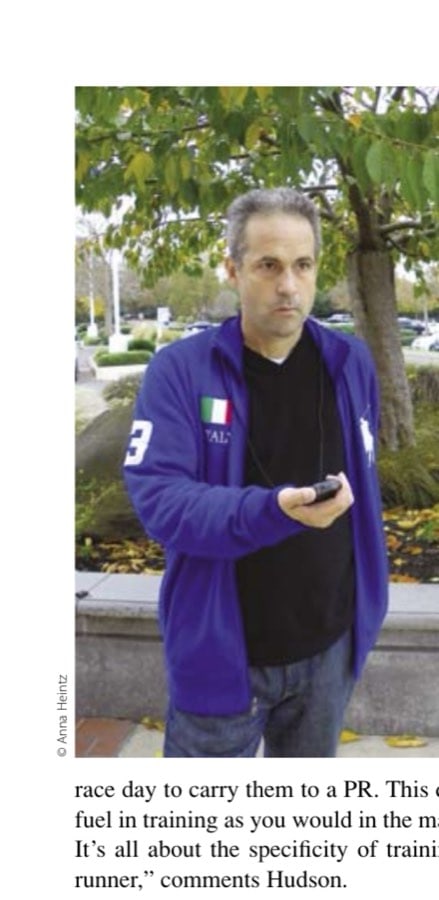
Brad Hudson currently coaches four elite athletes, including Mike Sayenko and Tera Moody, who were 10th overall male and female, respectively, in the 2010 Bank of America Chicago Marathon.
© Anna Heintz
best training in the world, but if you don’t pace yourself properly for the first 45 to 50 minutes, you’re going to run into trouble,” states Hudson. Tip 2: Run most of your long runs at goal marathon pace or 10 percent
slower, so that you are always burning the same fuel in training as you would on race day. Many marathoners make the mistake of running their long runs in training too slowly and then expecting adrenaline and the excitement of
race day to carry them to a PR. This does not teach your body to burn the same fuel in training as you would in the marathon. “The marathon is an event of fuel. It’s all about the specificity of training that makes you a successful marathon
runner,” comments Hudson. One training tip he gives his athletes: “We try to include a lot of long runs that are close to race pace or 10 percent within race pace and a lot of support runs which are within 20 percent of race pace. Some [training runs] are a little faster
than race pace.” The idea is to move your training runs closer to the time you want to achieve and be more specific. As in any other sport, you cannot expect to perform exceptionally better on game day than you have in previous weeks of practice.
Tip 3: Be willing to adapt your training schedule. One size does not fit all when it comes to training for a marathon. Recovery is different for each athlete. “Not everyone is the same and not everyone responds to the same training,” says Hud
son. “If you have three athletes do the same workout, the one thing you’ll know for sure is that they all had a different workout based on how they recover. You find out what their strengths and weaknesses are.”
For example, Jack and Jill run the same 8 800-meter workout at 90 percent of maximum effort, and the next day they both have a five-mile tempo run planned. Jack runs his tempo at 65 percent of maximum effort and feels lousy during the entire run. Jill runs her tempo at 75 percent of maximum effort and feels great. Both runners ran the same workouts but did not recover the same from the first workout. This is why marathon programs need to be adaptive, rather than written out all at once for a group of athletes. “Programs need to evolve and adapt. There is no ‘one’ program. Each program should be tailored toward the individual,” says Hudson. “I try to look at training through each cycle and change things so that athletes can improve depending on what they need.”
Hudson has a set of guidelines you can use to create your own adaptive marathon program: 1. Your first goal is to get to the starting line healthy. You work backward from there. 2. Put your easy days before your hard days. “A lot of elites need to be held
back because of injuries and because of overzealous training or else they will race their workouts,” says Hudson. If you are not fully recovered, you cannot run hard. The biggest mistake marathoners make is not going easy
enough on their easy days, nor going hard enough on their hard days. If all of your runs seem to blend together, you are not going to benefit from the workouts. It is better to run your easy run at what feels like practically
a walking pace so that you can do your next workout at the target rather than a mediocre pace because you had not recovered. 3. Put strength before speed. This is the best way to prevent injury. Some
marathoners believe that to get stronger they have to run strides and lift weights after a workout. This builds strength but you have a higher risk of overstriding or building up non-running specific muscles. It’s better to build
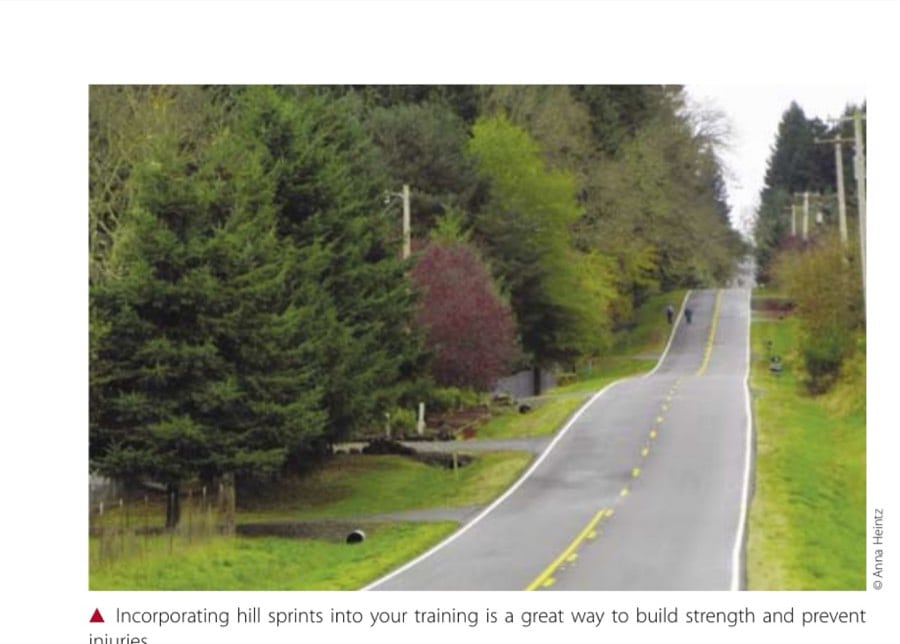
strength doing specific exercises that have meaning and will not allow you to overstride and get injured. For example, instead of running 100-meter strides on the track after your run, take the strides to a steep hill and run 8- to
10-second hill sprints (walking back down between each). This will allow your neuromuscular system to fire, strengthening specific running muscles used in the marathon, while also decreasing the risk of injury because you
are using the resistance of gravity. Hudson advocates using hill sprints rather than any other type of polymetric or weight-training exercises for runners. He advises starting with only two to three sprints for the first week or two
of your program and gradually working up to 10 to 12. 4. Finally, Hudson advises, “You need to look at what you’ve done in the past and then look forward.” Most runners have followed only one or two
© Anna Heintz
▲ Incorporating hill sprints into your training is a great way to build strength and prevent injuries.
different training styles over their lifetime, but there are many ways to train to maximize your potential in the marathon. The best way to realize this is to look at what has worked for you in the past and carry that into your
future, while leaving behind those strategies that have not worked. “When you have good athletes, you’ll realize it’s hard to get people to improve,” says Hudson. “You need to find little ways to get them to improve by
looking at their training and really fine-tuning things.” Although Hudson is not coaching people to simply finish the marathon but rather to perform at the elite level, he believes both beginners and advanced marathoners
can benefit from researching their past. Tip 4: Get with a good marathon program. This tip goes for both first-time and advanced marathoners. Beginners should find a good program where the goal is just to finish. “Do not worry about time,” Hudson advises, “and don’t do anything on race day that you have not done in training: shoes, socks, pace, gels, drinks, etc.” As for the more advanced marathoners, Hudson suggests they fine-tune their program. “If they have a strong aerobic base, like Shayne Culpepper had for many years, you definitely need to eliminate the waste and bring in the support paces closer to what you are trying to do and become more specific. Everyone is an experiment and everyone can learn what they need and how they respond to the training and what works for them.”
Inquisitive marathoners can contact Hudson directly on his Web site, www. marathonperformance.com, which he developed as a way to let people ask questions about their training. Hudson himself answers all the technical questions. You can find links to pages on each of his elite athletes, as well as videos and training logs. Over the years, Hudson has pulled coaching strategies from people in his past. “I look at everyone I can. I’ve had great coaches: Mike Manley, Bill Dellinger, Arturo Barrios, and Mark Wetmore. I’ve taken a little bit from each. That’s what you try to do: take the things you like and leave the things you dislike and hopefully carry that on.” Hudson considers his two greatest influences to be Terrence Mahon (coach of Ryan Hall and Deena Kastor) for his ideas on training and the Italian Renato Canova for his theory on using hill sprints for strengthening muscles.
Hudson recognizes that there is no “ideal” coaching strategy. There are many different types of athletes, each with different physiologies and psychologies, who require different coaches. “I think a good coach adapts to the athlete,” says Hudson. “There are different physical and psychological things to deal with. The goal is to get the athlete to improve.” Marathoners need to find a coach or a program that fits their needs and that will help them reach their goals. * * * Brad Hudson’s job is to turn great athletes into world-class athletes, yet anyone training for a marathon can benefit from his coaching strategies. This man from humble beginnings worked hard to become a successful athlete, and he gained much knowledge along the way. Runners looking to train for their first marathon, improve their PR, or train injury free will all benefit from the tips Hudson has given. He believes this knowledge should be readily available. More information can be found on his Web site or in his book. Hudson sums up, “I think everyone is an experiment of one and everybody can learn what they need and how they respond to the training and what works for them. I don’t think there are any secrets.” Happy running!
Brad Hudson—elite distance coach Residence: Eugene, Oregon Marathon PR: 2:13:24 Web site: www.marathonperformance.com Book: Run Faster From the 5K to the Marathon Fun Fact: Hudson played the role of Spanish runner Javier Alvarez in
the movie Without Limits.
This article originally appeared in Marathon & Beyond, Vol. 15, No. 1 (2011).
← Browse the full M&B ArchiveMore like this
1,000+ stories from 19 years of Marathon & Beyond
The complete archive of the legendary long-distance journal — digitized and free to read.
