

Between The “Crazy People”
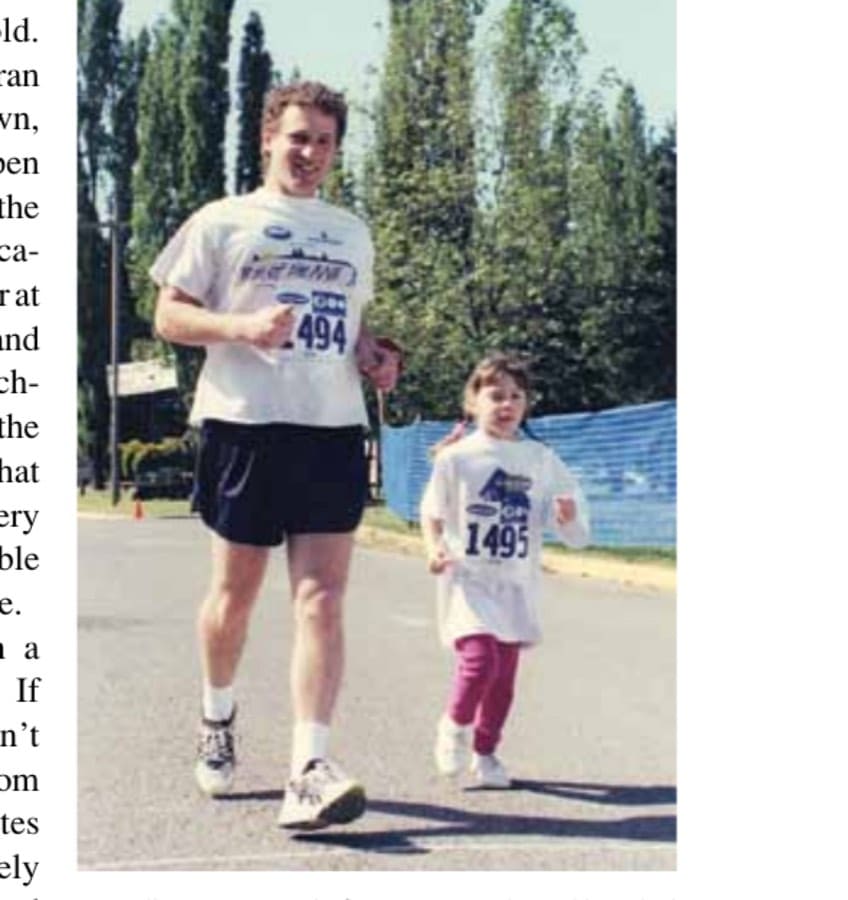
My dad ran his first marathon when I was 3 years old. Thirteen years later, I ran my first half. I should have known, growing up, that this would happen if that picture of him and me at the Daddy and Me Run was any indication. Perhaps if I had looked longer at the little girl in the pink leggings and the long pigtails sporting a muchtoo-long T-shirt and the man in the “real” running clothes wearing that pompously proud expression every father has, I would have been able to predict my own running future.
Running has always been a permanent fixture in our home. If the stench of salty sweat doesn’t clue you in, it’s the dirt left from my dad’s shoes that my mom hates cleaning up or the fact that I rarely see my dad wear a shirt purchased ▲ Following in Dad’s footsteps: Kayla and her dad from a store. The medals have taken at the Daddy and Me Run. over his office after 102 marathons and counting, and the pictures of him crossing the finish line are everywhere.
One picture cracks me up. My dad is nearing the end of the race, and in the picture he has his hands up, pointer fingers triumphantly piercing the air above
him. I always assumed he was too exhausted to realize that he meant to put his thumbs up, and in his defense, at mile 26 anyone would forget the order of his phalanges. The most important thing at that point is crossing the finish line and eating oranges and bagels and maybe getting a nice massage while yelping in pain as your muscles berate you.
With all this, you would think the whole family would be involved in the sport, but as I went through middle school and the beginning of high school, I decided that I hated running. My mom went through a running phase, and my brother’s running phase was even shorter than hers.
Naturally, we all decided my dad was crazy. In August of my sophomore year in high school, I agreed to join the crosscountry team with a friend. We began in the late afternoon, and I could almost feel the heat of the track as I struggled to keep pace with my teammates. I was more than disappointed to realize that I was the slowest one on the team. I assumed that a 10-minute mile was normal but these runners were flying and didn’t seem to even notice the sun’s violent burn. I couldn’t bear the thought of returning, and then my father, ever the wise one, sent me an e-mail.
A lot of it was the usual “Believe in yourself,” “I’m proud of you no matter what,” and so forth, not that none of that meant anything to me. It did. It meant a lot. But the part that really stuck with me was this: “I stuck with cross-country (and distance running) because I wanted to prove to myself that I could do it. Don’t worry about being faster than the others on your team; just focus on getting stronger and improving your own times. The rest will follow.”
A profound realization It was then I realized that if I don’t try to prove something, not necessarily to others but to myself, then how could I take myself seriously? If I felt inept or unable, it would be my own fault, and that would taint my view of myself for a long time.
Dad was right; the rest did follow. I sped up. I could run farther. I became more confident in my ability and even began sharing stretching advice with my dad. “I’m having knee problems,” I would say when I came home from practice. “
Here, try this,” he responded, promptly sitting on the floor and posing like a model in the beauty-queen stretch. Somehow, in those three years of cross-country, I became “crazy.” Instead of referring to the crazy person in the household, my mom would roll her eyes and say, “You crazy people.” I was in the club. I was official.
My dad had a different idea of official. We were in Oregon visiting family, and my dad and I were out for a morning run. I hit a rock with the toe of my right foot, and suddenly I was on the gravel.
“You OK?” was my dad’s first reaction. When I said I was and stood up, he began what I recognized as one of his wise-father talks. This one consisted of what falling meant for a runner. “You aren’t a real runner until you’ve fallen down,” he told me.
My dad is part of the Marathon Maniacs (#34), and his goal was to run a marathon in every state. He was going to Arkansas for his 37th state, 73rd marathon, and invited me along. I went, and just before my 17th birthday, I ran my first half-marathon at the Little Rock Marathon.
I’ll never forget that it was already warm when we started, and by the time I hit mile five, I had decided that I would never do this again. At mile eight or so, a fellow runner told her friend, “This sounded like a good idea when I signed up.” A supporter on the sideline kept yelling, “You’re almost there!” and I was rather disgruntled by the inappropriate comment. After all, we had five whole miles to go.
At the end of the race, I got a hat and a medal. I will admit that I felt that I had accomplished something. I didn’t want to do it again, but knowing that my feet could carry me 13.1 miles, that my leg muscles had proven their strength, and that my lungs and heart could stand the intensity, I felt pretty damn good.
After refueling and stretching, I waited for my dad and watched as he accepted a medal three times the size of mine. He smiled that smile I associate with pride and beckoned me over for a picture. Security said I couldn’t go back to that area now that I was out, but my dad played the “She’s my daughter and this is her first half-marathon” card. I pretended to be embarrassed, but secretly, it’s one of my favorite pictures.
Even though I swore that once was enough, I decided to give the half-marathon one more try. The North Olympic Discovery Marathon in Port Angeles is held on an amazing course, and I beat my time by about 10 minutes. The first half of the course was woodsy with bridges and rolling hills and birds cheering us on from the branches. The second half is along the water, so close that I could simply jump in without missing a beat. I found the scenery very inspiring, and it was almost easy to keep running and not stop. My family makes this Port Angeles trip every year, and the third time I ran the course, I achieved third place in my age group and got a plaque. My dad told every one of his running friends that he ran into and insisted that we check the results every 10 minutes, just to make sure.
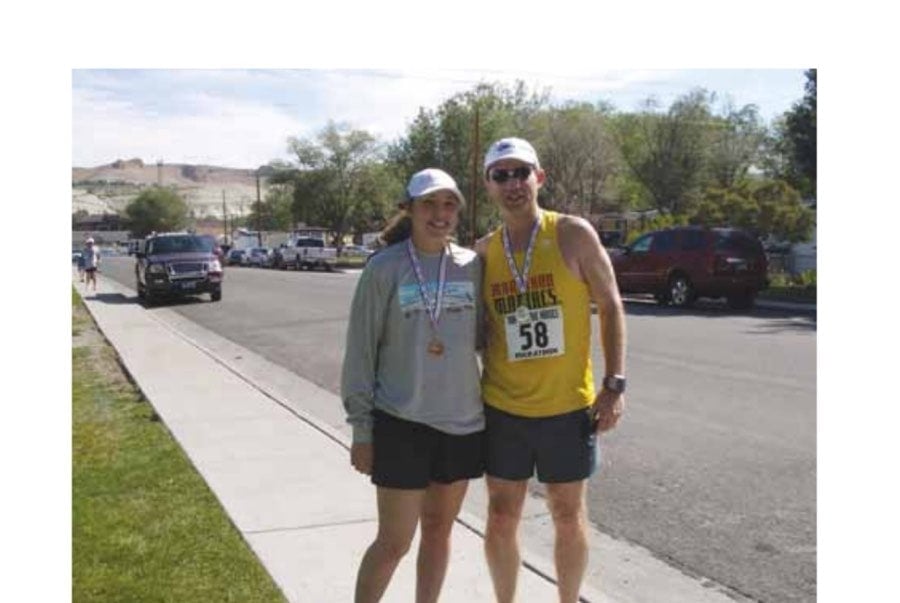
The states keep piling up When my dad ran Wyoming for state number 43, marathon 82, I went with him. Aside from the nonexistent finish line and primitive bathrooms at the start (aka
bushes), the Run With the Horses race in Green River ties with Port Angeles as my favorite course. We started on top of a butte where you could see nothing for miles except the town below. I suppose that’s good incentive to run. As I looked up and around, I realized there was nothing between me and the sky. Having lived in the Northwest my entire life, I was not used to this. Where I came from, there were always mountains or trees or hills. This was a new experience, and one that I will never forget. Along the way, there were wild horses, and I found myself romanticizing that they would run with me as I crossed the open terrain like in some bad movie, but all they did was stand still and observe all the crazy people. To them, we must have looked ridiculous: sweaty, huffing and puffing, and desperately trying to reach civilization. And logically speaking, it is rather insane to bus a group of people (this was a small race) wearing shorts and tank tops to the top of a butte in the middle of nowhere at 6:00 in the morning. But there it is. Port Angeles and Wyoming are wonderful, and my dad and I have some non-race-related places we love to run as well. Alki Beach, in west Seattle, is a nice place to run along the water. These are usually what I consider long runs and always end in a larger, delicious, calorie-filled breakfast at the Alki Café.
Just last summer my family took a vacation to Canon Beach in Oregon. Dad and I ran every morning, and it was incredible: the firm softness of the sand soaked
ad
▲ Many years later, the craziness continues for Kayla and her dad at Wyoming’s Run With the Horses Marathon.
from the night’s waves, the scattered seashells I couldn’t resist picking up, and the footprints we left behind as the waves crashed their applause. I’m 20 now and, true to form, still following in my dad’s footprints. I’m studying English in college and am still running. Although we don’t run together every weekend anymore, we still share running stories. If I strain my knees on the unforgiving hills, he tells me to ice and explains that “It’s just an ache or pain,” which usually is the case. If I had a particularly fantastic run, I’ll call and tell him about it. If he ran a race, he lets me know how he did. In March 2010, he finished his 50th state in Maryland, hitting 96 total marathons.
I owe my dad a lot. He never pushed me into this lifestyle but guided me when I needed help, and I know that he is proud of me. Although our relationship isn’t based on running, it is strengthened by the shared sport. We have an understanding between us that no one else in the family has. My mom doesn’t share this with my dad, and neither does my brother. This is just between the “crazy people,” and I’m proud of it.
I’ve come to learn a lot about my dad on our morning runs and now understand that pride is not just something a parent feels for the child but can also be something a child feels for her parent.
This article originally appeared in Marathon & Beyond, Vol. 17, No. 1 (2013).
← Browse the full M&B ArchiveMore like this
1,000+ stories from 19 years of Marathon & Beyond
The complete archive of the legendary long-distance journal — digitized and free to read.
