

Bigger is Better
FINDING THE PERFECT MARATHON
WHOEVER COINED the tidy little axiom “the more, the merrier” must have recently run a megamarathon. In New York, London, Honolulu, Paris, Los Angeles, Berlin, and Washington, D.C.—all host cities to running extravaganzas—the verity of this phrase is proved every time someone crosses the finish line—which is every second or so—and adds another weary but satisfied smile to the haze of collective exhilaration.
With a few possible exceptions—the frantic driver who encounters the obstacle of the megamarathon on the way to the airport, the disappointed runner who didn’t get an entry form in on time, the city sanitation workers forced to earn overtime cleaning up thousands of little cups—everyone stands to gain in a megamarathon.
These mighty races are for ladies, gentlemen, and runners of all paces—and for the world-class cities in which the marathons take place and for the spectating faithful who strain over police barricades to yell until they’re hoarse. The more the merrier.
So you want to run a marathon? Consider what it is you seek. Do you want a race? Or are you looking for an experience? A megamarathon is both. Do you want a solitary test? Or do you want a jogging jamboree?
IT’S A HAPPENING
When Grete Waitz describes her days on the “racing carousel,” it is evident that the aura of marathons in London and New York is still vivid in her memory. “When you run in big races,” she says, “it is a completely different atmosphere. There are spectators—you are never running by yourself. It is more than a race. It is a happening.”
Chris Brasher, the steeplechase gold medalist at the 1956 Olympics, observed the happening that was the 1979 New York City Marathon and stated: “Last Sunday, in one of the most violent, trouble-stricken cities in the world, 12,000 men, women, and children from 40 countries of the world, assisted by 2.5 million black, white, and yellow people, Protestants and Catholics, Jews and Muslims, Buddhists and Confucians, laughed, cheered, and suffered during the greatest folk festival the world has seen,” whereupon he founded the London Marathon, which debuted in 1981. Powerful marathons elicit powerful responses.
What is it, exactly, that makes a marathon a happening? The reasons for the beauty of the big marathon are as plentiful and diverse as the runners who enter them. First, a collection of runners from around the world gathers. And in every marathon with 25,000 entrants, at least 90 percent of the runners are not the world’s best.
No matter. What they lack in talent is made up for in the sense of belonging to a mass movement, tens of thousands strong. Distance feels less formidable, and the miles tick off more quickly when runners push each other along in a tidal wave of energy.
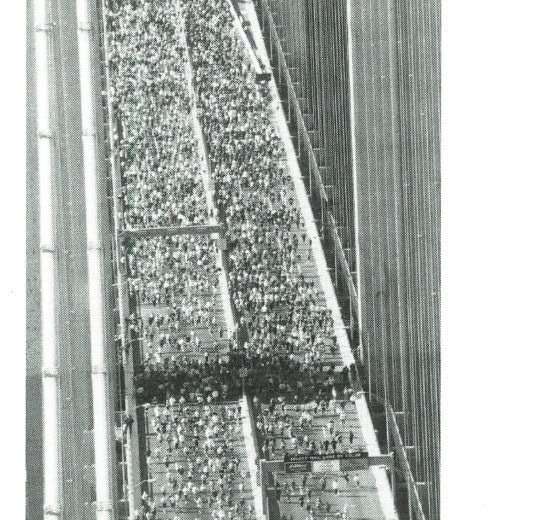
Running prudes argue that there are just too many people in a megamarathon—the start is crowded, and it’s difficult to establish a steady, rhythmic pace in the early miles. For those trying to reach or break a time goal, precious minutes are lost. But the alternative—arriving at the 20-mile mark without another soul in sight—seems far worse.
STRENGTH IN NUMBERS
The runner in a big marathon can expect strength to spring from within the race itself. It’s easier to hit the “wall” with hundreds of others who know exactly how you feel. So a few minutes are lost in the first few miles—misery loves company. So do runners. And for the back-of-the-packers, for whom time is of no object, friendships can be born in six hours and 26.2 miles. At some megamarathons, such as Honolulu, the finish line remains open and the clock ticks on until the last person finishes. Every runner, jogger, and walker records an official time. It is a proudly egalitarian event.
Simultaneously, megamarathons offer semi-elite runners the chance to compete in the same race as the elites. In what other sport can nonprofessionals compete against the pros? The school yard basketball champion never gets a shot at Michael Jordan, and the local tennis buff cannot sign up to return Steffi Graf’s slicing backhand. But for the price of admission, a 2:20 marathoner can line up next to the world’s toughest, fastest endurance athletes. A 4:20 marathoner runs the same course as the winner, under the same conditions. It’s all the same race.
Not only do runners run well at megamarathons, but the course runs well, too. Staging a marathon is precision science, and all entrants become the beneficiaries of technical finesse and logistical ingenuity. Marathons generally grow over the years. And as they do, the glitches disappear. These mega races evolve to a high level, because the organizers of complicated, crowded courses possess street smarts—a special kind of intelligence that comes from knowing a city intimately and being able to predict problems and solve them before they ever have a chance to occur.
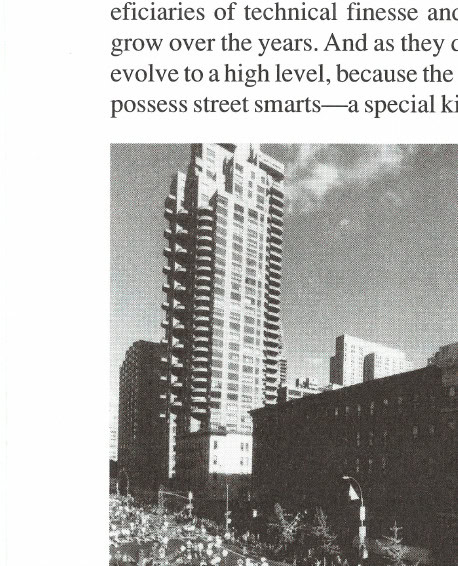
New York City Marathon race director Allan Steinfeld leans back in his chair and draws a graph in the air with his finger, depicting the growth of his event over time. “After each rise in participation,” he says, “there was a plateau for a few years, when we limited entry until all the problems were handled. Then we let it grow some more.” No race director wants a 25,000-person pile-up.
A few more luxuries of thoughtful organization include the assurance that when you check your baggage at the start you’ll find it waiting at the end, and that there’ll be a whole crop of port-o-sans waiting every few miles. Traffic stops for big marathons. Runners rule the road. There’s enough exhaustion without battling exhaust. There are aid stations, medical staff, volunteers, and plenty of water.
Marathoner Marty Chalfin has run the marathon distance 85 times, at least once in every state. “Large marathons always have water,” he says, and “this is important. Sometimes at small marathons, the race director announces, ‘No water. Gotta supply your own.’ At one marathon I went to, the water was from a well, with orange slices in it. It was brown. Just what I was looking forward to after 18 miles—a cup of brown well water.” Bottoms up, Marty.
The water guarantee is not to be taken for granted. But in addition, big marathons give away lots and lots of Neat Stuff: T-shirts, posters, energy bars, Band-Aids, ibuprofen, restaurant discounts, little wrist-strap velcro things to zip keys in to. You can even get your toenails checked for fungus, your posture evaluated, and your legs massaged at the finish.
You can expect a giant prerace pasta feast, with eau de tomato sauce hanging in the air, and a postmarathon party, for the surprising number of people who are still able to move after the race is over.
You can justify bringing the family to a megamarathon and making a weekend out of it. The New York City Marathon’s public relations office is overwhelmed months in advance with requests for course maps so devoted family members can plan when and where to make their moves to cheer their heroes home.
THE POWER OF THE CROWD
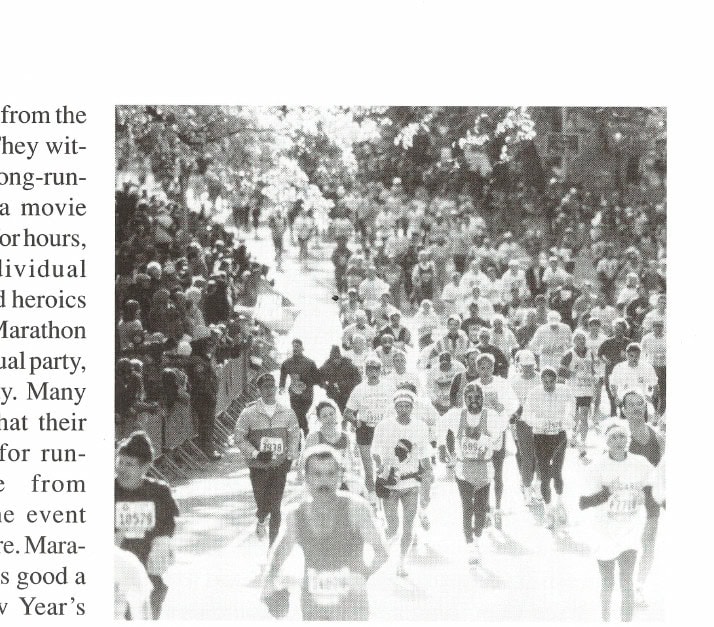
But the greatest gift tendered at a colossal marathon is the praise and approval of the spectators who fidget at roadside, waiting for their friends to pass by. The praise rings genuine, and loud, no matter how slow the runner—in fact, it is loudest especially for the slow runners. This must be how it feels to be a quarterback for a day.
In London, marathon officials estimate that 500,000 people turn out to watch; in New York, the number is guesstimated at 2 million. In the city with a reputation for hostility and coldness, strangers embrace the efforts of strangers.
Frank Shorter once said that “when you run up First Avenue in New York, if you don’t get goose bumps, there’s something wrong with you.” The residents feed the runners, setting up their own unofficial water stations, unofficial banana stations. There’s even, as marathon legend has it, an unofficial cheese blintz table in Brooklyn.
The relation between the runners and the crowd is symbiotic. Large marathons are interactive events. Spectators gain from the experience as much as the
runners gain from the spectators. They witness a very long-running show, a movie that goes on for hours, with individual struggles and heroics every mile. Marathon day is an annual party, a city holiday. Many will claim that their inspiration for running came from watching the event the year before. Marathon day is as good a time as New Year’s day to form resolutions. Inspiration, one finds, is reciprocal.
CITY REAPS REWARDS
The city itself reaps the rewards of hosting a huge marathon. Steinfeld has served as a consultant to many other marathons in many other cities. And he has always shunned the idea of having a marathon in some out-of-the-way location. “You can’t bring people to the marathon. You have to bring the marathon to the people. I always advise cities to put the course through the various neighborhoods, through the downtown. And if there are traffic tie-ups, so what?”
The Los Angeles Marathon course, which threads through many neighborhoods, offers South Central an opportunity to prove that bad public relations be damned, it is a very welcoming place.
When a course ends in front of a palace, as the London Marathon does—at Buckingham Palace—the city surely earns tourist dollars from marathoners and their families. Different cities have unique sights to see and diverse populations to experience, and marathoners appreciate that. A well-known race then attracts TV coverage, and the city looks pretty spiffy on the air. Trees are pruned, potholes get filled along the route. Mayors take the success of their city’s marathon as a personal triumph.
As a result, the local population is aware—and proud—of the race. Walk into a beauty salon, a school, a construction site, a restaurant, and the residents are ready to talk marathon and pick their favorites. Running grows more popular—it becomes more and more of a grassroots movement.
When the excitement is inescapable for even the marathon chauvinist, the “race-ist,” then a megamarathon helps bring running into the mainstream. The megamarathon has mass appeal and makes it not only all right to run, but also the height of fashion. Everyone is doing it, or knows someone who is doing it—either the hairdresser or the waiter or the teacher or the daughter of the boss. Running finally makes its way onto the sports page, and in so doing, gains legitimacy in a way that a smaller event in a remote corner of the country never could.
“BIG” IS BIG NEWS
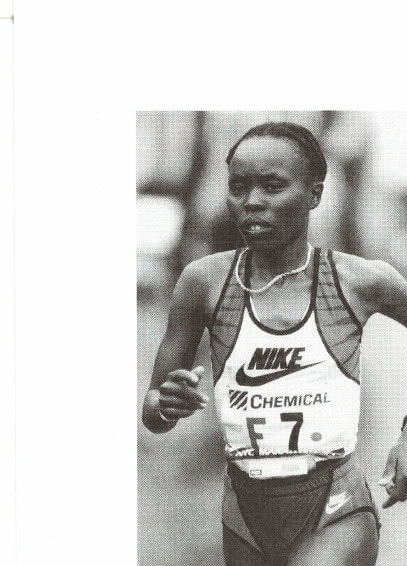
News of big marathons spreads to remote places, especially when elite athletes are involved. When Tegla Loroupe won her debut marathon in New York City in 1994, word of her victory made it home to Africa quickly, and public opinion about women running changed swiftly. Loroupe had previously been discouraged from running by gossiping neighbors and members of her tribe who thought it was inappropriate for women to devote themselves to athletics. It took a mere two hours, 27 minutes, and 37 seconds for the 4’11”, 21-year-old Kenyan to begin to dismantle a system of belief that had prevailed in her country. In 1995, when she won New York again, Kenyans greeted Tegla at home with a hero’s parade.
Similarly, the 1994 New York City Marathon men’s winner, German Silva of Mexico, returned to his country and met with government officials eager to congratulate him. The result of that meeting was that Silva’s hometown was wired for electricity. The consequences of winning a megarace can extend far beyond individual profits.
When Tegla Loroupe returned to New York in 1996 in an attempt to three-peat, she told the press, “In Kenya, they don’t write about the Olympics in the newspapers. But they write about the New York City Marathon.”
The more likely scenario is that Kenyan newspapers now report whatever events Loroupe attends.
New champions are made at really large marathons; winning establishes world-wide reputations. At the same time, already-famous champions return to reputable races.
BIG NAMES AT BIG RACES
Olympic medalists and world champions do not enter obscure marathons. They come to major marathons seeking great competition, and they find each other at megamarathons. Fast times and great duels are expected and rewarded. The starting line is an extensive exhibition of talent, with any number of runners poised to set course records, national records, world records. Elite athletes find generous prize purses, high visibility, and prestige. In 1991, Joan Benoit Samuelson commented, “It would mean more for me to win New York than to come back and do another Olympic marathon.”
But that’s just it about megamarathons. They mean more. Everyone who participates, whether spectating or running, at 5-minutes-per-mile or 15-minutes-per-mile pace, finds that the experience is greater than they bargained for. It is more than just running.
An event with thousands of entrants takes on greater significance than the physical feat of covering 26.2 miles by foot. There is an added intangible quality that is difficult to pinpoint. It is an emotional thing, this running business. There have been more than a few misty-eyed spectators, overwhelmed by watching the efforts of everyday people. And tears from the runners who cross the finish line and hate to see the race end.
They finish a megamarathon, and they say they feel connected to something bigger than a mere race—and they are. They can’t help themselves. Multiply the power of running by 25,000, and it equals a happening—a very memorable happening.
This article originally appeared in Marathon & Beyond, Vol. 1, No. 3 (1997).
← Browse the full M&B ArchiveMore like this
1,000+ stories from 19 years of Marathon & Beyond
The complete archive of the legendary long-distance journal — digitized and free to read.
