

Bipolar Madness
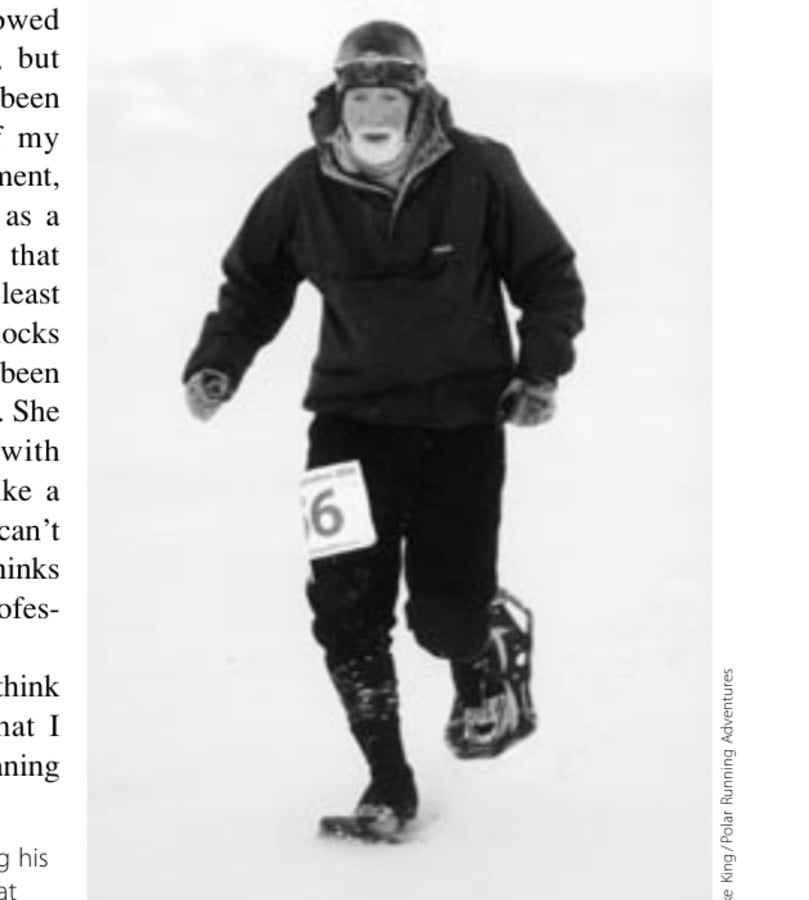
The author snowshoeing his way to a 6:13:15 marathon at the 2006 North Pole Marathon.
© Mike King / Polar Running Adventures
My all-consuming love affair with polar running began innocently enough. The event that seduced me into the situation was just a whim, a one-night stand of sorts. I never dreamed that something so simple and harmless would blossom into a wild ride filled with such desire and passion. Since that fateful trip to Baffin Island in 1995, the journey has been nonstop, with no end in sight. My wife—yes, I’m a happily married man—has allowed the affair to continue, but she hasn’t necessarily been happy about some of my choices. In one dark moment, she referred to herself as a running widow. Wow, that is just plain mean. At least she hasn’t changed the locks on the doors when I’ve been away on my adventures. She thinks the obsession with my polar mistress is like a merry-go-round that I can’t get off by myself. She thinks perhaps I need some professional help.
Of course, I don’t think so. I know exactly what I need: just one more running
trip to the Arctic or Antarctic. Just one more fix for this running junkie and then I will be OK—at least for a while, anyway. Why not just continue to run one event after another until the obsession and the fascination with my polar mistress dies a natural death? It can’t go on forever, as there is a season for everything. I will eventually tire of her siren song and no longer feel the attraction and the pull. However, until then, I have permission to continue, because my wife told me several years ago that I could run as many marathons and ultramarathons as I wanted, for as long as I wanted.
I know what you are thinking: no way would a spouse agree to such a ridiculous arrangement. Well, I assure you that it is true, and this is why I’m in such an enviable position. Both of our sons had recently graduated from high school and were going to college when my wife, Sue, was out for her daily walk with our two Australian shepherd dogs, Cosmo (my running buddy) and Pepper. Five blocks from where we lived, she spotted her favorite house with a For Sale sign in the yard. You can probably guess the rest. She hurried home and said we should go look at the inside of the house, just for laughs and giggles, of course. She loved the house, and that is when she made the crazy unlimited-marathons comment. However, today she readily admits her memory might be a little fuzzy on the history of that momentous occasion. However, I remember it like it happened yesterday. I naturally agreed to such a fantastic house (running) deal and made a full-price offer on our current home. It is the only time in my life I have made a full-price offer on a piece of real estate. It is the income from my apartment rental business, not my teacher’s salary, that pays for the marathon travels. There was another unspoken reason Sue agreed to my dream deal, thereby helping me down my chosen path of polar madness. Cancer!
A DEAD MAN “You should be dead,” my ROTC (Reserve Officers’ Training Corps) commanding officer told me. It was 1970, and the Vietnam War was in full swing. I started laughing at the guy and told him that was the best joke I had heard all day. After all, I was a track star attending the University of Northern Colorado on an athletic scholarship and believed I was healthy as a horse, not to mention stubborn as a mule. He got this dead serious look on his face and said, “You have been classified as 4-F, physically unfit for military duty, and your military career is over. Any malignancy disqualifies you from the service.” “Sir,” I said, “there must be some problem with the paperwork or perhaps some mistake occurred when I went for my physical at Warren Air Force Base in Cheyenne. I’m really looking forward to being commissioned as a second lieutenant in the Air Force, going to boot camp, and serving my country.” My begging would do no good. “Son, you are one lucky guy. I’m going to give you a copy of your medical records so you
can see what I’m talking about. Didn’t your parents ever discuss the cancer with you?” In a state of shock, I replied, “No sir, they didn’t.” My parents were dirt-poor Kansas kids from the small farming town of Iuka. They both lived through the Great Depression and used common sense and German discipline to raise us three kids. Raising kids back then didn’t take a college degree and a panel of experts. As a teacher, I cringe at all the psychobabble I see being dispensed today by psychologists and the so-called child-rearing experts to help confused parents raise their unruly children. In our family, behavior was black and white and justice was swift and sure. There were no shades of gray or concerns about self-esteem.
My parents had no medical insurance in 1961 when I was diagnosed with lymphoma (reticulum cell sarcoma) at age 12. The doctors told them the prognosis was ultimately poor, my chance of clinical survival (living longer than five years) was less than 1 percent, and that I would probably be dead in six to 12 months. Looking back, it is no wonder they didn’t tell me that. However, not much changed for me. I had to quit playing the trombone because it put too much pressure on my neck, the site of the surgery where the lymph glands were removed. There was the occasional doctor or hospital visit when I was getting my radiation and chemotherapy treatments. I still had to do my chores, and in my young mind, life seemed pretty normal except for one curious fact. After my surgery and radiation treatments, I rode the train every three months from Cheyenne to the University of Utah Medical Center for checkups. It was great fun because I got to travel, buy comic books to read, and eat in the dining car. Today, I’m somewhat embarrassed that I didn’t figure out my cancer before I got to college. However, back then people didn’t talk about cancer, and there were no support groups. My naïve nature and zest for life obviously prevented me from dwelling on my medical problems. To me, the medical issues were just a nuisance I had to tolerate, rather than a problem to be worried about. I was too busy being a country kid—riding horses, ranching, rodeos, sports, and exploring any new environment I found interesting. By the grace of God, I’m still doing that. My wife claims that the reason I’m still teaching seventh grade after 31 years is that I’ve never grown up. I take that as a compliment.
FIVE CANCERS AND COUNTING Since my youth, I have had other kinds of cancer on four additional occasions. They have all been confined to the left side of my neck and head. The most serious occurred in 1984 while I was studying in Israel on a Fulbright scholarship. One morning while looking in the mirror, I noticed an uncontrollable twitch under my left eye. For some reason, I knew the cancer was back. It was strange because I had this sense of calm and didn’t feel the need to rush back to the United States.
My wife met me in Tel Aviv, and we took a bus trip through the Gaza Strip to Cairo. Once I was back in the United States, a biopsy and pathology report confirmed the tumor was malignant—a myoepithelial carcinoma of salivary-duct origin. The surgeon removed one of my parotid glands and scraped the trigeminal nerve. As a result, the left side of my face was paralyzed for five months, and I talked out of the corner of my mouth like a gangster who had survived one too many street fights. The subsequent radiation treatments destroyed many of the remaining microcapillaries that had been compromised by the radiation I had received as a child.
My running buddies jokingly tell me they enjoy running with me at night because of the faint green glow my skin emits. Actually, I have very poor circulation and little or no feeling in my left ear and nearby face tissue. That fact has presented special challenges with extreme cold-weather events. The surgery also left me with a diminished supply of saliva and impaired jaw function. For example, I cannot open my mouth much more than an inch, and gracefully eating a Big Mac is definitely out of the question. The other three cancers have been basal cell carcinomas (skin cancers) that were easily removed. As I write this, I have eight stitches in my neck from the latest surgery. My wife is a nurse and could probably explain all this stuff much better than I do. When we were first dating and the thought of marrying her crossed my mind, I told her, “As a husband, I might be a bad gamble with my cancer history. I probably won’t live to see my 40th birthday.” Generally I’m an optimist, and loser statements like that don’t fall from my lips. Fortunately, my short-lived negativity didn’t discourage her, and she hooked me anyway. I’m sure those comments influenced her decision making with regard to my ongoing affair with the polar seductress. Sue travels with me some of the time, which seems to help keep my polar madness somewhat in check. However, during those quiet times when she is not there, I hear the siren song tempting me once again to the ends of the earth. As I indicated, it all began 11 years ago on Baffin Island.
BAFFIN ISLAND One of my running buddies, Mark Lisak, had informed me about a race in the Far North that was subsidized by a mining company and therefore a relatively cheap way to visit the high Arctic. I thought, Wow, I could actually become a Polar Pacer, whatever that meant. However, it sounded cool (forgive the pun), and I’m always up for a good challenge. The Polar Pacers have organized a race on the northern shore of Canada’s Baffin Island, 480 miles north of the Arctic Circle, each year since 1979. Runners from around the world gather to race along the road connecting the mining community of Nanisivik to the Inuit village of Arctic Bay. In 1998, the Polar Pacers celebrated the 20th anniversary of the Midnight
Sun Marathon races. The new Canadian territory of Nunavut was created on April 1, 1999, and the mine stopped subsidizing the race. After 20 years of racing in Nanisivik, the first official marathon in Canada’s newest territory was held on July 2, 2000, with the races taking place in Arctic Bay, rather than Nanisivik. On July 2, 1995, I made the first of what would become several trips north of the Arctic Circle. I had never seen the midnight sun and remember staying up the entire night and watching the sun make a big circle in the sky. All the houses at the mining camp had blackout blinds on the windows so folks could sleep at night because it was so bright.
One of the highlights of my polar baptism into running was the memorial service the night before the race at Terry Fox Pass, the high point on the road between Nanisivik and Arctic Bay. A memorial plaque and stone cairn mark the spot dedicated to one of Canada’s best-known heroes, Terry Fox, who helped raise millions of dollars for the Canadian Cancer Society with his courageous “marathon of hope.” I instantly felt a special bond with the place and his spirit. Each year from 1995 to 2000, I made the pilgrimage north to that special place. I also learned how to use snowshoes and ran Alaska’s Iditasport, completed the Antarctica Marathon on King George Island, and became the first person in the world to run ultramarathons on all the continents. (You can read the details in the September/October 2000 issue of Marathon & Beyond, “Beyond the Distance” by Teresa L. Wolff, pages 88-98). Thus began my quest for the icy grail and all things polar (see chart on the following page).
DEFINE POLAR REGIONS As a geography teacher, I make a clear distinction between true polar marathons and all the others. A true polar marathon or ultra is one that occurs north of the Arctic Circle or south of the Antarctic Circle. Those imaginary lines of latitude are generally considered to be the boundaries of the earth’s polar regions. Obviously there are other locations on earth, such as the summits of high mountains, that have polar conditions. Polar conditions also exist during the winter months for events such as Iditasport, Yukon Arctic ultras, Susitna ultras, Arrowhead 135, and others. For polar purists, the above definition requires us to carefully consider our choices of which marathons we want to run. Race organizers tend to promote and market their races with slogans like “the world’s toughest race,” “the world’s highest marathon,” “Antarctica’s only marathon,” “the world’s only marathon run on water,” and other tags that sometimes contribute to a lack of geographic understanding and subsequent geographical ignorance. For example, I’m a member of two “prestigious” and “honorary” running clubs created by race directors to market their events and recognize runners’ accomplishments. I belong to the “Marathon Grand Slam Club” and the “Seven Continents Club.” The first club
Date
Race
Distance
Location
Latitude
7/2/1995
Midnight Sun
26.2 miles
Nanisivik, Canada
73.02 N
6/30/1996
Midnight Sun
84K
Nanisivik, Canada
73.02 N
7/6/1997
Midnight Sun
84K
Nanisivik, Canada
73.02 N
7/5/1998
Midnight Sun
100K
Nanisivik, Canada
73.02 N
7/2/2000
Nunavut Runs
84K
Arctic Bay, Canada
73.03 N
1/22/2002
South Pole Marathon Ultra
45K
Geographic S. Pole
90.00 S
4/17/2003
1st Annual North Pole Marathon/Ultra
45K
Geographic N. Pole
90.00 N
4/9/2004
2nd Annual North Pole Marathon
26.2 miles
Camp Borneo, N. Pole
89.50 N
8/8/2005
N.W. Passage Marathon 35 miles (Somerset Is.)
Resolute, Canada
74.11 N
4/8/2006
3rd Annual North Pole Marathon
26.2 miles
Camp Borneo, N. Pole
89.50 N
12/22/2007
3rd Annual Antartic Ice Marathon
26.2 miles
Patriot Hills, Antarctica
80.19 S
awards T-shirts and recognizes people who have run a marathon on every continent and at the North Pole. The back of the T-shirt reads “The Marathon Grand Slam Club: North Pole, Africa, Antarctica, Asia, Europe, North America, Oceania, South America.” I was surprised to see Australia wasn’t listed. According to my geographer’s brain, Oceania is a region and Australia is a continent. Does my obsession have me splitting hairs? Perhaps. I once ran a marathon marketed as “The First Marathon of the New Millennium” in Hamilton, New Zealand, located over 1,000 miles from Australia. However, it counted as my Australian marathon because the tour director said it was in Oceania and therefore part of Australia. It is this kind of mumbo-jumbo geography and fuzzy reasoning that helped motivate me to organize the first true polar marathon and ultramarathon on the continent of Antarctica. (You can read about the details of that epic and very controversial race along with the early history of ultrarunning in Antarctica in the May/June 2002 issue of Marathon & Beyond, “My Most Unforgettable Ultramarathon,” pages 41-54.)
GROWTH IN THE NUMBER OF ANTARCTIC RUNNING EVENTS
© Mike King / Polar Running Adventures
Running competition on the continent of Antarctica is increasing, as are environmental concerns. As a geographer and race director, I want to respect the environment and honor the rules and regulations that have been established to protect ecosystems and landscapes. Current and future race directors will want to educate themselves concerning the permits and environmental documents that are required to conduct events in Antarctica; otherwise, future running events may be jeopardized. Most runners, especially trail runners and adventure runners, would agree that we need to protect the environment. The Antarctic Treaty and related protocols have been established to do just that. When events are conducted in Antarctica, the documents require us to follow certain procedures to protect the continent. The wilderness and pristine environments are what draw us to these remote areas in the first place.
There are at least three opportunities to run a marathon or ultra in the Antarctic Region. Two events (the Antarctic Ice Marathon and the Last Desert Stage Race, stage two only) are held on the continent proper, and one (the Antarctica Marathon) is located on an island off the coast of the Antarctic Peninsula. Runners could also help protect the continent by asking race directors for evidence that the proper permits have been obtained. However, this idea is probably not realistic. Having been a race director for over 30 years, I have never had a runner ask to see copies of our race permits. That is just something most runners don’t think about. Perhaps if you go to Antarctica, that thought should be on your radar screen. We all want to protect the environment for future visitors to enjoy.
▲ Record field of 54 runners for the start of the 2006 North Pole Marathon. The author is far left carrying the Wyoming flag.
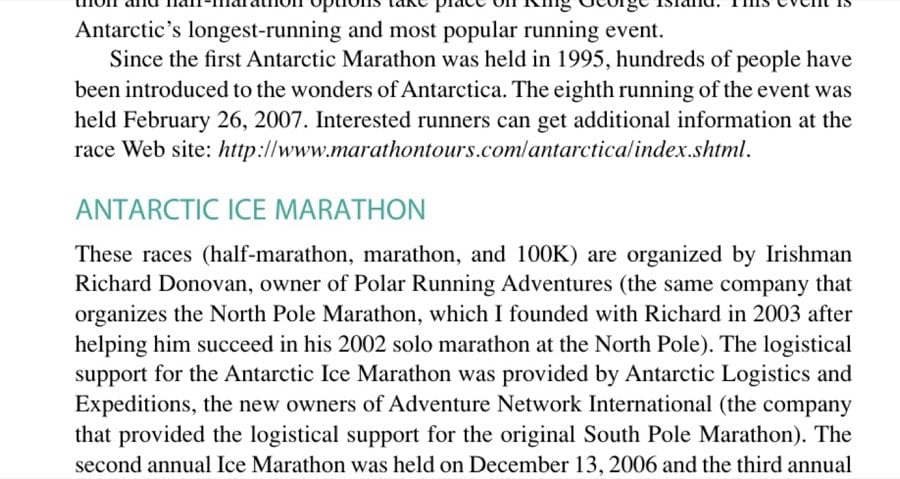
More people have been to outer space than have run a marathon on the continent of Antarctica. Until a few years ago, more people had stood on the top of Mount Everest than had been to the North Pole. The Third Annual North Pole Marathon in 2006 saw a record field of 54 runners complete the “world’s coolest marathon.” Despite the dangers and the remoteness of these locations, race directors and runners continue to seek out new challenges.
Since 2002, the number of running events held on the continent of Antarctica has tripled from one to three. The South Pole Marathon has currently not been rescheduled. Of the two new events, only one (Antarctic Ice Marathon) is held south of the Antarctic Circle, thus making it the only true polar marathon in Antarctica at this time. Runners have a choice if they want to run an organized marathon or ultramarathon on the continent. A significant number of Antarctic running firsts occurred in 2006. We witnessed the first marathon at Patriot Hills, the continent’s first 100K, the first stage race, the continent’s first 100-miler, and the first marathon held on Deception Island.
ANTARCTIC MARATHON Even though it doesn’t take place on the continent proper, the Antarctic Marathon is the grandfather of marathons in the Antarctic Region. Thom Gilligan, owner of Marathon Tours & Travel, pioneered the event over a decade ago. The marathon and half-marathon options take place on King George Island. This event is Antarctic’s longest-running and most popular running event. Since the first Antarctic Marathon was held in 1995, hundreds of people have been introduced to the wonders of Antarctica. The eighth running of the event was held February 26, 2007. Interested runners can get additional information at the race Web site: http://www.marathontours.com/antarctica/index.shtml.
ANTARCTIC ICE MARATHON These races (half-marathon, marathon, and 100K) are organized by Irishman Richard Donovan, owner of Polar Running Adventures (the same company that organizes the North Pole Marathon, which I founded with Richard in 2003 after helping him succeed in his 2002 solo marathon at the North Pole). The logistical support for the Antarctic Ice Marathon was provided by Antarctic Logistics and Expeditions, the new owners of Adventure Network International (the company that provided the logistical support for the original South Pole Marathon). The second annual Ice Marathon was held on December 13, 2006 and the third annual race was December 22, 2007. Details can be found at the official race Web site: http://www.icemarathon.com/.
On January 7, 2006, the inaugural Antarctic Ice Marathon was held in the vicinity of Patriot Hills (80.19 S), Antarctica. The 26.2-mile marathon is cur104 l MARATHON & BEYOND l MAR/APR 2008
rently the world’s southernmost marathon and the only race open to the public held within the Antarctic Circle. I specify that it’s open to the public because the Scott-Amundsen Station at the South Pole has an annual Race Around the World 5K that is closed to outsiders. Having been to Patriot Hills twice before, I pioneered several running routes and the original marathon course, which included two laps around Patriot Hills with a climb up and down Windy Pass on each loop. The geography of Patriot Hills and the Antarctic winds have created a natural blue-ice runway that jets land on. The new Donovan course included one large 15-mile loop around Patriot Hills with a smaller 11-mile loop out and around an old aircraft crash site. I intentionally avoided using this loop in the original course design because you would typically have to battle a prevailing head wind on the return to camp. The average elevation of the race was approximately 3,000 feet in the foothills of the Ellsworth Mountain Range.
The marathon race was followed the next day by the frozen continent’s first 100K (62.1 miles). Not just content to be the race director, Donovan completed the run alone in a time of 15 hours, 43 minutes, and 55 seconds. The race distance represented almost 10 percent of the total distance from Patriot Hills to the South Pole. Please see the chart below for the list of finishers.
GETTING READY FOR ANTARCTICA’S FIRST STAGE RACE It was difficult to choose between the Antarctic Ice Marathon and the Last Desert Stage Race. The deciding factor was the opportunity to run in Antarctica’s first stage race and the possibility of running the longest ever race held on the continent Rank
Name
Sex
Nationality
Time
Russia Ireland England England Scotland England England
5:09:38 5:16:31 5:39:35 5:43:38 6:33:30 6:41:06 6:51:04 6:54:27 7:10:50 15:43:55
Marathon
1 2 3 4 5 6 7 8 9
Evgeniy Gorkov
Male
John O’Regan
Male
Steven Seaton
Male
Mark Tointon
Male
Wendy MacKinnon
Female
Stephen Cushing
Male
Stevie Matthews
Female
Diarmuid Smyth
Male
Mike Pierce
Male
Ireland USA
Richard Donovan
Male
Ireland
100K
1
proper. As fortune would have it, running the Last Desert turned out to be my cup of tea and a fantastic decision. However, I must admit that missing Antarctica’s first 100K two weeks earlier was a huge disappointment. Richard Donovan had to run the epic 100K by himself, as none of the Antarctic Ice Marathon runners were up for another race so soon after finishing their historic marathon. Anyone with deep pockets can sign up for the Antarctic Ice Marathon, but the Last Desert is by invitation only.
I am always the teacher, so my preparation for the Last Desert trip involved my seventh grade geography students having the opportunity to experience the adventure vicariously. I have found the Internet and the World Wide Web to be two of the most powerful tools available to students and teachers. I prepared the following Internet lab sheet for them to use on their electronic field trip to Antarctica. (On the worksheet, Weendog is my nickname.)
Join the Virtual Adventure to Antarctica January 24–February 1, 2006 Hello students! Use the suggested Web site below and related links to follow the “Running Weendog” as he races in Antarctica. This is an electronic, real-time, real-event, field-trip activity. For daily race updates, use the
following Internet address: http://www.racingtheplanet.com/thelastdesert/live/index.shtml. You can also read why your teacher wants to return to the world’s most inhospitable continent. Click on the following link: http://www.racingth
eplanet.com/thelastdesert/live/feature-article-three.shtml. Internet technology will allow you to follow the race and see how the Weendog is doing. You can also e-mail him by following the on-screen in
structions. For additional information (biography) about Dr. Weigner, click on the following link: http://www.marquiswhoswho.net/brentjamesweigner/. Instructions: Use a separate sheet of paper to answer the following
questions. All papers must include the question and answer combined into a well-written blended sentence. Papers are due February 3. 1. What is the official name of this Antarctic race? 2. The runners will depart for Antarctica from what city?
3. Weendog is running to raise money for what charity? 4. The tip of the Antarctic Peninsula is approximately how many degrees south of the equator? 5. King George Island is part of what island group?
6. Name three kinds of penguins the runners might see during the race. 7. The race begins on what island? 8. What is Dr. Weigner’s official race number? 9. How many hours difference (time zones) is it between Cheyenne
and Punta Arenas, Chile? 10. The finish line is located near what bay? 11. How many total runners are taking part in the race? 12. Name Chile’s capital city. 13. What are the coordinates for Chile’s capital? 14. How many days does the race last? 15. What is the total distance of the event (all stages combined)? 16. The race includes how many stages? 17. List all required (compulsory) equipment the runners must carry. 18. Describe five (5) hazards the runners will face. 19. What makes Deception Island a unique geographical feature? 20. Athletes will see penguins on the course. Name the most common
penguin in Antarctica. 21. Name the two most deadly predators facing penguins in the water. 22. On land or ice, what is the penguins’ only natural enemy? 23. During the race, what will race organizers provide for each runner? 24. Where will the runners sleep each night? 25. Weendog was in what place after the first stage? 26. How long did it take Weendog to finish the second stage? 27. How many miles long was the longest stage? 28. At the finish, if Weendog headed straight north, he would come to
what continent? 29. What was Weeny Weendog’s average speed (miles per hour) for the race? 30. How many e-mails did you send to the Weendog? 31. After all stage times were added together, coach Weendog finished in what place? 32. What was Weendog’s official finishing time? 33. What kind of prize or award did the Weendog receive for finishing the race? 34. The Racing the Planet organization holds races in what four deserts? 35. Who was the first person to reach the geographic South Pole?
Bonus Questions: 1. What official document governs how countries use the continent? 2. What is IAATO? 3. Why should we protect the Antarctic environment? Are you curious about the first marathon race to the South Pole? Visit the following Web site: http://www.angelfire.com/wy2/marathon/South PoleMarathon.html.
BIG PILE OF ICE AND SNOW My youngest son, Scott, is an English teacher at McCormick Junior High School where I teach. He fancies himself as something of a philosopher, and he asked me, “How does a man know he is wealthy?” My response was, “It depends on how you define wealth.” I consider myself very spiritually wealthy. He then told me some Oriental wisdom: “A man is truly rich when he knows he has enough.” I agreed with him that I have enough of everything except experiences. I crave new experiences. Just before my trip departure, one of my teaching colleagues across the hall, Kevin Cates, asked me, “You have flown to the South Pole, you have run to the South Pole, and this will be your fifth trip to Antarctica. What’s wrong with you? It is just a huge pile of snow and ice, and the travel costs are so outrageous.” After he asked that question, I decided to try to answer it with considerable thought. After all, admitting my polar madness and writing about it might make it easier to diagnose and treat.
I learned many things in my previous visits to Antarctica, and now I seem to need more knowledge to quench my unrelenting polar thirst. Scientists recently discovered flowing rivers connecting huge lakes underneath the ice cap. They had previously discovered the large lakes, but not the rivers. This fascinating fact stretches my brain. Unfortunately, misinformation floating around about Antarctica and polar regions continues to drive me crazy. It just validates the truth found in an old Wyoming expression: “The trouble with most people ain’t necessarily ignorance, it’s what they know that ain’t so.”
Many unsuspecting folks who read Antarctica stories in the newspapers and elsewhere know a lot of things that ain’t so. I have seen a number of press releases and stories claiming that people have done this activity or that event at the South Pole, when in fact the activity occurred several hundred miles away along the coast and in some cases on islands located off the continent. The difference between Antarctica’s Polar Plateau (where the South Pole is located) and the continent’s coastline and islands is very substantial. The danger is multiplied many times over because of the extreme temperatures, extreme elevation, and extreme isolation found on the inte108 l MARATHON & BEYOND l MAR/APR 2008
rior of the continent. During the summer months near the South Pole, it is typically 30 to 60 degrees colder than it is along Antarctica’s coast and especially along the Antarctic Peninsula (the “banana belt” of the continent) that stretches northward. The South Pole’s elevation is approximately 9,300 feet above sea level.
To make learning fun and factual, I give my students extra credit if they find examples of geographic ignorance in the news media. Here is a gem that one of my students found in December 2005. Have you seen the Coca-Cola commercial on television that shows dozens of penguins on the ice? On a snow ridge above the penguins, a polar bear and her cubs are looking down at them. One of the bear cubs slips and slides down the slope and ends up among the penguins, and they bring him a Coke and have a grand old party. Problem: polar bears and penguins live at opposite ends of the planet. Penguins live in and around Antarctica, and polar bears live in the Arctic. They never get together, not even at Christmas.
It is no wonder so many students and adults are confused about geography. Those kinds of irresponsible ads support my theory that we are losing a whole generation of young people, because they are being seduced by television and American pop culture. I wanted to present more factual information about Antarctica for my students who would be following the Last Desert adventure via the Internet. Several of them already knew some things about Antarctica, because they had viewed movies such as March of the Penguins and Eight Below.
The White Continent sings a song of seduction that has lured me several times since 1992. Logically, the attraction makes no sense and seems to defy explanation. The thoughts, feelings, and emotions evoked by the world’s last great wilderness create in me a sense of mystery and awe. Just the thought of possibly returning to Antarctica causes great excitement, goose bumps, and anxiety—all at the same time. Part of the drama is the realization that Antarctica can be a very dangerous place. Despite the obvious dangers associated with extreme cold and a two-mile-thick ice cap, not-so-obvious dangers lurk outside most people’s realm of experience.
The siren song of such a beautiful environment can lull us into careless behavior. I’m reminded of that fact by the story of Canadian Gareth Wood’s 900-mile trek (the “In the Footsteps of Scott” expedition in 1985) to the South Pole. Starting at the coast near Ross Island, the expedition was crossing an ice sheet next to open water. All of a sudden, a leopard seal came out of the water and grabbed the unsuspecting explorer’s leg. His partners had to use the spearlike front tines of their cramponed boots to repeatedly kick the seal and drive it away. I’m sure the attack was a case of mistaken identity because Gareth doesn’t look anything like a penguin. However, hungry seals don’t care, and neither does Mother Nature when it comes to your well-being. After a scuba diver was killed by a leopard seal near one of the scientific research stations, station managers began to advise their scientists to use caution when in or near open water. In Antarctica, open water is
where most of the action is. Except for a mite and some extremophiles, nothing lives permanently on the continent during the long Antarctic winters; everything migrates to the water. Before my first visit to Antarctica, I read Charles Darwin’s book, Voyage of the Beagle. When the first sailors to Antarctica ran out of tallow for their candles, they would improvise by cutting off the heads of penguins and sticking a wick down the penguin’s necks. The makeshift candles burned quite well because of the high fat content. I can only imagine what the cramped quarters on small sailing ships smelled like. Darwin relates another story about a man who fell overboard and was unable to be rescued because skua birds kept divebombing him. They were trying to pluck out his eyeballs for lunch. Outside of the water, penguins’ only natural enemy is the skua bird. In the water, penguins are stalked by leopard seals and killer whales (orcas). Skuas feed primarily on the eggs and chicks of penguins, as well as fish, human waste, and basically anything edible they can find. However, they have been known to attack living things many times their size. During Antarctica’s first ultramarathon in 1999 on King George Island, several runners reported being divebombed by skuas. One runner’s head was slightly cut when a belligerent bird knocked off his stocking cap.
PENGUINS VERSUS RUNNERS Penguins aren’t meant to run, but they do. They have wings, but they don’t fly, unless you count flying underwater. Penguins’ movements on land remind me of how some competitors look when finishing the ultramarathon leg of a long stage race. They are waddling more than they are running. Furthermore penguins are similar to adventure runners in other ways. The birds congregate in out-of-the-way places, they are curious, they are tough and resilient, and they endure extreme climates.
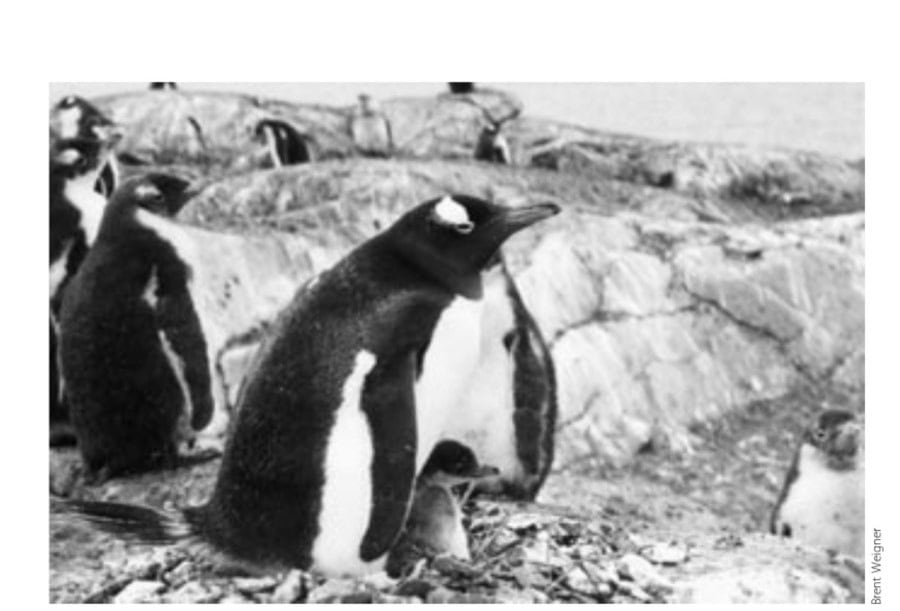
Runners in Antarctica always enjoy encounters with penguins because the birds have no fear of humans. You can quietly sit down in a rookery, and within minutes you will have a dozen curious birds (especially the chicks) pecking at your clothing zippers and rubber boots. You may notice penguin highways (think trail race on snow and ice), packed-down snow trails where the birds march from one nesting site to another in search of dry ground for their nests. Dry ground is at a premium, and most penguins (not the emperor penguins, because most of them live closer to the continent proper and not on the islands and Antarctic Peninsula) fiercely guard their nesting site. Gentoo penguins actually use loose stones to build their nests. One of their favorite pastimes is stealing stones from their neighbors’ nests.
Penguins are smart. I’m not so sure about some runners. (Memo to self: why would you want to run the North Pole Marathon three times?) Notice how long it takes penguins to leave the ice for the water. No bird wants to go first because it might end up on the menu for an ocean predator. Unlike humans, the penguin gene
Brent Weigner
▲ A mother Gentoo penguin and her chick are curious about the runner tourists near their nesting site. The nests are made of stones.
pool continues to improve through the process of natural selection. We humans, on the other hand, go to great extremes to protect everybody and keep everybody alive at whatever cost. It doesn’t work that way in the rest of the animal kingdom; if you are stupid, you perish. Mother Nature’s warning signs are very subtle and never spell out, “Danger. Beware.”
However, humans, unlike other inhabitants of the animal kingdom, are time binders. We generally learn from generation to generation, and we tend to build on the knowledge that has gone before us. We supposedly get smarter rather than simply accepting the notion of survival of the fittest. We use our knowledge to conceive new adventures. That realization is one of the things that drew me to Antarctica this time around. If successful, our team will make history by becoming the first group of explorers to run a stage race in Antarctica. Since Antarctica settled into its present polar position about 40 million years ago, nobody has attempted such an athletic competition. Yes, a few of us did run a marathon to the South Pole in 2002. However, it wasn’t 150 miles in several locations, and this time we are doing it not for prize money, a sponsor, a king, or a country, but for fun. Wow!
QUALIFICATION FOR THE LAST DESERT To qualify for the Last Desert (the final event of the Four Deserts series), I had to successfully complete the other three deserts—self-supported, seven-day, 250-kilometer footraces across some of the planet’s most forbidding deserts. I completed
the Atacama Crossing in Chile on July 10, 2004. (You can read about that adventure in the July/August 2005 issue of Marathon & Beyond, “Running on Mars: Outer Space or Spaced Out?” pages 18-36.) On April 30, 2005, I finished the Gobi March in China. On October 1, 2005, I jogged past the Pyramids in Cairo, marking the end of the Sahara Race in Egypt. My wife was a member of the medical team for all three of those events. Her university teaching responsibilities, however, prevented her from going to Antarctica with me. Just getting the invitation to the Last Desert was a very demanding project and a huge challenge. Eighteen competitors from around the world qualified for the Last Desert, and 15 of us paid our $9,500 entry fee and showed up in Punta Arenas, Chile, ready to meet the next challenge. The event was a wonderful family reunion because everybody knew each other from the previous three desert races we had all run to qualify.
THE LAST DESERT STAGE RACE The Last Desert consisted of four stages totaling 250 kilometers (155 miles) on the Antarctic Peninsula and nearby islands. Stages one and four were located on King George Island (home to the Antarctic Marathon); stage two took place at the Argentine research station, Esperanza, on the tip of the Antarctic Peninsula; and stage three was on Deception Island. Contrary to what most people would think, the majority of terrain was not ice and snow (we didn’t need our snowshoes) but dirt roads around research stations, mud, rocks, boulder fields, scree, volcanic cinder, sand, glacial streams, thermal streams, and some snow (during the blizzard) and ice (on the glacier). The second stage included the continent’s first 100-miler. The third stage included the first marathon on Deception Island, and the fourth and final stage included a double traverse of Collins Glacier on King George Island.
Temperatures were generally around freezing or slightly warmer, the exception being the blizzard, 60-knot winds, and windchill of minus 30 degrees Fahrenheit (minus 34 Celsius) during portions of the 100-mile stage. Unlike the previous Four Deserts races, we were not required to be self-sufficient. Meals were provided, and we slept in bunks on the ship except during the 100-mile stage. We had to wear backpacks, but they were relatively light with a bare minimum of survival gear. Doing a self-sufficient stage race on the continent of Antarctica (especially in the interior on the Polar Plateau) would be beyond the abilities of most runners, not to mention the extreme danger and prohibitive costs involved.
PUNTA ARENAS, CHILE Some of my fellow competitors and friends started arriving in Punta Arenas, Chile, on January 21, 2006. Punta sits on the southern tip of Chile on the western side of the Strait of Magellan and is the largest and most interesting city in Patagonia. I arrived on January 22 and soon hooked up with my roommate, Gunnar Nilsson,
from Sweden. We knew each other from the previous Four Deserts races. He had recently been accepted into the Badwater Ultramarathon (talk about out of the freezer and into the frying pan). We were the only two from our merry group who liked to sleep cheap and eat big. One of Gunnar’s hobbies is cooking, and he always seems to find new and interesting foods when he travels. We stayed at an $18-a-night hostel three blocks from the official hotel, the pricey Hotel Isla Rey Jorge (King George Island Hotel). On January 24, we had the official runner check-in and inspection of mandatory equipment. The equipment list was huge, and I had enough gear for an expedition to the South Pole; well, maybe not quite enough—no tent, because we would sleep on the boat between the stages. After several flight delays and an extra night in Punta, we finally departed for King George Island around 9:00 A.M. on January 26. Traveling itineraries and schedules mean nothing in Antarctica because everything is weather dependent. In the past, some adventurers have had to wait as long as two weeks before getting to the ice. Luckily for us, we were just flying to one of the islands rather than to the interior of Antarctica.
STAGE ONE—10 KILOMETERS/6.2 MILES: KING GEORGE ISLAND Thursday, January 26, 2006 We had a smooth flight across the Drake Passage with clear views of Cape Horn. The plane landed at a surprisingly large airport on King George Island, sometimes referred to as Antarctica’s unofficial capital because of the large number (nine) of national research stations located there. King George Island is the largest of the South Shetland Islands and the site of Antarctic’s longest-running marathon, the Antarctic Marathon. Shortly after landing, we were escorted to our new home for the next week, the DAP Mares, a ship that is used for both scientific research expeditions and adventure expeditions. Other than the crew members on board, it would be our private ship for the entire trip. Within hours we were transported by Zodiac from the DAP Mares to the Russian Station, Bellinghhausen, located on the shore of Maxwell Bay. The first stage was an out-and-back 10K dirt road course to Collins Harbor, at the foot of Collins Glacier, which we would later traverse twice during the fourth and final stage of the Last Desert. The temperature was near 40 degrees Fahrenheit with a slight breeze. This warm-up run was intended to allow us to test our kits and make any last-minute adjustments before things got serious. Therefore, this stage was not a race, and all the finish times were recorded as one hour. Back on board the ship, we lifted anchor and set course to the Antarctic Peninsula. Our route would take us across the Bransfield Strait to Hope Bay and the Argentine Station, Esperanza (“hope” in English). Tomorrow we would do the long stage, a planned 80 kilometers.
STAGE TWO—160 KILOMETERS/100 MILES: ESPERANZA Friday to Sunday, January 27 to January 29, 2006 Hope Bay lies in the Antarctic Sound, and the area is often referred to as “Iceberg Alley” because of the large number of icebergs passing through. Hope Bay was given its name in 1903 by a Swedish expedition leader, Otto Nordenskjold, when three members of his ill-fated expedition were forced to winter over. You can see the ruins of the stone hut built by the Swedish explorers. Hope Bay is also home to the world’s largest colony of Adelie penguins, approximately 400,000. We chased many of them off the road during each loop of the race. Culturally speaking, one of the most interesting things about Esperanza is the little-known fact that this site was home of the first native-born Antarctican. On January 7, 1978, a station commander’s wife gave birth to a baby boy. Who likes surprises? This morning we were officially informed that the second stage would in fact be 160 kilometers (100 miles) long instead of 80. The Argentine commander of Base Esperanza would graciously allow us to use the cook hut/staff canteen for two days and nights if needed. The race staff decided the runners should make history by doing the longest run ever held on the continent. I was thrilled and began to mentally prepare myself for a sleepless night or two.
The race began around noon with sunny skies and temperatures just above freezing. American Scott Smith immediately took the lead with Chuck Walker, Kevin Lin, and me in hot pursuit. The racecourse was roughly a two-mile loop consisting of dirt and gravel roads connecting the various camp buildings and boulder fields (glacial moraine). Each undulating lap had the runners climbing a steep hill on the dirt road near the start and then descending a rocky and very treacherous section on the backside of the course. During later portions of the race, some runners were actually knocked to the ground in these areas by 60- to 70-knot winds. About six hours into the race, runners were informed of a mandatory stop for dinner. Lap totals and times were recorded as each runner arrived at the cook hut and was directed inside for dinner.
Having thrown caution to the wind by going out hard with Scott and Chuck, I was feeling the effects and now enjoyed the opportunity to eat and recover. It became apparent that our total times for this stage would be skewed, because the race clock was stopped during mandatory breaks. There were other mandatory stops because of darkness and the blizzard. My ultrarunning philosophy has always been, if the clock is running, I’m running, or at least moving slowly. As we ticked off seemingly endless loops, I occasionally smiled to myself wondering about signs that should have read Penguin Crossing, because the little guys were encountered on each lap.
As the race progressed, the weather deteriorated to the point that it wasn’t safe at times because of the poor visibility, and thus a mandatory stop would be
called. The prerace favorite, Kevin Lin, struggled with the cold, as we all did, and was going in the hut after each lap to warm up. One by one, the majority of runners finished the long stage in various degrees of fatigue resulting from the wind, cold, and 100 miles of challenging terrain. I finished in position number four, feeling that I had left everything on the course. Three runners would need to complete the distance the next day when we arrived at Deception Island. Early finishers were also forced to spend another night on the floor of the kitchen hut because high winds prevented the Zodiacs from reaching the ship. The following day, fog prevented an early departure. The extra night and day allowed runners the opportunity to buy souvenirs from the Argentine station personnel, write postcards, look around the camp, and recover from their Antarctic ordeal.
STAGE THREE—42 KILOMETERS/ 26.2 MILES: DECEPTION ISLAND Monday, January 30, 2006
Brent Weigner
Running the marathon on Deception Island would mark my third visit to the collapsed volcanic cone. Despite periodic eruptions, Deception Island’s Port Foster is one of the safest natural harbors in the world. During my first visit in 1992, we hiked to Neptune’s Window, a break in the caldera’s wall, to see some of nature’s greatest endurance athletes, the arctic tern. These champions of long-distance flying
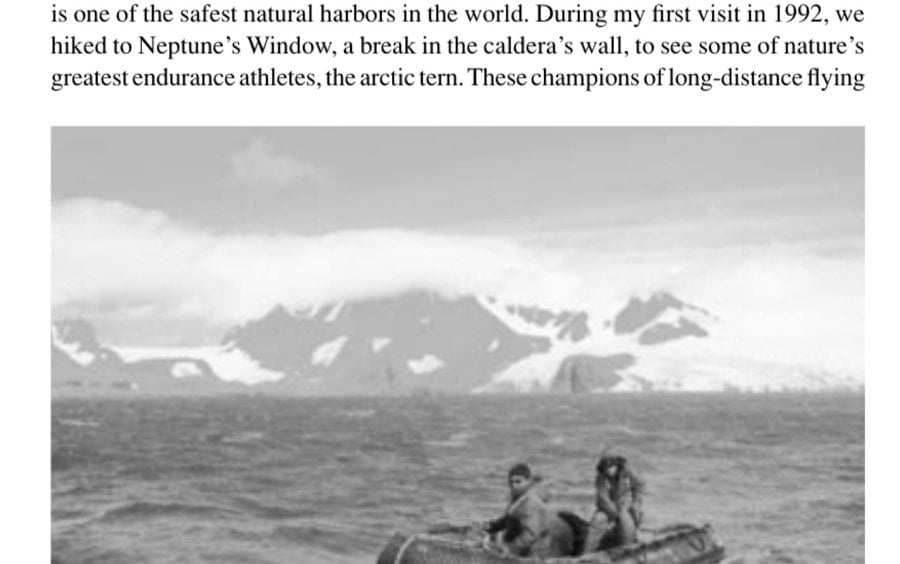
▲ Zodiac boats were used during each stage to ferry runners ashore.
migrate every year back and forth between the Arctic and Antarctic. The volcano that created Deception Island is not extinct. Eruptions have occurred as recently as 1991 and 1992. Historical reports document a time during the 1920-21 whaling season when the harbor boiled so hot that it removed the paint from the hulls of several ships. (Memo to self: do we really want to go swimming there?)
Despite the 16-hour trip (and rest) from Esperanza to Deception Island, most competitors were still pretty hammered from the 100-mile stage. Everybody looked forward to finishing the marathon stage so we could soak in the geothermal waters of Pendulum Cove. The race began on shore near Whaler’s Bay. At the height of Antarctic whaling, 13 floating factory ships operated here processing whales. We would run past the ruins that remained as a grim reminder of those earlier activities.
Our multiple-lap course followed the volcanic sand beach along Pendulum Cove, across several streams, and then climbed a steep 500-meter hill leading to Neptune’s Window. From there, we plunged downhill through loose sand and dirt before climbing another steep hill with poor footing. The remainder of the up-and-down course snaked past rocky ridges and dirty snowdrifts and across numerous streams created by melting glaciers and snow. The weather was good, with the temperature around freezing and a slight wind. Kevin Lin smoked the course, but Scott Smith’s lead was too substantial for Kevin to be a serious threat in the overall standings. This stage turned out to be my poorest finish (seventh place) of all the stages. Fortunately, my overall standing was not affected very much because of my strong showing in the 100-mile stage. After three stages, everybody seemed to be healthy, with nobody reporting injuries. I guess the other three deserts had hardened us enough for the Last Desert challenge. One stage to go, and the task would be complete.
STAGE FOUR—30 KILOMETERS/18.6 MILES: KING GEORGE ISLAND Tuesday, January 31, 2006 Arriving back where it all began, our merry little bunch of vagabond runners was anxiously anticipating the conclusion of our odyssey. Today’s two-lap course was primarily a very hilly road race along the same road used for the Antarctic Marathon and for stage one of our Last Desert event. However, the route included a couple of boulder fields with river crossings and a one-mile traverse across Collins Glacier on each lap. Once again, the weather was near perfect for Antarctica, around 32 degrees Fahrenheit with very little wind. Barring a total meltdown or broken leg, Scott Smith had the race in his pocket. The best possible race of the day would be between Chuck Walker and Kevin Lin. Chuck had about an hour’s lead on Kevin going into this final stage. They ended up running together for the
ad
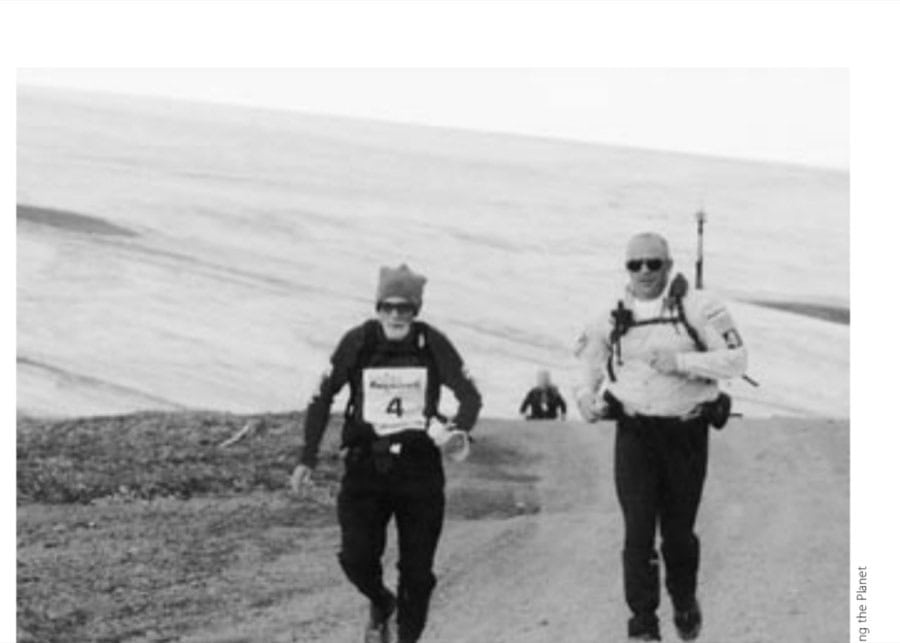
Mary Gadams / Racing the Planet
▲ The author (left) and Chuck Walker (right) during the fourth and final stage of the Last Desert Stage Race on King George Island. You can see Collins Glacier in the background.
entire race, crossing the finish line tied for first place. I thought third place would be mine; however, one mile from the finish, Matt Chapman came flying by me. I would happily settle for fourth place. As the runners finished near the grounded icebergs lining the beach, they toasted one another with bottles of champagne. Antarctica’s first stage race was officially concluded. I convey a hearty “Well done” to my friends who accepted the challenge (see results on page 123). You have now earned bragging rights as a new breed of Antarctic explorer, a Four Deserts Stage Race Warrior. What’s next?
ROAD RACE TO THE SOUTH POLE? I’m laughing as I write this. One of my former cross-country runners, Laura, just sent me a magazine she thinks explains my condition and why I’m still so nuts about running after all these years. Actually, she said it was the title of the magazine that defines my mental illness—Geezerjock. I’m not kidding. There is
6
9
15
4
16
10
12
13
8
3
7
5
11
1
2
1
2
3
4
5
6
6
6
9
10
11
12
13
14
14
Rank No.
Masashi Hayakawa
Satoru Otsuka
Derek T. Kwik
Gunnar Nilsson
Vincent L. Carroll
Alasdair G. Morrison
Lisanne C. Dorion
Joel E. Burrows
David P. Kuhnau
Nancy Fudacz-Burrows
Matthew R. Chapman
Brent J. Weigner
Kevin Lin
Chuck Walker
Scott P. Smith
Name
Japan
Japan
Hong Kong
Sweden
Ireland
Scotland
USA
USA
USA
USA
Australia
USA
Taiwan
USA
USA
Nationality
MM
MM
MM
FM
MF
MM
MM
MSex
62
65
37
50
46
57
40
30
35
38
29
56
28
39
50
Age
1:00
1:00
1:00
1:00
1:00
1:00
1:00
1:00
1:00
1:00
1:00
1:00
1:00
1:00
1:00
Stage 1
48:00:00
48:00:00
48:00:00
26:46:10
26:47:20
26:49:56
24:30:00
25:29:05
25:29:05
25:29:05
24:30:00
23:55:30
22:38:08
21:24:00
19:46:30
Stage 2
8:00:30
8:00:30
7:20:02
7:48:10
6:45:20
6:21:08
6:49:30
5:44:53
5:44:53
5:44:53
6:49:30
6:14:59
4:51:42
5:20:30
5:20:44
Stage 3
4:45:38
4:45:38
3:50:10
4:16:18
3:07:00
3:20:01
3:16:10
2:53:30
2:53:30
2:53:30
2:46:10
2:49:02
2:41:00
2:41:00
2:59:23
Stage 4
61:46:08
61:46:08
60:10:12
39:50:38
37:39:40
37:31:05
35:35:40
35:07:28
35:07:28
35:07:28
35:05:40
33:59:31
31:10:50
30:25:30
29:06:37
Total
Brent Weigner
▲
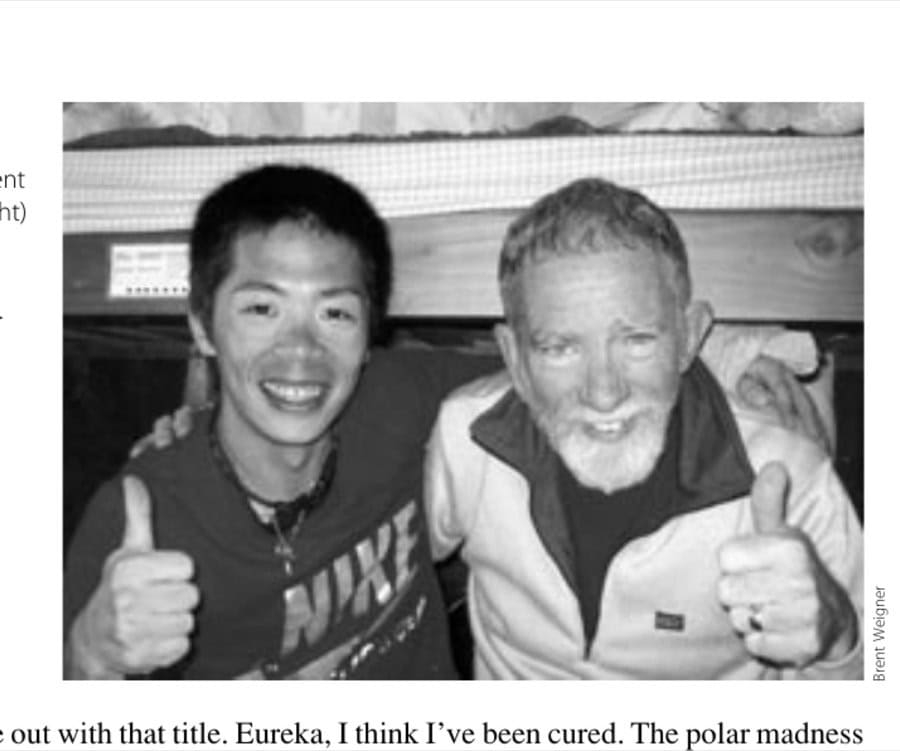
Kevin Lin from Taiwan (left) and Brent Weigner (right) celebrating their Last Desert finish.
a magazine out with that title. Eureka, I think I’ve been cured. The polar madness is gone. My shrink said I am simply a geezerjock and that the previous exam resulted in nothing more than a misdiagnosis, and he hopes I won’t sue. Heck no, I won’t sue because I’m just happy not to be crazy. My psychoanalyst, Dr. I. C. Clearly, explained to me that some people need ongoing therapy to chase away their demons, polar or otherwise. He explained, “In your case, the running trips are your therapy, and your past battles with cancer have actually been a blessing. You now have much clearer vision regarding life and what is important.” At first, I struggled with the idea that cancer had blessed me. It seemed just the opposite had happened. Why had I been cursed with cancer? However, after some additional discussion with Dr. Clearly, I realized that my approach to living was to celebrate life every day and live in the moment. I’ve learned much living the never-ending polar adventure and researching this story. It has been quite a year for ultrarunning in Antarctica. I am indebted to all the past and present Antarctic race directors who have helped make my polar dreams come true. Who knows what the future will bring? I am sure there will be other races in Antarctica. Man will continue to push the limits of what is believed to be humanly possible. After all, that is the nature of man and his madness. When I first conceived of running a marathon to the South Pole in 1999, only one person in the world initially believed it could be done—I, myself. And, as they say, the rest is history. What form of madness do you fancy to help you celebrate life? There is now an icy road from the National Science Foundation’s McMurdo Station to the South Pole. On November 11, 2005, a convoy of tracked vehicles left McMurdo and arrived 42 days later at the South Pole on December 23, 2005. The convoy covered 1,028 miles (1,654 kilometers) for an average daily distance
of just over 24 miles. Shucks, I know guys who can do that on foot. They could have raced those tracked vehicles to the South Pole and beaten them. Wow, have I got a crazy idea bouncing around in my brain. Am I mad or just celebrating life? Perhaps there is a very fine line separating those two concepts. Where you fall on that line is obviously a matter of choice. Some of us choose to count our blessings and celebrate life by pushing the envelope, when there is one, and inventing a new envelope when there isn’t one. Contact me at RunWyo@msn.com with your crazy ideas.
This article originally appeared in Marathon & Beyond, Vol. 12, No. 2 (2008).
← Browse the full M&B ArchiveMore like this
1,000+ stories from 19 years of Marathon & Beyond
The complete archive of the legendary long-distance journal — digitized and free to read.
