

Blue-Sky Trophy
It has been just a few days since my last marathon—a great day at the Steamtown Marathon in Scranton, Pennsylvania—but I’m itching to find another race to run in the next two or three weeks, preferably a 50K. You see, I’ve done the ultimate in craziness—decided to run a 50-miler in November—and I need the boost of confidence that another race will give me. And I want to know what it feels like to go past 26.2 miles and figure that an ultra (50K is roughly 31 miles) is the best way to find out. Is there any chance that this will work? To my surprise and delight, I find just the right race: the Blue Springs 50K Solo Trail Run, in Blue Springs, Missouri. Blue Springs, which I had not heard of before seeing this listing on marathonguide.com, is described as 17 miles east of Kansas City. Hmm. This is promising. I grew up in western Iowa, not all that far from the Missouri River, and Kansas City is not that far from my childhood home, where Mom still lives.
I clear the race with my coach. I tell him that I will run it as strictly a training run, and he concurs. “A fully supported training run—that could be good.” The next critical thing is to check with Mom. I realize it’s late notice, but it would be just too cool if Mom could come to the race. Over the years, she has been my biggest fan and supporter in marathoning, even though she thinks I’m a bit of an alien. Mom’s birthday is October 27; the race is October 24. Selfishly, I think of this as a birthday gift to her—that I would be in the Midwest that close to her birthday. I send off an e-mail and get an immediate reply: she’ll be there. So I’m in! I register for the race and make my travel arrangements, and suddenly there is another race to prepare for.
MY MOM Lately my mom has started joking that I must have been switched at the hospital, since I am so different from the rest of the family, what with all my running and biking exploits. What she doesn’t know is that she has been my role model and inspiration in my athletic endeavors ever since I was a little kid.
When I was growing up, one of the most impressive things I knew about Mom was that she made the Iowa All-State Girls Basketball Team with an honorable mention citation. This was in the early 1950s, and we had a picture of Mom in her girls’ basketball uniform—complete with skirt—in a defensive position. She looked tough and talented. I decided early on that I needed to be as good as Mom and set a goal to make the all-state team myself before I even touched a basketball.
In my junior high and high school basketball career, Mom came to nearly every game, no matter how far the drive. What I learned about sportsmanship was 98 percent Mom, 2 percent coaches. We lost the first game that I ever played in as a seventh-grader—a pretty lopsided loss, if I remember correctly—and our entire team ran from the court, wailing and crying. The pain of the loss was nothing, though, compared with the lecture I got from Mom when I got home that night. Her words are still clear in my mind: “You go out and play the best that you can, and then no matter if you win or lose, you can walk off the court with your head held high. No matter what the outcome, you shake the other team’s hands when you leave the court, and you congratulate them for the game. I don’t want to ever see you run off a court in tears again. If you can’t be a good sport, you aren’t going to play.” That was the last time that I ever finished a game in tears. When I was a senior, the first game of tournament playoffs came on a Saturday night, against a school we hadn’t played before. We had a fair team, and we should have had a pretty good chance at a win. But one of our star forwards missed the game because of a family wedding, the rest of the team pretty much fell apart, and we lost in a pretty miserable showing. When I got home from the game that night, Mom was there. “I’m so sorry that your basketball career is done. I almost cried for you when the game ended.” But I hadn’t cried. I had walked off the court with my head held high, as I had done for every basketball game the previous six years. I had learned that lesson from the best.
FALLING SHORT I failed in my goal of matching Mom’s basketball accomplishment. When the season ended, I earned my second honorable mention for the all-conference team, but that didn’t come even close to the all-state team. It was one of the biggest disappointments of my high school years. I don’t think that Mom has ever known, all these years, that I have thought of her as the better athlete. When I ran my first marathon, my mom was my biggest supporter, and she was an inspiration, too. After smoking three packs of cigarettes a day as long as I had known her, she quit one day a few years before my marathon—cold turkey—and never looked back. My brothers and I marveled behind her back that she could actually pull it off. But it never seemed to even be hard for her. Heeding the advice
of magazine articles that I had read before my first marathon, I worked up some mantras to repeat in my head when the going got tough. One of those mantras? “If Mom can quit smoking, I can finish a marathon.” Over and over and over again, I chanted these words to myself during that first 26.2-miler, and they helped me get through. No one was happier for me than she was when I finished that day; she just didn’t know how much she contributed to that finish.
So, you can see that, with 14 marathons under my belt, I have been hoping that some day my mom can be at one of my races. I have been dreaming that I can do well when she finally gets to see me cross a finish line. I still have a need to show her that I’ve become the athlete that she taught me to be. And so I am thrilled beyond explanation that she will be at Blue Springs.
WHERE IS THIS THING, ANYWAY? True to its billing, Blue Springs is just east of Kansas City. I fly in early Saturday afternoon and pick up a rental car at the airport. I’m surprised that the signs for Blue Springs arrive before I feel like I’m out of the city. This country is familiar to me: I grew up in the Missouri River valley north of here, and the hills and the fields and the timbered woods look like home. It’s a beautiful, sunny, warm Indian summer day when I arrive at the Kansas City airport; my biggest concern is that the wind is blowing. Mom has already arrived at the motel when I get there, and we chat for a little while before going to check out the course.
One of the things that I love most about running the 50 states is the chance to learn new things about these United States of America. The short drive from Blue Springs to the race start area—“the shelter house about a mile east of the traffic circle at intersection of highways 7 and 78”— takes us past Independence and signs for the Truman Library and Museum. Who knew that Independence was so close to Kansas City? I wish that I had the extra time to tour these treasures.
Actually, it doesn’t feel so close to a major city out here. We drive through hill country on the way to find the race start, and I joke with Mom that whoever described the race as flat had a different definition of flat from mine. The 20-minute drive is nothing but rolling hills. But then we see the traffic circle and follow the road around to the shelter house, and it’s amazing: completely flat. I scope out the area and satisfy myself that I can find this place again in the early hours tomorrow morning, and then we head back to the motel.
An added bonus of this Missouri race is that my sister, Sue, lives in Missouri, not too far from Kansas City. The good news is that she is able to make it down to Blue Springs while I am here. The bad news is that she is already booked for Sunday. Sue teaches nursing, and she is taking her students to work in a Kansas City hospital on Sunday. Further good news is that her Kansas City hospital stint
means that it makes sense for her to come spend Saturday night with Mom and me. The three of us have a carboloading dinner at the local Applebee’s. (OK, I carboload and Mom and Sue eat sensibly until I force them to share dessert with me.) Then it’s back to the motel; Mom and Sue stay up to watch the World Series while I am, very uncharacteristically for our family, the first to go to sleep.
RACE DAY Race morning always comes too soon, but I’ve learned the routine well. I’m up at 4:30 and take my bagel and Gatorade down to the breakfast room at our motel. It’s not officially open yet, but I’m able to toast my bagel and get a cup of coffee, and I eat and drink while watching the news on TV. I’ve started to feel at home in these early morning hours, alone with the dark and the quiet and my thoughts about the upcoming race. At 5:00, I go back upstairs, and Sue is up and getting ready for her workday. It’s really nice to have somebody to share my prerace jitters with, and Sue has always been a generous listener. Too soon she is packed and out the door, and I’m alone with my race preparations.
Another bonus of this race is that my cousin Janet, who lives in Lawrence, Kansas, and whom I rarely get to see, is going to make the drive over. I was completely dumbfounded when she replied to my e-mail, saying, “I’ll be there.” This is stupendous! It gives me the chance to see Janet, and it gives Mom someone to hang with while I run. Janet and Mom have made plans to meet at the motel in midmorning and to get to the racecourse in time to see the finish. So this race morning, I’m on my own.
As I drive back out to the shelter at 6:00 A.M., I realize that it’s pitch dark outside. Uh-oh. I have not planned to run in the dark—no flashlight, no headlamp. I hope for sunrise to come quickly and for daylight on the run. I keep glancing to the east, but there seems to be no light at all. I start to get worried.
It’s cool—just 40 degrees—when I get to the shelter and completely dark outside. I’m frozen with inaction. I decide to stay in the warm car. I decide to go to the bathroom but then decide again to stay in the warm car. I fuss with loading up my RaceReady shorts pockets with gels, and I try to figure out what to do about water. I’ve brought my fuel belt, completely stocked, but I’m not so sure I want to carry it. I’ve talked with the race director about water on the course, and it seems that I can get by without the fuel belt, but I’m a bit nervous. This is a very small race, and some of the aid stations are unmanned, water only. Finally, just before the race starts, I decide to run without water and take my chances.
THE RACE The race takes off at 7:00 A.M. without a hitch. It’s a very small field, but it’s still so dark that I can’t even estimate how many runners there are in total. Three races
are starting at the same time: a marathon, a 50K, and a 50-miler. The marathon starts slightly behind the other two distances, and I have the sensation of being passed by quite a few people as the race gets rolling. That’s OK; I’m used to it, and I’m concentrating on just staying on my feet. It’s still very dark!
This racecourse turns out to be a lovely run—a series of out-and-backs on a nice flat trail. The trail is wide and flat and mostly very even, crushed gravel, wide enough to easily run two or three abreast. The trail follows the Little Blue River, and we have the trees and bushes that you expect to see along a river in the Midwest. The race first goes north 4 1/2 miles to an aid station/turnaround and then back to the start/finish. From there it goes south four miles to another aid station/turnaround and back to the start/finish. It repeats the north route and then repeats a part of the south route (for the 50K runners). All the races start and finish at the central shelter house.
When we take off north, it is still very dark, with sunrise just beginning. Off to the right, or east, there is the most spectacular orange skyline that you can imagine, just at the base of a still-dark sky; there is low-hanging mist just hovering above a field on the other side of the river. This is a vista that a moviemaker would use as either a very romantic or very scary scene. I hear people around me mutter, “Beautiful, just beautiful,” and I couldn’t agree more.
I had been planning to use my heart rate monitor as a guide again today—it worked so well at Steamtown—but it’s too dark to see my watch for the first couple of miles. It’s also too dark to see the mile markers, which are painted on the trail. I am not able to get a split until mile three. The markings are good, but it takes a bit of time to get used to reading them. The red/orange markings are for the marathoners, who started a bit back from the 50K and 50-milers. Our markings are in blue, and finally, at mile three, I recognize them on the path and start to capture my splits every mile. That’s the good news. The bad news is that my HRM has stopped working; later I will figure out that it’s the batteries, which I’ve failed to change. For now, I just know that I am on my own for this race. So much for relying on technology.
LEAVING AIDS BEHIND At my car, I had decided to leave the fuel belt behind. I grabbed my half-full water bottle and my prerace gel and headed for the start area. After taking my gel, I gulped a little water and looked for a place to ditch my water bottle. But there wasn’t a trash can or bag nearby, so, somehow, the water bottle is still in my hand at the start. I figure what the heck and decide that I’ll carry it until the first trash can that I see, and then I can ditch it. For now, it’s not a bad idea to drink the water to get ahead of the hydration curve. The small field spreads out a bit, but I run along with other people. Somewhere between miles two and three, a woman I had talked to before the start passes me. I
let her go. She is from Lawrence and is running the marathon—her second—and she looks relaxed and strong. She settles in 10 or 20 yards in front of me, but I mostly keep pace. A few other people are running at about the same pace, and it’s nice to have some company.
There was an early start—at 6:00 A.M.—for people who think they will need the extra time, and soon we see these folks heading back on the trail. When we get closer to the 4 1/2-mile turnaround, the front-runners start to pass us; you can pick them out easily from the early starters by their speed. The first couple of guys go by, very businesslike, but then the next guys start to get friendly. “Good job,” “Looking strong,” and “Looking great” are all very generous offerings to us. We all return the sentiments—and it’s all honest, these guys are going strong. Then a guy comes by with a thumbs up and says, “You are the front two women.” Huh, me? Yeah, he’s pointing at the marathon woman from Lawrence and me. That would make me the second woman? I’m not sure whether I can trust the guy, but then I watch the people coming back along the trail, and sure enough, no women pass by. It’s incredible; four or so miles into my first ever ultramarathon, and I’m the second woman!
We hit the turnaround, the Lawrence woman stops at the aid station, and I blast past her. I’m still carrying my water bottle, and I have an ample supply of gels in my pockets. I’m feeling good and expect Lawrence lady to pass me. OK, this is no longer a training run, something has changed, and I’m racing it. I hear someone at my shoulder and I pick up the pace just a tad. I know that this is pushing it too early, but I can’t really help myself. My HRM is no help. And so I motor on.
BETTER A GUY THAN A GAL That person on my shoulder stays there and finally inches up next to me, and when I look over to the left, it’s not Lawrence lady; it’s a guy I hadn’t noticed before. He pulls up and is running next to me. He strikes up a conversation, and over the next 8 1/2 miles we run together and chat a bit. The guy, Dave, tells me that he is running the marathon without a time goal and just wants to finish feeling good. He ran the Quad Cities Marathon four weeks ago with a goal of going sub-four, but at mile 17, he tells me, “My legs went dead,” and he finished in 4:30. While he says that he has no goal for the day, I can hear the longing in his voice when he says to me, “You must be a sub-four marathoner.”
I’m not sure who pushes the pace—Dave or I—but these turn out to be the fastest miles of my day. My first 4 1/2 miles were at an average pace of 9:20 per mile, which is probably just right for this terrain, this running surface. It’s a tad slower than my last marathon pace of 8:49, but the difference can easily be explained by the soft dirt trail and the fact that I should be taking it a bit easy to go the extra five miles. In these miles that I run with Dave, our pace hovers right
around nine minutes per mile. It feels good—I feel good—and it’s nice to have the company. We share a little information about ourselves—we could not be much more different—Dave is a farmer and part-time truck driver from central Illinois, and I do high-tech stuff and spend way too much time on airplanes—but mostly we just run alongside each other.
The miles melt away. We pass through the central start/finish area, and Dave stops to pick up a gel from his wife (or significant other), but then he sprints to catch me. As we head south along the path, I point out a deer running northbound on the other side of the Little Blue River, and Dave sees that it’s a buck. I look more closely but only catch the deer kicking up a bit of water and then watch its white rump disappear into the woods. The turnaround at 13 miles is upon us in no time. I stop to fill up my water bottle—having decided that it’s a good thing to have with me and having not yet ditched it—and Dave heads north without me. When I start running again, I realize that I won’t be able to catch him, and I’m sorry to have lost his company. But we’ve passed the front-runners once again, and they are all telling me that I’m the first female, and I’m pumped. How far back is the next woman? It doesn’t seem that anyone is gaining on me, and I start to have fantasies about winning.
But there is a lot of ground to cover yet, and it’s getting warm. The temperature at the start was 40 degrees, but now the sun is fully out, and the temperature has climbed. I had kept my long-sleeve throwaway shirt until we passed the start/finish at mile nine, and then I had left it there. Now as I head north again, I take off my gloves and leave them at the start/finish when I pass through it at mile 17. There are many miles left to go, and I’m more and more grateful for the water bottle that I carry.
ALONE AGAIN, NATURALLY The second trip north seems a bit desolate. The first mile or two are like an awakening— “Aha, so this is what I missed in the darkness”—but then it starts to seem too familiar, and also very lonely. The field has spread out, and I can no longer see Dave or anyone else out in front of me, and I have no idea who is behind me, or how far behind. The route alongside the Little Blue River is very pretty, a nice flat path that meanders through forest with leaves that are just a bit beyond their prime and not quite as colorful as the Pennsylvania foliage of two weeks ago. There are a couple of footbridges, and it’s picturesque at these points. In each direction—north- and southbound—we have one road crossing and one road underpass, and those are the only real hills on this course. The underpasses are concrete and the paths leading up to the roads that we pass over are crumbling asphalt, but otherwise it is all nice crushed gravel. There are a few mud puddles, but they are minor obstacles and make the course a bit more interesting.
As I approach the north turnaround, the front-runners start to pass me. I love this about a small race: we are our own cheerleaders and fans. “Good job” and “Looking strong” we shout at each other. The guy who has been most vocal in telling me that I’m the first woman goes past. Now he says, “You’re the second female.” What? How did that happen? I curse myself and the race for allowing myself to think too big. I try to figure out how another woman got in front of me without my noticing, and I can’t figure it out. Then Dave is going past and he’s smiling and looking strong, and we yell encouragement to each other. When he took off so fast after mile 13, I worried that he might fade and have another day like his Quad Cities experience. But now, he’s truly looking strong with just 4 1/2 miles to go, and I think he might hit his secret sub-four goal. When I tell him he’s looking great, I mean it with all my heart.
BUT WHAT ABOUT “SECOND WOMAN”? When I hit the north turnaround, sure enough, there is another woman on the course wearing a race bib. I’m confused; I have not seen her before and cannot for the life of me figure out how she got in front of me. I pass her handily as I take off southbound again, but I worry that she will pass me. It eats at me. Have I been oblivious? How did I miss this? How did I allow myself to even dream about winning something? When will she pass me again? And, most disturbingly, did she somehow cheat to get out in front of me? It’s hot now. It will be 74 at the finish, and the exposed parts of the course are now warmer than I like. I welcome the shade, and, thankfully, there are nice stretches of it here. The wind has picked up—it was absolutely still at the start—and we have quite a stiff head wind as we head south. This part of the course gets very lonely; the field is spread quite far apart, and there are long stretches where it seems that I’m completely alone. I still feel like I’m chugging along pretty fast, but my splits belie the fact that I’ve slowed with the heat and head wind and, most likely, the fact that I went out a bit too fast. My pace northbound from miles 13 to 21 1/2 is around 9:30, but the head wind takes that down to around 9:45 in miles 21 1/2 to 26. As I approach the start/finish, I wonder whether Mom and Janet will be there, but I don’t want to count on it. I’m starting to think about running beyond the marathon mark; how will the extra five miles feel? My stomach has done fine so far, but suddenly I have an urge that can’t be denied, and I duck into the bushes. Ah, the beauty of a rural racecourse. I can see the trail, and nobody passes me in the minute or so that I cost myself on the side of the path. I’m feeling good and strong as I approach the central point. The cowbell reaches my ears first, and then I hear people cheering, and then the shelter house and parking lot come into view. A bunch of people are cheer28 l MARATHON & BEYOND l NOV/DEC 2005
Janet Kelly
ing, and loudest of all is Dave, who is shouting my name and telling me that I look good and to keep it up. He looks happy, and I think to myself: I bet he went sub-four. Then just past Dave I spy Janet, who is smiling and waving and getting a camera ready, and past her is Mom, sitting in a camp chair. I’m so happy! Mom is smiling and laughing, and I trip and almost fall as I round the corner to head out for the last leg of this race. They are here! I have let myself hope—just a little—that they would be here when I went through, and now I realize how important this was to me. I’ve been waiting for that wonderful “flying at the end of the race” feeling that I had at Steamtown, but I realize now that I took those miles that I ran with Dave too fast, and I don’t have anything extra for these final miles. I still feel strong, though, so I keep moving. There is no little devil today, no sign of him. I figure that he knows he is no match for the people out here to support me today: Mom, Janet, and my new friend, Dave. Still, these next few miles do not melt away; they just drag. The course markings, which have been excellent until now, disappear. I see the marker for mile 28 but never see another 50K marker. The trail, which seemed so nice and flat earlier, suddenly seems to be uneven and covered with huge sharp gravel; who put this here since the last time I ran here? Dave and I had noted the pink flags and turnaround directions on our outbound journey, and I’m looking for them. It takes so long before I see them that I start to wonder whether I passed them by accident. But no, finally, finally, there they are, and I toe the turnaround line, and then I’m in the final 2 1/2 miles of my first ever ultramarathon and I know that I can make this distance, no problem.
▲ The author passes by mile 26 and spots Mom for the first time in the race.
A TRAILING WIND
Janet Kelly
The head wind has been steady and stiff; when I turn around, it’s a huge relief. It seems utterly quiet and peaceful. The extra effort that I was putting into each stride to battle the wind is now found energy. I will my legs to run strong and with good form.
There is an unmanned water cooler about two miles from the finish, and I stop and put my water bottle into the trash bag that is tied alongside it. Finally, the trusty little bottle that I meant to ditch 29 miles ago is history. I grab a quick drink of water, and then I’m off. Other than my hamstrings sending “Stop! I’m unhappy!” signals to my brain, I feel excellent.
There is one last road crossing with just about a mile left to go. A guy I’ve seen at each turnaround—he’s carrying a water bottle just like the one I regularly run with at home—is now just a few steps in front of me, and he’s walking. I run by him and offer encouragement, but his face is the look of despair and defeat. I’m only a few yards in front of him, climbing up to the road, when I hear him surging behind me. He goes by me like a bat out of hell, crossing the road in front of me, but then he stops, and I know how much he is suffering. He stops to walk again, and I pass him again, and I know that his day is done; he won’t repass me. And on I go.
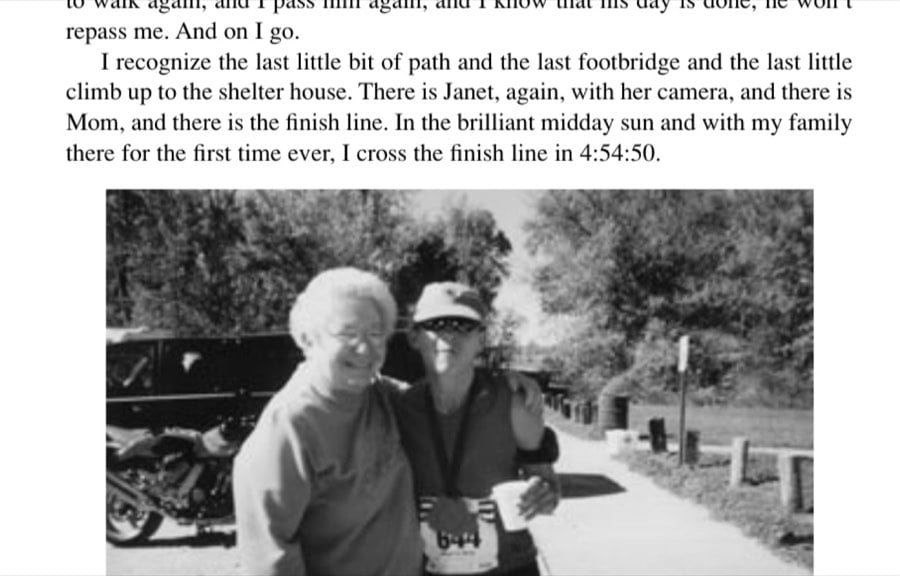
I recognize the last little bit of path and the last footbridge and the last little climb up to the shelter house. There is Janet, again, with her camera, and there is Mom, and there is the finish line. In the brilliant midday sun and with my family there for the first time ever, I cross the finish line in 4:54:50.
▲ The author and her mom at the finish line.
Just a few people are hanging around the finish area; many of the marathoners, including Dave, have already finished and headed out. I’m surprised at how out of breath I am as I try to talk to Mom and Janet, and then they send me to the refreshment table. I grab water, and more water, and cookies, and potato chips—all the things I meant to try during the race but never made time for. I’ve ingested my normal six gels, along with a couple of Succeed Caps (sodium and potassium tablets), and my stomach is fine for now: I’m just hungry.
The race director gives me a handcrafted ceramic medal for finishing, and then says, “You’re the presumptive women’s winner of the 50K,” and he gives me the prize: a New Balance hat and pair of socks. No matter; I’m thrilled but still not certain where I finished in the overall standings. A guy approaches me and asks me my finishing time, and then he says, “With the handicap, you might be the overall winner.” This race has a generous handicap system, and the finishing results are based on your combined race time and handicap. The guy, who tells me he finished in 4:36, looks younger than I am, so he might be right. The handicap system is generous to women and old people, perfect for me. But there are no posted results, and I don’t really know how many other people finished in front of me. For now, I treasure my blue NB hat!
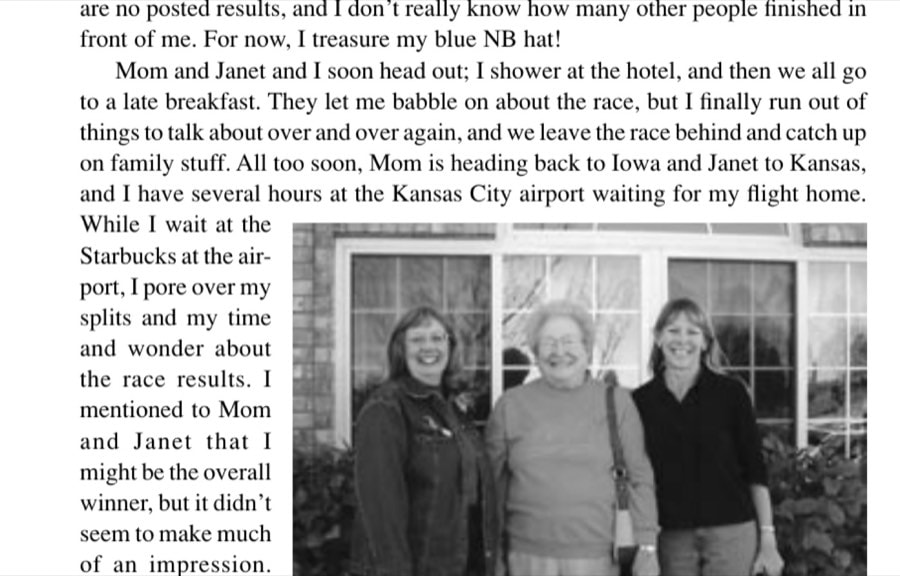
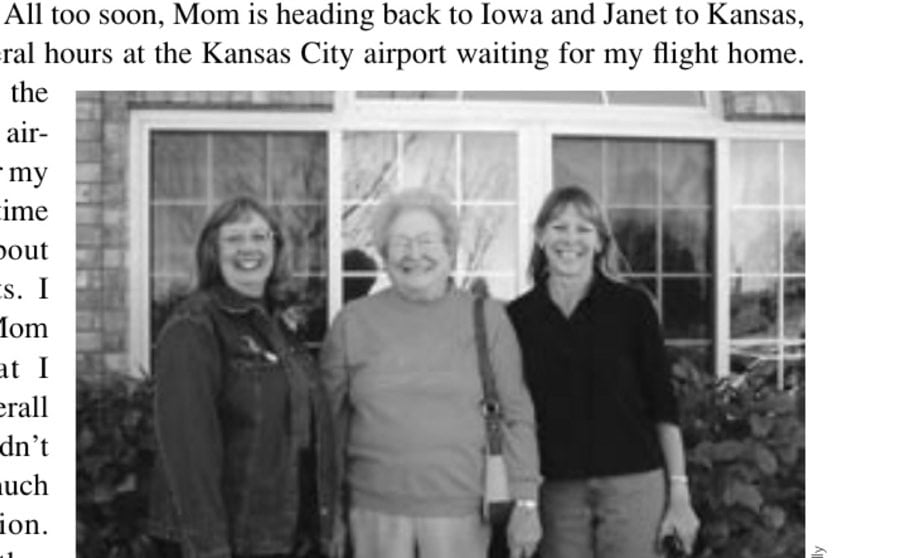
Mom and Janet and I soon head out; I shower at the hotel, and then we all go to a late breakfast. They let me babble on about the race, but I finally run out of things to talk about over and over again, and we leave the race behind and catch up on family stuff. All too soon, Mom is heading back to Iowa and Janet to Kansas, and I have several hours at the Kansas City airport waiting for my flight home. While I wait at the Starbucks at the airport, I pore over my splits and my time and wonder about the race results. I mentioned to Mom and Janet that I might be the overall winner, but it didn’t seem to make much of an impression. I wonder whether they know how important that would ▲ A family reunion: cousin Janet (left), Mom, and the author postrace, ready for a late breakfast. be to me.
Janet Kelly
RACE RESULTS
But silly me. When will I ever realize that Mom knows best? When I get home, I already have an e-mail from her. “Do you really think you won? When will you know?” And I realize again, a bit shamefacedly, what a great supporter and cheerleader she is.
It will be several days before the results are posted on the race Web site, but on Thursday after the race, the race director e-mails them to a list I subscribe to. The marathon results are there first, and I scan the names, looking for Dave. He did it! He finished in 3:59:50. I’m so happy for him that I have tears in my eyes. Then I look for my own name and there, for the first time ever, I see my name in a place that I’ve never seen it before. Number one. Numero uno. The only thing above it: blue sky, white space, the heavens.
This is, I know, a gift. My time for the 50K is the second fastest overall—the 4:36 guy was the fastest, but the handicap has given me the advantage—but I will take the gift for what it is. There is no trophy, no plaque, nothing but a blue cap and my name on a list on the Internet; still it’s enough. It may not be the Iowa Girls All-State Basketball Team, but it is the best I can offer. For the first time ever, I can type these two little words: I won. Thanks for the inspiration, Mom. Happy birthday.
This article originally appeared in Marathon & Beyond, Vol. 9, No. 6 (2005).
← Browse the full M&B ArchiveMore like this
1,000+ stories from 19 years of Marathon & Beyond
The complete archive of the legendary long-distance journal — digitized and free to read.
