

Bombs On Boylston
Among the participants in last year’s Boston Marathon, few could boast the credentials of Michele Collette Keane of Bay Village, Ohio. Keane’s first Boston came at age 2, standing beside her mother, Jean Collette, handing water to passing marathoners.
The Collette family’s private aid station was near the 12-mile mark, close to the border between Natick and Wellesley, only a half mile from the edge of the campus where Keane would attend college. While at Wellesley, Keane ran the marathon three times with classmates at the all-women’s school. “We ran it as a lark with a bunch of guys,” Keane remembers. “They dropped out. We kept going.”
Keane’s best time as a collegiate fun runner was somewhere in the vicinity of 4:30, but after graduation she dropped her personal record to 3:03:07, achieved in 1986, when she placed 50th among women. In years she did not run, Keane volunteered as a spotter. After moving to Atlanta and then Cleveland, Keane continued her love affair with her hometown race, running Boston whenever she could find an excuse. Last year the excuse was her daughter Shannon, now a student at Boston University. “Shannon never had seen me run Boston before,” says Keane. “I told her to stay away from Boylston Street, too crowded, and hang out with her college friends near Kenmore Square, around mile 25.”
Thus Keane’s goal for this year’s marathon was not to run a fast time but to give her mother a hug at 12 miles and her daughter a hug at 25 miles. She connected with both, pausing with Shannon longer than her daughter thought proper. “Mom, get going,” Shannon insisted. “You’re losing time!”
Michele obeyed but later realized that her two stops—one with her mother, one with her daughter—were the reason she was not closer to the finish line when the bombs exploded. On Boylston, she saw the first blast. “I stopped, hesitated, then took another step before the second bomb detonated. People were running
at me and shouting to stop, stop, stop!” Keane ran into a nearby parking garage for protection. Runners and spectators all around her were doing the same. It was a horrible ending to a wonderful day. * * * The day had started so much better, hadn’t it? It was the weather. How many times has the weather disappointed us, turning to trash months of training? Starting the day, it seemed that in terms of predicted temperatures, you had lucked out. The year before in 2012, temperatures had soared to 87.4 degrees. Ugly! But the weather reports for 2013 promised morning temperatures in the 30s, afternoon temperatures in the 50s: a perfect day, a glorious day, a “no-excuses” day, a day where everyone would fly like the eagles. The gods were smiling on 23,000 wellmotivated and well-prepared marathoners who had picked the right year to cash in on their BQs. Yes! You earned this day because of your hard training, didn’t you? You deserved this day.
It would be a day to remember. You said as much in meaningfully written blogs, in posts on Facebook, in tweets on Twitter. You posted pictures while running the race with your iPhones. Friends and family rode your shoulders from Hopkinton to Boylston, tracking your times online, knowing even before you did the estimated time you would finish. While the race up front among the fast men and the fast women would be told by credentialed reporters huddled in the media center of the Copley Plaza, the race among everyone else, the lumpenproletariat of our sport, would be presented to the world through social media. Consider the memories of some of those electronic reporters now.
Whitney B. Wickes of Aspen, Colorado, explained in a blog what Boston meant to her: “From the confirmation of acceptance sent to you in the mail to the point at which you finally cross that finish line, there is something undeniably majestic about the Boston Marathon. Much of that aura can be attributed to the regal tradition it has embedded within the city of Boston and the immense spectator support it has received year after year.”
George Karaganis had traveled to Boston from Athens, Greece, the birthplace of modern marathoning. He reported on the Internet how his day started: “When we walked out of the hotel, all you could see was people with yellow bags walking towards where they would catch the buses.”
Neil Gottlieb of Philadelphia remembered the same: “The streets were filled with runners heading in the same direction.” Gottlieb remembers the walk as being quiet, almost eerie. “Nobody was talking along the walk.”
Aubrey Birzon Blanda of Glen Ridge, New Jersey, blogged about arriving at Boston Common for the bus that would take her to Hopkinton: “I’m a chatty person, so I immediately fell into conversations with runners around me. We
were excited that the weather looked good. Not too warm. No rain expected. Everything completely normal.” Arriving at the Athlete’s Village at 7:30 a.m., Rosie Allister headed first for the “portaloos,” as the runner from Edinburgh, Scotland, called them later in an
Internet post. She could feel the electricity in the air: “There was a party atmosphere already: a nervous party but a happy one in anticipation of what was to come.” She described everyone in the portaloo lines as chatting. “Boston was the
long-held dream that brought us all together.” “The Athletes’ Village was abuzz with nervous energy,” offered Kara Zech Thelen of Grand Rapids, Michigan. “Like the other runners, I gathered with some friends and inventoried the critical supplies for our 26.2-mile trek: a jar of
Vaseline, water bottles, bananas and peanut butter, extra clothes for the finish, and extra energy packaged every way possible—from gels to beans to blocks to bars. “We were lubed and ready!” Jon Munro from Alloa, Scotland, defined what running Boston meant to him.
As far as Munro was concerned, it was all about the spectators: “You become a marathoner when you stand on the start line with the intention of covering 26.2 miles in the very best time you can manage and by doing so giving the spectators
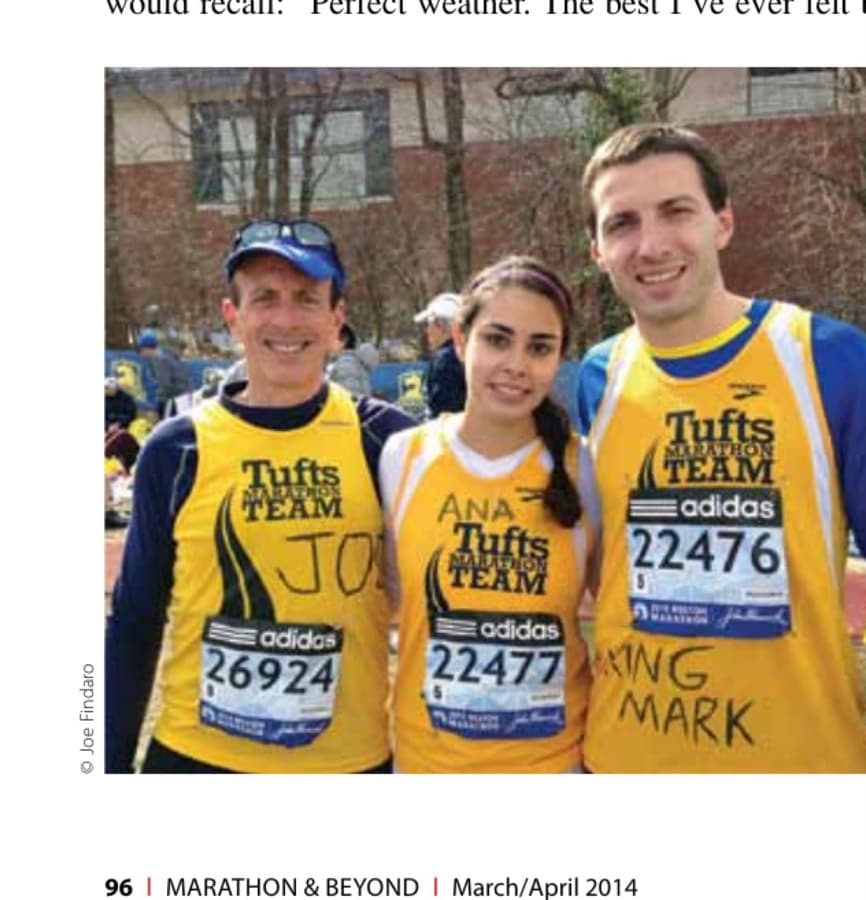
something to cheer for. They know that their hours of standing in the cold are worth it. You, the runner, give them someone to reward.” For Joe Findaro of Vienna, Virginia, Boston 2013 would be his 15th mara
thon, his sixth Boston in a row. He was running for the Tufts Marathon Team and would recall: “Perfect weather. The best I’ve ever felt before a marathon, both
© Joe Findaro
▲
Joe Findaro ran Boston with his son Mark and Mark’s girlfriend, Ana.
physically and mentally. We enjoyed the camaraderie of the Tufts team prior to the race, everyone taking photos. We were feeling high as we entered the pens at the start in Hopkinton. We met many international runners. Particularly moving was a Polish runner with a prosthetic leg.”
As a runner, Findaro could not begin to imagine what it must be like to lose a leg. * * * Carissa Von Koch of Portland, Oregon, described the first mile as a crowded mile: “My plan was to start conservatively. I had no desire to weave through the crowds. Passing would have been impossible had I tried anyway. We were packed in tight.”
Von Koch would remember: “The experience of running Boston was amazing. I kept tearing up, overcome by a surge of emotions. From the start, the crowd support was unlike anything I had experienced before. Each mile I ran, my heart filled more with the support of the crowd.”
George Karaganis felt the same: “Every single house seemed to be celebrating with us. Smoke blew across the road from massive barbecues on front lawns. Kids offered high-fives, and it was hard not to respond, despite the energy drain.” “
What always touches and inspires me about Boston are the people who come out year after year,” said Amanda Cronin of Norwood, Massachusetts. “And year after year, they stand on the sidelines and offer their support and encouragement. They want to scream and clap. They want to call your name. They want to offer you orange slices and Gummi Bears.”
The craziness of the crowds would peak as runners reached Wellesley College near the halfway point. “We entered the town limits, and soon I heard their cheers,” Mary Gorski of Milwaukee would recall. “The noise literally was ear-piercing. Then there were the ‘Kiss Me’ signs. The students offered to kiss for causes, to kiss men and sometimes other women, depending on their hair color. Kiss, kiss, kiss! It was all in fun and it brought smiles to everybody’s faces. That was what the day was supposed to be: all in fun.”
Among the signs held by Wellesley women, noted Jessica Reed of Athens, Ohio, was one that said: “Stop running after your dreams. I’m right here.” “The cheers were so enthusiastic and emphatic, they took my breath away.”
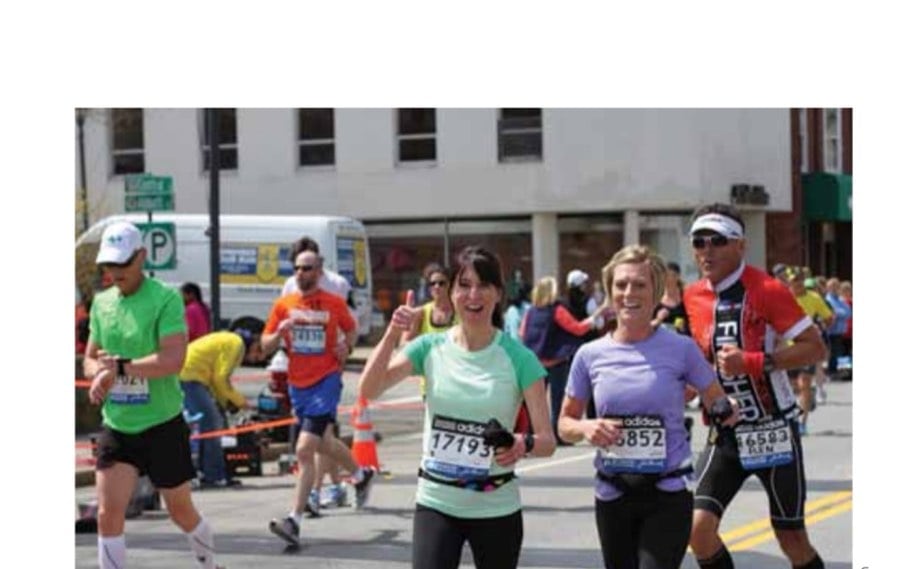
Kara Zech Thelen would blog. “And the tears soon followed. I prayed for all the people standing there along the course. I was overcome with gratitude for them and their jubilant support. For the few moments of my passing, we no longer were total strangers.” * * * But there was the course, Boston’s ever-challenging course—the downhills, the uphills, the terrain constantly challenging runners, particularly after they turned at the fire station near 17.5 miles and encountered the infamous Newton Hills. Heather
Lee-Callaghan of Halifax, Nova Scotia, wrote: “I kept chipping away at
© Kara Zech Thelen
▲ Kara Zech Thelen (17193) rode a wave of love from cheering spectators.
the hills, relaxing at the top of each hill as the grade started to plateau.” One hill, two hills, three hills, four hills until finally she saw the arch stretching overhead: the heartbreak is over! Kate Johnson of Lansing, Michigan, took Boston one timing mat at a time, knowing that friends and family were tracking her progress online. The first Newton hill, being a half mile long, was the hardest for her. She remembered her mantra, “The faster you run, the sooner you are done.” She continued to look forward to the timing mats, feeling the cheering continuing through the Internet back home.
Diane Di Stefano of Norwich, New York, reminded herself what it had taken to get this far: “The Boston Marathon is the Holy Grail of running. Some people spend years trying to achieve their Boston-qualifying time. Then once you qualify, you spend months in cold weather training, paying careful attention to do the specific workouts that will help you attack the tough miles towards the end.”
Running in the closing miles on Beacon Street, Patti Labun of Laguna Niguel, California, decided that she was both well trained and well paced. Nevertheless, with two miles to go, Labun did not quite hit the Wall, but she brushed up against it: “The last few miles were hard. It was the combination of head wind and downhills. It got so much colder.” She was thankful that she had kept her long-sleeve shirt and long compression pants.
Jen Marr of Ridgefield, Connecticut, reverted to basics: the sheer animal act of placing one foot in front of the other. OK, I can do this, she told herself at mile 22, and then told herself that again and again as she continued on Beacon. “It was frustrating, painful and exhilarating, all at the same time.”
Mile 23: Keep running. Mile 24: Just gut it out. Mile 25: I really want to run this last mile at a good pace, but I can’t. Then: Only 385 yards to run! Even the most fatigued, the most foot weary, the most despondent, those who seemingly have drained the last grams of glycogen from their tortured muscles, suddenly discover that that there will be a tomorrow. They realize that with a concentrated effort, they can summon the will to go faster, or at least offer the appearance of running faster.
Whitney B. Wickes would finish in 3:16:17 and credited the support of the crowd: “For us runners, it is such a privilege to have fans on the sidelines cheering us on: people who stand on the course for hours yelling our numbers and names, offering words of encouragement to someone they will never meet. Their love and support constantly puts a smile on our faces and keeps us believing in ourselves through their faith. They expect nothing in return, but they offer us a most unforgettable experience.”
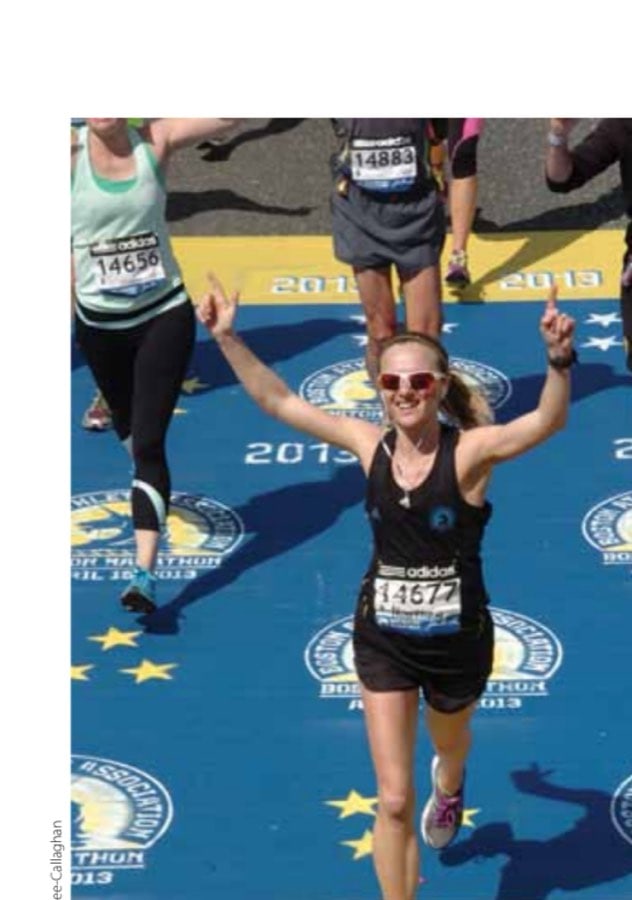
Boylston is the happy street for runners. It is our field of dreams. Heather LeeCallaghan was among those who felt swamped by emotions as she approached the end of her long day, en route to a 3:37:32 finish: “I turn a corner, then another, and there it is: Boylston Street! The finish line remains an eternity away. Push. Push. Push. I shift the sunglasses onto the top of my head, so I can see and be seen. Arms waving in the air. Screaming. Smiling at the cameras. I did it! This is marathon bliss. I step on the first chip mat, walk across the second, and break down, sobbing cries from the pain. Limping. Searching for water. Crying. So happy for my hard work and sense of accomplishments. I felt like a warrior.”
Lee-Callaghan would add: “Who knew that moments later, I would feel as small and vulnerable as an ant?” The digital clock above the finish line read 4:09:43 when the first bomb exploded near the finish line. Shelby Freeman Harris of Tarrytown, New York, turned the corner onto Boylston in time to see the first explosion. “The ground shook,” she would recall.
The world of long-distance running shook with it. * * * Among those closest to the bombs was Tracy O’Hara McGuire from Portland, Oregon. Approaching the finish line, McGuire directed her attention toward the grandstands to the right. She knew Chris, her husband, would be seated there.
© Heather Lee-Callaghan
▲
Heather Lee-Callaghan smiled while finishing, not knowing that soon her smile would turn to tears.
“Chris saw me, but I did not see him,” Tracy would write later. What she did see—and feel—was the first explosion. Hers was one of the more remarkable stories posted to my Facebook page in the days and weeks following April 15, 2013: “I stopped dead in my tracks. I was
not confused. I was not disoriented. I was nearly deaf from the explosion, but I knew immediately that it was a bomb, and it was bad, very bad. One minute I had been looking at hundreds of people along the finishing stretch, on both sides
of the street, left and right. And suddenly the people on the left were blown up, right before my eyes.” McGuire’s primal instincts took over. She immediately turned and began running backward on the course away from harm. But no: “Suddenly another
bomb went off in front of me. I thought to myself, Wait, I was just there. I had just slapped the hands of those people. Chaos ensued, with people screaming, crying, frantic people everywhere.”
At this point, Tracy’s husband, Chris, lost track of his wife. People around him in the grandstands rose as one, fearful that the next explosion might enwrap its evil arms around them. They scrambled for the exits. Tracy did the same: “I took off to the other side of the street, hurdled a couple of barricades, jumped over a garbage can, and bolted for survival. At any moment, I expected more bombs to explode all around me.”
She ran through a restaurant, through the kitchen, out a back door. Her instinct was to get as far away from Boylston Street as soon as possible. She screamed for people to evacuate, but many did not believe her and told her to calm down. “I wanted to tell them, I had just seen people get blown up before my very eyes, but a handful of people still were celebrating at the bar!”
Tracy started to feel more comfortable the farther away she got from the finish line. She was relieved that she did not hear any further explosions, but where was her husband, Chris? She borrowed a cell phone from a stranger. Chris answered her call. Tracy experienced a sudden feeling of relief.
So did he. “Where are you?” he asked. “I’m two blocks away.” Chris said that he was still at the finish line. “It’s nasty,” he said. Ironically, as close as she had come to the finish line, within a hundred meters of completing her well-trained-for journey, Tracy O’Hara McGuire is not listed as one of the finishers of the 2013 Boston Marathon. She would not be alone. * * * Among the nearly 5,000 nonfinishers on this day of infamy was Amby Burfoot of Runner’s World. In 1968, Burfoot had won the Boston Marathon, but celebrating the 45th anniversary of that victory, he took a more relaxed approach, running with friends far behind. He was not close enough to Boylston Street to hear the explosions and realized that something was seriously wrong only when runners in front of him began to slow and then stop. His first reaction was that college students had spilled out onto the streets, blocking the runners. “
But the crowd didn’t disperse,” Burfoot later wrote, “and I soon realized it was all marathoners, not spectators. We thudded to a stop, the road blocked ahead, and we were completely confused.” Burfoot’s first thought was: who’s ruining my party?
Then his cell phone rang. It was Cristina, his wife. “There have been two explosions, and the finish line is closed. The race is over.” * * * The race is over! The 117th running of the Boston Athletic Association Marathon was over, but the drama surrounding the race would continue. Videos captured from surveillance cameras revealed two young men, brothers, with packs on their backs. Photos taken by spectators showed the same two warped individuals
later without those packs. The packs had contained the bombs that killed three, wounding more than 250 others. What happened next was like scenes from a bad action movie. The brothers killed a policeman on the MIT campus and then were chased by police in a shootout that left one brother dead, the other brother wounded.
It was a sad day for those of you who ran Boston last year, made even sadder by the realization that the innocents killed and wounded were not the runners. Almost all the victims were spectators, those who cheered and supported us as runners, those who made the running of the Boston Marathon so much more special than any race in the world. They unwittingly had shielded the runners with their bodies. * * * Every one of the 23,000 of you who participated in the 2013 Boston Marathon retains at least one memory that overrides every other memory of what started as a perfect day for running. One memory: it is a memory of death. Even those who did not hear or feel the explosions know exactly where you were when you learned about the bombs on Boylston Street. In fact, runners all over the world will carry with them the memory of that moment when running a race of 26 miles, 385 yards changed for all of us—and not for the better.
The Washington Post would contact Amby Burfoot for his thoughts on the tragedy. “This was not just an attack against the Boston Marathon,” Burfoot told the Post. “It was an attack against the American public and our democratic use of the streets. We use our public roadways for annual parades, protest marches, presidential inaugurations, and, yes, marathons. We cannot cover our eyes and ears and pretend violent acts do not threaten our great institutions.”
Burfoot ended: “Our institutions did not become great by following a path of timidity and cowardice. We can only hope that the Boston Marathon, though pummeled, will rise again stronger than before.”
The Scotsman John Munro stayed several more days in the United States, visiting Cape Cod, allowing a walk on the beach watching whales to erase some of the bad memories. He departed for home Thursday morning, offering a passport to one of the security officers. Munro would remember the officer as being an older man with sad eyes. The security officer recognized Munro as a marathoner because of his unicorn jacket. Despite its being late in the week, there remained many walking the terminals in jackets identifying them as having run the 2013 Boston Marathon. “
Will you come back?” wondered the officer. “I will be back,” promised Munro. Yes, Boston, we will be back. The preceding article contains excerpts from Hal Higdon’s latest book, 4:09:43, and originally appeared in the B.A.A.’s 2013 race results booklet.
This article originally appeared in Marathon & Beyond, Vol. 18, No. 2 (2014).
← Browse the full M&B ArchiveMore like this
1,000+ stories from 19 years of Marathon & Beyond
The complete archive of the legendary long-distance journal — digitized and free to read.
