

Borne Free
THE MOST difficult run Uta Pippig ever took was not the Olympic or World Championships 10,000 meters or the New York City or Boston marathons, or any of the scores of races she has won. It was the run that began in East Berlin early on a rainy January morning in 1990 and ended in West Berlin—and freedom. Most runners worry about the wall that lurks near the 20-mile mark in a marathon. But the wall Uta faced was 15-feet high, made of steel-reinforced concrete, and topped with barbed wire, broken glass, watchtowers, guard dogs, and machine guns.
While West Germany followed the path of democracy after World War II, East Germany turned toward socialism and the East. One of its greatest achievements was the establishment of a sports system that rivaled any in the world and surpassed most. Uta Pippig was one of the rising stars of that system—a system that helped her develop into one of the best marathoners in the world—if it didn’t break her first.
But whenever the opportunity came for Uta to test her growing marathon prowess against the best in the world, she smashed into a bureaucratic wall. She was held in a “kind of prison,” not allowed to travel, race, or pursue the training outside of East Germany that she and her coach wanted.
When she escaped from East Germany, Uta was that country’s top female runner and a member of the East German army through her sports club in Potsdam. If caught, she would be considered a military deserter.
As the Berlin Wall began to crumble and East Germany wallowed in the aftermath, Uta and Dieter Hogen, her coach and boyfriend, decided to run for freedom. The pair stuffed three suitcases into the back of their small car and drove off into the morning rain. The rain extended to the western side of the wall, too, but in the sudden sheen of freedom, the western rain felt kinder, gentler. When they were safely in West Berlin, Dieter stopped the car, and the two got out. Uta turned her face into the cleansing rain, and for the first time in her 24 years of life, she was free.
Free at last from the shackles of the East German sports federation, Uta blossomed into the most formidable women’s distance star since the reign of the Big Four: Grete Waitz, Joan Benoit Samuelson, Rosa Mota, and Ingrid Kristiansen.
Uta delivered fast times and won races with a refreshing élan that injected new life into the post-Big-Four world of women’s running. “I’ve had three dreams in my life,” Uta says. “Coming to the West was one of them.”
She blew in like a mariah. In 1992, at age 26, she ran a 2:26 marathon. Two years later, Uta uncorked a 2:21:45 at Boston, the third-fastest women’s marathon time in history. The mantle of being the first woman to break 2:20 fell onto Uta’s shoulders. Doing so was the second of her three dreams.
MAKING SPORT
Uta Pippig was born in Leipzig, Germany, on September 7, 1965, and lived there until she was four. Her parents, both medical doctors, then changed their practice and moved with Uta and her younger brother to the countryside outside of East Berlin.
“It was a nice place to grow up,” Uta says. “There are lots of forests and many lakes.” Uta had a quiet upbringing. The biggest influence in her life was her parents, who instilled in her a Faustian love for learning and a tremendous capacity for doing difficult work. Uta entered athletics as most young East Germans did, through a local sports club. She began with gymnastics at age 10. When she was 13, she joined the club in Petershagen, where she lived, and started running.
Those small, local clubs were the backbone of the East German sports system. “It was a good system,” says Dieter, who was then one of East Germany’s premier athletics coaches, “because in the former East Germany, every kid made sport.”
The system worked. East Germany was a sports power from its first appearance in the 1956 Olympics to its last showing in 1988. East Germany was third behind the Soviet Union and the United States in total medals won through that period.
As a young girl, Uta didn’t believe running would be important. She was still running for fun, running with her clubmates, and expecting to be a doctor when she grew up, not an Olympic runner.
What motivated Uta when she started running and what continues to motivate her today is the satisfaction she gets from the effort she puts in. “Many great athletes came from poor families, or big families, where life was not easy,” says Dieter. “And hard work makes tough people.”
One incident illustrates the drive that characterizes Uta. She was extremely talented as a child, and at a sports day in her town, she competed in a variety of events, winning 11 medals—10 gold and one silver. She was very proud of her haul, of course, and ran home to show her parents. Her father’s reaction? Instead of praising the 10 wins, he angrily asked his daughter, “What about this silver?” Uta has never forgotten this, and she has spent her life trying to answer her father’s question.
TOO EARLY A MARATHONER
At age 16, Uta began training more seriously, and her running potential became apparent. Driven to be a success in running, Uta knew she had to move on, because she most likely would never realize her potential at the small Petershagen club. So, early in 1983, at age 17, she approached some of the larger clubs, saying, “Look, I can run very good.” They recognized her talent, and Uta was invited to join the Army Sports Club in Potsdam, one of the top clubs in East Germany. It was there that she met Dieter, who was coaching 800- and 1500-meter runners.
After showing her talent by winning short races, Uta was told by coaches that she should try the marathon, so her “official” marathon training commenced when she was 19.
That, Uta states with hindsight, “was too early. For me, it would have been much better to train first for middle distance, and then to grow up with the miles.” Uta’s first marathon came that year when she ran 2:47, fast enough for her to be pegged as a marathoner for good.
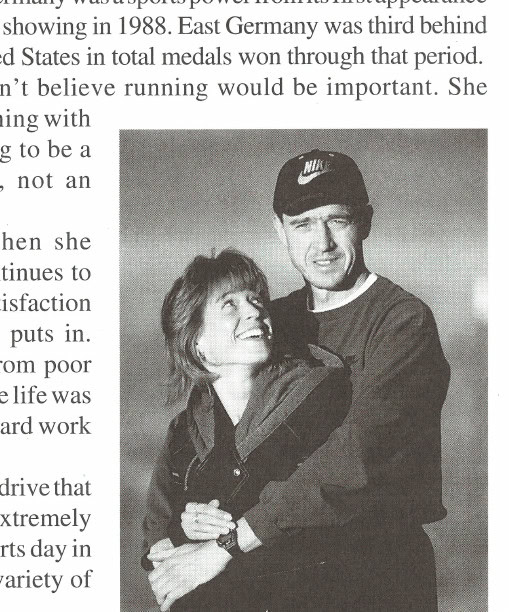
In 1986, Dieter, the club’s top coach, was asked also to coach Uta, the club’s most promising runner. It turned out to be a perfect match. The handsome, rugged-looking Dieter was smart and dedicated. He had not coached long-distance runners before, but he learned everything he could about marathon training by watching and talking with two-time Olympic marathon champion Waldemar Cierpinski and other German stars.
MARATHON IDEAS
The enjoyment Uta got from running, along with her success at regional championships, motivated Uta, who was nearing elite status. The only problem was that she could only read about the best women runners; she could not test herself against them, because the DVfL, the East German Running Federation, refused to allow her to leave the country. Her applications to run in international road races were “consistently rejected.”
Dieter’s coaching was working; at her next marathon that year at Leipzig, Uta ran a personal best, winning in 2:30:50. When she won the Leipzig Marathon again the following year, Uta began receiving a stipend from the East
German government and support in her training. That support included medical tests, equipment, free housing in a dorm with other female athletes, and more coaching from Dieter.
Dieter felt there were benefits to coaching within the club system. “Everything was very close; that was the system. And the parents were proud that the kids were in the sports club. That’s important for your work, so you have no problems. I could try different things and make my own ideas,” says Dieter.
This was the part of the East German system that was “really good.” The bad part was the close-minded officials who looked askance at some of Dieter’s innovative ideas. Even though Uta was one of the best runners in the country, she and Dieter felt stifled in their training.
Uta and Dieter continued to dream of making their great escape. After the 1987 Rome World Championships, where Uta ran the marathon but did not medal, Dieter and Uta decided to defect to the West. But after talking it over with her parents, Uta changed her mind. Her mother told Uta that if she left, the ubiquitous Stassi secret police would “make trouble” for the Pippig family, and her parents would lose their jobs. Instead, Uta stayed in Postdam, running up to 150 miles a week but racing infrequently, and Dieter continued butting heads with sports officials. Invitations for Uta from around the world continued to pour in, and Dieter continued to ask for permission to go to international road races. But officials continued to say no.
Uta and Dieter were even forbidden to read western running magazines. “You could ask for permission, but it was never granted,” Dieter explains. Fed up with the entire situation, Dieter said, “No more. We had many of these situations, and finally they said, ‘OK, you can’t go. You will never leave the country.'”
“That’s one thing,” says Dieter. Another was the bonuses he did not get. In the East German system, coaches received a base salary, which was “good money,” Dieter says. He was supposed to get all the bonuses, because his runners were among the best in the country. “They had all the points, all these medals, and all these championships in East Germany. But I never got the bonuses. They always cut the bonuses because I spoke my mind….That was the system. That’s all,” he says without bitterness.
People were tiring of Communist rule, and, after changes in the Soviet Union, changes came to East Germany as well, culminating in the dismantling of the Berlin Wall on November 10, 1989. “We were very, very happy when the Wall came down,” Uta says. They spent the night celebrating with friends, and, the next day, they went to West Berlin to talk with different people to see what the future held for them, their country, and Uta’s athletic career.
“I made a picture of what’s possible and what’s not,” Uta says. What was possible was the chance that Uta would at long last be able to travel and test herself against the best women in the world. She had missed so many races, but now it seemed certain she would get to race in the West. “Then, we waited a little bit, to see if things are changing,” she says. “But they didn’t.” Uta was still denied permission to travel. The same bureaucrats were still in charge, with the same hardened attitude. Adds Dieter, “Yes, after the Wall came down, it was still the same, and then we said ‘OK, now, we go.'”
GO WEST, YOUNG WOMAN
Dieter did not tell Uta that they were leaving East Germany until the day before the January 1990 day they were to flee so she wouldn’t have much time to think about what was happening. It was a decision fraught with danger. By leaving, she was deserting the East German army, a serious offense.
Uta telephoned her parents that night and cried. “I was calling just my parents and they were sad. They said, ‘Are you crazy? No, you can’t do it.’ It was a big risk more for me than Dieter because I was directly in the army. But sometimes you just have to try.”
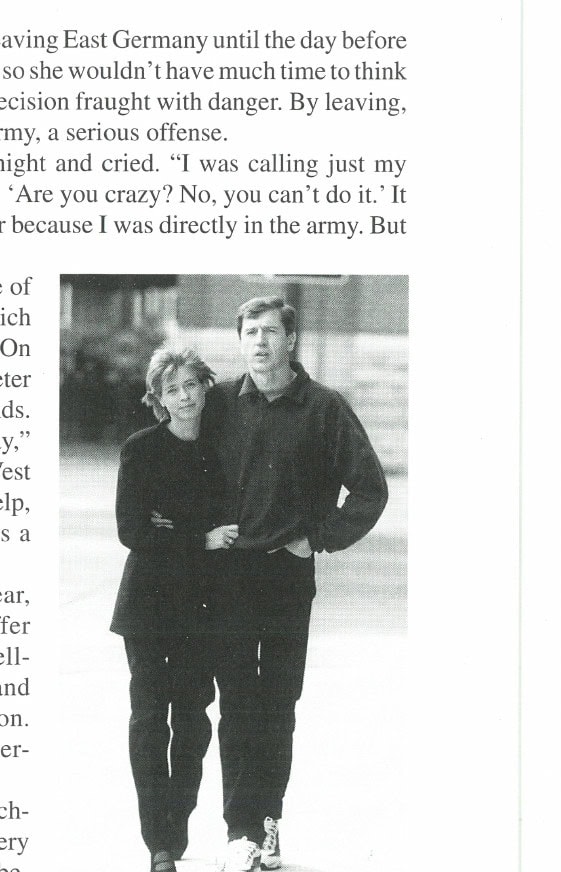
What they found on the other side of the “Wall” was a new world, one in which the old support systems were gone. On their own for the first time, Uta and Dieter got by with a little help from their friends. “We knew somehow we can find a way,” Uta says. “We can go to a club in West Germany and ask them if they will help, since at this time I was not so bad as a runner.”
They stayed in Stuttgart for a year, before receiving a “very good” offer from SC Charlottenburg (SCC), a well-established West Berlin sports club and the organizers of the Berlin Marathon. “We said, ‘OK, let’s go back to Berlin,'” Uta says.
Dieter was offered a full-time coaching job and the couple was given “a very nice apartment.” That was important because, says Dieter, “It was not easy to get an apartment, because so many people came from East to West. Everything in town was closed.”
FREE AT LAST
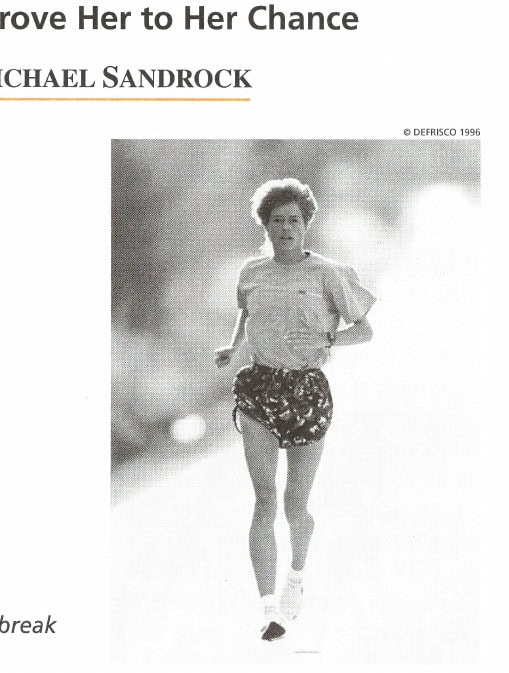
At long last, Uta was free to race in the West, and she made the most of it. After a good winter of training in 1990, Uta won the 3,000 meters at the German Championships. In February, Uta set the world record for the indoor 5,000 meters, clocking 15:13.71 to break Sonia O’Sullivan’s record.
Her first competition in the West came at the 1990 Boston Marathon, three months after leaving East Germany. “We had heard so much about the Boston Marathon that we said, ‘Let’s go to Boston….We have to try it; you can run fast there, for sure. Let’s go.'”
It was a good decision, as Uta ran 2:28:03 for second place behind Rosa Mota. That earned Uta $24,000. It seemed to many western observers that Uta had appeared out of nowhere. But, in fact, she had been running for a decade already, and she had taken the best from the efficient East German system to develop into a strong, solid marathoner.
Uta spent the summer of 1990 preparing for September’s Berlin Marathon, which for the first time would run through East and West Berlin. The prospect of reunification had left all of Germany on an emotional high, and for Uta, the race was the fulfillment of a dream. The marathon was run just three days before the reunification of Germany, and 25,000 people streamed through the streets of Berlin.
Uta went to the front of the women’s race soon after the start and led to the tape, buoyed by the cheers of the crowds lining the course. Polish national record holder Renate Kokowska made a late bid, but Uta won by 33 seconds in a course-record 2:28:37.
In 1991, Uta returned to Boston and lined up against one of the best women’s marathon fields in history: Joan Benoit Samuelson and Kim Jones of the United States, Norway’s world record holder Ingrid Kristiansen, and Wanda Panfil and Kamillah Gradus of Poland. Uta let the leaders go during the early downhill portion of the course, but she ran strongly over the second half. Panfil won in 2:24:18, and in the closest finish of a women’s marathon ever, Uta finished in third a mere 12 seconds behind Kim Jones. In a symbolic changing of the guard, Uta outkicked Joan Benoit Samuelson for her third-position 2:26:52. Joan followed Uta by a mere two seconds.
That autumn, Uta went to Tokyo for the third edition of the World Championships and finished sixth in the 10,000 meters. Then she returned to Berlin, where she increased her mileage to get ready for Boston ’92.
Uta now divided her time between Berlin and Boulder, Colorado, where she went for altitude training. Berlin grew after the reunification of Germany, the streets crowded with construction projects and cars. But outside of the city “it is still very nice,” Uta says. “You have lots and lots of forests and many lakes; it’s really nice for training.”
Those government-owned forests remain Uta’s favorite place to train. “There are two-meter-wide dirt trails,” she says, holding out her hands. “There is no traffic at all, just a biker once in a while. It’s good; you can go such a long while, and there are no fences.”
In April 1992, Uta placed third at Boston for the second straight year, running 2:27:12 and finishing behind Russian Olga Markova (2:23:43) and Yoshiko Yamamoto of Japan (2:26:26). Commentator Kathrine Switzer said at Boston that Uta was part of the “new wave” of women runners. Uta would have been one of the favorites for a medal in the Barcelona Olympic Marathon, but she opted for the 10,000 instead. She did not want to run a marathon in the heat and pollution of Barcelona. She placed seventh in the 10,000 in 31:36.4.
STUTTGART FAILURE, BIG APPLE SUCCESS
In September 1993, Chinese women runners shocked the running world with their spate of mind-boggling world records at Beijing’s National Games. Wang Junxia broke Ingrid Kristiansen’s 10,000-meter record (30:13.74) with an unbelievable time of 29:31.7, and Qu Yunxia clocked 3:50.4 for 1500 meters. Six different Chinese women ran under previous world records. Questions immediately arose concerning the possibility that the Chinese had used performance-enhancing substances. After dominating the 1993 World Championships in Stuttgart, the record setters seemed to drop out of sight.
Uta focused on preparing for the World Championships. She ran two road races and won them both, the Pittsburgh 10K and the Arturo Barrios Invitational, despite hard training weeks of over 100 miles before each race. She next won the Bix 7-miler in Davenport, Iowa, pushed under the course record by Ann Marie Letko. The next day Dieter and Uta left for Germany to prepare for the World Championships in Stuttgart. She ran some track races in Europe, lowering her personal best in the 3,000 meters to 8:45 and then 8:40.
It seemed that Uta was ready. But she had done “too much speed work. I pushed too hard in training again, for one and a half weeks, then I was tired,” she recalls. “I was overconcentrated. OK, Stuttgart is in my home country, so I have to be very good. [But] I pushed it too hard.” With tired legs, Uta finished a disappointing ninth in the 10,000 meters, won by Junxia in 30:49.3.
Uta took a short break after Stuttgart, and she began preparing for the 1993 New York City Marathon. She decided to postpone her premedical exams for a year, to give herself the opportunity to devote all her attention to running. Two weeks before New York, Uta did her last hard workout—a 30K time trial at 90 percent effort in the mountains (8,200-feet altitude).
She tapered the rest of the time before New York and finally allowed herself the time to shop for a sweater.
The 1993 New York City Marathon was the race that propelled Uta into the top ranks of world marathoners. Americans Kim Jones and Anne Marie Letko were to be her challengers. Letko had beaten Uta in the 10,000 in the World Championships. New York was Letko’s first marathon, and she let it be known beforehand that she was gunning for Uta. In the opening miles, the American did look like she was ready to challenge for the win, but Letko fell behind by the 8-mile mark, and, by 15 miles, she was two minutes behind. Uta was suddenly running against only the heat and the clock. Her high mileage makes Uta stronger than other marathoners, and she gets better as the race goes on. On this unseasonably hot and humid day, Letko was forced to drop out and was taken by ambulance to a local hospital, where she was treated for dehydration. Jones also was forced to drop out.
Taking only water, as she does in every marathon, Uta had a shot at the course record of 2:24:40 set by Lisa Ondieki in 1992. Uta was under course-record pace until 21 miles, but she began to slow under the conditions. Still, she was up by 2:30 over second place finisher Olga Appell. The race continued Uta’s streak of finishing in the top three in nine straight marathons since 1987, and it was her fourth win of a major marathon.
After taking a short break back in Boulder, Uta returned to Berlin and rested. She took a break and cross-country skied regularly over the winter of 1993–1994, then began laying her basework in anticipation of Boston ’94. Dieter was confident that Uta would run her best race there. “Before Boston in 1990, 1991, and 1992, Uta was always tired,” Dieter says. “There was no way to train correctly.” Now, by training correctly (with more recovery and more mileage), she had her sights set on becoming the first woman to break the magical 2:20 barrier in the marathon.
Can a woman run 2:20 for a marathon? “That’s possible, for sure,” says Uta. “OK, when I heard about the Chinese for the first time, I tried to run like a madwoman,” putting in even greater mileage. That did not last long, however. “But then I was tired,” she continues. “So many of us trained seriously for so many years—Ingrid Kristiansen, Liz McColgan, Lisa Ondieki, all trained so serious. Rosa Mota, all the great women, and they tried many things in training, all kinds of different training. And then some Chinese girls come…[she snaps her fingers] and they run under 30 minutes for 10K, they run near 8 minutes for 3,000 meters. It’s not step-by-step.”
“If it is without drugs, then I take my hat off my head, and say ‘oh, gosh, you are really great.’ Many people said it would be a very great thing, and the biggest goal for women in this century, to break 30 minutes [for 10,000 meters] and to break 2:20. And now, they did break 30 minutes, and everyone has a bad feeling. Instead of being something great, I have a bad feeling about it.”
TRAINING: FUN AND HARD WORK
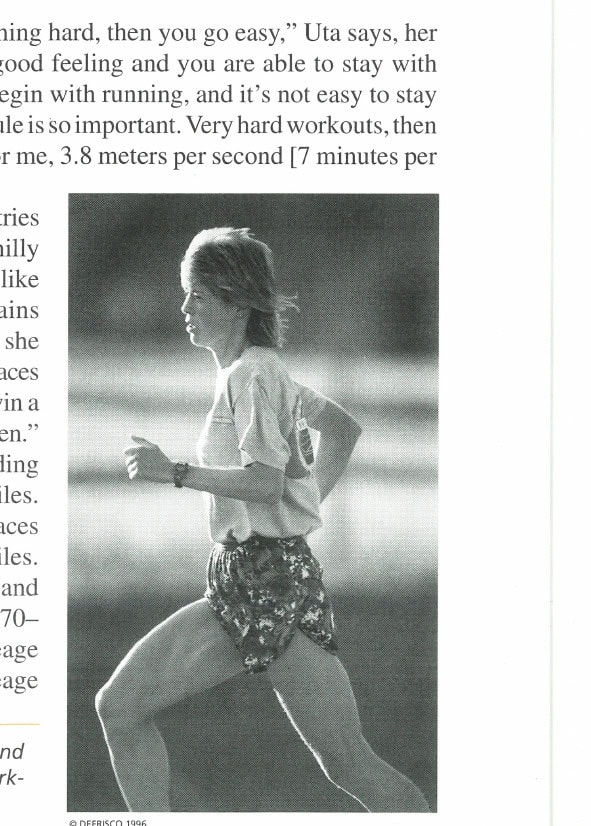
On the kitchen wall of Uta’s well-kept, frame and brick house in Boulder hangs a large calendar listing her training schedule, with the workouts color-coded: endurance workouts are in green, hard workouts are in red, and easy runs are in blue. It graphically shows the basis of her training: rigorous, scientific workouts tempered by good humor. “The schedule is a way of keeping the training fun. When you do it for 20 years, it becomes second nature…. I like it,” Dieter says. “We do that because, if you have the whole year on one schedule, it’s much easier to see mistakes.” But keeping the hard work fun is not enough. “Fun and success, too,” explains Dieter. “If you don’t have success, you don’t stay with it.”
“It’s like training, training, training hard, then you go easy,” Uta says, her voice lowering. “Then you get a good feeling and you are able to stay with running. Because it’s not easy to begin with running, and it’s not easy to stay with running. That’s why the schedule is so important. Very hard workouts, then very easy ones, just for fun. And for me, 3.8 meters per second [7 minutes per mile]—that’s fun pace.”
When training for the roads, Uta tries to run most of her workouts on hilly courses, because the courses she runs, like Boston, are hilly. Uta usually trains through road races. “I can do that,” she says, “because the depth in women’s races isn’t as great as for the men. But to win a race is tough for either men or women.”
The average for 10 weeks leading up to a marathon is around 130 miles. The mileage the weeks before road races is lower, but still well over 100 miles. Her yearly schedule is one of peaks and valleys; some weeks Uta runs up to 170–180 miles, followed by lower-mileage weeks. Dieter never counts the mileage Uta or his other runners put in. “I don’t really care how many miles she does,” he says. “For me, what’s interesting are the workouts we did, the quality workouts.”
Uta rests up for major marathons or championship track races. Her highest mileage week was 180, followed by easy weeks. “But you know,” Uta says, “I cannot go like the Chinese [runners]; I tried it. Over 160 miles a week is what the Chinese do every week! I was so tired after 160-mile weeks. I was going to San Diego, and I was not so fresh. I couldn’t run under 32 minutes [for 10K]; I could run just 32:17. You know, if you train very nicely, you can run much better.”
Training “nicely” means hard days interspersed with “fun” recovery days. The Sunday long run is between 19 and 22 miles, at 8,500 feet. A few times a week Uta will run with some of the male runners Dieter is coaching. Having training partners is important, Uta says, because “sometimes it is nice to have someone one step in front of you.”
Uta trains well in Boulder because she is comfortable there, and she blends in well in the athletic city. “It’s very good here,” she says. “The good thing for us is that so many people understand running and have a feeling for running. They know what it means. Surrounding yourself with a good atmosphere is key.”
In February 1994, Uta clocked 67:59 in winning a half-marathon in Kyoto, Japan, 1 minute and 19 seconds off Ingrid Kristiansen’s world best. That was such a good performance that some knowledgeable runners, when they heard the time, insisted it must be for 20K (12.4 miles) and not the 13.1-mile half-marathon distance. It was a time that indicated Uta was ready for a good marathon.
A RUN AT THE RECORD
Uta’s serious training resulted in some very serious racing. In April 1994, Uta faced what was being billed as the Boston Marathon’s best women’s field ever. Her prime challengers were Olympic gold medalist Valentina Yegorova, two-time Boston winner Olga Markova, and South Africans Colleen De Reuck and Olympic 10,000-meter silver medalist Elana Meyer, who was running her first marathon.
Uta’s training had been right on schedule, and she was prepared for anything that might come up—anything except getting sick. “It’s easier to get sick if you come in great shape,” says Dieter, and that’s what happened to Uta. She went for a run in the rain when she arrived in Boston the Tuesday before the race, and later that night she had “a little bit of a headache and a runny nose. On Wednesday it was bad, and on Thursday and Friday it was very bad.”
On Friday, Dieter took Uta to a local hospital, where she had a blood test. Sunday night, she took an easy run, and told Dieter she was ready to go. “I feel I’m in shape. I feel good; I have to go tomorrow and try. I’m in such good shape that even if I run with just one leg, I’ll finish in the top three,” she joked.
Uta was careful in the early going, running with a lead pack of Meyer, Markova, Yegorova, and De Reuck through the halfway mark. She was feeling good enough to run faster in the early going, but she held back until mile 15, when she threw in a 5:12 mile. Only Meyer could go with her, and, when the South African faded on the hills at 18 miles, Uta was able to run in for the victory. Helped along by a favoring wind, Uta clocked 2:21:45, history’s third-fastest time, after Kristiansen (2:21:06) and Benoit Samuelson (2:21:21).
With Mota, Waitz, Kristiansen, and Benoit Samuelson out of the running spotlight in 1994, Uta was the biggest star in women’s running. Dieter decided to end Uta’s 1994 season at the three-mile mark of the Bolder Boulder when he saw how tired Uta looked. She shrugged off discussions of how much money she was passing up. She learned early on to focus on the nonmaterial dimensions of life. “Money is not important,” she says. “It’s more important for me to have a vacation with Dieter.” The only way to do that was to have a vacation from racing.
“Here’s a secret, that many runners don’t know,” Dieter says. “If you have these breaks like Uta takes, your body can recover, and when you come back, you don’t have to keep doing more mileage to get faster. And that’s why you want to stay healthy for as long as you can, even if you don’t race for six, seven, or eight months. Then you can come back and do some great runs.” Taking a break gives the body a chance to renew itself and to feel that “the workouts are a new thing again,” says Dieter. “It brings you to a new level.”
THIS AGE FOR RUNNING
Something drives Uta to continue looking for “great runs,” so she decided to stop her studies for several years. “What I hear now is that so many runners are full-time runners. For me, I like to study, to read, and to learn things,” she says. “But not so tough like the last few years. It was crazy to do both.”
Uta gets her work ethic from her parents. “They say work, work, work, because the job is the important thing.
But now, I know I have this age for running. I like running so much and I’m having good results, and I’d like to improve my results, so I go for the sport now.”
Uta would have been Dr. Pippig and finished with her studying except that the four years of university classes she took and passed in East Germany did not transfer to West Germany. “They said, ‘Sorry, that’s not our system. You have to start again.’ Only physics transferred.” Being forced to start her medical studies over is why Uta needed so much time for schooling and why her life seesawed between studying and running.
GOING FOR 2:20
Uta has the composure to take the vicissitudes of life in stride; that is why losing does not bother her. “Why should it?” she asks. “I’m just a normal person. I can lose a race.” The way she races—win or lose, running in with a huge smile, blowing kisses—has endeared her to fans and the media. “Uta really likes her sport,” Dieter says. “That’s why she is very motivated to train harder than ever. And that’s why I think she can increase her results a lot. I think she can run much faster than she ran in Boston.”
Psychologically, the fast times by the Chinese gave Uta a sense of urgency to try to break the chimerical 2:20 barrier. “That is my second dream,” Uta says, and she has devoted her life to it, living and training with total focus. Everything she does is geared to the 2:20 marathon.
“I have been waiting for my record to go for years,” says Ingrid Kristiansen, who set her 2:21:06 in London in 1985. But as 1995 wound down, she was still waiting. “It will be taken, but it depends so much on conditions, the course, and the weather,” Kristiansen told Athletics Weekly. “The women’s scene seems to have stood still for years.”
Uta prepared very seriously for the 1995 Boston Marathon. She and Dieter had a new slogan for 1995—”Just do it.” After 10 years with adidas, the pair switched over to Nike for a reported $300,000 a year.
Uta spent the winter cross-country skiing up to six hours a day at different Colorado resorts. In February, she fell on the ice while training, and she had to drop out of the Gasparilla 15K. It was the first time Uta had pulled out of a race since 1984. Then she returned to Kyoto, Japan, and ran the half-marathon in 67:58, one second faster than 1994.
The field Uta faced at Boston in 1995 was even deeper and faster than the previous year. Tegla Loroupe, the Kenyan who won New York (in 2:27:37) in the fall, was there, as well as Valentina Yegorova and Elana Meyer.
Uta went to the front early, followed closely by her three main rivals. The winds were not favorable, buffeting the runners head-on, and Uta knew she would be running for the win, not the record. The other runners let her break the wind, and she passed the halfway point in 1:11:23, looking back over her shoulder several times to see who was near her. It was always Yegorova and Meyer, and, at 19 miles, Loroupe joined the leaders. The race was shaping up to be a four-woman battle to the end, but Yegorova dropped off the pace and eventually dropped out.
Loroupe then took the lead. But at the next water stop, at 20 miles, the two Africans, Meyer and Loroupe, lost ground while searching for their water bottles. Uta picked out her bottle and opened up a gap.
Meyer and Loroupe worked their way back up to Uta, but on Heartbreak Hill, the Kenyan fell back. “I run all the time in the mountains,” Uta said, “so Heartbreak Hill didn’t bother me. But I don’t want to say it’s easy.”
It was now Meyer and Uta running together, with Uta glancing over at her rival. But Meyer’s leg began to cramp, and she had to come to a complete stop to massage it. Despite being hampered by blisters, Uta was able to run in for the 2:25:11 win. Loroupe dropped all the way back to ninth (2:33:10).
BACK IN BERLIN
In September of 1995, Uta won the Berlin Marathon for the third time, in 2:25:37. Uta was forced to come from behind after a tough battle with Kenyan Angelina Kanana, a postal worker from Nairobi. “I’ve never met Uta; I’ve only heard of her. I’m trying to reach her level,” Kanana said beforehand. The two didn’t meet until 25 kilometers, as Kanana took off from the start, passing 5K in 16:46 and 10K in 33:26. Kanana, who had run 2:27:24 in her marathon debut in Hamburg earlier in 1995, was running with one man for company, while the trailing Uta was surrounded by a phalanx of males hoping to get on television. When Uta caught and passed Kanana, some of the men accidentally bumped the Kenyan. “After that, I was very unhappy,” said Kanana. “I lost my interest in running [the marathon].” “Look, it was a little crazy out there,” says Uta, who missed water bottles in the early going. “I was a little dehydrated, and had cramps in my right leg.” Uta was hoping to get the course record, but missed it by 26 seconds.
Berlin race director Horst Milde is a big believer in the arts, and he commissioned a bust of Uta, unveiled the day before the race. Instead of her trademark big smile, the bust has a slight “Mona Lisa smile.” Chiseled on the back of the sculpture is the number 2:19:58.
THINKING BOSTON
After Berlin, Uta and Dieter took a vacation and a complete break from running, as is their habit after a marathon. They then began the build-up for the attempt at an unprecedented third win in a row at Boston ’96. 1996 would be the most visible year in history for marathoning, with Boston’s “100th” running and later in Atlanta the 100th anniversary of the first Olympic marathon.
“Uta knew this was going to be her year,” says Arturo Barrios. “She was ready for ’96. I would see her training at the [Boulder] reservoir, and she looked very fit. She continued taking her training as a business, as it’s supposed to be.”
It is no exaggeration to say that the 1996 Boston Marathon was the most publicized and anticipated marathon in history. Organizers pulled out all the stops for the “100th” running of the venerable event, turning it into a true celebration of running, both for the elite and for the “common” runners.
A one-time-only world-record field of 37,500 was allowed in to make the race accessible to as many interested runners as possible. Runners from around the world pointed toward April 15 all winter long. The two runners who won it would hold a permanent place in marathoning history.
Dieter knew this. And in public, at least, he downplayed the thought of an attempt at Ingrid Kristiansen’s world record. Winning Boston, Dieter knew, would be hard enough.
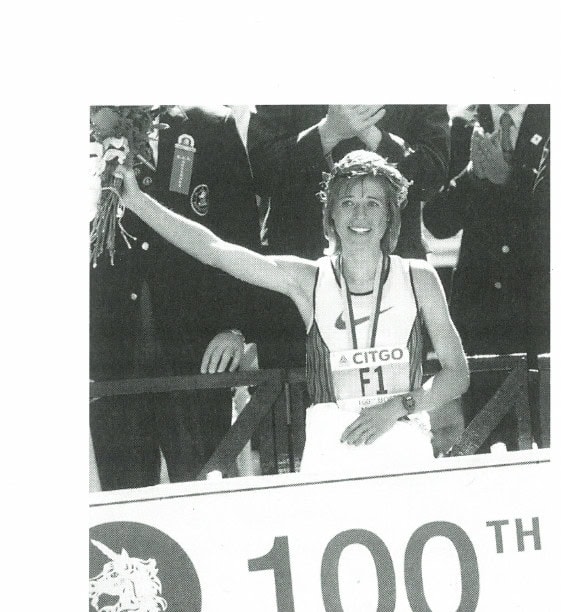
Dieter was correct. Uta didn’t get the world record she hoped for at Boston, but she did take her third consecutive win at the world’s most prestigious marathon. In addition, she secured something more intangible. In an incredible come-from-behind victory, Uta added a new dimension to her reputation by battling adversity, cramps, and pain to take the win in the last mile. She exhibited the mental toughness that only the greats have, the ability to follow through when things get tough. Catrina Campbell, coach at Oklahoma State University, says, “No matter what kind of runner you are, Uta’s Boston run was inspiring. That was one of the all-time great races.”
The build-up for the race was incredible. An army of former winners accepted invitations to attend. Among them were Rosa Mota, Lorraine Moller, Joan Benoit Samuelson, Bill Rodgers, Gelindo Bordin, Ingrid Kristiansen, and Rob de Castella. Kenyan Cosmas Ndeti was going for his fourth win in a row, and the race served as the Kenyan Olympic Trials. Uta’s prime competition was Tegla Loroupe, two-time New York City Marathon winner.
Nearly a foot of snow fell in the Boston area the week before the marathon. But thousands of runners’ prayers were answered when raceday dawned bright and clear. It would rain and snow again the day after the race, but on marathon Monday, the stage was clear for a classic race.
Dieter and Uta could plan out Uta’s training, her diet, rest, travel, and weight work, but they could not control her body. When the race got underway, she was already hurting. Menstrual cramps and diarrhea were turning her insides inside out. A record attempt was preposterous. Call it bad luck, call it fate, but marathoners have to deal with whatever raceday dishes up. Uta dealt with it.
She gamely took off after Kim Jones, Russia’s Alla Zhilaeva, and Nobuko Fujimori of Japan in the early going, trying to maintain her form and forget about the cramps and the creeping idea of dropping out. She hung in behind the leaders before taking the lead going past the cheering coeds of Wellesley. Loroupe hung just behind her. A cat-and-mouse game ensued, with Loroupe moving from side to side behind Uta, changing sides when Uta looked first over one shoulder, then the other.
THE REAL RACE BEGINS
Loroupe went in front at about 18 miles. She built her lead up Heartbreak Hill. With three miles to go Uta had fallen 200 meters back. Today this was not the Uta Pippig of TV and magazine ads. Today she was all agony and struggle, as blood and diarrhea streamed down her leg. Late in the race, Uta stopped at an aid station to wipe herself clean because, she said afterwards, “I felt not nice. I used a lot of water around me, to clean up a little bit. I had some problems with my period. It started out at seven kilometers. I was thinking several times of dropping out, it hurt so much. But in the end…”
In the end, the boisterous, vociferous crowds lining the course would not let their favorite daughter drop out. They cheered and yelled, doing everything to encourage Uta, save reaching out and physically pulling her up the hills. “It was amazing to me,” Uta says. “I thought, it’s not possible anymore, but they said, ‘You can catch her, you can catch her!'”
Buoyed by her fans, Uta began thinking not only that she could finish, but that, yes, she could also catch Tegla Loroupe. Inexorably, she closed on Loroupe, who was slowed by leg cramps. The Kenyan was soon reduced to a shuffle, and Uta drew closer. “‘Yes, I can do it, just go,’ I kept saying. Push, push and try to
win,” Uta said afterwards. With just over a mile left, Uta came even with Loroupe and passed her, running in for the win in 2:27:12. The race was heralded as “a comeback for the ages,” and Uta summed it up with, “I never imagined I could fly. I am home here.”
ON TO ATLANTA
Uta could not savor her Boston win, since the Olympic marathon was just over three months away. Scuttlebutt before both the men’s and women’s Olympic marathons concentrated on the depth of the fields, the tough course, and just how much the heat and humidity would adversely affect the runners.
Uta would be facing New Zealand’s Lorraine Moller, Elana Meyer of South Africa, Liz McColgan of Great Britain, Yuko Arimori of Japan, Manuela Machado of Portugal, Australia’s Lisa Ondieki, and defending gold medalist Yegorova of Russia. Uta, who did some of her post-Boston training in New Zealand, went into the marathon as the favorite among experts and fans. “What Uta proved in Boston is that she can win when she’s not at her best,” Frank Shorter observed. “That’s important. To win in the Olympics, you have to have room for a certain margin of error.”
The week before the race, Uta told journalist Neill Woelk, “It will be a tactical race, and that’s what I like. Whoever trains the best for the heat has the best chance to win.”
When the women’s Olympic marathon began at 7 A.M. on July 28, Uta took off as if the others had absolutely no chance to win. She opened a big lead early, as if to say, “Not only am I going to win the Olympic Marathon, but I am going to make a statement doing it.” Running alone over the hilly course, looking like she was on a training run, Uta was hoping to “steal” the race early, as Joan Benoit did in 1984. “I couldn’t believe it,” said Anne Marie Lauck of the United States. “I was running a 5:13 [pace] in the early miles, and I was getting dropped.”
But it was not to be Uta’s day. By 10 miles, she was noticeably slowing, and the pack caught up to her. Uta hung in there, but eventually dropped out at 22 miles. Ethiopian Fatuma Roba ran a beautiful race to win in 2:26:05, followed by 1992 medalists Yegorova and Arimori.
Before the runners had even cooled down, speculation arose as to what had gone wrong with Uta. Some said it was the humidity, others overconfidence, overtraining, or her shoes. Whatever the reason, Uta wasn’t saying. She disappeared after the race and reporters could not get a comment from her. “We never saw Uta,” says journalist Woelk. “She never appeared at the stadium, and even the German officials didn’t have an explanation about what happened. She was nowhere to be found.”
Says Benji Durden, “With Uta it’s always hard to tell how good of shape she is in. Leading up to a marathon, she doesn’t run a lot of races. Obviously, she was very fit for Atlanta, so it [dropping out] had to be something else.”
A few days after the marathon, Pippig told the German newspaper Bilt that she had been bothered early in the race by a pinched sciatic nerve in her back. She said she “could not move well,” and by 15 kilometers knew “this was not going to be it.” Uta said she will continue training through the Sydney 2000 Olympics, and she still holds on to her dreams of getting both an Olympic gold medal and Kristiansen’s marathon world record—two dreams she’s held for years.
Despite the Olympic DNF, Uta won respect for her front-running tactic. Says Arturo Barrios, “Oh yes, I think she did the right thing. She was going for the win. Basically, when you run like Uta did, you are going to scare people. She did, and they let her go. They knew she was the best one. At one point she had the big lead, but when the pack realized the gap was remaining the same, they came back. But I think it was a very good strategy. You have to attack; she had a bad day, but that is a chance you have to take. She went for it.”
That’s what champions do.
Adapted and updated by permission from Running with the Legends by Michael Sandrock (Human Kinetics, 1996).
This article originally appeared in Marathon & Beyond, Vol. 1, No. 2 (1997).
← Browse the full M&B ArchiveMore like this
1,000+ stories from 19 years of Marathon & Beyond
The complete archive of the legendary long-distance journal — digitized and free to read.
