

Boston After Knee Surgery?
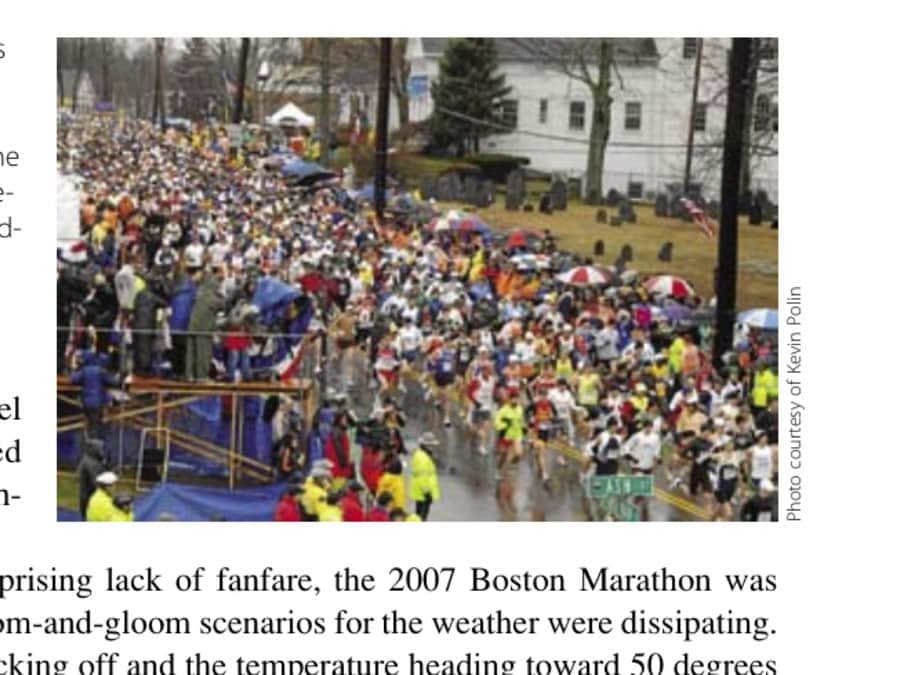
Photo courtesy of Kevin Polin
and always felt lucky to be running, considering that when I was a teenager I had been hit by a car while riding my motorcycle. The car stuck me smack on the upper part of my right thigh and impaled the lower part of my ankle onto a grease nipple protruding from the rear-wheel swing arm of the motorcycle. My upper thigh was squashed by the car. My toes, too, were somehow folded back over 90 degrees between the car and the bike’s engine.
As luck had it, the impact was so hard it knocked me clean off the bike and 20 feet through the air, where I struck a lamppost in midflight before slithering to the ground below like a fireman jumping down the firehouse pole headfirst. I’ll never forget the feeling of floating through the air upside down and seeing the church spire across the street spinning around as if I were in some kind of religious-inspired dream. The rear-wheel-driven car mounted over my bike and dragged it over 15 feet up the street before stopping. Being told by the police officer I was the luckiest man in town that day for not losing a limb didn’t help at the time while lying half off a rainsoaked curb, smelling the dog urine splashed on the bottom of the lamppost and realizing that the jeans covering my numb legs were completely soaked in blood. To this day, there is a large lump on the top of my thigh as a reminder of the event.
▲
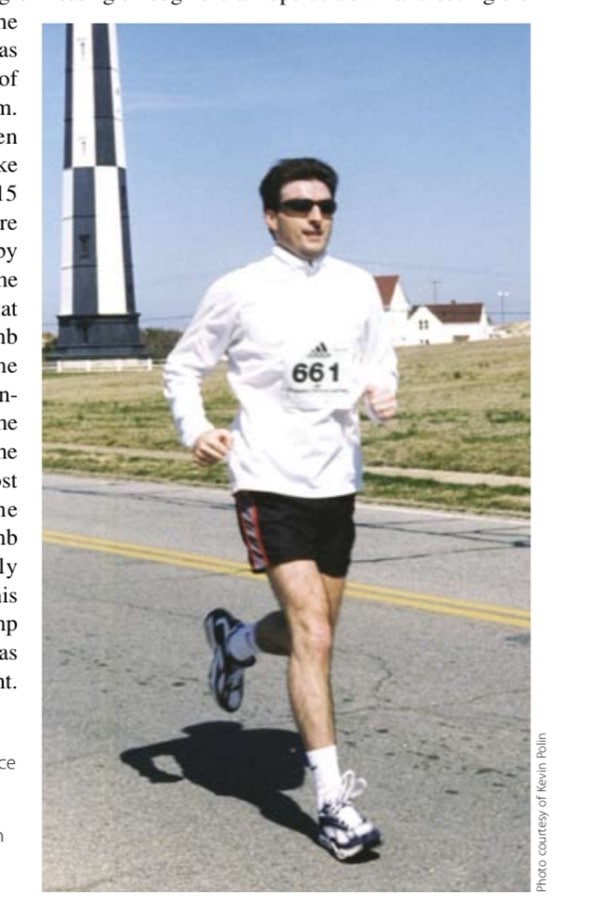
An experienced distance runner who always felt lucky to be running at all, the author cruises through the 1999 Virginia Beach Marathon.
I can still picture the owner of the car (a VW Scirocco driven by an Iranian man) leaning over me and saying, “You flew right across the street!” The man was given a ticket for careless driving and fined 50 pounds (about $100).
And so, 21 years later, my goal was not just to walk again but also to qualify for Boston, and in October 2005 I did just that at the Steamtown Marathon with a run of 3 hours, 15 minutes. However, before and during training for that race, there was a constant tightness in my left inside knee area. This first made an appearance after my second 100-mile race, at Vermont. The knee was never painful but prevented me from folding my left leg while sitting on the floor. But, like a man wearing blinkers, I knew it was a problem but continued running hard and didn’t feel the need to have it looked at. That was until I got serious and ramped up my training for Boston 2006.
Boston caused me to elevate my training level to new heights—not to Kenyan levels by any means, but quite high for me. My total weekly mileage was increased and, more significantly, I performed two sessions of speed or hill work per week as opposed to only one session previously. Not only that, but I increased the pace at which I did these speed workouts. It was these increases that aggravated what was already a significant injury, and just a few weeks into my Boston training, my left knee was in severe pain. From that point, the pain increased such that it became difficult to just walk to my car, let alone run. I wanted to believe it would go away, but, defeated, I went to an orthopedic surgeon, with my head bowed low.
The doctor, an ex-runner himself, after an examination and an X-ray, explained that it was a medial meniscus tear in my left knee and would probably require surgery. However, he continued, “You’ve obviously put in a tremendous amount of training to get this far, and with Boston just two months away I’m willing to prescribe you strong anti-inflammatories and a cortisone shot before the race itself, if necessary.”
I was very appreciative of this doctor—he was willing to do anything possible to keep me on track for Boston—and a smile returned to my face as I limped out of his office. I immediately had my anti-inflammatory prescription filled and the knee quickly felt better. I continued the aggressive training plan.
Things went well for a couple of weeks, but slowly the initial pain started to seep through the wall of safety provided by the anti-inflammatories. Within a month the pain was high—not as high as it had been but very noticeable and worrying. It then occurred to me that if the pain was returning with anti-inflammatories, what was happening to my knee behind the scenes? Was I masking worse damage with the medication? I decided to stop taking the pills for a few days and see how things went. Within two days the knee pain was so excruciating that I could hardly walk without supporting myself to take the weight off my legs. At one point, I attempted to play soccer with my sons in the backyard of our house. My
3-year-old boy passed the ball to me, I stuck out my left leg to trap the ball, the ball struck my foot, and my leg swung like a pendulum: I was unable to control my leg. At that point, I knew my Boston dream was over. In fact, it worried me that perhaps I had seriously damaged myself permanently. After an MRI and another visit to the doctor, the heartbreaking truth was illuminated: there was no way I could run Boston even with a cortisone shot. An immediate partial meniscopy was recommended: “the sooner the better,” the doctor said. “Also,” he continued, “You have to prepare yourself for the possibility . . . . ” You know the rest.
Meniscus tears and surgery Meniscus tears of the knee are a fairly common sports injury. The meniscal cartilage is a wedgelike material that prevents the femur and tibia from grinding on each other and acts as a stabilizing tissue when turning and bearing weight. A C-shaped structure, when torn the location of the tear becomes the most important factor in deciding on a particular treatment option.
A tear on the outer edge of the wedge will usually heal well since this part is thickest and has a good blood supply. Small tears in this area may heal well on their own with stabilization and rest. If not, a repair can be done entailing sewing the torn pieces back together. This procedure has a very high success rate.
The inner two-thirds of the meniscus are thinner and do not have a good blood supply. Therefore, this doesn’t heal well either on its own or after repair. Unfortunately, this is by far the more common of the two types of tears. Torn pieces here may break off and cause trouble for the other knee-joint areas, resulting in locked knee or other issues. In most cases the treatment for this type of tear is a partial meniscectomy, where the torn areas are cut out and any rough edges of the meniscus shaved smooth. My particular tear was of this type and “quite significant,” requiring removal of 25 percent of my meniscus.
These are two generalizations of the many types of meniscus tears, and the choice of surgery will be based on many factors including the patient’s age, activity level, preferences, and goals. Usually the partial meniscectomy procedure is performed arthroscopically using a thin tube with a camera attached and long, thin, surgical tools, all of which are inserted through small slits made in the knee area. This is outpatient surgery and can be done with general or regional anesthesia.
In my case, the surgeon made three slits in my knee: one for the camera and light, one to insert cutting tools, and one to act as a “drainage hole” where all the debris could be flushed out. I was nervous, but the surgery went well and was done in one morning. I opted for general anesthesia—not really wanting to see the activities of the “drainage hole.”
The surgery was performed on a Monday, and I hobbled into work on Wednesday. The painkillers prescribed apparently worked well, since I don’t remember much about the two days in bed except that I did rewatch my entire set of Monty Python videos, all of which seemed extra funny under the affects of Percocet.
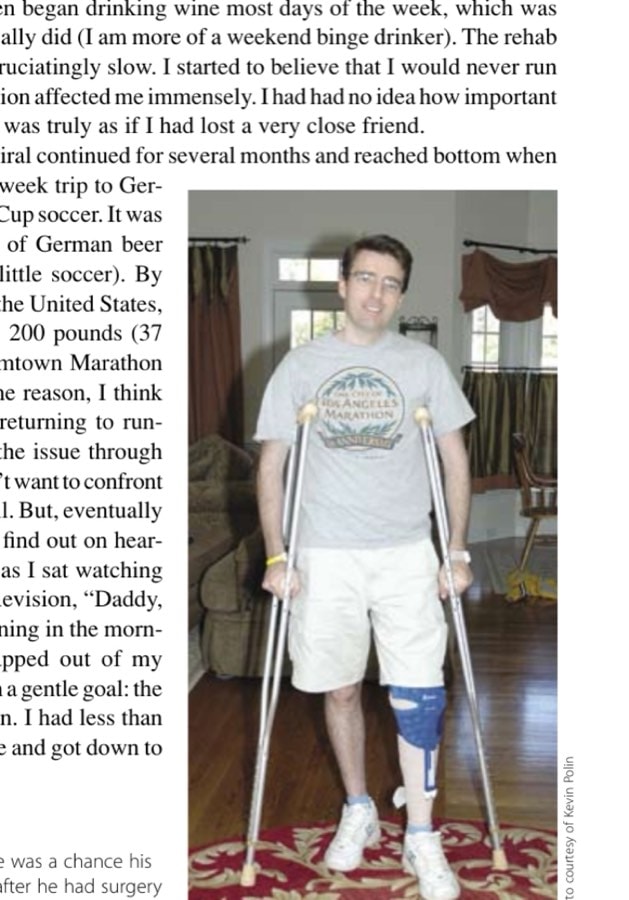
The following weeks revealed something that surprised me: depression. At the time, I couldn’t quite put my finger on it, but things around me just didn’t seem the same. I no longer had enthusiasm for things I once enjoyed, it became difficult to sleep, and sometimes it became even more difficult to roll out of bed in the mornings. I even began drinking wine most days of the week, which was something I never usually did (I am more of a weekend binge drinker). The rehab from surgery was excruciatingly slow. I started to believe that I would never run again, and this realization affected me immensely. I had had no idea how important running was to me. It was truly as if I had lost a very close friend.
This downward spiral continued for several months and reached bottom when I embarked on a two-week trip to Germany to watch World Cup soccer. It was one continuous party of German beer and sausages (and a little soccer). By the time I returned to the United States, my weight was up to 200 pounds (37 pounds over my Steamtown Marathon race weight). For some reason, I think I was worried about returning to running and so avoided the issue through overindulgence. I didn’t want to confront the fact that I might fail. But, eventually I knew it was time to find out on hearing my daughter ask, as I sat watching CNN Daybreak on television, “Daddy, why don’t you go running in the morning anymore?” I snapped out of my cocoon and decided on a gentle goal: the Atlanta Half-Marathon. I had less than four months to prepare and got down to work immediately.
▲
The author knew there was a chance his running days were over after he had surgery to repair a torn meniscus in April 2006.
Photo courtesy of Kevin Polin
After surgery
Back in training I took to my trusty Hal Higdon advanced program and modified it for the halfmarathon. I realized immediately that it was going to take some time to get back into the swing of training—the only activity I had been doing for three months was stationary bike work and short runs on a treadmill. On my first pace and long runs, I cursed every beer and sausage I had eaten in Germany. I rarely pushed myself hard: the memory of my leg swinging limply from side to side after the meniscus tear was with me every step of every run. I ran carefully. Probably because of this relatively slow pace, the German beer gut was hard to evict.
However, by the time the Atlanta Half-Marathon presented itself, I felt pretty much ready, although I didn’t really expect too much in terms of a good performance. My goal was to stay on my Boston qualifying pace (7:30 minutes per mile) as much as possible. The Atlanta Half-Marathon course is challenging, encompassing five quite difficult hills. Keeping on goal pace was a struggle. I found myself on the point of breathlessness most of the way but was able, incredibly (I thought), to keep on pace and finish in 1 hour, 37 minutes. I was back, I felt, even though my finisher’s photo looked suspiciously like that of a Teletubby running across the line.
The knee felt quite good. It was definitely different, though. At least twice a day the supporting bones around the knee seemed to click in and out of place— something I had never known before, and something quite disconcerting. Also, when the weather was cold, the knee would be almost too painful to bear. For some reason the cold weather really adversely affected it. After I ran a few miles, the pain would subside only to return when I stopped—only a hot shower was able to rid me of the grief. This, too, was very disconcerting.
All this aside, Boston 2007 was coming up, and my 2005 qualification was good to get me in. It was hard to think about requalifying, so I decided to ramp up the training and prepare for the spring race, in order to avoid requalification the following year.
So, on the first week of December, I embarked on Hal Higdon’s Advanced I program. I decided to do only one speed session a week (as opposed to the two sessions in the Advanced II program). Then, on the very first day of my new training program, I walked into my company’s changing room and there, lacing up his running shoes and donning a Boston Marathon jacket, was a man named Dean Jackman. Sometimes in life things just seem to “click,” and so it was on this fateful day for us both. Dean had run Boston twice and was a sub-3:10 marathoner, and since he was training for two local marathons scheduled around the same time as Boston, we immediately began training together. Lunchtime pace runs at work and early-morning Saturday long runs on the infamously steep North Turkey Trail of Raleigh’s Umstead Park, and the rest was history. We kept each
other motivated and focused on our training schedule through winter and into spring. More important, Dean somehow put up with my inane banter on earlymorning runs. By the time my new running partner/friend and I had finished 18 weeks of training together, I truly felt that I could not have been in better shape given where I was before the training. It was a lucky break for us both. The only negative was my inability to keep myself on a strict diet, and because of that I did not lose much weight. In fact, I was still 15 pounds heavier than before my Steamtown Marathon qualifying race.
However, before Boston I didn’t feel there was much more I could do. The nagging thought in my mind was constant worry over whether my knee could handle the course; in fact, my main thought was whether I could run any marathon course again. On Monday, April 16, 2007, I would find out.
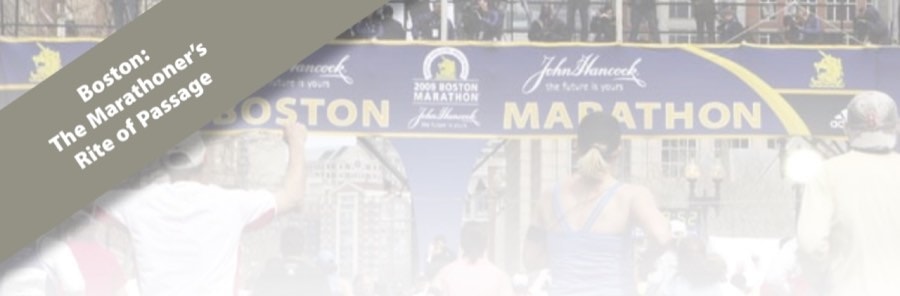
Boston Boston. Is there anything more that can be said of this event that hasn’t been said? Actually, I believe so, considering that 2007 brought with it some of the worst conditions the marathon has known in its hundred-year-plus history.
In the days before the marathon, there was an electric feel to the city—a real buzz I had not experienced at any other marathon or ultra. For me, it’s not just the history but also the fact that Boston faithfully requires all participants to qualify in a fairly challenging time (except for the several thousand charity runners and others who receive qualification exemptions). It’s what sets it apart from the others—most high-demand marathons turn to lotteries and charities as a way of filtering their entrants. I dearly hope Boston keeps its high standards in this regard.
For several days before the race, the national news services had latched onto the event after discovering a nor’easter would almost certainly hit the Boston area and most likely during the marathon itself. Race organizers sent out a weather alert to all runners the Wednesday before the Monday race. By Friday, the storm had packed a big punch through the Midwest and was causing havoc all the way up the East Coast. All the major media outlets prophesized a doom-and-gloom scenario for the race: “It could be the worst conditions ever experienced in the one-hundred-plus-year-old race.” The day before the race (Sunday, April 15) saw torrential rain throughout the city and high winds gusting well over 50 mph. It was not a matter now of whether the storm would affect the race but of how much it would affect the race. By Sunday night, the worst predictions were being touted: “heavy rain, 20- to 30-mile-an-hour winds with gusts of 50 to 60, temperatures in the 30s with the windchill in the 20s, and possible flooding on the course.”
After a sleepless night, I rose at 5:45 a.m. on race morning, not daring to look out the hotel window but instead putting on my race kit plus several layers of extra
clothes, topped off with a disposable rain suit. I took all the extra gear I could fit into the race bag including my race shoes, choosing to wear a throwaway pair of old shoes to the start area. On leaving the hotel to catch the shuttle to the subway, a gust of wind blew my cap clean off my head and through the parking lot. I was then, literally, blown several feet back by the wind. As rain pelted my head in the predawn darkness, I smiled knowing this would be an interesting day. The bus driver opened his side window and shouted to me, “Are you sure you want to do this? I can take you back to the hotel if you like.” I replied, “No thanks, I’m fine. Isn’t this what’s life’s all about? It’s a glorious day, glorious!”
Thirty minutes later I walked from the subway stop toward Boston Common to catch one of the school bus shuttles. Already about a thousand people had lined up quietly in the heavy, wind-laden rain, which made for a surreal scene. It took over an hour of torturously slow queuing up to finally board a bus, by which time I had drunk the only small bottle of water I had chosen to bring with me. This would prove to be a big mistake.
Three hours after leaving the hotel, the bus crawled into the athlete village area in Hopkinton and then spent a further 10 minutes trying to navigate to the disembarkation area. I decided to leave the bus early and walk the final block or two, having already changed into my race shoes within the dry sanctuary of its confines. Most of the other people on my bus were running in wave two. Since I was in wave one, it already was time for me to walk a mile more to the starting line. I trudged through the athlete village and failed to find any water stations. Panic sank in on the realization that I had been up and about for over three hours, had drunk only one small bottle of water, and had no time to stretch or prepare. I had to find water if I was to have any decent chance of survival in this marathon. As I sloshed through the village, drinkable water was impossible to find. The only place I knew of its existence was in one of the two large, impenetrable tents that were jam-packed with people (and somehow had a deeper level of mud than the outside fields). I decided to take a chance and walk to the start, on the way changing into my race kit in the still-pouring rain before leaving my bag at the baggage drop. Things got better 10 minutes later at the start line, where I found a water table and immediately gulped several glasses of Gatorade with the hope that it wasn’t too late.
In the dozens of marathons I have run, I’ve never experienced so many goose bumps while standing in the start corral. The culmination of two years of preparation for this moment was now being realized. The thought of my condition almost exactly a year ago after knee surgery came into play as I decided I would push as much as possible on this day. The problems of the morning subsided. It was my own fault that I had not thought to bring extra bottles of water in case water was not available, and I should have risen earlier to catch the buses to Hopkinton and so given myself more preparation time. But none of that seemed to matter as I
stood in the 6,000-level start corral surrounded by well-conditioned athletes. And so, with a surprising lack of fanfare, the 2007 Boston Marathon was started. By now the doom-and-gloom scenarios for the weather were dissipating. The heavy rain was backing off and the temperature heading toward 50 degrees Fahrenheit. Looking around, I thought that most people were thoroughly overdressed; I too was wishing that I had not worn a long sleeve.
I was expecting the first half of the course to be relatively easy, but the continuous rolling hills took their toll, and by 10 miles, my calves and thighs began to cramp—something that had never before happened to me in a marathon. I knew I was in trouble but continued to keep to my 7:30 goal pace quite well. Then just after mile 16, I finally came face to face with the infamous Newton Hills as I turned the corner at the Newton Fire Station. My first observation as I looked to the top of the first hill was of an American flag being blown continuously at full stretch. However, although the wind was troublesome the entire race—heavy full-frontal gusts up to 50 mph—my main problem was the excruciating pain from leg cramping. I believe the lack of prerace hydration coupled with being overdressed (I didn’t want to strip down further during the race because of the uncertainty of the weather) was the major cause of the cramping. In any case, pushing through the pain was certainly challenging—I had to call up deep-down resources to continue a respectable pace.
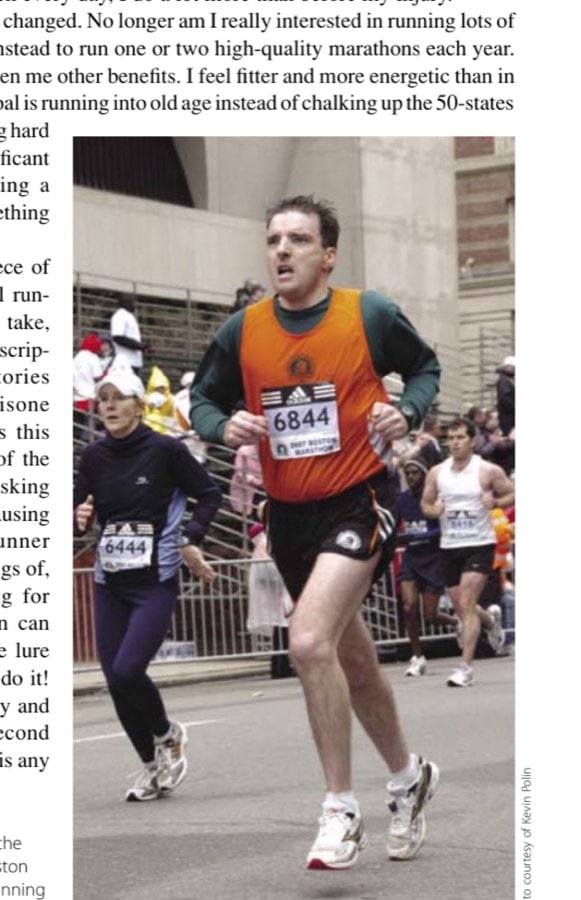
Finally finishing in 3:21:00 (1 second short of a Boston qualification time), I found that time quite satisfactory given the challenges of the day. But missing the qualification time by one second was hard to swallow. It was as if someone were saying to me: “We’ll allow you a good time for the race but will cut you short one second of requalifying to keep you on your toes.”
However, my comeback was complete and the Boston monkey off my back. I met with my wife and daughter after the race, and we later celebrated at Boston’s fine Aujourd’hui restaurant. While there, I established a new goal: a sub-threehour marathon.
Photo courtesy of Kevin Polin
▲
The major media outlets prophesized a doom-andgloom scenario for Boston 2007, saying “It could be the worst conditions ever experienced in the one-hundredplus-year-old race.”
I am now extremely careful on all runs, constantly checking my condition and closely monitoring my knees and legs. Each run is considered important and has a distinct purpose, whether it be a recovery jog, a maintenance run, a long run, or speed work. Mileage and speed are increased sensibly—any hint of problems and I’ll slow down or skip the workout. Stretching is given a high priority, too; although I can’t say that I stretch every day, I do a lot more than before my injury.
My goals too have changed. No longer am I really interested in running lots of 100-milers, seeking instead to run one or two high-quality marathons each year. This approach has given me other benefits. I feel fitter and more energetic than in the past. My highest goal is running into old age instead of chalking up the 50-states marathons. Continuing hard running after a significant injury collected during a 100-miler is not something I will ever do again.
If there is one piece of advice that I hope all runners reading this will take, it is to never take prescription anti-inflammatories and especially cortisone shots. As obvious as this sounds, fix the root of the problem without masking the symptoms and causing more damage. A runner caught up in the throngs of, for example, training for the Boston Marathon can easily succumb to the lure of an easy fix. Don’t do it! I learned the hard way and am grateful for a second chance. Also, if there is any
▲
The author overcame the odds to complete his Boston comeback—and is still running strong today.
Photo courtesy of Kevin Polin
Summary
doubt as to what injury you have, get an MRI (don’t rely on an X-ray). If my injury doesn’t recur, then to me this whole experience will turn out to be a good thing by instilling in me some much-needed common sense. Instead, the whole episode leaves me wondering how much extra damage I caused myself by taking the anti-inflammatories and continuing the vigorous training.
Future treatments for knee injuries Regarding new knee cartilage treatments, the future looks bright for more options that are almost ready for mainstream use. The two most exciting are stem-cell injections and cultured cartilage-cell injections.
Stem-cell injection therapy involves a patient’s receiving adult mesenchymal stem cells (MSCs). These cells are taken from normal adult donors and are not derived from embryo-related harvesting. Fortuitously, the cells are universally compatible (similar to blood type O) and can be used without the need to perform tissue matching. This type of treatment has been primarily developed by Osiris Therapeutics and is called Chondrogen.
Studies on animals have shown that MSCs aid in the repair of meniscal tissue. It was found that animals treated with the cells had a regeneration of previously (surgically) removed meniscal tissue. Also, it was found that the cartilage surface was protected and a lessening of joint damage observed when compared with a control group.
Duke University Medical Center is one of the study participants, and since it is local to me, I called to inquire about the treatment. I was told that the center was looking for people who needed at least 50 percent of their meniscus removed, and I had a 50/50 chance of receiving either the full treatment or a placebo. I turned down the study since my doctor informed me that I would need about 25 percent of my cartilage removed. Also, having only a 50 percent chance of actually receiving the stem cells bothered me.
The second treatment involves collecting, culturing, and reimplanting a person’s cartilage cells (chondrocytes) to repair articular cartilage damage in the knee. A surgeon first performs a cartilage biopsy on the knee to obtain an amount of cartilage about the size of two pencil erasers. This biopsy is then sent to a laboratory where the cells are cultured to increase the volume of cells from a few hundred thousand to over 10 million cells. The cells are then sent back to the surgeon where these autologous (that is, the patient’s own) cells are implanted into the knee during a second surgical procedure. A few months later, these cells should reestablish a new articular knee surface to replace the lost cartilage. Carticel, the product used in this procedure, has been developed by Genzyme Corporation.
I hope that these treatments will quickly become mainstream and of immediate benefit to runners.
This article originally appeared in Marathon & Beyond, Vol. 14, No. 2 (2010).
← Browse the full M&B ArchiveMore like this
1,000+ stories from 19 years of Marathon & Beyond
The complete archive of the legendary long-distance journal — digitized and free to read.
