

Boston, Again!
After the horrifying and heartbreaking finish to last year’s Boston Marathon, I looked for and found an article I wrote that appeared in the May 3, 1978, edition of the Buffalo Rocket, a fine North Buffalo paper that is mostly a vehicle for advertisements. It is my take on the running of the Boston Marathon that I had taken part in just a few days before, and I wrote it as soon as I returned to Buffalo, so the memories were fresh.
I would like to share this with you because I think it gives a pretty good look at what it was like to run this race back in the day. More important, it shows how much things have stayed the same, at least as far as why so many want to put themselves through this tough experience.
Among the changes, we used to finish at the Prudential Center; there are way more runners now but better crowd control so runners never have to run single file. I also mention passing some wheelchair participants. Remember, this was when Boston first had wheelchair racers, and a picture from the April 18, 1978, Boston Herald American that I saved shows the winner of the wheelchair participants crossing the finish line. A guy named George Murray won that year in a record time of 2:26, and he is in a regular, old-fashioned wheelchair like the kind you have to use when you are wheeled out of the hospital after having an ingrown toenail fixed. There were no souped-up racers of the sort that now get the participants to the finish line more than an hour faster than in those days.
A couple of disclaimers are in order also. In my article, I make a point by using O. J. Simpson as an example of a star athlete, and I did so because he was a big hero in Buffalo at the time. Of course, times have changed and events have happened that make him less of a hero if I were writing this today. If I were putting pen to paper now, I would undoubtedly pick a Buffalo sports hero from these days, if we had any.
The main thing about this article about the Boston Marathon that has not changed is the thrill of the crowds cheering us on. They brought us back to run
Courtesy of Bill Donnelly
▲
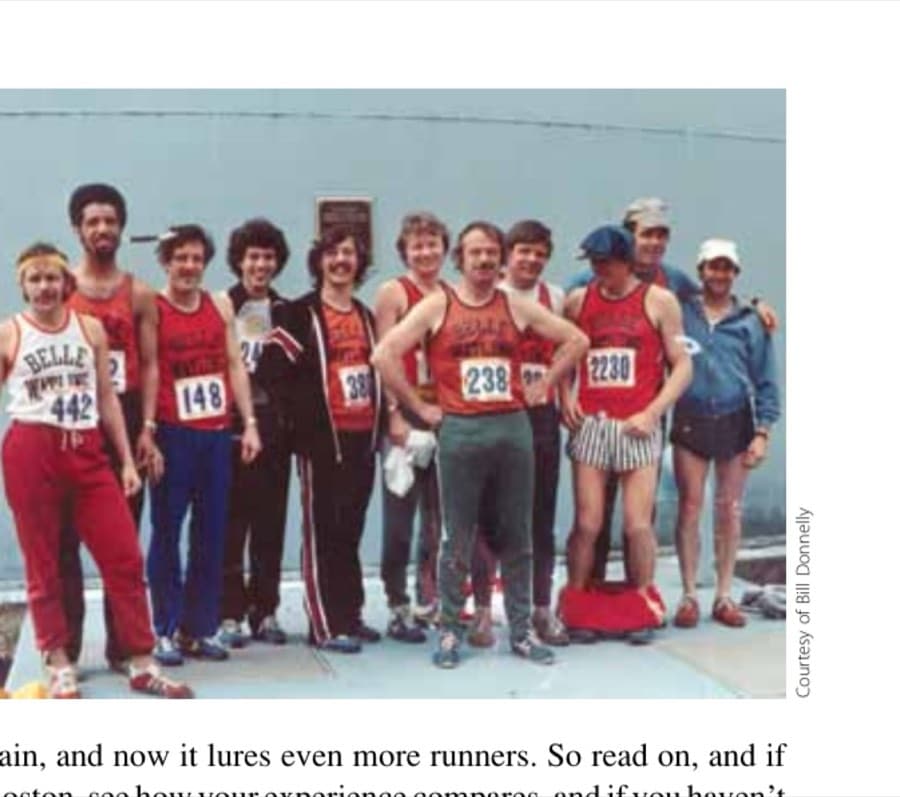
The Belle Watlings gather before the start of the 1978 Boston Marathon. They are, left to right, Dave Bogdan, Fred Gordon, Ralph Zimmerman, Tom Donnelly, Bill Donnelly, Bob Herzog, Dick Sullivan, Norm Schwendler, Paul Schwandt, Bill Cambell, and an unknown runner.
Boston again and again, and now it lures even more runners. So read on, and if you have ever done Boston, see how your experience compares, and if you haven’t run Boston, dream on. Maybe one April day you will run the Boston Marathon, and I guarantee you that it will be the thrill of a lifetime, and you can believe me when I say the crowds will still be there, only the throngs will be bigger and more enthusiastic than ever.
Boston Crowds Turn Grueling Marathon Into Exciting Event for Runners by Bill Donnelly I sat with back leaning against the wall and my aching legs stretched out before me. I was in the glass-enclosed lobby that separates the Prudential Center from the Sheraton Hotel in downtown Boston, Massachusetts. My whole body was sore and tired, but my legs were in especially bad shape. My throat was dry and I was shaking from exhaustion. People who passed by stared and one man even took my picture. I had just finished running the Boston Marathon, and I felt great!
I watched as many of the other 4,000 men and women who had run in the marathon walked, limped, and staggered past. I was in a good spot to see the runners from Buffalo, because we had all agreed to meet at a certain bar in the hotel in order to quaff a few beers after the race. I was eager to see how others had done in the race.
Finally, some Buffalo runners appeared. Fred Gordon was delighted by his best time ever of 2:25:29 but seemed just as pleased by the effort of his fellow teammate, Ralph Zimmerman. Ralph had accomplished what many runners dream
of but very few do. He broke 2 hours and 20 minutes (2:18:55 to be exact) and so now is designated as a world-class runner. This simply means that Ralph no longer needs a car because he can get around faster by running.
Ralph’s place of 28th out of 4,212 runners was the best of any Buffalonian. He had set a US record for his age group, which is 35 to 39 years old. Pat Janiga actually danced a jig that made my legs hurt. Bob and Jim Herzog limped in together and Jim simply collapsed next to me. Tom Donnelly staggered in as did Dave Bogdan, Mike Miesczak, and Paul Schwandt. All my friends had one thing in common. They were all very pleased with their races.
There is an excitement and thrill in running the Boston Marathon that can be equaled by no other sporting event. Why else would so many people come from all over the world to put themselves through such agony? Just to go to Boston, one must qualify by running another grueling marathon, and many of us have run Boston more than once. What is it that makes it so exciting?
I believe for all runners, much of the lure of Boston is the people there. From the minute we arrive there, we are treated as stars, not just a group of crazy runners. The media plays up the event bigger than any professional sporting event going on there, including the Stanley Cup playoffs.
The race is run on the third Monday in April, which is Patriots’ Day in Boston. The Red Sox and the Bruins are playing, but the event of the day is the marathon. Over one million people turn out and line the whole 26 miles. OJ Simpson may have had the thrill of hearing 80,000 fans cheer him after scoring a touchdown, but in Boston I literally had one million people cheering me on.
From the very start when we arrive at Hopkinton, where the race begins, electricity fills the air. A town of 6,500 residents, Hopkinton does not have enough bathrooms to service over 4,000 very nervous individuals who anticipate the agony they are about to endure. Thus, every available bush or tree in town becomes a potential bathroom.
Balloons, doughnuts, and T-shirts are being sold everywhere. A hot-air balloon rises near the starting line, and I count five helicopters directly over the start at one time. We line up, and I am fortunate to be near the front. Over 4,000 runners on a two-lane road form a line several blocks long, and once the gun goes off, the last runner will not cross the starting line until five minutes later.
The announcer shouts, “Ten minutes till we start. Everyone please line up. Joe Stump’s mother is looking for him to get his sweats. Will number 2507 please come to the official start because you’ve lost your number.” On it goes. We make small talk, but I wonder what the heck I am doing there. I’ve run 13 marathons and I know only too well what pain I will be in. Why should I be so happy and excited about being here?
The gun finally goes off and we slowly surge forward. A couple of runners fall in the start and one can only hope that they get up before being trampled. It’s downhill at first, and we are flying, feeling loose and good. There are people lining the whole course, but in the first towns they are thickest, sometimes 10 people deep.
I have long contended that the Boston Marathon is the greatest of all spectator sports because the spectators actually take part. Many people come with water or ice to hand to the runners. Thousands spend the night before slicing oranges to hand out. Some have hoses to spray us, and some simply hold out their hands hoping a runner will slap it. The rest will cheer loudly and help carry us through the race. Is it because we are amateurs that the spectators become so enthused and involved?
Over the next 14 miles, whenever I feel let down in my strength, I wave my arms “Rocky style.” The crowds love this and cheer all the more. By the halfway point my legs are already very tight and hurt, probably from going too fast on this cool day.
But at 13 miles we hit Wellesley, an all-girls’ school with the enthusiasm and spirit of a Buffalo stampede. These women get me moving. Then came the Newton Hills, which includes the famous Heartbreak Hill. These hills would be impossible but for the fact that the spectators become almost
ad
Courtesy of Bill Donnelly
▲
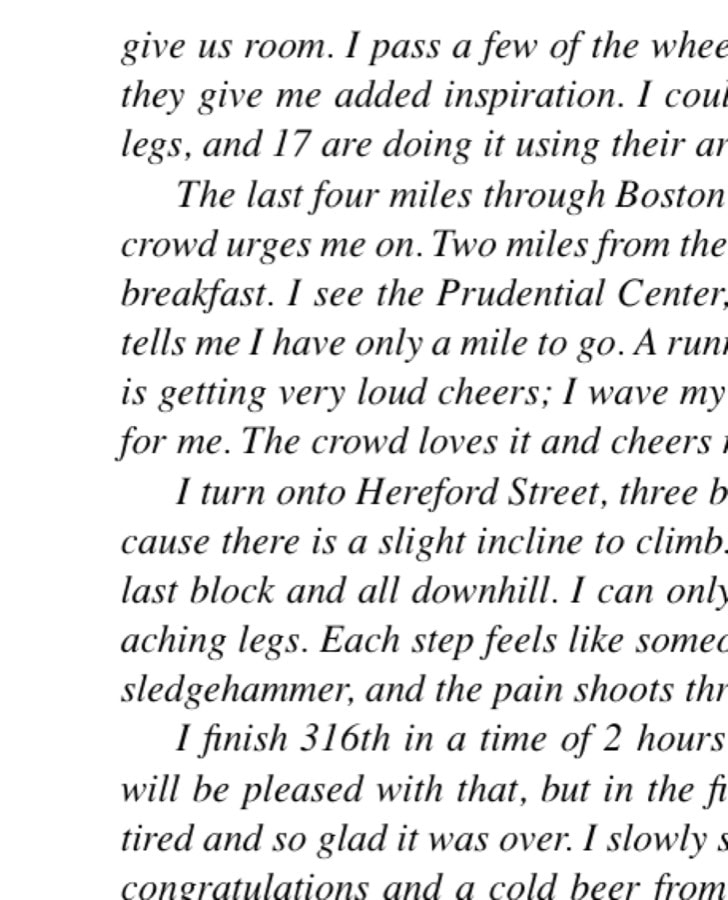
The author (#388) looking for encouragement on the hills of Boston in 1978.
overwhelming here, but they are the most encouraging to us runners. The crowds become so thick that we have to run single file through them. At the top, a police officer with a bullhorn congratulates us for climbing
Heartbreak Hill, and informs us that we have only a bit over four miles to go, all downhill. The crowds grow larger, and police and National Guardsmen have to hold back the spectators to give us room. I pass a few of the wheelchair racers, who started before us, and
they give me added inspiration. I could hardly make it up those hills using my legs, and 17 are doing it using their arms. The last four miles through Boston are long and hard. I want to quit, but the
crowd urges me on. Two miles from the finish I pass a runner bent over losing his breakfast. I see the Prudential Center, but it looks miles away while the crowd tells me I have only a mile to go. A runner from Boston University passes me and
is getting very loud cheers; I wave my arms in appreciation as if the cheers are for me. The crowd loves it and cheers me all the more. I turn onto Hereford Street, three blocks to go, but my heart sinks simply be
cause there is a slight incline to climb. I get over it, turn towards the finish, one last block and all downhill. I can only struggle in; there is no sprint left in my aching legs. Each step feels like someone is hitting the bottom of my foot with a
sledgehammer, and the pain shoots through my legs. I finish 316th in a time of 2 hours and 35 minutes and 45 seconds. Later I will be pleased with that, but in the finish chute I don’t give a damn. I was so
tired and so glad it was over. I slowly staggered through the huge crowd, getting congratulations and a cold beer from someone. I meet my girlfriend, Eleanor, and am glad to see her. It is over. We partied that night. I won’t be able to walk without pain for a
week, and going down stairs will be near impossible. But I am happy and have had one of the most memorable, thrilling experiences of my life. Next year I will be back in Boston to live it again.
This article originally appeared in Marathon & Beyond, Vol. 18, No. 2 (2014).
← Browse the full M&B ArchiveMore like this
1,000+ stories from 19 years of Marathon & Beyond
The complete archive of the legendary long-distance journal — digitized and free to read.
