

Boston Through Allens
Legs aching, sweat glistening, dehydration setting in, yet smiling ear to ear: a perfect illustration of my body and mind after a second journey along the legendary route from Hopkinton to Boston. There was nothing that day at the historic 118th running of the Boston Marathon that was going to keep me or any of the other 32,000 runners from completing every step of the 26.2 miles. There was simply too much support, motivation, and desire to retake the finish line to allow us to stop.
Rewind to 2013 It was an exciting day: my first Boston Marathon. Unlike many of the seasoned veterans of Boston, I had a nervous and anxious feeling in my stomach that all first-timers experience, but those feelings were intertwined with a feeling of anticipation and exhilaration. I arrived at the Boston Common bright and early and got on one of the hundreds of school buses that lined Tremont Street. There was the smell in the air of a crisp spring morning that is always the prelude to a beautiful day to come. I found a seat next to a gentleman from Texas, and we chatted along the way to Hopkinton, and both joked that it seemed like the bus was taking us much farther than 26.2 miles away from the city of Boston.
I had trained extensively to compete in the 2013 edition of the marathon, so once our bus arrived at Athletes’ Village, I was all business. After finding a place to sit on the packed-down dirt of the local high school’s baseball diamond, I focused on my plan, hydrated, and ate my energy bar. After seemingly hours and hours of waiting, it was finally time to head to the start line.
My qualifying time was under three hours, which meant that I had a nice spot in corral number two waiting for me. Due to the topography of the start line, those in the second corral stand at the top of a hill with the ability to look down over the elite athletes as they make their final preparations. The announcer enthusiastically read off the big names and their accomplishments, and once the gun went off, they were all long gone. And eventually so were the rest of us.
For the most part, my race went to plan until the 21st mile, when my quads cramped during the appropriately named “Heartbreak Hill.” It was a slow limp into the finish with a final time of 2:58:16, but regardless of the agony of those final miles, I was excited. I had the chance to see my girlfriend (now wife) and parents at mile 17 and had finished in under three hours. It had turned into the perfect day. We arrived back at our hotel a few blocks from the finish, I showered, and then the text messages started pouring in: “Are you OK?” “Where are you?” “
When you get the chance, let us know that you’re safe.” At first it was confusing, as I was experiencing nothing wrong besides the typical postmarathon pains. Then we turned on the television and it all made sense. It’s amazing how our friends 700 miles away knew before we did. My family, my girlfriend, and I were lucky. We were safe and unharmed. We watched the events on a screen, but many people experienced it with their own eyes. Again, we were lucky.
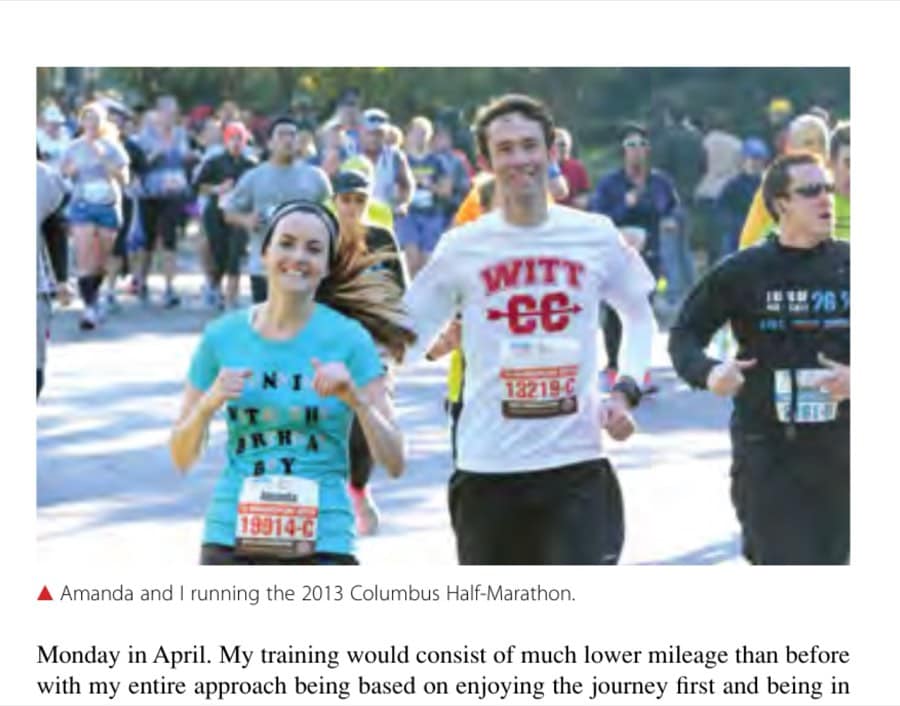
The months that followed Along with the others who had run, watched, or volunteered on that tragic day, there was simply no escape for us from the media’s coverage of the event. Speculation was everywhere about who had committed the attack and whether the Boston Marathon could continue. Everything about the event was dissected on the various news outlets: what it sounded like, what it looked like, even what it smelled like. It was enough to make me say that I would never do Boston again and maybe never even run again. My motivation for the sport was gone. Training had become too tedious, and injuries from years of running made each step painful enough that it just wasn’t fun anymore. Three or four months elapsed when something happened that changed my mind. During the heat of the summer, my fiancée asked if I wanted to run the Columbus Half-Marathon with her in October. Amanda had been a tennis player and had done some running before, including a couple of half-marathons. I was excited and agreed to sign up. It turned out to be one of the best experiences of my life. We trained together, and I learned that running was not about being the fastest but instead about the journey.
With this new outlook, I thought long and hard about the 2014 Boston Marathon; my time from the previous Boston was a qualifying time. It became clear to me that if I didn’t sign up, I might regret it. After registering for and then running the half-marathon with Amada, I gave serious thought to how I would train for Boston.
I decided that it would be best to start my training in the beginning of January to be prepared for Boston, which would be held on Patriots’ Day, the third
▲ Amanda and I running the 2013 Columbus Half-Marathon.
Monday in April. My training would consist of much lower mileage than before with my entire approach being based on enjoying the journey first and being in shape second. Unfortunately for anyone living in Ohio or elsewhere in the north, the winter straddling 2013 and 2014 proved to be miserably cold and snowy, and my motivation to train hit several bumps in the road—including the weather, illness, and injury. As Boston loomed, I found myself unprepared for 26.2 miles and as a result made the decision to run at a much slower pace than originally planned. I also had the idea to carry a camera with me to document what would certainly be one of the most famous Boston Marathons in history.
My father had retired from being a freelance photographer the previous September and was also an avid runner, perhaps more than me. Simply running was not enough for him, though, as he became famous in the community for being the guy who not only ran a lot but who ran a lot with a camera in his hand. Dad documented everything from his everyday runs to local road races and even marathons, including the Marine Corps and Air Force marathons. I guess you could say that it was in my blood to follow in his steps. So after several trial runs with my camera and producing a lot of really bad pictures, I finally mastered the art of photography in motion.
A city of support Like everyone else traveling to Boston that weekend, I was nervous, not just the normal nerves that go with running a marathon, which are challenging enough
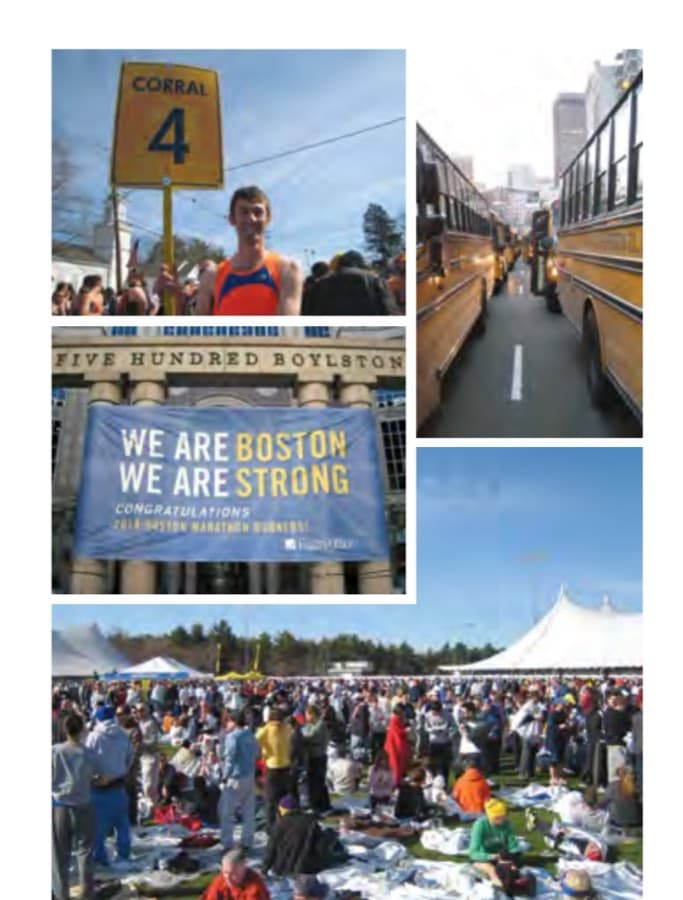
▲ Clockwise: Me holding the Corral 4 sign before the start of the 2014 Boston Marathon. The line of school buses on Tremont Street that transport us to the start. The Athletes’ Village in Hopkinton. The sign on Boylston Street near the finish of the race.
to overcome, but the anxiety about safety. However, I hadn’t been off the plane at Logan International Airport for more than five minutes before all of my concerns had vanished. There were signs, flags, and banners on every wall, building, light pole, and even many houses welcoming the runners. It’s like the city was welcoming us home. With this show of support that the people of Boston had prepared for us, I knew nothing could possibly go wrong. This city would not let that happen.
In the days leading up to it, the excitement of the coming race eclipsed the concerns I had about my fitness, which no longer worried me. Perhaps I wasn’t bothered because my time this year simply did not matter. I also knew that no matter how slow I might be moving, the thousands of people along the course yelling and screaming were going to make sure I ended up on Boylston Street one way or another.
The race With my camera and extra batteries in tow, I once again found myself strolling across the Boston Common, heading for that never-ending line of yellow buses. This time it was not with the hardened look of someone who might be trying to PR or win a race, but instead with the look of a tourist toting his camera around, taking pictures of signs and people with a big old smile on his face. I was here to enjoy the journey.
The Athletes’ Village had a much different feel to it from last year and from what I assume every year previously had felt like. Everyone knew security would be much tighter, but once you got past the police presence, it seemed like more of a party than a marathon. There was more laughter, more smiling, and way bigger lines for the port-a-johns! It became abundantly clear that I wasn’t the only one coming back to Boston to enjoy myself. Strangers talked with strangers. People conversed about how beautiful a day it was. Everything felt right.
As I moved to the start line from Athletes’ Village and began taking pictures in earnest, I realized how much better my day was going to be because of my camera. It forced me to look at my surroundings, whereas before I might have just focused on the road in front of me. I saw signs, costumes, and lots and lots of people that many other runners might have missed.
One last time before the gun fired, I took my bright-orange-and-blue singlet and wiped off my camera’s lens; it was about to get a lot of work. After a flyover by four military helicopters, a moment of silence, and a moving speech by race director Dave McGillivray, the crack of the pistol sounded and off we went. For me, the first few miles were chaotic. Though I started in wave one and with the fourth corral, I was planning on an 8:00-mile pace, not the 6:30-mile pace the people around me were prepared to run. Because of this, I was passed by an endless
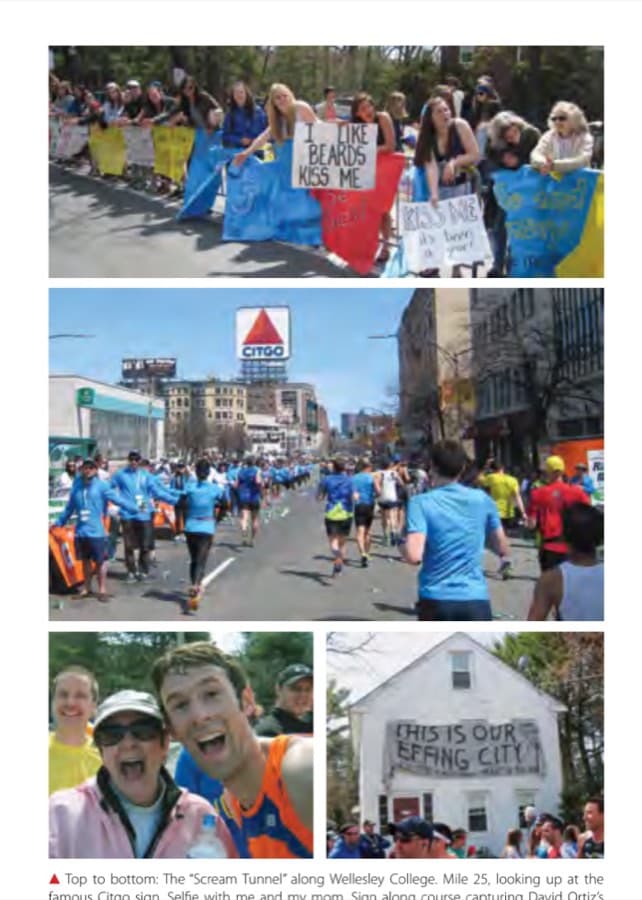
▲ Top to bottom: The “Scream Tunnel” along Wellesley College. Mile 25, looking up at the famous Citgo sign. Selfie with me and my mom. Sign along course capturing David Ortiz’s memorable quotation from the days after the 2013 Boston Marathon.
stream of far fitter athletes. I moved to the side of the road to get out of the way and settled in to enjoy the ride. Besides some rural stretches in the early miles, the crowds proved to be exactly what was expected: packed. People everywhere were stacked three, four, or five deep, yelling and ringing their cowbells. It was exhilarating, with everyone from little kids handing out high-fives to college students living up their day off from classes to older couples who have clearly made it a yearly tradition to cheer on the runners. Though I had run Boston only once before, there was no doubt that the crowds were bigger, louder, and more enthusiastic than ever before.
As I passed through the numerous small towns during the first half of the race, my head was always on a swivel. I looked for signs, people, buildings, and landscapes. The state of Massachusetts is truly beautiful. Several things specifically caught my eye in the early miles: the house with the Corvette in the front yard with a “For Sale” sign on it, and the fire hydrant that had been painted Boston Marathon blue and yellow—legally or illegally, I’m not sure. As in my first Boston, I looked forward to crossing the railroad tracks in Framingham, and in the ninth mile I had the honor of passing Team Hoyt in their final Boston Marathon.
For anyone who has run this great event, or for those who know something about it, just before the halfway mark comes one of the most iconic stretches of the race, the “scream tunnel.” This part of the course, which probably leads to many people running their fastest mile split of the race, runs along the all-female campus of Wellesley College, where seemingly the entire student body comes out to cheer on the runners. They bring signs that say things like “WE RUN TOGETHER” and “KISS ME, I’M FROM BOSTON!” It is hard not to get caught up in the moment, which is why I, like many others, ran way too fast through this part of the course. When you get past the roaring throngs of girls and into the just-as-exciting town of Wellesley, your ears will undoubtedly continue to ring for miles to come.
As the miles continued to pass, the crowds lining the course got bigger and bigger. It appeared that the sidewalks were ready to burst at the seams, but my eyes were hard at work focusing for just two people. My parents had traveled with me and were going to be somewhere around the 17-mile mark. I ran along the metal fence on the right side of the course searching every face. Then, finally, I spotted my mother and stopped for a quick picture. It turned out perfectly—that is, if you don’t mind the perfect stranger smiling in the background. I would later find out that my dad had found a place overlooking the course to look for me and unfortunately missed me. Because mile 17 occurs in the early stages of the infamous Newton Hills, seeing my mom was a big boost. Another bit of motivation that began to circulate through our pack was that Meb Keflezighi had won the race, becoming the first American in more than three decades to accomplish that
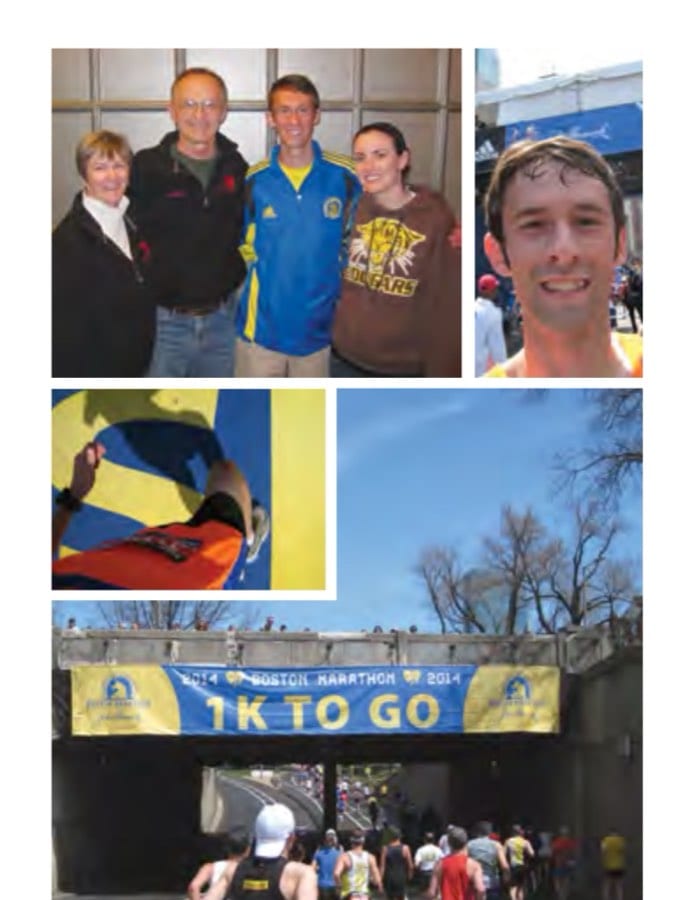
▲ Clockwise: With my parents and now-wife after the 2014 Boston Marathon. Me moments after crossing the finish line. One kilometer left in the race. Me literally crossing the finish line.
feat. It was understandably exciting as “U-S-A!” chants began to ring throughout the crowd. My pace had held steady, just under eight minutes per mile, but with the hills taking their toll I slowed to ensure that I would be able to enjoy the final miles. But as my speed slackened, my desire for good pictures was amplified. I wanted to document as much as I could in the final miles. To be honest, the hills hurt as my body began to crack due to a lack of fitness. But on I trudged, up and down the hills until the final test, Heartbreak Hill. I slowed my pace even more and surprisingly got up the long, curving hill in good order; it was the one time during the race that I was doing the passing. The crowd was relentless with their yelling and cheering, and as the heat bore down upon us runners, the enthusiasm was more than welcome.
As I passed mile-marker 22, my body finally had enough. Dehydration and poor training meant that I simply had no more gas in the tank. Though I never walked, my pace closed in on almost a 10-minute mile, but as my fiancée had taught me during our half-marathon, speed meant nothing and the journey meant everything. I continued taking my pictures by the campus of Boston College, past seemingly dozens of Dunkin’ Donuts, and into some of the most beautiful old neighborhoods this country has to offer. Finally, way off in the distance, that famous CITGO sign loomed. This tremendously large sign advertising the petroleum company is positioned on the top of a building and stands just beyond the 25-mile marker. Simply put, it means you’re almost home. It warranted many pictures.
My legs were screaming, but I could no longer hear them. What I heard was the deafening roar of Boston. People who looked especially for the weak pointed their cheers directly at them. Nobody who made it this far would be allowed to fail. With a mile to go, I saw Ethan, a college friend of mine who had moved to Boston and whose father has an impressive consecutive-Boston streak going. He saw me and yelled “Frick,” and somehow I managed an over-the-shoulder picture, which turned out perfectly, with Ethan in the center of the shot. It was the last push I needed to finish.
Instead of taking pictures of buildings and runners, my camera remained pointed at the crowd, first on the left, then on the right, and then back and forth, capturing the joy that the Boston Marathon is supposed to bring. People waved at me and smiled at me. The city and those who visited it for this event understand how important the marathon is and make sure they show the runners all the love they have to offer. The smile on my face stretched from ear to ear, and no longer did I notice any of the discomfort that occurs in the waning miles of a marathon. As the course along Commonwealth Avenue headed downhill and ducked under Massachusetts Avenue with one kilometer to go, we runners received a short reprieve from the noise of the crowd, allowing us to collect ourselves before the final two turns of the race.
With the right turn onto Hereford Street, I was met with a barrage of noise that I will probably never experience again. All of the NFL, NBA, and MLB stadiums and arenas in the country could not approach the sound coming from those standing on the sidewalks. Runners were clearly emotional as many waved their arms in the air, interacted with the crowd, and yelled back with excitement to the adoring spectators.
Then we turned left onto Boylston Street and saw the finish line in the distance. I picked my spot in the middle of the road and slowed even more so I could enjoy the moment just a bit longer. One banner stuck out to me more than any other throughout the entire race: it said “HUMANITY LIVES HERE.” I could not have agreed more. The people of Boston and its suburbs had been with us from the first step to the last stride. We passed by the convention center, the library, and thousands more people. With my eyes dancing from side to side and my camera following suit, I smiled and jogged into the finish at Copley Square. In the last 50 feet of the race, I put down my camera and simply soaked in the atmosphere, knowing that never again would I or anyone else in the future experience anything like it. As I crossed that famous blue-and-yellow line painted on the street, I was sure to point my camera down and snap a shot. It turned out perfectly.
And just like that, it was over: three and one-half hours of hard labor all resulting in a mixture of boundless glee and complete exhaustion. I had a volunteer take a picture of me by the photographer’s tower above the finish line, and then very slowly I made my way down the seemingly endless chute in the search for water. It was fun to chat with other runners and listen to their stories as we moved by the water, food, solar ponchos, and, most important, the medals. People told me about their PRs, about how they had to walk up Heartbreak, and about how they did exactly what I did: enjoy the experience.
As the adrenaline of the last mile began to wear off, the aches and pains of running a marathon crept in more and more. All I wanted was to sit. After I reached the end of the chute, the hotel my family and I were staying at was, thankfully, just a short block away. But before I made the turn, I took one last look toward the finish line and countless runners slowly slogging their way toward me. It was a view that I knew I probably wouldn’t get to experience again as my marathon career, especially in Boston, appeared to be coming to a close. I savored the moment. I enjoyed the moment. I thought about what this moment in history meant for the city of Boston and for those who were so terribly affected by the previous year’s events. Finally, I smiled, and before turning away, I took a picture. Photos © Kevin Frick
This article originally appeared in Marathon & Beyond, Vol. 19, No. 2 (2015).
← Browse the full M&B ArchiveMore like this
1,000+ stories from 19 years of Marathon & Beyond
The complete archive of the legendary long-distance journal — digitized and free to read.
