

Breaking Barriers in the Marathon
AT THE start of 1998, both the pundits and the public had decided quite definitely that the men’s and women’s marathon world records would fall within the year. With the Northern Hemisphere winter, spring, and what passes for a summer marathon season long completed, we have one record down, one remaining. Tegla Loroupe’s 2:20:47 at Rotterdam in April was brilliant. Will the men match the women? Let’s recap where we have come, and where we are going.
TWO BUSY YEARS OF FAST DISTANCE RUNNING
In the Runner’s World Online weekly reader poll taken on January 9, 1998, of 658 responses listing likely sport occurrences in 1998, 244 (34.1 percent) thought the men’s marathon record would be broken. Regarding which runner would do it, the RW Online poll report of January 16, 1998, included 304 responses. Six athletes were suggested: ’97 Chicago Marathon winner Khalid Khannouchi was the favorite (156 responses, or 51.3 percent), followed by ’96 Olympic champion Josiah Thugwane (45 responses, or 14.8 percent). The remaining list of choices included ’97 Berlin Marathon champion Elijah Lagat (2:07:41); ’97 Berlin runner-up (2:07:43) and ’97 Honolulu winner Eric Kimaiyo; ’97 Rotterdam victor Domingos Castro (2:07:51); and ’95 Berlin winner Sammy Lelei (2:07:02).
The “experts” offered several rationales for why these records would fall fairly soon. The first for both is longevity—both records have been around awhile. The men’s record passed its tenth birthday this spring. It was April 17, 1988, when Ethiopia’s Belayneh Dinsamo dipped under 2:07:00 to run the world best time of 2:06:50 at Rotterdam. And the women’s record would have entered its thirteenth year this spring if Tegla (two days before) hadn’t broken Ingrid Kristiansen’s 2:21:06 set in London on April 21, 1985.
I would be remiss if I didn’t note that these fastest performances are not really “records” but “bests.” The International Amateur Athletic Federation prefers this usage because marathon courses are impossible to standardize, which makes the idea of a “real” record somewhat meaningless. Some courses, being flat loops or out-and-back, with cool, cloudy weather, provide almost “laboratory” conditions for comparing one performance to another. But many courses have sizable elevation drops or extend from one city to another, which creates the possibility of aid provided by a downslope, a tailwind, or both.
The second rationale is that if marathoners new to the international scene can run record times, surely the seasoned experts should be running faster and more often, which would increase the chance that the records would fall. Look at Morocco’s Khalid Khannouchi, who came within 20 seconds of bettering the world “best” at Chicago ’97 last October, turning in the fastest men’s debut performance ever. And when Ireland’s Catherina McKiernan won at Berlin ’97 last September, her 2:23:44 was a world debut “best” for women.
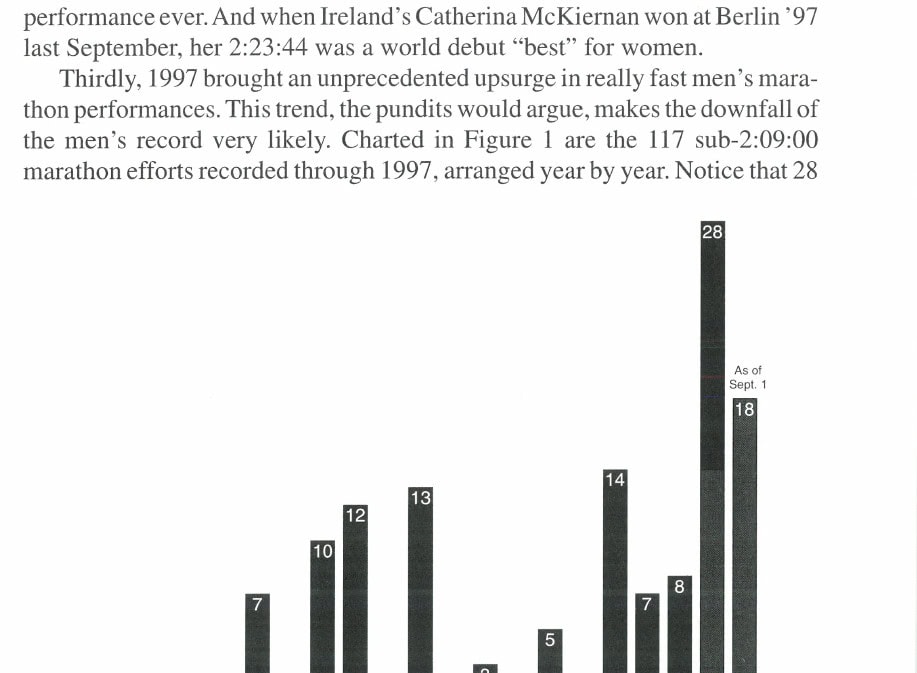
Thirdly, 1997 brought an unprecedented upsurge in really fast men’s marathon performances. This trend, the pundits would argue, makes the downfall of the men’s record very likely. Charted in Figure 1 are the 117 sub-2:09:00 marathon efforts recorded through 1997, arranged year by year. Notice that 28 of those performances occurred last year alone—that’s 23.9 percent of the total! Was 1997 a fluke year? We don’t know. Good weather did bless many of the top marathons that year. And some of the post-Olympic pressure was removed. And the hot-weather, mid-summer World Championships Marathon in Athens, Greece, did not seem to disturb the momentum of the rest of the year. If this is a trend, then this year we should see even more super-fast achievements (as Figure 1 shows, as of September 1, 1998, there were 18 sub-2:09:09 performances), and thus, the chance of someone running sub-2:06:50 ought to increase.
Lastly, 1997 and 1998 have also seen several high-quality men’s long-distance track barriers pushed back (see Table 1). Why wouldn’t the marathon record be the next to go? Haile Gebrselassie and Daniel Komen collectively lowered the men’s 5,000m record by 5.03 seconds. Gebrselassie and Paul Tergat similarly lowered the men’s 10,000m record by a collective 15.33 seconds. And then, this past April, two weeks after his World Cross-Country Championships win in Marrakesh, Tergat lopped off an equally astounding 30 seconds from the world half-marathon “best” on the road.
Probably the best-known running barrier was the 4:00 mile, broken by (the now Sir) Roger Bannister on May 6, 1954, at Oxford, England, when he ran 3:59.4. Just as there were skeptics 45 years ago who said no one could run that fast, today’s skeptics declare that runners “will never” surpass the next logical “round-number barriers” in the long-distance world. How about a sub-12-minute men’s 5,000m? How about a sub-26:00 men’s track 10,000m or a sub-59:00 half-marathon performance? Or a sub-2:00:00 marathon?
MATHEMATICAL MODELING OF DISTANCE RUNNING PERFORMANCE
How good is the best performance in the men’s marathon? Is Dinsamo’s 2:06:50 best so much better compared to these shorter distance records that it explains the marathon record’s longevity? How does a sub-2:07:00 marathon compare to a 26:20 10,000m effort? Wouldn’t it be neat if we could compare all these performances in terms of relative difficulty? Well, we can, using mathematics to model sport performance.
Mathematical models are only as good as the collective genius of the minds who create them. A little-known but quite competent group of Hungarian statisticians—Bojidar Spiriev, Attila Spiriev, and Gábor Kovács—have been comparing the relative worth of both track and field performances for a few decades. They first published a compilation of their so-called Hungarian scoring tables way back in 1982 and then updated them 10 years later. This latest edition has 323 pages of tables, constructed by computerized analysis of the fastest 10, 20, 50, 100, and 200 performances in track and field events from 1987 through 1991. Although athletes have been continuing to improve since 1991, the contributing factors are similar. Thus, if anything the performance prediction estimates err on the conservative side.
Table 2 compares the quality of present-day middle- and long-distance running world records using the Hungarian scoring system. Clearly, Haile Gebrselassie’s 5,000m performance at Hengelo (Holland) this past summer is the best of the world track records—it’s worth 1,341 points. Interestingly, notice that Dinsamo’s marathon world best performance received the lowest point value on the list—only 1,244 points! It is really the weakest of the eight performances listed! A marathoner delivering an effort comparable to Gebrselassie’s 5,000m record would have to run 2:02:19—an improvement on the men’s marathon world best by 4 minutes and 31 seconds!
Table 2 also allows us to see how much improvement is needed to bring each of the seven other running events listed up to par with Gebrselassie’s present 5,000m world record. Notice that the events cluster around three levels of difficulty in terms of the improvement required. First, athletes specializing in the 800m, 1,500m, and mile will need to improve between 1.30 and 2.18 percent to reach the equivalent effort of Gebrselassie’s 5,000m record. Wilson Kipketer, for example, will need to take another 1.93 seconds (1.91 percent) off his 800m world record.
TABLE 1 — Progression of World Records in Men’s Distance Running
| Event / Date | Athlete | Venue | Time |
|---|---|---|---|
| 5,000m | |||
| 16 August 1995 | Haile Gebrselassie | Zurich | 12:44.39 |
| 13 August 1997 | Haile Gebrselassie | Zurich | 12:41.86 |
| 22 August 1997 | Daniel Komen | Brussels | 12:39.74 |
| 14 June 1998 | Haile Gebrselassie | Helsinki | 12:39.36 |
| 10,000m | |||
| 23 August 1996 | Salah Hissou | Brussels | 26:38.08 |
| 04 July 1997 | Haile Gebrselassie | Oslo | 26:31.32 |
| 22 August 1997 | Paul Tergat | Brussels | 26:27.85 |
| 01 June 1998 | Haile Gebrselassie | Hengelo | 26:22.75 |
| Half-marathon | |||
| 03 April 1993 | Moses Tanui | Milano | 59:47 |
| 04 April 1998 | Paul Tergat | Milano | 59:17 |
| Event Distance | World Record Holder | Present World Record | Hungarian Point Value | 1,341 Point Time Equivalent | % Difference |
|---|---|---|---|---|---|
| 800m | Kipketer ’97 | 1:41.11 | 1,283 | 1:39.18 | 1.91 |
| 1,500m | El Guerrouj ’98 | 3:26.00 | 1,302 | 3:23.33 | 1.30 |
| 1 mile | Morceli ’93 | 3:44.39 | 1,275 | 3:39.50 | 2.18 |
| 3,000m | Komen ’96 | 7:20.67 | 1,323 | 7:18.16 | 0.57 |
| Steeple | Barmasai ’97 | 7:55.72 | 1,282 | 7:42.58 | 2.76 |
| 5,000m | Gebrselassie ’98 | 12:39.36 | 1,341 | 12:39.36 | 0.00 |
| 10,000m | Gebrselassie ’97 | 26:22.75 | 1,334 | 26:18.71 | 0.26 |
| Marathon | Densimo ’88 | 2:06:50 | 1,244 | 2:02:19 | 4.32 |
The longer distance runners (3,000m through 10,000m) have reached a level of excellence not yet seen by the middle-distance stars. Notice that the 3,000m and 10,000m marks are less than 0.60 percent different from the 5,000m world record. Still, improving each to be equivalent is no small challenge. Komen would need to lower his 3,000m mark by 2.51 seconds, and Gebrselassie would need to run 4.04 seconds faster in the 10,000m.
The steeplechase and marathon marks are the slowest in relative quality to Gebrselassie’s 5,000m mark. The disparity between the steeplechase and marathon marks and the others suggests that other factors in addition to simply running fast make their improvement difficult. And the longevity of the marathon’s record suggests that even more factors may be involved than for the steeplechase.
Barriers to Fast Running in the Steeplechase and the Marathon
One key difference between the steeplechase and other distance running events is the 28 large barriers and seven water jumps that runners must clear in each race. Successfully managing this continual disruption of running rhythm while maintaining a sub-64-second pace per 400m is an incredible challenge that requires a combination of endurance, strength, and coordination that is ideally developed through years of arduous training over undulating rough terrain at high altitude.
Only a small segment of the track-running gene pool trains this way—namely, the Kenyans. It’s no secret that 9 of the past 12 World Championships steeplechase medals, and 7 of the last 9 Olympic medals, reside in that country!
The marathon is an even more special case. Multiple factors interfere with athletes’ ability to achieve fast marathon performances, factors that either aren’t encountered in shorter-distance racing or aren’t as influential. For example, the weather becomes more of an influence as the race distance lengthens. The marathon is more than four times farther than the 10,000 and nearly 53 times longer than the 800. Environmental temperature must also be optimal for fast times. It can’t be so cold that muscle and connective tissue elasticity decrease from late-race cooling as a runner’s fatigue builds and pace slows. And it can’t be so warm that metabolic heat accumulates faster than it can be removed, or that decreased blood volume from sweat-induced dehydration reduces oxygen delivery to a runner’s working muscles.
Another factor is that people aren’t “built” to run marathons. Even with prerace carbohydrate loading, a marathon runner has marginal stored carbohydrates to combine with fats to provide the required energy to go the distance. Thus, a runner must take in additional carbohydrates during the race through drinking—and that duty opens a Pandora’s box of potential challenges that short-distance racers do not encounter. Have you ever tried drinking the contents from a cup, or even a squeeze bottle, while running at 72-second 400m pace (4:50/mile pace)?
And then there’s the dilemma of absorbing this energy drink into the bloodstream. The faster you race, the more blood is shunted away from the gastrointestinal system to provide optimum blood flow to the working skeletal muscles. As a result, a runner’s fuel absorption rate decreases and explains why marathoners often have a bloated feeling when drinking while racing—stomach intake has exceeded stomach emptying. A vivid example of this occurred in the 1996 U.S. Men’s Olympic Trials Marathon, when Bob Kempainen quickened his pace near the end to forge a lead. He wasn’t at all sick, but his increased pace reduced his stomach’s ability to absorb the energy drink he had been taking in. The result, witnessed by millions of viewers worldwide, was Kempainen spewing onto the street three times in the last mile the liquid that had accumulated in his stomach!
Still another barrier to record-setting marathon performances is a little-known feature (except to course measurement gurus) of road racing known as the Short Course Prevention Factor (SCPF). Course measurement technology, although sophisticated in its use of wheel revolution counters, is still an imperfect science: no one can guarantee that a marathon course laid out as 42,195m is exactly that. To ensure that a remeasurement (if a fast performance is achieved) doesn’t produce a course shorter than this, a 1 meter per kilometer course extension, or 42.2m, is built into the course layout scheme. At Dinsamo’s world-record pace, a difference of 7.7 seconds would exist between a 42,195m course and a 42,237m course (42,195 + 42). Thus, this variable “excess” distance adds an unknown factor to performance times.
In practice, of course, track athletes may also cover more than the requisite distance in their races, since the specified 400m lap refers to an ideal path near the inner edge of lane one. Runners in a pack may find themselves in a human oval that occupies two or three lanes.
Record-challenging races nowadays utilize a pacemaker, out in front initially in the inside lane, who covers only the requisite distance, behind whom the would-be record-breaker is tucked, following closely in his wind shadow. Then, in the final stages of the race, as the pacemaker falls behind, the record-challenger assumes the lead, remaining in lane one.
The effect of pacemakers increases significantly as race distance lengthens. Thanks to research published by two well-respected pioneers in exercise physiology, A.V. Hill in 1928 and L.G.C. Pugh in 1970, it is clear that an athlete running in the wind shadow of a pacemaker expends roughly seven to nine percent less energy “moving air molecules out of the way,” as Jim Fixx put it (p. 202) in his 1977 book, The Complete Book of Running. Exercise physiologist David Costill summarized the research a bit more technically two years later in his classic “how to” running book, A Scientific Approach to Distance Running (p. 48). He indicated that the difference in oxygen consumption (in liters per minute) between no headwind and the headwind caused by running forward can be calculated as 0.002 times the cube of the velocity in meters per second.
Considerable controversy resulted this spring at Rotterdam, with Tegla Loroupe being paced to a new world best time. Her two Kenyan pacemakers were men, and thus entirely capable of running at her pace for the entire distance. She could conserve energy during essentially her entire race, running in their wind shadows. Or, to put it a different way, she could maintain a faster effective pace than if she were breaking the wind herself. In men’s races, paced by men, the pacemakers typically cannot run that fast for the entire race due to the energy cost in breaking the wind, so they fall back in the latter stages. Tegla was paced essentially to the end. How many seconds were gained? We’ll never know. Was her assistance unfair? Perhaps we should ask the second-placed finisher? Is such pacing against the rules? Again, I’ll leave that for the “rules-makers.” What matters for the purposes of this discussion is that these energy-saving effects from pacing are not incorporated into the Hungarian tables. One conclusion is sure: if pacing were prohibited, record-breaking would suddenly become much more difficult!
Who Will Break Dinsamo’s Record, and When?
Competitive sport is all about breaking barriers—being better than you were yesterday, better than everyone else today, and setting new goals for tomorrow. Most barriers are individual, private matters, as athletes strive for greater excellence—running faster, throwing farther, jumping higher.
These improvements are due as much to the quality of the athletes as to advancements in everything from track surface composition to coaching strategies, and lots more in between. Obviously, there must be some limit to human performance, but, much to my delight, we haven’t seen it yet.
Table 3 summarizes the 15 fastest men’s marathon performances in history on courses believed to be at least 42,195m in distance. The 47 seconds separating the fastest time from the slowest represents a miniscule difference of 0.61 percent—physiologically insignificant, it would seem. Or is it? If 2:06:49 is so easy to achieve, why has it been so elusive?
At which race will the present marathon record likely be broken, and who’s the likely candidate to break it? Clues are provided by the 135 sub-2:09:00 performances achieved through September 1, 1998, summarized in Figure 1. Chances are that the record will fall on an out-and-back, essentially level course
| Time | Athlete | Nation | Venue | Date |
|---|---|---|---|---|
| 2:06:50 | Belayneh Dinsamo | ETH | Rotterdam | 17 APR 88 |
| 2:07:02 | Samuel Lelei | KEN | Berlin | 24 SEP 95 |
| 2:07:07 | Ahmed Salah | DJI | Rotterdam | 17 APR 88 |
| 2:07:10 | Khalid Khannouchi | MAR | Chicago | 19 OCT 97 |
| 2:07:12 | Carlos Lopes | POR | Rotterdam | 20 APR 85 |
| 2:07:13 | Stephen Jones | GBR | Chicago | 20 OCT 85 |
| 2:07:15 | Cosmas Ndeti | KEN | Boston | 18 APR 94 |
| 2:07:19 | Andres Espinosa | MEX | Boston | 18 APR 94 |
| 2:07:20 | Vincent Rousseau | BEL | Berlin | 24 SEP 95 |
| 2:07:26 | Fabian Roncero | ESP | Rotterdam | 19 APR 98 |
| 2:07:28 | Josiah Thugwane | RSA | Fukuoka | 07 DEC 97 |
| 2:07:34 | Moses Tanui | KEN | Boston | 20 APR 98 |
| 2:07:35 | Taisuke Kodama | JPN | Beijing | 19 OCT 86 |
| 2:07:35 | Abebe Mekonnen | ETH | Beijing | 16 OCT 88 |
| 2:07:37 | Joseph Chebet | KEN | Boston | 20 APR 98 |
when weather conditions are cool and cloudy. Rotterdam, Tokyo, London, Berlin, and Chicago have 18, 18, 16, 13, and 12 such performances, respectively, or 56 percent of the total. But the downhill point-to-point Boston course has 20 performances as well (another 14.9 percent)—with 6 added this year alone.
One suggestion that it might come sooner rather than later is seen in the totals of super-fast marathon performances for 1998 as compared to 1997. Figure 1 shows us that 1997 had 28 sub-2:09:00 performances—so many more than the previous years that it could be considered an aberration. Predictions are that 1998 will see even more. How can we develop such a prediction? Let’s look at the fast performances for the first eight months of both years. By September 1, 1997, there had been 39 performances faster than 2:11:00. As of September 1, 1998, there have been 47! And none of the fast fall marathons have moved to the earlier months. The fast races at Berlin, Chicago, Fukuoka, and New York are all alive and well.
Who will do it? Nineteen countries representing all continents account for the present 135 sub-2:09 performances, so running fast marathons is a global phenomenon. Past results suggest that an African may do it first, as six African nations account for 53 (39.3 percent) of the fastest performances: Kenya (23), Ethiopia (8), Tanzania (8), South Africa (8), Djibouti (4), and Morocco (2). A strong non-African possibility, however, could be Japan (16), Australia (10), Portugal (11), or Spain (10), although none of these nations has as much rising talent as is seen in Kenya.
In fact, Kenya stands out as the single nation whose athletes have made it their business in recent years to focus strongly on the marathon. In 1992 and 1993 they delivered only 19 and 32 sub-2:20:00 performances, respectively. This activity has increased dramatically ever since: 79 such performances in 1994, 86 in 1995, 109 in 1996, and a startling 163 in 1997 to surpass Japan (with 123) as the most prolific marathoning nation at this level of competition.
Breaking Two Hours in the Marathon
With the spring marathon season behind us and the men’s record in its eleventh year, only a few likely venues exist in the fall season—Berlin, Chicago, Fukuoka, New York—to provide the fast action. If and when the record falls, will such an improvement set off an avalanche of still faster performances, as we saw for the mile in the years following Bannister’s “couldn’t be done” achievement? And what about the possibility of a men’s sub-2:00:00 marathon?
For those who enjoy so-called “round numbers,” a sub-2:00:00 marathon is a real dandy, particularly as millennium mania grips the world. Most folks are still trying to sort out whether the new millennium starts January 1, 2000, or January 1, 2001. (By the way, it’s the latter because decades end, not begin, with a zero year. But try telling that to those who have already made their “millennium party” hotel reservations a year early!) I hate to sound pessimistic, because I’ve long learned not to tell an elite athlete that something’s impossible, but in my view the dawn of the new millennium will still see us nowhere close to anyone having broken the two-hour barrier in the marathon.
Why? Two lines of thought give some perspective. First, the Hungarian tables tell us that a 1:59:58 marathon is worth 1,393 points. Logically, if someone is racing marathons this quickly, then athletes ought to be racing at the 1,393 point level for the other events as well. How fast is that? Take a look at Table 4, and then have a word with athletes such as Bob Kennedy and Rich Kenah and ask them how they’ll gear their training to lower the mile world record more than 8 seconds, from 3:44.39 to 3:35.75, or take 12 seconds off the 5,000m mark! And remember, if anything, the Hungarian performance-equivalent tables are providing a conservative estimate of equivalent times!
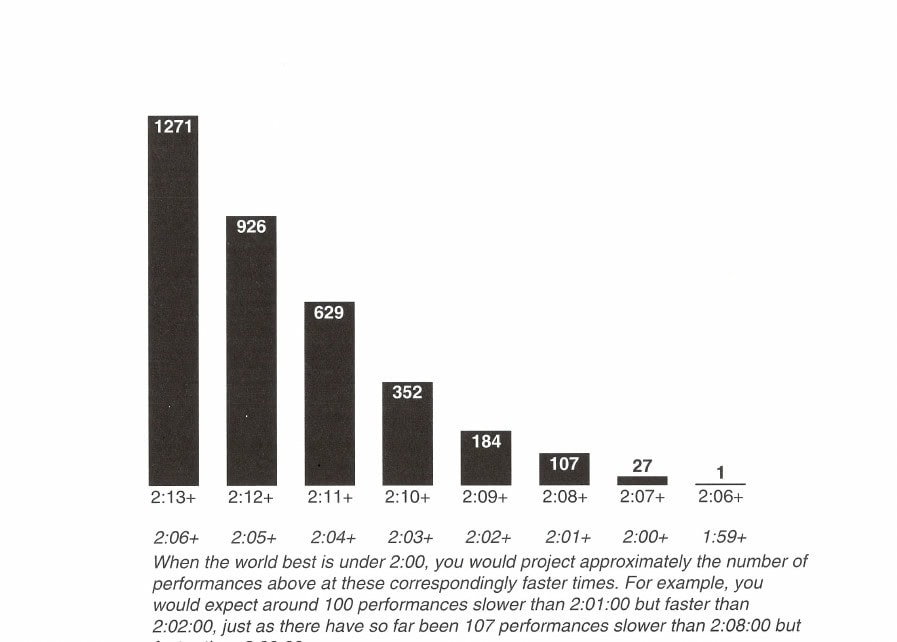
Second, take a look at the graphic breakdown of the 3,497 sub-2:14:00 marathons run in past history, shown in Figure 2. The upper row of times represents the current distribution of performances. The lower row of times represents the approximate expected distribution of performances if the world best were to dip below 2:00:00. In the future, with a similar distribution of fastest times, we would expect around 1,271 sub-2:07 performances when the marathon talent pool has improved enough to produce at least one sub-2:00:00 marathon. How many years will be required before 1,271 sub-2:06:00 performances are on the books, when we have only one now? I’d say a good many!
Table 4 Performance Equivalents to a 1:59:58 Marathon
| Event Distance | 1,393 Point Time Equivalent | Present World Record | Time Difference (sec) |
|---|---|---|---|
| 800m | 1:37.49 | 1:41.11 | 3.62 |
| 1,500m | 3:19.84 | 3:26:00 | 6.16 |
| 1 mile | 3:35.75 | 3:44.39 | 8.64 |
| 3,000m | 7:10.91 | 7:20.67 | 9.76 |
| Steeple | 7:31.12 | 7:55.72 | 24.60 |
| 5,000m | 12:26.99 | 12:39.36 | 12.37 |
| 10,000m | 25:50.28 | 26:22.75 | 32.47 |
| Marathon | 1:59:58 | 2:06:50 | 412.00 |
On the other hand, a sub-2:20:00 marathon performance by women now seems much more likely in the near future than a sub-2:00:00 marathon by men. There have been 443 sub-2:30:00 marathon performances all-time by women. The similar pattern of exponential reduction in numbers as performance time quickens indicates the same increasing difficulty as for men in racing steadily faster. But only 47 seconds of improvement remain for the women to go under 2:20:00 instead of 411 seconds for the men to dip under 2:00:00 hours. I’d bet on the women!
Postscript: Delightfully, as we go to press, Dinsamo’s record took a 45-second tumble at Berlin on September 21. Brazil’s Ronaldo da Costa, in his second marathon, put South America in a spotlight not seen since the Olympic victories by Argentina’s Juan Zabala and Delfo Cabrera in 1932 and 1948. Da Costa became history’s first to break the marathon’s two big pace barriers: sub-3 min/km (he was 2:59.3) and sub-4:50/mile (he was 4:48.53), improving more than 3 minutes over his 5th-place 2:09:07 at Berlin in 1997. In all respects his record is genuine. The race had drug testing. The course is out-and-back and thus unaided. The same AIMS/IAAF-certified course measurer (John Disley) also witnessed the run from the lead car. And best of all, da Costa ran so fast that no pacemakers could keep up! It was the race’s 25th running, leaving its director, Horst Milde, overcome with joy and tears—his dream finally realized. However, using the Hungarian tables, da Costa’s 1,260 point rating still keeps the marathon the weakest of the 8 distance events displayed on Table 2. Where will the record fall next? Chicago, New York, Fukuoka? Stay tuned!
This article originally appeared in Marathon & Beyond, Vol. 2, No. 6 (1998).
← Browse the full M&B ArchiveMore like this
1,000+ stories from 19 years of Marathon & Beyond
The complete archive of the legendary long-distance journal — digitized and free to read.
