

Building Boston
The internationally famous paved stretch of Massachusetts roads from Hopkinton to Boston can be run on any given day. There are no restrictions and no attention, fanfare, media coverage, or crowds. But for one day each year, what is built from the ground up on that span of 26.2 miles for each Patriots’ Day Monday transforms it into the Boston Marathon. The coordinated effort is massive. Signage, barricades, fencing, scaffolding, paint, tents, tables, cups, wiring, generators, and much more are all part of the creation of the overall polished look of the oldest annual continually run marathon. “
I personally conduct or attend roughly about 150 meetings,” said Boston Marathon race director Dave McGillivray. “We have about 90 people on the organizing committee and we have 8,000 volunteers. I usually delegate to various organizing committee members, but there are timelines and planning phases along the way that we have to adhere to. I always set false advance deadlines to be sure I get things well before I need them. Doesn’t always work, but most of the time it does.”
The heart of the Boston Marathon is an unassuming-looking yet all-encompassing three-ring bible that details every aspect involved: schedules, lists, names, timelines, contacts, phone numbers, backups, contingency plans, everything! “It is called the Operation Manual,” McGillivray said. “Now, everyone contributes their ‘work’ (documents), and we simply put them all in one manual. Very helpful to use as a reference and to ensure that all the work has been completed.”
Start area More than 1,200 barricades are used in the start area for the corrals, security areas, and crowd control and to line the beginning of the race. Between the start line and the northeast corner of Hopkinton Common is a large, fenced-in staging area
© Paul Clerici
▲ Much planning goes into the start area in Hopkinton, including the location of the water stations, the number of tables, the size of the corrals, and the overall utilization of street space since the width varies from as much as 85 feet to 39 feet.
where Jacques “Jack” LeDuc and Sue Smith share announcing duties; “the singing trooper,” retired Massachusetts State Police Sergeant Daniel M. Clark, sings the national anthem; and dignitaries, Boston Athletic Association (B.A.A.) officials, and former champions are recognized and fire the gun to start the various races.
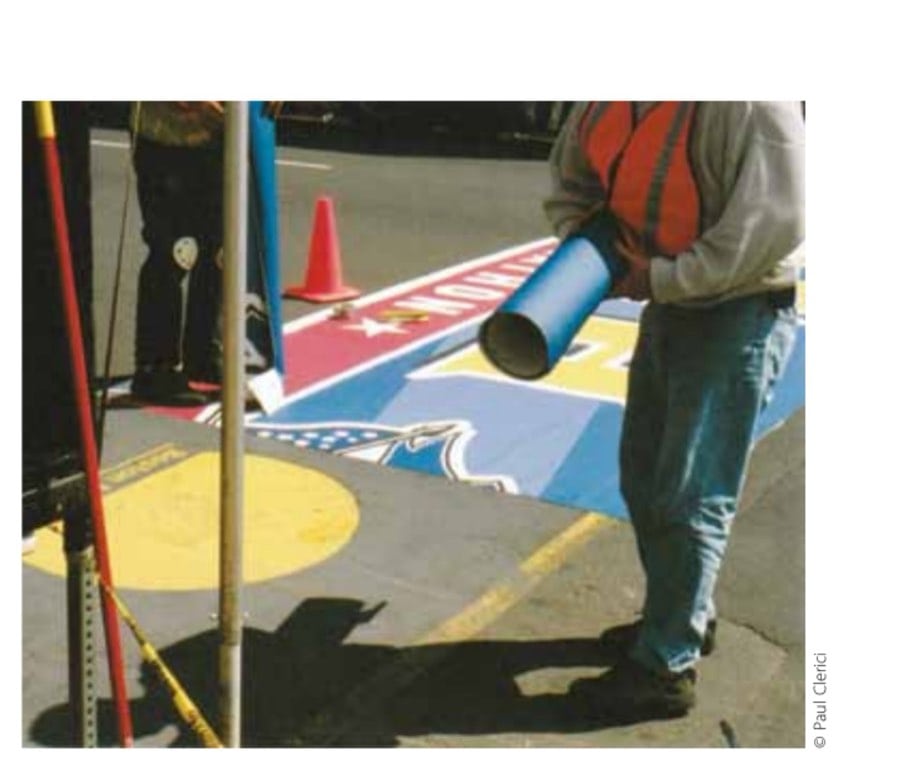
Of all the tangible elements that compose the historic route, one is mistreated and trampled for several hours by more than 50,000 running shoes: the roads. The start line, mile and kilometer markers, water and aid-station markers, and the finish line are just some of the visuals that are applied before a single runner takes a single step. In front of the stage, and stretching 39 feet from curb to curb across Main Street, is the multicolored start line, which covers approximately 244 square feet. It is, quite literally, where it all starts. Ideally, sometime within the week leading up to the race is when the paint job begins. “
We shoot for the Wednesday before and watch the forecast,” said LeDuc, also a Hopkinton Marathon Committee volunteer whose painted artistry has graced the start line since 1981. “We have painted as late as the day before, in 1996. Without question, the most memorable—if you want to call it that—event in my involvement has to be the event leading up to the 100th running of the Boston Marathon. The big dance! I’m talking about the 12 inches of wet, heavy snow that occurred on the Wednesday before what was supposed to be the biggest celebration of marathon history since the original battle.”
The painted area of the start line for the 100th was one of the largest in its history, and certainly up to that point. While the length of the start line never changes from its 13 yards from side to side, the width—or thickness—of the start line has changed. On average, it ranges from five to six feet, but not for the April 15th centennial edition. “
On the 100th running in 1996, the line was 100 inches thick. That grew until the 106th running, where it measured 106 inches,” said LeDuc. “But in 1996, the first time ever the B.A.A. was to open the course to no less than 40,000 participants, I had agreed to paint the start and the finish lines. Needless to say, time was running out and it took a few days for the snow to melt at the appropriate locations. We painted the finish line on the Saturday prior to and the start line on Sunday. We had to barricade the start-line area to keep the tourists away so we could work. People, mostly from afar, wanted to have a picture taken while the line was being painted. Needless to say, it was a fiasco.”
Until their passing in 2010, friends Paul “Buzzy” Buswell and Dr. Charles Bobeck would often assist LeDuc. In recent years, he has been aided by several members of his family including his mother, Ginette, sisters Carolle Lawson and Francine Harrel, daughters Laura and Jeanne, and also one of the race director’s sons, Ryan McGillivray.
Explained LeDuc, “The first few years we would apply the base coat of white with a 9-inch roller. After a while, the Hopkinton DPW would come up and spray the base with the same equipment they use to paint the crosswalks in town. Later, Accurate Lines out of Needham would put down the base on a schedule to fit the painting of the mile and kilometer markings along the course. But I have gone full circle and paint the base with a roller.”
Unique additions to the start each year also can be found in little personal touches that LeDuc incorporates. Along with the requisite START and accompanying date and names, he has painted other images including depictions of the course, elevation, and various landmarks; nods to a record or anniversary, as in 2012 with a runner’s bib number 40 to mark the years that women have officially run Boston; or tributes to honor the passing of someone special, such as when Johnny “The Elder” Kelley died in October 2004. “[
For Kelley] I sketched, cut, and painted a likeness of his face in the middle of the start line the following April. When Jock Semple passed away—the longtime trainer and coach of the B.A.A.—I attempted to memorialize him ahead of the line with a black laurel wreath with his initials in the middle. And when Harold ‘Lefty’ Rathborn, a former board of governor to the B.A.A. who preceded me as the start-line announcer for many years, passed, I like to feel we honored him by painting a graphic of a microphone with his initials under it,” LeDuc said. “In addition, I try to keep the start line topical. In 1991, when we were at war in the Middle East, I applied a large American flag, which appeared to fly under
© Paul Clerici
© Paul Clerici
▲ Jacques “Jack” LeDuc’s designs of the start line are reflections of each year’s event. When Johnny “the Elder” Kelley passed away in October 2004, LeDuc honored the legendary Olympian and two-time Boston winner with this homage of his likeness for the 2005 race. The 2012 start line celebrated the 40th anniversary of the first year women were allowed to run.
the start line. And when we went from a single start to a two-wave start, we displayed a continuous wave across the start line with the colors that represented the waves—red and blue.” A common sight in the days leading up to Boston is of tourists and runners having their pictures taken near the colorful Hopkinton attraction. This happens so often, especially throughout the weekend of the race, that town police gladly stop vehicular traffic to allow for the opportune snapshot.
Painted markers Along the course are painted 4-square-foot yellow mile and kilometer markers near the yellow center traffic lines and countless white B.A.A. unicorn logos and water-station markers (for the separate elite and nonelite stations) closer to the
sidewalks where the station tables are assembled. There is no painted blue line on the course, as it might be too confusing for drivers the rest of the year. In charge of all those applications is Accurate Lines, headed by its president
and co-owner Bill Sayman, who noted that the company uses “yellow and white traffic paint, and it takes two people to paint them. We have been painting the Boston Marathon since 1980. It is rewarding and has become a tradition.”
Course construction Instead of having to buff a court for basketball games or maintain ice for hockey games, McGillivray and company must monitor public roads through eight towns and cities. It’s no small task, of course, since the entire outdoor surface for this event is in constant use year-round.
© Paul Clerici
Boston Marathon technical producer Edward Jacobs, the president of Interstate Rental Service, maintains an extremely detailed nine-page checklist ledger called Gameplan Boston. Not only does it list nearly every requirement involved to build the Boston Marathon, it also includes a daily layout of jobs and tasks to be executed by whom and by when. For the 2012 event, the first entry in his 12day hourly schedule of must-haves was in the early morning of Monday, April 9 (“posting No Parking signs”), and the final item was listed in the late evening of Friday, April 20 (“the removal of all materials”). Race day itself occupies nearly four pages. Nothing—no matter how seemingly small—is left to chance.
One routine job that is repeated throughout the timeline is listed as “tag and tow”—the laborious tagging and towing of vehicles. This is a major undertaking in the city of Boston on any day of the week but especially so with the world coming to town and extra room being needed for workers to remove street signs, light posts, newspaper vending machines, park benches, and even a bus stop. While this is occurring, workers also construct bleachers, crowd control barricades, grandstands, and cement Jersey barriers.
Elite runners are provided with eight aid stations, which consist mostly of their own bottles of fluid that are often marked with colorful designs, country flags, or other discernable attachments in order to be easily seen from a distance. There are also 25 water and Gatorade stations available for all runners.
▲ The Boston Marathon features staggered water stations—first on the right and then ahead on the left—in order to avoid bottlenecks and potential runner collisions. Shown here volunteering are members of the Thirsty Irish Runners Club out of Dedham, Massachusetts.
“They’re on two sides of the road, nine tables on each side, three cups per person in the race, and about 80 to 100 volunteers per station,” said McGillivray of the layout, whose staggered placement at each mile is designed to eliminate the inevitable bottleneck if stations were situated directly across from each other. In addition, the course is sporadically lined with medical tents, portable toilets, and cooling stations (when required).
In recent years, the overall on-course image of the race has been in sync with signage by AMI Graphics of New Hampshire. The cohesive look includes everything from corral signs for each wave to standing mile and kilometer markers that accompany timing clocks, vertical markers at each station, and directional banners at turns and the finish. “
Several years ago, the event signage was limited to the finish line and some direction signs. Today, the program has grown to several thousand individual signs being used on race weekend,” said Mike Chamberas, B.A.A. consultant/liaison. “I feel very fortunate to be part of such a historic event and important organization. I also enjoy looking back at how the signage program has grown.”
The towns
© Paul Clerici
While connecting nearly 60 miles of barricades to fence in the entire course on both sides would prove prohibitive, Jacobs nevertheless uses more than 5,000 8-foot
▲ Shown here at about 24.5 miles, just before the Massachusetts Turnpike overpass, are some of the 2,000 metal police barricades that line portions of the course, start, and finish.
and 10-foot crowd barricades throughout the course: 1,200 at the start; 1,000 on the course; and 3,000 at the finish. Additionally, there are certain measures taken by each town and city on the route to line and secure the route.
Ashland, home to the first 27 starts of the Boston Marathon, is the second town on the course. Starting the first of April each year, the town’s Department of Public Works begins to transform its share of Route 135, which includes the rare traffic islands in the middle of the early miles. “[
We] fill potholes, install orange and white stanchions around islands, tape off islands with police caution tape, make sure structures such as manholes and water gates are not trip hazards, set up roadblocks using wood barricades at a dozen locations, [and] line-paint the course, if necessary,” says [former] Ashland DPW director Doug Small, who added that it takes about 30 barricades and 200 cones and stanchions to do the job. “[We also] set up cooling stations at various locations, if necessary, due to the heat and pick up litter before and after the race.”
In Natick, while barriers are also placed at every intersection over its fourplus miles of the course, work commences months before race day in order to be marathon ready. “About 40 barricades and signs [are used, and] we place the message boards in advance of the event,” said [former] Natick Director of Public Works [and current Deputy Town Administrator of Operations] Bill Chenard. “The work begins as soon as the snow is gone. We sweep and clean the course, paint the lines. Just prior to the marathon, we clean the entire route. Total staff is typically about 12.”
Some of the most popular and recognizable portions of the marathon—the Young at Heart statue of Johnny Kelley, Heartbreak Hill, Boston College—are in Newton, which is comprised of 13 villages (the course runs through four—Newton, Newton Lower Falls, West Newton, and Chestnut Hill). And as temporary host to thousands of college students who make their home in the Newtons, an important aspect of race prep is the constant maintenance of the roadways and greeneries that are well-traveled on for months before the marathon. “
We repave or fix damaged pavement and curbs; the grassy areas along the road will be reseeded; and loom boarders will be checked and fixed,” said [former] Newton Acting Transportation Director [and current Assistant Traffic Engineer] Nina Wang. She also stated that closer to the marathon, as well as on race day, Newton’s police, fire, recreation, and public works departments join several other crews—sweeper, trash, traffic, and others—to cover the four villages. “
The line painting will be refreshed before the race—these include the center lines, lane lines, and crosswalks. Sweeper crews will sweep the street on the day before. Trash crews will install trash bags and barrels along the route,” said Wang. “Traffic crews start working at 4:00 a.m. and will post 300 No Parking/Tow Zone signs along the route and side streets leading to the route for fire access and deliver [and set up] about 200 wooden barricades the day before at key intersections for
road closures during the race. There are caution tapes/ropes spread along the curb of the roadways for crowd control, and they set up 430-plus European (metal) barricades along the route.” Even though the marathon races through Brookline for only just over a mile of Beacon Street, that span of roadway is a highly congested portion of the course. It includes the MBTA (Massachusetts Bay Transportation Authority) subway cars and tracks of the Cleveland Circle Green Line; these are densely populated neighborhoods, and with only about 5K remaining an ideal dropout location. “
We set up barricades at all intersection streets along the race route, and we also provide a rope barrier along the sidewalk to keep pedestrians off the route,” said Brookline Highway, Sanitation, and Fleet Maintenance Director Kevin Johnson. “The management team starts meeting two months prior. Twenty-five DPW employees [are] directly involved with the preparation and setup on marathon day [with] 180 barricades, 200 metal barricades, 12,000 feet of nylon rope, 150 No Parking signs, two rubbish trucks, and three street sweepers.”
While fire apparatuses, ambulances, and police vehicles can obviously cut through the course in response to emergency situations, many nonemergency residential services such as water and sewer are still a concern that must be addressed by all the towns. “
It is important to have water and sewer personnel stationed on the north and south sides of Route 135 during the race,” Small said. This is also a concern for Johnson around miles 23 to 24 in Brookline. “We need to stage two water and sewer personnel and equipment on the north side of Beacon Street to be able to respond to any emergency that may occur during the marathon,” Johnson said. “We do this because there is no way to cross Beacon Street while the marathon is ongoing. There are several meetings with police, fire, and DPW to ensure public safety on this day.”
Similar preparations can also be found in Hopkinton, Framingham, Wellesley (including Wellesley Lower Falls), and Boston (including Brighton, Kenmore Square, Back Bay, and Copley Square).
Course checks The entire course is traversed periodically leading up to the marathon. And at one o’clock the morning before the race, street sweepers are driven from Hopkinton to Boston as well as on the 3.1-mile route of the B.A.A. 5K that takes place later on Sunday morning. This is also one of the last chances to report and repair any road-surface problems, a regular procedure that begins weeks earlier. “A few weeks out, I run most of the course myself on my last training run,” said McGillivray, a Boston Marathon “streaker” since 1973. “I also try to drive
in a few weeks out to check it. And, of course, many others on the staff and committee inspect it.” Even after all the stipulated checks and rechecks, there are still close calls. One in particular occurred when a water-main pipe burst in the Coolidge Corner area of Beacon Street in Brookline near the 24-mile mark. Several agency reps were immediately contacted, including Amy Dominici (state and federal liaison to the B.A.A. under Boston Secretary of Public Safety Kathleen O’Toole), Assistant Adjutant General David Gavigan of the Massachusetts Army National Guard, the Massachusetts Highway Department, and the MBTA because the century-old pipe broke early on Monday, April 17, 1995—the very morning of the 99th Boston Marathon! “
I received the initial call from Brookline Water Department that there was a break in the [water] main underground on the marathon route,” recalled Jacobs. “I responded to the site at approximately 4:00 a.m. The street pavement was broken and had risen five feet. I determined we could reroute the course with the breaks in the block before and after the site if we could not get through. Under these circumstances, we would measure the alternate course and report it as appropriate. I called Dave McGillivray and Amy Dominici and notified all state agencies. Amy received calls offering support from state highway, MBTA, etc. [And] Gavigan of the National Guard assigned troops to the site.”
The emergency forced the town to cut off the water, which affected area neighbors and businesses with reduced or no water pressure. And a quick decision was required in regard to the passability of the course itself.
“After a conversation with Dave, I let Brookline know we need 15 feet of street width for the lead ‘pack’ [of runners] to pass through,” said Jacobs. “The National Guard called me every 30 minutes to report progress on the width available. By 11:00 a.m., we had the 15 feet we needed. The troops stayed there and surrounded the damaged roadway to guide the runners through. All went well.”
Fortunately for everyone involved, the marathon in 1995 still had a noontime start and 11:45 a.m. wheelchair start instead of the current schedule of seven starts from 9:00 a.m. to 10:40 a.m., including the wheelchair division at 9:17 a.m. “
We were able to reduce the impacted area enough to allow the necessary 15 feet of roadway at that point in the race to allow runners to pass,” McGillivray said, and then cautiously added, “Now, if that happened at mile three, that would have been a very different challenge!”
The finish The most congested stretch of the marathon is the three blocks of Boylston Street from Exeter Street and Berkeley Street. That clustered area includes the finish line, 2,000-seat bleachers, 280-seat grandstands (with wheelchair access ramps), media tents, postrace supplies, emergency services, family meeting areas, and baggage buses. There are also several large tents with concrete anchors for VIPs and medical personnel, the latter of which are designed as emergency triage units with two main tents of 60-by-220 feet (with 200 cots) and 30-by-170 feet (with 80 cots). “
Each [medical tent] has electric, lighting, hot and cold running water, heat, and air conditioning as needed,” Jacobs said. “At the 2012 Boston Marathon, with temps approaching 90, we brought in more than 200 tons capacity (an HVAC— Heating, Ventilation, Air Conditioning—measurement) of air conditioning and accompanying generators. We were able to hold the main medical tent at 74 degrees. The attached 20-by-80-foot cooling area was maintained at 62 degrees.”
Slightly out of view are mobile command centers, forklifts, trailers, and golf carts. And usually hidden in and behind various structures is a myriad of electrical wiring, phone lines, cables, transformers, and generators. Also, closer to race day is the rerouting of select public transportation services of bus lines and the subway. “
There are roughly 12 operations trailers and mobile units placed at the command compound. They all get electric—shore and backup generators, hardwire telephone, and Internet,” said Jacobs. “They share a common internal-paging talkback system. This accommodates B.A.A. operations, Boston Police, Boston Fire, Boston EMS, Boston Transportation, MEMA (Massachusetts Emergency Management Agency), State Police, National Guard, and CST (military Civil Support Team).”
© Paul Clerici
▲
The Boston Marathon finish line that is seen on race day is a laminated mat that is applied in pieces over the painted finish line that is seen throughout the rest of the year.
High above the finish line is the decorated photo bridge from where the media capture the race. The colorful structure is a beacon to the runners, who can see the celebrated finish marker the moment they exit Hereford Street for Boylston about four blocks away. “
The photo bridge is built to accommodate vehicular traffic. Clearance underneath is 16 feet. Total [occupancy] of approximate 100 media, including live TV with talent, video, and still photographers,” noted Jacobs. “Takes two nights to build. We close the road Friday and Saturday from midnight to 6:00 a.m. Comes down before midnight on race day. Same with the announcers and officials position [to the runners’ left].”
The final touch is the majestic and commanding finish line itself. It is the ultimate goal of every person who crossed the start line hours earlier. But in actuality, there are two of them. Unlike in the early years when it was painted for race day, the finish line now seen on Patriots’ Day is a rolled-out version applied days before. At 329 square feet, the multicolored strip is 7 feet thick by 47 feet from sidewalk to sidewalk. Since 1970, this job has been assigned to Interstate Rental Service, whose workers annually clean off that portion of Boylston in front of the Boston Public Library (BPL) and unroll and adhere the shiny new photo op. “
The finish line is a laminated, adhesive-back, digitally printed 3M product. It is produced in panels,” Jacobs said. “We lay it down on Saturday, unless weather dictates different.” Interestingly, that laminated covering is the finish line for only a few days. The finish line seen the rest of the year is the permanent, smaller, painted version
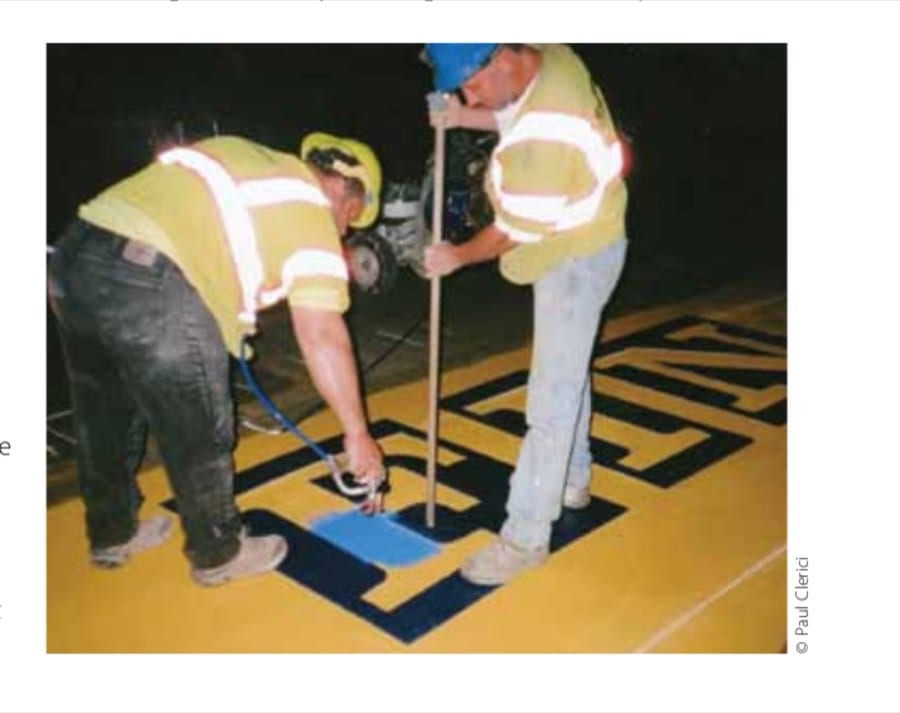
hidden underneath. “It’s not painted until the day after the race,” McGillivray laughs, “believe it or not.” In the lonely darkness of Boston two days after the 2012 running and the removal of the laminated line, RoadSafe Traffic Systems of Avon arrives to quickly paint it bright. Very early Wednesday morning, April 18, just before three o’clock, highway safety traffic designers Eric House and Will Belezos begin their clandestine proceedings. “
We try to get here before the street cleaners because they use water, and we’d have to wait for it to dry,” said Belezos as he stood on Boylston and watched the city street sweeper divert itself at three o’clock. “We beat them [this time]. We win!” he added with a laugh.
Police shut down Boylston between Dartmouth and Exeter streets. House and Belezos spread out stencils on the road and then carefully measure and draw chalk markings at various spots along the edge of the finish line so the letters and numbers can be recreated in the exact locations. “
We chalk the letters on the street because when we cover [the finish line] in the yellow paint, it will cover everything,” said House of that one very brief period of time when the finish line is entirely yellow with no words.
The next step includes the revelation of the secret names of each paint color that is ultimately seen by millions of people throughout the year. Three separate Titan Speeflo Powrliner 6900XLT line striper machines are filled with Franklin Paint Company Hydrophast Waterborne Traffic Paint called . . . 2015 Yellow, 2023 Black, 2014 White, 2024 Blue. Yes, the magic is finally revealed. The Boston Marathon finish line is made up of ordinary traffic paint identified by numbers.
© Paul Clerici
▲
Highway safety traffic designers Eric House, left, and Will Belezos begin the early-morning process on the Wednesday after the Boston Marathon to create the finish line on Boylston Street that is seen throughout the rest of the year.
ad
“Yeah, that’s it,” chuckled House. “The same traffic paint that’s used everywhere. But it dries fast. Takes about 20 minutes, half hour [per coat], so we get the next color ready.” Approximately six gallons of yellow paint are applied to the 343-square-foot finish line that measures 7-by-49 feet. While that dries, the five 3-foot letter stencils that compose the word FINISH are lined up according to the chalk markings. Once the paint dries, House and Belezos stand at each end of the finish line and snap a string chalk line that leaves a temporary 49-foot-long level mark on which each letter will be lined up and painted blue. That procedure is repeated for three more stencils for 116th, BOSTON, and MARATHON.
The B.A.A. unicorn logo and race name at each end of the finish line require three separate overlapping stencils, as each element is a different color. After each 3-foot letter for FINISH dries, the shadowing elements that give it that 3-D appearance are painstakingly cut out of cardboard flats and then painted white. Finally, two thin lines of black paint are laid down to frame the finish line. Touchups to correct color bleedings or mistakes are handled by hand with a brush or towel. The job takes an estimated eight gallons of paint, a dozen stencils, three line stripers, two men, and three hours.
LeDuc recalls one year (before RoadSafe) when for the first time he painted not only the start line but also the finish. Unfamiliar with the streets of Boston then,
and with all the stencils and paint in his truck, he knew only that the finish line was somewhere near the Boston Public Library. As LeDuc drove closer to where he thought it was located, he noticed a police officer and decided to get directions. “
I asked him where’s the Boston Public Library, and he says, ‘It’s right near the Boston Marathon finish line.’ And I said, ‘No, it isn’t. I have the finish line in the back of my truck!’” he laughs. “And when I finally got there and was on my hands and knees painting it, I see a pair of dress shoes come up to me, and he says, ‘Don’t you need a detail?’ And I said, ‘No, I have it.’” LeDuc then looked up and noticed it was another officer, who was kindly “offering” him a police detail since he was already blocking traffic. “
I’ll stick with [only painting] the start line,” LeDuc says now with a laugh. Weather also pushed it to the limit once when Accurate Lines was forced to paint the finish line on Patriots’ Day itself! “One year, we painted (laminated) the finish of the marathon the day of the race and the first wave [had] already started when we were painting,” stated Sayman. “It was due to the rain the whole week before, and [we] couldn’t get clearance until the day of.”
Signage Tying it all together, from start to finish, is the ubiquitous signage located throughout the course. From the Athletes’ Village to the start, from the course to the finish, there must be conveyed a single overall design. And that unifying look is Chamberas’s responsibility. “
One very important aspect of the job is creating and maintaining a consistent message to the participants and spectators,” he said. “I must ensure that the B.A.A.’s vision of a consistent look—color, font, logo, etc.—is executed at all venues. The scope of my services [is] not limited to just the racecourse but also the signage related to events surrounding the race—for example, from sponsor signage at the expo to specific signage for the elite athlete hydration stations. In the role, I interface with internal B.A.A. staff, outside consultants, sponsors, and the signage vendor.”
Weather But even the best-laid plans do not always promise great success for an outdoor event. The Boston Marathon has experienced everything from sleet (1907) to a partial eclipse (1939), snow (1961, 1967), record heat (100 degrees in 1905, 97 in 1909), and torrential rain (1970). Closer to McGillivray’s tenure were the drenched fields of the Athletes’ Village for its centennial (1996), low-ceiling dense mist (2002), a near-race-cancellation rainstorm (2007), and extreme heat that prompted the B.A.A. for the first time to offer deferrals (2012).
“[That] hit most of them!” he noted of the list. “We’ve been lucky. In my 25 years, not too many challenging issues; but again, most of them have to do with the weather, and there is not a lot we can do about that other than to gear up for what is being forecasted. [In 1996] we brought in hay bales, woodchips, and had [National Guard] helicopters hover low to help dry off the fields! [The 2007 rainstorm] was brutal, mainly the tough decision to go or no go, and it was based on the final forecast, that likely things were going to die down a bit—and they did. And if they didn’t? Well, I’d probably be saying now, ‘So, do you want fries with that burger?’ [For the record heat, we] just continued to ramp up the medical coverage all along the course.”
With such adverse experiences under his belt, McGillivray maintains a few mantras: for the “weather to cooperate, even though we have no control over that one; everyone carry out their jobs as planned; and I wake up on the morning on time and don’t oversleep!”
And amazingly, by the next morning’s commute most traces of the Boston Marathon—save for painted remnants and an occasional barrier—are all put away for next year. Editor’s note: This story was written prior to the 2013 Boston Marathon.
This article originally appeared in Marathon & Beyond, Vol. 18, No. 2 (2014).
← Browse the full M&B ArchiveMore like this
1,000+ stories from 19 years of Marathon & Beyond
The complete archive of the legendary long-distance journal — digitized and free to read.
