

Bunion Derby Fever
In the last years of the 1920s, all things seemed possible: Charles Lindbergh made his solo flight across the Atlantic; the nation’s factories were turning out 4.8 million cars a year to feed America’s new love affair with the automobile; and in a sprinkling of American communities, average citizens were entering ultramarathons.
The spark that brought these races into being was the “bunion derby,” the nickname for the first footrace across America, run from Los Angeles to New York City in the spring of 1928. The runners who came to dominate the event were not international superstars but men who held everyday jobs: farmer, shipyard worker, factory worker, and repairman. Their success inspired their contemporaries to give ultramarathoning a try and brought the sport back to its roots. Long-distance running—often staged on indoor tracks—had once been the sport of the masses and rivaled horse racing in popularity. Working people bet on their favorite runners and followed them with all the fervor of today’s NFL fans. By 1928, ultramarathoning was no longer the sport of the people. It had become the bastion of college and amateur-club athletes until the Bunion Derby shook things up.
THE FIRST FOOTRACE ACROSS AMERICA On March 4, 1928, 199 men embarked on an epic 3,422-mile footrace across America in 84 consecutive days of racing. They were chasing a pot of prize money that sat at the end of the transcontinental rainbow—$25,000 to the winner (10 to 15 times the yearly salary of a working man in 1928); $10,000 for second; $5,000 for third; down to $1,000 for the 10th-place finisher. The race was organized by Charley Pyle, sports promoter extraordinaire. He had started the American Football League, owned his own NFL franchise, and was the sports agent for Red Grange, the greatest football player of the 1920s.
Pyle had organized the race at the behest of a group of businessmen (the Route 66 Association) who wanted to advertise the newly designated highway to the na64 l MARATHON & BEYOND l MAR/APR 2008
tion. In 1928, Route 66 was little more than a potholed dirt road that took the derby runners across the firestorm of the Mojave Desert; the oxygen-starved high country of Arizona and New Mexico; and the muddy, tendon-ripping roads of Texas. The road then crossed Oklahoma, Kansas, Missouri, and Illinois until it ended in Chicago. From there the race followed better roads to New York City.
Charley Pyle signed up a bevy of European stars to run his great race. He had also thrown the contest open to the common man, offering to feed and house anyone who could come up with the $125 entrance fee—a promise that proved to be a cruel hoax for those who accepted his hospitality.
Only 55 sun-blacked men made it to see the Manhattan skyline. Most of Charley’s stars had broken down under the strain of daily ultramarathons that averaged about 40 miles. Most of the eventual winners emerged from the shadows—unknown and ignored by the national press. They were a cadre of American heroes. Each man could have taken the lead in his own real-life version of a Rocky movie.
ANDY PAYNE OF FOYIL, OKLAHOMA Twenty-year-old Andy Payne came from a struggling family that farmed 600 acres of hard-packed Oklahoma hill country. His family home was little more than a shack. Since Andy hated farming, he left home after high school to look for work. He ended up in Los Angeles, which had become the new movie-making Mecca of the world.
He found only disappointment until he read about the upcoming Bunion Derby in a Los Angeles newspaper. For whatever reason, the idea of racing across America grabbed him. He immediately went back to Oklahoma to raise money to enter the race. His disapproving father called his idea “not even good foolishness,” but Andy persisted, persuaded the chamber of commerce of nearby Claremore,
Charles Kastner
▲
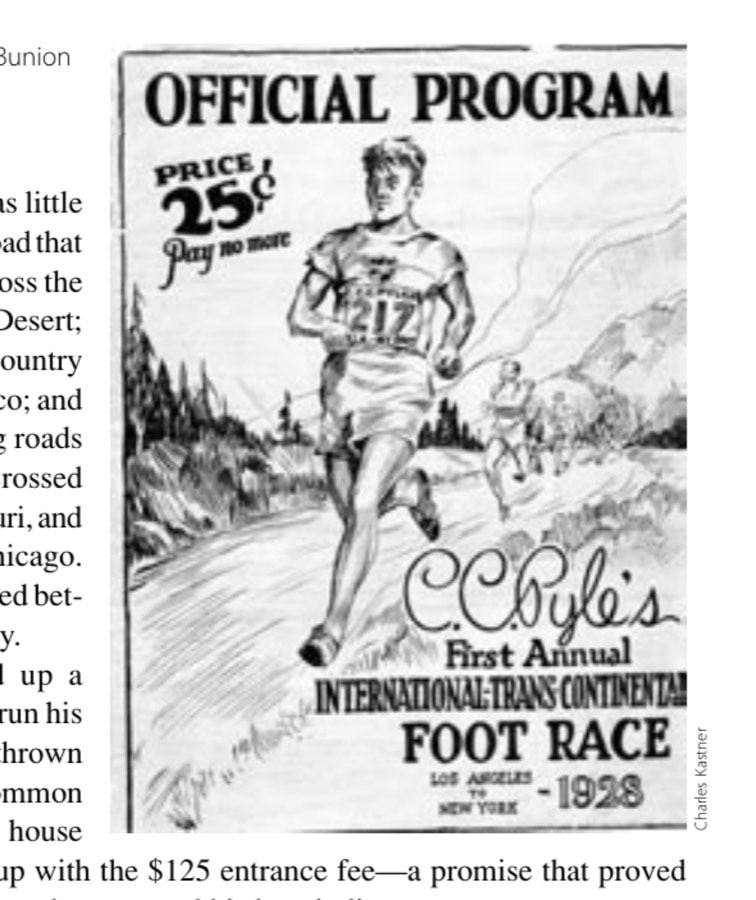
Cover of the 1928 official Bunion Derby program.
El Reno Carnegie Library
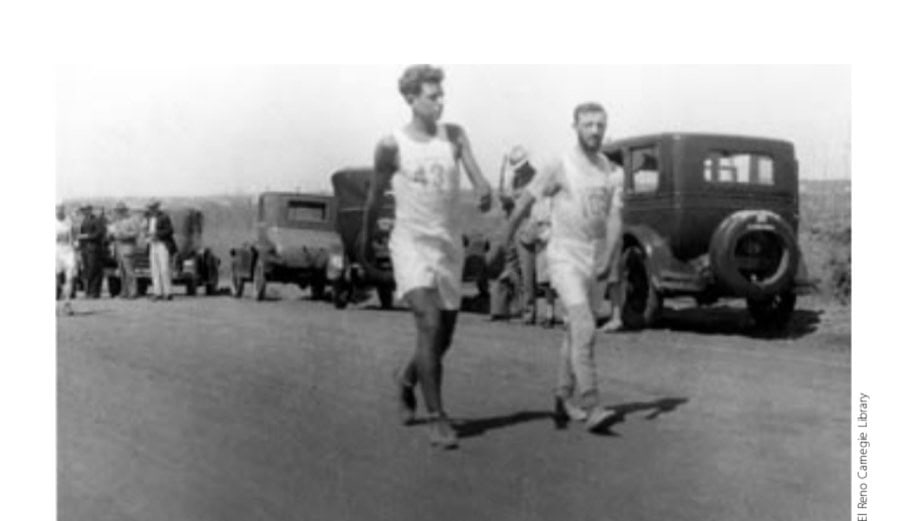
▲ The front runners, Andy Payne (#43) and Peter Gavuzzi (#103), on Route 66 in Oklahoma.
Oklahoma, to support his effort, and went on to win the $25,000 first prize.1 As he raced across Oklahoma along Route 66, he was a state hero. Schools let out for the day when he ran by. Parades were held in his honor. When he reached Claremore, he received a 22-gun salute, one more than the president of the United States. Payne used his winnings to pay off the mortgage on his family farm and to go to college.
JOHNNY SALO OF PASSAIC, NEW JERSEY Finnish immigrant Johnny Salo had two children at home, a wife, and a less-thansteady job at a Passaic [New Jersey] shipyard. At 34, he was long past the time when most men had dreams of athletic glory. He had had success in endurance racing, coming in first as part of the team competition in the 1926 Boston Marathon, but he had no experience with ultramarathon events. Yet he came to Los Angeles with just $12 in his pocket and a dream of winning the derby to make a better life for his family.
By the time he reached New Mexico, he was at the end of his rope. As a veteran of the First World War, he knew he had friends in the American Legion, and he turned to it for support. He soon had money in his pocket, which allowed him to eat better food than the slop Pyle fed his men and avoid the stinking communal tent that passed as sleeping quarters. By Illinois, Salo revealed an amazing talent that allowed him to run in the seven- to eight-minute-mile range for days on end. On the second-to-last day of the race, the derby passed through his hometown of Passaic, New Jersey. The entire town was on hand to honor him. A grateful town
Passaic Daily Herald, May 25, 1928
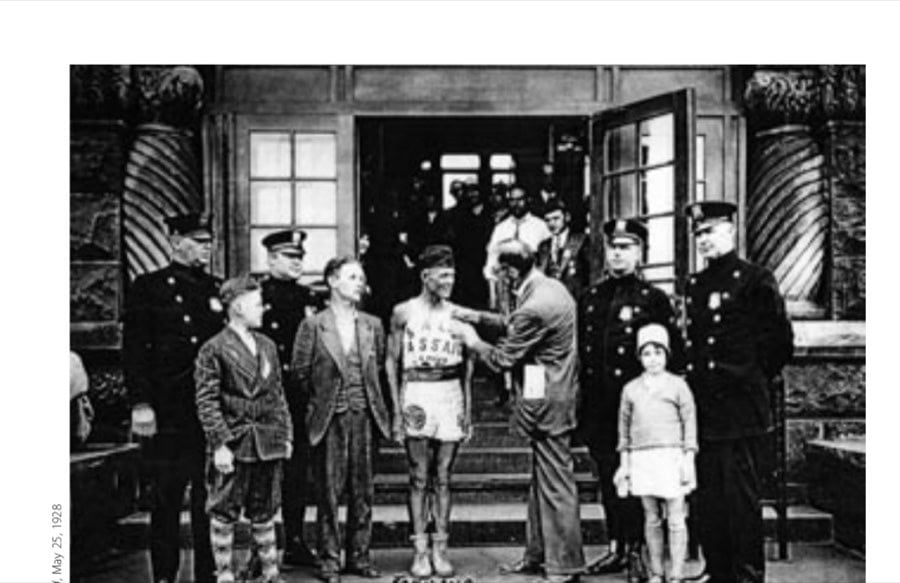
▲ Johnny Salo receives his commission as a Passaic, New Jersey, police officer, as son, Leo (left), and daughter, Helen (right), look on.
council offered him a steady job as a Passaic police officer. With his $10,000 second-place prize money, Salo bought a comfortable house for his family and settled down to his new role as the “flying cop from Passaic.”
MIKE JOYCE OF CLEVELAND Tiny Irish-born Mike Joyce of Cleveland was cut from very much the same cloth as Johnny Salo: He was 35, worked in the Fisher auto-body plant, and had four little Joyces to feed. Mike was a man on the wrong side of 30, tied down with
work and family. But Joyce, like Salo, couldn’t get the thought of running across America out of his head. He left for Los Angeles with most of the Joyce family savings and a wild dream that he would win the derby. Mike struggled at first
but gradually moved up in the standings. As the citizens of Cleveland learned of his success, donations began to pour in to the Joyce family treasury. When the Bunion Derby reached Cleveland, 5-foot-tall Mike was surrounded by a sea of supporters. Traffic came to a standstill as thousands of well-wishers cheered him on. He hung on to finish in fourth place and earned $2,500 for his trouble. His long-suffering wife could finally buy some new clothes for their children.
EDDIE “THE SHEIK” GARDNER OF SEATTLE
El Reno Carnegie Library
Eddie Gardner was born in Birmingham, Alabama, in 1898, more than 30 years after the end of the Civil War. As a black family, the Gardners were locked into a system of Jim Crow segregation that condemned them to a permanent underclass. Shortly after his birth, the family fled to the West, first to Colorado, then to Washington State, and joined the hodgepodge of immigrants that peopled the state.
In his 20s, Gardner had a job servicing steam boilers and became a familiar face to legions of Seattleites as he trained for the annual 10-mile Washington State championship held on the Fourth of July. He wore white shorts, a sleeveless white shirt, and a white towel tied around his head, giving him the look of a desert sheik. As he trained, people would cry “Oh, you Sheik.”2 The name stuck, and Gardner became the Sheik of Seattle. Eddie won the 10-mile championship three times before entering the 1928 bunion race.
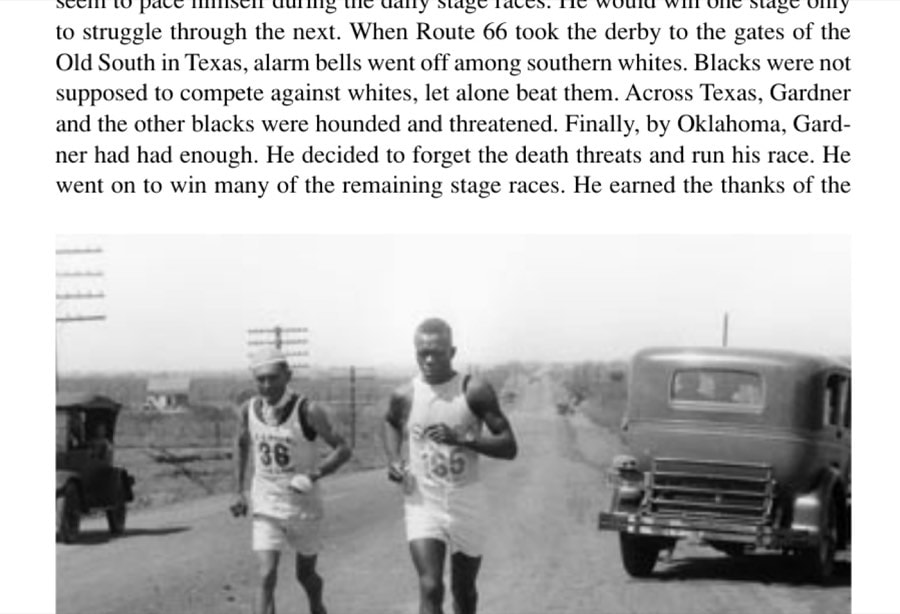
During the derby, Gardner ran with an effortless, graceful stride, but he couldn’t seem to pace himself during the daily stage races. He would win one stage only to struggle through the next. When Route 66 took the derby to the gates of the Old South in Texas, alarm bells went off among southern whites. Blacks were not supposed to compete against whites, let alone beat them. Across Texas, Gardner and the other blacks were hounded and threatened. Finally, by Oklahoma, Gardner had had enough. He decided to forget the death threats and run his race. He went on to win many of the remaining stage races. He earned the thanks of the
▲ Missouri’s John Gober (#36) and Eddie “The Shiek” Gardner (#165) on Route 66.
thousands of blacks who he passed on the long road to New York. The Sheik was a star of hope to black America and was embraced by the citizens of Seattle for his gutsy eighth-place finish. The exploits of Payne, Salo, Joyce, and Gardner became daily reading for the millions of fans who followed their progress in their local papers, thanks to a corps of syndicated sportswriters and big-city reporters who accompanied the derby. Their gritty example of courage and determination inspired local communities to hold their own one- to two-day derbies.
THE GREAT PORT TOWNSEND TO PORT ANGELES BUNION DERBY In the Olympic Peninsula in the northwest corner of Washington State, the town fathers of two seaside towns, Port Townsend and Port Angeles, held their own 52-mile Bunion Derby on May 1, 1929, with a $100 prize for the winner. These communities were rough-cut places, recently emerged from virgin forests. These towns survived from the land—farming and cutting, processing, and shipping timber. Twenty-two of their sons—one woman signed up but thought better of the idea—lined up in Port Townsend for the 52-mile trek to Port Angeles.
Most of the contestants were in their 20s. They worked with their hands as mill workers, loggers, farmers, and construction workers. An exception was Ernest Nelson, a crewman on a Coast Guard cutter based in Port Angeles. This was not a race for college or high school athletes since the contestants were racing for cash prizes. In those days, amateur athletes were prohibited from accepting prize money or participating in a professional event. This race then was for the everyday working stiffs who could use an extra hundred bucks in their pockets.
Few of the men who gathered at the start had trained for the event. It was common knowledge that training over 30 miles a week for endurance events strained the heart and that it was better simply to run the distance. They didn’t look much like marathoners: they wore ill-fitting clothes and tennis shoes but were confident that a life spent plowing fields or felling trees would get them through the long miles.
The race seemed easy at the start. It was an event that no one wanted to miss. The 22 starters were surrounded by a thousand well-wishers who jammed Port Townsend’s downtown streets. A military band from nearby Fort Worden serenaded the men with martial tunes. The event was broadcast live by Seattle’s KOMO radio. The mayors of three coastal towns on the route, Port Townsend, Sequim, and Port Angeles, made grand speeches and then briefly paced the runners in their own brief mayors’ race.
After the starting gun, the runners soon saw that it would take more than music and speeches to get them through the race. Eleven men dropped out along the
way, and most of the survivors suffered from severe muscle cramps and massive blisters. First-place winner John Gehrke, a 32-year-old gravel pit worker from Port Angeles, crossed the line with blisters the size of silver dollars in 9 hours, 22 minutes. He had to be carried to the banquet hall to receive his cash prize. The second-place prize went to the coast guardsman Ernest Nelson, who kept up a constant dogtrot during the race. The last man to finish was Tony Sofie Jr. of Port Townsend. By about the 40th mile, Sofie had cut his feet to ribbons, and blood oozed out of his shoes every time he took a step. He had crashed through the proverbial marathon Wall on many occasions. Close to collapse, he looked at a nearby field and saw a threelegged dog herding cattle. Sofie decided that if a dog could work without a leg, he should be able to finish the derby on his two. He pulled up his last ounce of courage, staggered through the last 10 miles, then fainted after he crossed the finish line. He spent the next two days in a Port Angeles hotel trying to recover from the ordeal.
These men were not forsaken on the long, lonely miles to the finish. Virtually the entire community turned out to cheer them along. Friends and neighbors lined the course and passed out food and drinks to the exhausted men.3
CONWAY’S GREAT TRANS-COUNTY FOOTRACE Inspired by Andy Payne’s performance, the Ozark mountain-farming town of Conway, Missouri, held its own 86-mile, two-day “trans-county footrace.” It consisted of a one-day, 43-mile race to nearby Springfield, Missouri, with a return run the next day. The town fathers opened the race to all physically fit “white male athletes” within a 30-mile radius of Conway.4 This reflected the tenor of the times, when strict segregation was the law of the land.
Under a scorching sun, 58 men lined up for the start of the two-day event, lured in part by a $150 cash prize and a bevy of free merchandise from local merchants. The first married finisher received an Ozark mattress; the first farmer to cross the line received a bushel of 99 percent pure timothy hayseed.
The men who vied for these prizes were much like the men from Washington State—blue-collar, roll-up-your-sleeves guys. And like their brothers from the Northwest, most were woefully unprepared for the task at hand. Most men “had given up the ghost” long before the runners reached the outskirts of Springfield.
Eighteen men completed the course, including 59-year-old Frank Smith of Conway. William Perryman, a 29-year-old farmer and father of three, had the biggest payday, taking home the first-place cash prize, the new Ozark mattress, and the bushel of hayseed. The Conway Weekly Record noted, “Probably the largest crowd ever gathered up in Conway” was on hand to witness the finish of
the race.5 The residents of Conway, like those on the Olympic Peninsula, turned out in force to support the contestants.
GUTHRIE TO LANGSTON MARATHON Oklahoma’s black community also caught Bunion Derby fever and held a race of its own, an abbreviated 14-mile run from Guthrie to Langston. Black athletes from across the state converged on Guthrie for a shot at the $25 first-place prize. El Reno sprinter Ned Gooden led the contest for eight miles before he collapsed like a “punctured automobile tire.”6 The aptly named P. E. Jones of Oklahoma City went on to win the race in 1 hour, 11 seconds, and Kenny Booker of Tulsa took second. Throngs of black supporters packed the road from Guthrie to Langston.
Soon after the race, the Reverend E. J. Cain of Okalahoma City began to organize a 25-day stage race from Tulsa, Oklahoma, to Houston, Texas, with $1,000 in gold as prize money. Billed as “The First Great Modern Marathon Contest,” or alternatively “The Great Olympian Marathon Contest,” the Reverend Cain restricted entry to “any Negro boy between 12 and 25 years of age,” provided they first paid a $7.50 entrance fee.7 The race had not gotten past the planning stages when Oklahoma’s African American newspaper, the Black Dispatch, found the reverend to be of dubious moral character and advised its readers to avoid the
ad
affair. It noted that a better-organized event would be “entirely feasible” given the interest generated “by the Pyle cross-country race.”8
BACK TO THE SPORT’S WORKING-CLASS ROOTS The shorter bunion derbies of 1928 and 1929 gave the working people of America a taste of the herculean efforts the bunioneers put forth in their race across the United States. The derbies also brought the sport back to its working-class roots. In the 1870s, interest in endurance racing had reached an all-time high in the form of “six-day, go-as-you-please” races, where contestants had six days to cover as many miles as possible on a track of loam and sawdust. Many runners made fortunes in the sport, as did the spectators who bet on the winners. A wealthy English lord and British Member of Parliament, John Astley, sponsored a series of six-day, go-as-you-please championships pitting the best American and English racers against each other. These wildly popular races generated huge interest on both sides of the Atlantic. Most American towns and cities had their tracks where local stars competed for cash prizes. By the mid-1880s, the sport had reached its zenith when allegations of race fixing, the growth of amateur athletics, and the popularity of bicycle racing caused a huge decline in endurance events. Pyle’s cross-country race reignited—briefly—the hope that participation in endurance races could make a better life for the contestants. It could offer a way out of poverty, and for black Americans, it was a chance to rattle the rafters of southern segregation. Distance running had again become part of the American dream—a way to pull yourself up by your bootstraps. The one- and two-day derbies of 1928 and 1929 gave the average working Joe a chance to taste that dream.
ENDNOTES Daily Oklahoman, April 6, 1928: 17. Seattle Post Intelligencer, Aug. 24, 1966: 24; The Seattle Times Charmed Land Magazine, Aug. 11, 1968: 2. 3 Port Angeles Evening News, May 3, 1929: 2; Port Angeles Evening News, May 2, 1929: 2. 4 The Conway Weekly Record, May 10, 1928: 4. 5 The Conway Weekly Record, May 31, 1928: 1. 6 Black Dispatch, May 17, 1928: 6. 7 Black Dispatch, May 24, 1928: 2. 8 Black Dispatch, May 24, 1928: 2. 1 2
M&B Referral Program Did you know that we have a policy of adding an issue to your subscription when a friend subscribes to M&B because you turned him or her on to the magazine? Have your friend give us your name when they subscribe and we’ll tack on an extra issue to your current subscription. No Limits on the number of referrals.
This article originally appeared in Marathon & Beyond, Vol. 12, No. 2 (2008).
← Browse the full M&B ArchiveMore like this
1,000+ stories from 19 years of Marathon & Beyond
The complete archive of the legendary long-distance journal — digitized and free to read.
