

Carey Pinkowski, Race Director Extraordinaire
A heart-to-heart conversation with the man who steered the Bank of America Chicago Marathon to world-class status—and beyond.
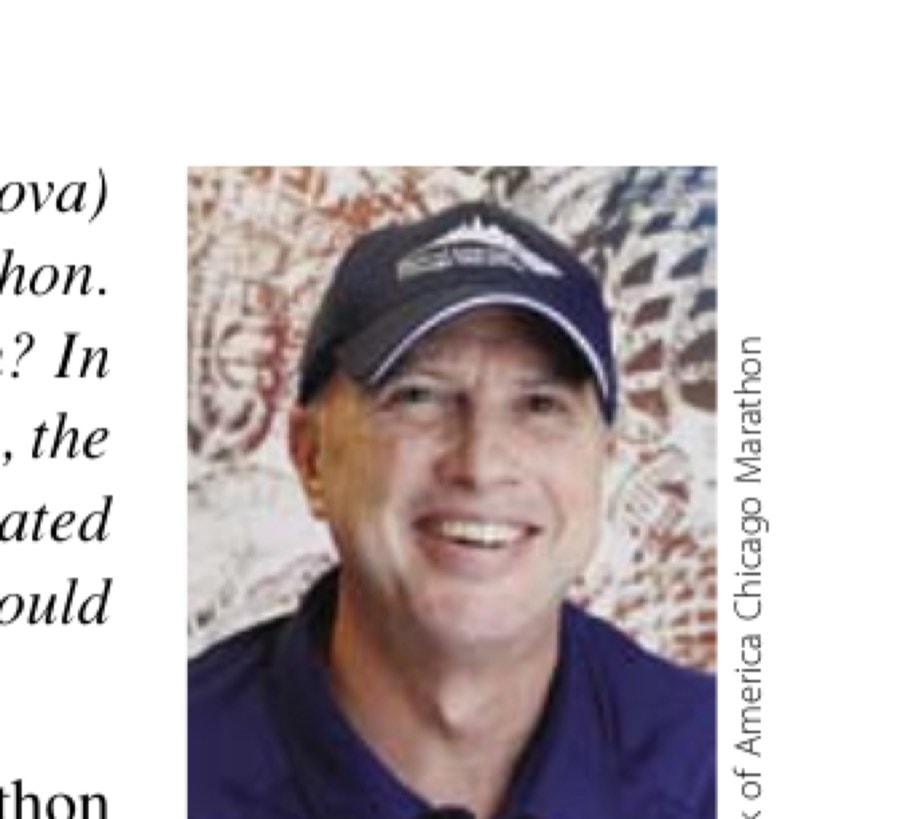
DA: I read a story of when you were in college (at Villanova) and traveled to New York in 1978 to observe the marathon. What was your perception of the marathon back then? In addition, would you say the 1976 New York Marathon, the first run through the five boroughs, is an underappreciated landmark in the sport in that it showed a marathon could be run in a major metropolitan area? CP: Yes, definitely. That 1976 New York [City] Marathon was truly the birth of the urban marathon. Fred Lebow was the first to understand that the masses are not going to come ▲ Carey Pinkowsk i to you; you have to bring the marathon to the masses. He has guided the Bank of America Chicago proved it could work.
As far as running the marathon, however, it was not Marathon for the past 20 years. something I aspired to do. Like most of my track teammates at Villanova, I was respectful of the marathon and curious about it, but back then it was considered something runners did at the end of their careers. DA: How did you become involved with the marathon initially? CP: I had the opportunity to meet Lee Flaherty in 1989. [Flaherty, a businessman and avid runner, was the founder of the Chicago Marathon in 1977.] During our discussion we talked about road running and the marathon. I had some ideas and
© Bank of America Chicago Marathon
by Don Allison
suggestions that he found interesting, and he asked me if I would be interested in “working on the event.” I accepted his invitation and my responsibility eventually grew into the role of race director, in 1990. DA: Why is the
Bank of America Chicago Marathon so popular? Did you ever envision the event reaching the stature it has attained? CP: Well, if you had asked me in 1990 if we would someday have 45,000 entrants, I would have said no way. When I first got involved in the late ’80s, the Chicago Marathon was in a struggle just for legitimacy. The viability of the race was questioned; it was definitely in the shadow of Boston and New York. That went on for several years. We had a year (1987) when the Chicago Marathon was not even held. It takes a long time to recover from something like that. Back then, to most people living in Chicago, the marathon was viewed as a disruption to daily life. And the city itself was looked at as something of an underdog, known as the “second city” and all that.
During the 1980s the race was all about the elite runners. Prize money was the biggest piece. There were some great races run by some great runners: Steve Jones, Carlos Lopes, Joan Benoit Samuelson, and Ingrid Kristiansen. But the race was viewed as an elite objective; the local running community was not really involved.
But over time, I think the city has really transformed itself as a destination, a world-class city, which has helped the marathon greatly. There was the success of the professional sports teams in Chicago, especially the Bulls and Michael Jordan. That brought a lot of attention to the city. Also, Mayor Rich Daley played a big role. He saw that the marathon could be a cornerstone event for the city, that we could establish “Marathon Sunday” in Chicago.
When we took over we wanted to give the runners a voice in the race, to include them as well as the people of Chicago. By doing that we knew we could have a great event here. The running community has made the event viable. CARA (the Chicago Area Running Association) and a lot of other groups are now fully engaged in the event; it is a team effort. DA: Has the race become too big? CP: It’s a question of popularity and demand. We hit our cap (45,000 entrants) earlier than ever in 2010. That illustrates the popularity of the marathon.
We are comfortable with the number we are at now. Could we handle 50,000 or 60,000 entries? Maybe, but 45,000 is a number we are comfortable with. When other race directors see our wide-open start and finish areas, within three-quarters of a mile of each other, they are envious, suggesting we could take more entrants, since the operational elements are in place to do that. But there are many factors
▲
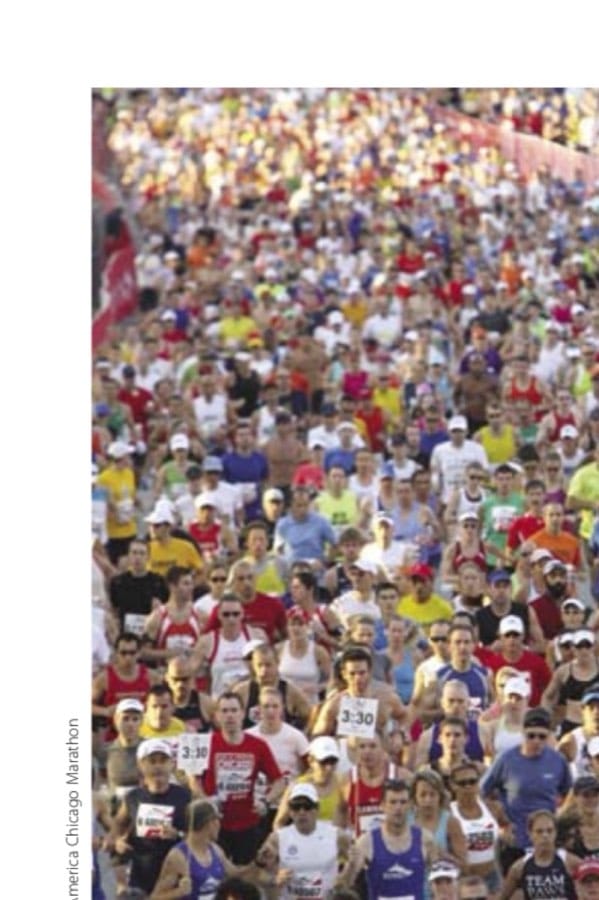
Traffic ahead: the Bank of America Chicago Marathon’s popularity is at an all-time high.
© Bank of America Chicago Marathon
to take into consideration: parking, gear, medical services, and other things. We have looked at other options, such as going with two waves, which could allow for a bigger field, but that is not on the table right now. We are
happy with our start, the seeding of runners, the corrals. The most important thing for us is the overall runner’s experience, not being the biggest event or setting a record for the number of entrants. We are committed to
making Chicago a special event for every runner. DA: Why have runners gravitated toward the marathon in such big numbers recently? CP: The economy has had an effect on just about everyone, in all walks of life.
Everyone is evaluating budgets, and it has become a complicated world in which to live. We are constantly bombarded with information that seems to come faster all the time. Every year there is a new technology to learn, it seems, such as
Facebook and Twitter. Everyone is feeling the pressure of living in such a challenging time. So in that light, the marathon is attractive because it is a basic, individual form of expression that is under your direct control. If you work hard, you will
have success. In some areas of life you can’t always control your own reward. In the marathon you can. It’s a personal prize. Runners know that from the start of their training all the way through the finish line, they are solely responsible for
the process. People are constantly being pushed and pulled in different directions these days; it is refreshing that the marathon has not changed since it first started to be run. It is a basic task that requires an individual commitment. The human
body is a marvelous instrument; many people have realized that and have chosen the marathon as their goal.
DA: What are your thoughts on the recent registration frenzy in which the 2011 Boston Marathon filled its entire field in just eight hours?Could you see the same kind of thing happening in Chicago? CP: The Boston Marathon is really an iconic event and has a special place in the sport. So many runners strive to meet the qualifying times, and when they do, they want to run that particular race and no other. It’s not like after you qualify for Boston you are going to say, “I’ll just run another marathon if I don’t get into Boston.” I’m sure this is what contributed to the race filing up so quickly, although I am sure Guy [Morse] would be the one to comment on this. As to whether we will see the same kind of thing with the
Bank of America Chicago Marathon, it’s hard to say. It took us five and a half months to fill the field in 2010. We will put it out there in February and see what happens. DA: Is a marathon such as the Bank of America Chicago Marathon recession proof? CP: The marathon is not necessarily recession proof. The word I use is “resilient.” We are very fortunate [that the sport has remained so popular]. DA: Given the high cost of entry into the marathon, do you feel your policy of no refunds and no deferment to the following year is a fair policy? CP: It is a policy that works for us. We give everyone an opportunity to run, and what they do with that is up to them. We can’t absolutely police [runners giving away or selling big numbers to other runners]. It’s difficult to monitor. Someone can show up with their identification, pick up their bib number, then turn around and give it to a friend.
That is not to say we don’t make our best effort to monitor it and stop it from happening. If we see a race number being sold on eBay, for instance, we will attempt to stop that. We will use the strictest measures to enforce our policy. We are very adamant that runners follow the stated policy, and we stress that in the informational communication we have with marathon entrants. Simply from a medical services standpoint, it is very important that the runner who signed up for the event is the one that runs with that bib number. DA: Are there too many “nameless” and “faceless” African runners for average fans to follow? Is there anything you can do to rekindle interest in the elite side of the race? CP: The marathon has gotten so competitive. Top runners are coming into it earlier, very athletic runners in the prime of their careers. It used to be guys turned to the marathon late in their careers, when they were fairly well known. Now you see fast 5,000- and 10,000-meter track guys at [age] 21 running the marathon, and
© Bank of America Chicago Marathon
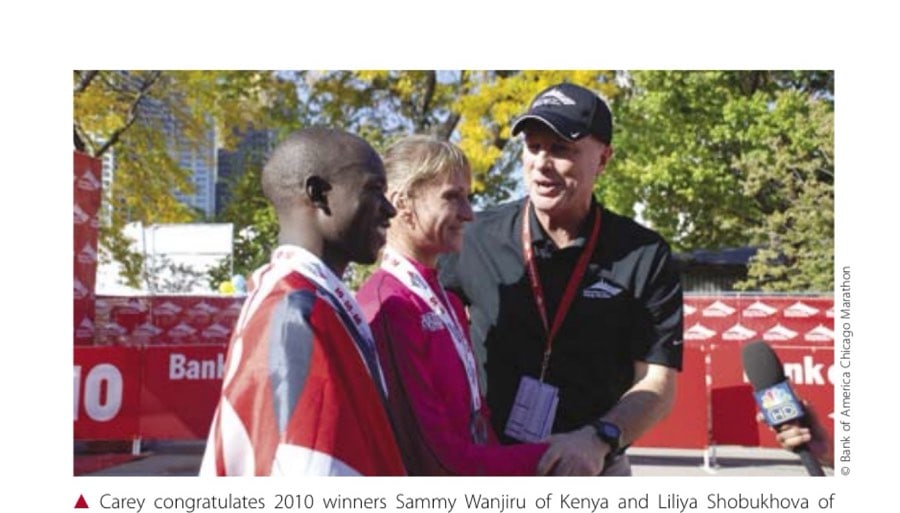
▲ Carey congratulates 2010 winners Sammy Wanjiru of Kenya and Liliya Shobukhova of Russia.
there are so many more athletes nowadays, unlike during the heyday of Rodgers, Shorter, and Salazar. Todd Williams was the top distance runner in the U.S. when he was about 25 or 26. I approached him then about running the marathon, but he wouldn’t do it; he wanted to stay on the track. As it was, he ran 2:11 [in Chicago, several years later], but if he started earlier I think he would have produced some phenomenal performances.
So many guys are running faster than 2:06 now; just look at the results from races such as Berlin and Rotterdam. It used to be marathoners had a patient philosophy, but that has changed. Now marathoners have an aggressive philosophy; they are going to run hard right from the start. Elite runners did not think that way 10 years ago.
As for the marketing of the top African runners, it’s difficult. It’s not like the NFL where you see the same players 16 times per year, or the NBA, where you see the same guys 82 times per year, or MLB, where you see the same guys 162 times per year, day in and day out. In the marathon, you see the elite runners just once. It’s a challenge for us.
Accessibility is also a problem in that regard. Their visibility is limited because they spend so much time training, away from where the event is held. It’s easy to overlook the nature of what these guys do. The marathon has become so competitive; elite runners have to train incredibly hard. They can’t afford to miss a single workout, a single medical treatment, even a couple of hours of rest. It all consumes a great deal of time. That all has to be balanced with accessibility to the media. They want to remain in their training camps for as long as possible before a marathon.
They [the African runners] are also shy, introverted, and quiet. Once you get to know them, they can be very engaging, but they come in the week before the marathon for press conferences, and no one really gets a chance to know them, to go deeper into their personalities. And the names are always changing, different runners coming along. It’s difficult. Plus there is a lot of luck involved. You can have a well-known runner that gets injured, and he is out of the race. Look at Martin Lel. He won New York and London, but then he got injured. DA: Does all of this play into the recruiting of the elite field? CP: Yes; recruiting is much different than it was 10 years ago. Now, a first-timer can produce a great performance, whereas it used to be a big gamble. That’s especially true for Chicago, London, or Rotterdam, where the courses are flat and fast. On those courses the speed element comes into play much more than, say, in Boston, where, due to the nature of the course, experience is a bigger factor. In the end we try to assemble a field that includes a mix of experience, speed, and visibility. DA: Do you feel there is too much pressure on top young American runners such as Ryan Hall, Dathan Ritzenhein, Kara Goucher, Desiree Davila, and Shalane Flanagan? Every move they make seems to be closely examined, especially when
ad
they run in Boston, New York, and Chicago. Are the expectations of these runners too unrealistic? It seems that almost anything less than winning is considered a letdown, even a failure of sorts. CP: It’s true; there is a lot of pressure. Everything they do is under the microscope. But they are all great runners and great people. They handle the pressure magnificently. Ryan Hall is a great talent, a fresh face on the scene. There has not been an American runner with his kind of talent since Greg Meyer and Alberto Salazar, back in the early 1980s. It goes back to this era of instant and constant communication. Most of these runners have blogs and Twitter accounts, so everyone knows exactly what’s going on with them and their training. That generates a lot of discussion and speculation, which leads to the often unrealistic expectations that are heaped upon them nowadays. But they are up against such incredible competition in these marathons. Look at [Ethiopian] Feyisa Lilesa, who ran so well [third place in 2:08:10] in the 2010
Bank of America Chicago Marathon at age 20. He has already run a 2:05 marathon! So many international runners are now bypassing track competition and going straight to the marathon at a much younger age, which makes it even more competitive for the top U.S. runners. It’s simply a lot tougher for American runners to win these big marathons than it used to be. DA: What did you learn from the 2007 Bank of America Chicago Marathon, in which extreme heat caused the race to be canceled while in progress and in which many runners suffered from the heat? CP: The events of 2007 served as a historic learning experience in dealing with extreme conditions on race day. Following the race in 2007 we engaged in a comprehensive assessment of what transpired and identified areas of opportunity and improvement in 2008 and beyond. We conducted one-on-one communication with hundreds of participants, volunteers, and spectators, along with conducting a runner survey and debriefing meeting with city agencies and volunteer captains. The main points of change, implemented at the 2008 event, included these: •
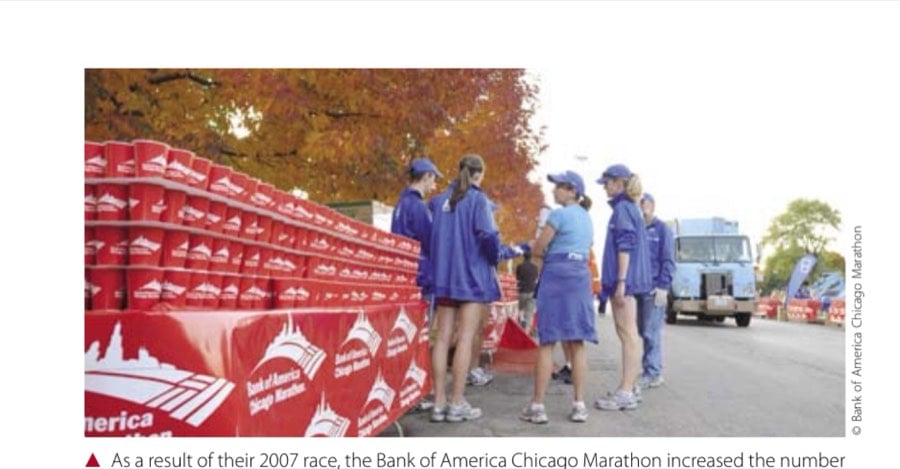
An increase in aid stations. We increased the number of distribution points and the amount of fluids, water, and Gatorade on the marathon route. • Operational enhancements. We introduced a color-coded “Event Alert
System” that provided course condition status ranging from “low” to “extreme” event conditions on race day. We added additional levels in our communication chain, stretching from the Unified Command team of
race and city officials down to volunteers and marshals along the course. The result was consistency of information from the event command post to individual runners on the course.
© Bank of America Chicago Marathon
▲ As a result of their 2007 race, the Bank of America Chicago Marathon increased the number of distribution points and the amount of fluids, water, and Gatorade on the marathon route.
• Medical support. We increased the medical team staff, ambulances, and supplies, along with the number of locations of support on the marathon route. We formalized a relationship with the American Red Cross and increased the number of trained personnel in CPR and AED use as well as activating their Patient Connect program in advance of race day. • Participant preparation/communications. Our volunteers received more training to be better prepared to provide assistance when necessary in less-than-ideal conditions. DA: Do you feel you do enough to support and promote the “second tier” marathoners in Chicago—those runners who finish in better than three [men] or three and half [women] hours? CP: We have seeded numbers for the nonelite groups and our “top 100” program, through which runners can apply based on their 10-kilometer or half-marathon times. Beyond that, the first 10,000 runners are placed in seeded corrals. We try hard to accommodate the runners who run behind the elite, world-class field, to try to allow those with specific time goals to run competitively. Now with the chip timing, we can get them their exact times as well. DA: Do you actively work to promote the
Bank of America Chicago Marathon “brand” in ways similar to New York and Boston? For instance, Boston has recently added a five-kilometer run and an elite mile the day before the marathon. CP: Well, back in 1990 when I first got involved as race director, we ran a fivekilometer on the day of the marathon. Basically, that was a numbers builder, a
way to get casual runners to come down and see the marathon, thinking it might be something they would like to try themselves in the future. It served its purpose, but the marathon now has its own identity. One thing I truly enjoy doing [to enhance the
Bank of America Chicago Marathon brand] is speaking to running clubs and organizations in the Chicago area, talking to both first-timers and veterans. I get some very effective and valuable feedback and suggestions. Almost all of our volunteers come from the Chicago area as well, which helps [with the branding of the race]. We also have partnerships with many area training groups, which have programs to prepare runners for the marathon. DA: Do you feel the Spirit of the Marathon film and the Chicago Marathon book properly portrayed the event? CP: Yes, both were great. The movie gave exposure to the race and showed a side of it not often seen. The shots of all of the different neighborhoods were great, as well as the overhead shots of the runners. Plus, it was the year with Deena [Kastor] winning in a great race with Constantina [Dita]. The book did a nice job showing the history and development of the race. DA: What stands out for you in your 20 years as race director? CP: Mostly, the struggles of the early years . . . then the great world-record performances by Khalid Khannouchi in the late ’90s, and then by Catherine Ndereba and Paula Radcliffe . . . then of course the heat of 2007 . . . but the marathon is like life; you make adjustments and move on. DA: What parts of directing the marathon do you enjoy most? CP: I have to say I really enjoy working on the course and with all of the volunteers. It’s amazing to think you can take 26.2 miles in a high-volume area in a major city with heavy motor-vehicle traffic and turn it into a marathon route. That is still amazing to me.
The marathon is still reliant upon the volunteers. There are thousands of them. They are a great display of human spirit. Some of them have been with us for the entire 20 years I have been directing the marathon. If we had to pay them all, there is no way we could ever put on the marathon.
We also have an unbelievable partnership with the city and our sponsors. Even after a very difficult 2007 and a difficult 2008, we have been able to continue working together as a great team. I have to say I live a charmed life. I am doing what I did as a young boy, at least in a manner of speaking. I look forward to continuing to do it, as long as I feel I can bring experience and insight into my role as race director.
This article originally appeared in Marathon & Beyond, Vol. 15, No. 1 (2011).
← Browse the full M&B ArchiveMore like this
1,000+ stories from 19 years of Marathon & Beyond
The complete archive of the legendary long-distance journal — digitized and free to read.
