

Chasing The Flying Goddess
Falling headfirst into the pavement at mile 13 during the 2011 San Francisco Marathon wasn’t what I envisioned while lacing up that morning. Yet, obsessively, my only thought was leaving with a finisher’s medal while a medic patched up my two-stitch head injury. Much of the rest of the race was a blur until I passed AT&T Park, where the stars floating around my head were replaced by question marks. What happened to normal ballpark names? Didn’t the Giants play at Candlestick Park for 40 years? Why would they need a corporate sponsor?
At the finish, another question came to mind: “Who sponsors the San Francisco Marathon?” The first place I checked was its finisher’s medal but found only the quotation, “Worth the Hurt,” which I found ironic considering that I had dried blood on my hands. The answer is WIPRO, a global IT company, the race’s presenting sponsor for 2011 and title sponsor for 2012. But how critical is its contribution to the medal, and why don’t all sponsors have their names added to the marathon finisher’s medal?
Two sides to every medal Runners differ on their thoughts about title sponsors having a place on the finisher’s medal. One of this year’s panelists specifically avoids marathons with large logo medals that may or may not fit the marathon theme. She believes that her entry fee, plus her running the 26.2 miles, makes the medal her property. She feels that sponsors should deservedly have their names throughout the running course yet not reach the Holy Grail of the medal. Her final question was: “What’s next; are we going to start seeing sponsor logos on the Olympic medals?” This is a very natural reaction shared by a great number of marathon finishers, but on the other side of the coin…
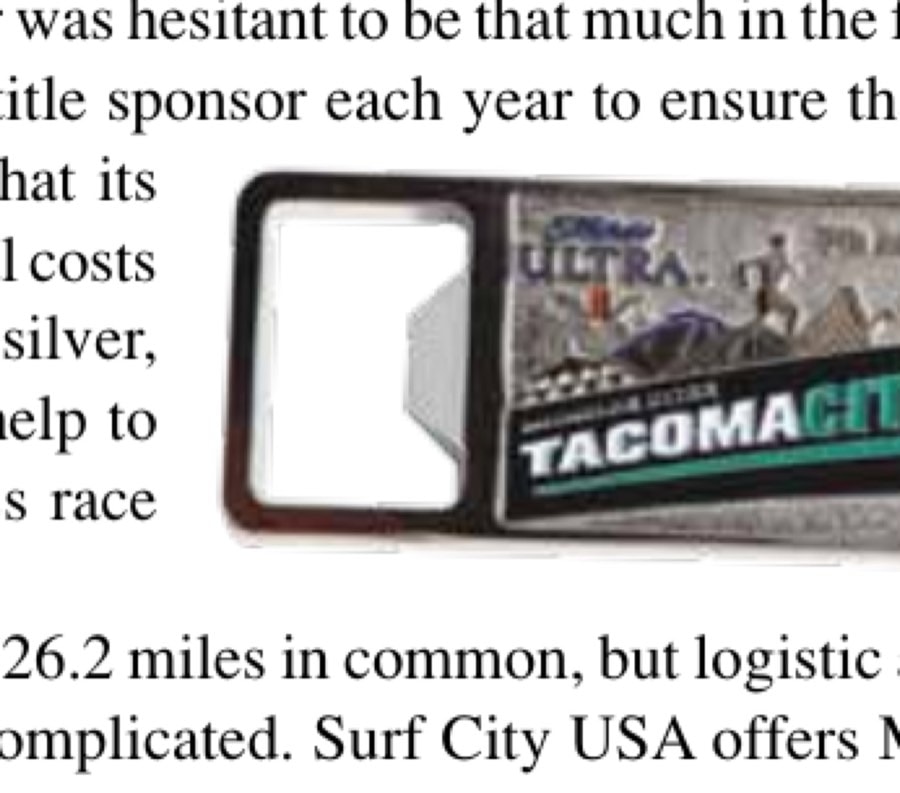
What about marathons that are smaller, with limited funding, and that are trying to keep costs down for the runner? A sponsor in this instance saves the day and has certainly earned a pat on the back for making the finisher’s medal much better than what would have been produced without its funding. For instance, the now-defunct Seafair Marathon had decent medals that were vastly improved in 2009 by Competitor Group (Rock ’n’ Roll marathons) when it took over running the marathon and significantly increased funding. Dodge is now the title sponsor of the Seattle Rock ’n’ Roll Marathon as well as many other West Coast half- and full marathons. P. F. Chang’s is another title sponsor for the series and has its logo on the
finisher’s medals in an unobtrusive fashion. A happy compromise can be met that satisfies all parties as long as marathons are careful in the creative and manufacturing phases of medal production.
Balancing act Race directors must have nightmares during the manufacturing process, envisioning angry runners storming their castles with torches in hand. How do you please multiple Type A personalities and also reward the sponsors? It takes funding, which has to come from other sources if entry fees are not enough to cover expenses. On average, the revenue that sponsors provide events ranges from 20 to 25 percent of the total pot of gold needed to run the race, so a hearty round of applause is certainly justified.
Tony Phillippi, director of the Tacoma City Marathon (TCM), looks at rewarding sponsors by adapting the event’s medal to the corporate branding. Finishers praised their 2011 Michelob Ultra bottle-opener medal, but this wasn’t the first time that Phillippi has had a clever idea. In past years, TCM also designed a bottle cap-shaped medal and even gave out a paint-can medal for Parker Paint. This took some convincing, as Parker was hesitant to be that much in the forefront. Phillippi runs design proofs by the title sponsor each year to ensure that it is happy with his creativity. TCM feels that its entry fee takes care of medal costs but appreciates the 15 gold, silver, and bronze sponsors that help to make the event a first-class race each year.
All marathons have the 26.2 miles in common, but logistic and funding issues are all very different and complicated. Surf City USA offers Marketing Partnership Programs to their sponsors. Their agreement indicates that their brands, for now, will not be on the finisher medal. Their sponsors have hands-on participation during their events and ultimately their investments are well worth it, but their surfboard medal is sacred in their eyes, as-is.
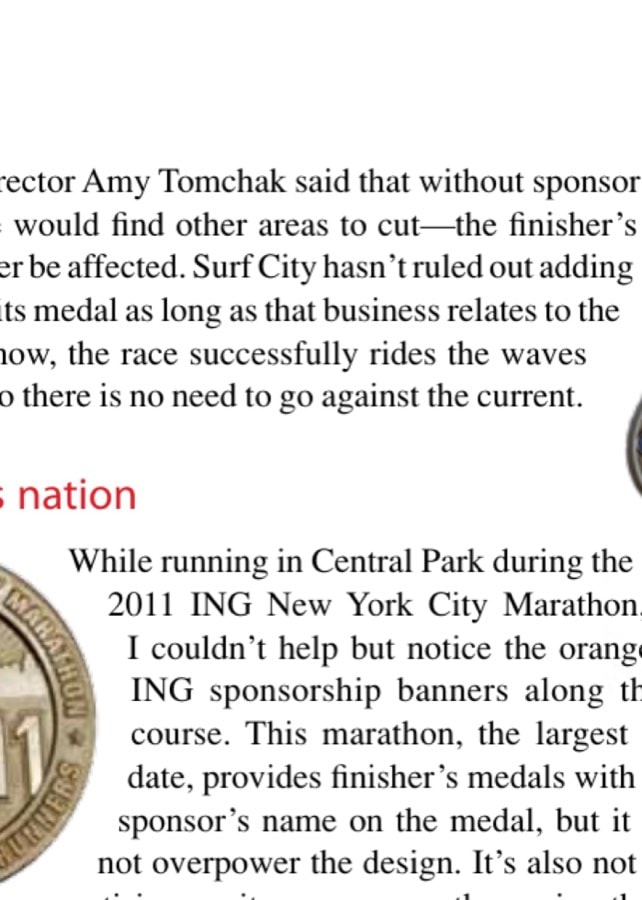
Executive Director Amy Tomchak said that without sponsor funding, the race would find other areas to cut—the finisher’s medal would never be affected. Surf City hasn’t ruled out adding a title sponsor to its medal as long as that business relates to the surf theme. For now, the race successfully rides the waves without falling, so there is no need to go against the current.
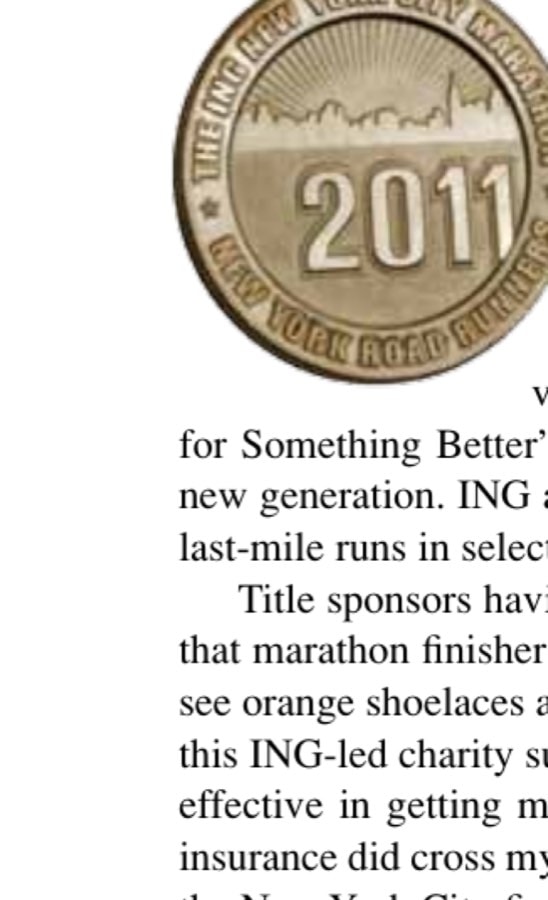
Orange laces nation While running in Central Park during the 2011 ING New York City Marathon, I couldn’t help but notice the orange ING sponsorship banners along the course. This marathon, the largest to date, provides
finisher’s medals with the sponsor’s name on the medal, but it does not overpower the design. It’s also not all about the advertising, as it sponsors youth running through “ING Run for Something Better” at its marathons, helping provide health awareness to a new generation. ING also partners with Competitor Group for ING KiDS Rock last-mile runs in select cities across the United States.
Title sponsors having a heart for the community is one of the hidden factors that marathon finishers may not comprehend while running the race. When you see orange shoelaces at a marathon, it’s because that runner is raising money for this ING-led charity supporting running and fitness. Yet its orange banners were effective in getting my attention, as my mortality and my need for additional insurance did cross my mind with my heart pounding a mile a minute en route to the New York City finish line.
ING also sponsors Miami and the Hartford Marathon, whose Soldiers and Sailors arch medal has graced our top 25 for three years running. The generosity doesn’t end with ING, as 70 other sponsors also help in the funding and support of the Hartford event. United Technologies provides 200 volunteers and designed a water-bubbler machine where runners can enjoy pure water from a 40-spigot fountain, also saving thousands of plastic bottles from reaching landfills. Here partnerships are the name of the game, as the fees that the runners pay would not even come close to the total cost of this top-notch marathon.
Sponsorship 101 Event Director Les Smith of the Portland Marathon leads the charge with his marathon-sponsorship approach. His organizational system is taught to running
directors across the United States at the Event Directors’ College in the days before the Portland Marathon each year. He has two rules for title sponsorship: (1) never sell a title cheaply, and (2) never give up the control or the timing of the promotion and production of the event to any sponsor, regardless of size. He advises, “A title platform should be a larger version of any other level of sponsorship. Remember, the unique entitlement is the title!”
Smith elaborates, “We want sponsors that are partners that understand the event. I am amazed at potential sponsors that do not understand ‘activation,’ the aspect of a sponsor actually spending additional money to advertise and promote the fact that it is a proud sponsor of the event and at the same time selling its product or services. We want sponsors to have a good return on their investment. We want to know how their business works, what their marketing goals and objectives are, whether our event fits within their overall vision, or whether the sponsor will spend money on activation. When we know all of this, we can then build a sponsorship platform that will really work for both of us.”
ad
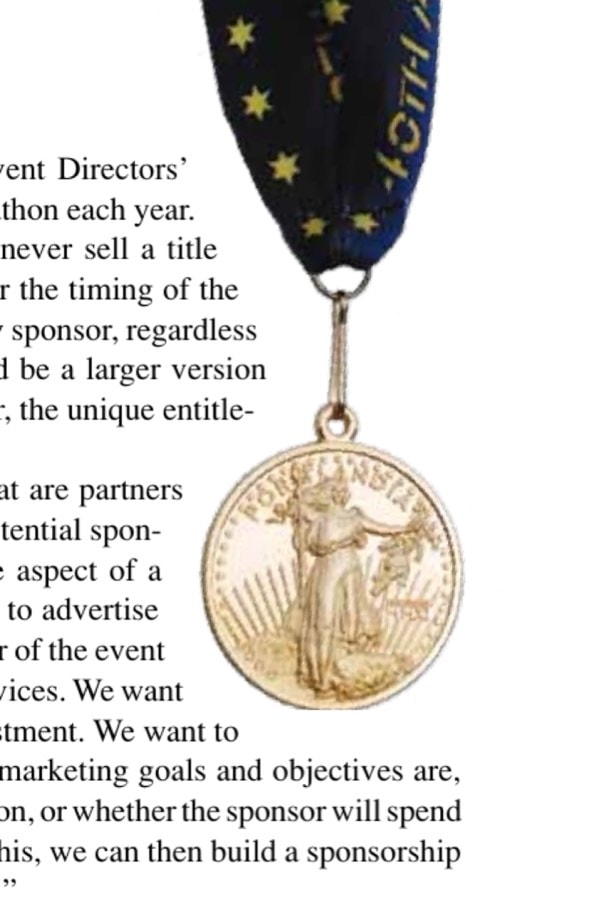
The Portland Marathon’s 40th-anniversary medal mirrored the 1911 St. Gaudens twenty-dollar gold piece with eight detailed changes that represent the city of Portland. If you compare the coin and finisher’s medal, you would not see a dramatic difference; that’s the beauty of it. Each year an amazing amount of effort is put into the race’s three-peat top-25 coin-minted finisher’s medal.
The race does not place sponsor logos of any kind on its medal, not even that of the Peter Stott Foundation, its long-standing partner. Smith noted, “Peter actually prefers to stay in the background. Plus, in my opinion, a sponsor on a medal, unless it’s a large six-figure title sponsor, adds nothing to the design and significance of an event’s medal. A medal should be a statement about the event and where it is held. It should not be about a sponsor.”
For the people “The People’s Marathon” is run by the Marine Corps, a government agency that doesn’t have a title sponsor. Instead, it has specialized sponsors. For instance, Brooks sells specially made Marine Corps Marathon (MCM) running apparel for the event and even brings in heated VIP porta-potties before the race for those who purchase their products. Brooks also partners with 19 Rock ’n’ Roll marathons and feels that it can get its name and footwear out to many more events than a title sponsor can by spreading out its monetary investments.
MCM covers its finisher’s-medal manufacturing costs with runner fees. Its current spinner medal once again reflects the excellence that “the few and the proud” represent. Even “Covert Affairs,” a USA Network spy drama, showed off MCM’s newest medal in a November 2011 episode. Think about it: the same medal that more than 20,000 finishers wore was broadcast around the world. Free publicity like this would make even a Marine smile!
Another marathon with government cooperation is Space Coast. NASA can’t officially endorse marathon events, but it does allow Space Coast to rent the Kennedy Space Center Visitor Complex. It provides mock launches of an Apollo rocket for runners and their families to enjoy at a reduced cost. Space Coast’s rocket finisher’s medal was the highest-placed new addition to the top 25 this year. The race’s sponsor categories are known as Universe, Milky Way, Sun, Moon, and Satellite.
David versus Goliath How can a small marathon financially compete for those medal chasers who look carefully at event medals before forking out their entry fees and airline tickets? Two-time top-25 medal finisher Tupelo is a prime example on how to get the job done. David Whiteside, director of this 225-finisher event, decided not to take
sponsors up on their offers. He says that this gives him the freedom to keep things simple without outside influences in the decision-making process. The race’s medals are 100 percent funded by the marathon runners, with about 10 percent of the registration cost going into the manufacturing. Tupelo finds other areas where it can save money, making its entry fee lower than average. Park City has a unique sun-catcher finisher’s medal, which is also paid for mainly through entry fees. About 15 percent of entry fees go to paying for these locally produced alternative medals. Interestingly, the race gives the largest sun-catchers to the faster finishers and gives smaller medals to finishers with more modest times. The Green Bay Marathon has a local mindset, much like the Packers, whose fans own the football team. Cellcom, the title sponsor, is a regional cellular company that succeeds even amidst phone giants. Green Bay epitomizes the “little guy finishes first” philosophy with Cellcom proudly sporting its name on the inventive pigskinleather finisher’s medal. Yet another example of small-town charm is Grandma’s Marathon, where you would need a dirigible hangar to house everyone involved in sponsorship. It has an incomprehensible 140 sponsors! Those names might perhaps fit on the huge Little Rock or Texas
finisher’s medals, but only one, Wells Fargo, has that coveted back-of-the-medal representation due to having joined the fold 25 years ago. The race offers three levels of sponsorship after its presenting sponsors: major, contributing, and supporting. At race’s end, if you chose to thank everyone involved in presenting the finisher’s medals, you’d go hoarse from speaking as well as exhausted from running!
Center of the universe I couldn’t help but think nostalgically as I passed under the Route 66 pedestrian bridge while running the 2011 Williams Route 66 Marathon. Every marathon runner should run this mother road, but I’ll admit that what brought me to this race was its history of magnificent
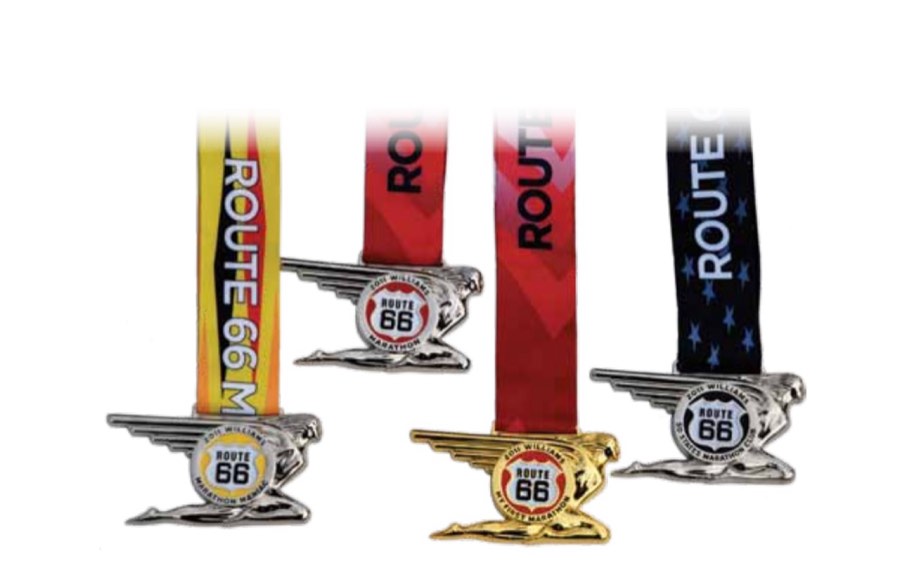
finisher’s medals. Added lures were the specially designed 50 States Club and Marathon Maniac finisher’s medals, which cost the race twice as much to manufacture. Even more priceless was Tulsa’s Midwestern hospitality, where a first-class passenger on my flight gave up his seat for a military member in uniform. Reflecting that same attitude is Williams Energy Services, the Route 66 title sponsor, which is rewarded with its name on the medal. It is a regional energy company whose core values and belief statement actively promote involvement and sup-
port of community activities. In the end, for about a dollar more than the average marathon finisher’s medal, Route 66 produced a classic replica of Cadillac’s 1941 Flying Goddess hood ornament with a hint of Tulsa’s art-deco architecture. Not content with a standard marathon, Route 66 added an optional three-tenths of a mile to the course with their “Center of the Universe” detour. As I neared mile 17, I felt pretty good, so an extra three minutes of running seemed like a good idea at the time, though if I had had the strength or dexterity to kick myself in the end, I would have! Runners making the detour are awarded a special medal-sized coin. This award was sponsored by Michelob Ultra, whose name appears on both sides of the coin. The Marine Corps Marathon provides an event finisher’s coin to all finishers, as does the Portland Marathon, which was the first marathon to give out these highly desirable coins. Its event director believes the coin is also a perfect way to highlight a sponsor, and marathoners love these extra swag items because they are colorful, collectible, and distinctive. Sponsorship or no sponsorship, on the medal or off, the common thread is the pride of accomplishment when finishing a marathon. For some of us, the token to remember that achievement is almost as big as the race itself. So one last question comes to mind: “Do marathon runners really consider the
finisher’s medals when picking out their races?” You can probably answer that question yourself by simply counting the number of events from our top 25 that you have run. If your answer is five or more, you should seek immediate counseling, as you could be suffering from medal madness! All photos © Robert Rayder
The Top 25 Marathon Finisher Medals for North America for 2011 Countdown to number 1. BY CARA MCLAURIN ESAU
With John Hayes’s amazing victory in the 1908 Olympic Marathon, long-distance running in America began to rise in popularity. It was nail-biting action as Dorando Pietri staggered the last 380 yards and was propelled across the finish line by officials just before Hayes caught up. Pietri was disqualified, and Hayes received the gold medal. Back then, only a handful of marathons existed. Now, a mere century later, you could choose from more than 500 marathons to run throughout the world. Most of us won’t be winning a gold medal, but we surely look forward to receiving a medal of our own, a reminder that we have crossed the finish line, that we are victors in our own right.
However, not all medals are equally eloquent reminders of our athletic journey and marathon experience. Some are gorgeous and worthy of display; others sadly look like we picked them up at our local dollar store. To scout out 2011’s best-designed medals, we gathered a diverse panel of marathoners from across the United States and Canada. They vary widely in their backgrounds and levels of experience, but all share a love for running and an appreciation of excellently crafted medals. Panelist Rachael Brown (Oregon) puts it succinctly: “Running a marathon is a substantial achievement; the medal should reflect that.” In hearty agreement, let’s look at the medals that scored big in 2011.
We racers love a medal that captures the spirit of the marathon it commemorates. Several of this year’s medals leave us longing for a vacation somewhere warm and sunny with sea turtles and surfboards. Others conjure nostalgic feelings of historic American landmarks and towns. We love a creative medal that spins, opens, or lights up, yet we also appreciate simplicity and beauty. The common bond is excellence, regardless of the form it takes.
This article originally appeared in Marathon & Beyond, Vol. 16, No. 3 (2012).
← Browse the full M&B ArchiveMore like this
1,000+ stories from 19 years of Marathon & Beyond
The complete archive of the legendary long-distance journal — digitized and free to read.
