

Comrades: A Firsthand Account
The Comrades Marathon looms large in the pantheon of ultras and with good reason. Throughout its long history (2005 was the 80th running), it has only gained in stature, attracting a huge field (approximately 12,000 on average) and luring the fastest ultrarunners in the world to test themselves on its punishing hills in hopes of earning a spot in running history as well as a nice amount of prize money.
The race is always held on June 16, regardless of the day of the week on which it falls. June 16 is a national holiday called Youth Day, which was set aside to remember the sacrifice of the Soweto, Johannesburg, students who died in 1976 in riots over apartheid and Bantu education and the introduction of Afrikaans as the language of instruction in schools.
The race is point to point (and about 90K, give or take, as the course varies slightly from year to year). It follows a route between the cities of Durban and Pietermaritzburg, and each year it switches directions. From the former to the latter is the “uphill course,” and the reverse is the “downhill course.” The uphill route is slightly shorter to compensate for the difficulty. Separate course records are kept for each direction. The majority of the field is South African. Running is much more a part of the culture there than it is here, and ultrarunning is not as much of a fringe sport as it is in America. I met one man from a village in the north of the country who told me that 80 members of his club were there to run Comrades and that it was the focal point of their training throughout the year. The race also attracts a fair number of other African citizens and Europeans. There were about 20 Americans at the race in 2005; two of them I know personally were repeat customers, a testament to the race itself that these runners would make such a big trip year after year.
WELL WORTH THE MAGNITUDE OF THE UNDERTAKING I had long thought about running Comrades, but it seemed to be forever stuck in the someday pile. This was partly due to what I perceived as the magnitude of the
Comrades Marathon Association
undertaking, and I’m not talking just about running 89K. I’m referring to the planning involved in getting there, racing with jet lag, and the assorted other unknowns that come with traveling to the other side of the world and trying to race well.
First order of business—enter the race. The deadline for entry is about six weeks prior to the race date. You have to qualify for Comrades, but the standards are not overly strict if you simply want to participate. Minimally, you must have run a marathon in five hours or less. The race has a seeded start (lettered A through H, with A being the fastest), and your qualifying race will determine your starting pen. Race officials try to enforce these standards by checking your race number when you enter the pens to make sure you are not sneaking into a faster pen, but somehow many runners get around the system.
Interestingly, the qualifying standards are the same for men and women. At first, I thought this was a quaint and archaic rule (it is easier for a man to run a sub-3:00 marathon than it is for a woman), but I have since reversed my thinking on this. The start is a bit of a crush, and it makes sense to have the runners sorted by time alone, regardless of gender.
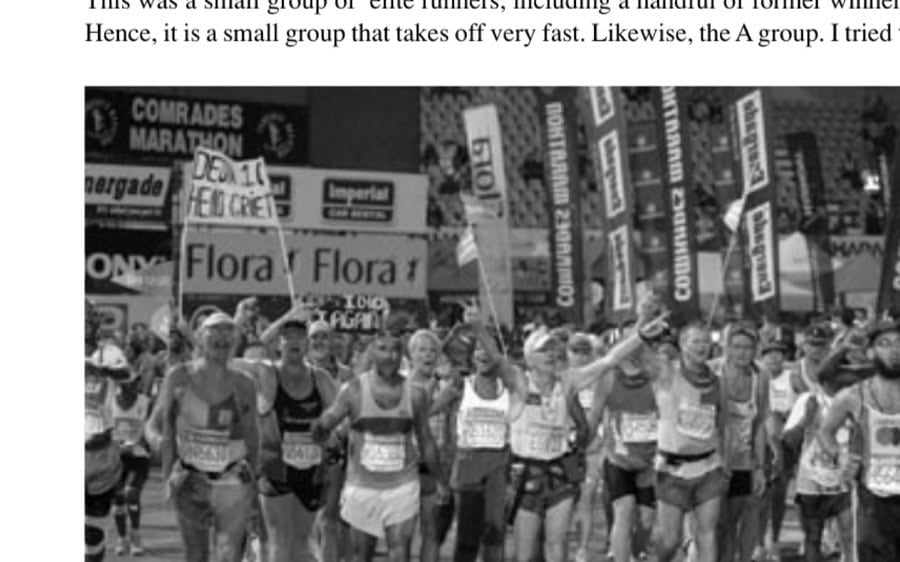
More than 12,000 runners started the 2005 race (and about 11,000 of them made the 12-hour cutoff). I started in the B group, which was actually the third group, because in front of the A group is a special section called Super Seeding. This was a small group of elite runners, including a handful of former winners. Hence, it is a small group that takes off very fast. Likewise, the A group. I tried to
▲ Start slow and ease up. The back of the pack celebrates at the start of the 80th running of the Comrades Marathon in 2005.
check my watch to see how much time it took me to get to the starting line after the cannon went off, but it was so chaotic that I didn’t dare mess with pushing buttons on my watch and taking my eyes off the runners right in front of me. I would say it was less than 30 seconds, though. Two of my fellow teammates were in group H, the farthest from the start, and they said it took them about seven minutes to cross the starting line.
MORE LIKE THE START OF A 5K Conversely, another teammate, who was the sole member of our group in the A pen, took mere seconds to cross the start, although he said that even in his pen, it was a stampede. Runners flew out as though it was a 5K, and to their credit, many hung on for quite a while. As the miles passed, I noticed many runners wearing As and realized that they must be quite fast at the shorter distances, and that even though this was not their best event, it was something they just did, at once an anomaly and a centerpiece of their running year.
But I’m getting ahead of myself. First, you must get to South Africa, and my goal was to do so as painlessly as possible (that is, not too many connections and not a lot of waiting around in airports between flights). This is easier said than done, especially if you’re trying to get the best deal on tickets. For those who are determined to avoid a stop in Europe, South African Airways does fly direct to Johannesburg from New York City and Atlanta. At the time of this writing, Washington, D.C., was looming as a third jumping-off point in the United States. From Johannesburg, you take another flight, about an hour in length, to Durban. If you are coming from the West Coast, you are going to take three flights minimum and more likely four. We met a couple from California who had taken the direct flight from Atlanta to Johannesburg and said it was just too long to be on a plane (about 17 hours). I would second this, because most people will not be flying business or first class, and based on what I saw on my return flight, the economy seats on South African Airways are not at all roomy. (Also, note that even though the flight is considered direct, the plane will land once in Africa to refuel.)
So that leaves the more typical route, which is to fly from the East Coast to Europe and then catch another flight to South Africa. One thing to note about this plan is that the majority of flights to Europe land in the morning, and the majority of flights from Europe to South Africa leave in the evening and fly overnight. This means you may land in London or Zurich at 7:00 A.M., and you don’t fly out again until 7:00 P.M. This also means two overnights on a plane.
USE WHATEVER CREATURE COMFORTS YOU CAN OBTAIN If you are a member of a frequent-flier program or have some kind of privileged status with an airline, this can be a huge help. Find out about lounges associated
with your airline. These will have showers and a place to lie down. It will make the trip much more bearable if you can wash up, change clothes, and shut your eyes in peace and quiet for a few hours. My itinerary took me from Newark, New Jersey, to Amsterdam, landing at 8:00 A.M. At 10:00 A.M., I was on another KLM flight for Johannesburg. Because my flight landed at 8:00 P.M., I had to spend the night there and go on to Durban in the morning. I stayed at the Grand Airport Hotel. I had low expectations, but it was very nice and also very cheap (about $50). The breakfast was great, and the shuttle to and from the airport was free. The flight from Europe to Johannesburg is about 10 to 11 hours long. It’s long and there’s no getting around it. One of the best things you can do is to head into the trip well rested and well fed, because the trip over will wear you down; and if you can buffer the experience by taking good physical care of yourself beforehand, it will help enormously.
The hotel situation in Durban is good for tourists, but it’s a good idea to book early and make sure you have a written record or locater number for your reservation, because you could be hard pressed to find a room once you are there if there is any sort of mix-up. The city fills up for the race. Most people stay at one of the hotels along the water, either on Snell Parade or slightly farther south, on Marine Parade. There are four Holiday Inns on this stretch, all within easy walking distance of each other and all of equivalent quality, which is to say clean and comfortable with almost all the typical amenities found in Western hotels. There is also a place called Blue Waters where we noticed runners were staying. A few blocks from the water are the Hilton (quite expensive) and City Lodge (much more reasonable). There is also a neighborhood called Morningside where there are bed-and-breakfasts and many restaurants, but it is a bit removed from the prerace activity (and also a bit far if you are taking one of the race buses to the start).
HOTEL ROOMS DON’T HAVE REFRIGERATORS One thing to note about the hotel situation that might be of interest to runners, especially those who like to bring their food with them and eat in their rooms at least some of the time: ours did not have a small refrigerator, and I suspect this is the case with most. Also there were no washing machines for guest use. (And why should there be, I suppose, as these hotels are really for South Africans on beach holidays, and why would they want to spend time doing laundry or cooking?) Laundry services are all over town, and the hotel will do it for you, but you will pay quite a bit more there, of course. On the plus side, there are Wi-Fi areas in the lobbies and business centers where you can pay to use the Internet if you didn’t bring a laptop (not cheap, though, and they charge by the quarter hour).
We stayed at the Holiday Inn Elangeni (since sold and renamed Southern Sun Elangeni), and we were very happy with it. It had three restaurants and a bar,
a pool, small gym, a car-rental office, a tour operator’s office where you could arrange a safari, and a gift shop. I picked the Elangeni after spending several hours on the Internet reading up on various hotels, and serendipitously, the hotel turned out to be a major hub of activity for the race, and we saw many of the top runners (mostly sponsored by a company called Mr. Price, which appeared to be the Wal-Mart of South Africa) daily in the lobby and the restaurant. This made for a fun atmosphere, and as race day approached, the lobby, where you could sit with a coffee or a glass of sherry, of which there were three decanters, in varying shades of amber, all complimentary and continually replenished, sitting by the towering floral arrangement in front of the reception desk, was a great place for people watching. I watched one man pour himself four glasses of sherry in rapid succession before a concierge took notice.
One less-than-desirable thing that happened (and which was not the fault of the hotel, but perhaps something could have been done about it) was an all-night session of jackhammering on the sidewalk on our side of the building the night before, as well as the night after, the race. Since we had to get up at about 2:30 A.M., we all retired to our rooms around 8:00 P.M. It wasn’t more than a few minutes after I turned off the lights that hammering started. It did not stop until about 1:00 A.M. I called the lobby and asked to speak to the manager. It felt like an act of futility, and I had the sense, based on the manager’s politely vague acknowledgment of my complaint, that my request to have this situation remedied was going to be ignored. I couldn’t have been the only guest that complained, and I lay there hoping the front desk was getting barraged with similar calls, as there is strength in numbers. I put in my earplugs, buried my head under the pillow, and tried not to let my growing irritation and frustration prevent me from getting at least some sleep.
A PLACE FOR FINAL PREPARATIONS The best place to run is along the water, north to the Blue Lagoon at the mouth of the Umgeni River and south to Vetch’s Pier. When we arrived on Monday, we saw only a few runners, but by the day before the race, we had a lot of company. The round-trip mileage is about 10K. You will run mostly on the sidewalk, which is brick and very hard. There aren’t any cross streets or traffic lights to stop for so you can run uninterrupted with a view of the Indian Ocean. We did see a number of people just hanging around or sleeping, and at first this made me uneasy, as I had heard many warnings about muggings; but in broad daylight with at least a handful of other runners, cyclists, and passing cars, I never had any problems. June is the beginning of the winter there, so the days are pretty short. The sun rises around 7:00 A.M. and sets soon after 5:00 P.M., so you can’t linger too much if you want to get a run or walk in during daylight hours. On the plus side, it did
make us settle in for the evening at a decent hour and pretty much guaranteed more rest and relaxation than if the days were long.
WEATHER As I said, it is the beginning of their winter, but this doesn’t mean it’s cold at all. In fact, it’s probably one of the nicest times of the year to be in Durban. I had read that it can be very humid there, and I was worried about racing in a hot, humid place, but summer (December) is the time when the humidity is oppressive. In June it isn’t bad at all; in fact, it was a relief from the weather here at home on the East Coast. The temperature was around 75, and we had a lot of clear sunny days. Race day was great if you don’t mind the temperature getting into the mid-70s. I heard many veteran Comrades runners comment that it was one of the best days they could remember. The start in Pietermaritzburg was actually a bit cold, and I wrongly guessed that it would warm up fast once the sun’s rays came over the horizon. It seemed to take about two hours before the damp chill lifted.
A FITTING EXPO, BUT NOT OVERWHELMING
Comrades Marathon Association
The expo is held at the Durban Exhibition Centre, across the street from the Hilton. The first day of the expo things are pretty quiet, but by the day before the
▲ No sleep ’til Durban. The 2005 field of some 12,000 runners fan out along the race course.
race, the place is very busy, with lots of vendors and a lot of historic Comrades information on display. There is an international runners’ booth where you pick up your number and goody bag and have your chip scanned. You have to bring your confirmation card (you receive this in the mail after you register, and it states your name, race number, and starting pen), chip, of course, and passport. I did not linger at the expo other than to pick up my number, look at the wall of history with former winners’ times and photos, and buy a bus ticket to the start. For those who like to browse and shop, though, this expo, though not as big as the New York or Boston Marathon expos, had a lot to offer.
Buses to the start leave at 3:30 and from two city locations, the Durban Exhibition Centre and the Holiday Inn Marine Parade (something to keep in mind when you choose your hotel). You have to buy bus tickets (for sale at the expo and inexpensive). I wondered how it would work with so many people needing transportation, but it was orderly and simple. We simply took our place in what looked like a very long line but which actually moved quickly, and we were boarded and on our way. I brought earplugs and a sleep mask to try to catch a nap en route. The bus was a bit stuffy and the driver played the radio, but the passengers were quiet. The ride takes about an hour, perhaps a bit less, and you are dropped off near the start at City Hall in Pietermaritzburg. It’s still dark, of course, and we were not quite sure where to go at first, so we followed the crowd. You had to show your number to get into the tog-bag area (where you place your bag to be brought to the finish). Thousands of runners milled around, many looking for a discreet place to go to the bathroom; there are portable toilets. I thought about the mess that would be visible around the park once the sun rose.
Consider bringing a throwaway shirt to the start or wear something you don’t mind wrapping around your waist once you warm up. You might not need it if you run an up year where you start in Durban, which will be a bit warmer; but this year was a down year, and the start in Pietermaritzburg was chilly, with temperatures in the low to mid-40s, I would estimate. I wore only my singlet and shorts, and I was a bit too cold for more than an hour into the race, something I had not expected at all. You should also consider sunscreen, as the course is exposed for the most part. For the same reason, you might also want either a hat or sunglasses.
ALL YOU NEED IS PROVIDED Aid stations are plentiful, almost one a mile. Water and sports drinks are provided at all of them and caffeinated soda, oranges, and bananas at many of them. There was also the odd station with candy bars. The one unusual thing about the water is that it is not in cups, as we Americans are used to, but rather in thin plastic pouches, almost like small IV bags. This was a little hard to get used to at first, but I finally got the technique down where I held the bag from the bottom and
Comrades Marathon Association
▲ Water “sachets” at one of the 52 aid stations lining the course.
tore the top with my teeth. This worked well enough, and I got to the point where more water went down my throat than down my front. The bottom line is that you don’t need to bring anything with you on the run unless there is something specific you feel you can’t race without, such as electrolyte tablets or gel packets.
The support on the course is excellent. The volunteers and spectators are so enthusiastic that it really does buoy the runners along. There are stretches where you run alone, but not many. The atmosphere is overwhelmingly positive and upbeat. People set up barbecues (braais, they call them), play music, even dance in the streets in certain places and make an all-day party of it. At two spots, you run by schools where the young students line both sides of the road and cheer on the runners. I was running near one man in the last few miles of the race who even stopped to join in the dancing himself before continuing on. I also ran near a man who I’m sure must be a well-known fixture at Comrades. (I saw his photo in one of the South African racing calendars that were in our race bags.) He is both extremely tall—towering over everyone else—and extremely skinny, and he was wearing a bright-purple fright wig.
Although the last few miles were physically a bit grueling—and I don’t mean to be disingenuous here, because sometimes they aren’t!—they were also some of the most memorable. I had lost all hope of running the time I had trained for (around seven hours), but I was definitely going to finish; so I just tried to take it all in, reminding myself that, wow, here I was in Africa, of all places, and in the middle of the biggest, wildest ultra of them all.
My mind did not cave in so much as my body, and I just muscled my way through the remaining kilometers. Out of sheer force of habit, I kept looking at my watch, and the news was not good. Not only was I not going to be in the seven-hour range, but I was not going to break 7:30 either. A sub-7:30 finish is sort of the ultimate goal for many Comrades runners because it gets you a silver medal (top 10 in each gender get gold, and then everyone else under 7:30 gets a silver). What I also found out is that if you get a silver medal you can start in the A group the following year. As I hit some of the remaining uphills (at the end of the race, these are long, exposed sunny stretches of highway leading into Durban), I fell back from the small group of runners, mainly Zulus, I was with. Even though the gap between us was widening, they continued to look back over their shoulders for me, silently motioning for me to pick it up and rejoin them. Although I simply could not respond, I deeply appreciated their encouragement and did feel like I managed to sustain what I was capable of doing at that point just a bit better thanks to their moral support. When I think back to that day, the memory of that part of the race—the simple kindnesses of my fellow runners—remains one of the things that stands out among all the experiences I had there.
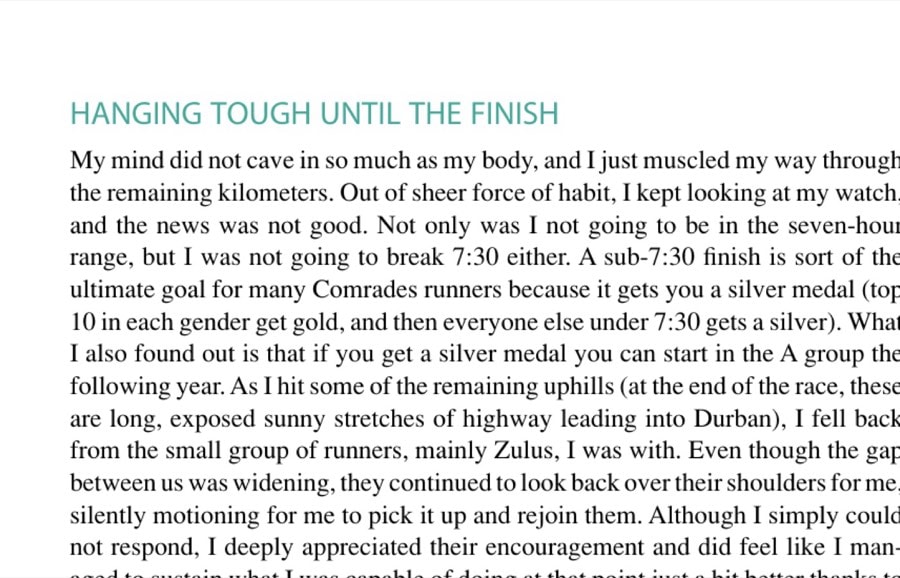
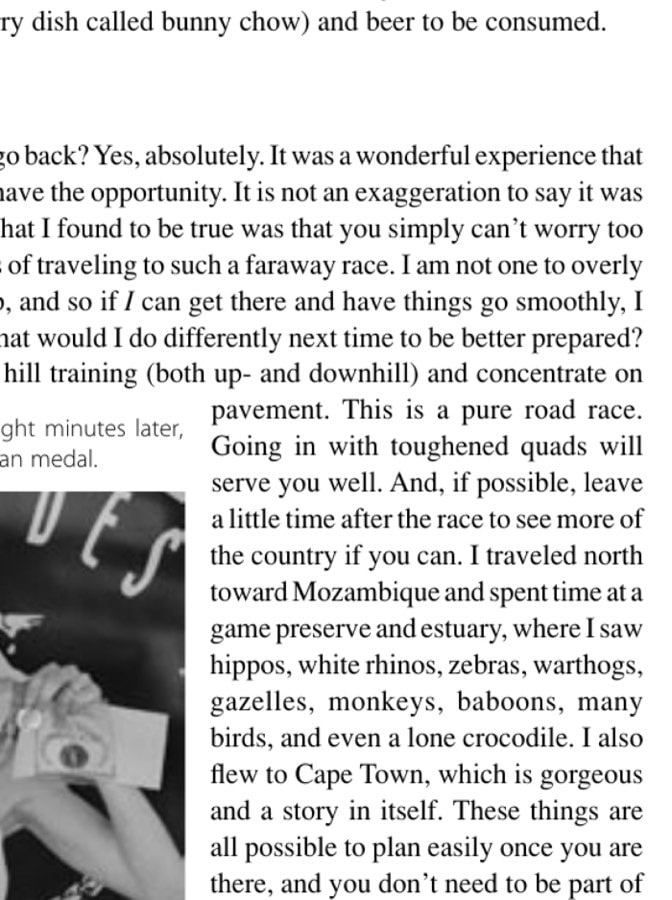
The overall winners ran phenomenal times: Tatiana Zhirkova from Russia finished in 5:58:50 (that’s a 6:29-permile pace for 55.3 miles), and the men’s race was won by South African Sipho Ngomane in 5:27:10 (5:54 per mile), just three minutes off Bruce Fordyce’s record. In the end, I finished with a 7:48 and a Bill Rowan medal, a combination silver and bronze medal that is the next category down from the silver-medal group.
▲
Don’t be fooled; the “down” run has some exceptionally tough climbs.
Comrades Marathon Association
HANGING TOUGH UNTIL THE FINISH
The home stretch of the race is called the Golden Mile, but it is more like a kilometer long. It leads into the Kingsmead Cricket Stadium, filled with cheering spectators and complete with a Jumbotron showing the finishers crossing the line.
You are handed a rose if you are a woman, and your medal is draped around your neck and you are photographed. It feels like a ceremony, which I suppose it is. After that, I collected my belongings at the tog-bag station and started the walk back to the
hotel in a contented daze, just happy to be done, to be walking instead of running, and feeling the warm South African sun on my back. For those who aren’t quite so eager to go back to their hotel to lie down, there are massages to be had, and food (
the signature Durban curry dish called bunny chow) and beer to be consumed.
IN SUMMATION Parting thoughts: would I go back? Yes, absolutely. It was a wonderful experience that is not to be missed if you have the opportunity. It is not an exaggeration to say it was a profound experience. What I found to be true was that you simply can’t worry too
much about the unknowns of traveling to such a faraway race. I am not one to overly plan the minutiae of a trip, and so if I can get there and have things go smoothly, I think most people can. What would I do differently next time to be better prepared? I would do more specific hill training (both up- and downhill) and concentrate on
pavement. This is a pure road race. Seven hours and forty-eight minutes later, Going in with toughened quads will the author with her Bill Rowan medal. serve you well. And, if possible, leave a little time after the race to see more of
the country if you can. I traveled north toward Mozambique and spent time at a game preserve and estuary, where I saw hippos, white rhinos, zebras, warthogs, gazelles, monkeys, baboons, many birds, and even a lone crocodile. I also fl
ew to Cape Town, which is gorgeous and a story in itself. These things are all possible to plan easily once you are there, and you don’t need to be part of a tour group to do them. I just brought some guidebooks with me and made
my plans after the race. Most of all, though, enjoy the country and your fellow runners from South Africa. Both are a delight and reason enough to make the trip.
Comrades Marathon Association
▲
This article originally appeared in Marathon & Beyond, Vol. 10, No. 3 (2006).
← Browse the full M&B ArchiveMore like this
1,000+ stories from 19 years of Marathon & Beyond
The complete archive of the legendary long-distance journal — digitized and free to read.
