

Confessions Of An Ultramarathon Skeptic
“You look into their eyes and see the soul separating from the body.” —Bob Lind, M.D., on when to pull a runner from the Western States 100
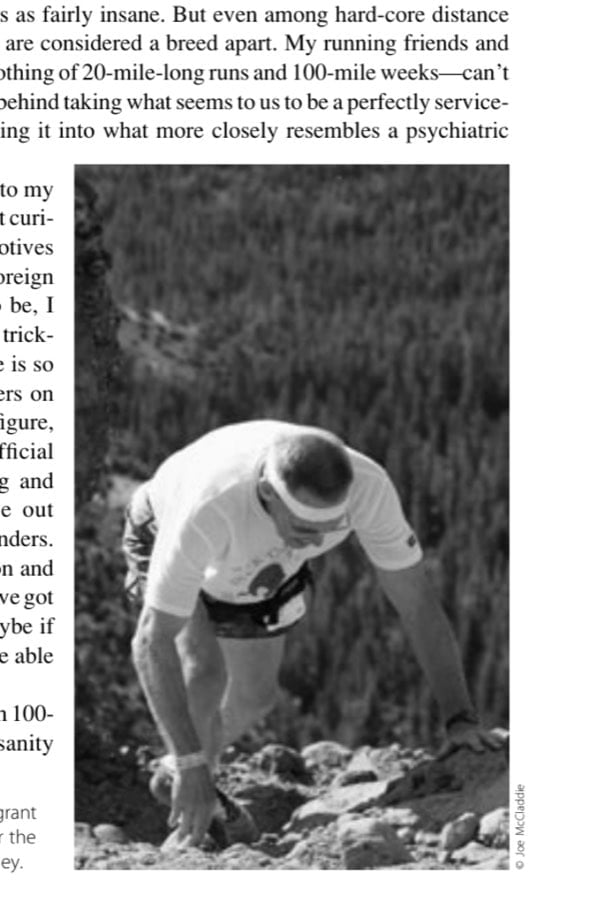
Ugh—altitude. Digging my way through the snow and scree lining the trail to Emigrant Pass, I’m only 10 minutes into the run and already feeling the effects of 6,000 feet of elevation. My initial pleasure at discovering that Squaw Valley is almost wholly without humidity—a welcome change from East Coast weather—is rapidly dissipating in the face of air that makes me feel as though I’m sucking a milkshake through a coffee stirrer. Not helping is the fact that my guide, Chuck Dumke, seems to be choosing the most difficult route up the mountain. Every 30 seconds or so, Chuck pauses to check the trail—usually just long enough for me to catch up, gasping—and sets off again, invariably straight through the nearest snowfield. “
I think this is the way . . . yeah, this looks familiar.” At first glance, the climb from Squaw Valley, the starting point of the Western States 100-Mile Endurance Run, to Emigrant Pass looked like a nice four-mile workout. As a 2:40 marathoner, I figured to set a leisurely pace up to the top in plenty of time for the ceremonial flag raising two days before the race start. Instead, over an hour after starting, I’m thrashing myself to a pulp, and the top does not appear any closer. I finally stumble in just behind Chuck—looking quite well rested, thank you—at 11:55, just in time for the noon ceremony, only to find that we’ve overshot the site and climbed an extra few hundred feet in the process. The views from 8,500 feet, however, almost make the hypoxia worthwhile.
I can’t imagine running another 95 miles after what we’ve just done, and I tell Chuck so. “Yeah,” he says, “but after this it’s all downhill.”
▲
A 2,000-foot climb to Emigrant Pass is merely an appetizer for the 100-mile Western States journey.
© Joe McCladdie
* * * It isn’t, of course; the 2,000-foot climb to Emigrant Pass is merely an appetizer for the 100-mile journey encompassing 18,000 feet of climbing and 21,000 feet of descent that comprise the world’s most prestigious ultramarathon. The following day at race check in, 400 nearly certifiable individuals will register, be weighed, have their blood pressure checked, and try to mentally prepare to tackle one of the most demanding trail races in the United States. I’m here not to run but to lend medical support, staffing the medical tents at the Michigan Bluff aid station (55 miles in) and at the finish. But I’m also here to try to understand exactly what these people are up to.
As a competitive marathoner, I am generally regarded by most of my family, friends, and coworkers as fairly insane. But even among hard-core distance runners, ultramarathoners are considered a breed apart. My running friends and I—many of whom think nothing of 20-mile-long runs and 100-mile weeks—can’t comprehend the rationale behind taking what seems to us to be a perfectly serviceable compulsion and turning it into what more closely resembles a psychiatric illness.
Personally, I’ve come to my first Western States not just curious but suspicious. The motives of these runners seem so foreign to me that there seems to be, I don’t know, some kind of trickery or subterfuge; the race is so unreasonable that it borders on the absurd. A marathon, I figure, is plenty long; it’s an official distance, one that is long and difficult enough to force out the sprinters and the pretenders. Who looks at the marathon and says, “Well, I’m not sure I’ve got the speed for that, but maybe if I keep going farther, I’ll be able to be competitive”? And it doesn’t stop with 100milers either. Further insanity
abounds at the Badwater 135, in 24 and 48-hour races, and various other events. Two of the most recognizable ultramarathoners in the world right now, Dean Karnazes and Pam Reed, have gained a measure of fame largely by attempting runs that no one else will try. Yes, it’s an impressive feat to run 301 miles or to run a marathon to the South Pole, but where does it end? Karnazes is an extraordinary runner—a winner at Badwater and a top-10 finisher at Western States on multiple occasions—but he is still less famous for his numerous competitive accomplishments than for his staged ones; his reputation is as a sort of runner’s daredevil, the ultra version of Evel Knievel.
Which brings me to my problem, my skepticism. Four hundred runners will toe the line tomorrow. Maybe 10 will contend for the win. Great athletes? Definitely. But I doubt if any of them could beat me—a decent local runner, nothing more—in a marathon, plenty long enough for a legitimate event. Do we just keep moving up in distance to be competitive, until no one else is willing to do what we are doing, and we become the world champions of the 412-mile run? Where does it end? When does it cease to be sport and become mere spectacle? * * * By noon on Friday, the line for check in is over an hour long. Without much to do, I lend a hand with registration for some of the medical studies that each year convert the race into the world’s largest exercise physiology lab. About 40 runners enroll in the immune-suppression study being coordinated by Chuck and Dr. David Niemann, both Ph.D.s in exercise physiology at Appalachian State University. The newly minted subjects line up for body fat measurements, urine samples, and blood draws. To a man, they complain about the amount of blood taken.
Outside our window, Karnazes holds court, signing copies of his book, Ultramarathon Man. A line of at least 50 forms quickly. Meanwhile, Scott Jurek, the six-time defending champ of this race and the ultramarathoner of the year for the past two years running, sits undisturbed on a bench in relative anonymity, having his blood drawn for Chuck’s study. (He, too, complains about the needle.) The clash of spectacle and sport strikes me oddly once again. Karnazes smiles and continues signing. The line outside grows.
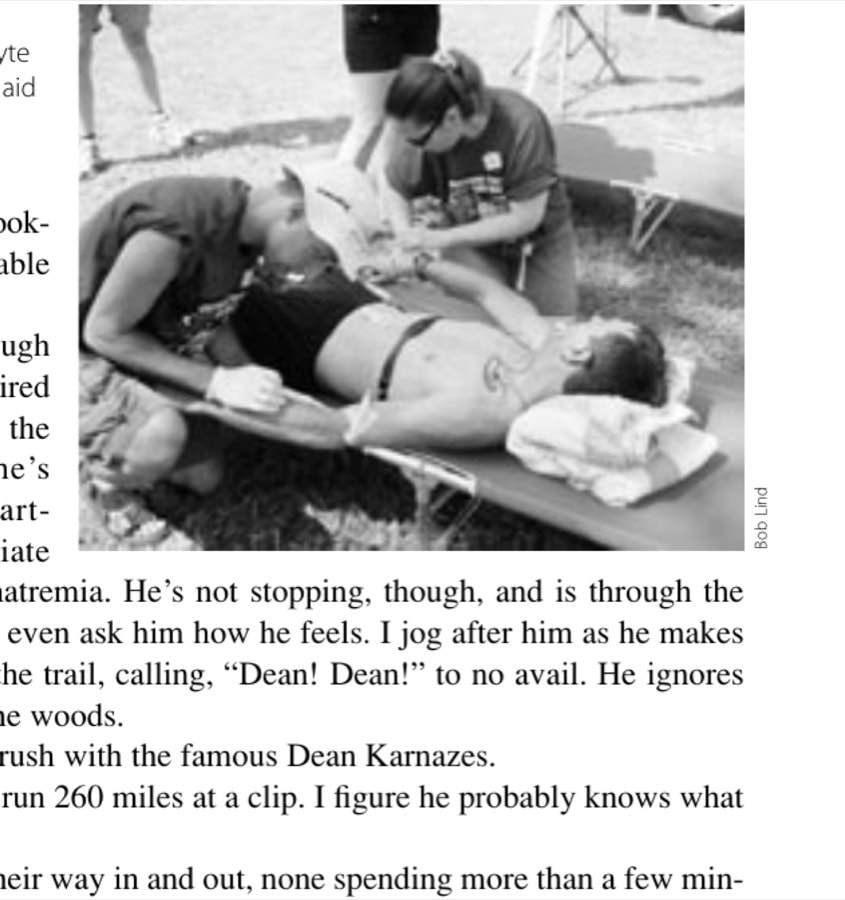
I meet up with Dr. Lisa Bliss, a rehab medicine specialist and ultramarathoner who is not only running the race this weekend but is also serving as the event’s medical director. Lisa is an accomplished ultrarunner—she finished Badwater last year—and also an expert on exercise-induced illness. In her suite, she introduces me to an i-STAT machine, a handheld blood analyzer we’ll be using at Michigan Bluff to measure electrolyte levels on runners midrace. It’s a new feature at the aid station this year, in response to a growing concern among the medical ultra community: hyponatremia.
The risks of dehydration during strenuous activity are obviously well documented—so well, in fact, that there are provisions in the Western States rules
regulating how much weight a runner is allowed to lose before being pulled from the race. More recently recognized, however, is the link between excess water intake—most runners’ primary defense against dehydration—and low sodium levels in the blood (hyponatremia), a condition that can lead to dizziness, vomiting, blurry vision, loss of coordination, and seizures. Lisa herself had a frightening bout with hyponatremia at last year’s Badwater and is particularly concerned that we don’t miss anyone who might go on to develop a problem during the race.
Armed with the two machines—each about the size of a cell phone, circa 1982—I meet up with my partner for the race, Jeff Lynn, another exercise physiologist from Slippery Rock University in Pennsylvania. We go over our plan of attack: grab people who have any concerning symptoms, including significant weight gain (a warning sign for overhydration), and run their blood through the machine, which requires only a few drops of blood and 120 seconds for a result. Of course, once we identify people whose sodium levels are low, it gets trickier. We won’t be able to start IV fluids on anyone without disqualifying them, so our options for raising their sodium levels will be limited to whatever we can get into them orally: broth, saltines, Gatorade, beef bouillon. The plan in place, Jeff and I, along with everyone else, get to bed early. The gun goes off at 5:00 A.M. * * * Mercifully, the starting line is just outside my second-floor hotel room window. I stagger downstairs groggily at 4:45, not even bothering with caffeine—the frontrunners won’t be due at Michigan Bluff for another eight hours, so I’m going back to sleep just after the start. Immediately I am jolted, not quite awake, but at least semiconscious, by the chill early-morning air. Clean and cold, about 50 degrees, no wind: perfect running weather. Of course, over the next 24-plus hours, the runners will pass through all manner of weather conditions; the temperature in the valleys routinely cracks 100 degrees. For now, though, there is hope.
The scene at the starting line is just like hundreds of other starts I’ve been to in my career. Scores of runners, in varying levels of age and fitness, mill about with a peculiar prerace mixture of excitement and apprehension. Some receive last-minute good luck wishes from the family or crew. A few dash off to empty overfull bladders. Almost inexplicably, several are jogging around, doing striders, going through the motions of a normal warm-up. The absurdity of warming up for a 100-mile race is exceeded only by the logic of it—in moments of such supreme uncertainty, the routine of a prerace warm-up is about the sanest thing I can think of. For the first time, I begin to feel a certain kinship with my competitive cousins.
At the prodding of the race director, Greg Soderland, the mass assembles beneath the start banner, tense with anticipation; Dr. Bob Lind, the longtime medical director of the race, raises the rifle, and—crack!—led by an exuberant whoop from Jurek, the pack is off and, immediately, running uphill. Jurek’s
reedlike form quickly vanishes in the darkness up the slope. My quads, remembering the agony of two days ago, give an involuntary shudder of sympathy, and I head back to my room for a few more precious hours of sleep. When I awake, the runners will have covered nearly 30 miles and will just keep on running, all day and all night. The prospect seems incomprehensible, and once again I feel the disconnect between us, the seeming nonsense of it all. Are they athletes? Stunt men? Running daredevils? Or just crazy? Unsure of how I feel and too tired to care, I crawl back underneath the covers. * * * I don’t know it yet, but the answers are coming at Michigan Bluff, the largest and most popular aid station on the course, where Jeff and I arrive at noon to spend the next 10 hours or so. We meet Norma Gordon, who along with her husband, Jerry, has run the aid station for the past 22 years. The various other medical volunteers include nurses, paramedics, an anesthesiologist, and a podiatrist. I’m told a chiropractor will be arriving shortly. We set up our gear and go over various protocols, readying ourselves for the onslaught of humanity over the next several hours. We anxiously await the arrival of the first runner. The ham radio operators, who coordinate communication between the aid stations, report that Vincent Delebarre, the European 100-mile champion, holds a slight lead over Jurek at Devil’s Thumb, six miles before Michigan Bluff. And then, at 1:51 P.M., a roar goes up from the crowd, and the first runner emerges from the woods, into the clearing.
It’s Jurek, hollering just as he was at the start, trying to outyell the spectators, who scream their support right back at him. He barrels into the weigh-in tent, whooping, clearly pumped, looking as fresh as if he had just started off on a 10K, not just past the halfway point of a 100-mile day. He takes off his hip belt and water bottle, handing it to a volunteer; steps on the scale; steps off with another yell; grabs his belt; and, still hollering at the crowd, is off again. Within 90 seconds of appearing out of the woods, he is gone. My entire body tingles with excitement; I can barely catch my breath, and I realize that I’ve been screaming since Jurek entered the aid station. With some effort, I calm myself, my head still spinning at witnessing such a powerful display of sheer physical excellence.
OK, then. Athletes. * * * Ten minutes later, Delebarre staggers gamely into the aid station, and with one quick glance at him it’s obvious that Jurek’s seventh title is all but assured. Where Jurek’s gait suggested a racer at the height of his powers, Delebarre’s is the painful motion of a man interested only in survival. And farther back, no one gives any indication of being able to close the substantial gap to the leader. Pacheco, Twietmeyer, Medina, all the contenders for the overall title, all come through, all looking, at best, OK. The only athlete whose energy level appears comparable to Jurek’s
is Andy Jones-Wilkins, looking strong and comfortable in about sixth place. Karnazes comes through near the top 10, looking tired but strong. He steps on the scale and—oh no!—he’s 7 pounds over his starting weight, an immediate warning sign for hyponatremia. He’s not stopping, though, and is through the checkpoint before I can even ask him how he feels. I jog after him as he makes his way back out onto the trail, calling, “Dean! Dean!” to no avail. He ignores me and heads off into the woods.
And thus ends my brush with the famous Dean Karnazes. Oh, well. The guy’s run 260 miles at a clip. I figure he probably knows what he’s doing. As the elites make their way in and out, none spending more than a few minutes at the checkpoint, we start getting our first customers in the medical tent. At first, it’s mostly those looking for blister and foot care, but soon enough more serious problems arrive. Around 3:30, one of the nurses summons me toward a female racer who is nearly in tears, being supported by her crew. I recognize her; it’s Luanne Park, second overall last year. She shoots me a pained glance as I approach. “
Are you a chiropractor?” she asks, pleading, almost hysterical. “No, I’m an ER doctor,” I say, smiling. “Can I help?” I can’t; the fact that I’m not a chiropractor leaves her almost sobbing. “They told me there would be a chiropractor here,” she chokes. “It’s my back; I feel like I can’t breathe.”
I recognize the despair and emotional liability as the product of complete physical exhaustion. I try to calm her with reassurance; making herself hysterical is only going to worsen the situation, and she’s nearly hyperventilating as it is. She’s doing fine, I tell her; I assure her that her lungs are clear and her air exchange is good; the chiropractor should be here soon; she’s still on pace to finish in under 24 hours. “
Twenty-four hours?” she nearly screams. “That’s terrible!” “Really?” I say. “I think that’s pretty good.”
Bob Lind
▲
The author draws blood to check a runner’s electrolyte levels at the Michigan Bluff aid station.
▲
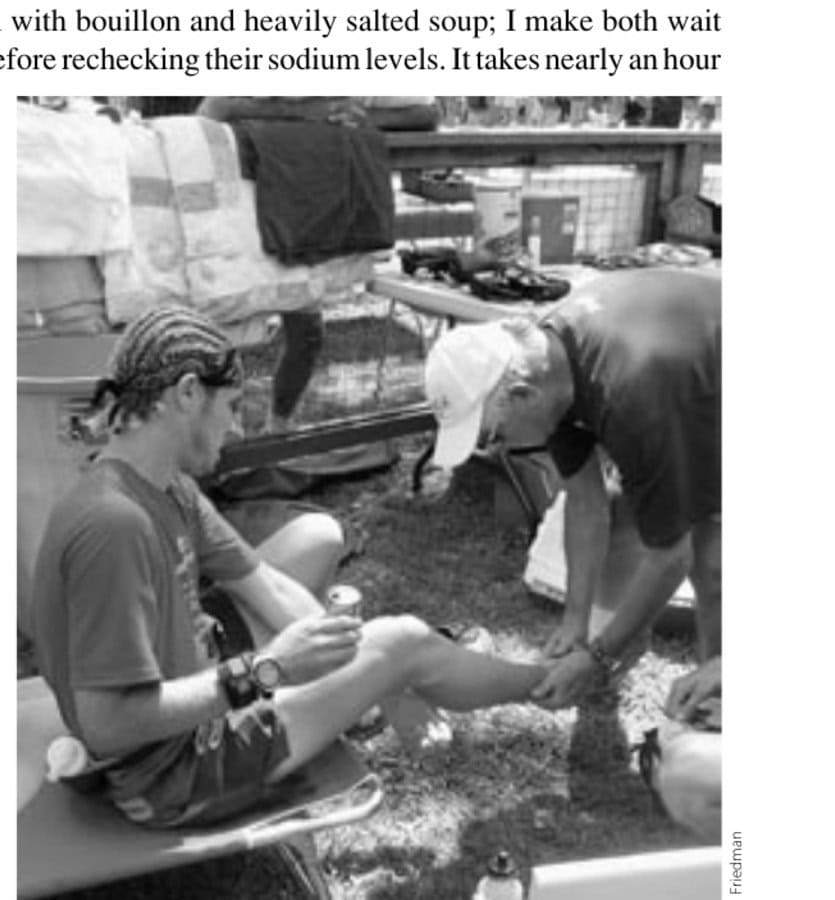
Treating blisters, the bane of the ultramarathoner’s existence.
Jason Friedman
This is clearly the wrong thing to say; she shoots me a look that could melt a glacier, and I retreat to another stretcher to measure electrolyte levels. Twenty minutes later, Luanne hobbles out of the aid station, back onto the trail, looking determined. I follow her, offering encouragement and some advice, and she smiles calmly. Somehow we’re friends now. Not only that, but the hysterical mess of half an hour ago is gone; in its place is a 100-pound mass of steely resolve. Clearly, she is not just aiming at survival—she’s ready to race again; her inner athlete has awakened. I’m impressed and tell her so. She smiles again and even laughs a little; she is still self-deprecating but now almost optimistic. I watch her go and hope she makes it to the next aid station.
Within an hour the chiropractor shows up. Sorry, Luanne. * * * The afternoon passes in a blur of wasted bodies. I tape feet and ankles, measure electrolyte levels, disinfect blisters. Two women come into the aid station within minutes of each other, each having gained nearly 10 pounds, an ominous sign. One is dizzy; the other is nauseous. Jeff and I check their blood work. Both have sodium levels below 126; normal is at least 135. Neither has urinated for several hours. We begin loading them with bouillon and heavily salted soup; I make both wait until they’ve urinated before rechecking their sodium levels. It takes nearly an hour before both are feeling better and have levels up to 128, at which point both are itching to get back to the race. With a bit of trepidation, I let them leave.
It is around this time that I realize my list of people to check on at the finish—those who have left the aid station, in some cases, against my better judgment—is growing distressingly long. I’ve already released
a half-dozen people back into the woods who, had they been patients in my ER, would have received intravenous fluids and possibly been admitted to the hospital. I shudder to think what my malpractice insurer would say.
A young man waits for me on a stretcher. He looks OK, just tired, but tells me he has been having abdominal pain since he fell on the trail about six hours ago. I palpate his abdomen; he’s tender on the right side. My mind instinctively jumps to the worst-case scenario: liver laceration, internal bleeding. He needs an ambulance, a CAT scan, a surgical evaluation, IV lines, a blood transfusion.
Calm down, I tell myself, be logical. The injury is six hours old; any internal bleeding should have manifested itself by now. His heart rate and blood pressure are normal. I grab the i-STAT machine; in addition to electrolytes, it can measure the hematocrit, or percentage of red cells in the blood. His reading comes back at 44 percent, normal. I exhale.
Forty minutes later he is back on the trail. Another name for my mental finish line checklist. I cringe. Just before I leave the aid station at 9:00 P.M., an older man comes in. He is soaking wet and shivering, his skin is clammy, and he appears very weak. I figure he is hypothermic and immediately change him into dry clothes and wrap him with blankets. At his request, I help him change into a fresh pair of shoes he has packed into his drop bag, though I can’t see him running another step. Quietly, I try to persuade him to drop out; while I can’t force him to stop at this point, I’m hoping he will. But he is undeterred. Packing my trunk for the drive to the finish line, nearly an hour later, I watch him stagger out of the checkpoint into the blackness. I don’t need his name for my checklist. I know he’s not going to make it. * * * The searchlights at Auburn’s Placer High School stadium light up the night; from 20 miles away I can see them blazing my trail. Having lost my sense of direction—and
ad
▲
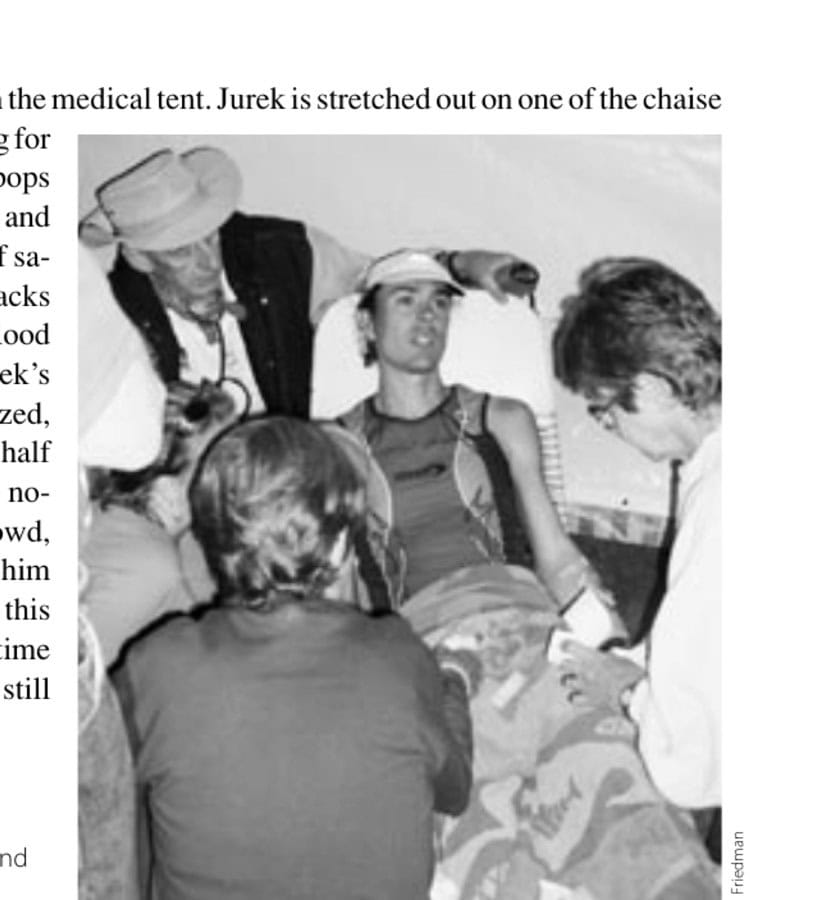
Medical director Bob Lind tends to Scott Jurek at the finish.
Jason Friedman
my map—I drive blindly, ignoring the road, gazing up into the pitch-black sky at my own personal homing beacon, drawing me toward the finish line. And I’m only driving. Think of how the runners must feel.
I arrive at the stadium barely in time to see Jurek’s amazing seventh consecutive victory lap. For the entire 300-meter circuit, he looks exactly as he did at Michigan Bluff, exactly as he did at the start—whooping, hollering, nearly jumping up and down in joyous relief, basking in the ovation of the crowd and sending it right back to them, feeding off it, an athlete truly overjoyed with his particular lot in life—to slog for 16 hours at a time over mountains, across streams, enduring unimaginable pain and fatigue, to lay claim to a title that few in the world would even want—that of the world’s best ultramarathoner. For those 300 meters, all the pain and fatigue are forgotten; for 300 meters, Jurek is simply a supremely trained, supremely talented athlete, performing his task with an excellence never before seen in his sport. Ten meters from the finish, he stops, lies flat on the track, and then rolls, childlike, over the finish line—seven revolutions, one for each of his record-setting victories. Then he pops to his feet, an enormous smile on his face, arms thrust skyward, pure ecstasy.
And then, collapse. Minutes later, I’m in the medical tent. Jurek is stretched out on one of the chaise longues that we are using for stretchers, as Dr. Lind pops an IV into his left arm and quickly runs in a liter of saline. A phlebotomist attacks his right arm, drawing blood for Chuck’s study. Jurek’s eyes are glassy and glazed, but he wears a satisfied half smile. He seems not to notice the needles, the crowd, Dr. Niemann pestering him for a urine sample. At this moment, for the first time in nearly 20 hours, he is still and serene.
* * * Soon afterward the bodies come, hard and fast. At Michigan Bluff, I was struck mostly by the athletes’ determination and resolve. At the finish, there is only one impression—devastation. The medical tent resembles a MASH unit, bodies and IV bags and blankets and chaise longues everywhere.
It’s chilly, even for Northern California at 1:00 A.M., and it’s quickly apparent that our major problem is hypothermia. The medical tent provides no warmth, and our blanket supply is quickly exhausted, but patients continue to stagger in. Somehow we discover the only warm spot in the stadium—the massage tent, which has about 18 tables and is, for some inexplicable reason, heated. Quickly, the nurses and I relocate all of our most dire cases to the massage tent, until the massage therapists get fed up and basically throw us out. I am deemed in charge and handle the situation extremely poorly.
I now quickly run into two more problems. First, the i-STAT machines, which Jeff and I brought with us from Michigan Bluff, are cold sensitive. Faced with a much more compliant (and casualty-prone) population than at Michigan Bluff, our machines are now only 30 percent reliable. Even my own personal ICU—the massage tent—won’t keep them warm enough, and I’m persona non grata there anyway. Ultimately I take to shuttling the blood samples to my car and running the tests with the heaters going full blast, keeping the machines warm.
Not only the machines are cold, though. Everything is cold. Our best method of rewarming cold and dehydrated runners—hot, salty soup—is quickly rendered useless, for by the time we can get the soup from the food tent to the medical tent, it’s lukewarm. Even at its hottest, we can’t dissolve any bouillon to help raise sodium levels; the best I can do is mix up an unpalatable, granular, chewy slurry. Instead I simply spoon the bouillon into an empty cup and have the runners swallow it dry. War-zone gourmet. * * *
ad
The night passes—3:00 A.M., 4:00 A.M., 5:00 A.M. Casualties continue to stumble in. In the context of a race, it is a scene with which I am not familiar. In all the races I’ve ever run, the vast majority of finishers appear none the worse for the wear; their personal struggle has been more mental than physical. And while I know that is true in this case as well—that the mental challenges of an ultra far outweigh the physical—the medical tent throws each runner’s personal struggle into stark relief. At the end of a normal race, most of us must trust ourselves to give an honest accounting of our efforts; there is often little objective evidence that we have run to our limits. The crucible of this race, though, leaves no doubt. I am envious of these athletes; the magnitude of effort is so readily apparent, so beyond question, that I cannot help but be jealous.
My two hyponatremic runners from Michigan Bluff finish well. Others that I treated at the aid station finish, not as well. Luanne comes in around 3:00 A.M., trucking gamely around the track, disappointed but still in line for a top-10 finish. I run part of the final lap with her. “
Dr. Friedman!” she yells. “I made it!” “Luanne, I’ve got you a chiropractor!” I say, smiling. More and more runners come through. Lisa Bliss finishes in a PR, 25 hours and change, looking incredibly fresh. I treat Carol O’Hear at the finish line for her severely sprained ankles, both of which I wrapped at Michigan Bluff. After her third-place finish last year, she is disappointed but relieved to be safely in. Her ankles are the size of grapefruits; they have looked that way, she tells me, since the 10th mile. I am both appalled and amazed, and once again envious.
Is it insane? Of course it is. I need look no farther than the devastation strewn about the medical tent to conclude as much. But to dismiss it completely as spectacle would miss the point—that there is a sport, a sheer excellence within it as well. These runners are daredevils and stunt men and athletes. They may attempt feats that I do not understand. But they share the same motivation that I do: to each find our limit and to translate the task into pure physical form. Inside the medical tent, the sport of it is revealed.
I look at the stadium—the runners, the volunteers, the medical tent, the lab draws—and I marvel. I marvel at the athletes and the daredevils, at the determination and the devastation, at the sport and the spectacle. I marvel at it all, at the pure dichotomy. After 30 hours, I stand in the center of the stadium under the blazing hot sun, and I am converted.
When I return home to New York, I’m online almost immediately. I don’t know about a 100-miler—but if I can find one that fits my schedule, a 50K doesn’t sound like such a bad idea.
This article originally appeared in Marathon & Beyond, Vol. 12, No. 2 (2008).
← Browse the full M&B ArchiveMore like this
1,000+ stories from 19 years of Marathon & Beyond
The complete archive of the legendary long-distance journal — digitized and free to read.
