

Connie Gardner
Connie was going for it. She had been on pace (about 10 minutes per mile) for nearly the entire event, the 2007 Ultracentric 24-Hour U.S. championship in Grapevine, Texas. The conditions were certainly not conducive to a record; the daytime temperatures had been in the 80s, and there was considerable humidity. Yet she definitely had a shot at the American women’s 24-hour record of 145.28 miles set 14 years earlier by Sue Ellen Trapp.
For the final two frenetic hours, time seemed to stand still as she ground out mile after mile at the required pace. For the final 45 minutes, runners were moved off the two-mile course and onto a quarter-mile course so that their distance could be monitored more closely. Then Connie heard the words she was so desperate for: “You’ve made it—you have the record!” “
I was completely exhausted and almost completely out of time. I immediately stopped and collapsed,” she said. There had been only minutes to spare. But that’s not the end of the story. Gardner was happy to have not only the record but also the $4,000 bonus check on top of the $4,000 she would get for the win. But here is the rest of the story. Race officials remeasured the course and determined that it was shorter than they had originally thought. Now Connie was informed that she had run 145.26 miles—about 40 meters short of the record. She wasn’t pleased.
The Ultracentric race capped off an excellent 2007 year for Gardner. In the months leading up to the event, she had won the Mohican 100-mile trail run, the Buckeye Trail 50K, and the Javelina Jundred 100-mile run. She also won her age group at the Akron Marathon as well as several other events.
The year in the life of Connie Gardner referred to in the title is 2008, but we just had to include at least this run that happened to be at the end of 2007. The year 2008 was also an extraordinary one of marathon and ultramarathon running—ordinary by Connie’s standards, that is, but extraordinary by almost any other human standards.
The most fascinating aspect of Gardner’s life and times has been her struggle. After a decade at or near the top of the ultrarunning world, she is still as competi-
tive as ever. And yet, making ends meet continues to be a major effort. Regardless, it’s a safe bet that she would be doing this even if it weren’t for the money. But the money helps. For over 35 years, top runners at shorter distances, up to and including the marathon, have been able to make a living through their sport. With perhaps only one or two notable exceptions, this has not been the case with ultrarunning. No, Connie isn’t poor, but she is also not able to rest on her laurels.
In more than a decade of competitive running, Connie Gardner has had many running experiences, including great, good, and a few not-so-wonderful ones. During this illustrious career, Connie has been •
national 100-mile trail champion • national 100-mile road champion • national 100K champion • national 24-hour champion • USATF Ultrarunner of the year • a member of multiple USA national ultra teams
Dan Horvath Photo
• a winner of many other ultraraces
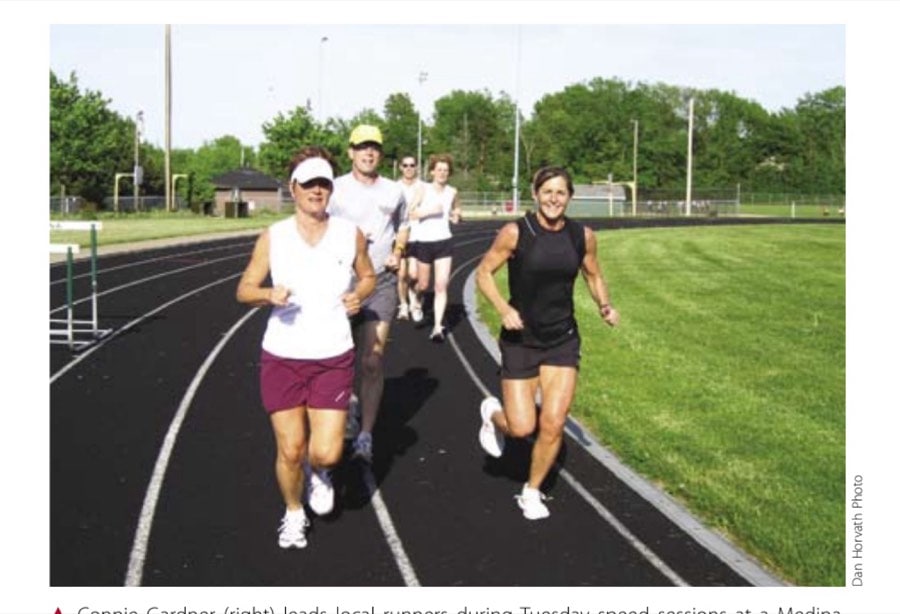
▲ Connie Gardner (right) leads local runners during Tuesday speed sessions at a Medina, Ohio school track.
Some early 2008 marathons On January 5, 2008, Gardner ran the competitive and hilly Mississippi Blues Marathon. With a time of 3:15, she placed sixth among women and was the first master. A month later, she traveled to Jacksonville Beach, Florida, to run the 26.2 With Donna: The National Marathon to Fight Breast Cancer Marathon. This time she ran a minute faster at 3:14 but was only the second master. Bummer.
Only a couple of weeks later, on March 1, Gardner ran the Snickers Marathon Energy Bar Marathon in Albany, Georgia. With an excellent time of 3:05, she won the masters division. That same month, Gardner drove to southwestern Ohio to run the small but well-regarded Ohio River Road Runners Club Marathon. Although the weather was nice, Gardner ran a bit slower than she had for her previous efforts. In spite of this, she won the overall female division in 3:17.
There would be one more spring marathon for our prolific subject: the Rite Aid Cleveland Marathon on May 18. This, along with Akron, is Gardner’s hometown race, and she ran well: 3:09 to finish as the second female and first female master.
Run for the money “Taxes were coming due, and I needed some money.” On April 12, 2008, Gardner competed in the Mad City 100K. She needed to place well in order to garner that prize money, and she did; she finished second in a time of 8:52:07. “So I did manage to get those taxes paid for the year,” said Connie. Whew.
Yes, Gardner will run for money. She will do this even in cases where she knows she won’t be at her best. This is often the case for road races, including marathons. Although definitely more oriented toward trails rather than roads and to ultra distances rather than marathons, Gardner often finds herself competing for marathon prize money. This is not to say that she doesn’t love to run in general. If necessary, she would do it for free. But it’s interesting how much a person will go through to make a living, not to mention running for road prize money to support a trail-ultra habit.
Like many of us, Gardner juggles her running life with her personal one. Hers may be a bit more hectic than some of ours, however. Most days are spent working in a running specialty store in the morning and early afternoon, followed by her work as a cross-country and track coach at a nearby high school. The cross-country and track coaching doesn’t end there, as she also coaches some individual runners from various high schools. Gardner also works part time at a community swimming pool. Somewhere in there, she finds time to run. This time to run may occur once, twice, or three times per day for up to 100 miles per week.
But please excuse Connie if she happens to be late for a run or for work; there’s just a lot going on. Oh, yes, one other thing: as a single parent, she raises her two teenage daughters, Abby and Gwen. Gwen has special needs, and this requires additional time from Connie. Gardner admits to being a fish out of water in at least one area of motherhood: shopping with Abby for a homecoming dance dress. “Had this been shopping for swimming or running equipment or simply going out for a run or swim with my daughter, everything would have been just fine.” In this instance, she did her best but was clearly out of her element. “I managed,” she said, “but that was enough of that.”
Gardner is stunned when she reads a paper that Abby wrote for a high school assignment. It extols her mother’s success and dedication to her sport. This extends back to Connie’s high school years where, unable to compete in any available sports, she worked to create a new cross-country team. Although she was one of the slowest on the team, she simply worked hard and kept running, and this work ethic, of course, led to her eventual success at longer distances. “Connie John Gardner has proved to me that hard work is bound to pay off,” Abby noted in the paper. Connie’s role as a mother of her two girls is the aspect her daughter admires most. “Connie John Gardner is the strongest person I’ve ever met, and I can only hope to be as good of a person as she has become.” Connie hadn’t thought that her accomplishments ever appeared on her kids’ radar screens and was flattered to be considered a role model. “I was flabbergasted when I read it,” she says.
The state of northeast Ohio ultrarunning On June 21, 2008, Gardner returned to Mohican to run the 100-mile race that had kicked off her extraordinary ultra career. It’s a tough one, but she finished in
Dan Horvath Photo
▲
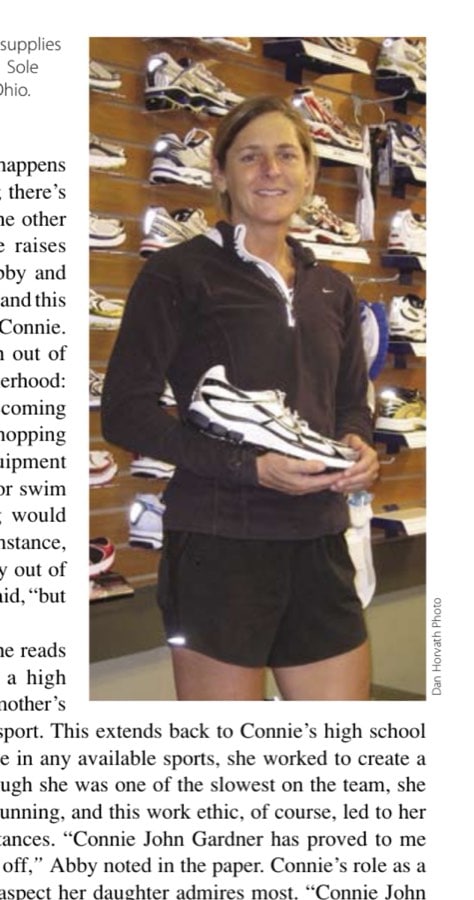
Gardner sells running shoes and supplies and also gives advice at the Second Sole running specialty store in Medina, Ohio.
19:22—14 minutes better than the first time, and like the first time, she was the first female finisher. After dabbling in some road races, including a few marathons, Connie Gardner had begun her ultra career in earnest with the Mohican Trail 100-mile run in 2001. She won the race with a time of 19:36. She was a bit disappointed that two men finished ahead of her. “I wanted to be the first overall. I wasn’t satisfied to be only the first female,” she says. Over the next few years, she continued road racing but also continued her success at trail ultras. She recorded wins at the U.S. 100mile road championship at Olander Park, the JFK 50-Mile (twice), the Umstead 100-Mile Endurance Run, the Groundhog Fall 50K, the Buckeye Trail 50K, the Toronto 100K, and the Sunmart Texas Trail Endurance Run 50-mile (twice).
Northeast Ohio is blessed with more than its share of excellent trail and ultrarunners. Mark Godale, Steve Godale, Kam Lee, Bob Pokorny, and Tim Clement, among others, have all won major events. Mark owns the American male 24-hour record. On Saturday mornings and Wednesday evenings, Gardner often runs with these folks on the trails in Cuyahoga Valley National Park. She also often leads Tuesday evening speed work, featuring a variety of runners at a local middle school. Unfortunately, Connie’s most consistent training partner, Kim Martin, has recently relocated to Minnesota. At Second Sole, a running specialty store in Medina, Ohio, Connie is extremely well regarded as the running authority of the area. She will gladly give valuable advice of all kinds to high school track and cross-country kids, novice adult runners, walkers, and experienced marathoners as well as fellow ultrarunners. She is just as comfortable discussing the experiences of others as she is her own. In the process, she will also sell a pair of shoes or two.
Burning River and other racing At the 2008 Burning River 100-mile race, Gardner was going for it once again. This time there was no American record or prize money; just (she hoped) the satisfaction of winning this grueling race outright. She had started conservatively and gradually moved up until, late in the race, she found herself in second place. Only one runner, Tim Clement, was between her and the goal of winning outright. Tim was now between 20 and 40 minutes ahead, but Connie was running well and thought she would have a shot. This was the point where, on the darkening trails, she saw some markers indicating that the race was to proceed in the opposite direction. Connie realized that something had gone wrong. Miles earlier she had emerged from one trail to another and was a bit confused about which way to go—left or right. She had picked the direction that she thought was right but now found herself going the wrong way around the almost circular route. She could have simply completed this portion and moved on, perhaps not losing any time
or ground. And late in the race, this surely was tempting. But Gardner knew the right thing to do: return to the point where she had gone off course and continue from there. By doing the right thing, Gardner still won the women’s division but was second to Clement in the overall finish. Most runners would be thrilled to be the first of their sex and not even have given the overall placement a second thought. And most runners in Connie’s situation might not have done the right thing to complete the course. For another runner’s view of the previous year’s Burning River Race, see “My Most Unforgettable Ultramarathon (And What I Learned From It)” by Wyatt Hornsby, Marathon & Beyond, July/August 2008.
On September 27, 2008, Gardner won the female masters division of the Akron Marathon. Her time was 3:13. Immediately after accepting her award, which included some cash, she went to her team’s cross-country meet, managing to catch the tail end of it. That evening it was into the car and off to Moline, Illinois. That’s a seven-hour drive. Sunday morning she was to run the Quad Cities Marathon and once again compete for masters prize money. She won the category at this race too, in 3:19. “I thought these back-to-back marathons would be good training for the upcoming ultra world championships,” she said.
A few shorter races also popped up on the calendar throughout the year. Most notable was the Youngstown Peace Race 10K on October 12. Gardner was the second master with a time of 39:58. “I had never broken 40 minutes for a 10K before,” she said.
World championships Gardner had been on U.S. national teams in the past and was chosen to be a member of the national 24-hour and 100K teams in 2008. She had high hopes of placing well at the world championship 24-hour run in Seoul, Korea, on October 20, 2008. Despite the extreme heat, humidity, and air pollution; despite the crowded, difficult, C-shaped course; and despite the mostly concrete surface, she was doing quite well for the first 12 of the 24 hours. It was the blister that got her. Blisters befall many an ultra effort, but Gardner generally doesn’t fall prey to them. This
time, however, at 14 hours and 88 miles, she stopped for medical attention with the intention of having the blister lanced and returning to the competition. Her second toe had swollen to well over twice its normal size, but the lancing didn’t hurt too much. It was when the medical person pressed down on her toenail that she felt such intense pain that she immediately vomited. This race was over for her. “If it had only been the concrete surface, the pollution, the heat, or even the blister, I could have made it,” she said. “But all these things together conspired against me. It was just too much.”
After this team race came another: the Ultramaratona degli Etruschi/International Athletics Union (IAU) 100K World Cup in Tarquinia, Italy, on November 8, 2008. Here Gardner gained some measure of redemption after the 24-hour race in Korea. “The team’s plan was for some of the runners to ‘go for it’ and for me to run a steady pace,” said Gardner. Running that steady pace as planned, she finished in 29th place among all women and was the fourth American. The USA women did great to finish second overall.
JFK
Courtesy of Connie Gardner
To finish off the year, Gardner traveled to Maryland to run the JFK 50 Mile on November 22. JFK is one of the country’s oldest, largest, and most prestigious
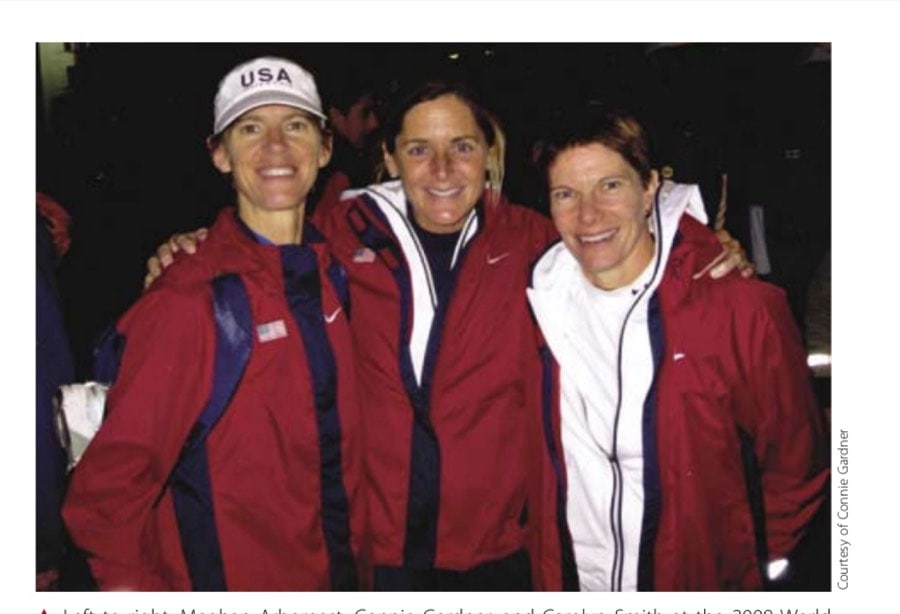
▲ Left to right: Meghan Arborgast, Connie Gardner, and Carolyn Smith at the 2008 World 100K Championship.
© Ric Dugan, The Herald-Mail
ultras. It was a last-minute decision, and the race had been filled to capacity much earlier. But past winners are allowed to register at any time, and Connie had won the race twice, in 2002 and 2004. She had also finished second and third on other occasions.
In 2008, having just turned 45, Gardner took the lead early during the hilly and technical Appalachian Trail portion of the race. “This was my plan; there were some fast runners behind, including a 2:40 marathoner,” she said. “I thought I’d better run fast while I have the advantage on the trail.” By the time she hit the towpath (mile 16 or so), she had a 20-minute lead. She ran a steady pace despite the wind, cold, and mud. Losing only a few minutes, she held that lead for the entire 26-mile towpath section and also on the final road section. She won with a time of 7:15, only four minutes slower than her previous fastest time there. What a great way to polish off the year!
So what makes Connie tick? She definitely is blessed with slow-twitch muscle fibers, but she also definitely works at it. The hard work is the thing. Other than that, to answer the question more directly, it sure beats the heck out of us.
Yes, 2008 was quite a year for Connie Gardner. And it will only serve as prologue for 2009. Sound familiar?
▲
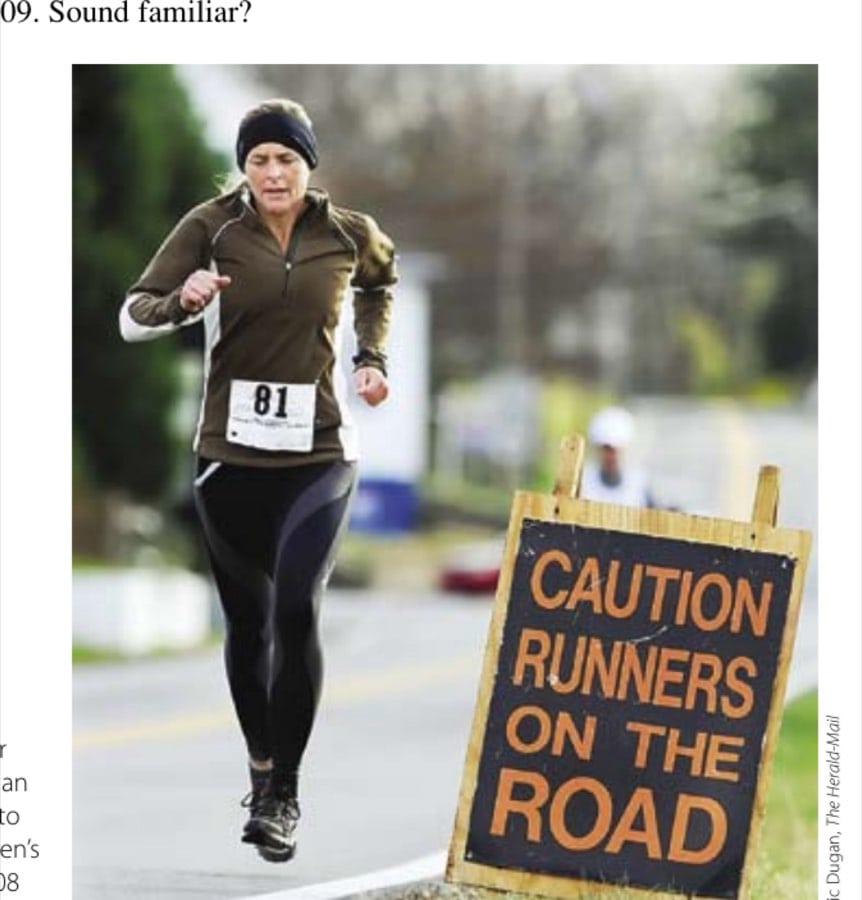
Connie Gardner runs along Spielman Road on her way to winning the women’s division of the 2008 JFK 50 Mile.
A Few of Connie Gardner’s Major Ultrarunning Awards and Accomplishments • Mohican Trail 100-mile: female champion 2001, 2007, 2008 • Kentucky 50-mile: female champion 2001 • Buckeye Trail 50K: female champion 2001, 2002, 2003, 2007; course record 2006 •
JFK 50 Mile: female champion 2002, 2004, 2008 • Sunmart Texas Trail 50-Mile: female champion 2002, 2004 • Western States 100-mile: top 10 finisher 2002, 2003, 2004 • Umstead 100-mile trail: female champion 2002, 2006; female cham
pion and course record 2005 • Umstead 50-mile trail: female champion 2003 • 100K USATF national champion 2003 • 100-mile USATF national champion 2003, 2004 • USATF national team member: World Cup 2003, 2006, 2008 •
Named USA Track and Field Ultrarunner of the Year 2003 • Named in most interesting people, Cleveland Magazine, 2003 • Chicago Lakefront 52-mile: female champion 2004 • Groundhog Fall 50K: female champion 2005; female champion and course record 2006 •
Rocky Raccoon 100-Mile Trail Championship: female champion 2006 • Toronto 100K/Canadian National Championship: female champion and course record 2006 • Laurel Highlands 70-mile: female champion 2006 •
Hocking Hills 60K: female champion and course record 2006 • Ultracentric 24-Hour national championship: third female 2006; female champion 2007 • 100K World Championship: participant 2003, 8:15 PR; 2007, 2008 •
Javelina Jundred 100-mile: female champion 2007 • Mad City 100K national championship: second female 2008 • Burning River 100-mile: female champion 2008
This article originally appeared in Marathon & Beyond, Vol. 13, No. 6 (2009).
← Browse the full M&B ArchiveMore like this
1,000+ stories from 19 years of Marathon & Beyond
The complete archive of the legendary long-distance journal — digitized and free to read.
