

Coping With the Inevitable
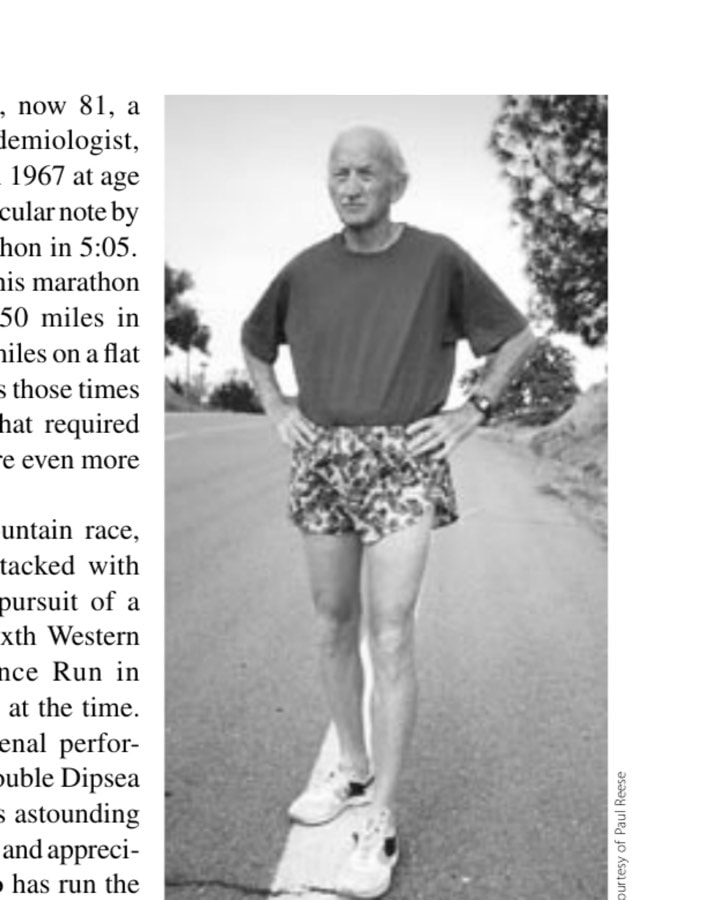
alph Paffenbarger Jr., now 81, a world-renowned epidemiologist, began his running career in 1967 at age 45 on a not altogether spectacular note by finishing the Boston Marathon in 5:05. By age 49, he lowered his marathon time to 2:44:39 and ran 50 miles in 6:13:08. At 50, he ran 100 miles on a flat course in 16:42:58. Good as those times were, his times in races that required stamina and endurance were even more sensational.
Turned loose on a mountain race, this genteel gentleman attacked with the ferocity of a lion in pursuit of a gazelle. He finished his sixth Western States 100-Mile Endurance Run in 22:03:58, a 60-plus record at the time. One of his most phenomenal performances was running the Double Dipsea in 1:54:51 at age 49. Paff’s astounding time here can be understood and appreciated only by someone who has run the Dipsea. Many world-class runners would
Paul Reese has been a legend in California fail trying to better that time. running circles. Until age 68, Paff savored the running life, racing two or three times monthly at places as far away as South Africa (Comrades Marathon, Two Oceans Marathon) and London (London Marathon, London-to-Brighton ultra). Then, in 1990, he met his running Waterloo in the form
Courtesy of Paul Reese
Rof a heart attack; this was silent (nonsymptomatic) in nature and discovered only by a routine physical exam. The result of this was that after three years of struggling with the condition, he was fitted with both a pacemaker and a defibrillator. His racing, even his running, came to an abrupt end, and his walking is limited.
COPING MECHANISMS
Courtesy of Paul Reese
Talking with Paff about his transition from outstanding athlete to being semisedentary, I asked how he copes with not being able to run or race. What does he miss most about not being on the running and racing circuit? What does he do
to compensate? What advice does he have for runners who, for whatever reason, are abruptly removed from running and racing? This is what he has to say. But before getting to his answers, here’s a question
for you: does this situation apply to you? You had better believe that the day may come when it will. Before he was derailed by a heart attack, on any strenuous mountain race, especially one with rough footing, Paff could outrun most of the
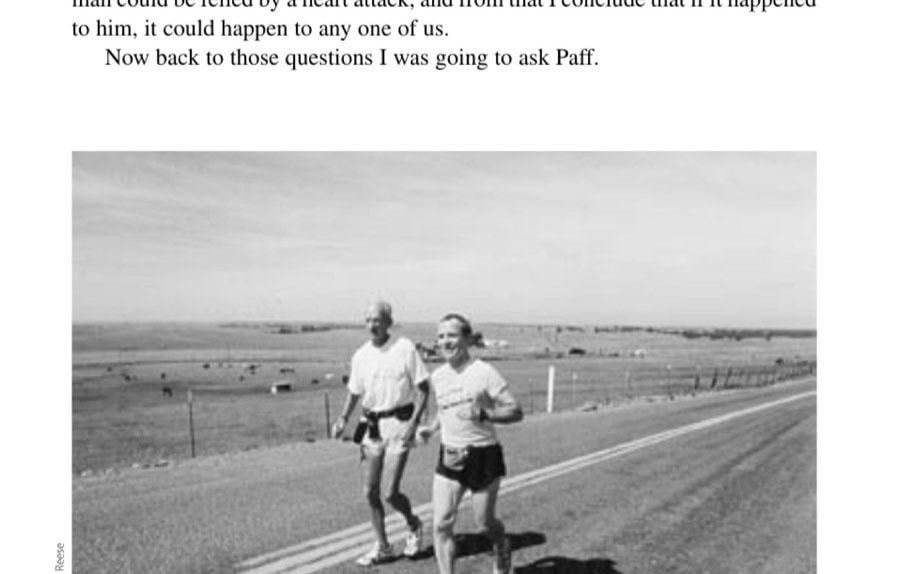
readers of this magazine. Until it happened, it was unbelievable to me that this man could be felled by a heart attack, and from that I conclude that if it happened to him, it could happen to any one of us. Now back to those questions I was going to ask Paff.
Paul and Paff logged thousands of miles together.
1. What, precisely, derailed you from running and racing? Tell me about the time when you first became aware that you had a severe heart problem. I went for a casual walk in December 1993, only one week after walking the Honolulu Marathon, and I suddenly and unexpectedly became lightheaded. I sat down to rest and gather myself. After 10 minutes or so, I got up and started to make my way home only two blocks away. Every 10 yards I had to rest. After I got home, Jo Ann, my wife, drove me to the hospital, where the process of getting my ventricular tachycardia back to normal started. Two hours later, my heartbeat was still 220 per minute. But a half hour after that, it was back to a normal 72. Some days later my regular cardiologist gave me an exercise-tolerance test, and I reached 13 on the Borg Scale. [The Borg Scale rates an athlete’s perceived level of exertion during exercise on a 0–10 scale, “0” being “nothing at all,” “10” being “very,very strong.”] Then I stepped off the treadmill, took two steps, and went into cardiac arrest. I had to be resuscitated. I revived, but shortly afterward my heart stopped again. And again I was paddled back to life. The next move was surgery. Thereafter, things didn’t go too well. The complications from surgery were being back on a ventilator, convulsions, pulmonary emboli, and bronchial pneumonia. All told, I was in the hospital five weeks. Six months went by before I was able to do daily walks of three miles. 2. These days, what do you do for exercise? Well, primarily, I try to walk as much as I can. On rare occasions, I use a stationary bicycle, a LifeCycle. Sometimes I do some stair climbing, very slowly and only for a short distance. And that’s pretty much it—no ball playing, no swimming, no disco dancing, and certainly no bungee jumping!
COMPENSATIONS 3. What do you do to compensate for not running, not racing? In a way, I’ve covered that; but to reflect on it a bit further, now that I am not running and racing, I devote more time to talking and interacting with my colleagues, discussing problems, and trying to arrive at decisions. I’d say that staying highly involved in research and interacting with my colleagues in the process is the main way I compensate. Fortunately, in these times, with e-mail and fax, communicating with colleagues is easy. 4. What do you miss most about not racing? More than the racing itself, I miss the loss of fellowship and lack of camaraderie with a group of people with whom I’m friendly yet competitive, especially when we were meeting almost on a weekly basis. We knew each other closely, we even know about each other’s family to a degree, and we habitually looked forward to
our frequent encounters. That is a serious loss, one that I will miss many times over the years. I also miss training runs with friends and all the talk about all kinds of topics.
5. How has not running affected your life? My not running came along suddenly. Illness demanded that I reduce my racing to running and in short order to walking. And as the months and now years have gone by, my walking has declined to the point where I am at a shuffle, three miles a day over a two- to two-and-a-half-hour period, a very sizable change. My attitude remains good. My mood and thoughts are always good, and as I think about it, I get more thinking done when I am not competing and concerned about times. Walking gives me an opportunity to think about family, friends, and everyday events as well as about my research studies. Walking is a relaxed time for me when I’m not distracted by anyone or anything, just lost in my thoughts. Were I running or racing, this would not come about. 6. What racing goals went unfilled? The main one I can think of is failure to run more marathon races in Europe. I’ve never run Berlin or Athens, nor Paris or Rotterdam, for example. I would have enjoyed these races and the travel that accompanied them. That’s the main goal missed, but I also regret not having run such attractive marathons as Grandma’s, Chicago, Los Angeles, Salt Lake, Houston. 7. How do you feel when you’re at a race, such as the Honolulu Marathon, and can’t participate? At Honolulu, I have the advantage of being able to walk the Mayor’s Walk, about seven miles, which ends near the marathon finish. I enjoy the fact that I can see my friends running, and I get vicarious pleasure from seeing my wife finish, knowing that she is pleased with herself. So Honolulu, which I’ve finished 14 times, is not tragic at all. But there was one event that I was very displeased—hurt, even—at not being able to run, and that was the 100th running of the Boston Marathon, a race I’ve run 22 times. I was especially displeased since many of my friends and professional colleagues were there for the event. In addition to the displeasure at not being able to be a part of the race, I felt—and this may sound a bit strange—a sense of embarrassment in that I could not be part of this with my friends. As for other races, especially ones that I’ve run, if I don’t have some outlet—something comparable to the Mayor’s Walk at Honolulu—I feel left out.
SIMILAR RESTRICTIONS These days I’m in the same boat as Paff: restricted to walking, no running, no racing.
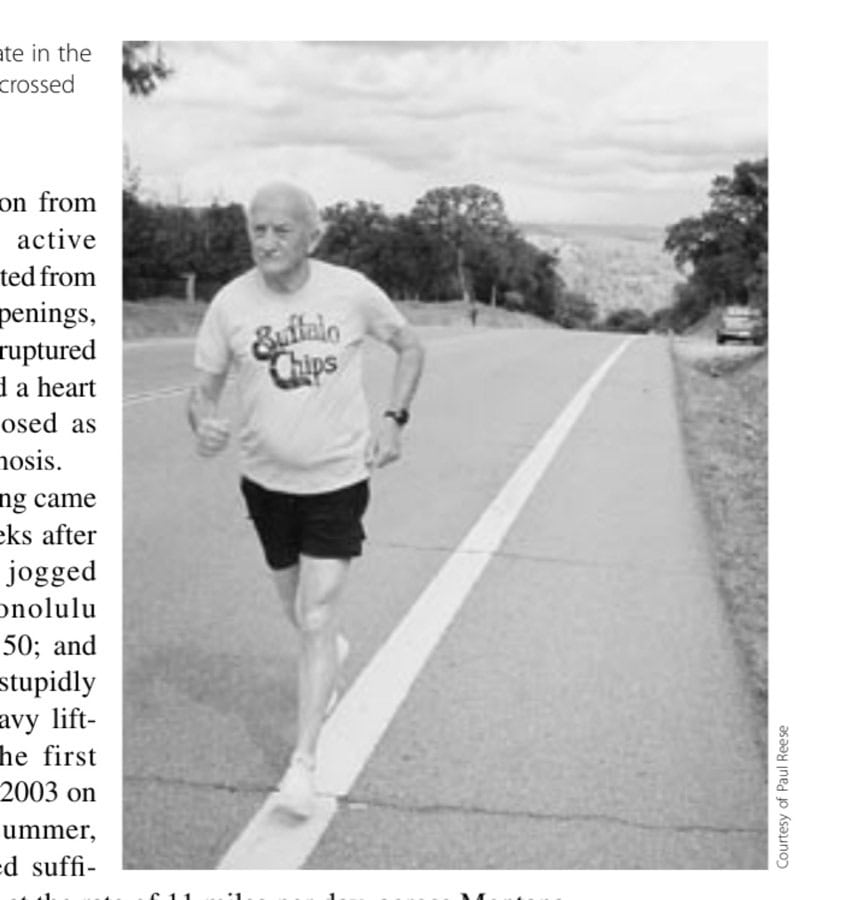
The transition from being a very active competitor resulted from two distinct happenings, both at age 86: a ruptured lumbar disk and a heart problem diagnosed as aortic valve stenosis. The disk thing came about three weeks after I walked and jogged the 2002 Honolulu Marathon in 6:50; and as a result of stupidly doing some heavy lifting, I spent the first four months of 2003 on crutches. By summer, I was recovered sufficiently to walk, at the rate of 11 miles per day, across Montana.
In routine physical exams in October, 2003, both my internist, Elliott Eisenbud, and my orthopedist, Frank Boutin Sr., detected a heart murmur. The echocardiogram that followed revealed that I have aortic valve stenosis, meaning the aortic valve does not open as widely as it should, which in turn causes the left ventricle to work harder to pump enough blood to the body. The only remedy for this condition is surgery; medications are not helpful. I’m told this is not a critical condition but that I should not exert myself and that running is a no-no (unless, of course, I sprout a death wish).
To find myself with a heart condition was as surprising as it was shocking. In the 20 years that I had been a subject in a medical study by the late Dr. Michael Pollock of 20 selected masters athletes, my cardiograms were textbook, and I was even told, “When you die, they’re going to have to take your heart out and beat it to death with a baseball bat!”
I found it a bit strange, almost a bit startling at first, to be sidelined with a heart problem, considering how active I had been. From age 47 to 72, I averaged three races a month at distances from three miles to 100 miles. At age 73, I ran 3,192 miles across the USA at the rate of 26 miles a day, crossing 12 states. Between
Courtesy of Paul Reese
There isn’t a state in the union Paul hasn’t crossed on foot.
ages 75 and 80, I averaged 75 days on the road each summer while running across the other 38 states. And in my experiment of one as a runner, during my heyday, the year I was ages 54 and 55, I ran 13 marathons (11 of them sub-3:00), one 50-miler (7:34), one 100-miler (17:14), and 24 other races. This total of 39 races included competing in the National Masters Track Meet, age-55 division, and running a 10K on Friday, a 5K on Saturday, and a marathon on Sunday.
NO IMMUNITY I cite all this not as braggadocio—after all, I’m not in any hall of fame—but rather as solid evidence that an athlete can be extremely active and still not be immune to succumbing to a heart condition. The message here is don’t think, as I mistakenly did, that you are immune to a heart problem; if it happened to guys as active as Paff and me, it could happen to you.
I was smitten with the love of adventure running—running across states, in my case—between ages 73 and 80, with some resultant drop-off in racing. By the time that racing was no longer an option (my last race was the Honolulu Marathon in December 2002 at age 85), I had been weaned to a considerable extent from the racing scene. Thus, being deprived of racing was not altogether a traumatic experience, which is another way of saying that the coping has been easier, a onestep-at-a-time thing. Some rebuttal here, though: I said “easier,” not “easy.”
It wasn’t easy because I miss many things integral to running and racing. I miss the anticipation, the excitement, the adventure of racing. My wife, Elaine, and I always enjoyed all the race-related travel. We always looked forward to the socializing, camaraderie, and gathering of friends, all sorely missed. Along the way, one thing I’ve learned is to stay away from races; to be at a race and not be part of the action is to open a wound.
What I have lost most from not being able to run is a dramatic drop in selfesteem. While running, even as late as age 85, I never thought of myself as an old man. True, I was slowed, was even somewhat stiff and arthritic. Nonetheless, I considered myself an athlete—old, yes, but without the old-man syndrome. Now, limited to walking and told to avoid strenuous physical activity, I am beginning to think of myself as an old man, a self-image that did not exist when I was running and racing. Thankfully, I am not yet at the point where I think and act like an old man. (I’m talking about the motions of life, not exercise here.) Translation: Elaine and I still live very active lives, albeit not to the point where you’ll find us at a disco dance, a carnival ride, or on a Harley-Davidson!
All right, then. Here I am, stripped of athleticism, unqualified for the racing fraternity, and reduced to walking, and that at a pace where women pushing baby strollers are passing me. Where do I turn? If I want to maintain my physical and emotional health, I must find ways to cope.
ad page
And that’s the best single suggestion, piece of advice, I can offer to any runner who, for whatever reason, is deprived of running and racing. You don’t surrender, you don’t stagnate; you fall back, regroup, and find ways to cope.
HOW DO YOU COPE? So just what have I done to cope? Luckily, while still being able to run, I discovered and became fascinated with adventure running, which I’ve come to enjoy as much as racing. Fortunately, though limited to walking, I’m still able to go across states. My first such walk safari was across Montana in 2003 at age 86, logging 11 miles a day for 27 consecutive days. After having been on crutches for the first four months of the year, I was ecstatic just to be able to walk. I’m blessed in that Elaine, who drives a Roadtrek camper van, supported me logistically and enjoys these adventures.
My cardiologist has already cleared me to continue my summer walks across states. He did caution: “Back off if you get tired. Go easy, go slow, don’t exert yourself.” Inwardly, I smiled when he said “Go slow”—as if I had some other choice.
With these crossings in mind, with their attendant planning and preparation, Elaine and I have adventure and excitement that to a considerable degree offset not being able to race. OK, so what do I do besides walking across states to take up the slack of not running and racing? The main thing that I do to stay on the racing scene is to direct an annual race—actually three races, a 10K, 15K, and 25K, on the same day. The event is almost as much a gathering of friends as it is a race. For the past 40 years, Elaine and I have been involved in race management; and year in, year out, the same runners have run our races. What’s more, we have a close relationship with a dozen friends on the race staff who work the race every year, and it’s a bit of auld lang syne when we convene.
On race day, I feel that I am part of the race, and I’m so busy managing it that I don’t think about not being able to run. On a day-to-day basis, I cope with trying to walk three miles, and in doing so, I find myself divided: on the positive side, appreciative that I am still mobile and sound orthopedically, on the negative side, woeful that I expend so much energy accomplishing so little. In my heyday, at run (not race) tempo, I could cover nine miles in the time it takes me to walk three today.
Just as Paff copes by embracing his research studies, I have two avocations that help: writing and talking. On the writing side, I crank out an annual article that M&B is gracious enough to publish, and I am still polishing and hoping to get published a book that covers our adventures across all 50 states.
As for the public speaking, which I’ve done over the past 20 years or so, how often I talk depends on how often I am invited to talk about our adventures running across states or about my World War II experiences. The talks appeal to me because they involve mental gymnastics and they present a challenge inasmuch as I speak without notes. Besides, they make me feel brave, because a Gallup poll once revealed that one of the things people fear most is to speak in front of a group. The point here is that to compensate for not running or racing, a person needs to have an outlet—a job, avocation, or hobby—that is both interesting and challenging.
LIFE ENHANCEMENTS Reflecting on 40 years of running and racing, I’ve come to the realization that the most important consideration about running is not how fast you can run, not how far you can run, but rather, the degree and manner in which running and racing enhance your life. That is the sum and substance of the worth of running. Having said that, I would venture to guess that very few runners either think or dwell on such enhancement. Their energies, their thoughts, are directed to times, PRs, races, mileage, gear, and the eternal search for the perfect shoe. I plead guilty to having done much of that when I was competing. Maybe the realization and appreciation of enhancement dawn only after a person has suffered the loss of running and racing. While active, we’re just too damned obsessed with the inconsequential to recognize how privileged we are, how running and racing enhance our lives. One thing for sure, if you lose running and racing, you had better be able to devise ways to compensate because you will have a huge void to fill when you come to realize how running enhanced your life.
GEORGE’S STORY George Billingsley’s story differs from Paff’s and mine in that, unlike us, he is still running and racing at age 82. George ran his very first race at age 55, a three-mile run. In subsequent outings, it didn’t take him long to discover that he could run long but not fast. His forte was distance, and he proved that he was a master in that department by breaking world and national age-group records in ultraraces eight times.
Among his proudest achievements are finishing the Lake Tahoe 72-mile run in 12 hours, 2 minutes at age 58; finishing the Western States 100-Mile Endurance Run at age 60; and, at age 68, running across the USA from Jenner, California, to Tybee Island, South Carolina, in 116 days, never taking a day off. His fastest marathon was 3:06 at age 60; fastest 50-miler was 6:31:28 at age 59. Today when he lines up for a marathon, his goal is to break seven hours.
Here’s a guy who once set age records and who often beat many younger runners in races ranging from 5K to 50 miles; how does he feel now that his times have dropped dramatically, now that he finishes near or at the end of the pack? For that matter, what are his thoughts and feelings about lacking the speed and stamina he once had when training? What suggestions does he have for runners who, out of pride, no longer run or race because their times have dropped dramatically?
I asked George to talk about these things, and this is what he had to say: “Even though I know it won’t help, it’s not easy for me to keep from feeling sorry for myself regarding this business of age decline. In my running prime, I could run 50 miles at a sub-8:00 pace. Currently, I can’t run a mile in 10 minutes. Even so, we all know that feeling sorry won’t make you run faster or farther; and since I want to do both, I say to myself, ‘Come on, George. Get positive.’”
THE PHILOSOPHY OF LAST “I’ve lived long enough, age 82, to run dead last in a race and be proud of it. You might think, ‘How can a guy be proud when everybody beats him?’ Admittedly, it took some doing for me to reach that happy state, to rationalize such an apparent disaster by realizing that I had the guts to enter the race knowing that I’d likely finish last, knowing that I could have been a wimp and stayed home snuggled under the covers, knowing that slow as I was, my effort was not ho-hum, for I’d
Courtesy of George Billingsley
George Billingsley didn’t begin running until age 55.
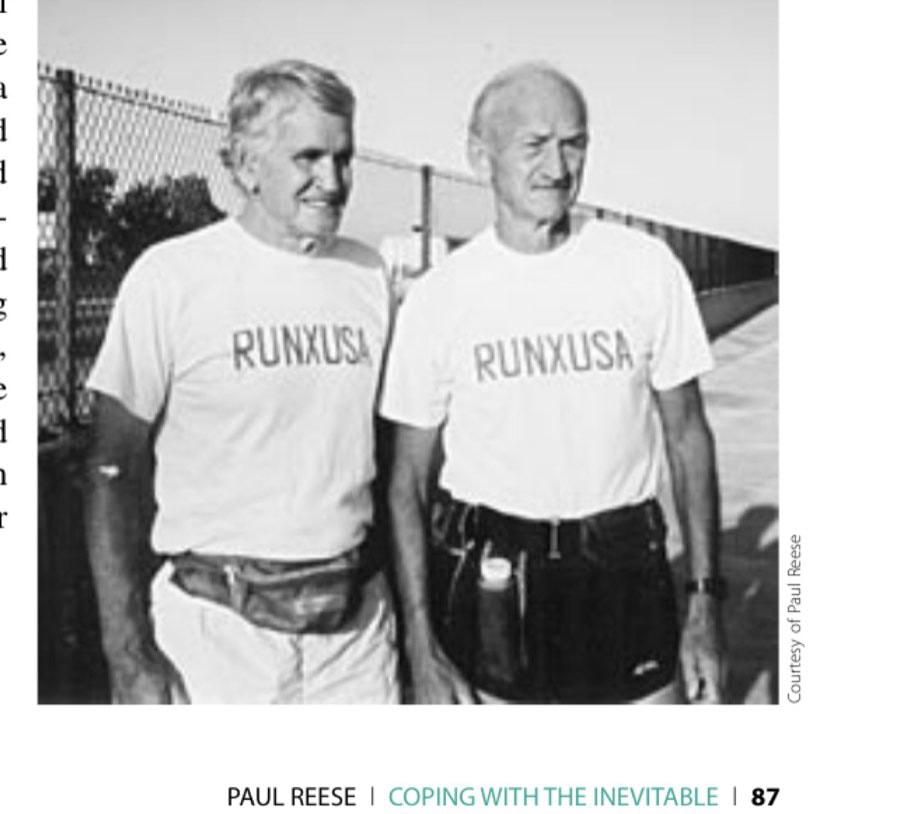
George and Paul have both run the width of the USA.
Courtesy of Paul Reese
done my best, and knowing that many younger runners would see an 82-year-old guy finish and have hope for their own longevity as runners. “Recently I read a statement by Rich Benyo [M&B, Sep./Oct. 2003] that has relevance for those of us still running in the twilight of our lives. Talking about what the instant marathoner misses along the way, Benyo listed ‘Gradual growth in physical potential, coupled with a long-range program that could last for a lifetime.’ Knowing that physical potential at any age can change for the better with good health and smart training—but that it ultimately diminishes with age no matter how hard we train—I ask myself, ‘What is my potential in this age group and what do I do to make it grow?’ This opens a new ballgame, because at any age you can try to run to your potential, strive to be the best that you now can, and not get bogged down by comparing the present with what you did in your prime. I’m trying hard to take joy in striving to be as good as I can be and not worry about declining times. “
One of the many things I’ve learned,” George continues, “is that having the support of family and friends makes plodding into old age easier and more fun. I’m not alone, because I find myself part of things that are bigger than just me, things like my marriage, friendships, running club, and participating in races. “
After being injured in the 1984 Western States Endurance Run and having a knee surgically repaired, I was horrified when I started back running and discovered I’d lost both speed and endurance. I vowed this pitiful condition would not stand. Even though I could no longer run even one mile in seven minutes, I still wanted to run a sub-3:00 marathon. “
I realized that if I was ever going to break three hours, I needed some coaching. Knowing that Paul Reese had broken three hours for the marathon a number of times, I asked him whether we could team up for some workouts and whether he could give me some coaching along the way. He agreed, and subsequently we’ve run hundreds of fun-filled miles together. We’ve run so many miles together
that these days when I’m racing and Paul is off somewhere else, I don’t feel alone, because I feel that Paul is running ahead or by my side. Like I said, having a friend makes it easier to keep running into the sunset.”
SELF-COMPETITION “Recently, when Paul and I were ambling along in one of our weekly runs and talking about running in our 80s, we agreed that we should compete with ourselves and not with other people. With this attitude, trying to better your own age PRs, you can be competitive as long as you live. Another reason for self-competition is that being in our 80s, we are the only entries in our division. “
One suggestion that I’d offer to older runners whose times are declining is that you should be kind to yourself regarding your expectations. It’s OK to have a time goal, but don’t despair if you fall a bit short. Most of us set the bar higher than we can leap. So don’t think failure if you don’t clear it. Rather think, ‘I came close this time. Next time I’ll make it.’ “
Another thing I’ve found is that curiosity—just trying something to see whether you can do it—can be an elixir. Recently another old runner asked me whether I could still do a chin-up. It had been so long since I had tried a chin-up that I really didn’t know if I could or couldn’t. I had to find out. When I got home, I headed for the chin-up bar and was excited to be able to chin myself. But in the process, I felt as if the muscles in my back were about to explode. Now, after a gradual buildup, I can do five. Curiosity got me there, and without it life would be ever so dull. “
I also believe that older runners need dreams to sustain them. I am currently dreaming of running the California International Marathon within the allotted 5 hours, 30 minutes. Can I again develop and maintain a 12:30 pace for 26.2 miles? I have to try. Like we used to say when I was in the air force: ‘It keeps my mind off desertion.’ “
Even though I’ve rambled on quite a bit here, I almost forgot to mention how profoundly grateful I am to still be active at 82; too many runners, young and old, take their good fortune for granted. I hope I’ve given some insight into how it feels to be running at age 82. “
Let me wrap up by offering older runners these suggestions that apply to both running and lifestyle: “Experiment. Find what works for you and then do it with gusto. “Really love your mate. “Be a friend. “
Don’t take it easy. “You can do more than you think you can. “Be slow—to give up. “Run fast enough to stay ahead of the Grim Reaper.”
ad page
Being barely a sub-five-minute-miler in high school didn’t bring Abe Underwood much satisfaction or attention, so he abandoned running. However, 15 years later he was 50 pounds heavier, and his condition did get his attention. By the early 1970s, Abe, then in his 30s, learned of the term “aerobics” and also became interested in the 1972 Olympics with its focus on the marathon.
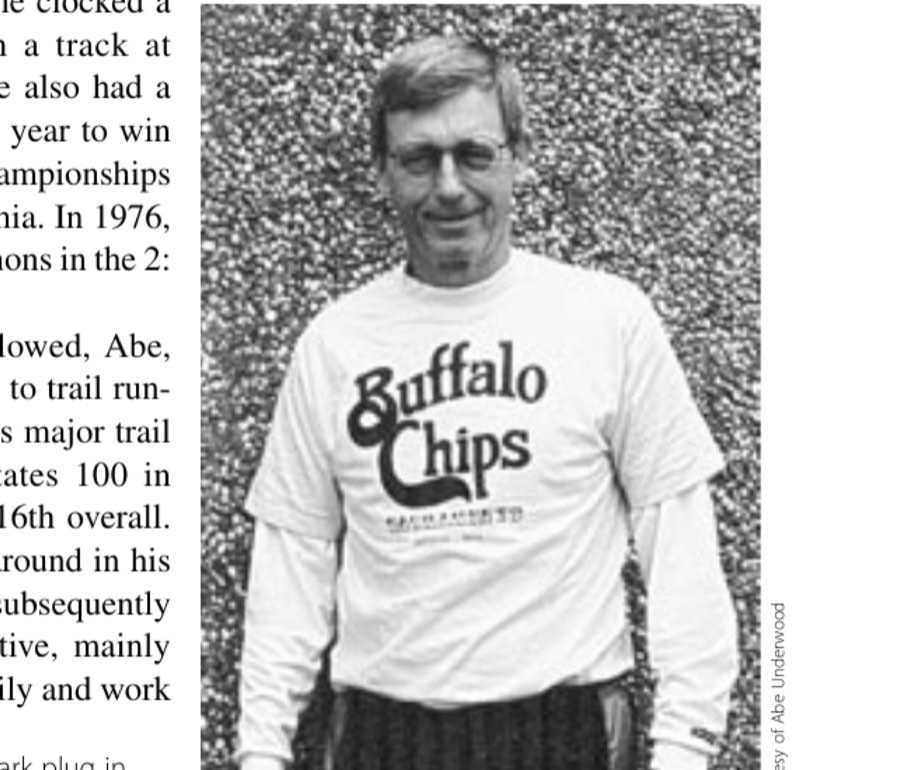
Wanting to be more than a spectator, Abe decided to try running again. In his first attempt he went to the local high school track and planned on doing an eight-minute mile as a good starting point. He completed the mile, but the only recording he had of the event was that he felt “awful”—so much so that after driving home, he collapsed on the couch and slept for 12 hours.
Despite this dismal start, he persisted in going back to the track, and his persistence paid off because the times dropped, the distances increased, and the weight came off. In 1973, he finished his first marathon in 3:30, a good first effort.
Running now became a lifestyle for Abe. He raced nearly every weekend, taught a jogging class, directed many races, founded the Buffalo Chips Running Club (now at 700 members), and ran many marathons, some under three hours. By 1976, the ultra distances caught his fancy. His first ultra was a 50-miler, which he finished in third place with a time of 6:48. Later in the same year, he finished third in the Pepsi 72-Miler around Lake Tahoe in 11 hours, 53 minutes, 15 seconds.
Abe peaked in 1978 at age 40. His best marathon that year was 2:40. Two weeks after that PR marathon, he clocked a 15:49 for 100 miles on a track at Woodside, California. He also had a 50-mile best of 6:08 that year to win the National Masters Championships in Santa Monica, California. In 1976, he also ran several marathons in the 2: 41 to 2:45 range.
In the years that followed, Abe, drifting from road racing to trail running, competed often. His major trail run was the Western States 100 in 1979 where he finished 16th overall. That race marked a turnaround in his running career, because subsequently he became less competitive, mainly because of increased family and work
Abe Underwood was a spark plug in the Sacramento running scene.
Courtesy of Abe Underwood
ABE’S STORY
responsibilities, and his training mileage dropped. Though he averaged 2,500 to 3,000 miles a year, he was never a high-mileage type. He did, though, continue to race often because, in his own words, “Racing is the dessert part of running.”
Always looking to break new ground and try the unusual, Abe decided on his 40th birthday to start running his age in miles, a feat he continued to age 55 in 1993, when he went through treatment for prostate cancer. “The cancer and retiring from work in 1995 caused a shift in my attitude,” Abe, now 66, says. “I’m trying to make another comeback. The runs are still difficult and the recovery time longer. Building a base is a constant effort. Getting close to a nine-minute
28th Annual Wyoming Marathon Races Run on dirt and gravel roads in Medicine Bow National Forest
—• PICK YOUR DISTANCE •— Rocky Mountain Double Marathon (52.4 miles) Oldest ultramarathon in the Rocky Mountain Region
Wyoming Marathon (26.2) Medicine Bow Half-Marathon (13.1 miles) Laramie, Wyoming 6:00 a.m. Sunday, May 29, 2005 • Aid stations every four miles • Pasta dinner the night before • $50 non-refundable ultra entry fee prior to race day, $40 for marathon, and $30 for the half-marathon • T-shirts to all entrants and awards to all finishers • Room discounts at Little America, host hotel • Ultramarathon race directors run for free
Brent Weigner 402 W. 31 St., Cheyenne, WY 82001 307/635-3316 (H) • Fax: 307/635-5297 • E-mail RunWyo@msn.com Register online at www.active.com Please visit our Web site for additional information. http://www.angelfire.com/wy2/marathon
mile for any distance is pushing the anaerobic threshold. At this point, I’m not even thinking of quality. I figure I’m like an old car: the shocks and suspension will last longer if not hammered over the road as much.”
ABE’S PHILOSOPHY Over the years, Abe has kept motivated by following these guidelines, which he says have become even more important as he copes with his declining performance. • Retain or regain your inspiration. Yes. That’s easy to say and difficult to
do. Running has been a part of your life for a long time, so why give up now? If you can physically still do it, that is what you should do. • Set—or reset—some realistic goals. Forget about what you once did. That’s
ancient history. Now it’s time to go for a new history. Assess yourself, then test yourself, but don’t feel sorry for yourself. Set a long horizon and accept small improvements. And don’t be discouraged by setbacks. •
Keep, rekindle, or make new buddy connections. Remember how you seemed to train better with one or more of your friends? That still applies now. If old friends can’t do it for you, find some new friends to fill that
role. Better yet, be a mentor to some younger runners who value your experience. And don’t be afraid to go for some runs with the opposite sex. That can do wonders for both parties. • Try something new. The ideas here are endless. If you’re a stranger to trails,
try running them. Run up a hill and walk down. Try a different distance and change your training to match. Run some races you’ve never done before. Cross-train, which can include weights, stretching, swimming, bik
ing, boating—especially boating where there is a lot of rowing involved. They can all help in ways you’ve never imagined. • Most of all, have fun! As already noted, Abe took up running in 1972 when he went to a high school track intending to crank out an eight-minute mile. While he did finish the mile, his time was considerably beyond eight minutes, and afterward he was so drained that he went home and collapsed on a couch for 12 hours.
Recently, at age 66 and considerably more experienced as a runner, Abe was pleased to run an eight-minute mile on a high school track. Asked about that, Abe says, “I was thinking if I can do one mile at this pace, I wonder whether I can do two miles at the same pace.” Hey, as Yogi Berra would say, “This is déjà vu all over again!” Editor’s note: Sadly, in the wake of heart surgery in October 2004, Paul Reese died on November 6. He will be dearly missed by all.
This article originally appeared in Marathon & Beyond, Vol. 9, No. 1 (2005).
← Browse the full M&B ArchiveMore like this
1,000+ stories from 19 years of Marathon & Beyond
The complete archive of the legendary long-distance journal — digitized and free to read.
