

Core Vs Skin Temperatures In Marathon Runners
of a critical core temperature has been challenged in recent years, with researchers arguing that core body temperatures during exercise should not be a major concern in the presence of cool skin temperatures (30 to 34 degrees Celsius) [ 86
to 93°F] and a large core-to-skin temperature gradient (5 to 8 degrees Celsius) [12 to 19°F]. Knowing that early-morning temperatures in July in Montana can be cool (10 to 15 degrees Celsius) [50 to 60°F], our hypothesis was that runners
may have high core body temperatures, but with cool skin temperatures and a large gradient they should have little difficulty dissipating heat. However, knowing the lower intensity of a marathon compared with a 5K or 10K, we did not expect
core temperatures over 40 degrees Celsius. From 2000 to 2007, the number of marathon participants in the United States increased by 36 percent, from 299,000 to 407,000. During this time period, the gender gap narrowed slightly, with female participants making up about 40 per
cent of all finishers (up from 37.5 percent in 2000). In absolute terms, this means that about 49,000 more women ran a marathon in 2007 compared with 2000. In 2007, the women’s fastest times were posted by 35- to 39-year-olds, who aver
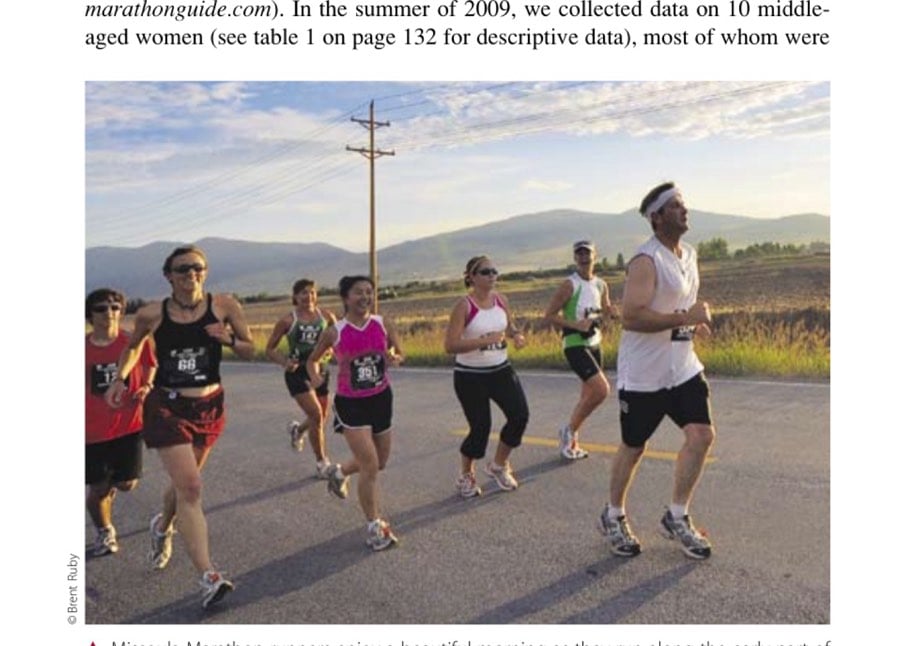
aged a time of 4:51:30 for their finishes (statistics obtained from http://www. marathonguide.com). In the summer of 2009, we collected data on 10 middleaged women (see table 1 on page 132 for descriptive data), most of whom were
▲ Missoula Marathon runners enjoy a beautiful morning as they run along the early part of the course.
first-time competitors. The purpose of the project was to determine physiological responses of core and skin temperature during competitive marathon running in middle-aged women. Core and skin temperatures were monitored continuously using a VitalSense integrated physiological monitoring system (Respironics, Bend, Oregon). Study participants swallowed an ingestible temperature sensor the night before the race and had a skin-temperature patch placed below the clavicle. During the race, the participants wore a lightweight neoprene waist pack containing the data logger that recorded temperature measurements every minute. Body weight was recorded before and after the race using a digital scale to determine weight loss during the race. On a separate visit to the laboratory, participants completed underwater body-fat testing to determine the . percentage of body fat and a maximal exercise test on a treadmill to determine VO2max (maximum amount of oxygen the muscles can use to perform work).
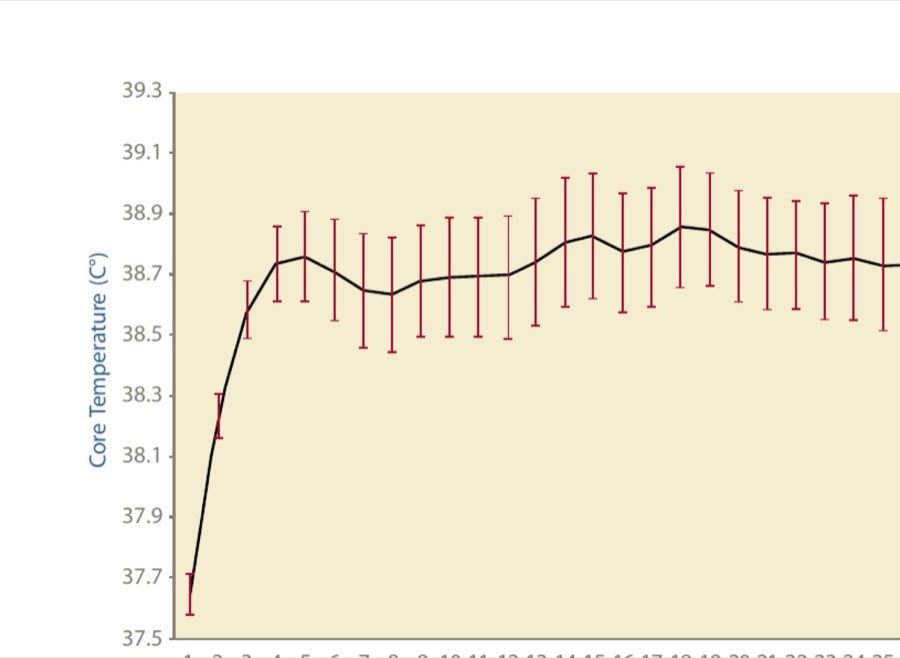
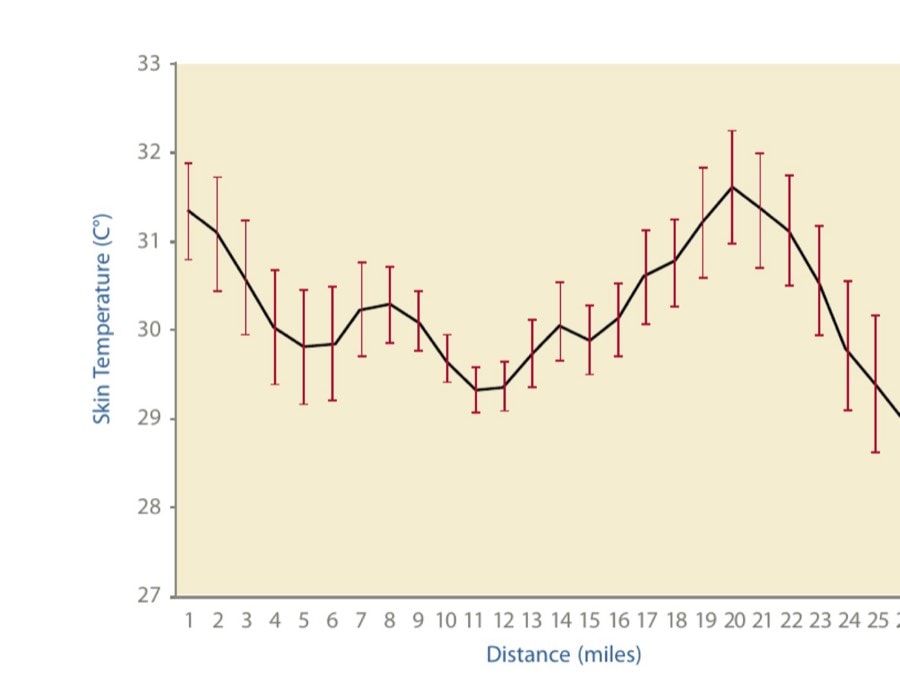
Unlike 2007, the weather in 2009 was near ideal marathon running conditions (13 to 18 degrees Celsius [55 to 65°F], 20 to 30 percent humidity, with partly sunny to cloudy skies, with a slight drizzle for about 20 minutes near the fourhour mark). The average finish time was 4:22:34 ± 00:30:07, and participants lost an average of 3 ± 1 pounds (2 percent of body weight). Average core body temperatures throughout the race were 38.7 degrees Celsius (38.0 to 39.4 degrees Celsius) [101.6°F, 100.4 to 102.9°F], considerably lower than the alleged critical core body temperature of 40 degrees Celsius [104°F]. Core body temperature rose steadily for the first four miles and leveled off for the rest of the race. As expected, skin temperatures were low, with an average of 30.4 degrees Celsius (28.8 to 32.0 degrees Celsius) [86.7°F, 83.8 to 89.6°F], yet fluctuated throughout the race depending on run speed and ambient conditions. To see the patterns of core and skin temperature during the marathon, see figures 1 and 2. As expected, there was a. strong relationship between VO2max and finish time. Ad- Table 1 Participant descriptive data (n=10). ditionally, there was a strong Age (yrs) 38 ± 5 relationship between skin
Height (cm) 166 ± 6 temperature and finish time Weight (kg) 60 ± 3 (see figure 3). . -1 2.9 ± 0.3 VO2 peak (L·min ) A common predictor of . . -1 race performance is VO2max, 48 ± 4 VO2 peak (ml·kg·min ) meaning that individuals
who Body fat (%) 18 ± 4 . have a higher VO2max will Fat-free mass (kg) 50 ± 3 perform better . than those Fat mass (kg) 11 ± 3 with a lower VO2max. This is especially true across a hetData are mean ± standard deviation. erogenous sample (runners
39.3 39.1
Core Temperature (C°)
38.9 38.7 38.5 38.3 38.1 37.9 37.7 37.5
1 2 3 4 5 6 7 8 9 10 11 12 13 14 15 16 17 18 19 20 21 22 23 24 25 26 Distance (miles)
Figure 1 Core temperatures during the marathon.
33
Skin Temperature (C°)
32
31
30
29
28
27
1 2 3 4 5 6 7 8 9 10 11 12 13 14 15 16 17 18 19 20 21 22 23 24 25 26 Distance (miles)
Figure 2 Skin temperatures during the marathon.
36
Figure 3
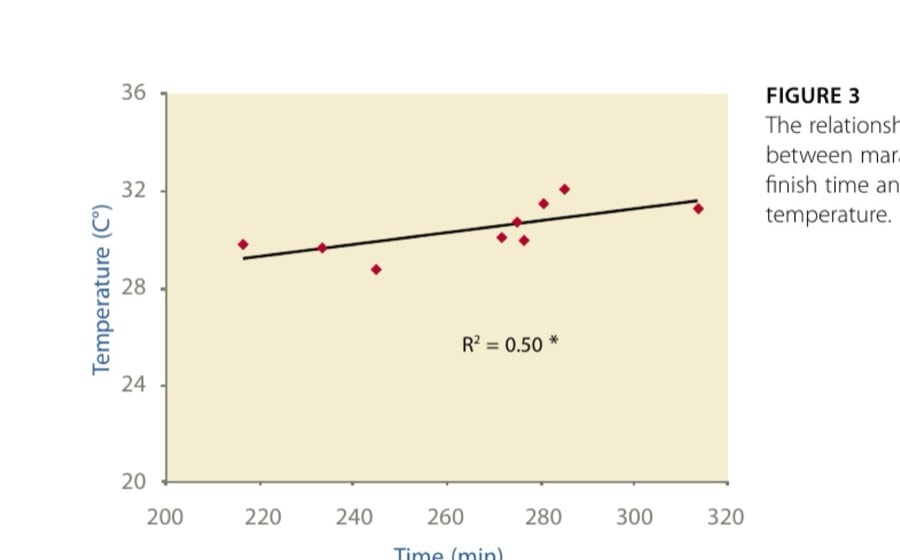
The relationship between marathon finish time and skin temperature.
Temperature (C°)
32
28 R2 = 0.50 *
24
20 200
220
240
260
280
300
320
Time (min)
with a wide range of finish times). Another major predictor of race performance is the percentage of body fat. Leaner people carrying less excess weight will typically run faster than those carrying more excess weight. To assess the strength of these variables in predicting performance, we used a multiple regression analysis to determine the strength of the prediction (r2). The overall r2 indicates the. percentage of variability in race finish time accounted
for by the variables of VO2, body . fat, and skin temperature. In this study, VO2max and percentage of body fat accounted for 69 percent (r2 = 0.69) of the variability in predicting race performance. However, the most significant finding from our study was that percentage of body fat and skin temperature accounted for 85 percent (r2 = 0.85) of the variability in estimating race finish time. This suggests that skin temperature was more indicative of. estimating how quickly an individual completed the marathon compared with VO2max.
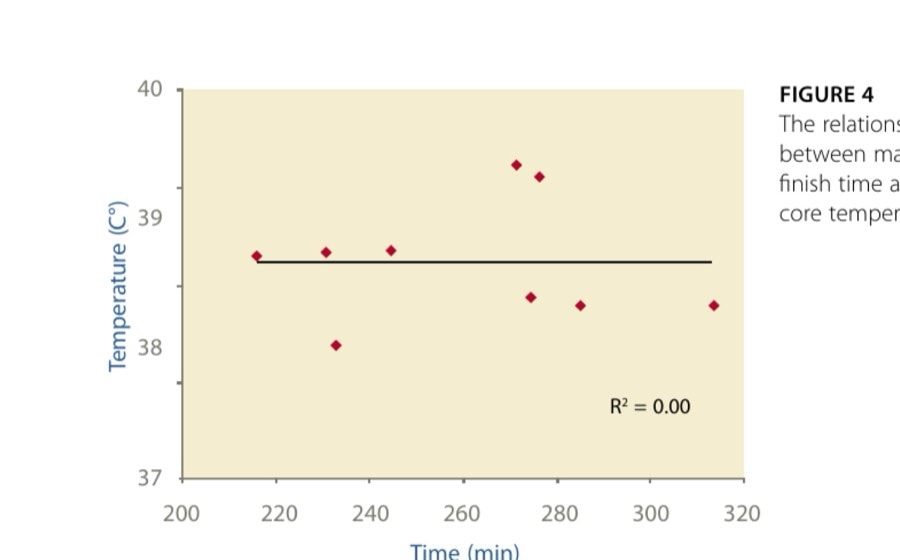
There was wide variation in core temperature responses during the race and no relationship with core temperature and finish time (see figure 4), yet there was a strong relationship between finish time and skin temperature. Why this strong relationship? From a heat-transfer perspective, the faster a runner moves through the air, the more heat loss will occur between the skin and environment via convective cooling (air flowing over the body, especially exposed skin). However, the difference between the fastest and slowest runner was only 2.25 mph. With wind blowing during the race, especially cross breezes, the small range of running speeds (5.0 to 7.3 mph) might offset the overall impact of run speed on convective cooling. A person running faster will produce more metabolic heat than someone running slower; because of this, it is easy to assume that faster runners should have a higher core body temperature. However, as you can see from figure 3, this was not the case. Often running intensity is expressed as absolute (minute per mile,
Temperature (C°)
40
Figure 4
39
The relationship between marathon finish time and core temperature.
38 R2 = 0.00
37 200
220
240
260
280
300
320
Time (min)
. m/s, and so forth) . or relative to VO2max. The average relative race intensity was 74 ± 5 percent VO2max (with a range of 68 percent to 80 percent). Therefore, it is not surprising that there was limited association between
core temperature and race finish time, since all runners, regardless of speed, were running at similar relative intensities. There is little relationship between the time to complete a marathon and core body temperature; the faster runners are able to dissipate the metabolic heat very effectively.
Another explanation is that the faster runners maintained a cooler skin temperature since they had less body fat than slower runners, allowing more heat to be diffused through the skin. Heat dissipation is critical to maintaining a balanced thermoregulatory status, and a runner who has less subcutaneous fat (fat beneath the skin) may have a greater capacity for dissipating heat more efficiently compared with someone who has more subcutaneous fat.
The most likely reason for reduced skin temperature during the race is simply that faster runners are more likely to spend more time training than slower runners (within the same age/sex class). Overall training volume affects VO2max, running economy, body-fat percentage, and the body’s capacity to thermoregulate during exercise (by influencing sweat rate and sweat composition). The physiological changes associated with the combination of greater training frequency, duration, and intensity create a more favorable microenvironment to better maintain consistent and faster performance times via a more efficient thermoregulatory system.
This project represents a simple descriptive study design that uses correlations to draw associations between the measured variables of interest. The findings from our study are not meant to establish cause and effect, but these current data do show some interesting relationships between specific variables that have received little attention in middle-aged female marathoners. However, these data
© Neil Chaput de Saintonge
▲
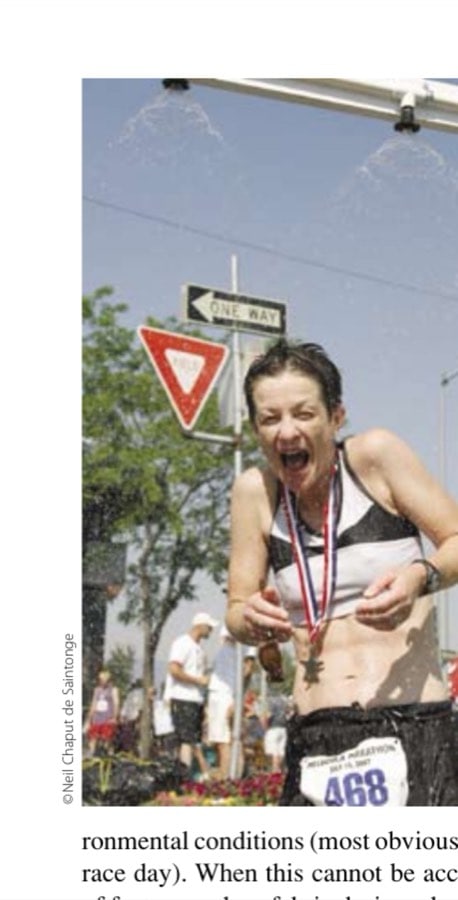
A runner cools off following a great race.
demonstrate that in recreational female runners, classic measures . of peak VO2 and the percentage of body fat do not forecast race finish time as accurately as do measures of skin temperature and body fat.
The data emphasize the importance of maintaining a cool skin temperature during marathon running to maintain favorable heat loss and maximize performance. During training, frequency, duration, and intensity are the key
factors that runners can control to maximize the adaptations that provide for maintenance of a lower skin temperature and body fat, especially in the right environmental conditions (most obviously those that mimic the forecasted weather on
race day). When this cannot be accomplished, it is important to take advantage of factors such as fabric design, shade, sunscreen, and water to maintain a cooler skin surface and to maximize the gradient between core and skin.
Acknowledgements—study funded in part by a grant from Run Wild Missoula.
This article originally appeared in Marathon & Beyond, Vol. 14, No. 6 (2010).
← Browse the full M&B ArchiveMore like this
1,000+ stories from 19 years of Marathon & Beyond
The complete archive of the legendary long-distance journal — digitized and free to read.
