

Covering Boston
Imagine game coverage where TV commentators view only home plate or one goalie net, or one hoop in basketball, or one end zone in a football game. How would they be able to broadcast a game without being able to see the entire
playing surface? Well, imagine covering a sports competition that plays out over 26.2 miles and seeing only the last few hundred yards. How would commentators convey the more than two hours of action?
At the Boston Marathon, that is the quandary for WBZ-TV (CBS) announcer Lisa Hughes and veteran race analysts Toni Reavis and Kathrine Switzer. From the photo bridge high above the finish line, they depend on a fine-tuned system of
data collection from throughout the course. That lifeline is the Spotters Network, one of the services provided by Race SpotWatch, a media-consulting division under worldwide sports marketing and event management group TRACS, Inc. “
It’s a critical part of our ability to cover the race,” Hughes said.
Courtesy of Fred Treseler
▲
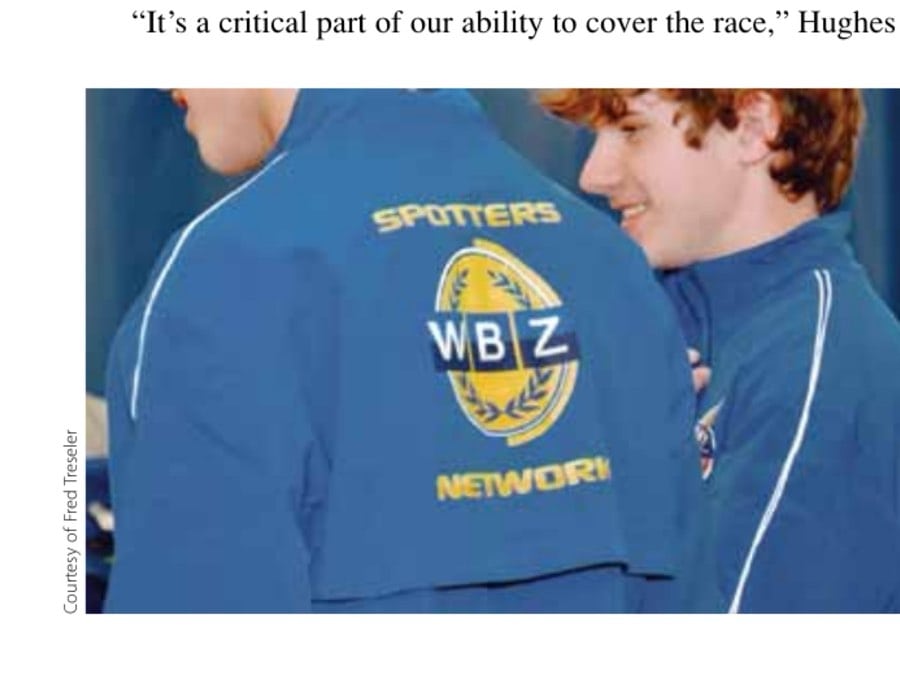
The Spotters Network logo for WBZ-TV’s coverage of the Boston Marathon.
How it works The effectiveness of the Spotters Network lies in its complexity. Nearly 80 spotters phone in observations and split times to a command center at the WBZ-TV studio, and the information is redirected through laptop computers to the finishline anchors.
At the height of the marathon, it can resemble the dynamics of an air traffic control tower, with TRACS founder and Spotters Network cofounder Fred Treseler as its director. “In marathons, there are no timeouts,” he says. “There’s no break in the action for those trying to cover the race.”
The situation at the command center may sometimes be a case of not seeing the forest for the trees. “You could spend the three hours in here—watching the race, reporting on the race, and then get done—and you don’t know who won. You’re too close,” said Bob Gillon, who is in charge of receiving the women’s race times and splits.
Jon Ellis, who operates the command center’s communication desk for the men’s lead truck, says the demand has increased exponentially since the marathon incorporated separate start times. “It’s like a feeder system here, and I’ll get the best information they get and I’ll feed that to the finish line,” he said. “We typically get those mile splits out really fast.”
Stacie Finnegan worked the 2013 Boston Marathon receiving and delivering data in the command center. “We track where the athletes are at every mile and feed that into the broadcasters at the bridge down on Boylston Street,” she said. “Fred talks directly to them, and we support them with the data so they have the exact times when they’re talking.”
Despite the TV studio’s location five miles from the finish line, communication is instantaneous, which Switzer appreciates. “Now that we’re getting the info by a computer connected directly to them in the control center, which is located at WBZ, we can also type questions to Fred, and he can answer if he knows,” she says.
Hughes, Reavis, and Switzer work off a half-dozen or so TV screens in front of them that show various views, lists of information, and news crawls.
Spotters’ prep work The finished product of showing runners on TV may seem simple, but the process is time-consuming. The Spotters Network’s planning involves rehearsals and training sessions that even include teaching spotters common terms such as referring to the runners as “boys” and “girls” instead of “men” and “women,” which can sound too similar when said quickly on the phones. Students have been used as spotters since 2001.
© Tim Kilduff
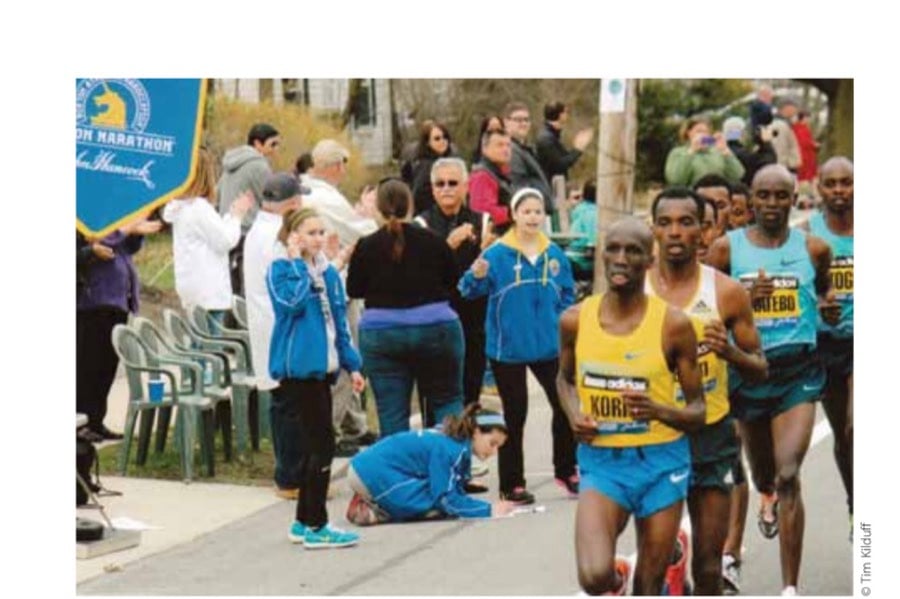
▲ Framingham High School classmates Hannah Greenberg (delivering data by phone), Isabelle Tambascio (kneeling, recording splits), and Grace Seta (signaling) work together as part of the Spotters Network during the 2013 Boston Marathon. They are carefully watching Wesley Korir of Kenya lead Markos Geneti of Ethiopia, Levy Matebo of Kenya, and Micah Kogo of Kenya.
“I believe if you empower young people, that typically they’re not going to let you down,” Treseler said. Fifteen schools representing 24 cities were involved in the Spotters Network at the 2013 Boston Marathon. Each student participated in orientation and training programs that ranged from general overviews to role-specific practices.
Audrey McKay, an eighth-grader at Ursuline Academy in Dedham, volunteered for the first time. “Ever since my mother ran the Boston Marathon a few years ago, I have been interested in it. So when this opportunity came up, I was very excited.”
She was posted at Mile 21 along the Newton hills on Commonwealth Avenue. “My job was to spot the runners’ names and numbers so that my teammates could mark their times to let WBZ know which runners were in the lead,” she said. “I think this was one of the biggest responsibilities I’ve had in [my] life, so I didn’t want to mess it up.”
Station prep work For WBZ-TV, it’s an all-encompassing endeavor, from promotion to the technical aspects of wiring, cameras, and satellites.
© Paul Clerici
Weather conditions heighten the importance of the Spotters Network and its ability to convey on-course data. “But at least once, years ago, when we had to rely on our chopper to relay our signal, we wound up in big trouble. Clouds and visibility were so low, the chopper couldn’t fly, so all we had were our cameras along the route,” Treseler said. “
We just reaffirmed with [the spotters] that we had lost our visual so that it was really critical—which we always stress with them, anyway—that they need to really make sure if they give us a [bib] number, they’re a hundred percent sure of that number because the only way we’re getting the information is from them.”
WBZ-TV airs more than 10 hours of marathon coverage, which includes its morning news shows, prerace programs, the race itself, two separate evening news programs, and extended coverage during its late-evening news.
The station also fields an additional dozen or so announcers, reporters, and meteorologists at strategic spots on location: Hopkinton at the start line, Newton at Heartbreak Hill, Brighton at Cleveland Circle (just after 22 miles), and Copley Square at the finish. “
Heartbreak Hill is a natural, given that it’s possibly the most famous segment of the course,” WBZ-TV senior sports producer Jackie Connally said. “And we’ve found our location in Cleveland Circle to be a good visual and good gathering spot for fans as the course turns onto Beacon Street. We also have news reporters who are not necessarily assigned to the marathon that day but are available should something happen along the course that we need to get a crew to.” (This proved crucial in covering the bombings at last year’s Boston Marathon.)
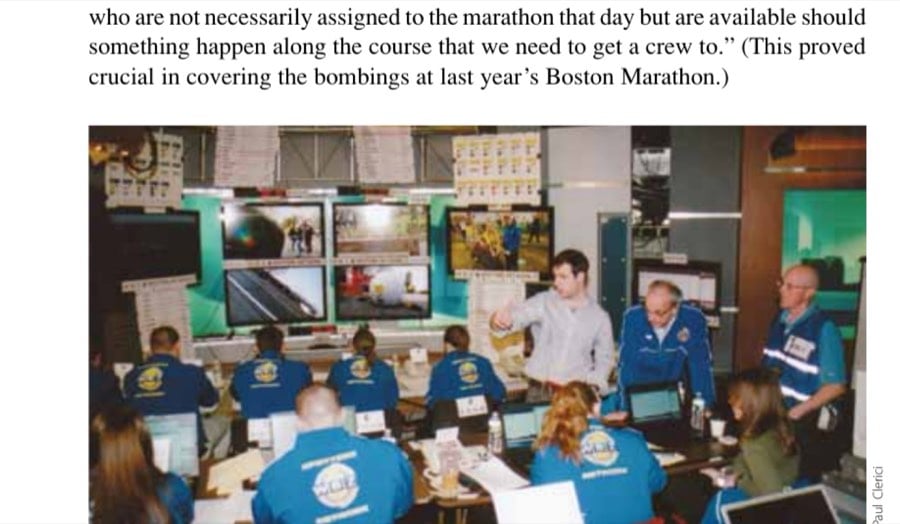
▲ In the command center of the Spotters Network at the WBZ-TV studio, last-minute checks and rechecks occur to ensure that all the telephone and computer connections, video and monitor hookups, and communication setups are ready to go for the Boston Marathon.
Analysts’ prep work Boston Marathon winners usually emerge from about three dozen invited elite athletes, which requires extensive preparation by the announcers. “I probably overprepare, but that is what makes me feel secure,” said Switzer. “Prep for Boston goes on year-round. You follow the progress of these athletes through their other races throughout the year.”
Likewise for Reavis. “Since I follow the sport year-round, once I find out the composition of the field, I go about preparing workup sheets on all the invited runners: race results, previous stories written, etc. I make a page for each athlete with current-year and past-career accomplishments.”
The three then come together to review their preparation, and Switzer says teamwork is paramount. “Toni and I are amazingly frank and honest and share info, and if we get something the other person doesn’t know, we let them know. We are colleagues, not competitors.”
There are also stories of a local nature, perhaps a celebrity raising money, soldiers humping gear in memory of a fallen hero, or Team Hoyt participating again. That same kind of focus is also aimed toward top US runners. “
With the East African runners being so dominant, we generally don’t see any Americans after the first 10 miles, much less New England-based runners on screen. Without the Spotters Network, we wouldn’t be able to inform our audience about their whereabouts,” Reavis said. “Any story that is out of sight of the lead pack is also out of mind, which is the nature of television. In today’s world that often means the top American is rarely, if ever, seen.”
Unproven In 1987, the Spotters Network’s second year of existence, several wheelchair athletes crashed shortly after the start of the Boston Marathon. Treseler had noticed that the early downhill portion of the course was recently repaved and there had been no rainfall until the day of the race. Tim Kilduff, the Spotter Network’s cofounder, was on the lead vehicle before the start and noted the conditions. “
Tim’s telling me he can see the oil slick on the road. He said it’s really slippery,” recalled Treseler, who notified the producer. “Wheelchair race goes off and we have the crash of the ages because they couldn’t control their speed on the slick road. We knew in advance the potential was there.”
Kilduff, about the incident that included able-bodied wheelchair athletes, says, “They kept the camera on them going down the street. Boom! One [athlete] goes flying off into the woods. He gets out of his chair, picks up his wheelchair, walks it back onto the course, plops it down. And they [WBZ-TV] had that!”
Switzer, however, recalled her apprehensiveness about the new Spotters Network, since the crash wasn’t shown live when the information came in. “TV cameras got the chairs leaving the start but did not immediately broadcast the crash; that is, we did not have it on air in pictures at the moment it happened,” she said. “
Instead, it was a couple of minutes before we had a replay of the pictures up. Now, after working with Fred and his team [for nearly 30 years], I would not hesitate with that information because I know coming from Fred it would be authentic.”
At the 1990 Boston Marathon, that trust paid off when Treseler explained what might happen between 1988 Olympic Marathon gold medalist Gelindo Bordin and 1989 New York City Marathon winner Juma Ikangaa.
Treseler was at the Seoul Games when Bordin won, and based on his observations there and what he was receiving from the spotters in Boston, he recognized the similarities as Bordin dropped back and then began to catch up to Ikangaa on the Newton hills. “
Just before [Bordin and Ikangaa reach] the top of Heartbreak Hill, they want to go to a commercial break, and I said we have to go to Tim in the truck,” Treseler said. “Bordin at one point was two-and-a-half minutes behind, [but] we predicted that if everything held the same that within the next two minutes, the lead would change. I tell Tim he has to trust me on this [because] he can’t see him—but the producer’s ready, graphics are ready. I told Tim that Bordin’s going to overtake Ikangaa, so just keep talking and stay live until it happens.”
WBZ-TV decided to continue the live coverage and have Kilduff report the action. “Tim called the moment,” Treseler said of when Bordin did, indeed, pass Ikangaa. “The other stations didn’t have it. We did. It was all about trust.” And Bordin became the first Olympic men’s champion to win Boston.
In the beginning The Spotters Network was born out of necessity—in Canada. In 1983 the Boston Athletic Association (B.A.A.) Runners Committee hired the B. A. A.’s first paid coach: Treseler, a coach at Boston College.
One of Treseler’s first events was to organize a marathon relay in Boston during the 1984 Patriots’ Day weekend as part of Xerox’s nationwide relay series that included 10 cities. “I studied what had been done in other cities and conceived a whole different concept for Boston,” Treseler said. “The other cities put a high percentage of their budget into downtown road closures and police costs—each city had a fixed budget. Given the nature of the event, I thought it would be fun to put more resources into hospitality.”
As a result of the successful event, Kilduff and Treseler and their wives, along with the winning teams, were invited as guests of Xerox to attend the 1984 US
Courtesy of Fred Treseler
▲
For the 2002 Boston Marathon, the team of (from left) Spotters Network cofounder Tim Kilduff, US Olympic marathon gold and silver medalist Frank Shorter, Spotters Network cofounder Fred Treseler, and 1974 New York City Marathon champion Kathrine Switzer helped provide the coverage for WBZ-TV.
Olympic Trials Marathon in Buffalo, New York. The Boston reps found themselves enjoying the race from an exclusive vantage point on the Niagara River, which runs parallel to the course for nearly 20 miles before cascading into Niagara Falls. “
Xerox brought several hundred of their top clients and their family members. Everyone was bused to the start of the race [in Buffalo]. Immediately following the start, we were rushed to two large boats to travel along the river adjacent to
the course,” Treseler said. While some of the runners were known names, it soon became apparent that the majority of those on the boats did not know much about any of the athletes, so Treseler was asked to provide commentary. “
You couldn’t see their bib numbers from the boat, but I’ve spent my life watching these athletes run,” he said. “It was impossible for most people to know who the runners were, and since we had a side view, it really depended on
knowing the runners’ gaits. And I knew them! I was tracking the runners and I had times on them.” At a meeting several months later with WBZ-TV personnel, Kilduff described his displeasure with the coverage of the Boston Marathon and listed several faults,
such as focusing on the front-runners, graphics that didn’t match what was on the air, too much of a delay in providing times and splits, and going to commercials during a lead change. Asked if he could do better, Kilduff convinced WBZ-TV that he could. He
then called Treseler and asked if it could be done. After much thought, Treseler tailored his experience along the Niagara River into the confines of the streets of the Boston Marathon. “What I had in the boat was an uninterrupted side view, which was not going
to happen in Boston. So what we needed to do was make sure that we had an
uninterrupted dialogue with the person on the lead vehicles; but more importantly, [that] we had a view from the side of the road as often as was reasonable,” recalled Treseler. “I wanted two things: I wanted people on the course—I came up with the idea of putting people at each mile; I also wanted to have whatever [WBZ-TV] had for live feeds so that I could see anything that was being seen in the control room, but also that I could get information from the course.”
Early stages Before cell phones, separate telephone wires hung down from select utility poles along the course, and on race day they were hooked up to phones on ladders from where the spotters would call in their reports. “There were some challenges,” Treseler said with a smile. “For example, in Newton for several miles leading up to and along Heartbreak Hill, there are no utility poles, so the telephone company had to bring telephone lines from a side street out to the course. Talk about old school—they would hang plenty of coiled telephone line and a junction box about 10 feet up on the pole. On race day, our spotters, each carrying an old-style rotary phone, had to find the line like a scavenger hunt because it wasn’t always right at a mile marker. They had to find the line, uncoil it, and put themselves in a place where no matter when the crowd came, they could see what was going to happen.” In the early years, there were about 75 spotters, all of them experienced runners because they were expected to report signs of fatigue, composure, strategy—elements that would enhance the coverage. Near the finish line on Boylston, the
Spotters Network command center collected the data from inside the Boston Public Library and then gofers would deliver it to the announcers on an elevated platform just outside the window. “It used to be much more hectic in the days when Kathrine and I were stationed on the second floor inside the Boston Public Library and anchor Bob Lobel was outside on the scaffold-held stage with the other outlets, when all three local stations still covered the race live along with ESPN and Japanese TV,” said Reavis. “Back then, we communicated with Bob via closed-circuit monitors and audio clues. But Fred and the entire Spotters Network was set up maybe 30 feet in front of us behind the cameras and monitors, and they used a runner to send us their information.”
Information traveled by a laborious process in the days before modern communication devices, but it did have its charm. “The young runner would have to negotiate a tight space and a snake pit of cables to get us the Post-It with the info,” recalls Reavis. “It was a crude system, for sure, but full of energy and camaraderie at the same time.”
Eyes and ears The average viewer can see the race on TV as it unfolds, but there are times when Hughes, Reavis, and Switzer struggle to identify the competitors. The Spotters Network also fills in those gaps of identification that are due to technical situations on location or clusters of athletes blocking each other. “
They are essential,” Switzer says. “They confirm the names and people since we often cannot see clearly on our monitors due to the sun glare and reflection. Also, the clothing companies—despite what we beg them not to do—still often insist on outfitting many athletes in similar if not identical outfits.”
Adds Reavis, “The Spotters Network can identify a runner who is moving up through the entrails of the broken pack and give us information on someone that might have run the fastest 22nd mile even if that person isn’t among the actual leaders. Or they can tell us definitely who that guy in sixth place is that we only see as a shape in the background.”
Another benefit of the Spotters Network having so many people along the course is its immediate connection to medical and emergency personnel should an incident occur. In 2003 a child wandered onto the course and was struck by a wheelchair racer traveling approximately 20 mph around Mile 11 in Natick. “
We didn’t have a camera at that location, but we did have a member of the Spotters Network,” recalled Hughes. “So we were able to report what was happening.” A student from Framingham High School’s academic at-risk program—Resiliency for Life—was the Spotters Network representative who responded. “
It was a horrific crash,” Treseler said. “But this girl had the presence of mind— because we’re also doing the wheelchair races—to say to her two teammates, ‘You do this, you do this, and I’ll check on that.’ She calls me on the trouble line back in the studio, and she tells me what just happened, and she got us the name of the kid, the name of the family. The newsroom followed the story to the ER, and we were able to report—before the race went off the air—[that] the child was OK. “
This 15-year-old girl did the whole thing,” Treseler continued. “She managed her teammates, gathered information from the scene of the accident, and communicated it clearly and concisely to be used in our broadcast. We went back to the school and gave her an award in front of the whole school. This is another example as to how the entire production is dependent on the trust and confidence we have in each other.”
It is the combination of the various observations from the spotters and the broadcasters that provides comprehensive coverage. “I take it pretty seriously, and what I was taught early on was to tell what I see,” said Kilduff. “I don’t have a watch. I’m not worrying about split times because the system does that, so what I can do is concentrate simply on what’s going on in front of me. That’s a big boost.”
ad
Added Switzer, “We can see who is in the lead, but what do they look like; how are they sweating; who is dominant in the pack? Sometimes you need to be alongside in person to see this clearly. Tim is very good on the truck. He is like our eyes out there.”
Competition It was not just in the Boston Marathon where the competition was fierce, it was also brutal over the airwaves. In the late 1980s and early 1990s, television ratings, advertising dollars, reputations, and bragging rights were all at stake for the three main Boston-area stations. Postmarathon critiques and platitudes filled the daily newspaper columns, and print and TV ads would boast who won the coveted ratings. “That’s a critical element to all of this,” said Kilduff. “’BZ got interested in [the
Spotters Network] because they were in competition with the other local stations.” Treseler notes that, “The competing stations got their information from the pressroom, which was running 10, 20 minutes behind. WBZ-TV saw the value in the Spotters Network’s ability to help get reliable information live faster than competing stations.”
Also, the norm back then for stations was to use the marathon as a showcase for their news anchors, much as they did to cover events like the Tall Ships or
Courtesy of Fred Treseler
▲
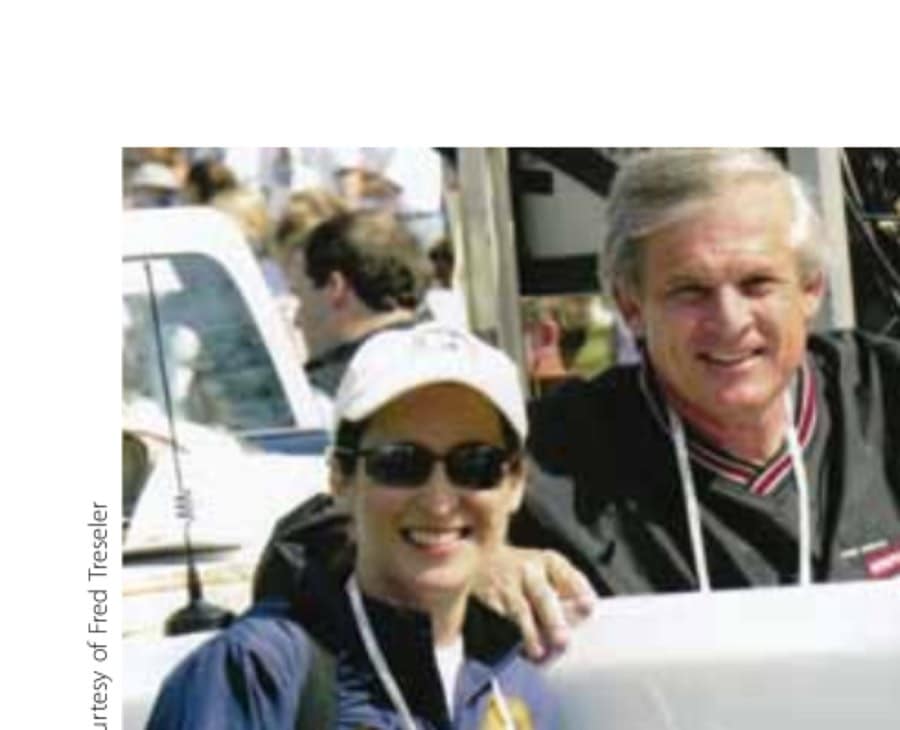
Lead vehicle commentators WBZ-TV news reporter Peg Rusconi and Spotters Network cofounder Tim Kilduff prior to the Boston Marathon.
Boston’s Fourth of July concert and fireworks. The Boston Marathon was considered a news event. “That’s another critical element,” Kilduff said. “The stations covered the race like an event, not like a competition. One of the pitches we made to ’BZ was you have to start covering this like a sporting event. That was a major shift.” While unheard of then, it was one of the more obvious points that needed to be addressed. “We convinced [WBZ-TV] to take their news team and put it aside and bring in their sports team. It was huge!” said Treseler. “No one in television had done that in the US at that point. Everybody always used it as a showcase for their anchors because they thought it was good business. You wouldn’t ask your news anchors to go cover the playoffs in the NFL, but here they were asking their news anchors to go cover something that only happened once a year, and they really didn’t have a big affinity for it.” WBZ-TV was and is the only station to employ the
Spotters Network. “It’s too bad the whole pressroom at the finish does not use our network, as it is faster and more accurate than whatever system they are using,” Switzer said. Treseler adds, “We have different requirements. We were in a competitive situ
ation with two other stations. As they disappeared, the competition that ’BZ has fostered has been against itself to do the best possible job covering this race. And to do that, you need information that is timely with the pictures you’re showing.”
Jennifer Street, a former producer at WBZ-TV, welcomed the advantage of having the Spotters Network during her years there. “The marathon remains the only live sporting event for which WBZ did live, wall-to-wall coverage,” she said. “The commentators need confidence that the in
formation they are receiving and transmitting is timely, accurate, and newsworthy!” Switzer said the Spotters Network had also been used at other marathons, including New York and Pittsburgh, and when it was replaced, “the other systems
were not as efficient and thorough. The Spotters Network is a treasure!”
This article originally appeared in Marathon & Beyond, Vol. 18, No. 2 (2014).
← Browse the full M&B ArchiveMore like this
1,000+ stories from 19 years of Marathon & Beyond
The complete archive of the legendary long-distance journal — digitized and free to read.
