

Crewing For Pamreed
Runners who want to take on the challenge of an ultradistance race have a couple of options. The obvious choice is to enter an ultra event; the alternative is to crew for an ultrarunner. Both running and crewing at an ultra is an around-the-clock commitment where many things can and do happen. However, crewing should be taken on as a labor of love that brings a different type of satisfaction than what comes from crossing the finish line.
Legendary ultrarunner Pam Reed, whose career has spanned more than 20 years, places a high value on her crews. A tenacious competitor, Reed has the utmost respect for her crews. Crewing requires skills such as problem solving, adaptability, and endurance. “In my opinion, it is harder to crew and pace than to run the thing,” says Reed.
Reed believes a supportive crew is invaluable. However, it has taken her awhile to fully realize all the benefits. In the early part of her career, Reed spent many years going it alone or enlisting the support of her husband, Jim Reed. A typical race went like this: Jim would meet Pam along the course, hand out whatever she needed, jump into his vehicle, drive to another location, and repeat, often with a few of their kids in tow.
Pam and Jim agree that crewing for family hasn’t always worked. It can be difficult for family to stay fresh and positive after crewing a lot of events, not to mention the emotions that can surface during an ultra. “You behave differently with family,” says Pam.
Jim has done so much crewing for Pam that it is no longer a novelty, and he admits that the experience can be nerve-racking at one end of the spectrum and boring on the other. Competitive by nature, Jim wants to see Pam succeed and savors the successes. According to Jim, crewing for a family member can be the “best of the best” experiences or the “low of the lows.” Still, Jim realizes that for some, crewing is new and exciting and that a lot can depend on the personalities of the individuals.
From independence to crew dependence Since her days of being independent, Reed has benefitted from crew support at more than a few events. For example, Reed set the American women’s record of 490 miles at the Self-Transcendence Six-Day race held in Queens, New York, in April 2009. She finished second to the Australian Dipali Cunningham who, pushed by Reed, logged 513-plus miles to break her own record. Reed is also a six-time finisher and two-time winner of the Badwater 135 where, in 2002, her time of 27:56:47 beat the closest challenger by nearly five hours.
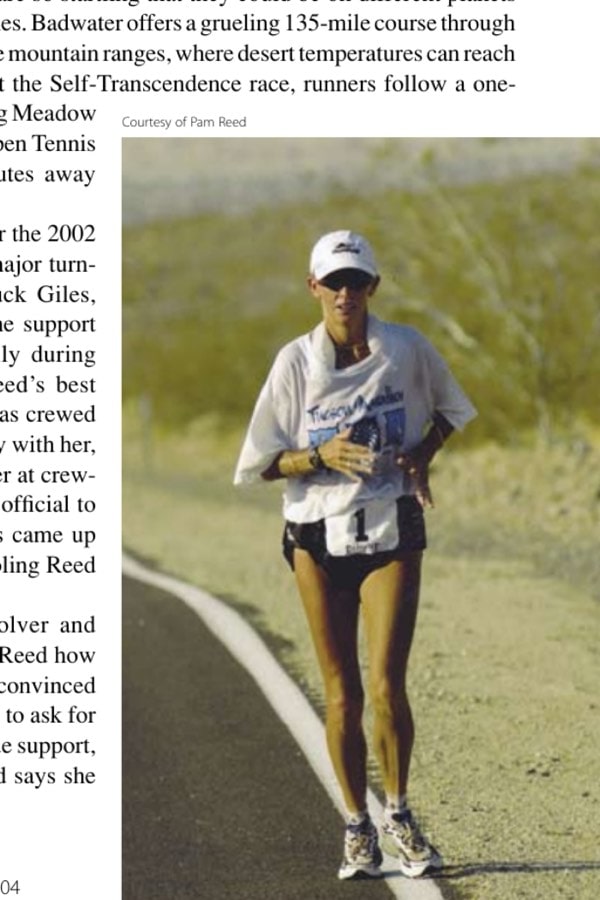
The contrast between running and the crewing conditions at Badwater and the Self-Transcendence event are so startling that they could be on different planets instead of different time zones. Badwater offers a grueling 135-mile course through Death Valley, covering three mountain ranges, where desert temperatures can reach 130 degrees Fahrenheit. At the Self-Transcendence race, runners follow a onemile loop course in Flushing Meadow Courtesy of Pam Reed Park, the site of the U.S. Open Tennis Tournament and just minutes away from LaGuardia Airport.
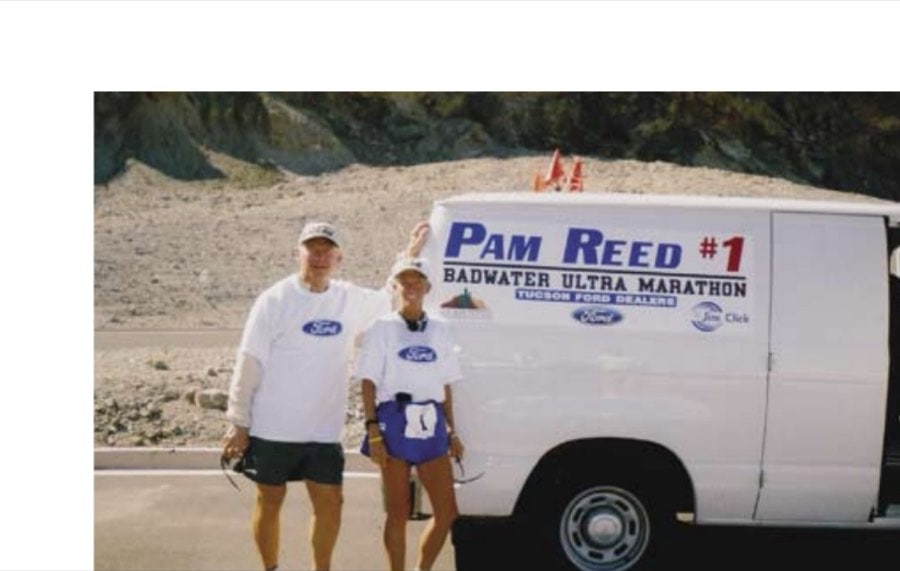
Reed’s decision to enter the 2002 Badwater race became a major turning point. Thanks to Chuck Giles, Reed learned to rely on the support of others outside of family during an event. Susy Bacal, Reed’s best friend and someone who has crewed for and traveled extensively with her, describes Giles as “a master at crewing.” From Badwater race official to crew chief for Reed, Giles came up with new strategies for cooling Reed down at Badwater.
A creative problem solver and ultracyclist, Giles showed Reed how to work with her crew. He convinced Reed that it was acceptable to ask for and expect a crew to provide support, whatever your needs. Reed says she
▲
Pam Reed cruising at the 2004 Badwater.
had to get over her embarrassment at feeling like a “prima donna” whenever she made a request. “Chuck would say the crew cannot win a race for the runner, but they could lose it for them,” says Reed.
When Giles was ready to pass the job as Reed’s Badwater crew chief to someone else, Bacal stepped in. She was on Reed’s 2002 Badwater crew and had watched Giles in action. Bacal says there can be only one crew chief, or as she jokes, “control freak,” to watch over Reed and the crew. She adds that the crew chief needs to be someone whom Reed trusts and who is willing to do anything that she asks.
When Reed enters an event, Bacal knows that the goal is to win, and she does everything she can to make that happen. At Badwater, Bacal stays focused on Reed’s goal, her hydration and nutrition intake, and the crew’s hydration and pacing schedule for those who run with Reed.
Bacal takes charge starting with the arrival at the Las Vegas airport. After picking up the rental vans, it’s on to Walmart for power shopping, ultrarunner style. The shopping cart gets filled with Reed’s standard items, such as Ensure and Red Bull, as well as other supplies of the latest favorite food that might be easy to digest during the run.
When someone like Giles or Bacal is at the helm, it benefits Reed as well as the crew. Reed knows that a good crew chief will take care of everything and everyone, which allows her to concentrate on running. “The crew needs to take care of themselves as much as they take care of you,” says Reed. “Runners are really counting on them.”
The high-energy Bacal fits the role as Reed’s go-to crew chief right now. She believes the qualities of a good crew are the ability to listen, to do anything that is asked, and to come up with good ideas. Why does Bacal crew for Reed? “Because she asks.”
Badwater 2005 Tucson-area residents and runners Doug Kelly and Jim Cady joined Reed’s crew at Badwater during different years. They were both new to crewing and didn’t know what to expect. Both Kelly and Cady are willing to crew again, although they agree that there was very little free time during the event.
At Badwater 2005, Kelly’s fellow crew members included Giles as the crew chief, Bacal, and a few others. He recalls that Reed left much of the planning to her crew. The crew would give Reed small amounts of Red Bull and Ensure three to four times each mile. “The thing about Pam is that she just keeps running,” says Kelly.
The job that Kelly most enjoyed at Badwater was running with Reed. It offered a chance for Kelly to stretch his legs and avoid what he thought to be the
Courtesy of Pam Reed
▲ “Badwater Guru” Chuck Giles with Pam Reed.
toughest assignment—preparing drinks in the van without allowing sweat to drip into the cup. During the race, Reed asked for status reports on the other runners. In 2005, Scott Jurek was setting a blazing pace, and Reed realized she would not be able to win. However, she wanted to be the first female finisher and knew that Monica Scholz was somewhere behind her. Reed finished fifth overall at 30:29:55, over seven hours ahead of Scholz. Jurek set what was then a course record at 24:36:08.
Kelly learned several things from his crewing experience, such as how to get along without sleep for 30 hours and still keep up with the busy schedule. It was also interesting to watch the other crews that would, in turn, be observed watching Reed’s crew. Kelly noticed that some runners were not getting the same level of support from their crews as Reed was getting.
There was another valuable lesson for Kelly at Badwater. He had never run an ultra and was curious about what to eat and when. “If you are going to do an ultra event, it is a good idea to crew first because you learn a lot by crewing,” says Kelly.
Badwater 2008/2009 When Cady joined Reed’s 2008 crew, he didn’t know anyone else except Bacal, who was the crew chief. He recalls that Bacal kept the crew on a rotation of
Courtesy of Pam Reed
running two or three miles with Reed. Rather than for pacing, the runners were there to help Reed pass the time. Cady says that Reed likes to listen to stories, and he struggled to think of an interesting tale.
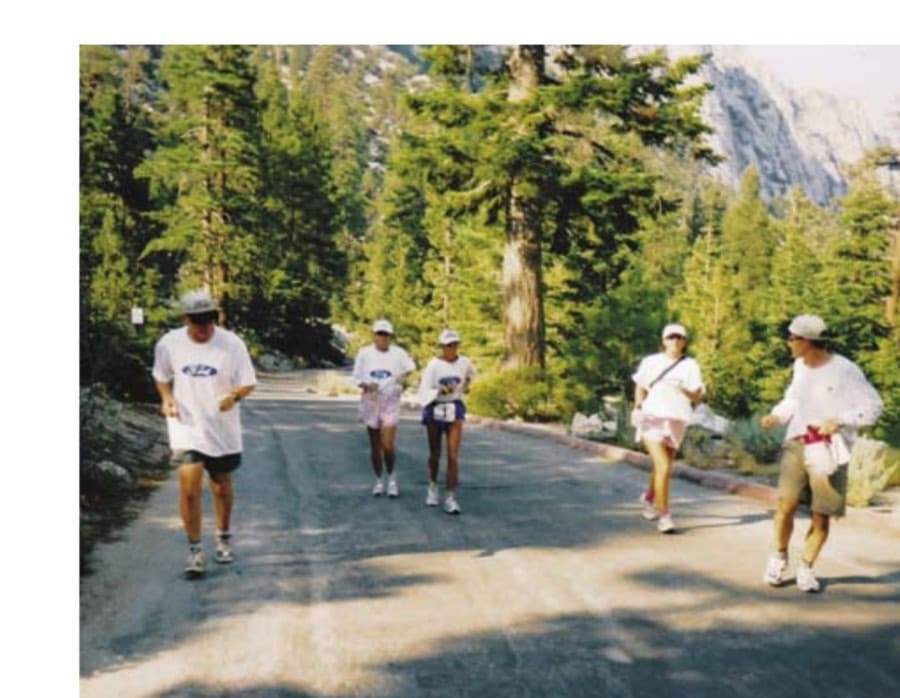
Cady describes crewing as a series of ups and downs with an underlying sense of urgency when supporting an elite runner. Reed never stops, and her crew always needs to be ready to supply nourishment in small doses and often. “We looked like cockroaches running out of the van to give Pam whatever she wanted—pudding, mashed potatoes, Ensure, Red Bull, club soda,” says Cady.
His advice to people who wish to crew is to remember that you are in a support role and not on vacation. The hardest part of crewing is to remain energized and encouraging throughout the event. “Put your own biases and irritations aside,” says Cady. “Your only reason for being there is to aid, support, and encourage your runner.” Cady, who crewed for Reed at Badwater in 2009 as well, views his crewing experiences as extremely rewarding and inspiring.
▲ Pam Reed and the crew “pulling” her to the finish line.
ad
From Badwater to Self-Transcendence Reed entered her first Self-Transcendence Six-Day event in 2009 knowing that she had to recruit a crew that would have a much different experience than at Badwater. On the plus side, the mile-long course eliminated the need for crew to have transportation at the event. However, Reed needed to eat real food, and often, to keep up her energy level. Her crew had to take charge and endure long days.
Reed looked for crew to fill three two-day shifts, in order to keep them fresh and avoid too much of a time commitment. Despite some challenges, it worked pretty well. A variety of weather fronts came through the area, bringing heat, cold, humidity, and rain.
Marlee Bisbey, a cyclist and licensed massage therapist, crewed for Reed the first two days in New York. Bisbey has a good deal of crew experience, including crewing for Reed at the 2008 Badwater and at multiple RAAMs, the annual transcontinental bicycle race. She also has raced at RAAM on tandems with blind athletes, which has helped her to understand the importance of having a crew to support your goals. “I’ve always crewed because I want to see athletes achieve their goals and do that in some truly memorable races,” says Bisbey.
As the first crew at the Self-Transcendence event, Bisbey traveled with Reed to New York and helped her set up on-site. Bisbey describes the experience as
intense. Reed took in a small amount of nutrition on almost every loop, and with one full-time crew member, it was a challenge to keep up with those needs. Bisbey recalls that the female winner, Dipali Cunningham, operated with two crew members. Cunningham appeared to watch when Reed took rest breaks and kept hers just a little shorter, which added up to an advantage over a six-day period. With an additional person on-site full time, Bisbey believes, it would have been possible for the crew to rest more often and keep a closer watch on the competition.
Self-Transcendence 2009, days three to six
Courtesy of Pam Reed
On the third day, Mary Croft, an ultrarunner and retired nurse, arrived at the event. Croft says the one-mile course forced the crew to be “on the ball” and ready for Reed every 10 to 11 minutes. She describes Reed as someone who is “low maintenance” to crew for, usually letting Croft know what she wanted. When she first arrived, Croft needed to call on her medical background to help Reed get treatment for an untimely bladder infection. Croft worked with the medical and homeopath resources on-site to get the necessary antibiotics and homeopathic treatments for Reed, which relieved the symptoms and cleared up the infection.
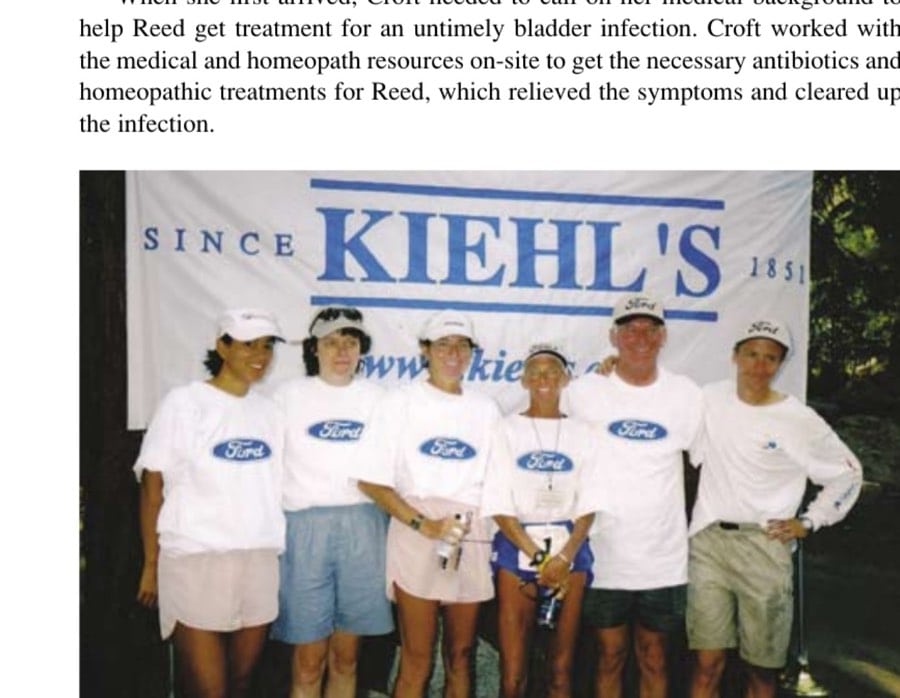
▲ Pam Reed with the team it took to win Badwater in 2004.
According to Croft, the working conditions for crew at the Self-Transcendence event were very nice, from a full kitchen where crew could heat and prepare food to the excellent medical support. The Sri Chinmoy community hosted the event with the runners’ needs in mind. A number of curious spectators who visited the park encouraged the runners.
Some additional unexpected and much-appreciated support came from a couple of young men who worked at a nearby office. The two guys would stop by on their lunch hours or after work, which allowed Croft to take a break. Croft says the guys also served as a great local connection, picking up burgers for Reed when she requested them. Reed’s portions were always small, and most of her nourishment came from other items, such as tomato soup, club soda, oatmeal, toast, eggs, Red Bull, and XOOD sports drink.
Croft relied on her ability to be positive and encouraging during the SelfTranscendence event. Other skills that have helped Croft crew are her medical training and running. “It helps to be a runner and to have participated in 24-plushour events to appreciate how a crew can support you,” says Croft.
During the last two days of the Self-Transcendence event, Reed’s husband, Jim, was her crew, and the local guys continued to stop by to offer support. It was a challenging time for runner and crew as wet weather moved in along with the frustration of knowing that Reed was falling behind the leader. In the end, along with setting the American women’s record for the Self-Transcendence Six-Day event, Reed and her crew had learned a lot.
The rewards of crewing During the six times that Reed has finished Badwater, dozens of people have crewed for her. Some she has known fairly well, and others have signed on to get experience at the event in hopes of running it. There have also been those serendipitous occurrences when individuals who were not full-time crew members have proved to be helpful and, in turn, were motivated by their experience at an ultra event.
Reed looks for some common traits in people she asks to crew for her. Overall, Reed’s crews are positive, smart, and in good physical condition. They also possess another valuable component—time. To ask someone to give up time to support her is still difficult for Reed. “It’s asking a lot of someone,” she says.
Crewing is another way to enjoy running. It brings the rewards and challenges that runners typically face, except that your efforts go toward the selfless support of someone else. The crewing experience can also give you the confidence to enter an ultra event in the future. If you are looking for a new challenge or just want to see what it’s like to be part of an ultra, maybe it’s time to add crewing to your bucket list.
This article originally appeared in Marathon & Beyond, Vol. 14, No. 4 (2010).
← Browse the full M&B ArchiveMore like this
1,000+ stories from 19 years of Marathon & Beyond
The complete archive of the legendary long-distance journal — digitized and free to read.
