

Curto Runs Boston
Boston Marathon 2013. Horrid images come to mind: a backpack, a runner falling as police scramble, a man holding a bloodied flag, smoke. It’s hard to look beyond the tragedy, as if in remembering that there were things to celebrate we might be forgetting those who suffered. But under it all, last year’s Boston Marathon was still the Boston Marathon. And what it’s famous for happened that day as it has for the past 117 years: ordinary people achieved greatness.
On that first true day of spring after a long New England winter, I was standing on Hereford Street (the last turn before the final stretch) waiting for my brother Joe to finish. I remember one of the wheelchair runners struggling up the hill, his arms shaking as the wheels threatened to succumb to gravity. A tough-looking old Boston cop was screaming for him to make it. I remember wondering whether Joe could break three hours, and I remember my sister-in-law saying, “You know, Curto just finished chemo six weeks ago.”
Christopher Curto, 32, of Lambertville, New Jersey, is Joe’s old teammate from The College of New Jersey. They and another former track and cross-country runner from TCNJ, Christian Talag, had journeyed to Boston together in the hope of pushing each other under the three-hour mark. It was a somewhat pedestrian goal for Curto, who had done it in all four of his previous marathons and has a PR of 2:32, until you factor in that he was diagnosed with testicular cancer the previous July and had endured a brutal schedule of surgery and chemotherapy since then.
I hadn’t seen Curto since he was a kid running at a track meet for TCNJ. I knew that he had had cancer but not the extent of the situation. He had actually finished chemo in mid-February after the disease had reached stage IIB, I later learned when interviewing him for this article. And he had gone through two operations the previous summer and fall. The first was to remove the cancerous testicular tissue, and the second was a lymph-node dissection that he describes as being “like no other experience.”
“They have to move a lot of organs out of the way to do the surgery,” he said. “And when you’ve been handling major organs, they don’t work so well right away. I was a mess from the surgery itself.”
But Curto had faced adversity before. “When I was diagnosed last summer, I was at a time where I was like, ‘OK, this is what’s going on. I’m just going to go forward.’ Athletics prepare you. As a runner or anyone else, there are advantages and obstacles. You have to get through the obstacles. Running is a metaphor for life. Sometimes you achieve your goals and sometimes you don’t.”
When Curto was only 19, his father suffered a stroke and died after several days in a coma. “Then I had a major lesson in overcoming adversity when I was sitting next to Chris when the second tower came down on 9/11,” he says, referring to TCNJ teammate Chris Ludwig, whose father was killed that day.
Curto recalls the team meeting with then cross-country coach Steve Dolan that afternoon. “He told us we didn’t have to do the workout. But we did. [Ludwig included.] All you heard was silence and the sound of spikes on the track. It was eerie and strange, but it was what we had to do.”
The pinnacle of Curto’s college career may have been making the steeplechase finals at Division III nationals. But those college years were defined by something greater. “Chris and I ran on our own a lot that year,” he says of the aftermath of 9/11. “And I was able to talk with him through things as Joe had done with me.” (My brother Joe was also only 19 when our father died a couple of years before Curto’s.) “To me that was the epitome of college running. Those experiences prepared me for life in general.”
Not surprisingly, many of the TCNJ guys stayed pretty tight after college. They kept running, too, and in 2007 they decided to run a marathon together. ▲
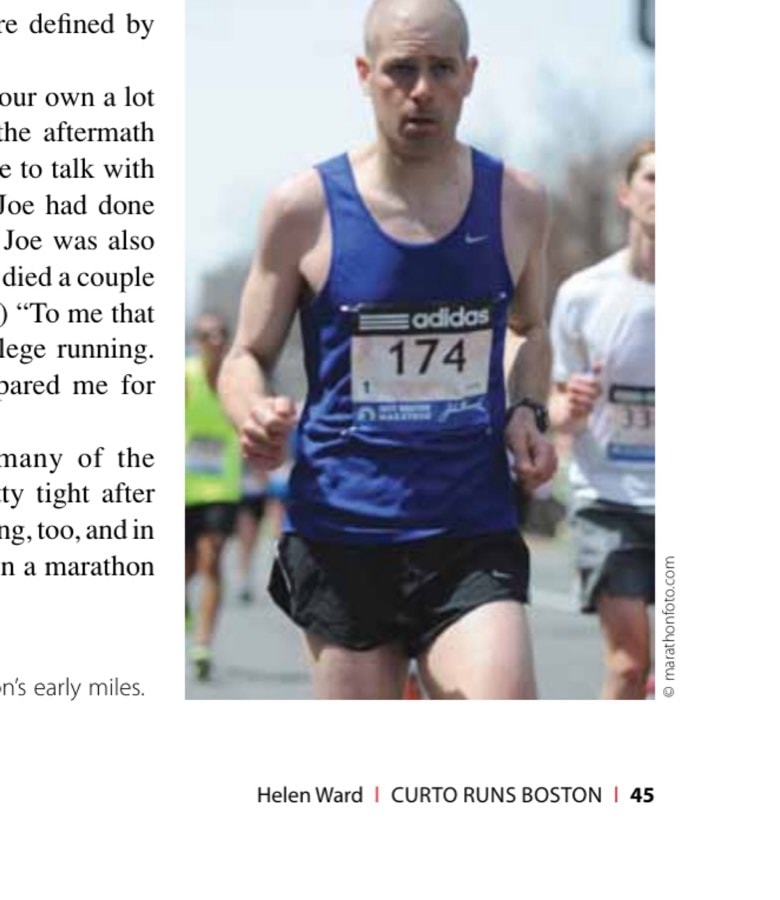
Chris “hammering” Boston’s early miles.
© marathonfoto.com
Pile up the adversities
“It was a classic knucklehead decision,” he says. “A bunch of us were out drinking and we said, ‘We should all do a marathon together.’” They wanted to do New York, but only a few of them got in, Curto among them. Coincidentally, he found himself jockeying during the race with another survivor of testicular cancer, Lance Armstrong. “
I was trying not to pay attention to him, but in Central Park he must have passed me,” he says. “It was a bit disappointing.” But the marathon itself was much more daunting than Lance. “I’d been a distance runner my entire life, but until you run a marathon you can’t get your head around it. I kicked out at a six-minute pace like I was on a track and just died.” Death was a 2:47 finishing time, not bad for a debut.
Together in Chicago The knucklehead decision for a big group of TCNJ alumni to run a marathon together finally came to fruition four years (and for Curto three marathons) later at Chicago in 2011, when Curto ran his 2:32 PR. Several of the guys had qualified for Boston, so that became the next goal. But they were unable to coordinate their schedules until Boston 2013.
Then came Curto’s diagnosis in July of 2012. The doctors wasted no time, and surgery was scheduled a few days later. “I thought, Whatever happens, I hope to be done with it by Boston,” he recalls. But thoughts of Boston had to be put on the back burner. Blood work later indicated the cancer had spread to the lymph nodes. “
In September I talked to a urologist and oncologist, and together we decided on another surgery,” he says. “I hoped to avoid chemotherapy. That word scared me, so I had the lymph-node dissection on Columbus Day.”
A hellish, hazy week in the hospital followed. “All I could do was try to shuffle down the hall a little bit more each day. I couldn’t read or really even watch TV because of the painkillers, but I wasn’t so high I couldn’t understand things. I didn’t want to use the morphine too much because it gave me vivid dreams, which were not at all pleasant. And then I’d wake up in the middle of the night in a hospital bed. That really sucked. “
The second night I woke at 3:00 a.m. in really bad pain, and I didn’t want to take the drugs because they were making me feel so weird. And then if I sneezed or coughed, it was the worst pain.” Among other insertions, Curto had a nasogastric tube. “It was pretty miserable,” he remembers. “And it was a good day when they removed it. I remember being able to have apple juice. It was just ordinary hospital apple juice, but it seemed like the greatest-tasting thing ever.”
The ordeal gave him a slightly new perspective on other things as well. “My brother came to visit and we were talking about that movie Zero Dark Thirty. I’d never thought torture was appropriate, and now I know why,” he said referring to the postsurgical pain. “No one deserves this. And it’s not that what I went through is as bad as that.”
No shortage of visitors But there was a bright side to his time in the hospital. In addition to teaching eighth-grade social studies at Reynolds Middle School in Hamilton, New Jersey, Curto is an assistant track and cross-country coach at TCNJ. And current and former team members wasted no time in showing their support. “
Brock (Chris, a former member and coach) and Steve Dolan were among the first couple of people to come see me in the hospital. And then there was a knock on the door and three guys who’d just graduated came in. It was cool for me to see my old coach shaking hands with the people I had coached.”
And led by captains Andy Gallagher and Mark Sidebottom, the current squad made purple bracelets to show their support. They were engraved with Curto’s motto (which he attributes to Dolan), “Keep the Turnover Going.” “
I had an IV in both arms so I couldn’t put it on, but I did wear it in Boston.” I asked him if Boston crossed his mind during any of those days. “If it did, it was like, ‘Jeez! I registered for Boston?’ Really, it was one step at a time. I couldn’t think in chunks of months. I was just thinking of getting the next tube out or walking a little farther down the hall.”
But he did think of running. “I could relate the experience to running. I’m thinking, I’m going to be uncomfortable for a period of time, and I’m going to get through it.” Complications after this operation sent him back to the hospital a couple of weeks later. While staying at a friend’s because he had lost power during Hurricane Sandy, he “felt weird and kept throwing up.”
It turned out that lymph fluid was leaking into his abdomen and pressing on his intestines. “I was begging the doctors to let me out by Tuesday (Election Day) so I could vote,” he said. “Half of me wanted to vote, and half of me just wanted to get the hell out.”
He was released and “headed straight to the polls,” but he had to wear a lymph bag until late December. And the first thing he did when it was removed was to go for a run. “I texted Christian (Talag) that it was the best and worst run of my life. It was just a couple of miles along the towpath near the Delaware/Raritan Canal. And it was the best because I felt so free but the worst because I hadn’t run a step since the beginning of October.”
No more avoiding chemo But more obstacles were ahead. “From the size and spreading in the lymph nodes, it was looking likely that I was going to have to have chemo.” He went in for the first round toward the end of January, taking only treatment days off from work and reporting that he felt “lazy” those days. In an act of folly most athletes could relate to, he tried to run between chemo sessions. He now refers to that attempt as “the near disaster in the woods.”
The TCNJ team was doing a long run. Curto was hoping to tag along for just a mile or two and head back. “I was feeling fine,” he says, “normal. Then after a mile I’m thinking, OK, you don’t want to do too much here.”
As he headed back to the parking lot where they had started, he passed two team members coming the other way. He couldn’t remember their names. Then he had to walk. He had a head rush and his vision started to fade. “
I was thinking, What the hell did you do to yourself?” he says. “For elite athletes (or anybody), this is how you can get into trouble,” says his oncologist, Dr. Jean Hoffman-Censits, of Thomas Jefferson University Hospital in Philadelphia. “They’re used to a certain oxygen capacity, and they don’t have it.” According to Hoffman-Censits, this can last from weeks to months after treatment, depending on the individual.
Curto made it to the parking lot, and that was his only run before round two of chemo, which he completed in mid-February. He was a bit wiser on his next postchemo run, testing his strength on a short stretch of campus known as “The Inner Loop.” “
I said to the guys, if I’m not back in 15 minutes, come and get me,” he jokes now. After chemo, he also struggled with side effects: buzzing in his ears, aching bones, and hair loss. “I just shaved it all off and wore a hat,” he says with characteristic pragmatism. “It was wintertime.”
Symbolically, his first good run after treatment came at Boston. He had gone for a meet in early March where one of his athletes was trying to qualify for indoor nationals in the 800 meters. Goal achieved, coach and athlete went for a quick warm-down around the city. “It was my first normal-feeling run since October.”
Thoughts of Boston I asked him if he started thinking about Boston then. “Well,” he said, “I was just trying to get back into running and then see if I could go longer.” The marathon was six weeks away. His first long run came a couple of weeks later at Washington Crossing Historic Park where he joined Joe and Christian for 13 miles of their 20-mile run. “I was
© marathonfoto.com
hurting after it,” he says, “But I was a lot more confident than the day before, like, ‘I can kind of do this.’” The following three weekends he would do three more long runs, including an 18-miler eight days before the race. “There was no reason to taper,” he said. “I hadn’t put in that much work.”
Still, he was chucking out 50- to 60-mile weeks on the heels of chemo and a training break of almost six months. By mid-March he had popped straight back into daily eight-mile runs. He admits that, “It goes against everything I tell my athletes.”
When I asked him what his oncologist thought of his Boston attempt he said, “I didn’t tell her,” which does make you wonder whether this was a good idea. Both chemotherapy and marathon training tend to take a toll on your immune system.
Hoffman-Censits says chemo rounds proceed in 21-day increments, which is the usual time frame for getting the immune system back to a safe level regarding white blood cell count. Three weeks after a treatment, a person can most likely resume ordinary activities, although it depends on the case. “
But we didn’t know he was going to do what he did,” she says. Her first reaction in the light of everything that happened that day was, “Oh, my God. You were there and you’re OK.” She also says she expected that Curto, as a young fit athlete, would bounce back quickly. “What Chris did inspired us. We do what we do so people are able to get to their life’s goals.” “
When he was starting treatment we didn’t know what he’d have to go through,” says his girlfriend and fellow TCNJ
▲
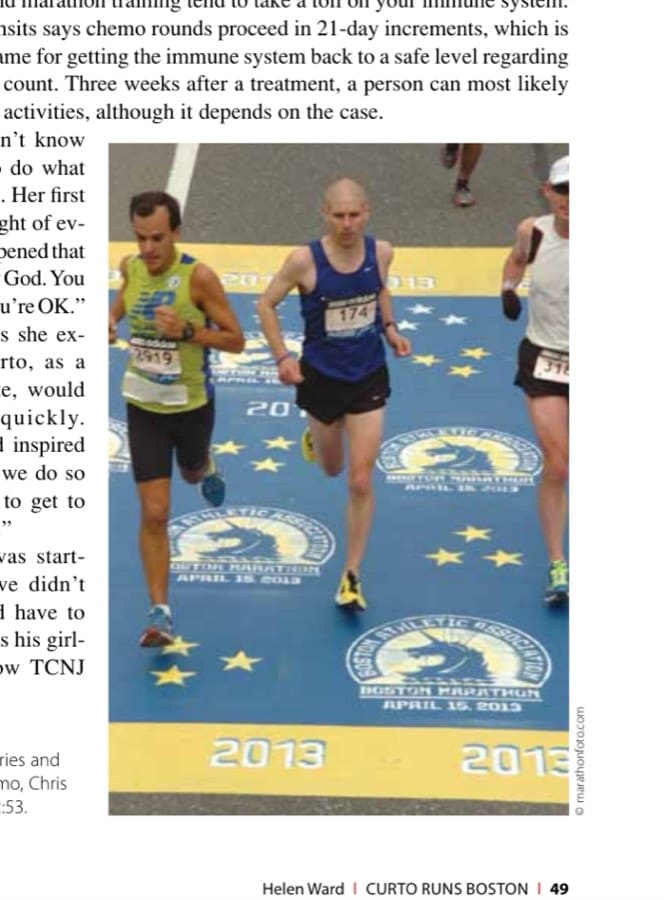
After two surgeries and two rounds of chemo, Chris finishes Boston in 2:53.
coach, Martine McGrath, who also ran Boston last year. “Boston seemed so far away, but it was probably a good thing. If anyone else of my family or friends were doing this, I might not support them, but running is such a part of him. I think it may have been helping him to focus on the marathon and not on treatment.”
Realistic goals Joe had been more skeptical. “I didn’t want to talk him out of it but wasn’t sure it was a good idea. He did his first long run the day I did my last one. Obviously, he wasn’t going to improve his time, but it’s still a big thing to run a marathon. His natural talent just came through.”
Curto knew a PR that day was out of the question, so instead he focused on helping his friends get theirs. “We were trying to run together,” he says. “And we kept each other in sight for about four miles when Joe started having some calf trouble. Then at about mile nine, Christian went to get water and I lost him.”
But Curto hammered on. “You’re in Boston, you have to go. . . . As you get toward the city the crowd starts building on itself. That’s the Boston Marathon, all these people out on Patriots’ Day, cheering for you. I just remember waiting for that turn (just before the finish) and then seeing the flags by the finish line, and it doesn’t matter how you feel . . . toward the end your competitive instincts just kick in.”
Curto crossed the line in 2:53:10. When he turned around a few seconds later, he saw Talag coming down Boylston Street. “He threw his hands up and gave a yell coming across the line. And two minutes later, here comes Joe,” Curto recalls. “The three of us hugged. It was huge going through this with two of your closest friends. The three of us were on top of the world. Those two guys PRed and I finished after what I went through.”
After retrieving his bag, Curto ran into a couple of TCNJ students who had made a five-hour drive that morning to watch him run. His phone was full of texts from students and friends congratulating him and saying he had inspired them. “That’s when it hit me that I just did something,” he says.
As the whole world knows, any elation that day was short lived. Just over an hour later, when Curto joined up with some friends in a bar near Copley Square, a woman rushed past, nearly knocking him over. “
She went up to a cop and said there were two explosions by the finish line.” Curto had been getting changed in the bathroom and hadn’t heard the bombs go off. He didn’t panic. He didn’t know at that point that it had been a bombing, but he knew he had to find Martine, who was in the medical tent being treated for dehydration. They were able to speak by phone and arrange a rendezvous just before cellular service was cut off.
© marathonfoto.com
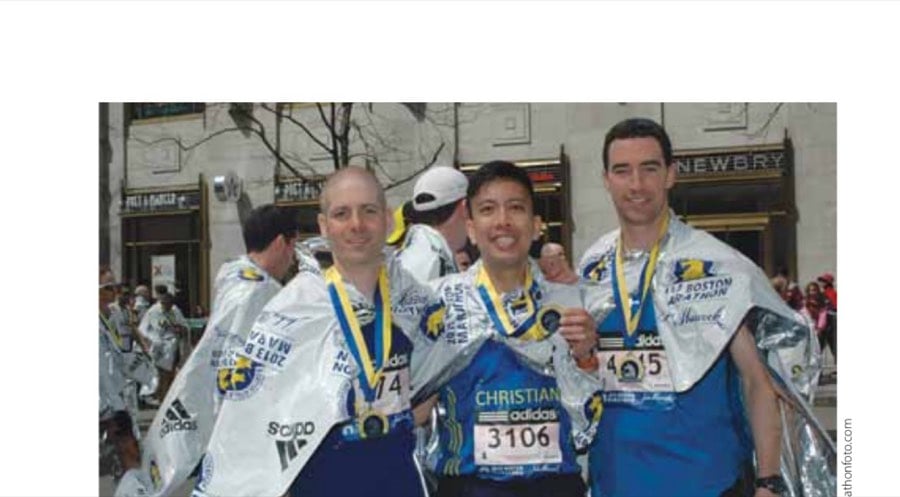
▲ Chris and his friends Christian (center) and Joe (right) enjoy a postrace celebration that would prove to be short lived.
Curto, Talag, McGrath, and some of her friends began to make their way to the Westin Waterfront where they were staying. But they didn’t know the city. “We were flying blind,” Talag recalls.
Offering some help A couple of blocks into their three-mile trek to the Westin, they came across a young woman sitting on the curbside, crying. One of their party, Mel Ullmeyer of Long Branch, New Jersey, approached her to see if he could help. “
All she had was a subway token,” remembers Ullmeyer. “She was from Utah and had just finished the race. She was cold and tired, and she was unable to go back and get her bag. And she didn’t know how to find her friends, so we just sort of grabbed her and brought her with us.”
As they walked, reports of what had happened were beginning to circulate. Curto says the staff at the Westin was great. They gave the woman from Utah a place to shower and rest. (Martine and her friends had given her some clothes.) Later they organized a taxi to take her back to her hotel.
The evening was one nobody could have anticipated. The lobby was full of people in marathon jackets and Red Sox gear, dressed for the party that is Patriots’ Day. “Everyone was quiet,” Curto says. “You didn’t want to say something in front of the wrong person. You didn’t want to talk loudly. It was like being at a funeral. The TV kept showing the bombing from the perspective of the finish line with the flags, and we were just right there.”
What is someone left with after such a day? “That day is such a tribute to the greatness of humanity,” Talag says. “And the spectators are there selflessly to support others. And then there’s this rupture in the fabric of humanity. There’s this virtuous circle of love that has been broken. The only way I can close that loop is to do it again.” “
That day means two different stories to me,” says Curto, “but I realize that even if I hadn’t achieved my goal, what mattered was that I was walking away with my friends. In fact, what I learned from this whole experience—from first being diagnosed until finishing the race—is what friends and family mean.”
And that means (among other things) that if not for his grandparents, who packed his lunch and drove him to treatments, or his mother and brothers supporting him through some of the toughest moments, or his eighth-graders who wore “Care for Curto” T-shirts to their Valentine’s dance, or his fellow alums and current athletes who encouraged him every step of the way, “There’s no way I would have recovered as well as I did.”
This year Curto and his friends will all be heading back to Boston to “close that loop.”
Postscript
© Brandon Rodkewitz
Chris Curto has been in remission from testicular cancer for several months. He is still teaching full-time and coaching track and cross-country at The College of New Jersey. He is heading back to Boston this April to pay tribute to the city’s strength and hopefully PR in the process.
▲
Chris takes a break from his training last autumn at TCNJ.
This article originally appeared in Marathon & Beyond, Vol. 18, No. 2 (2014).
← Browse the full M&B ArchiveMore like this
1,000+ stories from 19 years of Marathon & Beyond
The complete archive of the legendary long-distance journal — digitized and free to read.
