

Curves in the Canyon
More curves in the canyon already replete with curves? Oh yeah! As young as 19, as seasoned as 68; 27 states represented in a collage of feminine beauty; the kind of beauty identified by courage, class, and especially a capacity for fun. The first all-women’s marathon in South Dakota began at 6:30 in the morning at the Lead Country Club, and things went downhill from there.
From running a race to “running” a race. What was I thinking? Just because I had successfully completed running 108 marathons, why did I think I could run one? Because ignorance is bliss, hope springs eternal, and fools rush in where angels fear to tread. I knew it was a good idea, the time and place were right, and I don’t work in the summer anyway. What could be so difficult about staging a marathon? Ha!
The genesis of this gargantuan endeavor? Having enjoyed thousands of training miles in the tranquil beauty of Spearfish Canyon, I chose a 26.2-mile stretch to celebrate my birthday, and soloed it. Well, not quite solo, but with the mobile aid station/cheering squad of Jerry and Baron at two-mile intervals. (They are my husband and my dog, in that order.)
SHARING A PLACE OF BEAUTY It was a glorious experience! Not only breathtaking in beauty, but peaceful, quiet: a gentle downhill journey with just two short uphill segments (to put the toes back in the shoes) and a tree-bowered finish into Spearfish Park. Accompanied the whole distance by the cheerful chuckle of pristine Spearfish Creek, a healing massage in its icy ripples was another finish line perk. So in the heady intoxication of a glorious run, high on all-natural endorphins, I decided a course like this was too good to keep to myself, I must share with my sisters.
Thus was born the Leading Ladies’ Marathon (everyone’s a star!), South Dakota’s first and only marathon just for women. Beginning at the Lead Country
Kate Axlund
▲
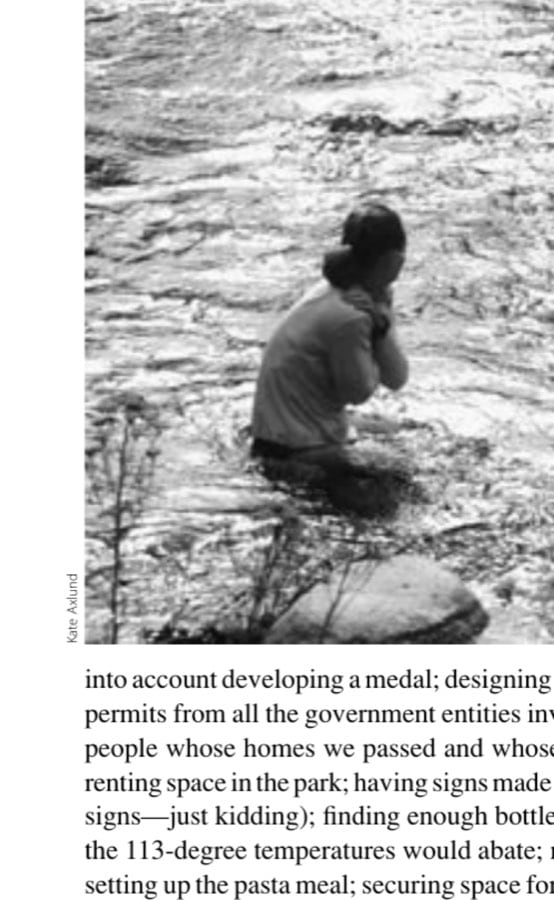
Race winner Tracy Stewart of Colorado cools off in Spearfish Creek after her blazing 2:57:17.
Club and serpentining down the Spearfish Canyon Scenic Byway where Hollywood’s Dunbar danced with his wolf, it was made even more beautiful and scenic by the women who came to run. And what an education the
whole experience has been. Five thousand details add up to an impression; little did I know those first 5,000 details provided only for the advertising, sponsorship, and volunteer recruitment. That doesn’t take
into account developing a medal; designing the shirt; certifying the course; getting permits from all the government entities involved; securing the goodwill of those people whose homes we passed and whose silence we momentarily desecrated;
renting space in the park; having signs made (mile markers; Caution, Curves Ahead signs—just kidding); finding enough bottled water; begging for ice; praying that the 113-degree temperatures would abate; reserving buses; renting porta-potties;
setting up the pasta meal; securing space for a speaker; getting food; orchestrating registration; manning packet pickup; finding people to stuff goody bags; ordering homemade chocolate truffles (OK, admittedly could have skipped that, but one
entrant I interviewed admitted she came for the chocolate); negotiating affordable long-stemmed roses; ordering bib numbers; finding a timing crew; establishing a domain name; setting up a Web page; designing a trophy; setting up the expo;
and determining how to get people in and housed the day after rally week! You’ve heard of rally week, where 100,000 motorcycle riders descend on Sturgis, just 17 miles from Spearfish? Just how do race directors do it, anyway? I promise to genuflect to each race
director I meet from here on out. But visualizing, orchestrating, and actualizing a marathon do represent the actual marathon experience in many ways; perhaps, then, it is a training ground for “running” one as opposed to running one. The training and planning are rig
orous, relentless, and critical. The vision for each must be solid, immutable, and
huge. The desire to complete must outweigh ennui, exhaustion, and negativism; and the resources for each must be renewable, rejuvenating, and reasonable. As with a marathon, you can do only what you believe you can do, and so it is with realizing—and actualizing—one for others.
JUST A FEW GOOD PEOPLE
Kate Axlund
Nothing happens in isolation. How many people does it take to put on a marathon? Not a lot, actually—they all just have to enjoy running around, zero pay, long hours, changed plans, the aroma of glow—as we ladies all know, horses
sweat, men perspire, and ladies glow—the pervasive stimulus of estrogen, and the euphoria of a job well done. It helps to have a community that endorses positive endeavors, welcomes strangers to our city, and gives of its bounty in time, talent, and treasure. It’s nice
to have a mayor who will take time to greet the celebrity guest, stay to support the finishers, and step up to eliminate a rude intruder. It’s good to have a husband with expertise in course assembly and finish line construction. It’s imperative to
have a gifted Web master to keep online communication smooth and professional. It’s invaluable to have a colleague who is organized and indefatigable. It’s phenomenal to have a famous friend who drops everything and not only charms the
city with her joie de vivre but also works like a slave all during the production and throughout the mop-up. And it’s delightfully advantageous to have a large family in close proximity.
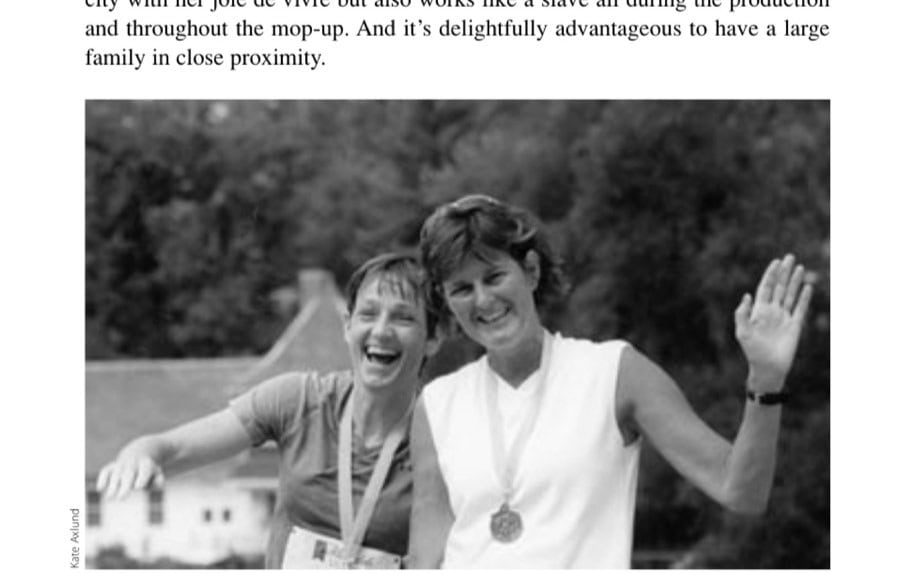
▲ Smiles abound for Le Ann Vette (left) and Deborah Lazaroff after the race.
But mostly it’s powerful to have people who believe in a crazy vision, who endorse and support a far-out idea, and who tirelessly reinforce the shaky foundations of a vision bigger than the person conceiving it. Kathrine Switzer’s initial imprimatur, when I told her what I had planned and asked if she would come: “It’s just wacky enough to work. I’ll be there!” Her sustaining energy and enthusiasm kept me going.
At one point, I e-mailed: “I can’t do this! I’d jump off Lookout Mountain if I could decide what to wear!” And did I get the usual kind and nurturing message to my whining? Noooo! She shot back with: “Great idea! Schedule a press conference and wear the hot pink bra!” There are all kinds of motivation.
WHAT BRINGS AMERICA TOGETHER? From Alaska to Florida, from California to Connecticut, they came to run. Women representing 27 different states gathered in Spearfish with their South Dakota sisters to experience the thrill of the marathon distance in the glorious beauty of the Black Hills. Women who care, women who dare. Women who pit themselves against time and distance to complete the impossible task of running 26.2 miles in a pilgrimage as unique to each individual as the fingerprint of her hand. To each it is a challenge; to each it is a labor; to each it is the survival of soul and spirit. They can, therefore they do.
Marathon Sunday was a perfect day. Keeping the theme consistent with theatrical productions, opening night was a smash hit. Ninety-six women left the parking lot of the Lead Country Club at 6:30 on Sunday morning and began the 26.2-mile trek to the finish line in Tretheway Park, a ribbon of women wending their way down the canyon with supporting actors at every aid station along the way dispensing water, Gatorade, chocolate, and cheers.
On the frivolous side, it was decidedly girls night out. Chocolate at all the aid stations; good-looking men manning said stations—we had bikers, cowboys, cyclists, realtors—a tiny girl-person at the crucial turn to the finish saying, “Follow the arrows I drewed for you!”; hugs from tuxedoed gentlemen at the finish; a pink-ribboned medal carefully hung by matching twin boys; one red rose presented by a gallant elder; and a lemon-scented face cloth offered by a dark-eyed lass with the soft reminder, “You’re beautiful.”
Even bringing up the rear was fun; the last runner was privileged to wear a tiara. She was reminded that it is fashionable to be late, that the queen enters last, that there is opportunity to practice the wave, and that last place is just the slowest winner. Passing someone required giving up the tiara; I had visions of a row of courteous women standing at the finish line saying: “You go first!”
“No, you go first!” “No, really, you go first!” until the moon rose over Crow Peak and the pines became shadows. It was a glorious day, cool for August, a slight breeze, and the retreating bikers encouraging the entourage as they met on the curves in the canyon. The overall
winner took the lead from the beginning, a classic example of athletic grace, her legs beautiful pistons powering through Hanna (once a small unincorporated community developed by the Homestake Gold Mine to support the mine), down the canyon road, and sailing into Spearfish City Park at undiminished speed, a
study in perfect motion. Breaking three hours by more than three minutes, she led the charge of a Boston qualifying time for 22 of her sisters.
CREATIVITY AT THE AWARDS CEREMONY
Kate Axlund
As the final athlete was draped with the final medal, the awards ceremony began. Handcrafted trophies were a star quilt for first place, alabaster stars for the masters, and pine-carved star ladies dipped in cherry Kool-Aid—it’s a color thing—for age-group winners. Resist licking. Kathrine assisted me in presenting the age-group awards; her grace and humor topped off the day as she led the group in a spontaneous rendition of a limerick written—at the finish line—by Sally Gordon, Philadelphia runner, and my daughter Sami Trask, creator of the quilt. It is as follows:
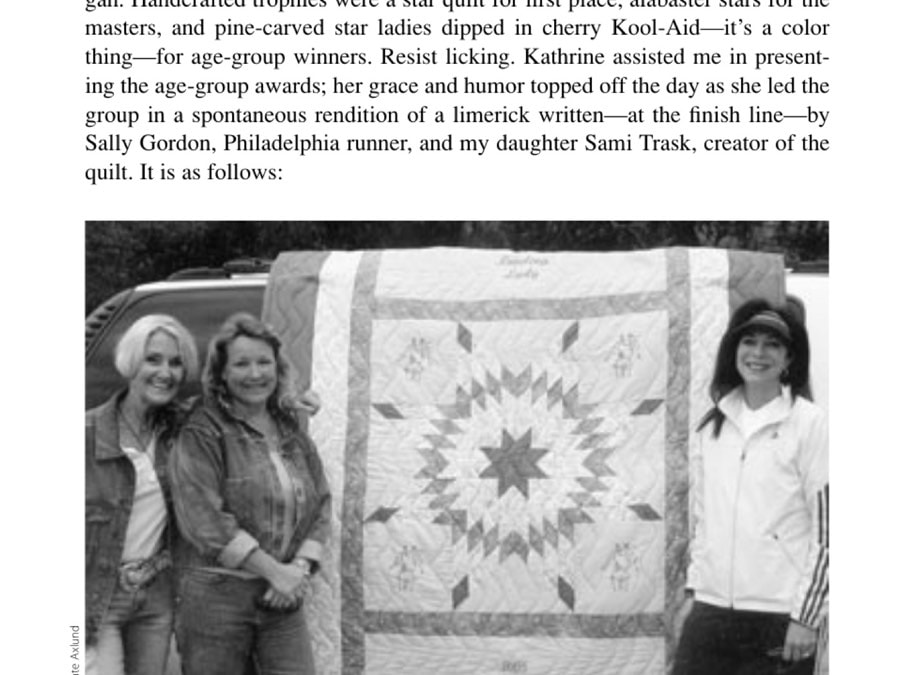
▲ Race Director Elaine Doll-Dunn (left) with her daughter Sami, who made the winner’s quilt, and special guest Kathrine Switzer (right).
Kate Axlund
There once was a gal named Elaine, Who laughed in the face of real pain. She said, “Come to Spearfish, “We’ll all get our real wish.” So we came; we must be insane. It was a breakthrough learning experience not only in being an event direc
tor but in the dynamics of an all-woman run. The supporting actors at the aid stations were amazed at the courtesy—always a thank-you. Never did they cut the tangent, and to a woman, gracious. The women were gratified by the men’s unselfish contributions of time and energy and by the respect and courtesy they
were consistently accorded. The photographer even titled his slide show of our event, “Miles of Smiles,” amazed at the happy demeanor maintained throughout a grueling endeavor. (I know I said it was an easy course, but 26.2 is 26.2, even in paradise.) The youngest runner, a 19-year-old first-timer, doubled over in pain and nausea at the finish line. As I held her up and our marathon physician—her
self a marathon woman—determined she was OK, I said, “So now what do you think of marathoning?” She flipped her long flaxen braid and chirped: “I love it!” Go figure. For me to watch a marathon (first time), to see the finish line from the other
side, to witness the joy on other faces, to worry about someone besides myself—it was an exciting yet humbling experience. Much goes into creating a venue for the wonderful magic that happens when you finish a marathon. I have new respect,
new understanding, and new gratitude to all who put their own athletic goals on hold and make it happen for others. So opening night is a wonderful memory and sleep deprivation a fading nightmare. Will this be a
long-running hit? Let’s hope so. The veterans of the first annual all say they’re coming back next year and bringing friends, the guys want to help again, Jerry is still here, my kids are speaking to me, and I’m up
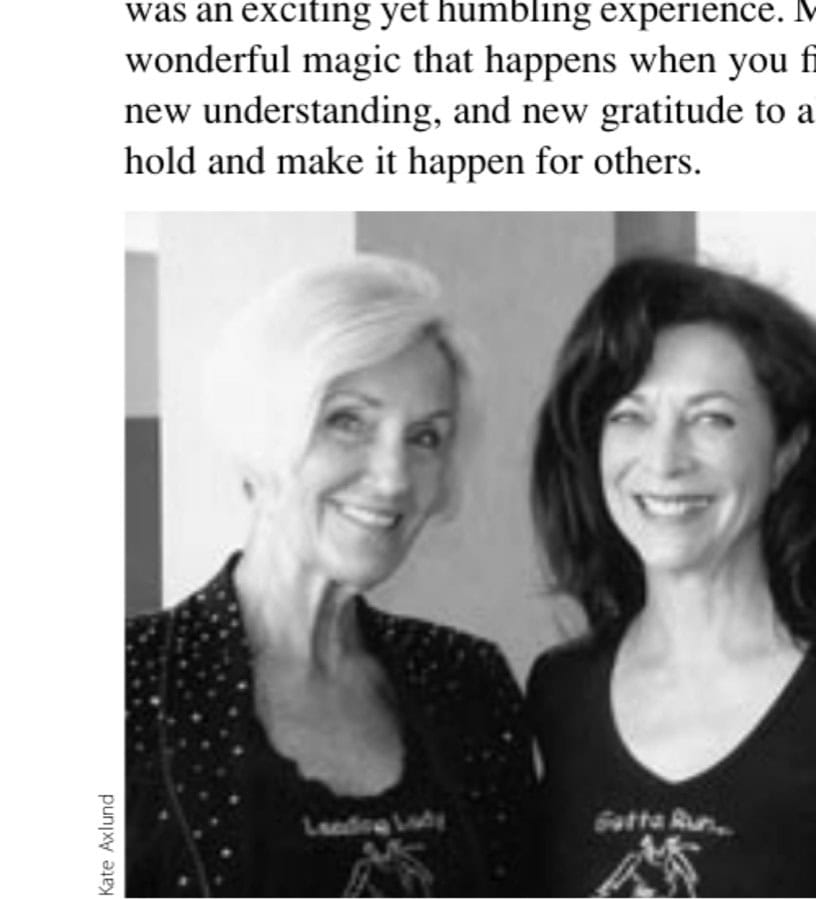
for it. So watch for the sign: “Curves Ahead. The Encore!” ▲ Elaine and Kathrine.
This article originally appeared in Marathon & Beyond, Vol. 10, No. 3 (2006).
← Browse the full M&B ArchiveMore like this
1,000+ stories from 19 years of Marathon & Beyond
The complete archive of the legendary long-distance journal — digitized and free to read.
