

Cycling For Runners
Most of us began running as children, purely for fun. Then we learned to ride a bike, and that was for freedom. A bicycle gave us the ability to visit friends, go places, and establish some independence from our parents.
Then we grew up, and many of us gave away our bicycles. We moved away from home and bought cars. Some of us became runners, and some of us even became marathoners and ultramarathoners. Now it’s time for us to return to our bicycles. Once again, the goal is freedom, although this time it’s freedom from the muscle imbalance, strain, and injury that may result from running.
The goal of this article is not to replace your running with cycling; instead, the goal here is to explain why adding cycling to your schedule will make you a better runner. This article will explain what gear and equipment you need and how to incorporate cycling into your workout routine. By the end you will know all you need to know to get started.
Why cycle? I often wish that I had invented the term “cross-training.” The royalties from its use would have made me a millionaire many times over. There are several good reasons why this term—and the concept—has become so popular. Reduce Physical Stress. Non-impact cross-training relieves the body of the pounding associated with running. For those runners who have suffered injury due to repeated impact, such as stress fractures in their feet, inflammation of their iliotibial bands, or tendinitis in their knees, substituting some of their runs with cross-training workouts have enabled them to continue as runners. Add Variety. As much as we enjoy running, we have to admit that not every run is a joy. Some are just boring slogs. Having cross-training as an option helps
Courtesy of Jeff Horowitz
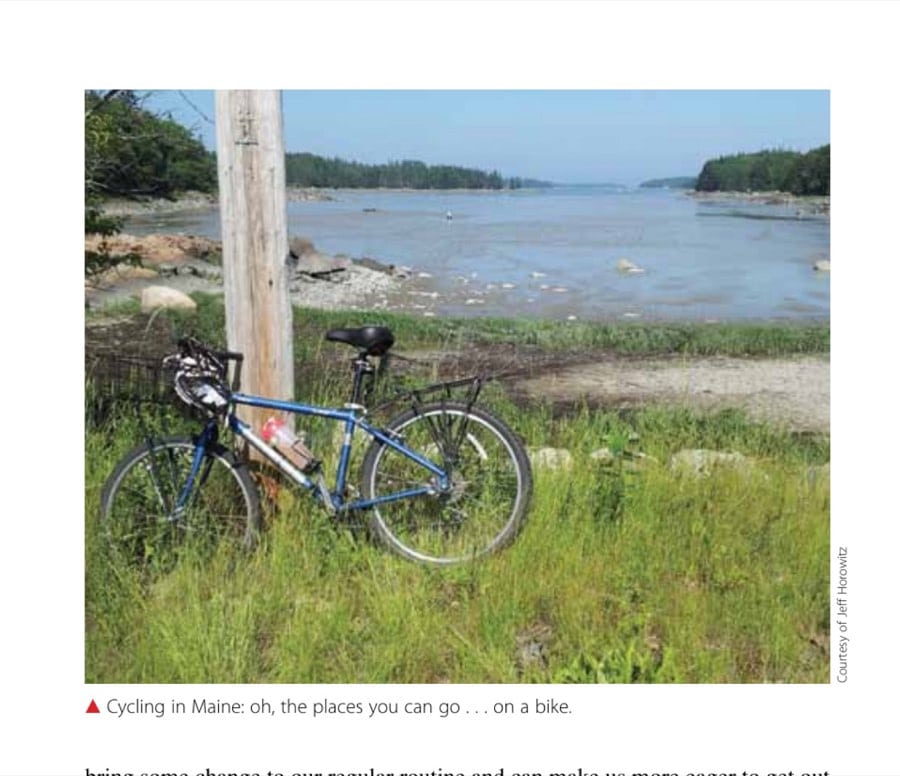
▲ Cycling in Maine: oh, the places you can go . . . on a bike.
bring some change to our regular routine and can make us more eager to get out for our next run. Handle Bad Weather. Not everyone enjoys running through rain, sleet, and snow. Cross-training—whether swimming, riding the elliptical trainer, or using the Stair Master—enables runners to train without concern for the weather. Having bathrooms nearby at all times is an added bonus.
All this is true, and yet not all cross-training is created equal. For runners, cycling in particular is the most useful choice. Here’s why. Work Complementary Muscle Groups. Cycling provides all of the cross-training benefits listed above, plus an additional important one: it targets muscle groups that are both different from and complementary to those used in running.
Running is primarily a back-of-the-body exercise. The large muscles of the glutes initiate the running motion by extending the hip and pulling the leg back. This is followed by the recruitment of the hamstrings as the knee flexes during follow-through. Other muscles are engaged along the way, but this is the essential movement of running.
The problem here is that other major muscles don’t get used—and strengthened—by running, and that leaves a gap in fitness that could lead to injury. The quadriceps muscles on the front of the leg are a major case in point. Knee extension occurs during the recovery phase of running, as you swing your leg forward and your body reloads for the next step. But this kind of movement doesn’t create the type of stress that leads to improvement. In exercise-physiology terms, the stimulus is too small to create an adaptation response.
The result is that the quads don’t get significantly stronger from running. This is a problem because the quad muscles help hold the kneecap in place. If the kneecap shifts around, irritation can result. This condition is called patellar tendinitis, or, appropriately, runner’s knee.
Cross-training will help eliminate excess pounding that can cause injury, but it may not improve quad strength. The elliptical trainer, for example, closely mimics the running motion. This might seem like a good characteristic, and in many ways it is—but not if the goal is to avoid injury by strengthening underused muscles, such as the quads.
Cycling, on the other hand, is primarily a quad exercise. Have you ever seen the thighs on pro cyclists? They’re relatively huge. That’s because their quads are really engaged during the push-down phase of cycling, when they are extending their knees.
Cycling, then, not only gives the body a break from the negative effects of impact, it also increases kneecap stability by strengthening the stabilizing muscles of the front of the leg. Maintain Running Fitness. In addition to these benefits, research has shown that athletes who include cycling into their workout routine will gain the same improvements to their VO2max—that is, their ability to process oxygen, which is a standard measure of cardiovascular fitness—as athletes who only run.
Researchers found that this was particularly helpful during the recovery phase of a runner’s season, after their target races had been run. This period is usually marked by reduced training due to both physical and mental fatigue. By including cycling, runners were able to stay motivated and maintain their fitness during these periods (White et al. 2003; Tanaka 1994).
Researchers also found that maintaining a high cadence while cycling—usually at about 90 revolutions per minute—can help athletes improve their cadence while running (Gottschall and Palmer 2002). This is important because a high running cadence—around 180 steps per minute is considered optimal—is associated with greater speed and reduced risk of injury. Sneak in More Workout Time. Finally, an added benefit of cycling is that it can be more than an effective substitute for some running workouts; it can enable you to get in more total training than would be possible with a running-only program.
For example, during the highest-mileage phases of marathon preparation, many coaches advise having an “off” weekend of training between long runs, when the reduced mileage allows the body to recover. In practice, the traditional long Sunday run over three weeks might look like this: 18 miles/12 miles/20 miles. By substituting a long bike ride on the off-week—that is, the scheduled 12-mile run—it would be possible to have a longer workout even while giving the body some recovery between long runs. Convinced?
I hope that you believe that adding cycling to your workout routine is a good idea. But rest assured, this won’t spell the end of your running days. That’s because of the specificity of exercise. This is a theory that maintains that to improve at a given sport, you need to engage primarily in that sport.
What this means for us is that as much as cycling can help your running, it can never substitute for a purposeful running schedule. The key run workouts—long endurance runs, interval training, and tempo runs—still need to be part of your program in order for you to reach your potential as a runner. Cycling should be a complement to your running, but it can never effectively replace running as the most important element of your routine.
The gear you’ll need Once you’ve made the decision to include cycling in your training, you’ll need to properly prepare for your workouts. As runners, we’re somewhat spoiled by the simplicity of our sport. Although it’s possible to spend a lot of money on all manner of gear, including GPS units, heart rate monitors, and MP3 players, running essentially requires only shoes and clothing—and some runners maintain that even shoes are optional.
Cycling, on the other hand, is an admittedly—almost ostentatiously—gearintensive sport. To cycle comfortably and effectively, you will need more clothing and equipment than you might be used to having. Still, don’t let this dissuade you from pursuing cycling. Although it’s easy to overbuy, we’ll aim to keep your purchases to the essential minimum.
As you’ll see, this discussion assumes that you want to ride a bike outdoors. If you want to ride indoors, you obviously don’t need to worry as much about equipment—you can simply use the stationary bike or spinner at your local gym. For our purposes, the training guidelines discussed below still apply, even if you never get outdoors.
As a general guiding principle, it’s a good idea to get the highest-quality gear possible. With cycling, you usually get what you pay for, both in clothing and equipment, so if in doubt, do without, at least until you can afford something of good quality.
Clothing As a runner, you no doubt already have a large collection of technical clothing that you can use for cycling. All of your shirts, socks, and jackets can be put to use when you head out for a ride, so you shouldn’t have to devote a lot of money to this.
The one essential piece of clothing that you should invest in, though, would be a good pair of cycling shorts, which are skin-tight and come down midthigh. Bib-style shorts include a short singlet-type pullover that turns the shorts into a snug one-piece, but the cheaper short version with an elastic waistband is perfectly acceptable as well.
The key part of a cycling short is the chamois lining in the crotch. This padded area makes the ride more comfortable and helps prevent saddle sores. A cycling jersey is useful since the back pockets allow you to carry tools and food, and the zipper allows you to adjust for the temperature, but this isn’t essential equipment, especially since a jersey can cost from $70 to $100.
Cycling gloves can also be useful. They have padded palms to help reduce soreness from leaning on the handlebars and the vibration that comes from riding on less-than-perfect roads as well as a soft patch of material over the thumb to be used for the occasional nose wipe (yes, that’s really what it’s there for), but they, too, are not really essential.
Cycling shoes, on the other hand, would be a sound investment. These feature a rigid sole, which allows you to use your whole foot as a lever that transfers energy directly from your legs down to the pedals. Cycling shoes also have fittings for a cleat to be bolted in, which in turn would attach to the “clipless” pedals that you could install on your bike. This of course requires that you make sure that your pedals and cleats match.
While it’s possible to cycle in regular shoes that you simply lay on top of the pedal platform, a clip-in cycling shoe will allow you not only to push down on the pedal but to pull up as well. If you imagine the path of the pedal as being a clock face, you could see that a foot that is unconnected to the pedal would be able to apply power only during roughly the 1:00 p.m. to 5:00 p.m. phase of the revolution. A clipped-in foot, however, could both pull and push and would therefore be able to apply power from about 1:00 p.m. to 11:00 p.m.—virtually the entire range of the pedal’s revolution.
Pushing on the pedal, as we discussed, primarily works the quads. Pulling on the pedals involves knee flexion and so would primarily work the hamstrings. Because our goal in cycling is to work the quads, pulling on the pedals is theoretically less important. However, pulling is a better way to approach tackling hills, and learning good form from the start is a good way to approach cycling, so getting cycling shoes and riding properly is my recommended approach.
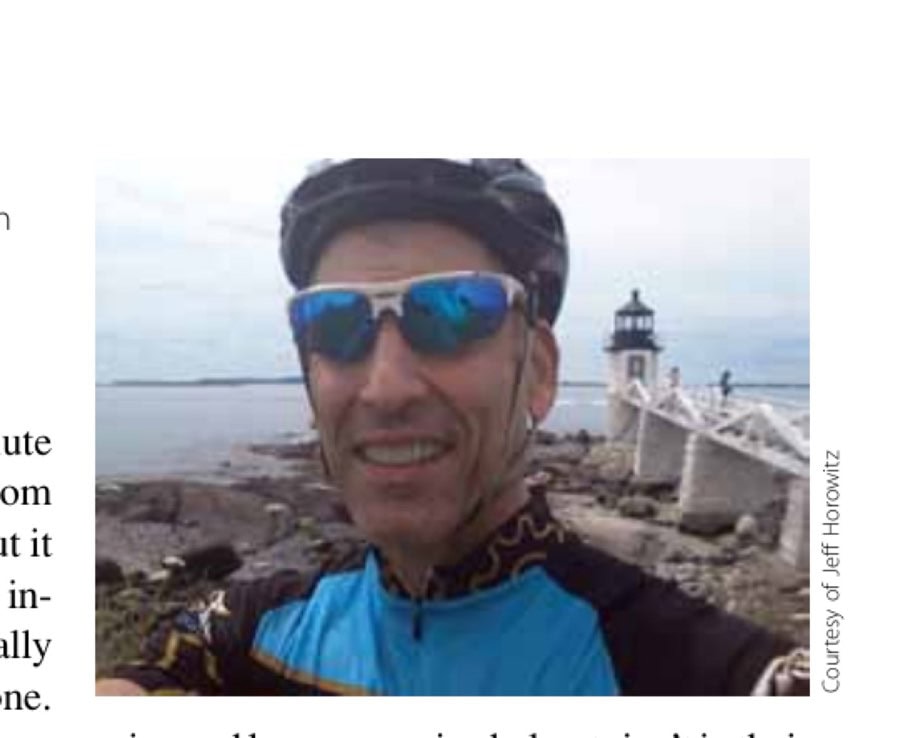
A bicycle helmet is an absolute necessity. It may not save you from every possible impact injury, but it can save you from many of them, including those that can be potentially fatal. Don’t ever ride without one. The basic difference between expensive and less-expensive helmets isn’t in their ability to protect you—they can all do that effectively in certain circumstances—it’s in their weight and their ability to let cool air run past your possibly overheated scalp. The key here is not to feel that you need to invest in an expensive helmet, it’s to make sure that you’re actually wearing whatever it is you decide to buy.
Equipment The money that you save on clothing will probably be spent here, but if you spend wisely, you should be able to get what you need without breaking the bank. The Bike. This is where good intentions go to die. Figuring out what you need to buy and how to find what you need from all the options that are out there is where many runners get overwhelmed. This leads many of them to just give up the idea of cycling.
Don’t fall into that trap. The essentials aren’t that hard to figure out. Any sales person in a reputable bike shop would be happy to explain this information to you, and I recommend that you visit your local shop to have a talk. Meanwhile, here’s some basic information.
Bikes come in three basic styles: road, mountain, and hybrid. Road bikes are the ones with skinny wheels and drop handlebars—what we used to classify generally as “10-speeds” when I was a kid. These bikes are light and fast and made for training and racing. These are the best choice for your training goals.
Mountain bikes were created by counterculture cyclists in California and are heavy machines that are made to handle off-road riding. Unless this is a specific interest of yours, this is not the bike to choose for cross-training.
As their name implies, hybrids are a mix of road and mountain bikes. Their wheels are thicker than a road bike’s, but they aren’t as heavy as a mountain bike’s. These are durable bikes that are a good choice for city commuting, and they can effectively be used for training, but they won’t prove as useful for training as road bikes.
Courtesy of Jeff Horowitz
▲
Proper headgear is a must. The author properly clad during a ride in Maine.
Bottom line: go with a road bike. Here’s an important tip: the difference between a low-end, inexpensive bike and an entry-level good bike is tremendous, but the difference between a good bike and a better bike isn’t all that great. With this in mind, you can expect to pay about $1,000 for your bike. (The resale market for bikes is strong, so you can make your consumer dollar go further by buying a used bike. To do this effectively, you’ll have to educate yourself a bit on what to look for in the online classifieds, but this is easier than you might think. One shortcut is to find a bike in your price range that sounds good and then do a web search for a review of that listed bike. If the reviews are good and the asking price seems fair or better, contact the seller.)
Now let’s get down to some specifics. The Frame. One big difference between high- and low-end bikes is the weight of the bike. Generally, lighter is better, since you don’t want to drag around more weight than you need to. There are many good materials out there to choose from, but in all likelihood, it won’t make a tremendous difference to you unless you become quite serious about cycling. Many cycling snobs would never consider anything other than carbon fiber, which is indeed light and strong, but great bikes are also being built with titanium, aluminum, and even steel. Go with what feels right and fits in your price range.
For sizing, the rule of thumb is to get the smallest bike frame that feels right to you. The reasoning behind this is weight-based; you don’t want to have more frame than you need, since that’s just more frame to move around.
Bike frames are generally measured in centimeters. To figure out your size, measure your inseam by placing a ruler up against your crotch with as much pressure as you would expect to feel while sitting on a bike seat, and then measure the distance from that ruler down to the floor. That’s your size.
Some bike manufacturers have started to simplify this, however, and have begun sizing their bikes like clothes; small, medium, and large. Just make sure that whatever you choose feels right. The Gears. These are also called the components, including not only the gears themselves but also the shifting mechanisms, called derailleurs. The difference between a good bike and a lesser bike is in the quality of the gears. Mass-produced bikes that you can buy in large department stores have machine-punched gears. The teeth of these gears often mesh poorly with the chain, which leads to increased wear and other mechanical problems. Higher-end bikes have more precisely made gears and ride and wear much better.
The more you read about bikes, whether in classified ads, magazines, or elsewhere, the more familiar you’ll become with the brands and models.
One name that you’ll no doubt see frequently is Shimano. Its entry-level component model is the Tiagra, followed by the 105, and its upper-end models are the Ultegra and the Dura-Ace. Campagnolo (referred to as “Campy” by its fans) is another well-known and beloved brand. Its entry-level component groups are called Chorus, Athena, Centaur, and Veloce, and its top-level groups are the Record and Super Record.
There is much more that you can learn about bicycles if you so choose—information on picking wheels and tires can alone fill a book—but don’t get bogged down in this. And remember: you don’t have to look at this as if it’s the only bike purchase you’ll ever make. If you decide that you love cycling and would like something better, you can always sell your bike and move on up. The point is that the less that you think of this as a once-in-a-lifetime purchase, the more likely you are to take action and avoid getting stuck in the details. The Tools. The best bike in the world won’t be of much use to you if it’s broken down. Major repairs should be done by a trained professional at your bike shop, but every rider should know how to handle basic emergencies and have the tools to do so.
Buy a basic kit to repair flat tires, which should consist of a patch kit, tire levers to ease the tire on and off the wheel, and a small air pump. Often this is
ad
sold as a package, sometimes complete in a bike bag that fits underneath the bike seat so that you’ll have it handy when you need it. For simplicity’s sake, you should consider having a spare tube; this will eliminate the need to repair the old tube while you’re on the road; you can replace the tube and repair the damaged one later at home.
You should also have a multitool, which is like a Swiss Army knife, with various wrenches taking the place of blades. This will enable you to tighten almost anything on your bike. There are many more tools that you can buy, but at this point you would do better to make friends with your local bike mechanic. He or she knows what to do if your bike needs work and will do the job that you probably don’t feel like doing.
Cycling basics Pedaling. We touched on this earlier when we discussed the link between cycling cadence and run cadence and also when we discussed pedals and bicycle shoes. To summarize what was discussed, just recall that you want to maintain a relatively high continuous cadence of 90 rpm—without gliding—and that you want to push and pull through as much of the pedal rotation as possible.
One way to imagine the cycling motion is to think of your feet moving in circles instead of pumping like pistons. Focus on moving your feet round and round and not just pushing down. It sounds simple, but it might be harder to accomplish than you would think. Handling Gears. This is an area that can be intimidating, but it doesn’t need to be that way.
We’re going to drop this down to two simple rules: first, set the front and rear gear selection so that you feel comfortable and can spin smoothly. The shifter on your left side handles the front derailleur and the chain rings (front gears), and the shifter on your right side controls the rear derailleur and rear gears. Change the left/front derailleur for changes that require a big adjustment, like a sudden uphill or downhill; use the right/rear shifter for fine-tuning.
Second, avoid cross-chaining, which is when you select the far left gear in front and the far right gear in back, or vice versa (this would be small-to-small or big-to-big). When you cross-chain, you put a lot of excess strain on the chain, and it absorbs more wear and is more likely to break faster. Safety. It’s probably not much of an exaggeration to say that while most running injuries are due to overuse and involve ligaments and muscles, most cycling injuries are sudden and traumatic, involving a crash that leaves cuts, bruises, and sometimes broken bones or worse.
Cycling accidents aren’t inevitable. Here are some tips on how to stay out of harm’s way. • Give your bike a once-over before you head out; check the condition of the tires and chain, and see if anything feels loose. • Obey traffic lights and signage. • Assume that a driver can’t see you, and cycle accordingly. • Use proper lighting in dim or dark light conditions—bright light in front, red light in back. • Ride with traffic, and stay on the road shoulder when possible. • Have ID, cash, and a cell phone with you, and let someone know when and where you’ll be riding. • Avoid riding when roads are wet or icy.
The workouts Cycling workouts are essentially the same as any other cardiovascular workout, including running; depending on how you structure your workout, you can work on endurance, speed, or strength, or you could do an easy spin as a recovery session.
Endurance workout Easy spinning on a bike is an enjoyable way to get in a workout and enjoy an afternoon. Cyclists like to measure their work by the watts they generate or by the speed they travel. I find it easier to go by time and perceived exertion. Thus, I recommend that endurance runs should feel moderately hard during the timed duration of the ride, such as a 6-7 out of a scale of 1-10, where 1 is very, very easy, and 10 is redline agony. Naturally, this assumes constant pedaling, which isn’t always possible when riding outside. I tend to be a bit obsessive about my timed workouts, just as many of you probably are, so I stop my watch when I have to stop my bike. In the long run, I know, this probably doesn’t make much of a real difference.
There are different opinions on what the conversion multiplier would be to convert a run into a ride. For my own use, based on my unscientific consideration of my own fatigue after running and cycling, I assume a run-to-ride ratio of 2:3. Thus, in order to achieve the cardiovascular training effect of a two-hour run, we would need to engage in a three-hour steady bike ride.
Another way to analyze the conversion is to calculate the relative calorie burn. Running burns roughly 100 calories per mile, whereas steady cycling burns about 35 calories a mile. This disparity is due in part to the fact that when cycling, you are essentially sitting, and so less of your muscle mass is actively engaged.
However, keep in mind that your cycling speed will probably be twice as fast as your running speed, which brings us back to the 2:3 ratio we discussed earlier. But don’t worry too much about the details. Just get out and ride. Use this rough guide to schedule your workouts: • Short maintenance ride—one hour of cycling as a substitute or addition to midweek training • Long maintenance ride—two to four hours of cycling for a weekend workout • Endurance-building ride—four to six hours of cycling for a long weekend workout
Speed workout In 1996, a research team in Japan led by Izumi Tabata discovered that a workout consisting of seven to eight sets of 20 seconds of very high intensity cycling, interspersed with 10-second recovery intervals, would improve both anaerobic and aerobic fitness more effectively than lower-intensity training (Tabata et al. 1996). This finding created something of a sensation and spawned a method of training referred to as the “Tabata protocol.”
This is a workout that you could easily replicate on your own. Start with a 10-minute warmup, and then locate an empty stretch of road for your fast riding. Your high-intensity speed will probably be about two and one-half to three minutes per mile. At that pace, you could plan to travel perhaps an eighth of a mile, or about 220 meters, during your fast repeat. You could time your 10-second recovery the old-fashioned way, as we did back in gym class: “one-Mississippi, two-Mississippi . . . .” Finish with an easy 10-minute cool-down.
Another way to do this workout effectively is to take it indoors; this routine is well-suited for a stationary bike. Strength workout Just as hill-climbing builds strength for runners, so, too, does it build strength for cyclists. After a 10-minute warm-up, find a stretch of road that has an incline that is approximately a half mile long—the difficulty of the incline may vary, and you could always adjust the difficulty by adjusting the gear that you select to do the workout in. Plan to do four to six repeats, and then do a 10-minute cool-down.
If you live in an area without a good hill, or there are none where you can safely ride, consider doing your repeats on the ramps of an underground parking garage during off-peak hours. Recovery workout Cycling is an especially effective mode of exercise to turn to after a hard race, particularly a marathon.
Hard running creates microtears in the fibers of the muscle groups that you relied on during your race. It takes several days for these tears to heal and longer until you feel like your old self. In fact, a good rule of thumb for recovery is to take an easy day of training for every mile that you raced hard. Jumping back into running on sore legs can result in injury, since your body’s ability to handle impact and to maintain proper form will be compromised.
This doesn’t mean that you need to be sedentary, of course. You could still get in your workouts by relying on other modes of exercise that are nonimpact and that use other muscles: in a word, cycling.
Your recovery workout should be used less for a real training effect and more just to increase blood flow, which flushes out lactate and reduces muscle and joint stiffness. So don’t plan to cycle at a high intensity or for a long period of time.
In the week following a hard long-distance race, plan to do rides of 30-45 minutes at an intensity of 5-6 on a scale of 1-10. This is a good time to relax and enjoy your rides; you may even invite some friends along to make this a social workout and plan to end at a café or lunch spot.
Final considerations
Courtesy of Jeff Horowitz
Under this plan, your training week will probably consist of three to four runs and one to two rides. Keep in mind that your schedule might vary as the seasons change. Over the course of the year, cycling and running are complementary: on the coldest days, it would still be possible to run, but cycling becomes difficult due to the persistence of windchill. On the other hand, on the hottest days, when it’s sometimes dangerous to run, that same windchill makes cycling more comfortable and feasible. Don’t be surprised if you start to develop a love of cycling. There ▲
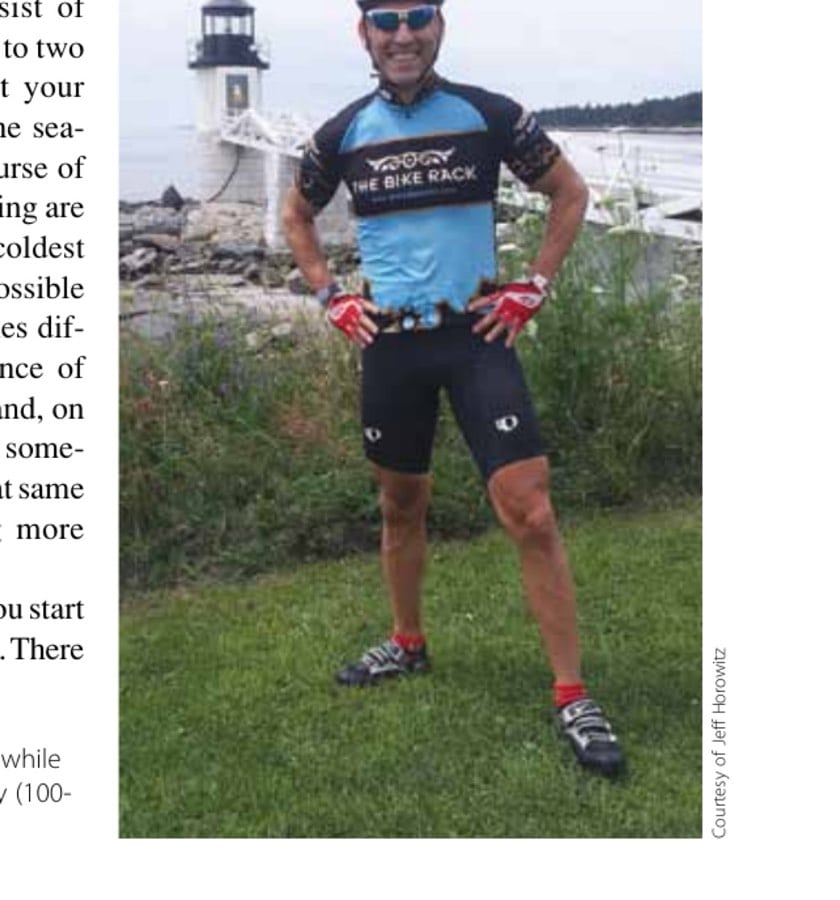
The author taking a break while riding the Lobster Roll century (100mile) ride in Maine.
is a joy to cycling that is unique to that sport, where you can undertake epic journeys using your own power as channeled through a light, little, amazing machine. As you develop as a cyclist, you may find that you would like to try participating in some cycling events, just as you enter road races as a runner. Here are some events to consider: •
A Century Ride. As the name implies, this is a 100-mile event. These are supported rides, with well-stocked aid stations usually set up every 20 miles or so and a SAG wagon on the course to help riders who are hav
ing problems or who want to call it a day and need transport to the finish. These are rides, not competitive races, so you will not be timed. • A Gran Fondo. Originating in Italy, this race format is usually about 60
to 100 miles in length and is a timed race. Think of this as more like a marathon—it’s what the participant makes of it. Want to be competitive? Sure, this is for you; race awards and prizes for top finishers are part of
the allure. On the other hand, would you rather just have a fun, supported ride? Then this event is right for you also. • Shop Rides. If you’re not in the mood for a mass-participation event, but you like to have company on your rides, check the ride schedule of your
local bike shop. Much like with running stores, most bike shops offer group training on weekends. Often these rides are “no-drop,” which means that the group will be kept together and no rider will be left behind.
No matter how much cycling you do, don’t worry about your commitment to running; you will still be a runner at heart. Taking up cycling is not a betrayal of running. Instead, it can improve your running and keep you injury free, which, after all, is our biggest goal.
References Gottschall, J. S., and B. M. Palmer. 2002. The acute effects of prior cycling cadence on running performance and kinematics. Medicine & Science in Sports & Exercise 34(9):1518-1522. Tabata, I., K. Nishimura, M. Kouzaki, Y. Hirai, F. Ogita, M. Miyachi, and K. Yamamoto.
1996. Effects of moderate-intensity endurance and high-intensity intermittent training on anaerobic capacity and VO2max. Medicine & Science in Sports & Exercise 28(10):1327-1330. Tanaka, H. 1994. Effects of cross-training. Sports Medicine 18(5):330-339. White, L. J., R. H. Dressendorfer, S. M. Muller, and M. A. Ferguson. 2003. Effectiveness
of cycle cross-training between competitive seasons in female distance runners. Journal of Strength and Conditioning Research 17(2):319-323.
This article originally appeared in Marathon & Beyond, Vol. 18, No. 4 (2014).
← Browse the full M&B ArchiveMore like this
1,000+ stories from 19 years of Marathon & Beyond
The complete archive of the legendary long-distance journal — digitized and free to read.
