

Dick Merriwell’S Marathon
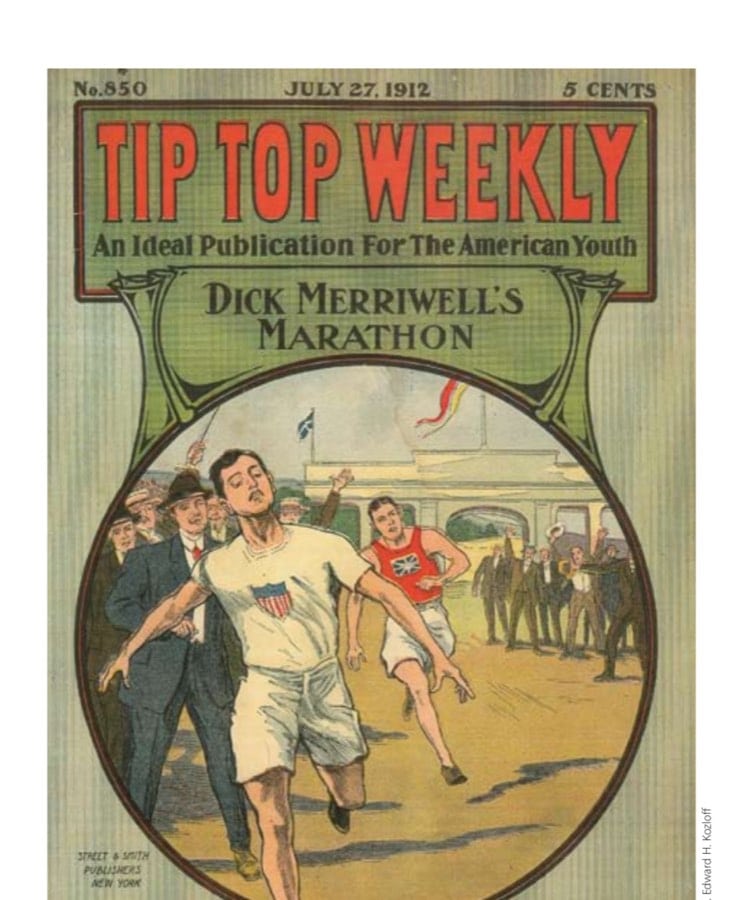
Or, how the last Olympic mile brought victory. Tip Top Weekly. Part 4 of 4. by Dr. Edward H. Kozloff
Editor’s note: Tip Top Weekly was a popular nickel weekly for boys back in the early decades of the 20th century. Many of the issues featured track and field stories starring the Merriwell brothers. In a set of issues published during the period of the 1912 Stockholm Olympics, the Merriwell boys are recruited to help the American team. But everywhere they go, mystery and intrigue follow as the villain Carberry attempts to undermine their efforts. The first episode followed the mysterious goings-on aboard the ship carrying them to Europe. In episode 2, the plot twists expanded once they reached Sweden and began to compete. In the third episode, Carberry’s men do everything but start a world war in their attempts to sabotage the American efforts at the Games, but each time Carberry is outmaneuvered by the Merriwells. This is the fourth and final installment of the cliff-hanging adventures of the Merriwells at the Stockholm Olympics.
The Swedish setting was much different from the neighborhood where the Yale athletes and Dick Merriwell trained and ran. However, the long runs back home had given Merriwell the ability to race in the Stockholm Marathon. According to the original plan, he would set a killing pace and be followed by all the other competitors, who would then tire themselves out. But all of the other Americans who were entered in the race were either sick or injured, and, as a result, more pressure was placed on him. Now, one of the others would set the pace for as long as possible, and Merriwell would hang back until the moment was right.
Harrigan, head of the American Olympic Committee, picked up Merriwell and they went to the hotel, where Harrigan reported that a protest had been lodged against Jack Tempest, America’s top sprinter. The hearing would be held the next day. The charge was professionalism. Then, Harrigan said the charge had been
dropped and a letter of apology sent explaining that the Swedish Olympic Committee had been misled by false information. In reality, Jim Phillips, who had been on the wireless continuously, with no success, finally heard a message from Carberry (the head of a conspiracy trying to foil the success of the American team). Carberry’s plan was to produce a letter with evidence to back the charges against the sprinter Tempest. However, as Carberry tried to harm the American team, his troubles had prevented him from following through.
Harrigan grew concerned that the strain of the confrontations with Carberry was demoralizing the team. Additionally, he worried that Carberry might attempt to free his men who had been taken prisoner.
A decision to become tourists It was decided that the athletes needed a break and that it would be safe to let them off the ship to go into the city. Arrangements were made to visit some of the buildings, museums, and fortifications. Merriwell selected the group that would accompany him, and he could see their spirits brighten as soon as they left the Rhineland.
As the men traveled through the city, they were extended special privileges and allowed to visit areas that were usually off limits. As they visited a fort, they were shown the guns, bombproof shelters, and other details of the fortifications.
Jack Tempest, the top sprinter, was especially interested since he was familiar with many of the fortifications along the American coast. During one of the explanations, he quietly wandered off. Suddenly, as Merriwell looked up, he saw that Tempest was about to snap a picture with his camera. Running toward him, Merriwell shouted that the camera must be put away. Unfortunately, it was too late. A sentry grabbed Tempest, and the entire group was put under arrest.
What Tempest had thought harmless was a serious matter to the foreign soldiers who were unaware that a camera had been brought into the fort. Their worry that a spy might be taking pictures was not something that would be tolerated.
As time passed, Merriwell worried that their detention would cause Tempest and Hayes (a second American sprinter) to miss their afternoon races. He told Hayes privately about his concerns. Hayes answered that he could understand some Swedish and would carefully listen to hear what was being said.
Shortly thereafter, the group was taken to an older officer whose demeanor was the opposite of the friendly, younger ones. The men were questioned through an unfriendly interpreter and subsequently taken to a room where they were locked in, though fed well. While there, Hayes told Merriwell that the interpreter had not told the officer what he had said and made it sound extremely bad for the Americans. No message would be sent to the American minister as had been requested.
This information greatly depressed the group. Steve Carter, the pole-vaulter, stood by an unbarred window and announced that he thought he could escape. The window was high above the ground, and a sentry passed every 10 minutes. The group was opposed to Carter’s doing anything; however, before anyone could stop him, he was gone.
Carter had judged his jump well, and the escape was easier than he thought. He walked to the front of the fort, mingling with other visitors. As soon as he left the fort, he took a cab to the American minister’s office. When he arrived, he discovered that nearly everyone had gone to a reception at the royal palace. The only person remaining was the youngest and newest secretary, who thought everything Carter told him was a joke and, therefore, would give no help.
Carter grabbed, subdued, and tied up the secretary. Exchanging clothes with him, he was now properly attired to attend the royal function. He hailed a taxi, which took him to the crowded palace; however, despite his search, he was not able to find the American minister. Fortunately, the sprint races were scheduled for later in the day because of the royal reception. Finally, Carter spotted the American military attaché. Taking him to a private room, Carter explained the team’s dilemma and described the predicament of the undersecretary, who was bound in a closet and wearing only his underwear. The attaché found himself laughing almost uncontrollably.
An intervention from above As the attaché left the room to get help, a man no one had seen before entered and asked Carter to repeat his story. Carter complied, telling the story in great detail. The stranger left and the American minister arrived shortly thereafter. As Carter began to repeat his story for the third time, the stranger returned and stopped him. In fact, this stranger was the crown prince and had put matters in motion to free the Americans.
Back in the prisoners’ room, time was passing slowly. Suddenly, the door burst open, and the surly officer entered and apologetically informed them that the crown prince had ordered their immediate release. He asked that they understand why they had to be arrested, and they said they did.
Two government vehicles awaited them at the gate and rushed them to the stadium. Upon their arrival, they found that the 100-meter race had already been run but there was still time before the 200. As the two runners readied themselves for the event, Hayes spoke quietly to Tempest, suggesting an unusual strategy to assure an American victory.
The race began, and Hayes and the top English runner got off to a better start than Tempest. These three were the class of the field and pulled away, with Hayes leading and Tempest in third place. Nearing the finish, Hayes began to fade, and
Courtesy of Dr. Edward H. Kozloff
the Englishman keyed on him. Taking the lead from Hayes, he eased slightly, forgetting about Tempest, who lunged to the finish, barely defeating him. The honors went to Tempest. It was Hayes, however, who had lured the Englishman into easing slightly as he passed, but just enough to allow a surging Tempest to come from behind for the all-important American victory.
Right after the race, Carter and Captain Henry, the attaché who was acting as his escort, arrived and detailed the pole-vaulter’s adventures, bringing a great deal of laughter from the group as they realized the risks and subsequent successful ending with Tempest’s victory.
On the Rhineland that night, the day’s exciting adventures were again rehashed. With the loss of the 100-meter sprint, a marathon victory became even more important. Carberry began to plot his next move to harm the American team.
Jim Phillips and Brady went to bed early that night but, with the excitement of the day, found it difficult to asleep. Instead, they talked through the night. Finally, as they were about to fall asleep, they heard an unusual grating sound against the side of the ship. They got up, donned dark clothing, and carefully stepped out onto the deck. Thinking they should alert Merriwell, they went to his room but found it empty. Returning to the deck, they heard heavy breathing and saw a stranger who was guarding a bound and gagged body. They quickly subdued the guard and found the prisoner to be Dick Merriwell. As they untied him, he whispered that six attackers were after Carberry’s men, who were being held prisoner below deck. The captain and others were alerted, and the group went below. After a struggle, they subdued the offenders. This attack could only mean that Carberry’s yacht had returned.
The ship’s watch should have prevented anyone from boarding the boat, but an investigation by the captain failed to turn up any information. They expected a disguised Carberry yacht to be somewhere in the harbor but could find nothing. The next day, the team went ashore. Merriwell and Little Bear, the Indian long-distance runner, drove the marathon course and carefully planned their race. Little Bear usually went out fast and was able to get a lead that no one could come close to at the finish.
The dangers of pole-vaulting Back at the stadium, the main concern was with Steve Carter and the pole vault. He was quite confident that he could win. Carefully, he tested his bamboo poles. As the vaulting progressed, only three competitors were left as the bar reached 12 feet, 7 inches. At 12 feet, 9 inches, only Carter and the Englishman Murdock were left. At 12 feet, 10 inches, Murdock failed on all of his attempts, and it was up to Carter. He again checked his pole. He raced down the runway, planting the pole, and soared upward. As he reached his highest height, the pole snapped. He seemed to hang motionless with the jagged, broken pole pointing up dangerously. With a desperate effort, he hurled himself over the bar and then dropped safely to win the event. With a face full of anger, he checked his pole and found a bullet hole. Carberry had failed, but he was still around, determined and dangerous.
The Olympic program was down to the night before the marathon. America led England by one event. Winning the marathon would win it all. If England lost and any other nation won, America would still lead. If an Englishman won the marathon, the Olympics would end in a tie.
As a last-minute plan, Merriwell decided to sleep onshore, and he and Harrigan went ashore to eat. The regular dining room was overcrowded, so they entered a smoke-filled cafe. Though he did not smoke, Merriwell did not object to others around him who did. However, he was definitely bothered by the fumes of a very strong cigar of an army officer in uniform at the next table. The officer could see that he was causing Merriwell discomfort and, in fact, seemed to deliberately send more smoke in his direction. As Merriwell and Harrigan rose to move, it seemed to upset the men at the other table, who began to glare at them.
While they thought nothing of it, shortly after returning to their room they were met by one of the men from the cigar-smoking table. He claimed that his friend, German Captain Strauss, had been insulted by Merriwell’s actions and challenged Merriwell to a duel. Harrigan tried to explain that Americans don’t fight duels, but Merriwell stopped him. Since he was the one being challenged, it was his choice of weapons. Merriwell chose rapiers, and the duel was to take place in one hour in this very room. The man was shocked! His friend preferred pistols, and it was unheard of to fight immediately.
However, to avoid dishonor, the captain, his second, and a doctor appeared at the appointed time. The captain was only a fair swordsman and did not know that Merriwell was an expert in the discipline. From the beginning of the duel, Merriwell toyed with the captain and on several occasions knocked the sword from his hands and could have run him through at any time. Finally, the German, who saw he had no chance, surrendered. He stated that he had been wrong and that he had been told many disparaging things about Merriwell, which he now realized were untrue. Indeed, Merriwell was a gentleman. The evening ended.
Merriwell rose early on marathon morning, showing no ill effects from the previous night’s fencing. The athletes were driven to the start, and it seemed that the entire population of Stockholm had turned out to witness the event.
Fifty competitors were entered in the race. Merriwell was concerned about five. He and teammate Little Bear lined up together. At the start, most of the runners settled into a comfortable pace. Gradually, Little Bear picked up the pace and soon had a 100-yard lead. He had a reputation for starting fast and being able to hold the pace. This began to worry some who went after him, not realizing that his pace was set to draw them out and tire them early, and the plan was working. Although most of the field moved past Merriwell, he and Swedish distance champion Helvarsen and English favorite Morgan maintained a more sensible pace.
Little Bear sets the pace At 15 miles, the lead pack was out of sight; however, one of the favorites, a South African, was lying by the roadside cramped up as a result of the killing pace. Shortly, they passed one of the top English runners, also in a state of collapse. At 18 miles, Merriwell took an orange slice and was told that Little Bear—running at an unbelievable record pace—had a 10-minute, nearly two-mile lead.
At 20 miles, he saw a commotion in the distance. Outside a house that had an antenna on the roof, indicating a wireless station, men were fighting. It looked as if half the Stockholm police department was there as well. Then, Merriwell recognized Inspector Lane and surmised that he must have discovered another Carberry plot.
He heard more shouting from the crowd, and as he turned a corner in the road, he saw Little Bear walking in a state of distress. Two of the other race favorites who were still in contention could be heard sighing as they passed the Indian. The American spoke briefly with Little Bear, who had recovered and could go another three or four miles at a fast rate. When the runners would chase him now, they would burn out, and Merriwell could race the final two miles to the finish.
Now running alone, Merriwell soon heard the shouts from the crowd and realized that Little Bear had caught the leaders. However, fatigue and his having to run alone were taking a toll on him. It seemed as if he were running in a dreamlike state.
Finally, with two miles left, he gathered his strength, lengthened his stride, and picked up his pace. He was further encouraged by the cheering crowds, which grew louder as he ran. He knew he was closing in on the leaders.
With a mile left, he reached Little Bear, who was staggering as he walked. At the sight of Merriwell, he broke into a run and said that the two leaders who were just ahead were all done in and could be caught. He then dropped off. Around the next turn, Merriwell passed the Swede, who was only going through the motions of running and barely moving.
Now, on the last straight stretch, he could see the crowded finish area and the Englishman in the lead just ahead. With a hundred yards left in the race, the English runner still led Merriwell by 25 yards, but the American’s last wild sprint put him past the staggering Englishman as he collapsed after crossing the finish line.
Water was splashed over Merriwell, and when he opened his eyes, he saw a shadow hovering over him. The American flag was being raised and the band played “The Star-Spangled Banner” in honor of his victory.
At the dinner that night, Merriwell retold the story of the race and learned of the discovery of Carberry’s last hiding place and how the inspector and Swedish police had captured him. It was all over now, and the successful American team headed back to the United States.
This article originally appeared in Marathon & Beyond, Vol. 13, No. 4 (2009).
← Browse the full M&B ArchiveMore like this
1,000+ stories from 19 years of Marathon & Beyond
The complete archive of the legendary long-distance journal — digitized and free to read.
