

Did Not Finish
Like most runners, I’ve always thought of a DNF as something awful, something to be avoided at all cost. It’s hard to be philosophical about a DNF. We enter a race to finish, not to give in to some human weakness. To add insult to injury, have a look at most race results. The runners who DNF are typically not listed, as though they were never there.
But looking back over my log of race results from the past 20 years, I noticed an odd thing. Two types of races stood out. One type was the “firsts”—my first 10K, first marathon, first ultramarathon, first 100-miler. The other races that seemed fresh in my mind—even after years had gone by—were the DNFs. Why had they made such an impression on me?
One reason, I believe, is that every DNF delivers in an unmistakable way a valuable lesson. During this race, I learned that it does not pay to run with a bad cold. At that race, I found out what happens when the temperature soars and I don’t drink enough water. This timeout taught me that running three races in three weekends could uncover some nasty weaknesses in my knees and ankles. Another reason that each DNF is so memorable is that when it comes to drama, when it comes to digging down deep, when it comes to having that quintessential running experience—catching a glimpse of your soul—nothing is quite like a hard-fought DNF.
WHEN A RUN TURNS ON ITSELF Long-distance running is an exploration of self, both physical and mental. A successfully run race is satisfying, but it leaves open the question of your physical and mental limits. A DNF, on the other hand, will draw a very clear line in the sand. It will say to you, “Here is your limit. You can whine and snivel and blame your problem on all sorts of bad breaks, but beyond this point on this day, buddy, you could not go.” Then it is up to you to go back to the drawing board, to train, to sweat, to worry your failure as a dog worries a bone. In that process, you will absorb the lesson and learn more about yourself so that one day you can return to that point in the race, face the demon that resides there, and run right by.
Robert checks the list of aid stations and cut off times the day before the race.
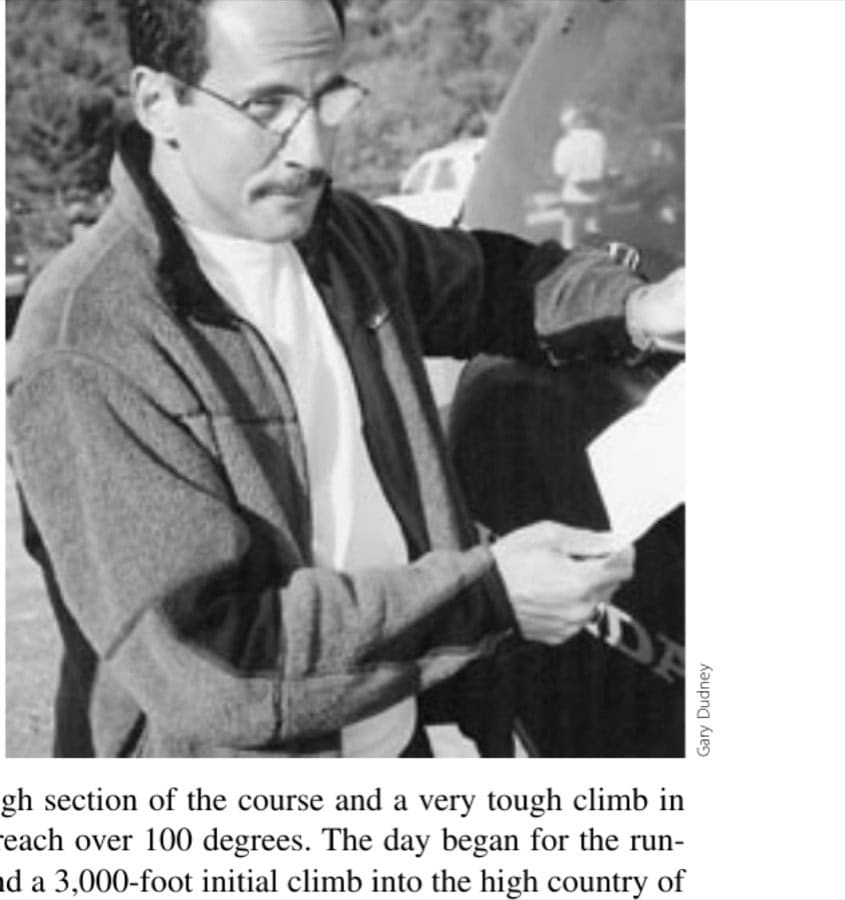
Strangely, though, the DNF that I remember most vividly was not my own. It happened when I was pacing a friend, Robert Josephs, at the Western States 100-Mile Endurance Run. Watching him go through the process of a DNF turned out to be one of the most inspiring things I have ever seen in running.
The aid station at Michigan Bluff comes at 55 miles into the race. It is a critical juncture for the runners. It marks the end of a very tough section of the course and a very tough climb in temperatures that typically reach over 100 degrees. The day began for the runners with a 5:00 A.M. start and a 3,000-foot initial climb into the high country of the Sierras. The struggle with the rugged mountains has been going on for over 12 hours. Runners doing well come jogging down the road into Michigan Bluff smiling and waving at their crews. Runners who are struggling come trudging into town, wilted by the heat and exhausted from climbing in and out of the two toughest canyons, Deadwood and El Dorado.
This was my first look at Robert that day, and he was definitely trudging. He was also late, barely maintaining a pace that would get him to the finish under the 30-hour time limit imposed at Western States. But the crew gathered there to help Robert through his ordeal was hopeful. We all knew that Robert was famous for struggling through the night, flirting with the cutoff times at the different aid stations, and then roaring back unexpectedly in the morning to collect his finisher’s belt buckle.
His wife led him over to where we had set up his camp chair. His bag full of extra clothes, flashlights, Band-Aids, and the like was within easy reach. He sat
Gary Dudney
2000 WESTERN STATES 100-MILE ENDURANCE RUN
down heavily in the chair, clutching a cup of soup he had gotten at the aid table. We changed his shoes and socks for him. I wiped him down with a damp towel. His wife got a sandwich into his hand and switched the soup out for a cup of ice water. He had little to say. Mostly he just bent forward with his head down.
We kept up a nice positive chatter as we worked. “The tough part’s over, Robert. Just focus on getting to Foresthill. It will be a lot cooler when it’s dark. Keep drinking. Just get into the night. Finish the sandwich. You’ll be OK.” He listened and nodded. No one said anything about his slow pace. We had decided to worry about that once he had gotten to Foresthill, seven miles down the trail.
At last, he pushed himself up out of the chair and strapped his belt on. We walked in a big group down to the end of the street. Everyone was talking excitedly, full of advice. We shouted and hooted after him as he walked off down the road toward Volcano Canyon. “Way to go! Doin’ great! See you soon!”
THE LONG WAIT AT FORESTHILL It was a full two hours before we heard his name announced at Foresthill. We had hoped he would make something of a comeback as the temperature dropped and dusk came on, but he had lost 10 minutes to the cutoff time. Again we steered him into his chair, but this time there was a rush to get him revved up and back on his feet. Unless he came alive and started making up some time, he would risk missing a cutoff on his way to the Rucky Chucky river crossing at mile 75.
After a couple of minutes of tender loving care, we were dragging him back on his feet. I had my flashlight and water bottles ready to go and was champing at the bit to get on our way. As we left, the crew shouted after us, “Run! Run!”
We trotted down the main street of Foresthill with people cheering us along as we passed the parked cars jammed up near the aid station. Farther along, the street was quiet, peaceful, and empty. The only evidence of a race going on was the orange cones spaced out before us to mark the route. We came to the final cone with an arrow pointing us down a side street, and soon we were out of Foresthill and on the California Street trail.
First up were several switchbacks leading downward away from Foresthill. Robert made an effort to run this section, but the trail was badly rutted in spots and lots of loose rock made the footing treacherous. He seemed to need smooth trail to be able to run. After a mile or so, we settled into a fast-paced walk that he was comfortable with. I figured we were not going to lose any ground if we stayed with a strong walk, so I didn’t push him to run. I concentrated on monitoring his drinking and kept up a little conversation to keep him occupied.
After what seemed a long time, we pulled into the first aid station, Dardanelles. I checked my watch against the list of cutoff times I was carrying. We had maintained the same margin to the cutoff time. I counted that as a success. A volunteer took charge of Robert, and I turned toward the aid table to find something to
Gary Dudney
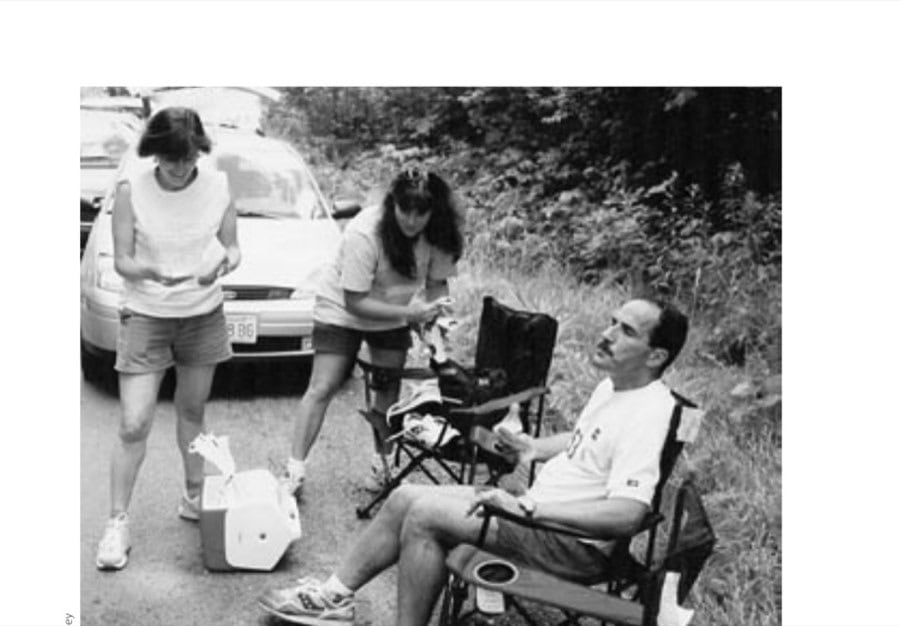
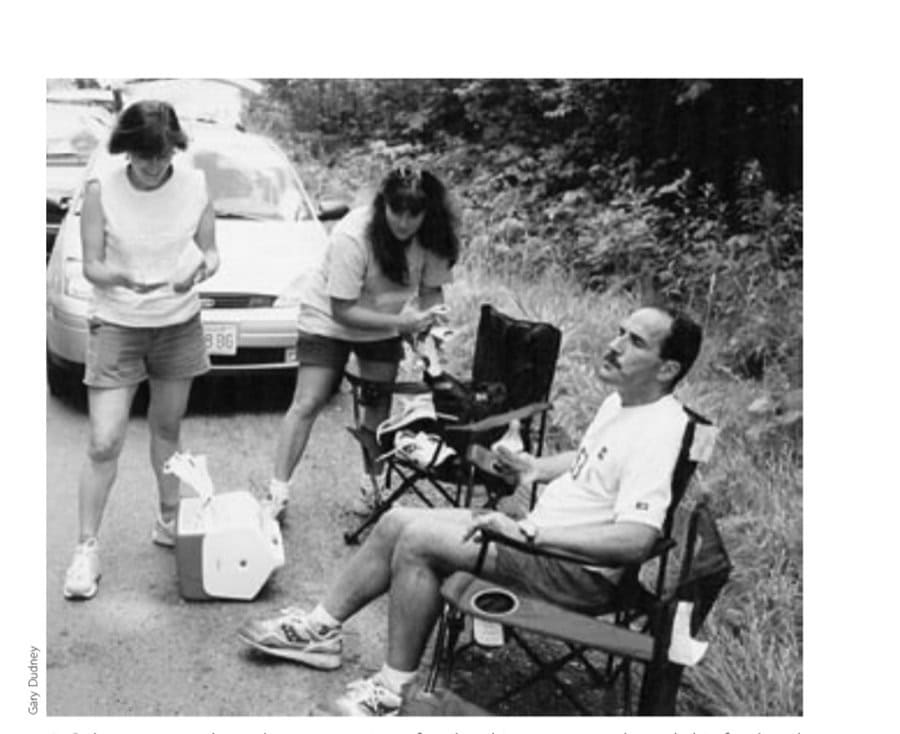
Robert contemplates the next section of trail as his crew sorts through his food and equipment.
munch on. When I turned back around, I was shocked to find the volunteer helping Robert down into a chair. I had wanted to get us through this station quickly and get on our way. I made sure Robert had everything he needed and told him he had two minutes before we had to go. He munched away at a cookie, content to let me set the rules.
PEACHSTONE ON OUR MINDS We left on our way to the next aid station, Peachstone, with words of encouragement drifting out to us from the volunteers. Immediately the night swallowed us up and aid became a distant memory. We seemed to be next to a canyon now on our left. Above were bright stars and a half-moon just over the opposite horizon. We moved along steadily for a while, but now Robert was coming to a dead stop when he took out his bottle to drink. Our pace over this section had dropped considerably from what we had managed on the way to Dardanelles. Also, there seemed to be no question about running. It was all walking. I took out the chart
to see what kind of margin we had to the next station. With so far to go, it was hard to tell whether a steady walk would keep us in the game. When the path leveled out or tended slightly downhill, I went into a little shuffle to try to spark some running, but to no avail. “We’re going to have to hammer this a little bit,” I said. “I am hammering,” Robert replied, maintaining his slow walk. “This is hammering.” I had to laugh.
But the showstopper turned out to be the hills. This section of trail had a good surface, soft dirt and not a lot of rocks; but bit by bit we were climbing up along a ridge, and each uphill portion seemed to be exacting a terrible toll. Robert’s pace dropped to almost nothing as he leaned into each climb. He could barely lift his feet high enough to clear rocks. He stumbled often.
As I checked my watch, time seemed to be evaporating. I began to calculate how much time we had to the next cutoff, how far I thought we had gone, and what pace we would need to get there. Meanwhile, Robert had started weaving from side to side on the trail. I peered nervously out to the left to see what kind of fall he might take should he actually veer off the path. I tried talking him up, but he seemed able to concentrate only on making one step after another.
A heavy silence descended upon us as we moved slowly along. I glanced up at the stars and the moon. The night was very still, the quiet broken only by an occasional rustle in the brush. It seemed hard to believe that we were part of a major race. Nothing around us suggested any hurry. I wished that I could tell Robert to relax, that there was no rush, but I knew that our situation was getting more desperate by the minute. Meanwhile, he had become so exhausted that he could barely put his bottle back in his fanny pack after taking a drink. “
We have to be getting close to the next aid station,” I said. I was guessing based on how much time had elapsed since the last aid station. But my guess turned out to be way off. We crept on, following what seemed an endless trail.
Finally, with no fanfare, no outward sign, the cutoff time for Peachstone came and went. I didn’t say anything to Robert. I held out some hope that because the course had been modified for this year’s race, maybe I somehow had the wrong time on my sheet. The trail at last seemed to have crested and took a sharp turn down and to the right. At the same time, we could just make out the lights of the aid station across a dark gulf in front of us. As we turned back down the trail, we actually had to walk away from the station until we finally crossed a stream at the end of a canyon and the trail twisted back around.
BAD NIGHT AT PEACHSTONE When we arrived at Peachstone, the aid-station captain met us on the edge of the clearing. Looking beyond him, I could see people busily clearing off the aid table. I also saw a row of runners, about 10 of them, all slumped in camp chairs,
each covered with a blanket. The aid-station captain shook Robert’s hand and congratulated him on reaching Peachstone. In his other hand, he held a pair of surgeon’s scissors. “The bad news,” he said, “is I need to take your wristband. You’re beyond the cutoff time.” And with that he carefully snipped the band off Robert’s wrist. The band disappeared into his pocket. That was it.
I later asked Robert how he felt at that moment, the moment he knew he was finished. Was he angry, frustrated, heartbroken, decimated? “I was relieved,” he said. I found an empty chair and led Robert over to it. He undid his belt and let it fall to the ground. Then he lowered himself carefully into the chair. A volunteer brought over a blanket, which I draped over his shoulders. “You did a great job,” I told him. “You never gave up.” He nodded and closed his eyes. “What can I get you?” I asked. “Just water would be OK,” he said.
I went over to the table and had a volunteer dig out a cup for the water. While I waited, I greedily wolfed down the one item left on the table, a big hunk of brownie. Everything else had been packed away or trashed. I looked at my watch. It was three o’clock in the morning. Robert had his eyes closed when I went back with the water. I set it down next to his feet.
All the runners sitting there were totally wiped out, motionless under their blankets. Now that the race was over for them, no one was paying any attention to them. The volunteers were busy getting the place picked up and packed away. Then I noticed another group of people standing on the edge of the aid station clearing, talking and laughing. I realized they were the other pacers, who, like me, were now stranded in the woods in the middle of the night. One pacer seemed to be in a pretty heated exchange with the aid-station captain. I could just overhear him saying, “How could you not be ready to get us out of here? Didn’t you know there would be runners dropping here?” The aid-station captain shrugged. He assured the guy they were making arrangements.
In fact, it wasn’t long before word got around of a plan. The aid station sat at the lower end of an access road that led straight up the ridge for a mile to another road that in turn led to the highway. The runners were to be hauled up in a trailer that had been used to bring in the aid-station supplies. The pacers were going to have to hike out under their own power up the road.
HITCHING A RIDE The trailer, hitched to a Jeep, was backed down into place. We rousted the runners out of their chairs and led them staggering over to the trailer. They had all stiffened up from sitting down. One runner had to be helped off a cot and complained of feeling sick. The trailer was a very low affair, the bed sitting only about a foot and a half off the ground, but even so the runners could barely manage getting into
it. Then, once in, they had trouble bending their limbs enough to sit down. They let out heart-rending groans as they collapsed down on the steel bed. Robert took all this very stoically, trying to do as much for himself as he could. The runners showed tremendous dignity as they endured this torture. They didn’t complain. They arranged their painful limbs as best they could and then waited patiently for the next step in the process.
The trailer lurched forward up the road, and I fell in with the other pacers to make our ascent. Despite the late hour, the pacers seemed to be bursting with energy. Finally freed of creeping forward for hours at a time, endlessly encouraging their flagging runners, the pacers shot up the road like the devil was chasing them. I could barely keep up. Everyone was talking and laughing, hugely relieved that at last they could move along at a good clip. What a contrast we made to the groaning cargo of runners jolting up the road ahead of us in their steel-bottom trailer.
We reached the top in no time and came into a big clearing in the pine trees. We unloaded everyone in a painful reverse process of what had gone on below, the runners wincing as they stepped off the trailer into our supporting arms. One runner got out and promptly threw up. I found a place for Robert on the fender of the trailer, and he sat quietly waiting.
Soon a big Suburban showed up and swung around next to us. We loaded as many people as we could, but some had to be left behind. Robert volunteered
ad
to stay and wait for the next ride. The last runner into the Suburban could not negotiate the tight fit into the backseat and had to exchange places with the guy sitting in the front seat. At last settled, they were gone into the night
Next a minivan came down the road, and the last of us were carefully loaded in. We headed off to Auburn and the finish line at the Placer High School stadium. Once there, I led Robert down the stadium steps to the infield where the medical tents were set up. He collapsed onto a cot. I covered him with a blanket, and he immediately closed his eyes and lay perfectly still. I went outside to look for the radio operators so I could tell the rest of the crew where we were. I didn’t know whether any information had been sent out of Peachstone or not. As it turned out, when the radio operator relayed our runner’s number to the crew at Green Gate, it was their first word that we were no longer on the trail.
A DIFFERENT KIND OF FINISH My job now pretty much done, I found a place to sit down near the finish line and settled in to watch other runners finish. The timing couldn’t have been better. It was just past four in the morning, so all the people arriving were earning their sub-24-hour silver belt buckles. Most of these runners were finishing strong, smiling and laughing, enjoying their great success. They bounced up onto the scales for their final weigh-ins and then only reluctantly sat down to have their blood pressure checked. They were the kings and queens of the event, conquerors of the Western States course.
I couldn’t help but think of the beleaguered line of defeated runners I had come upon at Peachstone only a couple of hours earlier. They had been slumped heavily in their camp chairs under their thick blankets, with only their sweat-soaked caps and dirt-caked legs and shoes visible. For them, time had run out. Their quest had ended miles and miles from Auburn in the quiet of the dark woods with the half-moon and the stars hanging over them.
But then I recalled how, as I followed Robert over the last few miles that we traveled, I had noticed that his shoulders were not sagging, his determination never having deserted him. Even as the quest became hopeless, he had continued to struggle to keep his dream alive. He never quit. He never gave up. He never lost heart. He had stayed with the race to the very end, and then with great dignity and equanimity, he had accepted that it was over. In that, it seemed to me, he had triumphed just as greatly as—maybe more greatly than—the runners whom I was watching now.
Did Not Finish It Is Painful to Drop Out of a Race, but It Can Be More Painful to Watch a Friend Fall Short of His Goal. BY GARY DUDNEY
Like most runners, I’ve always thought of a DNF as something awful, something to be avoided at all cost. It’s hard to be philosophical about a DNF. We enter a race to finish, not to give in to some human weakness. To add insult to injury, have a look at most race results. The runners who DNF are typically not listed, as though they were never there.
But looking back over my log of race results from the past 20 years, I noticed an odd thing. Two types of races stood out. One type was the “firsts”—my first 10K, first marathon, first ultramarathon, first 100-miler. The other races that seemed fresh in my mind—even after years had gone by—were the DNFs. Why had they made such an impression on me?
One reason, I believe, is that every DNF delivers in an unmistakable way a valuable lesson. During this race, I learned that it does not pay to run with a bad cold. At that race, I found out what happens when the temperature soars and I don’t drink enough water. This timeout taught me that running three races in three weekends could uncover some nasty weaknesses in my knees and ankles. Another reason that each DNF is so memorable is that when it comes to drama, when it comes to digging down deep, when it comes to having that quintessential running experience—catching a glimpse of your soul—nothing is quite like a hard-fought DNF.
WHEN A RUN TURNS ON ITSELF Long-distance running is an exploration of self, both physical and mental. A successfully run race is satisfying, but it leaves open the question of your physical and mental limits. A DNF, on the other hand, will draw a very clear line in the sand. It will say to you, “Here is your limit. You can whine and snivel and blame your problem on all sorts of bad breaks, but beyond this point on this day, buddy, you could not go.” Then it is up to you to go back to the drawing board, to train, to sweat, to worry your failure as a dog worries a bone. In that process, you will absorb the lesson and learn more about yourself so that one day you can return to that point in the race, face the demon that resides there, and run right by.
Robert checks the list of aid stations and cut off times the day before the race.
Strangely, though, the DNF that I remember most vividly was not my own. It happened when I was pacing a friend, Robert Josephs, at the Western States 100-Mile Endurance Run. Watching him go through the process of a DNF turned out to be one of the most inspiring things I have ever seen in running.
The aid station at Michigan Bluff comes at 55 miles into the race. It is a critical juncture for the runners. It marks the end of a very tough section of the course and a very tough climb in temperatures that typically reach over 100 degrees. The day began for the runners with a 5:00 A.M. start and a 3,000-foot initial climb into the high country of the Sierras. The struggle with the rugged mountains has been going on for over 12 hours. Runners doing well come jogging down the road into Michigan Bluff smiling and waving at their crews. Runners who are struggling come trudging into town, wilted by the heat and exhausted from climbing in and out of the two toughest canyons, Deadwood and El Dorado.
This was my first look at Robert that day, and he was definitely trudging. He was also late, barely maintaining a pace that would get him to the finish under the 30-hour time limit imposed at Western States. But the crew gathered there to help Robert through his ordeal was hopeful. We all knew that Robert was famous for struggling through the night, flirting with the cutoff times at the different aid stations, and then roaring back unexpectedly in the morning to collect his finisher’s belt buckle.
His wife led him over to where we had set up his camp chair. His bag full of extra clothes, flashlights, Band-Aids, and the like was within easy reach. He sat
Gary Dudney
2000 WESTERN STATES 100-MILE ENDURANCE RUN
down heavily in the chair, clutching a cup of soup he had gotten at the aid table. We changed his shoes and socks for him. I wiped him down with a damp towel. His wife got a sandwich into his hand and switched the soup out for a cup of ice water. He had little to say. Mostly he just bent forward with his head down.
We kept up a nice positive chatter as we worked. “The tough part’s over, Robert. Just focus on getting to Foresthill. It will be a lot cooler when it’s dark. Keep drinking. Just get into the night. Finish the sandwich. You’ll be OK.” He listened and nodded. No one said anything about his slow pace. We had decided to worry about that once he had gotten to Foresthill, seven miles down the trail.
At last, he pushed himself up out of the chair and strapped his belt on. We walked in a big group down to the end of the street. Everyone was talking excitedly, full of advice. We shouted and hooted after him as he walked off down the road toward Volcano Canyon. “Way to go! Doin’ great! See you soon!”
THE LONG WAIT AT FORESTHILL It was a full two hours before we heard his name announced at Foresthill. We had hoped he would make something of a comeback as the temperature dropped and dusk came on, but he had lost 10 minutes to the cutoff time. Again we steered him into his chair, but this time there was a rush to get him revved up and back on his feet. Unless he came alive and started making up some time, he would risk missing a cutoff on his way to the Rucky Chucky river crossing at mile 75.
After a couple of minutes of tender loving care, we were dragging him back on his feet. I had my flashlight and water bottles ready to go and was champing at the bit to get on our way. As we left, the crew shouted after us, “Run! Run!”
We trotted down the main street of Foresthill with people cheering us along as we passed the parked cars jammed up near the aid station. Farther along, the street was quiet, peaceful, and empty. The only evidence of a race going on was the orange cones spaced out before us to mark the route. We came to the final cone with an arrow pointing us down a side street, and soon we were out of Foresthill and on the California Street trail.
First up were several switchbacks leading downward away from Foresthill. Robert made an effort to run this section, but the trail was badly rutted in spots and lots of loose rock made the footing treacherous. He seemed to need smooth trail to be able to run. After a mile or so, we settled into a fast-paced walk that he was comfortable with. I figured we were not going to lose any ground if we stayed with a strong walk, so I didn’t push him to run. I concentrated on monitoring his drinking and kept up a little conversation to keep him occupied.
After what seemed a long time, we pulled into the first aid station, Dardanelles. I checked my watch against the list of cutoff times I was carrying. We had maintained the same margin to the cutoff time. I counted that as a success. A volunteer took charge of Robert, and I turned toward the aid table to find something to
Gary Dudney
Robert contemplates the next section of trail as his crew sorts through his food and equipment.
munch on. When I turned back around, I was shocked to find the volunteer helping Robert down into a chair. I had wanted to get us through this station quickly and get on our way. I made sure Robert had everything he needed and told him he had two minutes before we had to go. He munched away at a cookie, content to let me set the rules.
PEACHSTONE ON OUR MINDS We left on our way to the next aid station, Peachstone, with words of encouragement drifting out to us from the volunteers. Immediately the night swallowed us up and aid became a distant memory. We seemed to be next to a canyon now on our left. Above were bright stars and a half-moon just over the opposite horizon. We moved along steadily for a while, but now Robert was coming to a dead stop when he took out his bottle to drink. Our pace over this section had dropped considerably from what we had managed on the way to Dardanelles. Also, there seemed to be no question about running. It was all walking. I took out the chart
to see what kind of margin we had to the next station. With so far to go, it was hard to tell whether a steady walk would keep us in the game. When the path leveled out or tended slightly downhill, I went into a little shuffle to try to spark some running, but to no avail. “We’re going to have to hammer this a little bit,” I said. “I am hammering,” Robert replied, maintaining his slow walk. “This is hammering.” I had to laugh.
But the showstopper turned out to be the hills. This section of trail had a good surface, soft dirt and not a lot of rocks; but bit by bit we were climbing up along a ridge, and each uphill portion seemed to be exacting a terrible toll. Robert’s pace dropped to almost nothing as he leaned into each climb. He could barely lift his feet high enough to clear rocks. He stumbled often.
As I checked my watch, time seemed to be evaporating. I began to calculate how much time we had to the next cutoff, how far I thought we had gone, and what pace we would need to get there. Meanwhile, Robert had started weaving from side to side on the trail. I peered nervously out to the left to see what kind of fall he might take should he actually veer off the path. I tried talking him up, but he seemed able to concentrate only on making one step after another.
A heavy silence descended upon us as we moved slowly along. I glanced up at the stars and the moon. The night was very still, the quiet broken only by an occasional rustle in the brush. It seemed hard to believe that we were part of a major race. Nothing around us suggested any hurry. I wished that I could tell Robert to relax, that there was no rush, but I knew that our situation was getting more desperate by the minute. Meanwhile, he had become so exhausted that he could barely put his bottle back in his fanny pack after taking a drink. “
We have to be getting close to the next aid station,” I said. I was guessing based on how much time had elapsed since the last aid station. But my guess turned out to be way off. We crept on, following what seemed an endless trail.
Finally, with no fanfare, no outward sign, the cutoff time for Peachstone came and went. I didn’t say anything to Robert. I held out some hope that because the course had been modified for this year’s race, maybe I somehow had the wrong time on my sheet. The trail at last seemed to have crested and took a sharp turn down and to the right. At the same time, we could just make out the lights of the aid station across a dark gulf in front of us. As we turned back down the trail, we actually had to walk away from the station until we finally crossed a stream at the end of a canyon and the trail twisted back around.
BAD NIGHT AT PEACHSTONE When we arrived at Peachstone, the aid-station captain met us on the edge of the clearing. Looking beyond him, I could see people busily clearing off the aid table. I also saw a row of runners, about 10 of them, all slumped in camp chairs,
each covered with a blanket. The aid-station captain shook Robert’s hand and congratulated him on reaching Peachstone. In his other hand, he held a pair of surgeon’s scissors. “The bad news,” he said, “is I need to take your wristband. You’re beyond the cutoff time.” And with that he carefully snipped the band off Robert’s wrist. The band disappeared into his pocket. That was it.
I later asked Robert how he felt at that moment, the moment he knew he was finished. Was he angry, frustrated, heartbroken, decimated? “I was relieved,” he said. I found an empty chair and led Robert over to it. He undid his belt and let it fall to the ground. Then he lowered himself carefully into the chair. A volunteer brought over a blanket, which I draped over his shoulders. “You did a great job,” I told him. “You never gave up.” He nodded and closed his eyes. “What can I get you?” I asked. “Just water would be OK,” he said.
I went over to the table and had a volunteer dig out a cup for the water. While I waited, I greedily wolfed down the one item left on the table, a big hunk of brownie. Everything else had been packed away or trashed. I looked at my watch. It was three o’clock in the morning. Robert had his eyes closed when I went back with the water. I set it down next to his feet.
All the runners sitting there were totally wiped out, motionless under their blankets. Now that the race was over for them, no one was paying any attention to them. The volunteers were busy getting the place picked up and packed away. Then I noticed another group of people standing on the edge of the aid station clearing, talking and laughing. I realized they were the other pacers, who, like me, were now stranded in the woods in the middle of the night. One pacer seemed to be in a pretty heated exchange with the aid-station captain. I could just overhear him saying, “How could you not be ready to get us out of here? Didn’t you know there would be runners dropping here?” The aid-station captain shrugged. He assured the guy they were making arrangements.
In fact, it wasn’t long before word got around of a plan. The aid station sat at the lower end of an access road that led straight up the ridge for a mile to another road that in turn led to the highway. The runners were to be hauled up in a trailer that had been used to bring in the aid-station supplies. The pacers were going to have to hike out under their own power up the road.
HITCHING A RIDE The trailer, hitched to a Jeep, was backed down into place. We rousted the runners out of their chairs and led them staggering over to the trailer. They had all stiffened up from sitting down. One runner had to be helped off a cot and complained of feeling sick. The trailer was a very low affair, the bed sitting only about a foot and a half off the ground, but even so the runners could barely manage getting into
it. Then, once in, they had trouble bending their limbs enough to sit down. They let out heart-rending groans as they collapsed down on the steel bed. Robert took all this very stoically, trying to do as much for himself as he could. The runners showed tremendous dignity as they endured this torture. They didn’t complain. They arranged their painful limbs as best they could and then waited patiently for the next step in the process.
The trailer lurched forward up the road, and I fell in with the other pacers to make our ascent. Despite the late hour, the pacers seemed to be bursting with energy. Finally freed of creeping forward for hours at a time, endlessly encouraging their flagging runners, the pacers shot up the road like the devil was chasing them. I could barely keep up. Everyone was talking and laughing, hugely relieved that at last they could move along at a good clip. What a contrast we made to the groaning cargo of runners jolting up the road ahead of us in their steel-bottom trailer.
We reached the top in no time and came into a big clearing in the pine trees. We unloaded everyone in a painful reverse process of what had gone on below, the runners wincing as they stepped off the trailer into our supporting arms. One runner got out and promptly threw up. I found a place for Robert on the fender of the trailer, and he sat quietly waiting.
Soon a big Suburban showed up and swung around next to us. We loaded as many people as we could, but some had to be left behind. Robert volunteered
ad
to stay and wait for the next ride. The last runner into the Suburban could not negotiate the tight fit into the backseat and had to exchange places with the guy sitting in the front seat. At last settled, they were gone into the night
Next a minivan came down the road, and the last of us were carefully loaded in. We headed off to Auburn and the finish line at the Placer High School stadium. Once there, I led Robert down the stadium steps to the infield where the medical tents were set up. He collapsed onto a cot. I covered him with a blanket, and he immediately closed his eyes and lay perfectly still. I went outside to look for the radio operators so I could tell the rest of the crew where we were. I didn’t know whether any information had been sent out of Peachstone or not. As it turned out, when the radio operator relayed our runner’s number to the crew at Green Gate, it was their first word that we were no longer on the trail.
A DIFFERENT KIND OF FINISH My job now pretty much done, I found a place to sit down near the finish line and settled in to watch other runners finish. The timing couldn’t have been better. It was just past four in the morning, so all the people arriving were earning their sub-24-hour silver belt buckles. Most of these runners were finishing strong, smiling and laughing, enjoying their great success. They bounced up onto the scales for their final weigh-ins and then only reluctantly sat down to have their blood pressure checked. They were the kings and queens of the event, conquerors of the Western States course.
I couldn’t help but think of the beleaguered line of defeated runners I had come upon at Peachstone only a couple of hours earlier. They had been slumped heavily in their camp chairs under their thick blankets, with only their sweat-soaked caps and dirt-caked legs and shoes visible. For them, time had run out. Their quest had ended miles and miles from Auburn in the quiet of the dark woods with the half-moon and the stars hanging over them.
But then I recalled how, as I followed Robert over the last few miles that we traveled, I had noticed that his shoulders were not sagging, his determination never having deserted him. Even as the quest became hopeless, he had continued to struggle to keep his dream alive. He never quit. He never gave up. He never lost heart. He had stayed with the race to the very end, and then with great dignity and equanimity, he had accepted that it was over. In that, it seemed to me, he had triumphed just as greatly as—maybe more greatly than—the runners whom I was watching now.
This article originally appeared in Marathon & Beyond, Vol. 9, No. 1 (2005).
← Browse the full M&B ArchiveMore like this
1,000+ stories from 19 years of Marathon & Beyond
The complete archive of the legendary long-distance journal — digitized and free to read.
