

Distance Learning And the Ultra Life
To most of the nonrunning world the idea of running any distance becomes more outrageous the longer the distance. Even to runners, the marathon distance has only gradually and begrudgingly gained acceptance as a reasonable goal, mostly after shorter distances have been tried and in the best cases become accustomed to. There is also the belief, or perhaps myth, that as runners age and gradually slow down they become attracted to longer, nontraditional distances. An operational definition of a traditional distance is that it is “found in the Olympics” even though the 26.2-mile marathon distance was set somewhat arbitrarily in the last century in the first London Olympics. I’m not too different from many runners in that I still have an outsider’s view of ultrarunners. What are they thinking? Just what makes them tick? I decided that I would try to compare my own experiences up to and including the marathon distance with those of a good friend who exemplifies the ultra life. There are others who have run a marathon (or farther) every week for a year, but this individual ran his first ultra at age 18 and continues to run them in his 50s.
Distance learning My own running career followed the usual path for a kid in the late 1960s and early 1970s, from running a few miles around my neighborhood in North Carolina for fun, to competing in high school and college in the distance events (at that time cross-country in the fall and three and six miles on the track in the spring) with a few road races sprinkled in, and finally to 10-milers, half-marathons, and marathons in my 20s and 30s. Even in high school the usual training run was six miles max and in college usually 10 miles was about it, although we read in Track and Field News that the 10K record holders and other distance stars were running 100-mile weeks, and we heard rumors of crazy Brits and some Kenyans running 200-mile weeks. I managed to run a couple of 100-mile weeks after
© Joe Herget
© Scott Eden
college graduation just to see if I could do it. None of my individual runs was more than 15 miles, and I couldn’t do much else either during those weeks or for a while after. My younger brother and I decided to try a full marathon in 1975. It was the
next logical step, having just graduated from college and school-related running. There was an interesting intercity race being run from Greensboro to WinstonSalem (North Carolina), which were fortuitously about 26 miles apart. This was a
considerable distance that we had traveled on numerous occasions by car. It was also a Pheidippides-type marathon course where you were actually getting from point A to point B on a map. The race was scheduled in the summer, and we started
in Greensboro in the early morning in the dark. As the sun came up we enjoyed seeing familiar highway landmarks previously visible out of a car window coming into view but so much slower! We ran together conservatively until about the 20
mile mark, when the high towers of Winston-Salem came into view in the distance. At this point my brother’s girlfriend drove by. The combination of temptations
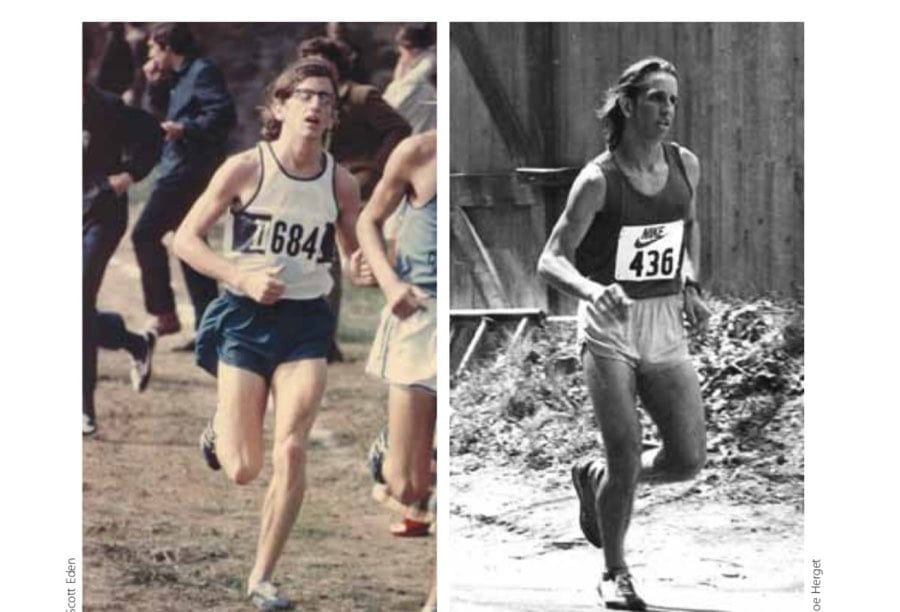
▲ Left: Walter at age 19 running an exciting but conventional 5-mile cross-country race for Duke. Right: Bob at age 19 running his lifetime PR at the Lake Waramaug 50-miler (7:27:54). And his first 50-miler was more than a year earlier.
was too much for him, and I finished the marathon alone. Even as a “seasoned” marathoner with one full marathon under my belt, I still couldn’t imagine running more than 26 miles. My brother and I never ran another marathon together, but his banter to me about nontraditional and adventure running now seems to have portended the coming ultra craze.
The natural Bob McCubbin was born in Baltimore in 1960 and started running at age 12 when he joined a small, local track club. His two brothers were younger, so there were no role models to follow. He continued school-related running through junior high (the middle school of the day), but he wanted more. At age 14 he participated in a walkathon and ended up running 19 miles! He also organized neighborhood Olympics where same-age kids competed in various athletic events, and he made cardboard medals to be given out to the winners. Bob had a fascination with the real Olympics, and at age 16 he planned a solo trip to the 1976 Montreal Games. With his parents’ permission, he traveled alone on a bus to Montreal and actually made it to several of his favorite running events before returning home safely.
Around this time he started to hear about road races: “I wanted to run a road race, but I didn’t know there were any road races shorter than a marathon,” so he waited until age 16 when he became eligible to run the Maryland Marathon and finished in 4:11. At this point he joined the Baltimore Road Running Club, and he began to learn about all the running opportunities available in that era. He ran several other marathons as well as shorter road races that he had discovered and rapidly improved his marathon time to 2:56 at age 18. He still wasn’t satisfied, and the same year he signed up for the JFK 50-miler. “I wanted to see how far I could go.” He finished in 8:33 and the next year he ran the Lake Waramaug 50-miler, a road course, over an hour faster (7:27), which put him in the nation’s top 10 Junior (age 19 and under) 50-mile runners. Who knew that there was more than one?
What kind of crazy-ass kid was this? For one thing, he liked numbers (as an adult he became an accountant), and he liked to “put something unique into a run.” In 1979 at age 19, he asked one of his friends to drop him off at the Pennsylvania state line so that he could run the 20 miles back to his home in Baltimore. “It started getting dark, and my friend told his mother about the plan, and she drove out the route and made me get in the car to take me home.” Having been stymied in that effort, he soon asked friends going to a swimming hole on the Pennsylvania state line to drop him off so he could run back the same 20-mile route to Baltimore. This time he persuaded two younger runners to do it with him. It was a hot day and one of his companions became disoriented and stopped at a house where the occupants called the police, who drove him home. Bob completed the run. So much for role modeling.
On New Year’s Eve in 1979, Bob persuaded two friends (different friends) to try to run one mile on each high school track in Baltimore County from midnight until whenever! Baltimore County is not small, and they weren’t familiar with all the tracks. It was also dark—they got lost at one school that turned out to be a middle school, and the high school track was finally found across the street. They ran 20 miles on 20 different tracks that night. The fastest mile was aided by pursuing dogs, but no one was bitten.
Our paths cross and lead to a world record
▲
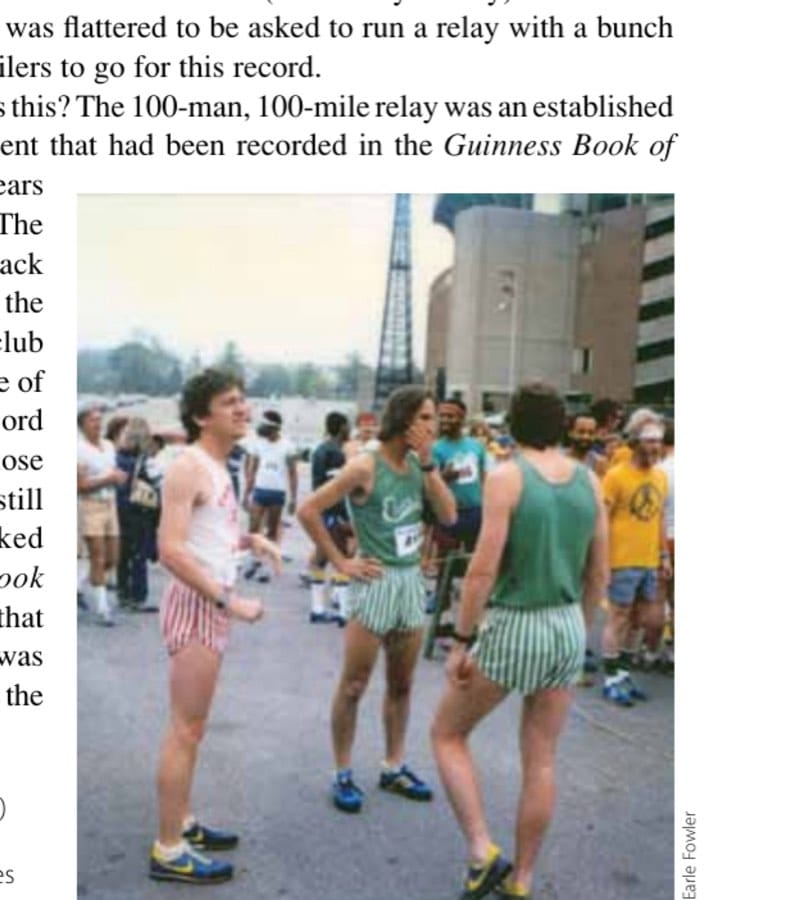
Walter (left) and Bob (center) shaking loose before one of many head-to-head road battles in Baltimore in the early 1980s.
© Earle Fowler
In 1980 I moved from North Carolina to Baltimore, Maryland, where there was a seasoned running community represented by the Baltimore Road Runners Club. I became involved in group runs and I heard about a local college kid who had run ultras “just for the heck of it.” The kid was a pretty good runner, and he went to a lot of the local road races that I was competing in, and he beat me a couple of times. I became more impressed with this kid, Bob McCubbin, when he organized an attempt at the 100-man, 100-mile Guinness Book World Record, which was my first experience with an ultradistance event (admittedly a relay). Since I had just moved to Baltimore, I was flattered to be asked to run a relay with a bunch of local sub-five-minute milers to go for this record.
What kind of record was this? The 100-man, 100-mile relay was an established although nontraditional event that had been recorded in the Guinness Book of Records for at least 10 years prior to our record attempt. The record had been passed back and forth between a club at the US Naval Academy and a club in Scotland at least a couple of times, and the existing record in 1981 was on average close to 4:45 per mile. While still in high school, Bob looked through the Guinness Book of Records for something that might be “doable while I was still young” and came across the
▲
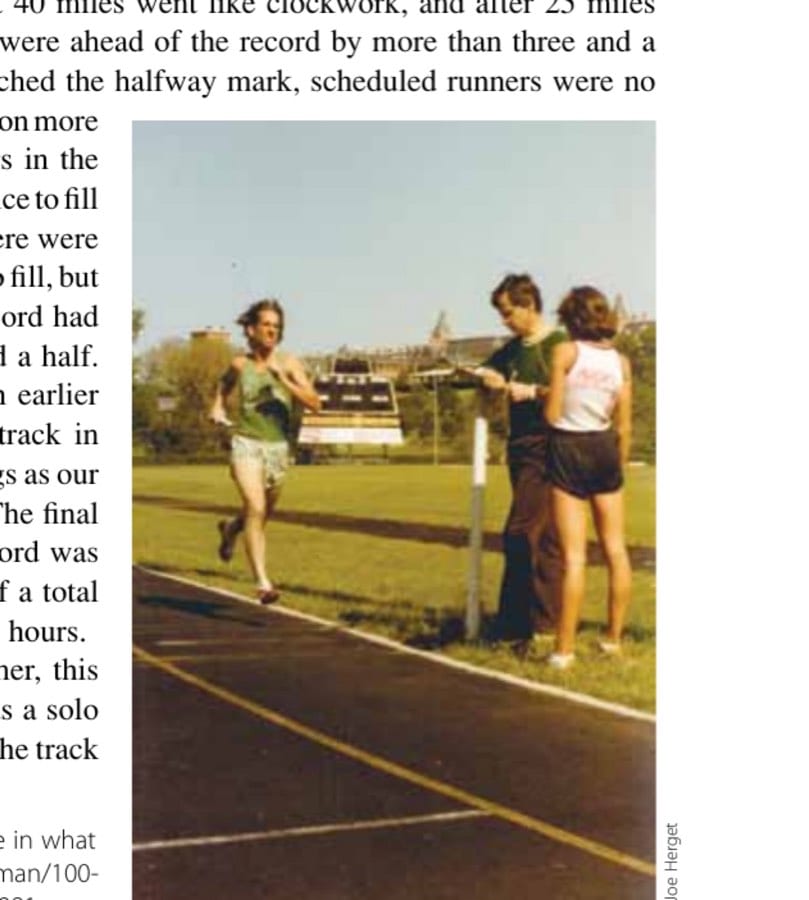
Bob finishing the lead-off mile in what would be the world record 100-man/100mile relay that he organized in 1981.
© Joe Herget
100-man, 100-mile record. Key requirements were that it had to be accomplished by 100 different men who all belonged to the same club and everything had to be documented (for example, three timing watches). Bob was also working at a running store at Harbor Place in downtown Baltimore that had just opened, and he got fellow employees and friends interested in the project. Remember, this was the era before cell phones and e-mail, and 100 runners was and still is a big group. First they signed up all their high school and college running buddies and runners in the Baltimore Road Running Club—“anyone who could run under five-minute-per-mile pace.” Then they enlisted local sportswriters to spread the word and put ads in the paper as well as chatting up everyone who came into their running store. They signed up about 106 runners because several of the runners “seemed iffy.” They predicted that in the best-case scenario, we would beat the old record by more than six minutes.
The event was held at the Towson State track and was to last about eight hours. Each runner had to be present only long enough to warm up and run the mile, so a tight schedule had to be drawn up as to who would run when. Telephone reminders were called in the night before, and early on race morning all the preparation seemed to pay off. The first 40 miles went like clockwork, and after 25 miles (coincidentally my leg) we were ahead of the record by more than three and a half minutes. As we approached the halfway mark, scheduled runners were no longer lining up on deck, and on more than one occasion spectators in the stands were pressed into service to fill the gaps. Toward the end there were fewer holes in the schedule to fill, but the cushion over the old record had shrunk to only a minute and a half. Many of those who had run earlier in the day returned to the track in time to watch the last few legs as our world record was secured. The final margin ahead of the old record was less than two minutes out of a total elapsed time of almost eight hours.
For each individual runner, this was not a race. Each leg was a solo run with no other runner on the track
to focus on or compete against. The average age of the runners was 22 1/2 years. The oldest runner was 41, and five of the 100 runners were 16 years old. At least two of the runners went on to compete in the US Olympic Trials. This was no group of neighborhood Olympians, but we didn’t even get cardboard medals! The 100-man, 100-mile world record that was set by our team in 1981 lasted for 16-plus years before it was broken, and the subsequent record lasted only a little over a year.
A Super Bowl ultra After the record attempt, I saw a lot of Bob, since we were both running every local race we could. In fact, Bob was the open-division champion for the Baltimore Road Running Club (based on a series of races, five miles to 20 miles long) in 1981, and I was the champion in 1982. Bob was also running college track events in this era, which was a strong reason to stay away from ultras at least during cross-country and track seasons. In 1983, in his last college semester, Bob came up with a plan to run from Baltimore to Washington, DC—about 30 miles. Unlike the Greensboro to Winston-Salem marathon that I had run, there was no formal race between these neighboring cities, but the course was straightforward as well as unique! Bob knew that this run would also complete the last section of his career goal of running from the Pennsylvania border all the way to Washington, DC. Bob and his friend Bryan Denson drove the course in advance and spray-painted mile marks on the highways, which apparently wasn’t frowned upon in those days. On Super Bowl Sunday 1983, Bob and Bryan started off from their home track in Baltimore with no fanfare—or bus fare for that matter. Bryan’s girlfriend had been enlisted to drive the route and check on them at certain points. The run was uneventful except for seeing a running buddy while passing through the University of Maryland campus in College Park and seeing a passing car containing two girls briefly run onto the shoulder of the road. The boys like to think that “they
© Walter Fowler
▲
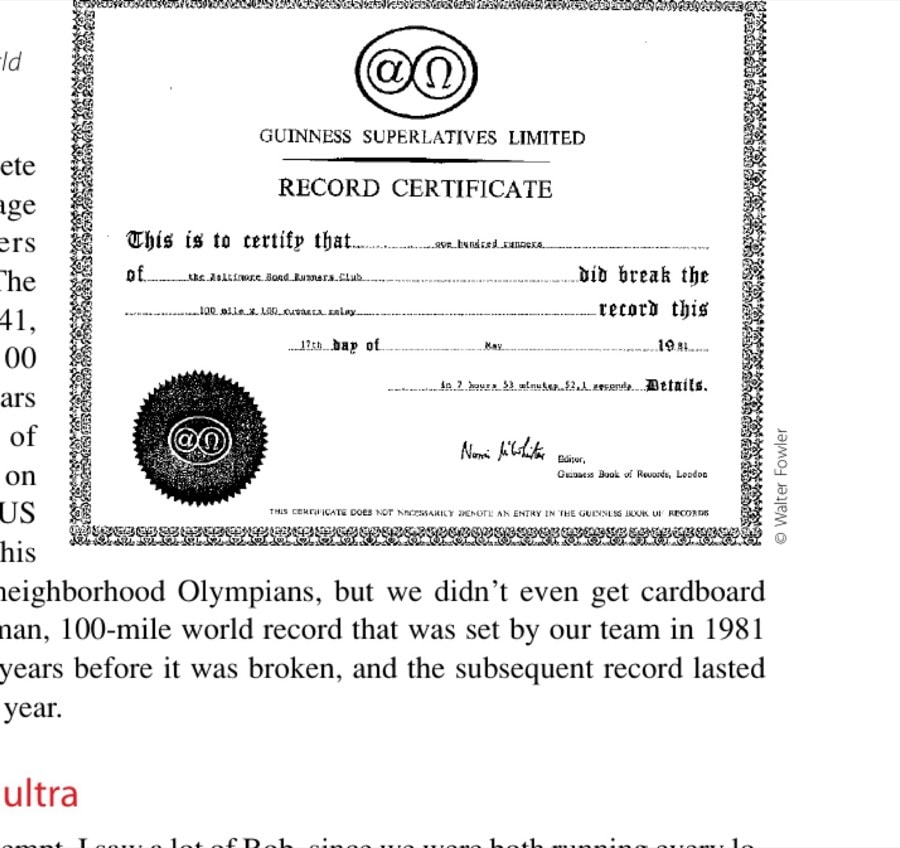
The world record certificate from the Guinness Book of World Records.
were checking us out,” but we all have our fantasies after running 20 miles. The two runners picked it up as they approached their 26.2-mile mark and broke three hours by a few seconds. They reached the District of Columbia line but kept on going another mile to finish 30 miles. No crowd was waiting for them. They just got in the car and rode back to Baltimore—not bad for a training run.
Ultra life on hold, ultra life reclaimed After college graduation in spring 1983, Bob stopped running seriously. “I was burned out and had to think about getting a job.” In retrospect, he admits that the early ultras or maybe just the crazy lifestyle of his youth may have contributed to his burnout. He got a job as an accountant, which fit with his love of numbers and orderliness, and before too long it was these traits that led him back to the ultra life. In 1990 he turned 30, and it seemed like a good time to start running again (ah, even numbers!). He was still interested in the 50-mile distance, but he admitted that he was less competitive and for the first time he was more interested in finishing than in his time. He found that this goal was more common among ultrarunners in the 1990s than it had been in the late 1970s and early 1980s. Many now considered themselves participants rather than racers. Bob continued to be interested in streaks, and he signed up for the JFK 50-miler, which he had first run 12 years earlier. It turned out to be one of his hardest runs ever since he twisted his ankle at mile 14 and ran the last 36 miles limping. He ended up in an emergency room, where he was reluctant to tell the medical staff how he injured the ankle and what he had continued to do for 36 miles after he had injured it.
Bob continued on an ultra tear, running 15 more 50Ks and 50-milers through the 1990s, including the 1991 Fort Meade 50-miler, which was run on a quartermile track! That comes out to 200 laps, and his lap counter wanted him to stop a lap early. “I was counting the laps myself, and I knew that I had to run another one to finish.” He ran 9:30. What do you think about while running 200 laps on the track? “Numbers.” That’s why he knew he was a lap short!
Second contact—our paths cross again I moved back to North Carolina midway through 1983. I hadn’t thought much (OK, any) about the 100-man, 100-mile relay or the record until I literally ran into one of my fellow relay mates at a beach run on the North Carolina coast in 2001, and he told me that we had actually been recognized as the record holders for the past 16 years and had lost the title only in the late 1990s. I went home and looked at my daughter’s Guinness Book of World Records from the mid-1990s, and there it was! I had missed 16 years of gloating with my North Carolina running buddies, and I had become an ex-record holder before I had recognized my
formal status as a record holder. I have never been involved in anything like that in my life before or since, although my appreciation of the event’s significance came quite late. I read on Facebook about a planned reunion in July 2009 of our 100-man, 100-mile relay team, and I was intrigued. It was organized by Bob, of course. I had been back to Baltimore only once or twice over the 25-plus years since I had left, but I had not seen or heard from Bob or the others with the exception of the unplanned meeting on the North Carolina beach where I had first heard about the record. At the reunion I found out that a few of the relay members were still running races and that Bob was still running ultras. He had actually started the Vermont 100-miler with his father-in-law-to-be in 1996 but didn’t finish. His future father-in-law, who had duped him into this endeavor, did finish. Bob told me that he is much more interested in distances up to 50 miles. “I’ve run a 50-miler in about eight hours. That’s enough—a full day’s work.” I’ve reminded him that our 100-man, 100-mile relay record was also about eight hours. I have also pointed out that although he has continued to avoid the “overtime work” required for a 100-mile run, he had been known to run single miles on strange tracks in the middle of the night in his youth before he was encumbered with a full-time job.
Are ultrarunners born, not made? There is no doubt that ultradistance running has become more popular in recent years for the challenge, adventure, novelty, solitude and/or companionship as well as many other reasons. As mentioned earlier, some aging runners compensate for having set unrepeatable PRs in their youth by running new distances, most often longer. A few runners have “wanted to try everything” and “put something unique into a run” from the very beginning, and Bob is a good example. Clearly, his idiosyncrasies were often demonstrated through unusual running feats, either carefully planned like the world-record relay or spontaneous like running midnight miles on New Year’s Eve. He still revels in his accomplishments, especially the world record, and he is content to keep racking up more JFK finishes without having to worry (as much) about his finishing times. After all, his e-mail address starts with RunJFKBob. He is also still working to complete long-range personal goals such as his “race in every state” project!
What about me? When I reach a long-cherished goal, my next goal is sometimes in a different direction. I finally broke 2:30 for the marathon in Boston in 1983 after numerous tries and several near misses. My focus on 2:30 for the marathon was based on that being the qualifying time for the 1972 US Olympic Trials Marathon. OK, so I was a few years too late! I thought that just under 2:30 was about my limit in a marathon, and I certainly never thought of going to longer distances. I had other goals in mind, medical school among them. I continued
© Tina McCubbin
© Earle Fowler
▲
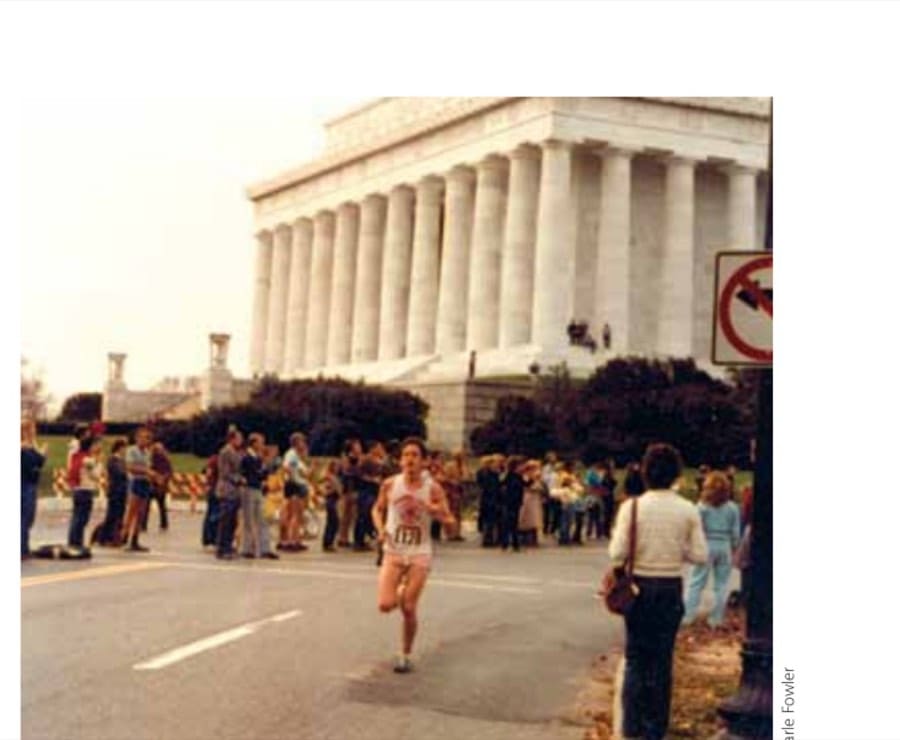
Walter during one of several “near-misses,” this one at the 1982 Marine Corps Marathon (finishing time 2:30:14!). It would be several more months before his sub-2:30 marathon.
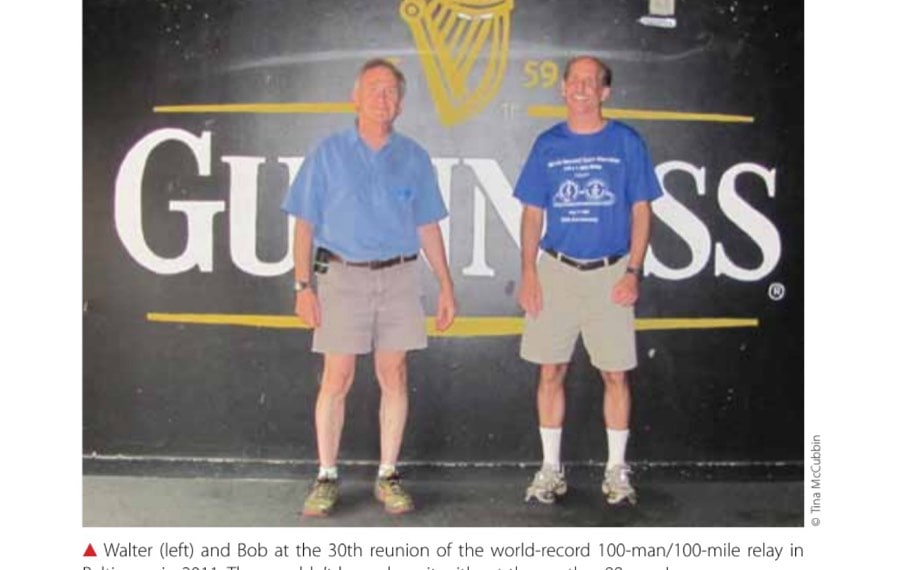
▲ Walter (left) and Bob at the 30th reunion of the world-record 100-man/100-mile relay in Baltimore in 2011. They couldn’t have done it without those other 98 guys!
running shorter races for a while, but I lost contact with Bob and my running past. I was rewarded when I finally found out about our world record, but I have never achieved the ultra life. Even Bob has taken prolonged breaks in his ultra career, and it may never be too late to join the ultra life, but few start in their teens and have Bob’s longevity.
Epilogue I returned to the 2012 Leadville 100-mile trail run as a pacer/crew member and met a talented young high school runner from Bethesda, Maryland, who was also pacing/crewing and who had a fascination for the ultradistance. Fifteen-year-old Alex was approaching his sophomore year of high school and was in a position to help his cross-country and track teams. He was intrigued about running the Marine Corps Marathon in Washington, DC, in fall 2012 (during his school’s cross-country season) and running an ultradistance race as soon as he hit the usual minimum age of 18. We did our best to persuade him to skip the marathon in order to help the team and to delay his personal entry into the ultra world until he ran out of his scholastic eligibility. I think that Bob in his current incarnation might agree with our entreaties to this youthful soul mate, but it is clear that, at least for some, the lure of the ultra life starts early and remains strong.
Bob McCubbin’s Ultras—So Far 1978 JFK 50-mile 1979 Lake Waramaug 50-mile 1990 JFK 50-mile 1991 HAT 50K 1991 Fort Meade 50-mile (on a track)
1997 Finger Lakes (New York) 50K 1997 Rattlesnake (West Virginia) 50K 1997 JFK 50-mile 1997 Fat Ass (Virginia) 50K
1991 JFK 50-mile
1998 Holiday Lake 50K
1993 HAT 50K
1999 Holiday Lake 50K
1994 HAT 50K
1999 HAT 50K
1996 Holiday Lake (Virginia) 50K
2000 Holiday Lake 50K
1996 JFK 50-mile 1997 Holiday Lake 50K
2000 HAT 50K 2010 JFK 50-mile
This article originally appeared in Marathon & Beyond, Vol. 18, No. 6 (2014).
← Browse the full M&B ArchiveMore like this
1,000+ stories from 19 years of Marathon & Beyond
The complete archive of the legendary long-distance journal — digitized and free to read.
