

Dog Days at Boston
“We seem to be living in dog days. From cyberspace to pet superstores, pop culture to haute couture, our love affair with the dog has reached new heights and shows no sign of abating,” reads the inside of the dust cover of Marjorie Garber’s book Dog Love.
The dog industry has created doggie walking services, doggie day care, and doggie health insurance. The August 6, 2006, Sunday Denver Post headline asked, “Denver Going to the Dogs?” because of the prevalence of doggie services in the Denver area. Garber goes on to observe: “The social integration of dog into human culture—and human into dog culture—is, we might say, at an all-time high.” But it has not always been so.
Robert Louis Stevenson’s essay “The Character of Dogs” criticizes a sizable portion of Victorian society, which was very fond of dogs “but in their proper place.” Canines have insinuated themselves into our lives since Stevenson’s time; in fact, Stevenson regarded endearment as a canine’s principal job. He observed that “Dogs live with man as courtiers round a monarch, steeped in the flattery of his notice and enriched with sinecures. To push their favour in this world of pickings and caresses is, perhaps, the business of their lives; and their joys may lie outside.”
Could it have been the outside joys that the dogs of the Boston Marathon were seeking when they trotted and yapped their way into America’s most famous marathon? No longer supplicants in their masters’ courts, they mischievously scampered though the course and at the heels of the runners. They cut their bit of trouble at a time when they were free to roam—well before today’s doggie leash laws, which, according to Garber, a Harvard Bostonian herself, remain stridently controversial. Or perhaps it was the sight of runners in full flight that triggered the dogs’ ancient chase instincts. And if not the chase, then perhaps it was the call to find their place in the pack. Of course, runners know a thing or two about the nervous hierarchy of the pack. In any case, the dogs appeared and figured into book and newspaper accounts of the Boston Marathon.
The first was a feisty fox terrier in 1947 that made Yun Bok Suh fall hard to all fours at mile 19. The fall ripped his hand and tore open his knee. Binding his hand with his sweatband and letting the knee drip, he nevertheless flew to victory. In 1950 another Korean, Yun Chi Choi, also encountered a Boston Marathon canine when a red chow nipped at his heels. Yun managed to elude the chow and went on to finish third as the Koreans completed the first 1-2-3 sweep at Boston. The third encounter is best known, that of Johnny “The Younger” Kelley, who was shadowed by a black Labrador retriever in the 1961 race. The account in the New York Times featured a photo dubbed, “Everybody Gets Into the Act at Boston Marathon.” Kelley took yet another of his famous second places at Boston, but not until he had stumbled over the dog at the 17th mile of the race. Kelley’s fall was short because Fred Norris, a 39-year-old Englishman, helped him to his feet. The Times quoted Kelley after the race as saying, “Fred, I don’t know how to thank you. Did you get third? I’m very glad.”
The Labrador did not fair as well as Norris in the Times’s account, though other accounts, namely Michael Connelly’s in 26 Miles to Boston, go easy on the interloper. Connelly reports that Eino Oksanen, the Finnish winner, said, “laughingly, the dog should be shot.” The Times article suggests a different account and a different attitude toward the incident: “Somebody should have taken a gun and shot that dog to stop him from doing that thing to Kelley. The dog bothered Kelley and everyone else. I [Oksanen] almost fell on top of Kelley.” However, Tom Derderian’s Boston Marathon account asserts that “Kelley understood the dog and secretly liked that the dog liked staying with the leaders.” What is to be made of the different accounts?

This is a marathon that has featured a number of famous “takeouts,” not all of them by canines. Clarence DeMar socked two spectators in the heat of the 1941 Boston Marathon: one for throwing water and another for asking for his autograph on the course. As the Korean Kee Yong Ham was about to complete his victory in 1950, a student burst from the crowd to insert himself into the victory photo. It was a stunt for the student’s fraternity. He was swiftly taken out by Joe Smith, a spectator who won the race in 1942. Smith took him out hard enough to send him seeking medical attention. And in 1960, the B.A.A.’s Jock Semple, seven years before his historic Kathrine Switzer grab (to remove her number) and shove, pummeled a clown—yes, literally a clown—to the ground with enough ferocity to attract a police officer’s attention. Jock was let off because of his status as a race official and the crowd’s empathy. Clearly, the sentiment of the time was that the race and its runners weren’t to be interfered with.
Garber, I believe, would point out the cultural anxiety revealed in the different accounts. She would highlight how we uneasily tack back and forth between Oksanen’s objective view and Derderian’s and Connelly’s more anthropomorphic views. She would cause us to wonder whether we are revealing more about the dog or about ourselves in these accounts.
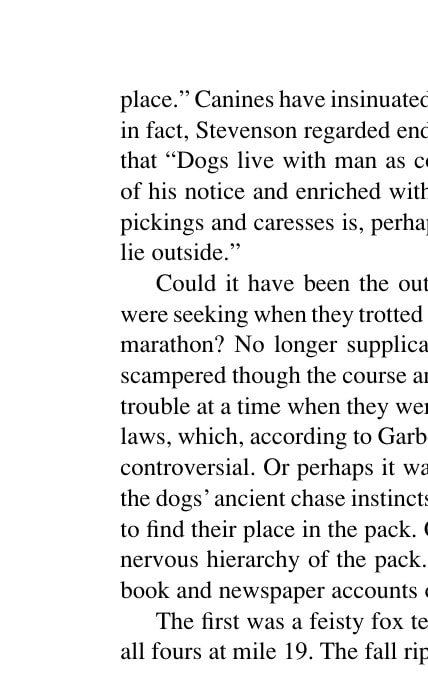
Kelley’s experience anticipated Hal Higdon’s greatest fear of dogs while on training runs. Though he had been bitten, Higdon’s greatest fear was of being tripped, as he reveals in his classic book On the Run From Dogs and People: “What they
Today, marathons are run in virtually every country in the world, all trying to attract your tourist dollar and entry fee. A glance through a three-month stretch of the calendar put out by the Association of International Marathons (AIMS) reveals marathons in Thailand, Mexico, Ecuador, Finland, Brazil, Russia, Japan, Switzerland, India, Colombia, Panama, Germany, Poland, Great Britain, Estonia, Denmark, Italy, the Netherlands, Tunisia, Spain, Kenya, Ireland, Korea, Trinidad, and Greece, to name a few.
Combining a marathon with international travel is a great way to visit other countries while enjoying your favorite pastime. However, it doesn’t take much for things to go horribly wrong if you fail to plan ahead. Medical-misadventure stories abound for tourists, businesspeople, and marathon runners while traveling overseas. Much of the problem lies in the fact that most of the more serious diseases that proliferate in underdeveloped or third-world countries have been eradicated in the United States, and we tend to expect this high health standard from the rest of the world. The reality is that health care around the world differs tremendously.
Furthermore, it doesn’t take much for us to get sick even in westernized countries like Australia and New Zealand or those in Western Europe. When we travel, we may not pay as much attention to basic hygiene, or we may be fatigued from the travel and jet lag, which lower our resistance to whatever bug happens to be floating around at our destination. Travelers even complain of gastric upset from the clean water in westernized countries, since tap water has its own local microorganisms.
When you toss a stressful, fatiguing endurance competition like the marathon into the mix of travel fatigue, jet lag, disorientation, change of diet, inexperienced travelers, alcohol, and third-world countries, it’s amazing that more marathoners don’t get sick while traveling to overseas marathons.
Some pretravel advice from Dr. Ochenrider
Planning your overseas trip around a marathon requires preparation and foresight. These go a long way to helping you rectify medical problems as they occur. Here is some advice from Dr. Mark Ochenrider, a primary-care internal-medicine physician who specializes in international travel medicine at Eastside Family Health Center in Kirkland, Washington, on what runners should consider when running in international marathons: “Become self-educated on the terrain, climate, and medical hazards well before traveling. For instance, in many countries it is not wise to swim in fresh water because of the risk of schistosomiasis and other diseases, but without research beforehand, you would not know this. A Web site that has excellent country-specific advice is www.cdc.gov/travel. The UK also has a great Web site with similar info at http://www.fitfortravel.nhs.uk.”

This article originally appeared in Marathon & Beyond, Vol. 14, No. 2 (2010).
← Browse the full M&B ArchiveMore like this
1,000+ stories from 19 years of Marathon & Beyond
The complete archive of the legendary long-distance journal — digitized and free to read.
