

Duel at Deadwood
My interest in this race began with Billy Mills. Born and raised on the Pine Ridge Indian Reservation in South Dakota, Mills was orphaned at age 12 and went on to overcome incredible adversity in his life. At the Tokyo Olympics in 1964, he became the only American ever to win an Olympic gold medal in the 10,000 meters. When my husband (Tom Burr) and I heard that Billy Mills planned to be at the 2004 Deadwood Mickelson Trail Marathon (DMTM), we knew we had to run (www.deadwoodmickelsontrailmarathon.com).
For a number of reasons, the DMTM provides the perfect destination marathon. There are numerous places to visit, including Mount Rushmore, Custer State Park, Sylvan Lake and Harney Peak, Needles Scenic Highway, and Spearfish Canyon, to name a few. Don’t miss the Prairie Edge Gallery on Main Street and Sixth in downtown Rapid City. The appeal of this race is the ever-changing, spectacular scenery along the race course. Other than a very short distance at the beginning and the end, the entire race course is on the Mickelson Trail, a gravel-packed railroad bed.
FROM GHOST TOWN TO THE NATIONAL HISTORIC REGISTER Not much more than 20 years ago, Deadwood, named for the burned trees that the miners found in the area when they came in search of gold, was a ghost town. During the interim, the townspeople of Deadwood made a decision to bring gambling to their town and in doing so were able to restore historic saloons, hotels, and other landmarks. Today the entire city is listed on the National Historic Register.
Once a runner sends in the application, the DMTM Web master wastes no time getting and staying in touch. Frequent e-mail updates keep the runner well informed and familiarize the runner with the area, including places to stay. By the time we arrived in Deadwood, I felt right at home.
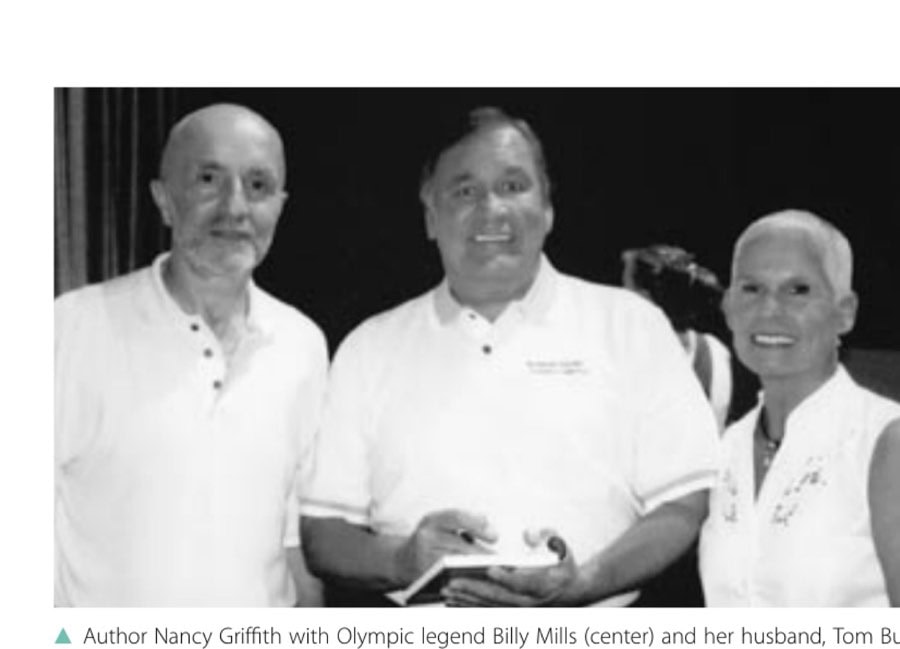
One of the high points of the weekend was the Friday evening get-together in Rapid City with Billy Mills and Jeff Galloway, both of whom were captivating but in very different ways. If you’re ever presented with an opportunity to hear Billy Mills speak, don’t miss it. He’s not only an Olympic legend, he is also a
Courtesy of Nancy Griffith
Author Nancy Griffith with Olympic legend Billy Mills (center) and her husband, Tom Burr (left).
phenomenal storyteller and motivator. I was in tears as he described his childhood; I was moved as he expressed the manner in which his father passed on spiritual teachings; I was sitting on the edge of my seat as he showed the video of his 1964 Olympic win; I was mesmerized as he described his emotions during each step of that unbelievable race; and I left the auditorium visualizing an astonishing personal finish for myself on Sunday.
On Saturday, while picking up our race packets at the Deadwood Pavilion, we admired the work of Joe Langer, the local artist who (along with his wife and four of their grandchildren) produced the marathon and half-marathon finisher medals. Made of Black Hills alabaster, a white stone with reddish streaks, each one is slightly different. On each medal’s face is a running caricature etching of Wild Bill Hickok and Calamity Jane, certainly two of Deadwood’s most notorious citizens. The medals are stunning, and at first glance, I thought they must be a commemorative piece you could purchase. Imagine my excitement when I discovered they were the real thing. This alone would be incentive to finish the race.
BOOZE, GUNS, AND THE WILD WEST Main Street in Deadwood is approximately one mile. Its ambiance transports you to a time and place where booze, guns, and the Wild West ruled. Modernday Deadwood is still booze, gambling, and steak, not necessarily in that order. If you’re a vegan, be prepared to bring your own food. I was happy to see that Starbucks Coffee is beginning to make its appearance in Deadwood.
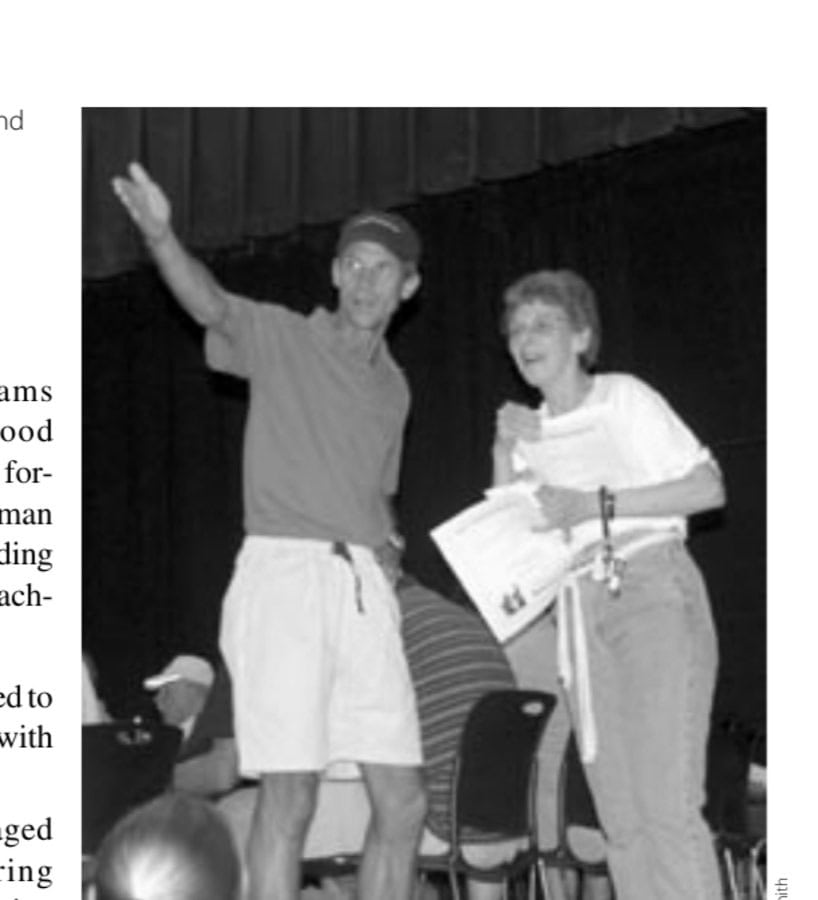
Motivational speaker and coach–guru Jeff Galloway during his prerace presentation.
Visiting the Adams Museum in Deadwood made me realize how fortunate I am to be a woman in today’s world. In reading the 1915 “Rules for Teachers,” I noted that they
• were discouraged from loitering downtown in ice cream stores; • were prohibited from dressing in bright colors; • were required to wear at least two petticoats; and • were not allowed to ride in a carriage or automobile with any man unless
he was a brother or father. Without a doubt, they would not have been running the marathon, and not because they weren’t capable! Also of interest to me was Blanche Coleman, who became the first woman authorized to practice law in South Dakota. She lived in the Franklin Hotel and was a devout member of the Jewish faith. Florence Stanford, who graduated from Boston Medical College in 1879, moved to Deadwood in 1888. She was the first and until recently the only female doctor in Deadwood. There were women of every race and religion in those early days. I found the details of their lives most intriguing.
PAHA SAPA Driving through Custer State Park, we were delighted to be delayed by a herd of several hundred bison running down through a draw, the caramel-colored calves kicking up their heels as they ran. Bison evolved with expansive shoulders, perfect for plowing through winter snows in search of food buried deep below. Later,
Kevin Smith
• were not allowed to keep company with men;
Kevin Smith
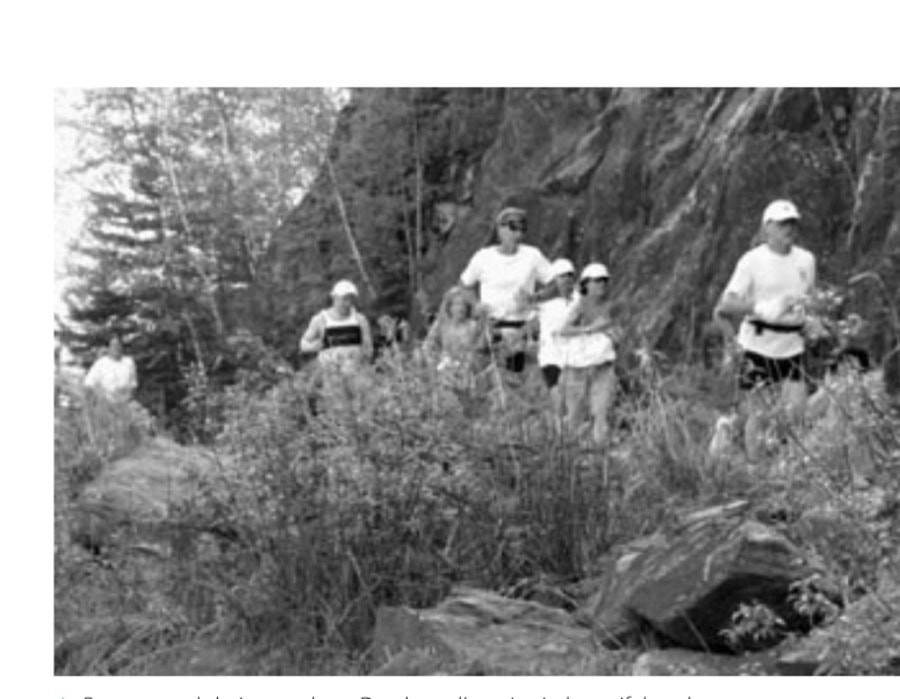
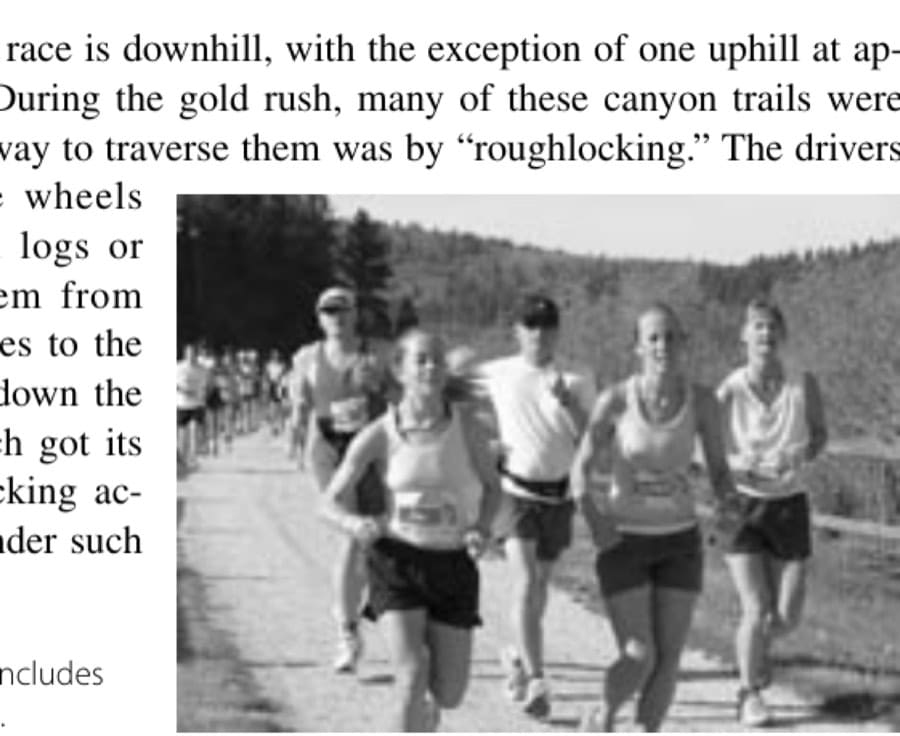
Racers wend their way along Deadwood’s majestic, beautiful, and serene course.
while touching a beautifully tanned bison hide at Prairie Edge Gallery in Rapid City, we could see, feel, and understand why tatanka were key to the Indian way of life and survival. Bison provided much-needed food as well as enduring warmth in a harsh environment where staying warm was vital to staying alive.
Few people take the time to realize the drama and tragedy that have made their mark on the Black Hills. This is a land that was and is sacred to the Indians. They consider the Black Hills (Paha Sapa) to be the birthplace of their spiritual universe. From these hills the Indians draw strength, courage, and inspiration.
The ultimate is not to win, but to reach within the depths of your capabilities and to compete against yourself to the greatest extent possible. When you do that, you have dignity. You have pride. You can walk about with
character and pride no matter in what place you happen to finish. —Billy Mills The DMTM is one of the most well-organized races we’ve ever encountered, thanks to Jerry Dunn and his incredible staff of volunteers. At 5:00 A.M. sharp on race-day morning, buses picked up the runners just outside of our hotel. Forty-five minutes later, we were delivered to the starting line in Rochford. As the sun rose, so did the temperature. By 10:00 A.M., it had reached the mid-80s.
The starting line in Rochford has an elevation of 5,305 feet. It’s hard to imagine that in 1878, this spot on the map was a town with 100 log cabins, three
saloons, six stores, two hotels, a drugstore, a butcher shop, and a barber shop. By contrast, in 1881, it was all but deserted, its citizens having gone elsewhere in search of gold. During the first half of the race, the trail consistently wound its way to 6,200 feet. Although it appeared harmless, the combination of subtle uphill, elevation, and heat was challenging. The race volunteers provided aid approximately every two miles, but unless you are a sub-three-hour trail marathoner (and there was only one in this race), I would recommend carrying at least a handheld bottle, especially in hot weather.
The racecourse is unbelievably majestic, beautiful, and serene, at times passing through meadows of wild irises and spiderwort, at other times through immense pastureland or deep canyons. Because of the numerous mountain streams, the course included 30 bridges and one tunnel. Beavers are not uncommon in the Black Hills, and in many locations just off the course, their dam-building talents were apparent.
Just before mile 13 of the race, located at 6,200 feet is the Dumont Trailhead, named after an early French settler. This spot was once a lumber town and included a railroad section house that was a shipping point for cattle.
Farther along, we ran through what was once Englewood, a settlement established originally as Ten-Mile Ranch, a stagecoach stop in the late 1870s. Its name was later changed to Englewood when the Burlington Railroad arrived on its way to Deadwood in 1890. Local historians claim a man named Mr. Kelly operated a still at Ten-Mile Ranch, which allegedly kept Deadwood supplied with tax-free whiskey.
ROUGHLOCKING
The Deadwood course includes 30 bridges and one tunnel.
Kevin Smith
The second half of the race is downhill, with the exception of one uphill at approximately mile 18. During the gold rush, many of these canyon trails were so steep that the only way to traverse them was by “roughlocking.” The drivers would roughlock the wheels of their wagons with logs or chains to prevent them from turning, hitch the horses to the rear, and slowly skid down the slope. Breakneck Gulch got its name from a roughlocking accident that occurred under such circumstances.
THEY SHALL MOUNT UP WITH WINGS AS EAGLES. —ISAIAH 40:31 At mile 19, deep in the canyon the temperature was close to 100. Looking up into the sky, our eyes were drawn to an eagle, soaring high above. I couldn’t help
but think of my dad. Last summer he made a special card for Tom just prior to the Vermont 100 Endurance Run. As inspiration, he quoted Isaiah 40:31: “But they that wait upon the Lord shall renew their strength; they shall mount up with
wings as eagles; they shall run, and not be weary; and they shall walk, and not faint.” Six weeks after our marriage in Vermont and Tom’s successful finish of the 100-mile race, my father died suddenly. As I remembered him, I gave thanks
for the virtues of patience and perseverance that he and my mom had instilled in me. Always adventurous and not prone to giving up easily, my mom is very proud of my marathon finishes.
Kevin Smith
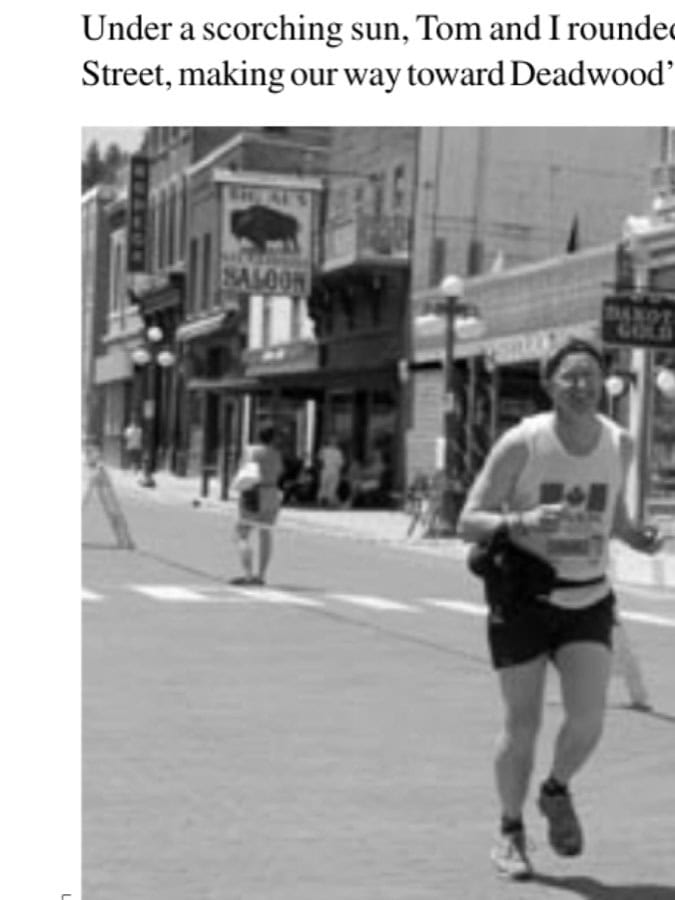
GOD HAS GIVEN ME THE ABILITY. THE REST IS UP TO ME. BELIEVE. BELIEVE. BELIEVE.—BILLY MILLS Under a scorching sun, Tom and I rounded the corner into town and onto Sherman Street, making our way toward Deadwood’s Main Street and the finish line in front of
the Bullock Hotel where employees and patrons have reported seeing the ghost of Seth Bullock, Deadwood’s first sheriff. Closed to traffic on race day, Main Street provided an inspiring finish line with its cob
blestone street, historic buildings, and ample spectator cheering. The flashing thermometer read 93 degrees. As the race official placed that gorgeous alabaster marathon medal around my neck, I gave thanks
for my finish and began to contemplate The homestretch is along Deadwood’s historic Main Street. next year’s race.
Lessons From a 100-Mile Virgin Plan for Everything and Expect Anything. Then Go With the Flow. BY KEVIN POLIN
I am probably like most people who wind up running a 100-miler: the thought of doing the distance had been eating at me for some time. It was as if there was always some unfinished business waiting for me. After I ran the Umstead 50 and JFK 50 in 1999, the next logical step was the 100. Well, pneumonia that I caught during an Alaskan mountaineering jaunt soon after the two 50s and then our first child in 2000 and second in 2003 put the big distance on hold. Three and a half years went by after the JFK 50 until just the right set of circumstances came together that enabled me to attempt what I now thought of as a fabled 100. In other words, I decided to get off my fat ass and do something about my goal.
After the two 50s, I ran 12 marathons in 2000 (incidentally, one per month in different states) and then immediately became completely uninterested in running. I didn’t run again for more than two and a half years until the summer of 2003 when I decided enough was enough and that the extra 30 pounds of fat layering my body was covering up the chiseled athlete waiting to jump out. I started running (well, jogging really) and even changed my diet. I would be missed at the local Taco Bell.
Starting from scratch was challenging. I felt like a rookie once more as I plodded along. Running in the humid South after work each day was a chore rather than the pleasure it once had been. Running as a chore was new; I still had memories of many great runs—not just marathons or ultras but also solo training runs. It was mostly the feeling I remembered of covering long distances over hills, through valleys, and over trails among the animals and not even being that tired when finished—in fact, of finding myself more energized after a quick eight-miler through the woods. But now it was a struggle to do just short distances as the feeling of being more and more tired each day continued. I realized that running without being in good shape was not a good thing and that I needed a goal to motivate me. A 100-miler on the schedule for the coming spring seemed the logical choice to start getting back in shape and to knock off a major goal.
TRAINING The only 100-miler in the southeastern United States is at the Umstead, North Carolina, State Park. This seemed like the sensible choice since I had already run the 50 on the same course. I also had friends who lived close by and knew several of the local pubs. The 100 was scheduled for April, so I decided to run through the fall and do
the Atlanta Marathon in November. I found out from the race director that Umstead usually gets its maximum of 200 entrants by the end of January. So my plan would be to train through January, and if things felt right I would sign up then.
I kept a moderate weekly dose of four or five four-milers and then increased my weekend long run up to 20 miles just before the marathon. I ran a surprisingly good Atlanta Marathon in under four hours, which I felt good about considering my short training time. More important, I felt the running legs come back and lost about 25 pounds. I continued the training and even managed some long runs through the Irish countryside (although it looked more like bog lands to me) while visiting family over there.
In February, I ran the Tybee Marathon in Georgia and managed again to come in under four hours. After that, I kept the long runs between 12 and 18 miles each weekend. Seven weeks after Tybee it was time for the race. Mentally, I knew I could do the distance; but physically, I was a little worried about my lack of real ultra training. I hadn’t run anything over the marathon distance or a night training run and had only recently gotten back in shape after almost two and a half years of idleness. I decided on a very conservative goal: finish in less than 28 hours. This would give me an extra two hours to finish under the 30-hour cutoff if need be.
UMSTEAD DESCRIPTION The Umstead course is a 10-mile loop with a two-mile out-and-back spur. It is mostly on crushed gravel, and the footing is very good. This was a change from the 1999 race when most of the trail was covered in small rocks, which caused severe havoc to my feet after 50 miles. The course is hilly, with about 8,000 feet of climb over the 100 miles. Since it is for the most part a 10-mile loop, the information packet stated, “Getting lost will be difficult.” More on that later.
Umstead has a qualification of at least a 50-mile run in the last two years. Obviously, I hadn’t done that but was kindly given a waiver from the race director after I sent him an explanation of my training, although I must say I did round up some of my long-run mileages to significant figures.
PRERACE DAY After a seven-hour drive, my wife, Dawn, and I arrived directly at the race headquarters located at Camp Lapihio inside Umstead State Park. Number pickup was straightforward and easy. Outside the race meeting room, I saw Tom Green, whom I had run with for over 30 miles during my last time here in the 50 (see article in M&B, March/April 2001). I said Hi but he had no idea who I was—as in most aspects of my life, it seemed that I was quite forgettable. (Tom went on to finish in 22 hours, 50 minutes.)
My wife (to whom I am not forgettable) and I listened to the race briefing at the headquarters in Camp Lapihio before going to dinner with friends, where I drank a few beers. (Surely a few beers would be insignificant for a run of this distance?) I had avoided most caffeine in the two weeks before the race, although I wasn’t quite able to give up my weekend Starbucks latte. The night part of the run worried me, so I decided that by avoiding caffeine before the race, coffee during the night portion of the run would have more effect.
MILES ZERO TO 20 Standing at the start line on a cool, clear, expectant morning, I felt privileged to be attempting this event in the company of this special group of people. From my earlier 50-milers, I knew that running up the hills came with a very high price on the legs. So, as soon as the gun went off, I held in check my fast-twitch muscles and speed-walked up the hill—as I focused on walking up all the hills. My plan was to go out slowly and keep it slow. My pace while running felt very slow indeed, but the first 10 miles came and went quickly since it was more of a fun lap where the runners got to know each other and the course. In fact, many of the runners were very chatty. Was this a tactic to pretend they were not doing something ludicrous today, like running 100 miles? The second 10 miles seemed to go by fast also, and I pulled into the aid station after four hours feeling perfectly fine and right on scheduled pace. The day was filled with hazy sunshine and the temperature was perfect, in the low 60s. It sounds corny, but I sensed that it would be a special day.
MILES 20 TO 40 Feeling strong, I decided to push the pace a little on miles 20 through 30, although at the end of the loop I found to my surprise that I had managed only to keep up my earlier pace! Obviously, fatigue had begun to set in. At the end of this loop, I realized that I had forgotten to put Vaseline on in the vital areas. Thankfully, I found some at the first aid station, but I couldn’t bring myself to spread the stuff on my private parts after I realized that several other runners had dipped their hands in the pot already. The Vaseline pot seemed to remind me of a culture dish from my high school biology class.
On miles 30 to 40, I again pushed the pace a little since I felt strong and knew that I would lose time during the night, but I found later that I was actually slower than my last lap! Stiffness started to set into the legs at this point after eight hours, 34 minutes of running.
The two aid stations at each end of the Umstead course were pure and simple oases. Every kind of food and drink was available, and the volunteers were helpful, encouraging, and generally great people. In fact, it was quickly obvious to me that the whole race was a labor of love for many of these people. It seemed they shared a love for ultradistance running and were prepared to give up countless hours of their time. How they managed to put this first-class event on and charge people only $85 (a price many marathons charge) is a mystery to me. These volunteers deserve more credit than any of the runners for giving of themselves for nothing in return. They humbled me.
MILES 40 TO 50 During the 40- to 50-mile lap, I was able to keep the earlier pace and felt fine except for continually stiffening legs. After completing 50 miles in 10 hours, 55 minutes, I pulled off the course, sat down, and checked my feet since they felt a little ticklish. I was shocked to see a blister stretching from the heel to the ball of each foot. This
really demoralized me, knowing that I was only halfway through the race and had the biggest blisters I had ever seen. I was mad at myself for not sticking to my plan of checking my feet and changing socks every 10 miles. Even now, I couldn’t change socks since I had already left the rest area and wasn’t about to turn around. I felt even more demoralized, since Dawn had now left with my gear bag and I wouldn’t see her for at least another five hours because she was off visiting friends for the evening.
MILES 50 TO 60 At mile 50, I took a couple of Aleve (my first of the day) and pushed on and was able to run quite well except for the pain of the blisters, which felt like they were enlarging with each mile. I tried to pretend my feet were fine, but every time I ran over a stone I felt a jolt of pain through my feet and was reminded of the pain I had felt during my first 50—a pain I thought had been lost in the back of my memory banks somewhere.
The second half of the Umstead 100 course is shortened slightly so the runners do not have to run an extra 100 yards or so around a boat dock. I’m not sure whether this is for safety or for logistics. In any case, I forgot about this and ran around the pier anyway, adding 100 yards or so to my distance. Normally, this wouldn’t have been a problem in any race, but with the blister problem increasing, it added to a mental decline.
MILES 60 TO 70 After completing 60 miles, I pulled into the rest area where I was hoping to change socks and see whether I could do anything for my feet. Unfortunately, Dawn was not there. She had said she might not be able to make this loop, but this was really disheartening because she still had my gear bag with spare socks and a flashlight that I needed since it was now totally dark. I asked around and thankfully found a volunteer who lent me his small flashlight. It was 7:36 P.M., and I had been on the course for 13 hours, 36 minutes by this point.
Into the night, I realized this is where the race really starts. By now it was quiet on the course—hardly anyone was around, since many people had finished the 50-mile distance and left, leaving less than about 90 people on the course. But it was quite comforting in a strange sort of way to be enveloped in the dark, as if cocooned in a blanket of anonymity. An odd but nice sense of freedom washed over me as I ran through the lonely woods with the full moon sending eerie tree shadows across the trail.
Blisters were now a real problem. It felt as if the entire bottom of each foot was covered by one giant blister. Running on stones was almost unbearable. The blisters were so bad at this point that it was easier to keep moving. If I stood for even a few seconds, I could feel the blisters swell immediately, so the pounding of my feet on them kept the fluid from getting too full in the base of my foot. Running became extremely uncomfortable as each placement of my foot caused a huge squishing sensation. I kept telling myself that I was fine and that it was “just a couple of little scratches on my feet.” This worked for a while until I passed a runner just standing in the middle of the trail. “Are you all right, mate?” I asked the man. “
It’s my feet. I have blisters all over them. I can’t run anymore.” “Why don’t you sit down and I can tell someone at race headquarters to come and get you? It can only be
about a mile away from here.” “It’s OK, I can walk back. I just need to take a rest first.” “Well, good luck then.” And with that I ran off. Seeing this guy wasn’t good, since I kept wondering whether that would be me in 10 miles time.
To make matters even worse, about 10:00 P.M., as I neared the race headquarters, I turned off a wrong path into a cabin area. The flashlight I had borrowed worked only intermittently, and I hadn’t seen the course marker and couldn’t see the flashlights of other runners anywhere near me to use as a guide. Running farther down this strange path, I realized in about 10 minutes that I was on the wrong trail. I wondered whether to continue on and perhaps pick up the trail farther down or to turn around and find the place where I had turned off incorrectly. I turned around and raced back up the trail and lost about 15 minutes of time—very disheartening indeed.
MILES 70 TO 80 Thankfully, I found Dawn at the rest area after completing 70 miles, and she gave me my flashlight. As I passed the Red Cross hut, I decided to see whether anyone could treat my blisters. There wasn’t much the workers could do since the blisters had already popped, so they treated them with antibiotics and taped them up with gauze. “How much longer do you have to go?” one of them asked me. “Oh, just 30 miles,” I replied. The looks on their faces weren’t encouraging. I changed socks, cleaned my feet, and was on my way by 10:30 P.M. I had considered bringing larger shoes since I knew my feet would swell, but I already had the largest
Montrails available. The flashlight I had was quite light since it needed only two AA batteries, but I found out later that the batteries lasted only about two hours—not enough time to complete a 10-mile loop. Again, I got a little annoyed at myself for not testing my equipment. I trudged on through the dawning of a new day and felt a little more confident since I knew everything possible had been done for the blisters.
MILES 80 TO 90 For the last 30 miles, I had been drinking Red Bull every 10 miles. I wasn’t sure whether it helped, but I did not feel too tired even though I had now been on my feet for 19 hours, 45 minutes. But fatigue was definitely setting in. As I left the rest area after 80 miles at about 2:00 A.M., I ran up and down the hills from the headquarters area and took an immediate wrong turn. Five minutes later I realized that I was running down the wrong path. Again, I didn’t know whether to turn around or go forward and try to get back on the trail ahead. I saw a car parked farther up and asked the startled driver whether he knew where the race trail was. He told me it was farther up the road I was on.
So, I ran ahead for a few minutes and found myself back at the race headquarters! I had somehow spent the last 25 minutes running a full circle around the start area. This realization made me angry with myself for losing concentration and running off course on a route where getting lost was “almost impossible” according to the race
brief. I was almost heartbroken that I could have made an error like this for a second time. I could not understand how I could have made two very simple mistakes that caused me to run an extra 45 minutes with severely blistered feet. It was apparent that I was mentally very tired and unable to keep focused on what I was doing.
It was during this 3:00 A.M. to 4:00 A.M. period that wayward thoughts started to strike me. Little things started to irritate me, like anyone without a flashlight (why should I light their way and do all the work?). By this time, perhaps only half of the runners who passed me on the out-and-back spur were saying Hello. I was too tired to say anything, so I decided on a rule of replying only to people who spoke to me.
At one point on the trail around this time, I came upon another runner who saw me stop and start walking. “Get down to work, buddy,” he told me. To which I felt like responding, “Up yours, mate. I’m tired.”
However, I said nothing, thinking that I didn’t want to spread any bad karma to other runners who might have heard. I’m glad that I didn’t succumb to those menacing urges that I knew were due to fatigue but were hard to stop at that point. Or maybe I do need counseling?
MILES 90 TO 100 Finally, around 5:00 A.M., the birds started to sing, even though it was still pitch black. I ran up to my SUV and tapped on the window to wake Dawn, who was sleeping in the back. Even though she was three months pregnant, she was adamant about running the last 10 miles as my pacer. And this was perfectly fine with me.
We started to jog the beginning of what turned out to be the most enjoyable lap of the whole race. It was as if I had suddenly awakened from a bad dream as Dawn filled me in on what she had been doing the day before. The miles melted by and the pain seemed to subside in my feet and legs as I heard and talked about shopping plans, house hunting, and dinner menus rather than blisters, broken flashlights, and wrong turns. As the sun rose farther and beat back the night, my energy level rose and I started to smile and even crack a joke or two with fellow runners. Gone was Kevin the malicious, and up appeared laughing-boy Kev. The
lap
seemed
to
fly
by,
and
in
no
time
at
all
Ifinished
the
race
with
asprint up the last hill for a total time of 26 hours, four minutes—two hours faster than my plan. The massive, cheering crowd of four people was a welcome sight indeed.
POSTRACE For the first few hours after the race, I felt fine. In fact, I had so much energy that I cleaned out my SUV while I was still at the race course. My earlier visions of crawling in the back of the vehicle directly from the finish line and then being carried into my hotel room were dashed. Obviously, the blisters were still bad but felt much better when I popped them again. I felt nauseated for a while, but that quickly passed. All in all, my condition was much better than when I had finished both my 50-milers several years earlier. The only lasting problem I had was a few weeks later, when three toenails that had turned black after the race suddenly fell off, exposing tiny growths of new nails underneath.
I do have to put a note for first-timers on the reaction from other people who hear of your running 100 miles:
be wary of whom you tell. To just about everyone reading this magazine, running 100 miles is a brilliant and worthwhile achievement. However, I quickly found that some people believe ultramarathons are too far outside the norm to be acceptable. Usually, I now tell people only that I’m a keep-fit enthusiast.
What kept going through my mind over the next few days was my witnessing the fantastic efforts of the lead runners: running the entire 100 miles at a nine-minute pace. This was awe inspiring and a privilege to watch and be a part of. It was all the more inspiring to watch these superb athletes perform at full speed over a 100-mile trail and finish the race for . . . a belt buckle. And, unlike me, they felt no need to write of their accomplishment. No newspapers covered this race, and most residents of Raleigh had no idea this unique event was being held in their local state park. Personally, I can say only that the Umstead 100-mile race was the most fun I have had in years. Nothing can beat the absurd realization that you have just run 100 miles.
For the rest of the day after the race, I said I would never do anything like that again. Later the next day, I said that I might do just one more 100 to make sure the first one wasn’t a fluke. A few days later, I realized that Umstead was just a warm-up for something harder. I began thinking in terms of doing the Vermont 100 later in the year.
TIPS AND SUGGESTIONS FOR 100-MILE ROOKIES Anything that takes a long time on your feet counts as training for a 100. I felt in better shape after the 100 than I had after either of my two 50s five years earlier—all of this without a long run over 26 miles. It strikes me that there are plenty of ways to train for a 100 besides the regular long-run structure. In 2000, for example, I ran numerous training marathons by driving to them the night before (anywhere from a five- to eight-hour drive), sleeping in the car for a few hours, running the marathon, and then driving home. I realize now that this helped build up my stamina and sleep-deprivation techniques.
Learn how to keep focused during the night. I don’t know how you can do this except by long training runs through the night. Pacers are a great idea for nighttime, especially on your first run, when you don’t know how you will cope with running more than a day with no sleep.
Foot care is essential. Check your feet often and change your socks and shoes before you have problems. Have a checklist of to-do items for rest stops, such as Vaseline, ChapStick, and special drinks. Start running through this checklist as you near the rest stop.
Sort out drop bags so you are highly self-sufficient. Rely only on yourself as much as possible. Don’t expect your support crew to make it to every meeting point, and have a backup plan. Expect problems. Even though I felt that only the blisters and course navigation were my problems in this race, I’m sure that if I solve these in future races, other problems will arise.
Have the correct gear for the terrain. Even in the relatively easy trail conditions at Umstead, the continuous kicking up of dust and rocks over 20-plus hours will cause dust and stones to get into your shoes; be prepared with gaiters or other gear.
Eat as much food as you can at aid stations. Salt pills are also a great idea. I took two pills every 10 miles. I’m not sure whether they helped, but I didn’t seem to get stomach problems. Start slowly. I was in 136th place after 10 miles and moved up each lap to finish in 66th place, since my speed was relatively even.
This article originally appeared in Marathon & Beyond, Vol. 9, No. 3 (2005).
← Browse the full M&B ArchiveMore like this
1,000+ stories from 19 years of Marathon & Beyond
The complete archive of the legendary long-distance journal — digitized and free to read.
