

“Duel In The Sun” Revisited
Hal Higdon’s Classic Chronicle of Boston’s Best Duel: Alberto Salazar vs. Dick Beardsley, 1982. Part II. HAL HIGDON
Editor’s note: Part I of “‘Duel in the Sun’ Revisited” appeared in Boston Marathon & Beyond, a special issue about the Boston Marathon published in April 2006.
MIND GAMES
At Wellesley College, women from the school crowded into the streets, forming a corridor so narrow that the entourage of vehicles accompanying the lead runners had to slow to squeeze through. The female spectators shrieked in appreciation of the runners passing their doors. “They were screaming so loud it hurt,” recalled Salazar. Several of the lead runners offered quick waves of thanks. Most yearned for the relative quiet once the college was behind them, although there was little quiet on the Boston course that year. The unseasonably warm and sunny weather, plus the promise that Alberto Salazar might set a world record, had attracted more spectators than anyone could remember from previous years. Some suspected the number to be as high as two million, although nobody could say for sure. Boston was a sporting event where you could not count the number of tickets sold.
Nike had a store on the left side of the road, just before runners departed Wellesley around fourteen miles. In passing, Salazar spotted a number of Nike employees he knew, including Brendan Foster, director of marketing. Briefly relaxing his concentration, Salazar smiled and waved at them. Beardsley noticed: “It was as though Al was saying, ‘This is my turf. This is my territory.’ He wanted me to know how relaxed he felt.” In response, Beardsley began to wave at spectators on the right. He saw that Salazar immediately got a stern look on his face, as though he disapproved.
Remembering the incident years later, Salazar would recall that immediately after he waved at the Nike employees, Beardsley moved to one side to pat the back of a wheelchair athlete they were passing. “It was to psych me out,” Salazar interpreted the action, “to show me how good he was feeling.”
Actually, although Beardsley did pat the back of a wheelchair athlete, this happened in the Newton hills, almost four miles farther down the road! It was an example of how runners in a marathon often compress time, blotting large segments of a race from their memory, as they concentrate on the effort required to continuously move at the fastest possible speed for a period of more than two hours.
At that point in the race, Salazar felt anything but good. “My hamstring felt tight through the halfway point, so I had been concentrating on running as easily as possible,” Salazar recalled. “But I had not taken much water: a mouthful here, a mouthful there. It was seventy degrees, but dry. Since I wasn’t perspiring, I hadn’t thought much about the heat, or the fact that I might be losing fluids. By thirteen miles, I started to work a little. By fifteen, it took more effort. By the hills at seventeen, I had really begun to hurt.”
Salazar was not the only one hurting. Among the leaders, Doug Kurtis began to fade after ten miles. He eventually would finish 109th in 2:27:13. Ron Tabb and Dean Matthews failed to finish. Tabb stopped at thirteen, blaming a new pair of shoes. Matthews dropped out at fourteen miles with calf problems. He said: “One minute, I was running strong; the next minute, I was out of the race.”
Beardsley remembers: “Each mile, we’d lose another runner.” By mile fifteen, only Bill Rodgers and Ed Mendoza remained with Salazar and Beardsley. Near sixteen miles, Rodgers took a brief lead on the long downhill stretch leading to Newton Lower Falls. Rodgers excelled as a downhill runner, one reason he usually ran well at Boston. But his surge into the lead proved to be a final and desperate gambit. Salazar, Beardsley, and Mendoza quickly caught him. Rodgers began to lose contact.
It was now a three-man race. Beardsley surveyed the two other runners and himself: “Of the three, I thought Mendoza looked the best, then all of a sudden it was like he dropped off the end of the world. One minute he was there, and the next minute I looked over my shoulder and couldn’t see him.” Mendoza would fail to finish.
As they made the right turn onto Commonwealth Avenue at the firehouse and headed up the first of the four Newton hills, it was now a two-man race. As planned, Beardsley picked up the pace, moving clearly in front. They had reached the “moment of truth” anticipated by Salazar, when Beardsley would attempt to destroy him. “This is it,” Salazar told himself. “Don’t let him break you! You’re better than him!” Salazar kept reminding himself that if he just stayed with Beardsley to the top of the hills, he could win.
TWO-MAN CONTEST Salazar might tell himself that, but he was not sure he believed his own words. Beardsley would stretch his lead by several yards, and Salazar would need to
fight to gain the yardage back to avoid getting dropped, which would have been devastating psychologically at that point. Mostly, Salazar tried to run just off Beardsley’s left shoulder, a half stride back, signalling that he was there and waiting, but sometimes the effort to hold that position was too great, and he dropped to a drafting position immediately behind Beardsley. It was a position he disliked to assume. It wounded his dignity. “It was frustrating for me to be behind him,” Salazar admitted. “It was a matter of pride with me that I didn’t want anybody to be close to me at that point in a marathon.” Salazar had no choice. He was running as hard as he could to stay even. Any time he moved to Beardsley’s side as though threatening to take the lead, it only urged Beardsley to run faster.
Beardsley was acutely aware of Salazar’s position. “I never looked back,” he would say, “but the way the sun was positioned, I could see the shadow of Alberto’s head. A couple of times the shadow would loom up bigger, and I’d figure he was getting ready to jump me, so—boom!—I’d take off, because I wanted to get the first jump. The shadow never disappeared. I couldn’t get rid of it.”
Salazar kept telling himself: “There’s no way I’m going to lose this race! There’s no way I’m going to let him beat me!” Any chances of improving his world record had long ago been forgotten. Salazar later would admit: “My attitude changed during the race from wanting a fast time, to wanting a clear victory, to finally just wanting to win.” Salazar began to realize that, unless Beardsley cracked soon, it might come down to a sprint on the final straightaway, something he feared despite his seemingly superior speed.
Beardsley was in front doing what he had to do to beat the world record holder: run fast between seventeen and twenty-one miles. The fact that four of Boston’s toughest hills were located within that four-mile span was almost incidental to his strategy. He had trained on those hills in a snowstorm, so he dismissed them. “I didn’t even see the hills,” Beardsley would say later. “The hills weren’t even there to me. I went flying through the hills.”
Royce Flippin, a reporter for The Runner, had been assigned to watch the race from the Woodland checkpoint at 17.75 miles, where he had a view of the top of the first hill. He had watched Mendoza slowly slipping away after the runners had turned at the firehouse. “At the top of the grade,” wrote Flippin, “Beardsley seems unaffected by the ascent. He is still running fluidly, with a faint look of anticipation on his face. Salazar appears hot and fatigued, his jaw hanging slightly open and his head dripping from a recent dousing. But he is on Beardsley’s shoulder, and as Beardsley crests the hill and begins to surge down the other side, Salazar goes right with him in what has become a two-man contest.”
It was Beardsley’s strategy to not merely run fast up the hills, but to run fast over the crest of those hills, down the back sides and into the flat valleys between the hills. Beardsley felt he could not afford to allow Salazar even a few strides to relax and gather confidence. Thus, he would betray no hint of weakness. He
wanted to hammer, hammer, hammer on his rival until he broke. The pair started up the second Newton hill, having covered near eighteen-and-a-half miles. At that point, an employee from New Balance popped out of the crowd and attempted
to jog with Beardsley for a few strides. He could barely do so, but handed the runner a bottle of water, shouting: “Dickie, Dickie, keep it up!” Beardsley drank from the bottle, carried it for a period, then offered it to his
rival a half step behind. Salazar shook his head. Beardsley and Salazar rushed over the top of the second hill and into the valley leading to the third, a short hill where a statue in honor of the elder John Kelley
would be erected a decade later. Beardsley continued to push, but he had not yet broken Salazar. “I was in the lead,” Beardsley recalls, “but I was not leading. Al was right off my left shoulder. But at this point, I could almost feel the crowd
come to me and say, ‘You’re the farm boy from Minnesota. You’re about to score a major upset.’ Because now we were at a point where nobody had been able to stay with Alberto Salazar before.” The lead pair moved over the top of the third hill and across the short, flat stretch
before the ascent onto fabled Heartbreak Hill. Heartbreak held no fears for Beardsley; he had conquered it in a snowstorm. He had no idea yet how much he had begun to hurt his rival. Their charge through the hills was at
a pace faster than anyone had ever run the Newton hills before. Salazar could only remain near Beardsley by reminding himself continuously: “You’re better than him! You just ran 27:30! You can beat him!”
Clay Shaw
▲
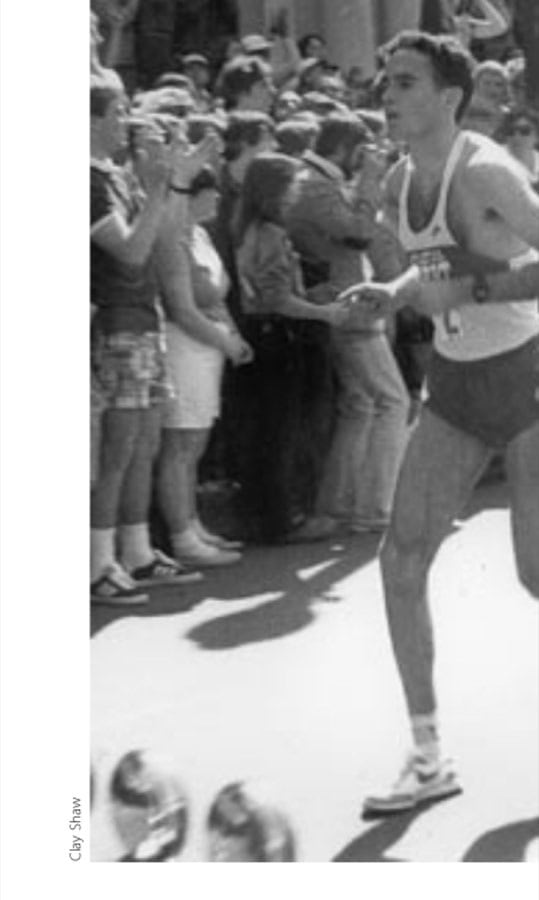
Through Heartbreak Hill, Salazar hung with Beardsley, telling himself repeatedly, “You can beat him!”
Salazar would say later: “It was a whole different game once we got to the hills. We had been running really slow, and from my point that was fine. But once we started up, he began pushing the pace at an intensity that neither of us could continue to the finish. It was a matter of time before either he would break me, or he would have to slow down himself.”
DOWNHILL RACERS When they crested Heartbreak Hill, Salazar was not broken. But neither was Beardsley. The duel continued as each looked for a sign of weakness in the other. Beardsley remained in the lead as they began a long descent past Boston College. It is this descent that many runners fear more than the preceding ascents, because of the punishing effect that downhill running has on the muscles. The elder John Kelley once referred to this stretch as the “Haunted Mile.” The ghosts of many runners who at least figuratively had died on this descent were present.
Tom Hart, another reporter for The Runner, was stationed by the Lake Street checkpoint near twenty-one miles. “Beardsley looks stern, but still loose,” wrote Hart. “Maybe it’s only an illusion engendered by the pertly upturned bill of his white cap, but he seems to have more left than Salazar, who runs with an absence of expression to which Raymond Chandler might have done justice in describing a professional killer. Salazar is locked in two steps directly behind Beardsley, and he’s not enjoying himself.”
But neither was Beardsley enjoying himself at this point. Five miles remained, and he knew those last miles would not be fun. He also was close to cracking, although he did not want his rival to know it. A sudden move by Salazar might finish him. Beardsley would recall: “I had taken that pounding punishment coming down the long hill after Heartbreak, and my legs bit the bullet. I thought I could break him, but he went right with me. He was still there—and, I couldn’t feel my legs! There was just a numbness from the waist down. I put it on automatic pilot, running just on instinct, putting one leg in front of the other.”
ONE MILE AT A TIME Beardsley decided to adapt a mental strategy that would ignore the fact that five miles remained. He would run those miles one at a time, not caring whether there was another, not worrying whether or not tomorrow existed, unconcerned whether any moment he would step into a sewer to be carried far out to sea. He accepted any artifice that would allow him to remain in front, because any moment Alberto Salazar might fall into his own sewer. “Okay,” Beardsley told himself at twenty-one miles. “You’re leading the Boston Marathon. You’ve got the world record holder on the ropes. You can hold this pace for one more mile. One more mile! Only one mile to go!”
Clay Shaw
▲
Beardsley’s mantra over the final miles was “One more mile!”
At twenty-two miles, Beardsley punched the reset button on his mental speedometer. “Okay, Dick. Still in the lead. All you have to do is run one more mile and you can win this race. One mile to go!” And at mile twenty
three: “One mile to go! You’re beating the world record holder. One more mile!” The runner behind him, meanwhile, continued to employ his own mental strategies. “Once we got off the hills, he slowed down
immediately,” Salazar recalled. But Salazar did not move to take the lead. He attempted no long surge that might have gained him that lead. Tactically, that would have been a sound strategy. It would have worked. The duel would be over. But
Salazar did not employ that strategy, because he could not! He knew that doing so might destroy him. After leading so long, the pair could easily self-destruct, opening the door for some trailing runner who had followed a more conservative
strategy. That had happened to Abebe Bekila and Malmo Wolde in 1963. The two Ethiopians, who between them won three Olympic marathons between 1960 and 1968, had set checkpoint records all the way through twenty miles only to finish ignominiously in fifth and twelfth places. As Bill Rodgers once said: The
marathon can humble you. “We let the pace drop four or five seconds,” said Salazar. “I began to feel good again.” But the moment of truth did not come. Salazar, uncharacteristically, continued to run in a drafting position behind Beardsley as the two ran single-file
down Beacon Street through Boston’s Brookline district. Beardsley was having difficulty remaining focused. It was the crowds. Running along Beacon Street in the heart of the city, people seemed to press closer
and closer. “The crowd noise was so loud that it got to a point near the end when I could not feel myself think,” said Beardsley. “It was like standing next to a runway with a jet airplane ready to take off.” There were more spectators than he ever had seen in a race, more than he remembered from New York’s First Avenue. Crowd control seemed nonexistent. “Why don’t people get out of the way?” he thought. A phalanx of eight motorcycle policemen accompanied them, but neither they nor policemen at intersections, nor mounted policemen along the route, seemed to be able to contain the crowd from pressing closer and closer to the point where he feared the long corridor ahead would close, swallowing him and Salazar and ending the race two miles from the finish.
The large press bus that had accompanied the lead runners from Hopkinton also was having difficulty maneuvering through the crowds. Near twenty-three miles, Beardsley was running on the right side of the road, Salazar behind. Beardsley suddenly found himself engulfed by a large shadow, except it wasn’t Salazar. It was the press bus, which threatened to push him into the crowd.
Beardsley remembers the bus coming so close it brushed him on one shoulder. Salazar remembers Beardsley not yielding, remaining on the right and pounding on the bus with one fist in anger to keep it away. Salazar slowed and moved around the bus to the left. He used the incident to allay his own personal doubts. Salazar told himself, “That’s foolish. Why waste mental energy worrying about the bus. Simply go around it.” Salazar decided that it was a sign that Beardsley was about to crack.
With about two miles to go, a spectator lunged out of the crowd at the runners. Beardsley thought it looked like the spectator tried to stuff a dollar bill into Salazar’s shorts. Salazar later described the spectator lunging at Beardsley, but missing and striking him on the chest instead. This was surreal. At moments, it would be difficult for each to tell what was dream and what was reality.
As they crossed painted numbers on the street announcing that they had covered 25.2 miles, Beardsley suddenly felt himself overcome with emotion. “Seeing how far we had come and how little we had left to go almost got the better of me,” says Beardsley. “I almost felt weak-kneed. I thought, ‘Not only am I running the Boston Marathon, but I am one mile away from the finish and running in the lead with world record holder Alberto Salazar!’ I began sobbing to myself, then I thought, ‘Dick, get a grip on yourself. You can’t break down now. You’ve come too far. You’ve got to get refocused.’” At this point, there was only one mile to go!
SYMBOL OF VICTORY Beardsley thought that he probably had achieved his greatest lead at that point, but a glance over his shoulder told him it was only five meters. Salazar remained
right behind him, waiting, like a panther ready to pounce. Beardsley remembered what Coach Squires had told him: “Dick, Alberto doesn’t have a great kick, but it’s a better one than yours.” Beardsley decided to go into a long surge and hold it all the way to the finish line. Suddenly, he felt his hamstring cramp. He could no longer push off with his right leg. He would tell reporters later that Salazar detected the limp and jumped into the lead. Salazar later would deny that occurred, saying that he had simply chosen that moment to take the lead. In all probability, it was Salazar’s sudden move to the front, forcing Beardsley to react and increase pace, that caused the latter’s hamstring cramp.
Regardless, Salazar relentlessly began to pull away. Years later, Beardsley would remember Salazar’s lead stretching to one block, then a block and a half: “Before we made the turn onto Hereford Street, it seemed like he had a twoblock lead.” The videotape of this point in the race, however, shows that as the pair turned onto Hereford Street, Salazar’s lead was exactly 2.8 seconds, barely twenty meters. This, indeed, was a duel of classic proportions.
Beardsley’s hamstring cramp by now had subsided. Ironically, he had stepped in a pothole and the sudden jarring seemed to relax the muscle. He and Salazar had two slightly uphill blocks on Hereford before reaching Boylston Street and the final straightaway. Eight motorcycle policemen accompanied the lead runners, but they now proved to be more hazard than help. Beardsley found that once he had been dropped, several of the policemen slid into the vacuum separating him from the leader, forming a psychological as well as physical barrier.
At that point, nothing could deter Beardsley. He would run over the tops of the motorcycles if necessary. “Al’s lead started shrinking,” Beardsley recalls. “It seemed like every ten feet he went, I’d go twenty. I remember him glancing back, and I don’t think he expected to see me that close.”
Salazar looked back at Newbury Street, halfway up the Hereford incline. He saw that Beardsley was gaining. The motorcycle policemen also saw Beardsley coming, but didn’t seem to know which way to go to avoid him.
As Salazar crossed Boylston Street and started a quick right-left zigzag that would take him onto the frontage road paralleling that street, he looked again. Somehow, Beardsley had weaved through the motorcycle policemen without breaking stride. He was there, just off his right shoulder.
Salazar, however, had misjudged the distance. Despite living in Boston, despite having watched the race in high school, despite having visited the finish area before the race, despite having crossed the numbers indicating one mile to go, Salazar somehow was not quite sure how much distance remained once they made the turn onto the frontage road. He would say: “I was thinking, ‘There’s more than a half mile to go.’ Then all of a sudden he was on top of me. I looked ahead and realized: less than 200 meters! That was the exact nightmare situation
that I had wanted to avoid. With that much left in a race, anybody can beat you. You might have a lot of energy left, but might not be able to turn your legs over. You can get beat.” Beardsley remembers relaxing as he pulled even, rather than using his momentum to roll forward around Salazar into the lead. But it may not have made any difference. Salazar glanced one more time at Beardsley—then accelerated. Very sharply! His arms pumped. His knees rose. And so the duel was won and lost. “
At this point in the race, there wasn’t any way in the world he was going to beat me,” Salazar later told Runner’s World. “I don’t care if a motorcycle cop had run me over; he was not going to win!” Salazar’s sudden sprint propelled him into a ten-meter lead. Beardsley countered with a sprint of his own, but could not regain the ground he had just yielded. With the crowd cheering wildly, the two ran the last straightaway almost in lock step, one behind the other, Salazar continuing to glance backwards hoping he would not be asked to summon one last sprint. With two strides to go, Salazar attempted to lift his arms in a traditional symbol of victory breasting the tape. He could barely raise them above his shoulders. Time, until that last moment, had seemed almost inconsequential, but the clock above the finish line read 2:08:52, a new course record despite the heat.
LAUREL WREATH Spent, Salazar almost fell into the arms of two policemen waiting just past the line. Beardsley finished two seconds back in 2:08:54. He too raised his arms, half in joy, half in despair. He said: “I can’t believe I just ran 2:08 and only finished second!” The two embraced each other in the finishing chute, mumbling congratulations. Salazar told Beardsley: “Dick, you pushed me harder than anybody ever pushed me. You’ve made me run harder than I ever have before.”
Those words, spoken by two runners who showed each other no mercy, would become part of the legend of the eighty-sixth Boston Athletic Association Marathon, their duel becoming one of the most memorable races—maybe the most memorable race—of Boston’s first hundred years.
The awards ceremony would be brief. It was over even before third-place finisher John Lodwick crossed the line. Lodwick had started slow, passing Rodgers in the last mile. Lodwick ran 2:12:01, Rodgers 2:12:38. Rodgers crossed the line looking like he had been placed in a burlap bag and beaten with rubber hammers. When he heard the winning times, Rodgers said, “I can’t believe they ran that fast on this hot a day.” Sweden’s Kjell-Erik Stahl, who never came close to the lead pack, placed fifth in 2:12:46.
The laurel wreath was placed on Alberto Salazar’s head, the medal draped around his shoulders. Beardsley stood on the stand beside Salazar, nobody denying him that moment although he would be handed his second-place trophy later.
Salazar raised his rival’s arm to join his in triumph. “I thought that was a nice gesture,” Beardsley would say later. Dehydrated, Salazar began to feel woozy. His muscles started to cramp. The top two men departed the awards stand long before the first woman appeared. Grete Waitz had been on world record pace during the early stages and led until twenty-three miles, when she almost inexplicably stepped off the course. She had felt good through the Newton hills, but the downhill stretch afterwards had proved too painful. “My legs locked up,” said Waitz. “I couldn’t make them move anymore.” Germany’s Charlotte Teske crossed the line in 2:29:33, thinking she had finished second and was surprised to be escorted onto the victory stand. “Grete was so far ahead,” said Teske, “I never saw her stop.”
Beardsley and Salazar were sent in separate directions: Beardsley to the media room to give interviews to reporters, Salazar to the makeshift hospital in the parking garage of the Prudential Center, to receive medical care. Having taken little water, he was dangerously dehydrated. His muscles were cramping so badly, he could barely walk. He was made to lay down on a cot. The BAA’s Jock Semple started to massage Salazar’s shoulders. Others massaged his arms and legs. William P. Castelli, MD, the white-haired director of the Framingham Heart Study and supervisor of the marathon’s “medical tent,” moved to Salazar’s side and instructed his aides to begin intravenous injections in both his arms. In a previous situation at the 1979 Falmouth Road Race, Salazar also had collapsed, his temperature soaring so high that he was given the last rights of the Catholic Church.
Dr. Castelli did not feel the situation was that critical. Actually, Salazar’s core temperature was below normal. The problem was hypothermia, not hyperthermia. Hypothermia, or low body temperature, is a common problem at Boston because of temperature differences between the start and finish lines. As the runners had turned onto Beacon Street, ocean breezes had begun to cool Salazar. A rectal probe suggested that Salazar’s temperature had dropped to eighty-eight degrees (although that probably was a false reading related to dehydration). Dr. Castelli may have seemed calm, but a nervous television assistant who crowded next to him was not. The assistant told the doctor that they needed Salazar live and in color within thirty minutes, since Mike Wallace planned to interview him on national TV.
Dr. Castelli, having nursed many dehydrated runners back to life, smiled and told the TV assistant: “He’ll be ready.” Dr. Castelli positioned two state troopers next to the cot and told them to grab the plastic containers containing intravenous fluid being pumped into Salazar’s veins. “Squeeze!” he instructed. In this way, Salazar’s dehydrated body absorbed six liters of fluid within thirty minutes. He got off the cot, cramps subsided, head clearer, not able to run twenty-six miles for a while, but ready to meet the press.
THE WAY IT WAS Ask Alberto Salazar his most vivid memory surrounding his Boston victory, and it is none of those moments of truth during its running, not outsprinting Beardsley, not crossing the line first, not having the laurel wreath placed on his head, but rather what happened en route to the press conference. “Remember, that nobody had been able to get hold of me, or interview me, after I finished,” Salazar recalls, the trace of a smile tilting his lips. “As they escorted me toward the press room, there was a phalanx of people, including policemen, on each side. Jock Semple and my grandmother—who was eighty-five at the time—were in the vanguard of the group. “
My grandmother, especially, was being very protective. People would hedge in wanting autographs, shouting, getting quite aggressive, and she would push them aside. John Linkowski, who was the equipment manager at Oregon, took some photographer who grabbed at me and threw him against the wall. My grandmother got angry. She had a cane and was swinging it in front of her to clear people out of the way. “
We came to a point where a mounted policeman was blocking us. Jock Semple raged at the cop on his horse, ‘Get out of the way!’ But it was so tightly crowded that the cop couldn’t move. So Jock slugged the horse on the leg. And my wife, Molly, was there, and John Linkowski getting red in the face, and my grandmother muttering curses in Spanish, and the pandemonium and yelling and screaming and it seemed so funny that I began to laugh. “
When I think about Boston, that is what I remember.” After the awards ceremony, Beardsley had been approached by two young kids who had darted under the barriers separating the runners from spectators. One wanted the painter’s cap that Beardsley had worn in the race. Without thought that it might some day be considered a collector’s item, Beardsley handed it to him. The other asked for the sponge that Beardsley had carried in his waistband. Beardsley gave it away.
While Salazar was being ministered to by medical personnel, Dick Beardsley talked to the press. He first removed his racing shoes and placed them on a ledge behind him. Midway through the conference, Beardsley looked over his shoulder and noticed the shoes were gone. He had promised those shoes to a Catholic priest, a friend of Bill Squires, who wanted to use them for a church fund-raising raffle. Beardsley assumed that Kevin Ryan, one of the New Balance representatives, probably had commandeered the shoes to save them for him.
Some time later, Beardsley was back in his hotel room, soaking in a hot bath to ease the pain in his legs, trying to come up with some explanation as to why he could not have run two seconds faster to ease the pain in his mind. The telephone rang. His wife Mary answered it.
“Is this the room of Dick Beardsley?” asked the person calling. Mary Beardsley acknowledged that it was. “Tell him that he ran a great race,” said the caller. Mary thanked him. “And tell him that I’m the guy who stole his shoes—and I don’t plan to return them!” The caller hung up.
MOMENTS AFTER The following years would not be easy for either Alberto Salazar or Dick Beardsley. On reflection, the 1982 Boston Marathon was the pinnacle of each runner’s career. They had pushed each other so hard, destroying each other physically, that afterwards there was nowhere to go—except down. “My health problems began after that race,” acknowledges Alberto Salazar.
Salazar would win his third New York City Marathon that fall, but in slightly slower time (2:09:29) with Mexico’s Rodolfo Gomez remaining near him all the way. In the spring of 1983, Salazar chose to run the Rotterdam Marathon rather than defend his title in Boston. His time was respectably fast (2:10:10), but he placed fifth. In 1984, Salazar finished fifteenth at the 1984 Olympic Games in Los Angeles, still slower (2:14:19). After a battle with various ailments that seemed to defy medical intervention, it would be ten more years before Salazar won another long distance race. In 1994, Salazar surprised people who had written him off as a has-been by winning the Comrade’s Marathon, the classic 53.8 mile race between Durban and Pietermaritzburg, South Africa.
What Alberto Salazar seemed to lose on the road from Hopkinton was his will to push himself almost to the point of destruction. Salazar was always a strong runner, but never a graceful one. He was described in print once as running with all the style of a mailbag thrown off the back of a truck. His winning edge—apart from a high maximum volume of oxygen—came from his ability to endure. In tests at Ball State University’s Human Performance Laboratory, David L. Costill, PhD, had Salazar run on a treadmill to determine his maximum oxygen uptake, the point where muscles cannot absorb any more oxygen from the bloodstream, the point where heart beat plateaus, the point where most top athletes can remain on the treadmill for barely two more minutes.
Salazar had remained on the treadmill four more minutes. It was this will to push through the pain barrier that enabled him to become great and allowed him to defeat others with equal or even greater natural ability.
Salazar recalls a childhood game that he played with his cousin Ricky Galbis: “My uncle lived in Maine and sometimes they would visit. Our older brothers often got us to do stupid things, like grab hold of each other’s hair and start pulling. You’d be hurting like crazy, and crying, but it would be a contest to see who
quit first. And that to me is what marathoning was often like: this brutal struggle, where you think you are about to break, and can’t hold out any longer, but you hope the other guy breaks sooner. Survival. Toughness. It’s your ability to hold on just a little bit longer than anybody else. You cry, and wish you could end it, and you have all these doubts, but if you want to win, you have to hold on and not let go.”
The morning after the marathon race, Dick Beardsley received a call at 8:00 AM from Jim Davis, the president of New Balance: “Dick, there’s a car awaiting you at the front door. It’s for your enjoyment.”
After Dick and Mary dressed, they went downstairs and climbed into a white stretch limousine. They toured Boston, doing the sightseeing they had avoided while he had conserved energy awaiting the race. Toward the end of the day, they were driven to the New Balance offices. Several executives brought Beardsley into an office and handed him a three-year contract offering $30,000 a year. “I need time to think this over,” said Beardsley, politely handing the contract back.
After he returned to Minnesota, adidas continued its pursuit. Beardsley eventually agreed to a contract with New Balance that offered $180,000 for three years, not including bonuses for performance. Fortunately, the contract was backed by an insurance policy should Beardsley become injured. He won Grandma’s Marathon two months after Boston in 2:14:49, but an Achilles tendon injury forced him to cancel a return showdown with Salazar at New York. In the next decade, Beardsley would become injured in a car crash, nearly have his leg torn off in a farming accident, and be hit from behind by a car while training in the dark near Minneapolis’s Metrodome. “
It seemed like I could never train for more than six months without getting hurt,” Beardsley would reflect on his blunted running career a dozen years after finishing second at Boston. “My body had taken such a beating—not only at Boston, but in all of the marathons I ran leading up to it—that it no longer would respond.”
Beardsley should have been sad, but he had a wide grin on his face: “If there had to be an end, I’m glad it came at Boston.”
This article originally appeared in Marathon & Beyond, Vol. 10, No. 3 (2006).
← Browse the full M&B ArchiveMore like this
1,000+ stories from 19 years of Marathon & Beyond
The complete archive of the legendary long-distance journal — digitized and free to read.
