

Early Miles
My long and slow journey to the marathon began with a single mile. Everyone’s does, of course, but mine was a timed mile—which led to hundreds of one-mile races before I even thought of training for a marathon. This excerpt from my next book—titled Home Runs: Early Efforts of a Writing Runner, and Where They Led—dwells on the miles that started all that would follow. These chapters appear on the 50th anniversary of my first official race. In keeping with the book’s subtitle, I supply instant updates to each of the old stories.
The Mile DES MOINES, IOWA, April 1954—My father didn’t raise his second son to be a distance runner. A sprinter in his own image and that of his big brother Chuck, maybe; both had sprinted for Iowa State College. But runners who continued for more than a lap at a time were as foreign to their hometown as dark faces and odd accents.
Yet Dad couldn’t have done more to point me toward long runs if he had planned my future. He first trained me to run by putting me to work on his hog farm, then by taking me with him to track meets. I learned to run by chasing young pigs. They aren’t lazy and don’t just lie in mudholes and fatten themselves for the kill.
Neither are pigs lovingly obedient like dogs. They more closely resemble cats in their independence. Pigs go where they choose and at their own speed. When they sense they are about to be ill used—such as being loaded for show, sale, or slaughter—they balk or bolt.
Mom refused to go to the farm on days when we tried to steer the animals up the loading ramp into a truck. Dad’s words hurled at them didn’t fall gently on her Methodist ears. The pigs wanted to stay home, and who could blame them? They enjoyed the good life there, with two-legged servants catering to their desires. Pigs can’t smile,
and licking the hand that feeds them is beneath their dignity. So ours showed they liked this life by balking at leaving it. Pigs move like quick, shifty high school halfbacks. They squirt past blockers and tacklers with short, jerky strides—“woofing” with doglike barks in place of their usual grunts.
My sharpest memories of Dad find him dashing across a pasture, screaming threats and insults at a terrified sow that had eluded him. I chased and yelled, too, but this pursuit did little more than toughen my running legs.
I tested those legs whenever Dad watched track meets in the nearby towns of Clarinda and Shenandoah. I counted down the events until the last one, the mile relay. When it ended, I jumped the grandstand railing and ran a lap or two. Distance and time didn’t matter. I just wanted to feel a cinder track under me.
That spring we Hendersons took our annual 150-mile trip to the Drake Relays in Des Moines. Premeet publicity centered on Wes Santee from Kansas University. He was one of a few milers worldwide who were closing in on the world’s first sub-four-minute mile. He had come within a second of the magical but elusive time but wouldn’t reach it at Drake, where he would run only relay events.
Santee ran with almost inhuman power, ease, and calm. He had already broken the tape twice that weekend, and now he was winning again in the distance medley relay. “It’s Santee of Kansas,” the announcer shouted. “He’s all alone and going for the record. Let’s hear it for him on the backstretch.”
A roaring wave followed him through the last lap, washing over and chilling me as I stood to watch him pass. Minutes later, Santee jogged the outside lane of the backstretch on his victory lap. I stood in the front row, held out a program and pencil, and stammered, “Uh . . . can . . . would . . . please sign this for me?”
He interrupted his curtain call long enough to scrawl his name across his photo in the program. He made me want to try running a mile someday. An event the next week would inspire me to run it right away.
Update: My First Mile Thanks, Doc. I needed that. The doctor here is Roger Bannister. He gave me an early and essential booster shot in this sport. May 1954. I was only 10 years old then, and most of my memories of that time are lost in the haze of too many birthdays. This was long before I took up the habit of recording every scrap of running trivia, yet one memory is indelible. I had heard from my track-fan Dad about the four-minute-mile chase. I heard his happy whoop when news reached him that Bannister, a medical student from England, had just run 3:59.4.
My neighborhood gang already held track meets each spring. But we competed only in the sexy events— hurdles over window screens propped up with bricks, pole vault with a water pipe, javelin with a bamboo pole, and discus with a metal plate.
We did little straight-ahead running, and none lasting longer than a minute. We never timed or measured anything; we just competed. Bannister prompted my running a mile for time. I thought it would be neat to run it in less than twice his time. After all, I was little more than half his weight and, at almost 11, less than half his age.
None of my buddies cared to go this far. But they agreed to help me with the measuring, timing, and pacing. Three of us took turns stepping off the distance around the home block. We averaged about a quarter mile for this “track” that was uphill on one side and downhill on another.
We borrowed Dad’s precious stopwatch, which he normally broke out only for real track meets. The most reliable and sure handed of the neighbor boys, a preacher’s son, took charge of the timing. I enlisted rabbits, as Bannister had done. Each ran in front of me for one lap around the block.
This first timed mile (or timed anything) took me 7 minutes and 23 seconds. I’ll never forget the time, or my first case of shin splints that resulted from this mile. The pain soon went away, but my fascination with this distance never did. Fully one-third of all my 700-plus races have been a mile, and so have most of the best races.
I never thought seriously about breaking four minutes. But I did close the gap from more than 200 seconds slower than that time to less than 20 seconds. I still run a mile for time every so often (now in times slower than that first one). Each new mile links me to a past that reaches back more than a half century. Thanks, Doc Bannister, for starting all this.
The Contests COIN, IOWA, March 1955—Dean Roe, who coached all sports at our school, didn’t coach me to be a distance runner. But he couldn’t have done more to point me that way than by introducing me to basketball. His talent hunt began with sixth-graders. Twice each week we played ball for him in the high school gym, which was like receiving a papal invitation to the Vatican.
Courtesy of Joe Henderson
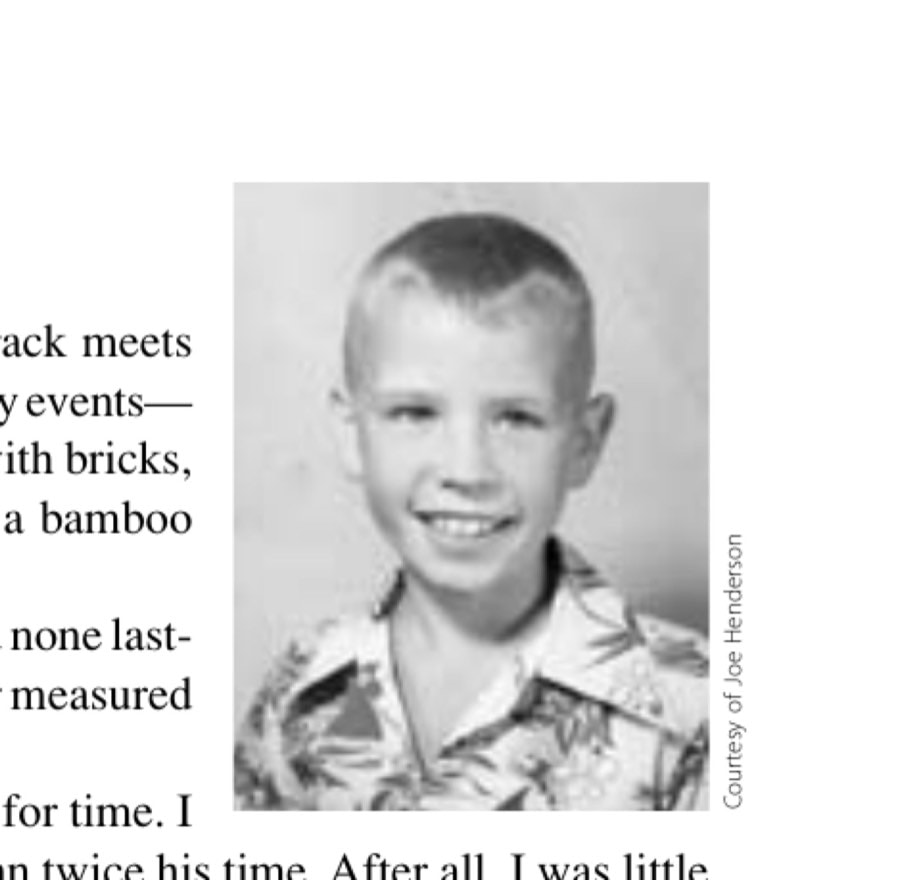
As a little kid of 10, I ran my first timed mile.
Mr. Roe taught us the barest fundamentals of shooting, dribbling, passing, and team play. We forgot most of this as soon as we returned to the playground. There we played for hours on a clay court that generations of canvas sneakers had pounded as smooth and hard as a road. The poles holding the backboards swayed in the wind. One hoop was 6 inches too high, the other one equally too low.
Games went to 21 points. When one round ended, we rechose sides and started again, playing as many as 10 games straight on a Saturday. These fast-breaking, shoot-from-the-hip, no-fouls-called contests developed little skill or discipline but lots of speed and endurance.
I played my first real game—in the Coin gym, before a crowd, with a referee and a scoreboard—in the Page County 4-H Club tournament. The ball bounced differently on wood than on clay, the baskets weren’t the accustomed height, and we didn’t dress for cold or allow for wind.
None of this was basketball as I knew it, nor was sitting on the bench instead of playing nonstop. I finally entered the game late, took a pass, panicked as hands pawed at me, then heard a whistle. “Shoot one and one,” the ref commanded. I stood at the free-throw line, my shaky knees barely poking out of oversized shorts. I flung the ball at the distant hoop, and it dropped cleanly through the net.
Another whistle blew. I followed the ref’s finger as it pointed to my feet. The shot’s momentum had carried me across the foul line. What would have been my first official point as an athlete didn’t count. * * * COIN, August 1956—“Henderson, Joe,” called the doctor who had come to town to give prefootball physicals. We took the test in alphabetical order. Following me was my brother Mike, two years older and built much better for this sport while carrying 50 pounds more.
Behind Mike stood Norm Johnston. Only a freshman, he already was being compared favorably in town with Jim Yeisley, Coin’s all-stater who played later at the University of Nebraska. I stepped on the scales. The doctor shifted the counterweight from the 150s to the 100s, balanced it, and announced, “110 . . . no, make it 111 pounds.”
Then he slid the height arm down 6 inches to touch my head. “Five four and a half,” he said. These dimensions made me the shortest boy in the room as well as the lightest—also the youngest at 13. The doctor placed his cold stethoscope to my chest and certified that I was alive. “You pass,” he told me.
Mr. Roe let eighth-graders practice football with the high school boys. We couldn’t play in games yet, but he viewed this as a season of essential basic training before we could take the field for real.
His unspoken rule was no games until you spent a season practicing—which meant no playing next year as a freshman unless I practiced this year. Junior high boys served as blocking and tackling dummies in practice and waterboys at games. But this early initiation to football still was offered and received as an honor and privilege.
Off came the last symbol of childhood, my undershorts decorated with cowboys and Indians. On went my first jockstrap, followed by the armor of football. Nothing fit except the helmet. The toes of the shoes curled 2 inches past the ends of my toes. The pants made to end at a player’s knees grazed my ankles. The kneepads protected my shins; the thigh pads hit my knees; the shoulder pads drooped to my elbows.
I flopped and clattered while running, and we ran plenty—laps around the freshly mowed field, wind sprints down the center, charges up the short and steep hill leading to the school building. The running was merely clumsy. Contact was terrifying to face and painful to endure.
Mr. Roe lined me up across from a bigger boy—they all were bigger—in a tackling drill. My job was to bring him down; his was to run me over. “Go!” the coach shouted as he slapped the ball into Norm Johnston’s hands. I crouched, shut my eyes, and blindly groped for his knees. One of them caught my chest, drove the loose shoulder pads into my chin, lifted me off the ground, and rolled me aside.
I got up shakily, my knees still not sure they could support 111 pounds. Mr. Roe shouted, “You can’t tackle what you can’t see. Try it again, this time with your eyes open.” I absorbed three more blows before bringing down the ballcarrier. Norm appeared to have taken a fall to end this one-sided contest.
Update: Trial Runs Running was the great equalizer. Here, size didn’t matter. Here, skill counted for less than will. Each May, Mr. Roe put his junior high PE class through a multiday track meet. The longest race was a half mile, four laps around the football field.
Seventh- and eighth-grade boys all ran together. This matched me against Norm Johnston, a year older and already destined to become Coin’s athletic hero. He stood a head taller as we lined up beside each other for the half mile. When the coach blew his starting whistle, Norm took his rightful leading role.
I followed . . . for one lap, two, three. On the final go-round, Norm’s stride grew as ragged as his breathing. Then the unimaginable happened. I took the lead and held it.
My own comeuppance came a year later. Norm Johnston had moved into high school by then, reaching the state meet as a freshman hurdler. I figured that leadership in the annual PE half mile was rightfully mine. All but one runner yielded it. Eddie Smith dogged my steps this time. On the last lap, I faltered. Eddie took the lead and held it. This loss taught me that winning is hard. Continuing to win is harder. (Eddie Smith went out on top. He never ran another race.)
The Start COIN, March 1958—My basketball playing that winter had amounted to 10 minutes of shooting before each practice. Then I had sat on the bench the rest of the day while the first two teams scrimmaged.
I hadn’t even made the bench for games, never climbing higher than 14th man on a team that suited up only 12. Now came a sport without a bench. “As you know,” said Dean Roe while introducing track to the 15 of us facing him in the gym, “we placed sixth in the conference last year. Need I remind you how many teams there are in the Little Seven?”
He added, “Let’s try to move up a couple of places this year. All it takes is a little more work, and God knows I saw little enough of that last year—with one exception.” He glanced at Norm Johnston. Only Norm and the coach had traveled to the state meet.
Mr. Roe talked about working harder but always let up on his discipline each spring. Since August, coach and athletes had put full effort into the team sports, where Coin had winning ways to uphold. The school had no such history in track, so hard work was optional, and most of the boys opted to do the least they could get by with.
Dean Roe’s training system was simple. Between track meets, his athletes practiced competing, running races against each other and the stopwatch. In March the low-lying football field remained marshy from snowmelt. Without a place to sprint, hurdle, jump, or throw, everyone started the new season as a distance runner on the streets of town.
That first day we gathered behind the gym. We wore baggy cotton sweats in mixed shades of gray and high-topped canvas shoes carrying the smells and stains of the basketball season. The veterans knew what the first practice would be, since it never changed. One of them mocked the coach’s voice: “OK, let’s see what you’re made of. Run all the way around town.”
The perimeter of Coin was exactly one mile: downhill in two steep installments to the Wabash tracks, north three blocks, then one long climb before the road leveled again in the homestretch.
Courtesy of Joe Henderson
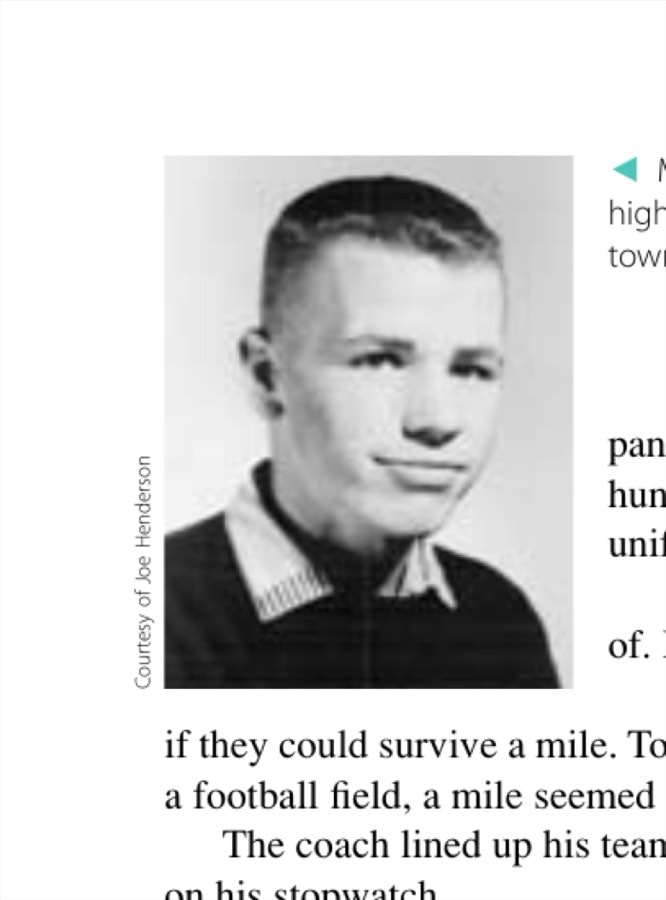
My freshman class picture, taken in 1957 while starting high school in Illinois. I soon fled back to my Iowa hometown to start running there.
Mr. Roe walked out in the knee-length football pants that he wore at practices in all seasons. A whistle hung around his neck, as much a part of his working uniform as a businessman’s tie. “OK,” he shouted, “let’s find out what you’re made
of. How about a little run around town?” All but one of the runners took this to mean: see if they could survive a mile. To boys who thought a long run lasted the length of a football field, a mile seemed like a marathon.
The coach lined up his team racing style. He blew his whistle while clicking on his stopwatch. I went right to the front. Everyone else, including Norm Johnston, assumed a survival shuffle. For them, this was a test where only finishing counted, not time or place. I wanted more.
My exposure to this sport had shown me only one way to run: all out, all the way. I hadn’t learned, or done, the training that made this possible. I ran alone, at once exhausted and exhilarated, on the final 200-yard gravel
path that connected the grade school and high school buildings. Mr. Roe stood at the far end of the path, holding his stopwatch. “Five fifty-one,” he yelled as I reached him. Then I bent over, hands on knees,
trying not to lose my school-cafeteria lunch. “Walk it off or you’ll cramp up,” the coach ordered. I staggered a few steps, then sat down heavily. “You OK?” Mr. Roe asked a few minutes later, after the last runner had arrived. “
Fine . . . great.” I couldn’t yet say more about what this run meant to me. In the mile, I wasn’t an uncertain little kid, trying and failing against big and confident athletes. In running, size didn’t penalize.
Here I didn’t have to collide with anyone, but only to put distance between them and me. I thought I had found my sport at last.
Update: Big Brother My brother Mike was born to be the team player in the family. He grew bigger, stronger, and faster than I ever would. In his junior year, Mike became the starting quarterback ahead of Norm Johnston, who shifted to running back.
Courtesy of Joe Henderson
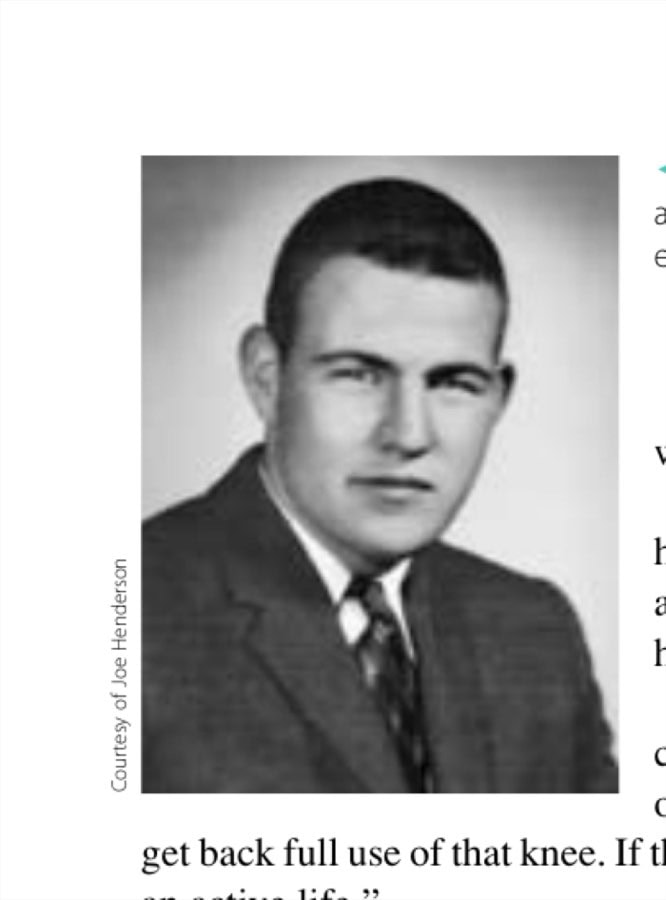
Brother Mike was two years older than I, bigger and the better natural athlete. A knee injury ended his efforts early.
Mike guided the team well. Coin usually won. Then in a routine play of a midseason game, he went back to pass, dug his cleats into the turf, and cocked his right arm. A tackler blindsided him at knee level.
The doctor told my brother Mike that he had a choice: “Either you can go on limping indefinitely, or we can operate and give you some chance to get back full use of that knee. If the surgery is successful, you’ll be able to resume
an active life.” “Including playing football next fall?” Mike asked. That was his best sport. “No promises, but it’s possible,” said the doctor. “However, as with all operations on a joint this complex, there are risks involved. There is a chance that your knee
won’t ever come back to full strength. Are you willing to take that chance?” Mike told him, “Sure, I’d like to try.” Our parents agreed, taking him to Omaha for the surgery. He still walked on crutches when I started to run. He didn’t yet know that he
would never go full speed again. During my track preseason, Mike hadn’t accepted his sudden loss of mobility and activity. He fought himself and everyone closest to him. My good legs reminded him too much of his condition.
One night I bragged about my latest local victory. Mike snapped, “Come back after your first real track meet and tell me how great a runner you are.”
The Stop TARKIO, MISSOURI, April 1958—Mike was just off his crutches when the track season began. His appreciation of the sport now had qualified him as Dean Roe’s unofficial assistant coach when the team opened its season at the Tri-State Relays.
It sounded like a better track meet than it was. Tarkio College’s track was barely runnable, its golf-ball-sized cinders having come straight from a coal-burning furnace. Tufts of dry weeds poked through the rough black surface.
The competition was no better than the setting. This meet opened the season for small schools like ours, and no one had trained more than a few weeks for it. My training time was minimal, and I had run as far as a mile only once.
Officials didn’t seed the milers by ability, with the fastest on the front row, inside lanes. Dozens of us ran in the one heat. Elbowing for position began before the race did. I bounced to the back row.
I stood admiring my new red leather shoes with white trim. A salesman had come to town with them that week. Now I twisted the spikes into cinders for the first time. The starting gun caught me rooted to the track. I left the line last and sprinted hard to catch up along the shortest path, the inside lane. Everyone wanted to follow that same line, and at the first turn the walls closed in on me.
I saw daylight to my right and veered toward it. The momentum of that move carried me past some boxed-in runners, and I sped past others down the backstretch until the leader was close enough to touch.
Not until the second turn did it hit me: how fast I was going, how labored my breathing was, how weary I had grown in less than a minute’s running. I began to surrender the ground I had won with the speed burst.
Into the homestretch I still ran in the passing lane, but now runners on the inside passed me back. I tried to cut in, was elbowed outward again, and nearly tripped. A voice shouted, “67 . . . 68 . . . 69.” Sixty-nine seconds had been my fastest time for a single quarter mile in practice races.
And I still had three laps to go. If I could . . . I couldn’t. I looked for a place to stop, a spot where the fewest people would see me. On the first bend of the second lap, I weaved to the infield. Most of the milers were still to come, but that didn’t matter. I had imagined myself as more than an anonymous pack filler and now knew I wasn’t.
I plopped onto the grass, staring at the barely used red shoes, gulping air, fighting tears. Right then I had not only dropped out of this race but had made an early exit from this sport. A hand touched my shoulder. The words that followed would set my future course in ways I couldn’t have guessed just then. “
What’s wrong?” asked coach Dean Roe. I couldn’t look him in the face, so I kept studying the red shoes as I shook my head slowly and mumbled, “Guess I’m not much of a runner.” Mr. Roe knew when to kick butts and when to pat backs. I couldn’t have stood a kick just then.
I had been too light for football and too short for basketball. Track, where size didn’t matter, was my best and last hope for athletic glory in a school that perhaps overvalued it. “How can you say you aren’t a runner?” the coach said quietly. “You haven’t yet finished your first race.
Courtesy of Joe Henderson
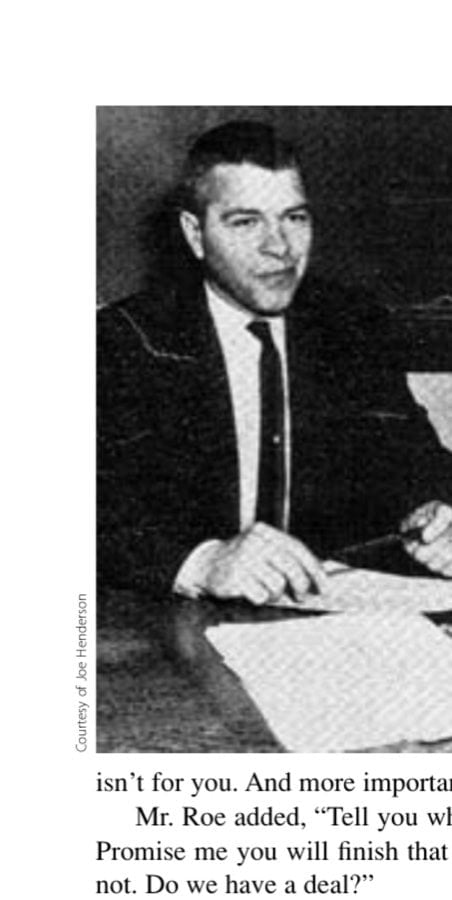
Coach Dean Roe picked me up and put me back on the path of a lifetime after my first mile race went incomplete.
“You only found out today that you can’t start like a sprinter and try to fight an elbow war with everyone in the race. Let’s see what happens when you run smarter.” Eyes on the grass, I choked out a
protest: “Not sure I want to try again.” The coach stayed calm, but his voice took a harder edge: “You know that you owe me one now, don’t you? I hate it when my athletes quit on me in the middle of an event for no good reason.
And being tired doesn’t count. “I’ll think a lot more of you if you finish a race and then decide that running isn’t for you. And more important, you’ll think a lot more of yourself.” Mr. Roe added, “Tell you what—I’ll enter you in the mile again next week.
Promise me you will finish that one, and then we’ll talk about your quitting or not. Do we have a deal?” The coach stuck out his hand. I shook it limply and nodded my agreement. I looked for no excuses to avoid running again, because Mr. Roe would have heard none.
By now, brother Mike had limped over to where we stood. When Mr. Roe left, Mike delivered the verbal butt kick that the coach had withheld. “Quit feeling sorry for yourself. At least you still have two good legs.”
Update: Learning to Win The most popular sign in school locker rooms of the 1950s read, “Winners never quit, and quitters never win.” Later I would redefine the meaning of that line, but at the time I believed wholeheartedly in its original meaning. So did my first coach. To Dean Roe, quitting was worse than losing. He wouldn’t let me quit. He told me to pick myself up and, next time, to finish what I had started. Without knowing it or having words to explain it, I had started learning how to win. By doing that, even while finishing last, I would reach the first level of winning. The second and third would come later.
The first level of winning is completing what you set out to do, be it a mile or a marathon. By finishing, you’ve beaten everyone who started but dropped out early, as well as those who hadn’t started and never would. The second level of winning is improving. You’re granted about a decade of improvement, and getting faster or going longer doesn’t require beating anyone else, only a time or a distance. The third and highest level of winning is continuing after the improvement stops, as it surely will if you run enough years. Slower and shorter running still beats no running at all. Winners never quit; quitters never win. This old locker-room slogan means much more to me now.
The Rerun CLARINDA, IOWA, April 1958—My second chance to complete my first official mile race came at the Cardinal Relays. This time I took unsolicited advice from my brother Mike, an astute student of this sport. “Stay out of elbow trouble,” he told me. “Start on the back row and hesitate a beat at the gun. “If this leaves you in last place, so what? You’ll catch some runners later. Everyone in these races starts too fast.”
ad
He was right on all counts. I did start last, did stay out of trouble, and did catch people. The odd-sized track was short of a standard quarter mile, meaning we started on the backstretch and still had four laps to go once we passed the finish line the first time. I had gone that extra half lap before catching up with fellow laggard and freshman teammate Gary Almquist.
Gary was my good friend but not my equal as a miler. He was my superior, having reached the first level of winning—finishing his first race—when I hadn’t. Soon the runners who had started as recklessly as I had the week before were coming back to me. I held my pace while others were losing theirs. I learned how much better it feels to pass than to be passed.
I ended my first full mile in the anonymous middle, far from the front and the back. My time, 5:25, provided a first target for the second level of winning— improving that time. Coach Dean Roe had set my thinking straight in the week before my first and second attempts. “Don’t try to keep up with the guys who’ve been running longer than you have,” he had said. “Try to beat everyone and you’ll always be disappointed, because no matter how good you get, there’ll always be someone better. “
Compete with yourself. Try for your own best times, and run at your own best pace. That way no one can beat you but yourself.” This time Mr. Roe didn’t need to console me or cajole me to race again. He didn’t have to say that I had repaid my debt to him and could now retire as a distance runner. A week after thinking I wasn’t meant to run this far, I couldn’t wait to see what the next mile would bring.
Update: Better Halves More miles brought better times, down as low as 5:09 that first year. While I was watching the watch, improved placings took care of themselves. They climbed from midpack to a ribbon-winning finish.
But my success, as surprising to me as it was to the coach, came at half this distance. Running it taught me a lesson about how simple training can be. Brother Mike, whose knowledge of sports statistics was encyclopedic, told Mr. Roe after the first couple of meets, “It doesn’t look like any of our runners except Norm Johnston can qualify for state in individual events. But we might be able to put together a relay team that can make it.”
The team-oriented coach liked this idea. Right away he turned most of his runners into half milers in hopes that the fastest four would qualify for the state meet’s two-mile relay. I joined this quest. Running my now-standard way—apparently a slow start and fast finish but actually even pace—I began this set of almost-daily trials at 2:36. By late season, my time was 20 seconds faster.
For me at least, the best training for racing was racing. I could have used some longer and slower runs in between for recovery and endurance, but those would come later. In the district meet that first year, I dropped to a team-leading 2:14, by far the youngest and smallest runner. We reached our goal of qualifying for state.
On my first overnight road trip, Mr. Roe, his “assistant” Mike, and I shared one room. Norm Johnston and my three relay teammates, all juniors—Jim Brownlee, Tom Waldron, and Phil Whitmore—crowded into another.
The next day I led off the relay with a 2:11 half mile. Our team finished out of the money in the slow section of this relay, in the state meet for the smallest schools. The goal that year had been only to qualify. Higher goals would come with each return trip to these meets. Basketball and then football slipped away, and training stretched year-round.
Sophomore year, I placed fifth in the state-meet mile. Junior year, I won there. Senior year, I planned to break a record—not only for the small schools but for all schools, at 4:21.1—while winning again.
That final year didn’t go as hoped or planned. An illness (the flu) in March and an accident (a fall and spiking in a race) slowed the early season. I lost three races and tied once with Don Prichard, who was new to the mile that year. Now came our final mile of high school, at the state meet.
The Showdown AMES, IOWA, May 1961—Other milers ran this race. But I would recall racing with only one, Don Prichard, a congenital front-runner. I would see only his back and the track ahead. The crowd numbered about 1,000, and dozens of these people had come just to see Don and me. But I would hear nothing coming down from the stands.
A skilled announcer would call the race. But after his starting-line introductions, I would turn deaf to all but the lap times he called. I had never entered a race with a focus so narrow. I had never been so “present,” as psychologists would say. Nothing else but the two of us, the track, and the race against time would exist for the next 4 1/2 minutes. * * *
As fastest qualifier, Don takes the pole position. I start to his right as second quickest. He offers a clammy hand and I take it with one equally sweaty. “I hope we both get it,” he says with a pained smile. He didn’t have to say what “it” was— personal best times at least, a state record maybe, a sub-4:20 mile at best. “
Good luck,” I say with an almost-grimacing grin. I really do wish him well, because his luck will help determine mine.
The starter draws out the word “s-e-e-e-t.” His shot sends us to find whatever answers stand a few minutes away. Don moves out ahead of me. From the back, his uniform looks just like mine— black shorts, white singlet.
My gaze locks onto the race number on the back of his shirt. I talk to myself: settle down . . . find the rhythm. Down the first backstretch, legs and lungs feel fine. On comes the warm rush of calm and confidence that always follows the tension of the start. “
Sixty-three seconds for our leader,” I hear as Don passes the quarter-mile post. I trail him by about a second. Right on pace. The last two laps of a mile are the hardest, but the second is the most dangerous. The decision to push on or let up comes here.
The excitement of the start has passed. The first signs of strain have appeared. Every instinct natural and reasonable shouts, Don’t do this to yourself! You still have time to avoid feeling worse. Concentrate, I order myself. Get through this second lap on schedule. Then you’ll have too much invested to think again of slowing down. My focus shifts to a circle of sweat between Don’s shoulder blades. “
Two-oh-nine at halfway,” the announcer tells us. Now I’m just a yard behind Don. Lap of 65—still as planned. “Hope we both get it,” Don had said. So far he has done all the work of setting up a record run. I’ve leeched off him, letting him set the pace and push aside the wind.
I move to his outside shoulder, trying to pass. Don shoots me a look that says: no help needed, buddy. Three laps down, one to go. “Three-sixteen.” Uh-oh—a 67 lap, a second off pace. Need a 64 to break 4:20 . . . faster than I’ve ever finished.
While I calculate pace, Don remembers that this is a race, not just a time trial. He accelerates and opens a five-yard gap on the first turn. I reel him back in. We enter the backstretch together. Time to go, I tell myself with 250 yards left. Again I pull alongside Don.
He has fought off the first challenge but can’t answer the second. Into the last turn I go, leading. I’m dead on my feet but pulled along by a force beyond will. Out comes strength built by years of summer and winter road runs and speed honed by dozens of races.
The question now isn’t who can finish the fastest. It’s who will slow down the least. Don has slipped out of my vision. I slide into the inside lane for the shortest possible path to the finish.
Courtesy of Joe Henderson
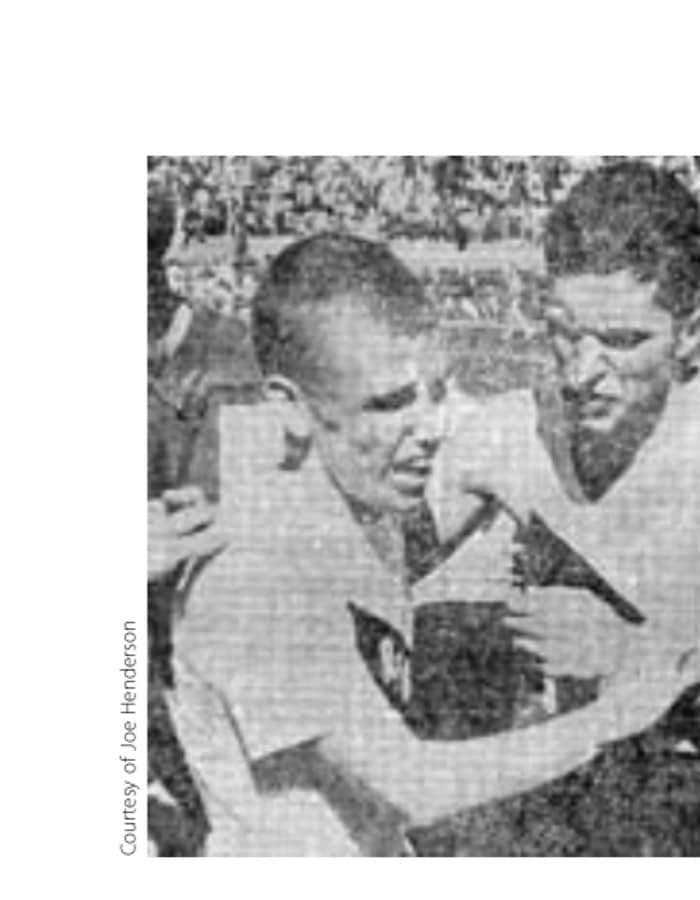
The Des Moines Register caption read, “MIGHTY MILERS—Don Prichard (right) of Bridgewater–Fontanelle High and Joe Henderson of South Page congratulate each other after staging a stirring mile duel.”
Mistake. This chewed-up lane now feels like a long-jump pit. I veer back into lane 2 for a longer but firmer run around the final curve. Into the homestretch. Less than 100 yards to go. Can’t pick up pace. Not slowing, either.
Fifty yards. Where’s Don? Has to be coming. Don’t dare look. Finish line. Break tape alone. Hear: “ . . . Close to record time . . . Await the official results.” * * * Ten yards past the finish line, I stopped and turned back. A clench-jawed,
struggling Don Prichard was just finishing. Our placings known, I could no longer stand upright. Bending over, hands on knees, I strained to gulp back the oxygen I had spent in the past few minutes. Don struck an identical pose beside me. He reached out and weakly took the
hand I could barely lift. “Good . . . job,” he said on his chest-heaving exhales. “Sorry . . . it wasn’t . . . closer,” I told him. I wished we could have tied again . . . well, maybe been 6 inches apart with the same time.
Brother Mike came out of the stands as fast as his damaged knee would allow, yelling as he approached, “You did it! You really did it!” “What time?” I shouted back. “Don’t know yet,” he said. “I’ll check with the officials.”
They shooed him away. Mike walked me to the family section as back slaps along the way almost knocked me over. Our Dad stood, cheeks wet. He didn’t speak, couldn’t speak, but with shoulders shrugging and hand shaking held up the watch he had forgotten to stop.
Uncle Kent yelled, “I had you in 4:21.” Twenty-one-flat would be a tenth of a second under the state record, but Kent was known in the family for his quick stopwatch finger. No time from our group matched Kent’s. Others ranged up to 4:22.5.
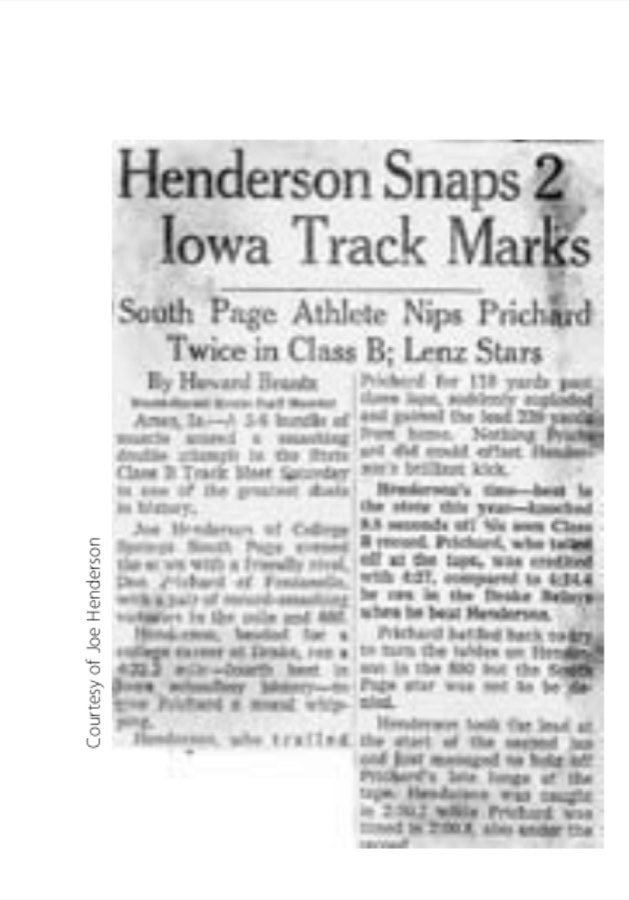
Howard Brantz’s report on the state meet for the Omaha World Herald, for which I’d once served as a paperboy in Coin, Iowa.
Courtesy of Joe Henderson
The announcer stopped our babbling conversation. He called for attention, then prepared to read results from “that thrilling mile.” He started with fifth place and worked up. When he reached the winner, the name and school came first. Then finally, “The time . . . a new meet record . . . of . . . 4 minutes . . . 22.2 seconds.” This time left me 1.1 seconds shy of the state’s best ever. But on this day I couldn’t have done any better. I couldn’t stop smiling over this mixed result.
Update: Backtracking I am a runner and a writer on running, and I have been since taking my first halting steps in 1958 and writing my first shaky lines a year later. The running apprenticeship ended in Ames, Iowa.
This spot, so hallowed in my memory, now supports a strip mall, anchored the last time I visited there by a Kmart. I peeled away the buildings and parking lots along with the decades. Below the modern surfaces rests the Ames High track of 1961.
Sitting on the bleachers is my cheering section of family, coaches, and teammates. On the track with me is my toughest competitor and best running friend from high school—the same person. Since memory comes with sounds as well
as sights, I hear the announcer call our names. I don’t even need to come back here to see and hear all of this. I can replay it anytime, anywhere. Don Prichard and I both accepted track scholarships at Drake University.
He did more to earn his, improving his mile time to 4:10. My improvement was modest, just four seconds in four years. Along the way, though, I adopted long-distance racing—and then long training, in that odd order. First I jumped into a 30-kilometer race off a longest training
distance of four miles. Longer training led to better short-distance racing. And finally, 13 years after my first timed mile, nine years after my first official mile race, I reached my first marathon.
This article originally appeared in Marathon & Beyond, Vol. 12, No. 3 (2008).
← Browse the full M&B ArchiveMore like this
1,000+ stories from 19 years of Marathon & Beyond
The complete archive of the legendary long-distance journal — digitized and free to read.
