

Ecomaratona
We entered the craggy, southern Italian hills, where the towns are built on impossible cliffs and the chitarra pasta is cut with wires. My husband, Luciano, and I had driven 400 miles south from our home in the Veneto to Abruzzo, the Wyoming of Italy, to run in one of the few trail marathons in Italy, an ecomaratona. This region sits between northern and southern Italy, a border state straddling two worlds. To the north, a cold resentful Milan hums with a productive bustle. In the south, Rome and Naples sit back on their heels in their own happy squalor and, according to northerners, wait complacently for the north to sustain them. Abruzzo is so wild, so isolated, that it is geographically able to rise above it all, literally.
Luciano planned to run the classic marathon, starting at an elevation of 2,900 feet, straight up a mountainside. I was, to celebrate my birthday, going for the baby run—a measly 13K. I’m a veteran of hundreds of rolling, sea level 6K to 10K races, but this one would be the longest and highest of my trail-running career, and I was secretly petrified.
We drove past villages perched on rocks hundreds of feet above a narrow gorge, the stone houses clinging to the cliffs like gray crabs on a boulder. Luciano commented that the bricklayers who placed the foundations must have been medieval acrobats, working with ropes and pulleys, swinging above the dizzying precipices. With the opportunity to plummet to their death only inches from the front door, we imagined that nocturnal trips to the outside loo might have been a death-defying adventure—and an easy explanation for any occasional disappearance.
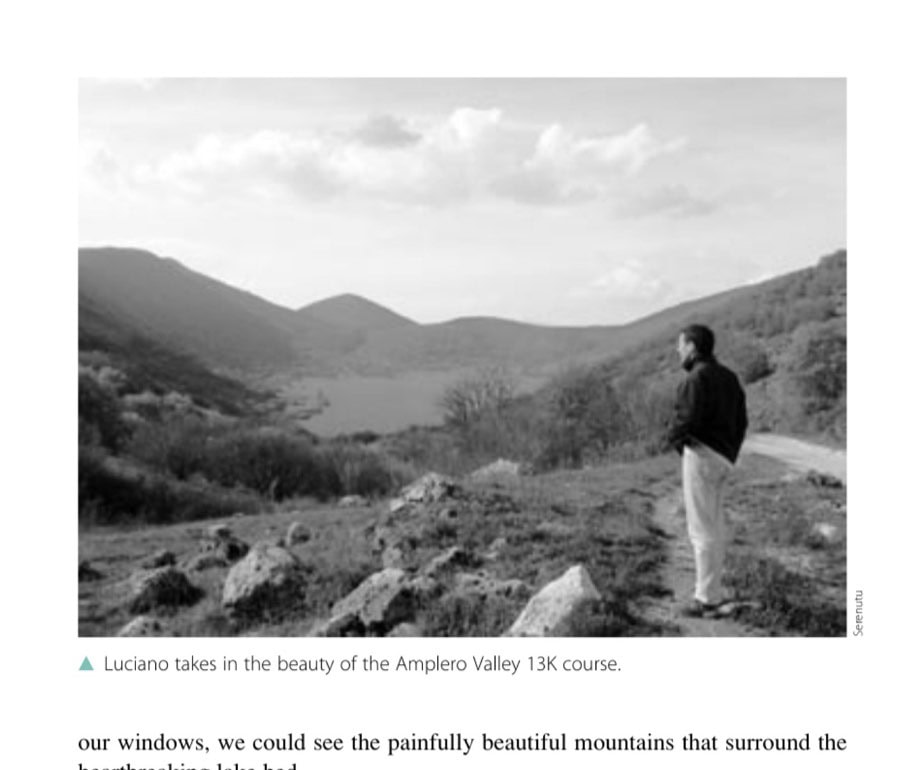
THE LAKE THAT IS NO MORE We dropped into a valley that was once the third-largest lake in Italy. Drained in the 1800s to create more farmland, it now stretches despondently to the horizon, dry and hazy in the heat, studded with communication towers. We checked into our hotel in the town of Trasacco, which must have once stood on the banks of that long-ago destroyed lake. Trasacco sits in the dust and sulks, a more dejected town I have never seen, forever fuming at that decision to drain the lake. Our hotel was really more of a youth hostel, with simple but comfortable rooms. From
Serenutu
▲ Luciano takes in the beauty of the Amplero Valley 13K course.
our windows, we could see the painfully beautiful mountains that surround the heartbreaking lake bed. That night, we went to the prerace meeting in the amiable but raggedy town of Collelongo, nine kilometers away and the host of the race. The room was packed: runners and officials hobnobbed; children ran about the room, screaming. While the village possesses no hotels, it boasts a group of leaders who obviously think beyond the barrier of the surrounding mountains. Collelongo, a town clearly dancing on the edge of economic extinction, takes pride in organizing this unusual race, which draws runners from all over the country and beyond. For this weekend, the population doubles, the grandmothers put on their pearls and the men their best felt hats, and everyone strolls the narrow streets in a proud passeggiata.
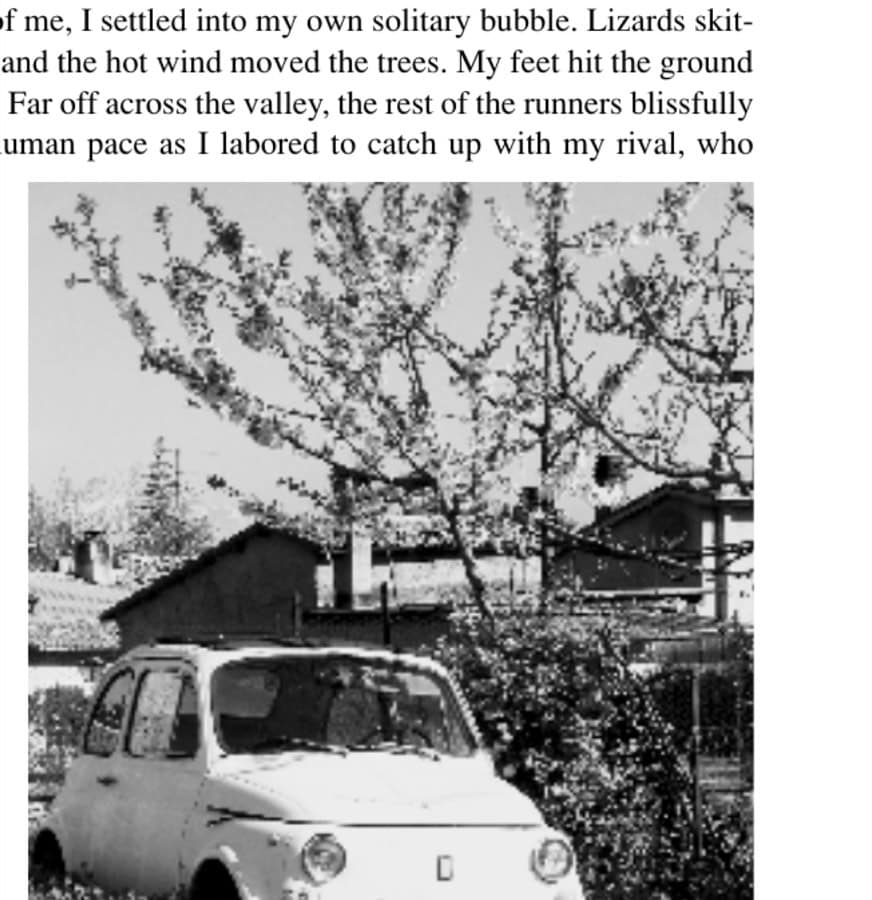
We later joined the other race participants, and most of the town’s population, in the diminutive central, and only, piazza for a pasta party. We all stood ready, forks in hand, waiting for the pasta to arrive. From whence it came, I don’t know, but we all knew somehow it was arriving in a Panda, an Italian version of an old Honda. It was a cold evening, so I was happy to be in the middle of a crowd. I turned to check the size of the line and was surprised to see it was only two people deep and that the big-bellied man behind me was companionably leaning on my back, for warmth I imagine.
Suddenly the cry went up, “La Panda, la Panda!” A miniature car sped importantly across the tiny square and backed up to the table. The village ladies, sleeves rolled up and ready for action, began dishing out steaming plates of pasta, each with one sausage and one piece of bread. They were deaf to the pleas from the man behind me for a second sausage and handed me a paper cup so full of wine it sloshed over onto the cobblestones.
Luciano and I sat and watched everyone—children, athletes, even the town drunk—jostling good-naturedly for a place in line. I recognized the former mayor of Collelongo whom we had just heard speak at the meeting. From his appearance, he could easily have been a Manhattan stockbroker, holding a Starbucks coffee in one hand and a Blackberry in another. But no, he was hanging out in a town with a population of 1,500 people in a narrow valley, at the end of a dead end road, in the hills of Abruzzo. You could not imagine a town farther away from Wall Street. He is an immensely popular young man, but according to local law, he can be mayor only two times in a row. So he is taking a couple of years off, and that night the current mayor, tall and elegant, was working the crowd.
WHERE EVERYBODY KNOWS EVERYBODY’S NAME At the end of our bench sat another stout man who, of course, knew both and called out salutations. He told us proudly, “Those are our mayors.” People outside the cities tend to be friendly, ready to talk, and on discovering that I am American, eager to practice their surprisingly good English. Our dinner companion, Roberto, told us that he had lived for a while in Quebec and then brought his family back to Collelongo. “
Now that I think about it, perhaps it was not the best choice, but here we are,” he mused. He sat quiet for a moment, ruminating on that long-ago decision, and then looked up and told us to watch for him tomorrow as he, along with everyone else in town, was helping out with the race.
Sunday dawned brilliant and cold with a strong sun coming over the snowdusted mountains. The whole town was turned out again in pearls and fedoras for the event, tirati a festa. The piazza had been transformed overnight from a pasta restaurant into a minuscule county fair, with booths of typical foods and running shoes crammed into the limited space. In one corner, burly-armed men wearing little white caps were setting up something that looked exactly like a bell, set upside down on a pile of sand.
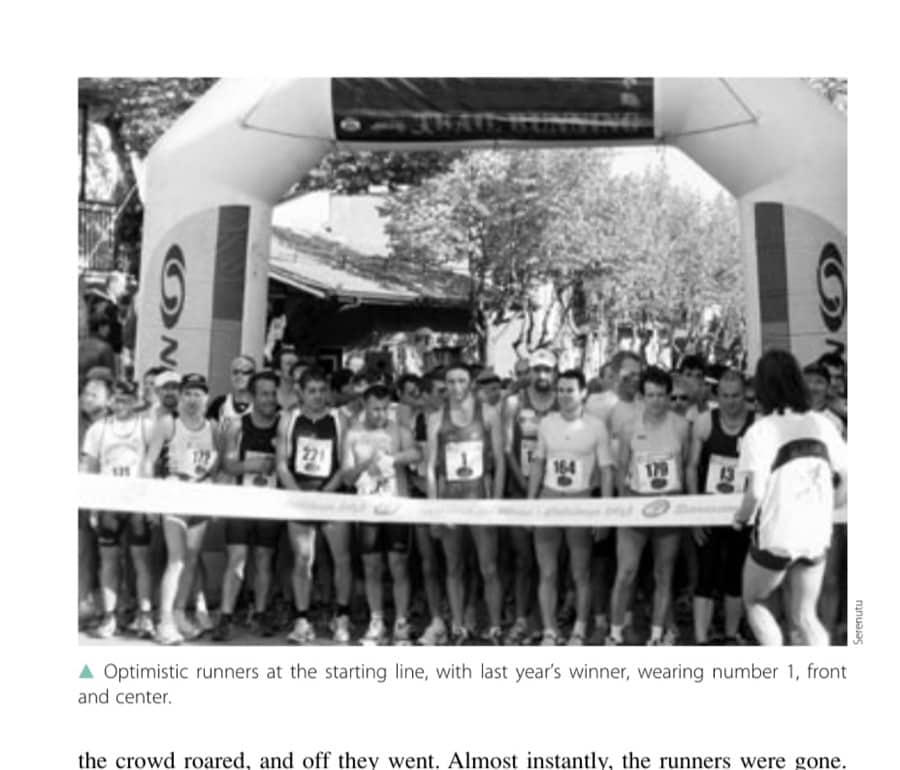
I turned my attention to the runners gathering at the starting line. Last year’s winner stood in the front of the line with an enormous “#1” as his bib number. I imagined this being a great deal of pressure to perform. I mean, if you are going to have “#1” on your stomach, you had better come in first. Luciano joined the group of 200 or so at the marathon starting line. Someone fired a cap pistol,
Serenutu
▲ Optimistic runners at the starting line, with last year’s winner, wearing number 1, front and center.
the crowd roared, and off they went. Almost instantly, the runners were gone. Everybody shuffled off to the bars. I had two hours before my race started, but time passed quickly. As I drank a cappuccino in the piazza, a few lead runners came through, finishing their first loop, each one crossing himself as he passed in front of the church. I watched the activity around the bell. It turned out to be not a bell at all but a kettle for a cheese-making demonstration. Cheese tasting was a long way off, so I tied and retied my shoes, focusing on the laces and not the 13 kilometers ahead of me.
A DAY OF LOW EXPECTATIONS My bib number was 265, and I surmised that race organizers did not have high hopes for me, and rightly so. As I joined the 40 or so runners at the starting line, a slightly smaller but just as enthusiastic crowd gathered and someone fired the same cap gun. With a jump, we set off, and almost instantly I was at the back of the pack, following the curved road around the town and out into the valley. We left the paved roads, and with the sound of feet crunching on gravel becoming distant, I looked up again and I realized I was absolutely last. After only 10 minutes, I felt burning in my chest from the altitude. Now it must be pointed out
that Luciano was running to a 5,500 foot elevation for 42.2 kilometers up the side of a mountain, bushwhacking across open tundra. Meanwhile I was panting on a rolling country road. What a wuss. The road led us past the remnants of a farm—beat-up house, wrecked cars on blocks, and a skinny, swayback horse that watched us with calm interest. With heavy feet, I began climbing the first hill. Behind me strolled the race organizers, bringing up the rear. The men gently urged me on, “Avanti, avanti, dai, dai!” (“Come on!”) An aid station sat at the top of the hill, and I suspect the organizers were eager for a glass of wine. As I made the crest, I could see a green valley stretched out in front of me with the other runners making their way around the left rim. Then, just a little bit ahead, I spotted the man who was to become my nemesis, my archrival, and my one-and-only opponent. He was about 75, round, and carried a camera. I focused all my energies to catch him.
With the lead in my feet spreading to my legs, I trudged up the gentle, but never-ending hill outlining one side of the valley. With the organizers gone and the main pack way ahead of me, I settled into my own solitary bubble. Lizards skittered in the dry leaves, and the hot wind moved the trees. My feet hit the ground with little puffs of dust. Far off across the valley, the rest of the runners blissfully moved along at superhuman pace as I labored to catch up with my rival, who never stopped moving. I could hear my breathing in my head, but I kept moving my feet. And then it happened. He stopped to take a picture. I heard him mutter, “Troppo bello” as I swept past him.
Suddenly I was at the crest of the hill, there was an aid station, someone handed me a glass of water, and the trail turned sharply to the right and downhill.
Serenutu
▲
Abruzzo, the Wyoming of Italy, where the race was held, is wild and isolated.
The trail plunged into a narrow gorge, straight down with a rocky single track. I love this kind of course and ran full on, feeling no pain and forgetting all about my breathing. I popped out onto the vast valley, and the breezes blew across the grass, and still I felt no pain. I looked back as I got to the other side, and I could just see my opponent. He had lost ground. He must not be a downhill runner.
A RETURN TO UPHILL RUNNING At the other side of the valley, the trail went up again. This time it was open, rocky, and dry. Now my pain returned in my feet and arms, and the sun was beating down on my neck. And still I could see my rival move slowly but steadily across the emerald valley. It reminded me of the scene from Butch Cassidy and the Sundance Kid, in which a mysterious man in a white hat is doggedly tracking the heroes. “Who is this guy?”
I was alone at the top of the hill. The wind blew around the now-deserted aid station and swirled over my shoulders as I closed the enormous loop. I checked my watch. One hour and 30 minutes into the race. I wondered for a moment if there was a time limit, and then it hit me: this year the organizers were giving a prize to the last runner, man and woman. It gave a whole new meaning to this race. I pushed off down the hill, heading back into town and the finish line, hoping to use the gathered momentum to get across the flatland by the cemetery, where a lone grouchy race official stood in the shadow of a tomb. He grunted at me, “Sei l’ultima?” “
No, there is one more behind me.” I panted. I did a mental check of my body from head to toe, performing an inventory of each moving part, a technique Luciano had taught me. I used it now to distract myself from the fact that I was running. It did not work very well because: first, it was painfully obvious that everything hurt; and second, being only 5 foot 2, this visualization tool never lasts very long.
Just as I got to my left toe in the inventory, I heard a noise behind me. I turned and saw him, my adversary, camera put away, coming up fast. Who is this guy? A nascent competitive spirit stirred, and I forgot all about the last-place prize. I moved faster. But he caught up with me, and as we turned into town and I turned to glare at him, he smiled pleasantly and said, “Non sei italiana, vero?” (You are not Italian, are you?) and then, switching to English, asked, “Where are you from?”
Ignoring for the moment the irritation of always being pegged as non-Italian, I answered, “San Francisco,” and for the last half mile of the race, we talked—in short, gaspy little sentences, but we talked. He was from Rome and had spent time flying a small airplane around the United States, and he cheerfully spoke English with me. We ran side by side up the main street, past the bar and the pizza
shop doing a brisk race-day business. At the last moment, with the whole village watching, he grandly waved me across the finish line, saying elegantly with a bow, “Prego.” With that, I spurted over the line, the absolutely last woman, at 1
hour and 58 minutes: the hardest race I have ever run. We shook hands and went our separate ways, enemies no longer, he perhaps to a bar for a coffee and I to recover less gracefully, head down, with tattered breath, collapsed in the shade.
After I had regained some composure, I wandered over to the cheese demonstration and tried a piece. It was warm, wet, squeaked between my teeth, and had absolutely no taste. But I was ravenous and ate two hunks between big oily slabs
of the local focaccia being distributed by the same village ladies, sleeves rolled up, still ready for action.
Serenutu
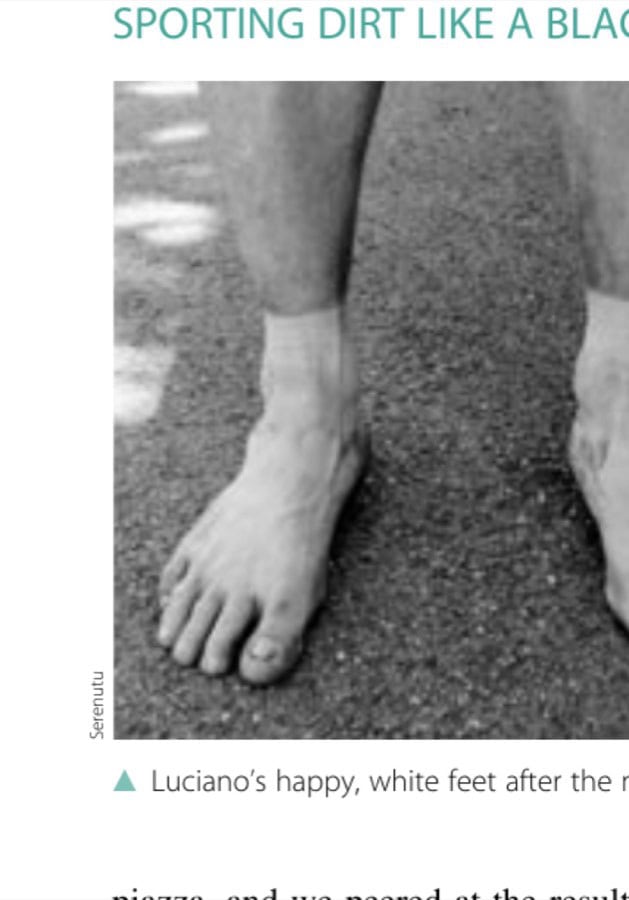
SPORTING DIRT LIKE A BLACK BADGE OF COURAGE An hour later, Luciano arrived, happily black with mud, his feet shockingly white where his socks had ended. He grinned through the sweat dripping down his
dirt-splattered face but shook his head disappointedly at his time. I did not care. I was floating in my own runner’s high and was feeling damn cocky. We went to check the results and to collect my last-place prize. Luciano was reluctant, saying it is not re▲ Luciano’s happy, white feet after the marathon.
ally something to brag about, but I dragged him back to the piazza, and we peered at the results posted on the crumbling City Hall door. I noticed that runner #1 would be wearing bib #3 next year, which I suppose is less
stressful. Then I found my name and was shocked to see four women’s names listed after mine. This was not possible unless they had been hanging out drinking coffee for the last hour and then decided to get up, pay the bill, and finish the
race, long after I had passed. I was absolutely sure no one was behind me. I had been robbed! But my time was listed at 1:54, not 1:58. I’ll take those extra four minutes, thank-you very much. Luciano said, “Don’t worry, Ciccio. There is always next year. Just run slower.”
This article originally appeared in Marathon & Beyond, Vol. 11, No. 4 (2007).
← Browse the full M&B ArchiveMore like this
1,000+ stories from 19 years of Marathon & Beyond
The complete archive of the legendary long-distance journal — digitized and free to read.
