

Edmonton Festival Marathon
Consider, for instance, that one of the festival’s leadoff events was the annual Black Tie & Shorts Gala at the elegant Hotel Macdonald, which is built from huge blocks of stone on a cliff overlooking the river, with ceilings more than 30 feet high. The construction was an attempt at permanence that seems quaint but fetching today. At that tongue-in-cheek affair, bagpipes were piped on the well-manicured lawn overlooking the river while another sold-out crowd of more than 200 running enthusiasts cavorted inside.
A JAM-PACKED WEEK
Wearing tuxedo jackets and black ties, the attendees completed their ensembles with running shorts, bare legs, knobby knees, and running shoes. When seated in the magnificent dining hall, the revelers appeared to be at or at least near the height of elegance. The illusion was quickly shattered, however, as soon as someone stood up and exposed bare legs. The mixture of banal and brash appeared right at the beginning of the affair, as symphony harp player Nora Bumanis led three colleagues, musical instruments in tow, through the streets from the Winspear Centre for Music, each wearing elegant attire from the waist up and running shorts down below.
They were led by three city police officers on motorcycles and followed by Edmonton Journal columnist Nick Lees’s “Back of the Pack” marathon running amalgamation, a loosely-knit group Lees cajoles into running marathons whether they are ready to or not. They carry a ladder with them, on the rungs of which are advertisements for their sponsors. Their charity is the Hope Foundation, which helps people facing life-threatening illnesses.
The Black Tie & Shorts Gala is the group’s annual sojourn . . . er . . . sally into polite society, where they raise thousands of dollars with silent auctions and loud auctions and with contests like a golf putting challenge on the patio of the historic hotel. Inside, local beauty salon Derma-Esthetics donates pedicures to the runners with the ugliest feet. Each table is required to send a representative to the dais for foot inspections.
Festival week is also stuffed with a 50-mile relay race to benefit kids with cancer, a racewalking race and clinic, basketball challenges between local media personalities, orienteering races for the novice, field lacrosse, beach volleyball, 3-on-3 basketball, a rowing regatta on the river, exhibition football, a family fun run, Triple-A baseball with the Edmonton Trappers, and on and on and on.
Oh, yes, we almost forgot—The High Level Mile. On Thursday evening before the marathon, the High Level Bridge, which crosses the Saskatchewan River at a great height (which differentiates it from the Low Level Bridge farther downstream), and on whose top a street car runs, is closed off, and a series of mile races are held (a half-mile sprint across the bridge, a 180-degree turn, and a half-mile sprint back). There are age-group divisions and a corporate challenge division. As serious as such mile races are in New York City, The High Level Mile isn’t. Chris Glowach of Winnipeg, perennial winner of the Edmonton Festival Marathon, pushed his infant daughter across the bridge and back in a baby jogger in the heat of the youngsters’ race. Chris Nicoll, an Edmonton mailman and two-time winner of the half-marathon, ran the mile race with his two daughters, one of them not far removed from learning how to walk.
The Fringe Festival
Simultaneous with the sports festival is another Scottish tradition: The Fringe Festival, where avant-garde plays are offered on a half-dozen stages at once, street artists perform, pubs move outside to the sidewalk, food of every ethnic variety imaginable is available, and entertainment runs all day and night. Fringe fan Brett Hilton managed a marathon of his own, stuffing in 63 shows over the 10-day festival run. His favorites: Gordon’s Big Bald Head, Lysistrata, and Two Guys Who Desperately Want to Get on TV.
The marathon course runs right through The Fringe site, fortunately at an early enough hour that the only revelers left are those who forgot to go home the night before.
John McGee is the chairman of the let’s-stuff-as-much-sports-fun-as-we-can-into-as-short-a-time-as-possible Sports Festival. He’s a barrister and a marathoner who does not subscribe to the “less is more” theory.
MAKING UP FOR LOST TIME
Edmonton seems determined to overcome a history in which they were regularly overlooked by the rest of Canada—and the rest of the world. During the early 19th century, Edmonton, although never large (the 1881 population was 263), was important to the Hudson Bay Company because it was situated along the water route that ran from Hudson Bay all the way to the Canadian Rockies, thence overland to the West Coast.
Edmonton anticipated enormous growth in 1881 with the coming of the Canadian Pacific Railroad (CPR), which was crossing Canada from east to west, only to learn in mid-summer that someone within the hierarchy of the CPR made the decision to build the railroad directly across southern Alberta and through Edmonton’s long-time rival, Calgary, in an attempt to forestall an invasion of Canada by Americans. Edmonton had to settle for building a stage line to connect itself with the railroad.
As though that weren’t enough of an insult to Edmonton, in March of 1885, during the Indian uprising led by Louis Riel, Edmonton was left virtually defenseless. The city was isolated and boasted all of 125 able-bodied men, while there were nearly a thousand seasoned Indian warriors in the vicinity. The telegraph line was cut. For nearly two months the city quaked in its boots, anticipating an Indian attack at any moment. Fortunately, one never came—even the enraged Indians were studiously ignoring poor little Edmonton.
The same ignominy nearly occurred again in 1896 at the height of the Yukon Gold Rush. Tens of thousands of gold-fevered men purchased millions of dollars’ worth of provisions in Seattle and Vancouver for their rush north. Edmonton provisioners felt left out. In an attempt to get in on the action, they advertised a faster, easier land route to the Yukon: six weeks by dogsled from Edmonton to gold! Their estimates failed to take into consideration the swamps, millions of acres of fallen trees that needed crossing, and the fact that the route looped above the Arctic Circle. Those who rushed for gold from Edmonton took 18 months of cruel depravation to reach the by-then-picked-over gold fields. The incredible story is well told in first-rate Canadian historian Pierre Berton’s wonderful book, Klondike: The Last Great Gold Rush: 1896-1899.
In more recent history, Edmonton has come into its own. It is the center of Canadian oil production; one day’s production is sufficient to replace the oil in every crankcase in Canada. West Edmonton Mall set new standards in providing indoor shopping and entertainment in northern climates; the mall is so large that when it opened, a local running club sponsored a 5K race inside it. The river valley boasts 75 miles of dream running trails. The University of Alberta at Edmonton is one of Canada’s largest institutions of higher learning. And the city boasts one of Canada’s most active and growing running—and sports—communities.
As in any number of North American cities, Edmonton had a marathon for quite some time. But as with many cities, the marathon frittered itself away into a shadow of its former self, never living up to its promise. A group of hardcore runners, some who only casually knew each other, came together some years ago and decided to do something radical to revive the marathon. Which they did, reversing
The Basics
| Edmonton Festival Marathon 1301, 5555 Calgary Trail South Edmonton, AB, T6H 5P9 Canada |
| PHONE: 403/437–2240 |
| FAX: 403/438–5788 |
| WEBSITE: http://www.planet.eon.net/~bhapr/default.html |
| RACE DIRECTOR: Shayne Page |
| FESTIVAL DIRECTOR: John McGee |
| YEAR ESTABLISHED: 1995 |
| SANCTION: Athletics Alberta |
| CERTIFIED: Assn. of International Marathons & Road Races (AIMS) |
| START TIME: 7:00 A.M. |
| RACE RECORD HOLDERS: Male Open: Chris Glowach, Winnipeg, 2:26:30, 1997 Female Open: Sandy Jacobson, Edmonton, 2:47:30, 1997 |
| TIE-IN EVENTS: half-marathon and 5K family “mini-marathon” |
| NO. VOLUNTEERS: 550 |
| MARATHON FINISHERS IN ’97: 725 |
| PROPORTION MALE/FEMALE FINISHERS: 68% male; 32% female |
| COURSE MARKING: every kilometer |
| NO. AID STATIONS: finish, nine along course (eight are visited twice) |
| FUTURE RACE DATES: 23AUG98, 22AUG99, 20AUG00 |
| ENTRY COST FOR 1998 EDITION: Until 1JULY98, $45 CAN; until 1AUG98, $60 CAN; after 1AUG98, $80 CAN. |
| AREA HOTELS: The Westin Hotel (10135 – 100 Street, Edmonton, Alberta, T5J 0N7, Canada, 403/426–3636, fax: 403/428–1454, reservations: 800/228-3000) is host hotel and is a beaut! Centrally located in downtown Edmonton and only five minutes to Edmonton’s spectacular river valley trails; 413 guestrooms; a (downhill) mile to the start. |
| FOR INFO ON EDMONTON: Edmonton Tourism (403/496–8400; fax: 403/425–5283), Alberta Tourism (403/427–4321), or use an Internet search engine to locate “Edmonton Alberta Canada.” |
| GETTING THERE: Edmonton is easily accessed by many major airlines, including Air Canada, Canadian, Delta, Horizon, and Northwest. For those with some extra time, experience the breathtaking national parks by driving north to Banff through Jasper and on to Edmonton. |
Must See/Must Avoid
Every major city in the world features an array of attractions that make it unique and that enlighten and entertain visitors. And, because of its very size, every major city is saddled with areas it would rather have vanish in a puff of smoke. The following is a brief consideration of both.
GO SEE IT
West Edmonton Mall. Yeah, yeah, we know. If you’ve seen one mall, you’ve seen them all. And if you don’t like shopping, what’s the point? It’s worth seeing West Edmonton Mall as a spectacle, even if you don’t spend a penny. The first of the supermalls, the West Edmonton Mall was built to give folks forced inside by terrible winter weather conditions a place they could enjoy while stretching their winter-stiffened legs. The mall has an amusement park (which includes the 13-story Drop of Doom), a water park (complete with waves), a deep-sea diving adventure, an 18-hole golf course, and a full-size ice-skating rink. It also has 55 shops for women, 90 places to eat, 8 department stores, and 4 species of shark in the Sea Life Caverns. The place covers the equivalent of 48 city blocks.
Second-Hand Bookstores. When the winter chill sets in, Canadians read. Edmonton has a wonderful array of 10 used bookstores, each with its own specialties. One of our favorites is the Edmonton Book Store (8530 – 109 Street), which specializes in books on Western Canadian history, Arctic regions books, philosophy, and literature. It’s directly across the street from the Running Room, where race packet pickup happens. The Edmonton Book Store even has its own homepage: http://www.compusmart.ab.ca/ebs/
Edmonton Space & Science Centre. (11211 – 142nd St.). Largest planetarium dome in Canada. There’s also the Challenger Learning Centre, where there’s a simulator of a mission control room and Alpha 7, a space station.
Muttart Conservatory. (9626 – 96A St.). The four glass pyramids are one of Edmonton’s most striking landmarks. Inside them are four radically different environments with native plant species, from a steaming jungle in one to an arid desert in another. This is a nice place to visit in the middle of winter.
Edmonton Queen. Located on the south side of the North Saskatchewan River, and within easy walking distance of the heart of downtown, the Queen takes daily cruises down the river. There are also brunch and dinner cruises.
The River Valley Park System. For a runner, the park system on both sides of the river offers nirvana. Miles upon miles of trails for running, hiking, bicycling, horse-riding. In size, the River Valley Park System is 22 times the size of New York’s Central Park.
AVOID IT
We can’t say we found any place that was particularly dismal or threatening. Sorry.
the race’s slow slide to oblivion. The effort has worked. Not huge by some metropolitan marathon standards, the Edmonton Festival Marathon has grown steadily each year of its revival. Some in the core revival group would like to see it grown faster; we’re not certain the organization itself could handle too ambitious a growth. Slow and steady is better. Ask the tortoise.
ALONG THE COURSE
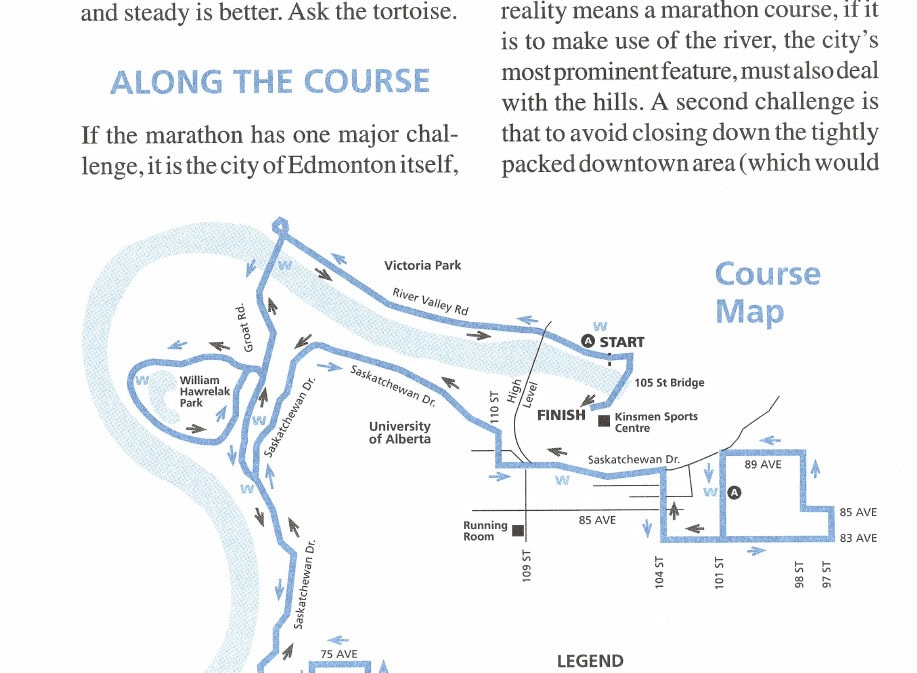
If the marathon has one major challenge, it is the city of Edmonton itself, not necessarily the bureaucracy but the geography. Built along both banks of a bend in the North Saskatchewan River, Edmonton sits above the river valley, and any time the river is crossed, a pedestrian must descend into the river valley and then climb back out. (The exception is the High Level Bridge.) This topographical reality means a marathon course, if it is to make use of the river, the city’s most prominent feature, must also deal with the hills. A second challenge is that to avoid closing down the tightly packed downtown area (which would cause a major inconvenience because the streets funnel down to a series of bridges to cross the river), a marathon course must hug the less-traveled areas of the city. This means that it must double back on itself frequently to maximize the minimal array of less-traveled streets. These challenges make it nearly impossible to describe the course without becoming tongue-tied. But here goes.
The course begins on River Valley Road, the first miles paralleling the river, then crosses the river to William Hawrelak Park, which it circles. The course then climbs to Saskatchewan Drive, where it plateaus for most of the rest of the course, as it loops through suburban neighborhoods near the Workers Compensation Board building. It then cuts back upon itself to take Saskatchewan Drive in the other direction toward the university and the Fringe Festival site, where it loops through more neighborhoods, then retraces itself back to the Workers Compensation Board building. Finally, it shoots down toward the river, back onto River Valley Road, where it runs to the 105th Street Bridge, crosses the river, and finishes in front of the commodious Kinsmen Sports Centre, the ideal finish line area. The Kinsmen is one of the many sports centres where Edmontonians spend their winters playing sports indoors. Adjacent to the centre is a series of grassy playing fields where the awards ceremonies are held. On a warm August day, the grassy fields are a perfect place for relaxing after the race.
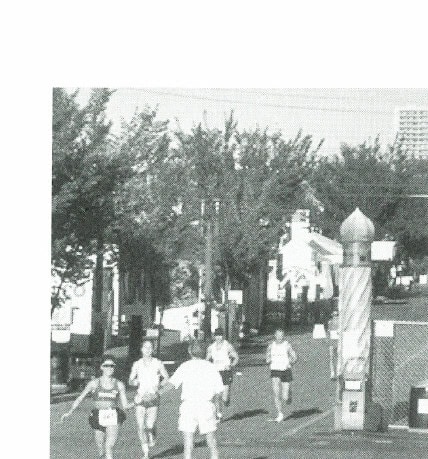
The finish area is about as perfect as they come. The Kinsmen Sports Centre has showers and athletic facilities on one side and the grassy sports fields on the other. The finish line bisects the two and is easily controlled from a race director’s standpoint. As runners cross the finish line, medical aid is quickly available. So, too, are boxed breakfasts, with muffins, bagels, fruit, bottled water, and other goodies.
PASTA AND ENTERTAINMENT
The Kinsmen Sports Centre is also the site of Friday evening’s pasta-loading, which is typically attended by more than 1,000 runners, family, and friends. Lines move quickly, and entertainment is provided by emcee Nick Lees, who oversees awards presented to volunteers (the race boasts 550 volunteers), race committee members, and special folks within the local running community. Famed running scribes such as Jeff Galloway and Joe Henderson are perennial guests and add greatly to the festivities.
There is no expo to speak of (a limited one is planned for 1998). From Monday to Saturday runners can pick up their race numbers and other goodies at the sprawling Running Room store on 109th Street, which runs an ambitious marathon-training program out of its store and also out of two major sports centres. Compared to most running stores, the 109th Street store is massive, and, until the recent opening of the chain’s Toronto store, was the Running Room’s flagship retail outlet. As with most running stores in Canada, the Running Room offers an extensive running book section. Look for wonderful foreign running books you’ve never heard of and occasionally books you thought were long out of print.
Since the race is sponsored by the Edmonton Journal, the race coverage, as expected, is excellent. The coverage begins midweek before the race and finishes with front-page coverage on Monday. The front page of the sports section is also dedicated to race coverage.
The Edmonton Festival Marathon brings millions of dollars’ worth of business to the community, and the marathon organizers donate their “profits” to local charities. In 1996, the Edmonton Festival Marathon donated $20,000 to the Fringe Festival and to the Firefighters’ Burn Treatment Unit.
Plans are afoot to expand the sports festival further, while gradually growing the marathon and half. Pity the athlete who decides really to get into the Edmonton Sports Festival. There are so many other athletic diversions, by the time the marathon comes along, even the most well-rounded athlete may be too exhausted to get out of bed. But facing an imminent winter of minus 40-degree temperatures, what better way to celebrate a summer too short?
Runner’s High/Runner’s Low
HIGHS
- Pleasant, welcoming city
- Exceptionally friendly fellow runners
- No shortage of sports opportunities
- The River Valley Park System
- Good race organization
- Laid back postrace awards ceremony
- Quick, efficient pasta feed
- Madman Nick Lees, official majordomo of fun
LOWS
- Race course cuts back on itself too often
- No expo (a limited one is planned for 1998)
- Long uphill to get out of river valley
We have weighed various aspects of a marathon within a 1,000-point scoring grid. Besides the author of the article, a dozen runners at the race were randomly chosen to score the race for us. (EFM = Edmonton Festival Marathon.) The results follow:
1. History/Tradition
Evaluate the race’s sense of history and tradition.
[Possible points: 30 EFM score: 15]
2. Entry Form
Is the race entry form clear, concise, attractive, complete, and easy to fill out?
[Possible points: 20 EFM score: 18]
3. Entry Cost
For most races, the entry fee covers between 30 and 50 percent of the cost of putting on the event. Rate the value of your dollar relative to this race.
[Possible points: 30 EFM score: 28]
4. Locale/Scenics
Is the race held in an area that is easy to get to and scenic, offers adequate food and housing services, and nonrace activities for family and friends?
[Possible points: 50 EFM score: 46]
5. Registration
Is registration well-organized and efficient? Does it bog down unnecessarily?
[Possible points: 20 EFM score: 18]
6. Prerace Activities
Evaluate activities such as pasta feeds, parties, and so on, during the days before the race.
[Possible points: 50 EFM score: 48]
7. Expo
Does the expo offer a fair number and variety of booths relative to the race’s size? Are there quality exhibitors and good guest speaker(s)?
[Possible points: 50 EFM score: 5]
8. Course
Take into consideration the following: degree of difficulty, certified, sanctioned, quality of road or trail surface, adequate mileage and directional markers, aid stations, medical coverage, race communications, accessibility to course for friends and family, typical weather, and so on.
[Possible points: 400 EFM score: 313]
9. Race Amenities
This category includes race T-shirt, finisher’s medal, finisher’s certificate, adequate and efficient finish area, ease of sweatbag retrieval, showers, postrace refreshments, awards ceremony, raffles, results postcard, results book, and so on.
[Possible points: 250 EFM score: 241]
10. Volunteers
Are the volunteers experienced and adequate in number?
[Possible points: 100 EFM score: 82]
Total Score for Edmonton Festival Marathon:
814 points (out of 1,000)
This article originally appeared in Marathon & Beyond, Vol. 2, No. 2 (1998).
← Browse the full M&B ArchiveMore like this
1,000+ stories from 19 years of Marathon & Beyond
The complete archive of the legendary long-distance journal — digitized and free to read.
