

Even A Midpacker Can Take On The Extreme
When runners talk about serious hills, there can always be debate. One-hundred-mile runs at Hardrock, Leadville, Wasatch Front, and Western States can all lay claims for the toughest hills in ultrarunning. When you look at the raw numbers, however, one humble 50K in Southern California has them all beat by a mile—or three—in distance, or by many feet per mile in steepness. That is the Baldy Peaks 50K.
Baldy Peaks requires 10,775 feet of climb and an equal amount of descent in 32.14 miles. That includes twice summiting 10,064-foot Mount Baldy by different routes, the first time climbing 5,864 feet in six miles, then a second ascent of 3,864 feet in four miles. In terms of steepness, those two climbs rise 977 and 966 feet per mile, respectively. By comparison, Hardrock’s Grant Swamp Pass and Leadville’s Hope Pass (inbound) rise 1,077 and 1,046 feet per mile, respectively, but both are only 2.6 miles long. The notorious Devil’s Thumb at Western
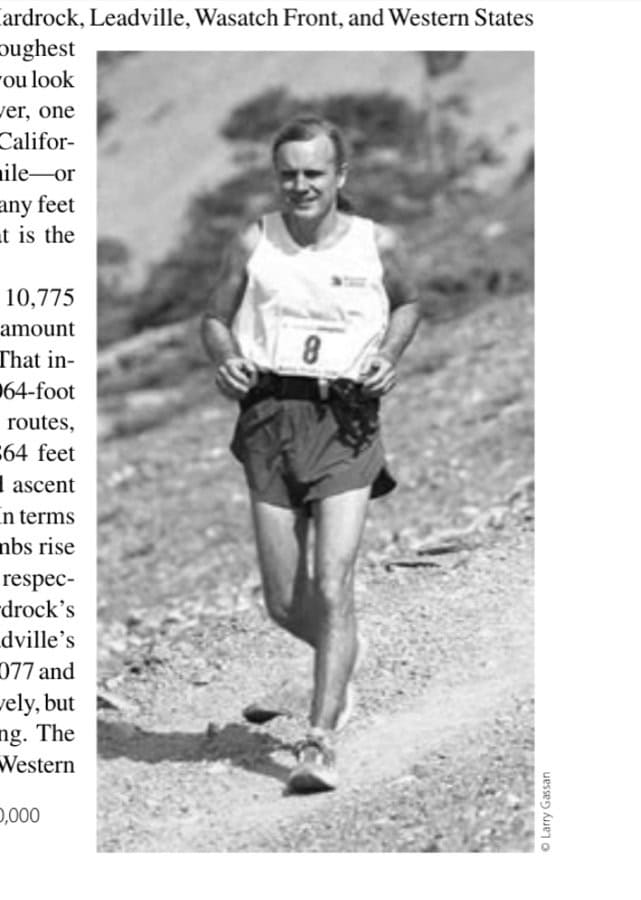
The author still smiling at 10,000 feet on the Baldy Peaks course.
© Larry Gassan
WStates is nearly identical in steepness (978 feet per mile) to the two climbs at Baldy Peaks but is a mere 1.6 miles long. Granted, you have to cover 100 miles and more hills in those other ultras; but for sheer long, steep, back-to-back hill climbs, it can be argued that Baldy Peaks is second to none.
To give you an idea of just how tough this course can be, six-time Western States champion Scott Jurek ran it in 2001 and finished third! In the 14-year history of this 50K, only six runners have managed to break six hours. The course record of 5:36:22 looks more appropriate for a 50-miler, not a 50K, and was set in 1997 by a no-less-impressive ultra champion than Gabriel Flores of Badwater 135 fame.
REASONS TO CONTEMPLATE MOVING UP Lest you think this extreme event is only for the most serious and accomplished ultrarunners, I’m here to tell you that even a midpack marathoner can do it and it’s more than worth the effort to give it a try. The views from the top are spectacular, the race is well organized, the aid stations and volunteers are super, and the feeling of accomplishment for a nonelite runner completing this arduous trek can rank right near the top for a running career.
Since most entrants—in fact all but the few competitive elites—walk most of the uphills, you can actually finish less beat up than from a hard marathon effort. Just make sure to leave all expectations for a fast time at home.
So, how did a 57-year-old like me, with 26 marathons and only one ultra notched on his belt, come to take on Baldy Peaks, which in 1990 was rated the toughest 50K in the United States? The truth is that when I signed up, I had no idea how formidable Baldy Peaks is. I was traveling south from my home in Montana to attend my high school graduating class’s 40th reunion, and I went looking for a run in Southern California around the same time. Baldy Peaks fit the bill a week before the reunion. I figured it would be nice bragging rights when I met with my old classmates. We were all raised in the area and had spent lots of leisure time in our youth on old Mount Baldy. And after all, I had completed Montana’s Le Grizz 50-miler, so how tough could a little 50K be? Only after I signed up did I begin to realize what I had gotten myself into.
The first clue came from my wife. Browsing the Internet one evening, she discovered www.run100s.com and its listing of notorious ultra hills. “These look like some pretty serious hills,” she mused, handing me a printout. I had seen veteran ultrarunners struggling up Devil’s Thumb at Western States in the Race for the Soul video. So when I studied the list and saw that Devil’s Thumb was just as steep but only about one-fourth as long as the first Baldy Peaks ascent and one-third as long as the second trip up, I realized my wife’s “pretty serious hills” might be an understatement.
That’s when I undertook an urgent search of my immediate geographic area for the meanest hills I could find. Fortunately, I live near—and work in—one of the most mountainous and scenically breathtaking pieces of nature on the planet: Glacier National Park in northwest Montana. A quick check of some maps and hiking books confirmed that I had a near-perfect training “hill” (read that as bad-ass mountain) nearby. The Mount Brown Lookout Trail is described by one Glacier Park hiker’s guide as involving “the greatest elevation gain of any hike in the park that doesn’t require technical climbing skills and gear.” Perfect! The steepness and distance of the Mount Brown Trail, it turned out, are nearly identical to what I would face on the two ascents of Mount Baldy.
FINDING A REASONABLE FACSIMILE Since I run three or four marathons a year, I’m always more or less in marathon shape. But I knew I wasn’t ready to take on this kind of elevation gain without working up to it a bit. So it was that six weeks out from Baldy Peaks, I scheduled a gentler hill-climb warm-up: 16 miles round trip on Glacier Park’s spectacular Going-to-the-Sun Road, from the Loop to Logan Pass on top of the Continental Divide and back down. (There is, after all, 10,775 feet of descent at Baldy Peaks to even out the ascents.)
What I hadn’t counted on in the middle of a Montana summer was the weather. On the day I could fit the run in, in the middle of June, Mother Nature served up 40-degree temps and threatening skies at the start and 34-degree temps and a driving sleet storm by the time I reached the top. It was great! The few passing motorists who were out in this nasty weather were suitably impressed, amazed, or amused that some hardy soul was out running to the top of the mountain in this storm. It really lets you know that you’re alive.
A week later, I was ready to power hike up the Mount Brown Lookout Trail for the first time and run back down. Upon summiting, I was treated to the kind of spectacular 360-degree scenic view you can get only from a forest lookout. They are called lookouts for a reason. When nonrunners ask why we run so much, we might remember that at least one answer involves how training and racing get us out in raw nature and its sometimes astounding rewards.
It didn’t hurt that on reaching the top, I also discovered four college girls relaxing on the Lookout catwalk after their arduous hike up. They asked how long my ascent had taken. Since they were athletic and thought they had made it up pretty quickly, they were dumbfounded when they learned I had covered the same climb in half their time. Then they discovered I was 57 and said that I appeared to be in my early 40s. You don’t get that kind of lifestyle-affirming boost sitting on the couch.
But here is the important lesson for the average midpacker to consider when facing this sort of challenge. After my first trip up and down Mount Brown, my
flatlander muscles were good and sore for five days. Then, just one week after the first try, I found that my body had made the adaptation so that following the second Lookout training run, I was only mildly sore for just two days. In other words, if you are in basic marathon shape, it doesn’t take much additional specific training to ready yourself for this sort of challenge. It was time to taper. I felt ready for Baldy Peaks.
RACE DAY If you are an experienced marathoner but are new to the world of ultras, I can tell you there is a distinctly different prerace feel as runners gather to take on distances beyond 26.2 miles. These are experienced runners. Missing are the familiar nervous chatter and anxious looks you see from novice marathoners before a race. These veteran ultra folk approach a challenge like Baldy Peaks not with misgivings but with the comfortable knowledge of athletes who have been to the mountain before. This is going to be fun, they seem to say.
And these relatively smaller events have a sense of community. It seems most everyone knows everyone else. In the predawn dark of the Ice House Canyon parking lot that serves as the Baldy Peaks start and finish area, old friends become reacquainted and share the latest news of mutual running compatriots not there on this race day. A relaxed feeling in the air makes even a newcomer like me feel less anxious about what is to come.
Baldy Peaks has a colorful 14-year history that includes tales of legendary bighorn sheep smoking Pall Mall straights and luring weary runners into the wilderness to a life of sloth and vice. The race has two race directors who match. I never learned whether it was Larry Gassan or Andy Roth who gave us the prerace words of wisdom, but it was a hoot. The race director started by moving close to the restrooms and speaking loudly so those “taking care of business could multitask” and hear the instructions simultaneously.
Baldy Peaks is in Southern California, so late July features “full solar exposure” and at least eight unsupported miles, meaning no aid stations. Our weather forecast that day called for high 80s to low 90s. In the chilly dawn morning, I think it was Larry who warned us it was going to be hot! “How hot, Larry,” you ask? “Pretty #&@#&! hot,” he said with obvious glee. At least two full water bottles are listed as mandatory for this run. Luck was with us, and we enjoyed a merciful cloud cover that spared us the worst of the heat for most of the day.
If race founder John Davis devised a demonic mountain-climbing route, he at least had some pity (and common sense) when he allowed us to start with a nice gentle few miles of downhill warm-up. Immediately after that, when the course heads steeply uphill for the first time, I learned how most participants handle a grinding challenge like this: they walk! With the handful of leaders long gone
(and still running), the rest of us shifted into the standard mode of the day—a steady power hike up the relentless mountain trail. That’s when I was also reminded of another unique quality of ultrarunners. While lots of marathoners are friendly and supportive, many ultrarunners seem even more so. They are, not surprisingly, ultra friendly and supportive. Something about the shared awareness of what it takes to do what we’re doing brings us closer together. It is a large part of the appeal that draws us to run beyond the standard marathon distance.
SOLID ADVICE FROM THE VETS I fell into line with a group of like-paced power walkers. It was not long before we were all acquainted. There was Paul, who had run scads of marathons but was trying his first ultra as a warm-up for his next marathon to be run the next day in San Francisco. His main concern was finishing in time to make his afternoon flight to the Bay Area. Paul had lots of questions for the more experienced runners on the trail on how to complete this course and told us in his East Indian accent that he was blessed to be benefiting from the collective wisdom. Much of that good advice came from a veteran of numerous Baldy Peaks completions, a woman in her 60s who periodically repeated the trusty ultra admonition that “slow and steady
ad
gets you there.” She took her own advice and told us to go on ahead at one point, but I noticed later that she finished more than a half hour ahead of me. Another benefit of ultras over marathons: because of the longer distance, you find yourself enjoying more prolonged periods of time running alongside others of like pace. The miles melt away as you exchange life stories, running history, and local course knowledge. Being new to this distance and extreme elevation gain, I was concerned early on whether our power-hike pace was sufficient to make the two course cutoff times required to avoid being pulled from the race. A four-time Baldy Peaks veteran named Barb, whom I stayed with four or five miles, reassured me that we were on schedule to beat the cutoffs with ease.
Barb’s “slow and steady” was faster than mine, as she later pulled away during a stretch of boulder hopping and finished nearly an hour and a half ahead of me. I was fortunate that she waited until most of the way through the rocks before disappearing from sight, as the obvious route up the mountain often became less than obvious. It was comforting to know that Barb had passed this way four times before, otherwise I might still be wandering lost among the boulders. As advertised, the Baldy Peaks course is marked “clearly, but sparingly, as befits a mountain trail race.”
It did take me almost forever to finish: close to 12 hours—nearly an hour and a half longer for this tough 50K than for my one previous 50-miler. But therein lies my final note of encouragement for midpack marathoners looking to step up to a more serious challenge. Simply finishing an event like this is where it’s at—how long it takes is of little or no consequence. The organizers of these events know that, and they treat every finisher like a winner.
If I’m still running as planned when I’m 100, I don’t think I will ever forget rounding the corner and walking into the Ice House Canyon parking lot. One hundred fifty yards from the finish line, I heard a bullhorn announce, “And now, here comes Gil Jordan.” Trudging along a moment later, I heard, “Now that everyone knows who you are, you’re obligated to run!” Hurting though I was, that brought a smile to my face and allowed me to break into a wounded shuffle. The accompanying applause, cheers, and congratulations from the hearty band of finishers and spectators still in attendance make it clear that you have accomplished something quite extraordinary. It is, quite simply, the experience of a lifetime.
Are You Moving? Please let us know when you move so there is no interruption in your subscription. Send address changes to Marathon & Beyond, 206 N. Randolph St., Suite 502, Champaign, IL 61820; or via e-mail to jan@marathonandbeyond.com. Put “Address Change” in the subject line.
This article originally appeared in Marathon & Beyond, Vol. 9, No. 1 (2005).
← Browse the full M&B ArchiveMore like this
1,000+ stories from 19 years of Marathon & Beyond
The complete archive of the legendary long-distance journal — digitized and free to read.
