

Every Morning! Run
My cell phone alarm goes off underneath my pillow to start my day. I fumble out of bed and grab my running clothes off the chair. I laid them out last night, so I dress in record time: sports bra, long-sleeve shirt, tights, gloves, and socks last.
Teeth brushed, hair in a ponytail, I’m on my way down the stairs. I stop by the rack of running shoes at the door and grab mine off the top. I wear the dirtiest pair, and I am proud of every mile that I ran in those brown, broken-down shoes. I keep my watch inside my left shoe because otherwise I would probably forget it. I struggle to get my shoes on . . . I wiggle and stomp until my heels slide in. I will tie them when I get to the track. I’m out the front door.
It’s still dark; the sun has another 30 minutes to sleep. As I step into my kellygreen Ford Focus, I think to myself, I’d like to sleep for another 30 minutes, but then I remember that I chose to do this. In Whitman’s words, this is the “song of me rising from bed and meeting the sun.” I do it every day.
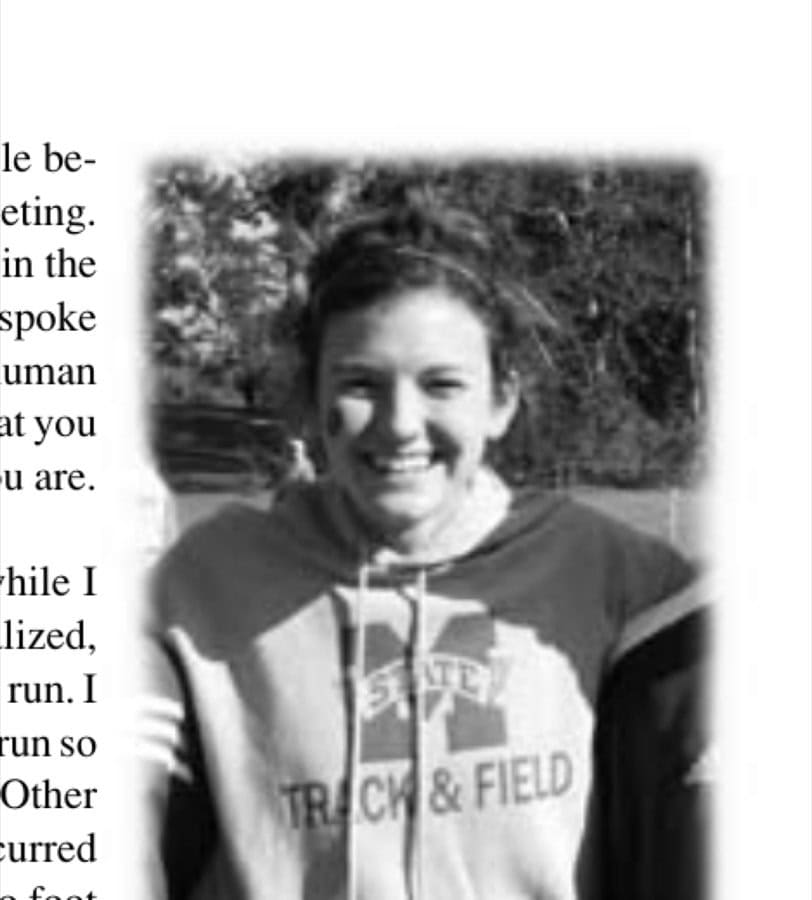
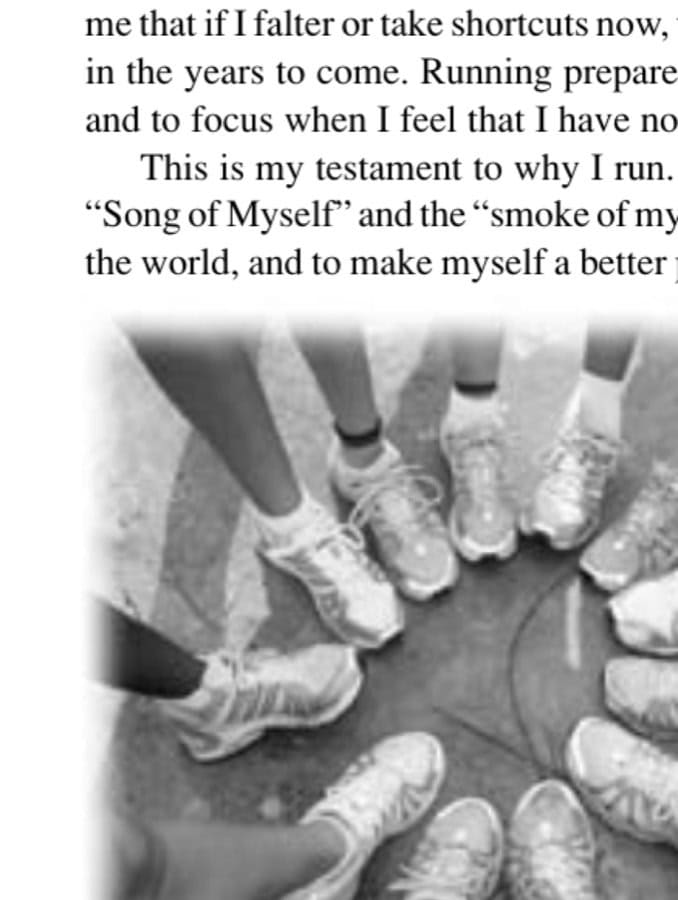
My teammates meet me at the track. In a circle, we wait for the others to report for duty. There are 11 of us, and we are a sisterhood—bonded through suffering and determination. Dickinson says that “the Soul selects her own Society,” and they are mine.
Teammates must have trust, patience, and love for one another—and must willingly accept brutal pain. Running is a sport about the human body and sacrifice. There are 11 girls on the Mississippi State cross-country team, but to me, we are one. We strive for team unity. Each season between August and November, each member must “close the Valves of her attention/like Stone.” We must focus on the goal.
I’m not really awake until I’m running. I catch myself closing my eyes while I wait for the others. When it is time, we stand up, strip down—and run. On my favorite mornings, the mist sits low in the valley surrounding the track. The bleachers, the weight room, and the locker room are concealed by the canopy of white clouds. The outside world disappears. I see only the red track and the grass infield.

We start our warm-up run by striding into the white foam. As we run, the mist moves to the sides. Moses must have felt exhilarated when he led his people across the Red Sea as it parted before him. I know I feel empowered.
Finally, I am running. I appreciate “my respiration and inspiration . . . the beating of my/heart . . . the passing of blood and air through my/lungs.” When I am not thinking about the rhythms of my body, I keep track of the color of the sky: black, deep gray, faint orange, dusty pink, and finally pale blue. The sunrise is my cup of coffee. When the sun is up, I am running. I am awake, but more important, I am alive.
Inevitably, every runner is asked, “Why do you run?” Dickinson and Whitman give me the answers. Largely, I run to feel alive. There is more to it, though. For one, I think that I am trying to outpace “the Carriage.” Dickinson personifies death as a carriage driver who “kindly stopped” to take her on a ride to eternity. For fear of age and death, I long for “the feeling of health” that Whitman mentions. He would understand why I am compelled to run. I also share his love for nature: “I am mad for it to be in contact with me.” I strip down to minimum coverage: only a sports bra, spandex, and shoes—and I savor the breeze on my bare stomach. During hard workout sessions, my chest pounds and my mouth
hangs open. I inhale desperately, deeply, quickly—“It [the atmosphere] is for my mouth forever . . . I am in love with it.” Second, I run to observe the world around me: “We passed the school, where children strove/at races—in the ring;/We passed the fields of gazing grain/We passed the setting sun.”
I can imagine looking back on my life and seeing myself running through the stages of it. My grandma said that I learned to run before I knew how to walk. Running has been my preference since then: tag on the playground, elementary school races, middle school running club, high school track, and now here— college. I will continue. Someday, I will run in marathons and jog miles around town, pushing my babies in a stroller. I run to experience the “sniff of green leaves and dry leaves” in the fall. In the winter, I dash through the new-fallen snow and make the first footprints. In the spring, I run in the rain, and mud splatters across the back of my white T-shirt. In the summer, I “delight alone” in the coolness of the morning and jump into a lake when I am done.
Despite the enjoyments that running provides for me—nature, friendship, health—the reality is that running causes immense physical pain. I suffer every day. My days do not feel worthwhile unless I have been exhausted, depleted, and weak from fatigue.
ad
I run intervals until my legs tremble beneath me. Yesterday, we had a team meeting. My sisterhood sat close together, and in the silence of a cold field house, my coach spoke loudly: “You are on an endeavor for human excellence. The misery and anguish that you go through is what makes you who you are. It is the fiber of your being.”
Using Whitman’s words: “Now while I sat in the day and look’d forth,” I realized, without a doubt, the third reason why I run. I run to become excellent. Some days, I run so hard that I lose control of my bladder. Other times, I throw up or pass out. I have incurred five stress fractures and undergone two foot surgeries. I have been frustrated, defeated, and on the brink of giving up.
In the sport of running, the trials and tribulations mirror the challenges of life. I understand Whitman when he says, “And [there] will never be any more perfection than there is now.” My coach reminds me that if I falter or take shortcuts now, then I will falter as a mother or as a teacher in the years to come. Running prepares me for life—to be strong, to overcome, and to focus when I feel that I have nothing left to give.
This is my testament to why I run. This is the narrative of my daily life, the “Song of Myself” and the “smoke of my own breath.” I run to feel alive, to observe the world, and to make myself a better person. I run to assure myself that I do not “
take things at second or third hand.” I run because I am a human, and like Dickinson, I am searching for “a Plank in Reason.” The Walt Whitman excerpts in this article are from Leaves of Grass. The Em
ily Dickinson excerpts are from “Because I Could Not Stop for Death” and “The Soul Selects Her Own Society.”
This article originally appeared in Marathon & Beyond, Vol. 12, No. 4 (2008).
← Browse the full M&B ArchiveMore like this
1,000+ stories from 19 years of Marathon & Beyond
The complete archive of the legendary long-distance journal — digitized and free to read.
