

Evolution Of The Boston Marathon Press Conference
Nestled inside the opulent and gilded Oval Room of the Fairmont Copley Plaza Hotel two days before the 2011 Boston Marathon, the defending champions found themselves in front of dozens of national and international photographers, members of the media, television cameras, and previous victors and Olympians. They were presented their respective bib numbers, which were actually their last names. And that photo opportunity was subsequently followed by a scheduled brief impromptu onstage question-and-answer session.
Three days later at the Boston Athletic Association (B.A.A.) Wrap-up Media Conference were the newly minted 2011 winners, sitting behind microphones and a row of tables on another stage in the Copley’s Venetian Room. They stared into the eyes of hundreds of camera flashes and then fielded a wave of questions from that very same mass of media.
By contrast, for the 1977 Boston Marathon, returning champion Jack Fultz of the United States not only didn’t receive his bib number—which was the number 1 as a result of his victory at the previous year’s “Run for the Hoses”—but subsequently ran the entire race without it.
And after the finish of those early Bostons, the tired and sweating winners usually found themselves immediately surrounded by a few local newspaper reporters and TV cameras in the darkened parking garage under the Prudential Center building on Boylston Street, which was near the finish.
The gatherings Nowadays, elite athletes are present for two main gatherings among the many media conferences scheduled throughout the weekend of the Boston Marathon:
© Paul Clerici
the John Hancock Elite Athlete Program Media Conference on Friday and the B.A.A. Champions’ Breakfast on Saturday. As the B.A.A. annually boasts, “In terms of on-site media coverage, the Boston Marathon ranks behind only the Super Bowl as the largest single-day sporting event in the world [with] more than 1,300 media members, representing more than 250 outlets.”
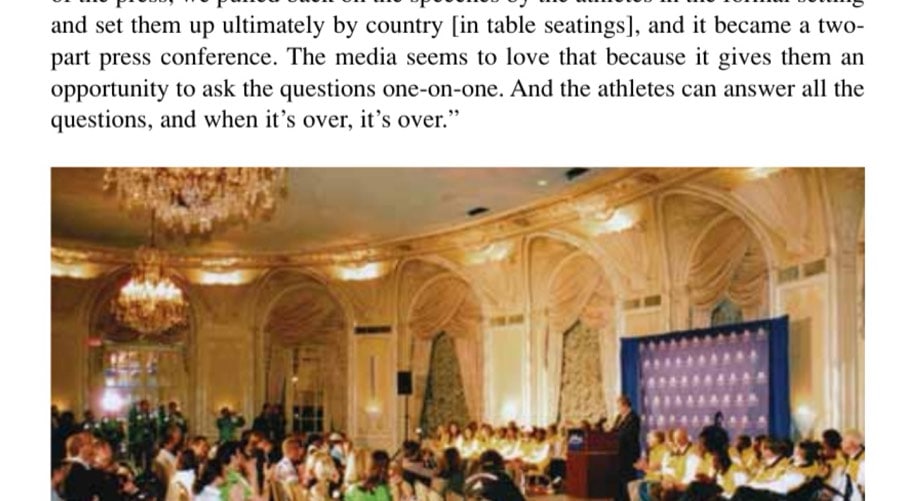
John Hancock’s multihour media conference originates the vast majority of the newspaper and magazine photos and articles, news and television footage, interviews, sound bites, and filler and background stories that viewers and readers will see that weekend.
At the Friday event, the assembled media take their seats and patiently wait as the 30 to 40 invited elite athletes are silently and majestically paraded into the Oval Room to their own row of seats on a small stage. In the past, a select athlete or two—usually the defending male and female champions, and for a period of time four-time winner Bill Rodgers—would talk on behalf of the other athletes. “
The first few years we asked a few of the athletes to speak in that setting, and there wasn’t the separate opportunity for interviews,” recalls B.A.A. Senior Director of External Affairs Guy Morse. “That evolved where to meet the needs of the press, we pulled back on the speeches by the athletes in the formal setting and set them up ultimately by country [in table seatings], and it became a twopart press conference. The media seems to love that because it gives them an opportunity to ask the questions one-on-one. And the athletes can answer all the questions, and when it’s over, it’s over.”
▲ The large Oval Room of the Fairmont Copley Plaza Hotel in Boston is needed to accommodate the assembled national and international members of the media and the dozens of invited elite athletes at the John Hancock Elite Athlete Program Media Conference.
Currently, there is only one speaker from behind a podium—usually a John Hancock representative—who cordially welcomes and addresses the room. Instructions are then given to the members of the media to please allow the athletes enough time to make their way from the stage to their assigned tables, which are all located along the walls throughout the two rooms. The flag of each country that is represented by an athlete is draped behind the various tables, thus marking where each competitor will be seated. “
I think all of us who put on events like this understand that athletes have their own rhythm that they need to be able to follow to get ready to do their very best, and it’s our job to help enable them to do the best they can,” said B.A.A. Executive Director Tom Grilk. “So when it comes to the structuring of these events, we ask them, ‘What would be best for you?’ And [we] try to provide for them the structure that will allow them to be the best competitors they can be.”
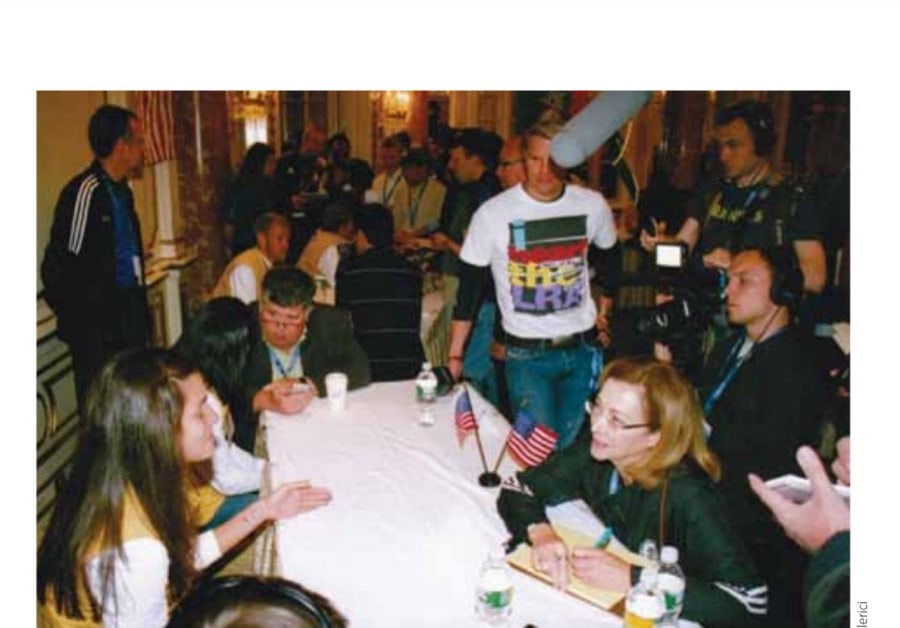
Once all the athletes are situated at their respective tables of country, for the next couple of hours a seemingly hectic, yet somewhat organized, rush ensues where hundreds of media members question the assembled talent. “
I don’t mind,” said two-time Irish Olympian Alistair Cragg of Mammoth Lakes, California. “Sometimes answering questions clears your thoughts. You’re talking about things you talk to yourself [about] more times than you talk to other people, so I don’t mind being bugged. I don’t have the problems [highly soughtafter top Americans] Ryan Hall and Kara Goucher have, but this is handy. It’s nice to get it out of the way.”
Added US Olympian Ryan Hall: “It’s good. You just get it all done, and then you can clear your mind and just get ready for the race and stay focused.” Desiree Davila of the United States—second at the 2011 Boston (2:22:38)—favors this method. While it may occupy several hours of her time on marathon weekend, she knows that once she is finished, she can prepare for her run. “
It is good because it can kind of be drawn out for days if you don’t have it all at once and say, ‘All right, this is it. When it’s done, it’s done.’ You get it done, and you know you’re going to be there for however long, and you’re excited about that because that’s what you want to do—to talk to everyone and tell them how things went,” she explains. “But then you do want to focus on your race, so it’s nice that it’s all done in a chunk like that. I think it just fits better because you can be more present and ready to be answering questions, whereas if someone calls me [another day], it’ll be, like, a half-ass interview because I’m not prepared for that. I think you get a better answer when you’re ready for it. I think it’s better for both parties.”
Alvaro Mejia of Colombia, who won Boston in 1971 before such large-scale media organization, noted: “It should be done like that, of course. It’s more difficult all apart,” he said in reference to answering questions in various unscheduled interviews throughout the weekend.
Australian Olympian and 1986 Boston winner Rob de Castella concurs. “Obviously, as a professional athlete, you appreciate the opportunity to get it all done and settled in one event, and then you can just relax and prepare for the marathon.”
Two-time New Zealand Olympian Kim Smith knows that she will be in demand wherever she competes. Because the Kiwi great is always a contender, she is aware that there will be interest from the media, which will inevitably require some of her time for interviews. That’s why she is appreciative of the kind of media conferences that are organized for the elite athletes and the press in Boston. “
The last couple of weeks [before the 2011 Boston], I’ve had a few different interviews in a few different places as well, and it’s nice to get them all out of the way. Then it’s just about relaxing and keeping calm. It’s nice to focus on the race,” she said. “Marathons usually have some kind of press conference. [Boston] is pretty big compared to the other ones I’ve done, but usually they try and make sure that you’re not going to be bothered the days before the race.”
On the other end of the camera and microphone are people like Emmy Awardwinning television journalist Lisa Hughes of WBZ-TV. Since 1980, Boston’s CBS affiliate has provided live start-to-finish coverage of the Boston Marathon. The station features established running experts Kathrine Switzer and Toni Reavis with Hughes, who joined WBZ in 2000 and first covered the Boston Marathon in 2001.
Hughes herself ran Boston in 2002 and sees the availability of so many of the elite marathoners in one place and at one time at the media conferences as invaluable for her preparation. Hughes covered Catherine Ndereba’s successful defense in 2001 from the women’s lead truck and says the additional media conferences help her provide viewers with expert on-air coverage come race day. “
The Friday press conference is a good opportunity to meet the athletes, to get a sense of their demeanor and focus, and to put the names with the faces. I appreciate that the speaking program is brief and that most of the time is devoted to individual question-and-answer sessions,” she said.
Bibs and breakfast Forty-eight hours before the gun, a more casual and celebratory event is held by the B.A.A. in the Oval Room of the Fairmont Copley. It is celebrated as the Champions’ Breakfast. Tables are adorned with colorful Boston Marathon-related centerpieces, and the program—which includes top-bib presentations and brief questions and answers as well as respectful nods to previous winners and race notables—moves along swiftly, yet warmly, as the B.A.A. welcomes the world to its town. But while that Saturday morning before the marathon always held a B.A.A.sponsored media event in some form, it wasn’t always as defined and refined as it is today.
© Paul Clerici
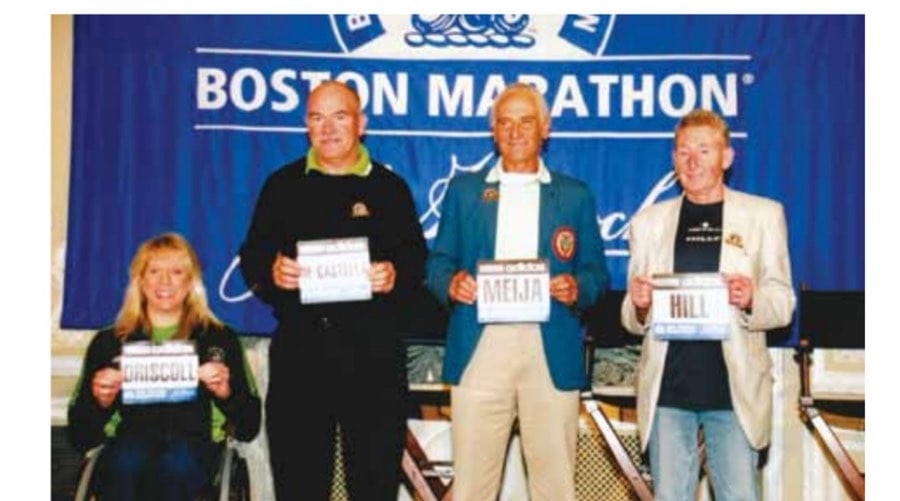
“We used to have a press conference on Saturday morning to really call the press together. It would be a press-focused event, as opposed to a gathering of the clan [as it is today]. More of a photo op,” explained Grilk. “The bib presentations were more like a press conference on Saturday morning, and that’s evolved into this reunion/Champions’ Breakfast where, yes, we make a formal presentation of the number 1 bibs to the returning champions, but as much as that [we also] bring back together the running community and as much of the history as we can find on two feet.”
In the lean years of the 1960s and early 1970s, fields averaged under 400 runners between 1960 and 1967 and around 1,300 from 1968 to 1974. (It wasn’t until 1975 that a field first exceeded 2,000 participants). The number of media members was far lower, most of the elite athletes knew the scribes, and most of the race officials knew the runners. “
Just like there weren’t the numbers of runners that there are today, there weren’t the number of press either,” said Morse, who for many years was also the B.A.A.’s executive director. “I think all the bib numbers were brought out to the start, like every other road race [at the time]. They were just given their
▲ Part of the Boston Athletic Association (B.A.A.) Champions’ Breakfast media conference includes the ceremonial presentation of bib numbers to the defending champions and select elite athletes, as well as the recognition of anniversaries of former winners. From left, in 2011, are Jean Driscoll (eight-time winner), Robert de Castella (1986), Alvaro Meija (1971), and Ron Hill (1970).
numbers. I think [race official] Jock Semple would give them the once-over to make sure they looked healthy to him—otherwise, they didn’t get their number,” he laughed. “There was a much less dramatic approach back then. There was no press conference, per se, and there weren’t that many media around. And they weren’t allowed in that room, I believe, out in Hopkinton, so they didn’t catch up with the athletes until they finished.”
Pulitzer Prize-winning Boston Globe staff writer John Powers, who first covered Boston in 1973, recalls that the smaller scale of the marathon enabled Semple to make one-man decisions, and there was no outcry for large media conferences. “
Basically, if you wanted to run in the Boston Marathon, you called Jock at the old Boston Garden [office]. I was with him when he got a call, and he would ask about your mile times and races. If you couldn’t convince him you were a runner, you couldn’t get in,” noted Powers. “And you could fit everyone [of the media] in one small bus. It was basically only the Globe and the Boston Herald, so for years there was no real call for them.”
Elite bibs, which currently feature names, were then numbers roughly based on seeding. Fultz, who several years after his win was the elite-athlete liaison for the B.A.A., was privy to the process by which numbers were assigned. “
What they did then and continued to do all the way up through the late ’80s and early ’90s when I was the liaison was the seeding process where anybody that returned who had finished in the top 50 got the bib number that equated to their finishing place. And then all the ones that were left open got put in by a subjective seeding process by what they ran,” he explained. “I had the lucky number 14 in 1976. That was Bill Rodgers’s number in 1975, and I think number 14 [won again].” That numeral was also worn by Canadian Johnny Miles in 1926 when he won his first of two Bostons and by Bob Hall, who was the first official wheelchair entrant in 1975 and also won Boston two years later in a world record.
The other main feature of the Champions’ Breakfast—the recognition and reunion of past winners and notables—began in earnest at the centennial Boston Marathon in 1996. That seminal celebration drew more than 40 previous champions including the late Johnny Miles (1926, 1929), Sara Mae Berman (1969-1971), Rodgers (1975, 1978-1980), and Joan Benoit Samuelson (1979, 1983), among many others. “
Saturday morning, which was the traditional B.A.A. press conference that has gone back decades even before [I started in 1984],” noted Morse, “was retooled so that it was more of a breakfast—a little bit more informal—and as it continues, we hope to get it more and more informal. We also made it the reunion, if you will, for the athletes. The B.A.A. breakfast has really become a focal point and important not only to the elite athletes for the presentation of numbers but also to all the returning champions. That’s because this event, more than any other event, I think, has that fraternity of past winners, and it has become an annual
meeting, if you will, for the elite of today and the elite of the past. It’s a very, very important event.”
The turning point John Hancock Financial Services entered the picture 26 years ago as the principal sponsor of the Boston Marathon. That was the start of an increased presence of signage, advertising, and attention and, of course, brought prize money for the first time. Morse was two years into his position as executive director when Boston forever changed and started to become the world-class event it is today. “
When we instituted the whole prize-money structure and really aggressively recruited the elite athletes, we also thought, when we did that, that we needed to continue to make the race and the environment around the race the best that it can be in terms of conditions for the athletes,” he recalled. “So we structure the media requests and the other appearances that they make, all to be in tune with what they need to do to prepare for the race because that’s their primary motivation—that’s their primary objective—to be the best that they can be in terms of preparation for the race on Monday.”
One of the elite athletes drawn to the newfound prize money and the attraction of Boston was de Castella, whose international marathon resume included gold
ad
at the 1982 Commonwealth Games and 1983 IAAF World Championship and a fifth-place at the 1984 Olympic Games. “It wasn’t quite the big event it is today,” he recalled of those early media conferences, “but Hancock had a good handle on it all. Boston was quite behind the other marathons of the time, but Hancock knew what needed to be done, and there was a commercial agenda in place as well. The media were, I recall, well supported and looked after. There were press conferences before and press conferences after, but I think it was a little bit separate from the B.A.A. Now there’s much closer integration between Hancock and the B.A.A.”
Back in the day “Back in the day” can refer to a concept as well as to a time period. For the Boston Marathon, they are intertwined. Prior to the commercialization and professionalism that slammed into Boston, a more relaxed and casual groove permeated the streets of the Hub around marathon time. There were no hours-long press conferences where the media would surround the elite athletes. But it was also not unusual to see the likes of Bill Rodgers walking among the mere mortals of the running community. In fact, when the springtime air of April began to waft through the city, he was the one to whom the media turned. “
It was intense. I always did a lot with the media,” he recalled. “And they would be calling me all the time. They’d call me at home, they’d come up to my house, I’d meet them at my store, I’d go to the [TV and radio] studio. I was into it—that’s the way I am. I’m a marathoner, and that was the deal. I do love the sport, and it was fun. It didn’t bother me, but there were some times I did get a little tired and I’d have to go back [home].”
For the local media, especially the learned ones who were not only writers but also runners, organized media conferences back then weren’t necessarily a necessity. Toni Reavis—a pioneer in the coverage of the sport dating back to his groundbreaking radio show Runner’s Digest in 1977—recalls the ease with which he could locate his subjects. “
Hell, we lived with them! I used to live on Beacon Street [in Boston], two blocks from Bill Rodgers’s store, so I would walk up every day and run with him. I lived it. Plus, they were mostly American kids, so I followed the sport year-round. These were American kids, and I’d see them all throughout the races. And then I’d call up the international runners. It was actually easier. There were fewer athletes [and] you knew them better,” Reavis said. “Nowadays, because of the way the money is structured in our sport, the marathon has so outstripped the regular road races that people don’t road-race anymore. They go to these isolated training camps, sequester themselves for three months at a time, and come out of
© Paul Clerici
the hole once or twice a year to go race. It makes it very, very difficult to have rooting interest.” Much like Reavis, when Powers needed to locate a top runner for an upcoming story or feature back then, he also knew where to turn. “
The first several years I covered it, it was just a [one-]day event. If you wanted to talk to someone like Billy Rodgers, you did it. The clearinghouse back then was the Eliot Lounge, really,” he said of the well-known runners’ bar inside the Eliot Hotel near the marathon course. “You went there because that’s where they were—(Coach) Bill Squires, Rodgers—because back then they were all usually [Greater Boston Track Club] guys. There wasn’t the national or international presence like there is now.”
Some of the media see the assemblage of dozens of elite athletes in a single setting as the answer, especially with the appearance of those who now disappear for months at a time. And some see a drawback to the big weekend media conferences because athletes don’t seem to be as available as they once were, years ago, outside the designated time frame.
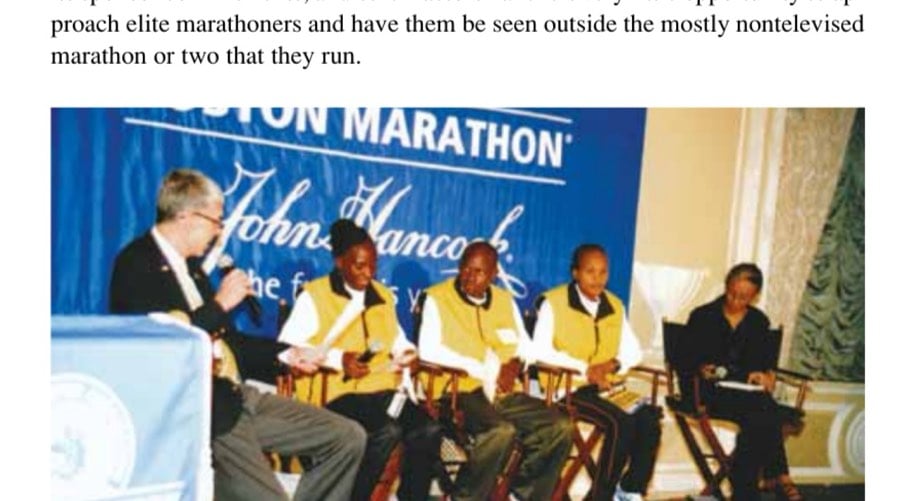
Reavis feels, in part, that the sport’s increasing need for managers and agents, its sponsor commitments, and other factors have left very little opportunity to approach elite marathoners and have them be seen outside the mostly nontelevised marathon or two that they run.
▲ After the Champions’ Breakfast media conference, B.A.A. Executive Director Tom Grilk, far left, interviews four-time winner Catherine Ndereba as defending champions Robert Kiprono Cheruiyot and Teyba Erkesso (and her interpreter, Sabrina Yohannes, far right) listen in and await their turn to answer a few questions.
“You walk [2011 Boston winners] Geoffrey Mutai and Caroline Kilel outside the Back Bay up and down the street, and nobody knows who they are,” Reavis said. “That’s a disservice. But part of that is the system that creates the reality. That system is they run few races a year of consequence. The format for us in the press conference—20, 30 athletes in two hours—it’s impossible. You can’t talk to everybody. I don’t particularly enjoy the system that’s in place. In the old days, it was just more organic. We were lucky in having people like Billy in the old days, who was very outgoing and very well spoken and was a good talker and he liked to talk about it. It’s difficult to get really good information [now]. But I have a good relationship with the coaches and the managers.”
Prep work With a major event like the Boston Marathon, planning for coverage obviously begins weeks and months beforehand. In addition to what is offered in the media conferences, there are plenty of workarounds, such as with Reavis and the coaches and managers, and Powers and his approach with the B.A.A. “
It doesn’t work for me, except for my notes,” said Powers in regard to the weekend press conferences and his densely informative Marathon Notebook section in the paper. “If I need to talk to someone one-on-one, like the defending champion, it’ll be arranged [for] after the press conference, and they’ll bring them in. With the B.A.A., about a week before the press conferences, I’ll say what I need for the features we’re doing, and I’ll ask, for example, when are the Kenyans coming in, and we’ll meet in the conference center. We’ll work around their schedules, and we’ll meet there in case a translator is needed. That works.”
De Castella, whose competitions took him all over the globe, understood the demand. He was prepared for what was expected of him as an elite celebrity runner. “As a professional athlete, you have an obligation to promote the event, recognize and acknowledge the sponsors, and be there to support what it’s all about. That’s part of your job,” he said. “I think most of the sports journalists that covered the marathon had a reasonable respect for the athletes in terms of their preparation. You’ve got to be accessible, but you don’t want that to be abused. And if you do have a journalist who abuses it, then the next time they call you, you’re less inclined to be available or you don’t give as good an interview. So it goes both ways. It’s never been a major issue for me. It never worried me.”
Not everyone embraced that same open policy as de Castella or Rodgers. Some elites would rather be anywhere else than within the scheduled confines of even the one short media conference. “I remember some other runners, like [Japan’s Toshihiko] Seko, and he didn’t want to hear it. He wanted to get the heck out of there,” recalled Rodgers of a
nemesis of his from the boom years. “He’d be there for a little bit and then, ‘I’m done.’ But I think because I lived here, I could just go home. He was halfway around the world from home. It’s tougher. But back then, I was in some room with about five or eight of the top runners in those days; they didn’t bring everyone in like now. And there would be media there, and I would do quite a lot of prerace interviews. There would be one day that was the main day but not as well defined with all the tables by country. But today it’s much more structured, and I think that’s a good idea. The athletes have to rest. There’s plenty of time to talk later, after the race.”
Mejia, a three-time Olympian for Colombia, also recalls fielding inquiries from the media decades ago. But he didn’t seem to mind either. “They call me at home, yeah, and then they call me all the time, and I was in all the papers in the United States,” he said of his victorious 1971 Boston experience. “When I wake up, I go and bought all the newspapers here in Boston, so I have all my papers,” he added with a smile.
While it’s rare nowadays for the media to call the athletes at home, there is still a chance during their stay in a city to bump into each other in a hotel lobby or a store or on the sidewalk after a training run. But, again, it depends on the individual as to its level of inconvenience.
ad
© Paul Clerici
▲ A behind-the-scenes look at the John Hancock Elite Athlete Program Media Conference, where the likes of top American marathoner Kara Goucher, sitting at left, fields several hours of questions by the many reporters and journalists, including pioneering runner and longtime writer Kathrine Switzer, kneeling at right.
“It doesn’t bother me,” said Cragg. “But again, I don’t have the problems Ryan Hall or Kara Goucher have. Being American, there’s a lot of need for a great performance, and people like to hear about it.”
Postrace There are several media-related photo and interview opportunities following the race. Immediately after each race—male and female wheelchair, male and female runner—is the presentation of the laurel wreath, medal, and trophy.
In the early days, the wreath was placed on the victor as he literally crossed the finish line. In some cases, the race official was often seen chasing after the still-moving champion. In recent years, it was decided to wait until the winner was on a nearby podium to award the trophy and medal and play the national anthem.
Some interesting times have surrounded that ceremony, of course, such as when medical assistance was required for Alberto Salazar in 1982, or when in 1971 Mejia first decided to take advantage of the water fountain at the Prudential Center. To cool off for a moment from the heat of the day, he stood in the
fountain and splashed water on himself after he won. Many other runners also enjoyed that perk. Only a handful of photographers were present in the old days, and later they would encircle the podium for the best shot. Today they are corralled in a large group several yards behind the finish line.
The official setup for postrace interviews has also evolved over the years, from questions on the street near the finish line, to a makeshift locale in a barbershop, to rows of tables on a stage in the Copley.
Fultz recalls that the hectic minutes after his 1976 win were filled with a whirlwind of being directed to several familiar and unfamiliar places while he was still euphoric. “After they put the wreath and medal on me and the five minutes of fanfare and photos out by the finish, they escorted me in and sat me down in a barber chair in a barbershop in the Prudential. They put a baby in my lap—the barber’s grandchild for a photo op—and I sat there and answered questions for half an hour. And they gave me a big trophy from the [Massachusetts] Podiatry Society, I remember that,” he says with a chuckle at the recollection. “You sit in a barber chair, and it’s like a little throne. By the time I got back out of the chair after sitting there for 45 minutes, I couldn’t move. My legs had all stiffened up. But I was fine. I went out for a little run the next day.”
ad
Shortly after the race now is the Boston Marathon Race Day Press Conference at the Copley’s Grand Ballroom. It starts when the top wheelchair athletes arrive and continues with the top men and women, master’s winners, and others. It can last for nearly three hours. That is followed later that evening by the B.A.A. Awards Ceremony, which is open to the public.
The day after In 2011, the official B.A.A. Wrap-up Media Conference was held Tuesday morning, 24 hours after the main start of the Boston Marathon. A relatively new event in terms of media conferences, the day-after get-together provides both another chance to interview the new winners and the opportunity to listen in on the B.A.A.’s view of events.
Also included were the photo ops of the big (as in physical size and monetary worth) checks for wins and records presented to Kenyans Mutai ($225,000) and Kilel ($150,000) and to wheelchair winners Masazumi Soejima ($15,000) and Wakako Tsuchida ($32,500) of Japan. They all waited patiently, and they graciously smiled for the many photographers. The top American finishers—Hall, who came in fourth, and Davila, who was second—were also available. (By contrast, the 1986 winners—de Castella and Ingrid Kristiansen of Norway—earned $30,000 each for their victories, $5,000 in bonuses, and a new car; de Castella also won an extra $25,000 for his course record.)
This gathering can particularly benefit the local news stations and the weekly and monthly newspapers more than the dailies, as Powers views the wrap-up with less urgency and need. “I don’t get anything from that because we’ve talked to everyone the day before. But if there is a highly unusual race, like when the storm hit [in 2007 and the race was nearly canceled], then it works,” he said.
The Tuesday-morning event didn’t exist in prior years. Years ago, the only postrace activities were truly postrace, as in minutes after the win. Runners were directed from the street level of the Prudential Center finish on Boylston Street, down the road from today’s finish line, to the Pru’s garage area.
As Powers recalls, “The first year that Billy Rodgers won, 1975, we were at the barbershop at the Pru, and he sat down in the barber chair. There were about a half-dozen of us [media] there and only about a handful of [elite runners] were coming in,” he said. “Then they moved us in the Pru on a ramp to the garage. I remember in 1980 when Rosie Ruiz ‘won,’ we were on a ramp that went down to the garage. They had some tables and chairs set up, and I remember that’s when we met Rosie and she asked us who were we, and we asked her, ‘Who are you?’ Only the top few people were there. [In 1982] I remember we also talked to guys in the medical tent. When (Dick) Beardsley and Salazar ran each other into
the ground, we talked to Salazar while he was hooked up to an IV! When John Hancock came in, we moved again to the Copley Plaza Ballroom, and afterward they’d bring them [the winners] in when they were ready after the race.” Fultz said, speaking for himself but echoing every winner, “And of course, my whole life changed.”
In search of my number It may be unimaginable by today’s standards, but there was a time when the top athletes of the Boston Marathon did not receive great attention. When it came time to receive their bib numbers, for instance, in lieu of
any grand photo op at a media conference, they had to pick up their own numbers at Hopkinton High School like everyone else. An interesting tale about the number pickup involved Jack Fultz, who won the sun-baked “Run for the Hoses” in 1976. “
When I came back to defend in 1977, I received no assistance coming to town whatsoever—no invitation and no help from anybody, anywhere, for anything. It was a different beast. I don’t begrudge anybody that.
That’s just the way it was. There was no expo—you didn’t pick your number up in the weekend before the race,” he said. After Fultz arrived late to the starting line on race morning, he ran the seven-tenths of a mile to the high school for his number but was informed
that the remaining top-100 numbers that hadn’t been picked up had been sent to the start. With time closing in on the noontime gun, he quickly ran back to the start and was subsequently notified that no one knew
where the bib numbers were located. He ran sans bib. “Interestingly enough, I finished 1976 winning without my bib number on (it had fallen off), so no one knew who I was. And I never got my bib number in 1977—which would have been number 1 for my scrap
book—so I started the race without my bib number. Consequently, I got no supportive cheer that I needed. I was struggling! I ran the same time, generally, within 30 seconds, but only finished ninth,” he noted of his
winning 2:20:19 in 1976 and his ninth-place 2:20:44 in 1977. “Of course, when I crossed the finish line [in 1977], I didn’t have a bib number on, and they tried to kick me out of the race. No one recognized
me, which is not surprising,” he said with a smile, “and finally someone
came out and vouched for me. Then they [race officials] asked me what my bib number was, and I’m figuring if they didn’t believe I ran the race, they’re certainly not going to believe my bib number when I tell them.”
When the defending champion informed the skeptical race officials of his prized top-bib number 1, the reaction that followed was expected. “Sure enough, they thought I was a hoax, and they tried to kick me out
again. It took a while to convince them, and finally someone said, ‘Oh, it’s Jack,’” he laughs at the simplicity of those days. “And the next year in 1978, same thing—we showed up at the school, picked up our bib
numbers, and there was no fanfare whatsoever. It was just a different era.” In 1967, for Kathrine Switzer—who was obviously not an elite athlete since women were not allowed to run then—there was also that lack
of attention given to the number pickups. Had there been any kind of organized photo op at the high school for the presentation of numbers to the top men, there would have presumably been more photographers
milling about. And had any of those photogs happened upon Switzer before the start, imagine how different the story of the first woman to run with an official number might have turned out. Having registered simply as K. V. Switzer, a common moniker of hers
at the time, the 20-year-old arrived in Hopkinton with her coach and teammates from Syracuse University. “The morning of the race—it was snowing and sleeting—my coach, who was the team captain, the president of the club, went in the high
school and picked up the packet with our numbers. They were all in a packet. We could drive up and park right in front of the high school,” she recalled. “He wanted us to wait in the car because it was so miserable.
He’d come out, and we pinned our numbers on in the car, and we’d park the car, and then we’d start our warm-ups at the last minute. “That was it—you went into the gym, and you got your number,” added
Switzer, who only four miles later would simultaneously meet history and Boston race official Jock Semple, whose photographed attempt to remove bib number 261 and the runner at the 71st Boston would soon galvanize a movement.
This article originally appeared in Marathon & Beyond, Vol. 16, No. 2 (2012).
← Browse the full M&B ArchiveMore like this
1,000+ stories from 19 years of Marathon & Beyond
The complete archive of the legendary long-distance journal — digitized and free to read.
