

Famous for Losing
NO “WONDER BOY”
Jim Peters was no “boy wonder” who became a champion. He disliked running. His ambition was either to be a professional footballer or a cricketeer.
Peters was born at the end of World War I—on October 24, 1918—in Homerton, London, England, and it became clear to his parents early on that he was a weak, anemic, and underweight infant. He spent as much time in the hospital as he did at home, a situation that lasted until he was seven years old.
At school, Peters made valiant attempts to get on the school’s first teams at football and cricket—and he failed miserably. The turning point for his athletic career was when a new youth club was begun in his town. It was a sports-oriented club with an enthusiastic leader who insisted that to get on any of the teams, one had to be able to complete a five-mile run once a week from the club house. Peters was surprised to find that he was the fourth boy home out of 50 on his first training spin. Very quickly, he became the first boy back home. So began 21 years of serious running.
Peters competed in cross-country for his new club, the Essex Beagles, and ran the mile and half-mile in the summer right up until the outbreak of World War II in 1939, when he was conscripted into the Royal Army Medical Corps. He was quickly promoted to sergeant optician, having just completed a four-years’ apprenticeship with a London firm.
Peters left the army at age 27 with a wife and a little boy to support. He began running again mainly because he had developed “a stomach.” As he became fitter, he contemplated competition again at the longer distances of three and six miles.
His wife Frieda did not approve. “You were a runner before the war, Jim,” she observed, and “the sooner you get used to that idea the better it will be for you.” In other words, she was saying politely, “Running is kids’ stuff; you’re too old for it now. Grow up.”
PETERS FORGOT TO GROW UP
But Jim Peters was not to be deterred. Within a year he had won the AAA six-mile championship in a time of 30:50.4 and later the AAA 10-mile track title in 53:21. It was the last time that particular event would ever be staged.
Those two victories led to his appearance in the 1948 Olympic Games in the now-famous 10,000, in which Peters was one of many athletes lapped by Czech sensation Emil Zatopek, who won the race in a new Olympic record of 29:59.6. Peters went to his newly acquired coach, Johnny Johnstone (who had competed in both the 1924 and 1928 Olympic Games), and told him that he was retiring.
Johnstone’s reply was fate-filled: “What about this marathon business, Jim?” To which Peters countered, “I’ve finished, Johnny, and that’s that.”
Johnstone was a cunning old fox, however. He had carefully scrutinized Jim’s face as they sat together watching the finish of the 1948 Olympic Marathon. First to enter the stadium was the Belgian Etienne Gailly, utterly exhausted and barely able to run. Less than 500 yards away was the finishing post, and as he stared at it glassy-eyed, the Argentinian Delfo Cabrera came in full of running, closely followed by the Briton Tom Richards. Both passed the staggering Gailly, who finished third. Peters had raced against Richards successfully over cross-country, and Johnstone knew exactly what Jim was thinking. . . .
Yes, Jim Peters was considering the marathon, but the then-accepted training regime made him shudder: four runs a week of 20 to 25 miles each, plus a three-hour walk on Sundays, was completely out of the question. The idea of running for two and a half hours after finishing work at 6:00 p.m. meant he’d go running, eat supper, and go straight to bed. His wife wouldn’t tolerate it!
For three months Jim did no running; instead, he watched his waistline grow. The latter condition always disturbed him, and as the cross-country season came again, he ran in the races as a form of training. He continued with this format in the summer, where he raced three and six miles with no training.
At some of these race venues Peters would run into his old coach, who always replayed the same question: “What about this marathon business, Jim?”
After hearing this query a dozen times, Peters began to rationalize, Well, I’m nearly 31. If I’m going to have a go, I have to do it as soon as possible and try to get to the top, but I shouldn’t expect anything for a year or two.
BASIC TRAINING
So Peters phoned his old coach, and they met in November 1949. At that point, Peters had not raced for four months. It was agreed that Peters would start off running four miles six days a week and that he’d compete in every club cross-country match as well as run one workout that was double his daily average, or eight miles. He followed this plan for six months. When Peters began the program he weighed 11 stones (154 pounds), but at the end of that spell he weighed a stone less.
In the spring of 1950, Jim’s mileage had increased to six runs of 10 miles each, and Johnstone ordered him to run in the Essex 20-mile championship in May. Peters won in a time of 1:59:50.
Although the basic training plan was 10 miles a day, on one of those days seven miles of the run had to be done at maximum effort. One additional run of six miles was at maximum effort. Eventually, each run contained a kernel of three to seven miles at maximum effort.
THE RECORD-SETTING RACES BEGIN
This work paid off in a 15-mile race where Peters recorded 1:26:55, a course record. This was followed by a 20-mile race in which Peters lowered his 20-mile time to 1:52:24, but in the process he was defeated by legendary marathoner Jack Holden. Peters found that Jack introduced bursts of speed that lasted a mile or two, and after the third such explosion of speed, Peters could not cope.
Not long afterwards, a major breakthrough occurred in a 20-mile race when Peters ran an official world record of 1:47:08. The scene was now set for a Peters-versus-Holden showdown in the 1951 Polytechnic Marathon: Jim’s first marathon, Jack’s 21st. It was an epic encounter. Peters built up an early lead of 200 yards, but at the 13-mile mark Holden not only drew level but threw in a five-minute mile to build up a lead of 200 yards. It remained like this with five miles to go, when Peters noticed that Holden glanced back to see where he was. Jim took this as a sign of anxiety and made strenuous attempts to close the gap, which he did, to take the lead. Holden dropped out, and Peters went on to win by some 90 seconds in a record time of 2:29:24 (the previous British record had stood since 1929). The 1952 Olympics awaited him.
HELSINKI, 1952
Peters prepared for the Olympic Marathon meticulously, running six miles during his lunch-hour at work, and another 12 miles at night before supper. These runs were always fast, much faster than marathon pace. He started off his Olympic preparation in January of the Olympic year by winning the 13.5-mile Morpeth-to-Newcastle race in 1:11:45 and the Finchley 20-miler in a course record of 1:49:39. His fast time prompted allegations that the course was short. When remeasured, however, it was found to be 460 yards too long!
In the AAA Marathon he came close to cracking the 2:20 barrier with a 2:20:42.2, another course record. The British sports writers were convinced Peters would return from Helsinki with a medal of some color.
However, the British Amateur Athletics Board were more concerned with saving money than spending it on medal prospects. For the trip to Helsinki, they chartered an old, four-engined York transport plane, a relic of World War II. Seats had been jerry-rigged into the plane, and during the long journey no hot meals of any kind were served. Bad weather stretched the journey to nine hours. The decrepit aircraft’s engine and fuselage noise was so deafening that the team were issued cotton wool to plug their ears. Conversation was impossible.
A further snag came when Peters was given a seat near the door, which allowed a howling, icy-cold draft to envelop him. He arrived in Helsinki frozen stiff. His subsequent training was well below par.
But there were other obstacles about which he could worry: Emil Zatopek, his nemesis from 1948’s 10,000 meters, had again won the 10,000 in Helsinki in an Olympic record 29:17 and a few days later added the 5,000 meter gold medal to his stash. Now, to top it all off, Zatopek announced that he would also run the marathon! He had never run in a marathon before, but he was so buoyed that he decided to make the Olympic Marathon his maiden voyage.
There are two conflicting stories about the race. Zatopek and Peters found themselves side-by-side at 10 miles, in the lead. Zatopek claims he asked the more experienced Peters, “Jim, are we running fast enough?”
Peters asserts that halfway through the race, Zatopek pointed at a runner named Gustaf Jansson who had joined them and said to Peters, “The pace? Is it good enough?” Peters, anxious not to reveal that he was feeling badly, replied, “Pace too slow.”
Shortly after this dialogue, Zatopek and Jansson began to pull away, and Peters began to cramp up.
Peters ran gamely on to mile 17, where the cramp became unbearable. He staggered on until the 20-mile mark and collapsed. He made feeble attempts to continue, but he collapsed again after several hundred yards. Peters took his failure at the 1952 Helsinki Olympic Marathon very badly.
MAKING AMENDS
So bitter was Peters at his bad luck and defeat by a complete novice marathoner that he vowed to make amends. Another runner in the same Games who made a similar vow was Roger Bannister.
In January 1953, Peters again won the Morpeth-to-Newcastle run in record time, to be followed by another course record in the Mitcham 15.5-mile road
race: 1:19:02. Three months later he ran the Mitcham 20-miler in a course record of 1:45:24, just outside five minutes per mile.
Things were going according to plan, and the culmination came a month later when Peters ran 2:18:40 in the 1953 Polytechnic Marathon—10.8 seconds faster than Yamada’s Boston Marathon time set on April 20, 1953—to become the fastest marathoner in the world.
He had been humiliated by Zatopek in the 1948 Olympic 10,000 meters, being lapped by the Czech Locomotive. He had been, many said, psyched out by Zatopek again in the 1952 Olympic Marathon.
For the Commonwealth Games in 1954 at Vancouver, Peters swore things would be different. He planned to make Zatopek’s Olympic Marathon time look mediocre. In fact, he had done this on June 26, 1954, in the AAA Marathon, where he ran 2:17:39.4, six minutes faster than Emil’s Olympic record. He had won eight marathons in two and a half years, three inside 2:20, and all inside 2:30. The only hitch in that winning streak was a second-place finish in the 1954 Boston Marathon, in a time of 2:22:40. That was not enough. Peters was convinced he could be the first man to go under 2:15.
THE RACE THAT MADE HIM FAMOUS
So it was that Jim Peters, then 35 years old, traveled to the 1954 Commonwealth Games in Vancouver, British Columbia, to compete in the marathon and as a third-string runner in the 10,000.
In the latter race Peters led to the final lap, being passed by his two compatriots, but he gained a bronze medal. Not a bad start to the Games, he thought, especially as he was 14 years older than the two who preceded him.
With a week to go to the marathon, Peters realized there were two problems. The first was the idiotic timing of the marathon start: high noon. The summer sun in Vancouver was at its zenith between midday and 3:00 P.M. and regularly reached 100 degrees. Once body temperature reaches 104 degrees, things within the body begin to go drastically wrong if the runner doesn’t consume fluids and administer cooling fluids over the head. And it was not practical for Jim to slow down when going up against other competitors, some of them from hot climates.
The second problem was the course and its measurement. Each time Peters and his compatriot, Stan Cox, drove over the course, the odometer registered 27 miles before they reached the stadium, which meant the course was more than 27 miles, not counting the 400 meters required within the stadium. It was going to be tough enough to run 26 miles, 385 yards, let alone an additional 600 meters or more. And, if the overall distance was wrong, all the measurements at intermediary stages would also be incorrect. A scheduled 37:30 through the first 10K might come up 38:30 because it was, in fact, a good 500 meters past the actual mark. This could cause some runners to step up the pace, a dangerous thing to attempt in the adverse heat.
Officials, however, do not like being told that a course for which they are responsible is too long or too short. It makes them look inept. When the British team manager queried the course length with the chairman of the Games marathon committee, and it was found to be 27 miles before entering the stadium, it was dismissed with, “No car mileometer is accurate.” But a car used to gather evidence in court cases involving speeding was then driven over a known-mile course in the city, and the car’s mileometer was pronounced accurate.
Officials remeasured the course and stated it was 83 yards too long; the finish line post was repositioned accordingly. Peters and Cox felt the course was still more than a half-mile too long. That extra half-mile might prove fatal to some. . . .
Time to Race
The night before the race, Peters went over things in his mind. He was the fastest man in the field, that was true, but there was the heat and the extra distance, and it was the hilliest marathon course he’d ever seen, which would suit Stan Cox, since he was a renowned hill runner, but it would not suit Jim Peters.
When raceday arrived, Peters’s first thought was, Well, this is the day I’ve come 6,000 miles for. The heat was building, and there would be no shade on the roads. That was another irritating factor. Then there was the fact that there would be wet sponges only every three miles after the 10-mile point in the race. In England, Peters had been used to having sopping sponges where and when he wanted them.
As the field lined up, the heat was intense, and Peters and his teammates were in for another disappointment: Most of the British team officials stayed behind in the stadium waiting for the “Miracle Mile” race, the epic battle between the front-running John Landy and the big kicker, Roger Bannister, the former having stolen Bannister’s mile record two months before. Peters placed a lot of weight on being told how far he was in the lead, and on a hot day like this, he felt that knowledge was crucial. With the officials back at the stadium, he would get no such information during the race.
Peters had one more ritual to complete. Before every race, when called to his marks, he carried out a self-examination: “Have you trained assiduously and lived right?” The answer was positive.
The gun went off, and round the track, up a steep ramp, and out of the stadium onto the highway went Peters at the rear, a pack in front. For the first three miles there was a long hill, which spread out the field. Peters worked his way up into the lead, followed by his teammates Cox and Joe McGhee.
At eight miles there was no change, but shortly afterwards, Peters sprinted up a hill to surprise Cox and got away. McGhee was not to see him again for another 10 miles. At 11 miles, Peters was now 300 yards clear, but he had planned to be farther away.
Cox was hanging on well—he must be gotten rid of, Peters decided. Peters applied more pace, and for Cox it was the final straw.
The Heat! The Heat!
Peters recalls this stage: “The heat by now was almost overwhelming, and I would dearly have loved to use the sponge. But I had to wait for them at the official feeding stations. The first two I got were nearly dry. I liked them very wet. As a result I didn’t get the relief I hoped for. On I went, up what felt like a little mountain. I grunted and groaned as I plodded up the slope. I learned later that I must have gotten nearly a half-mile to a mile on Stan [Cox], but at that time I still pictured him hot on my heels, less than a quarter of a mile behind. By the time I came to the last feeding station, which was only a half-mile from the stadium, I still thought that Stan was close behind. I was completely unaware that around 24 miles poor Stan had collapsed from sunstroke and run into a telegraph pole; with less than three-quarters of a mile to go, I actually had a lead of nearly 3.5 miles.
“If only I had known then, I could have stopped at the last feeding station, had a good sponge down, and trotted in slowly.”
Losing a Race But Winning a Thousand Hearts
But Peters was short on good information. So was McGhee, who passed the Australian Lawrence at about 19, where he was sitting on the pavement.
Peters approached the stadium, he recalls. “I went up a hill and wobbled a bit,” but the crowd cheering him gave him new hope. He was on target for 2:20, but the heat, the long course, and the hills had made him run nearer to 2:15, which was suicidal in such conditions.
Peters wobbled again as he went up a ramp inside the stadium that deposited him on the track. The next three minutes provided drama, courage, horror, and tragedy. One minute the crowd was cheering, then they gasped, then they screamed encouragement, and finally they covered their faces and many wept.
In that epic spell of 180 seconds, Peters crashed to the track 11 times and covered only 50 meters. Each time he rose, his rubbery legs could only take him a couple of yards.
Mick Mayes, physiotherapist to the British team, stepped forward and caught Peters just as he was about to fall again. Mayes thought Peters had crossed the winning line, but he hadn’t. Peters was disqualified.
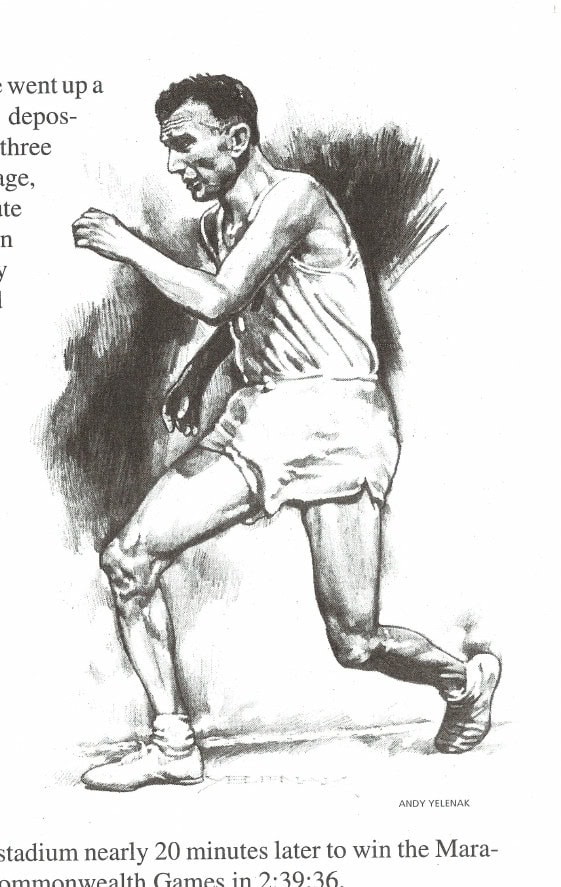
Joe McGhee ran into the stadium nearly 20 minutes later to win the Marathon Championship of the Commonwealth Games in 2:39:36.
The Aftermath
Just before Christmas 1954 a parcel arrived for Jim Peters bearing a Buckingham Palace postmark. Inside was a large gold Commonwealth Games medal set in a thick Perspex stand, on the base of which was a small gold plate on which were engraved the words:
THIS GOLD MEDAL
was given to
H.R.H. THE DUKE OF EDINBURGH
at Vancouver and presented by him
to
J. PETERS
as a token of admiration for a
MOST GALLANT MARATHON RUNNER
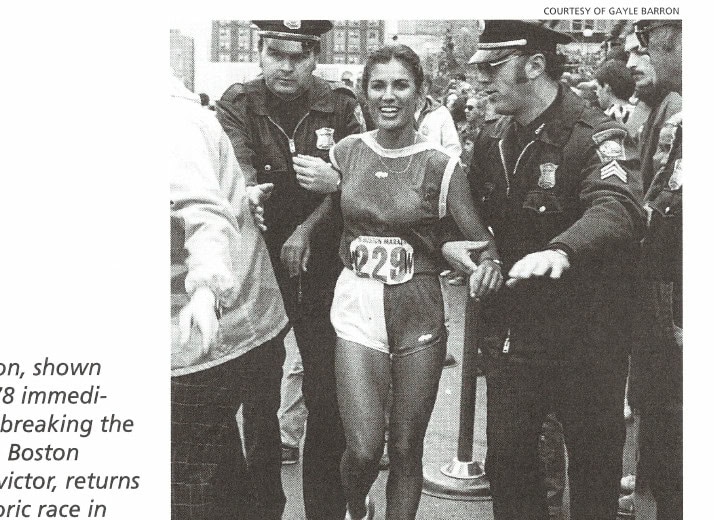
BOSTON, April 15, 1996—Like most runners who have raced more than a few marathons, there have been quite a few that I consider unforgettable. From 1972 to 1980 I ran 23 marathons and was very fortunate to win the 1978 Boston Marathon. Standing on the victory platform, my head decorated with the laurel wreath, and feeling the awe of an unexpected win was truly a thrill. But, surprisingly, the 1978 Boston win was not my most memorable marathon.
This article originally appeared in Marathon & Beyond, Vol. 2, No. 5 (1998).
← Browse the full M&B ArchiveMore like this
1,000+ stories from 19 years of Marathon & Beyond
The complete archive of the legendary long-distance journal — digitized and free to read.
