

Fast Times Down Under
It was, I had to admit, a long way to go for a run. Coming from me, that was a pretty big admission. Over the years, I had gone to some remote places to try out new races, but this time I had outdone myself. I had just flown for almost 20 hours across North America and the Pacific, covering almost 10,000 miles, for a three-day stopover in Australia to run in the 10th Blackmores Sydney Marathon.
I checked my watch. It was set for the US East Coast, 16 hours behind the local time. I would have to fix that. It was about 9 a.m. on a sunny and cool late-September morning in Sydney. I was making my way downtown to the packet pickup, pretty sure that I was heading the right way. “
Can you help me with directions?” I turned toward the voice. A young blond woman, a bit frazzled, stood before me. She had that singsong accent that is so unmistakably Australian. “I just got here myself. I probably can’t be much help,” I said. Then, “Wait! I’ve got a map!”
We unfurled the sheet, managed to orient ourselves on it, and found where she had to go. She thanked me, and as she walked away, she turned back and said, “I like your accent.” Which was crazy, of course. I don’t have an accent.
I smiled back and tried to figure out which direction I needed to go. I should have felt dead on my feet but I felt fine. This sort of made sense since I had flown out at night and arrived early in the morning, though a day later. I had managed to get some sleep on those flights, so I was still more or less on my regular schedule. I knew I would pay for it with massive jet lag on my return trip, but I would worry
about that later. Right then, I had a city to explore, and I had no time to waste. It was Friday morning, and I would be there only until Monday. I had never been to Australia before, so I was hoping to do some sightseeing, but most of that would have to take place during my 26.2-mile running tour on Sunday. When I had told my friends my plan, they just shook their heads, but there was method to my madness. A friend with frequent-flyer miles to spare had offered to sponsor my flights, and some friends in Sydney offered to host my visit. What marathon junkie on a budget could say no to that? After arriving, I was met by Phil, half of the couple with whom I would be staying. He drove me to their row house on the edge of the city center. I was on vacation, but it was just another workday for them, so I would be on my own. After a quick breakfast and a refreshing shower, I was ready to hit the street.
Getting the lay of the land
Courtesy of Jeff Horowitz
Australia is famously known as having been established as a penal colony for castoff British convicts. This dates back to 1788, when 1,400 convicts, soldiers, administrators, and their families arrived at Sydney Cove. Free settlers arrived just five years later, but the waves of convicts continued landing for over 50 more years. In 1851, gold was discovered in the surrounding area. This did not go unnoticed by the outside world; the population soon ballooned and continued to rise into the next century, when Sydney reached the 1 million resident mark.
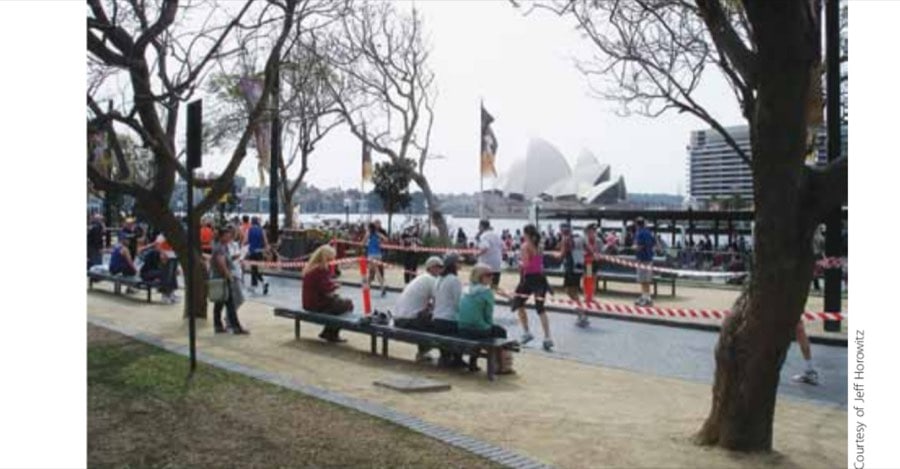
▲ Unmistakeably Sydney: running within sight of the famous Opera House.
As I strolled toward downtown, I was struck by how the old Victorian architecture of Sydney’s early boom days peacefully coexisted with modern design. An elevated monorail spun past overhead, flanked by ornate brick-and-stone facades and high-end retail outlets. Sydney was both an outdoor museum and a bustling metropolis. The fact that everyone more or less spoke English made it all the more accessible.
I zigzagged my way to the race-festival expo, which was being held in several connected tents in Cook & Phillip Park, across from St. Mary’s Cathedral. The festival offered four races: a marathon, a half-marathon, the 9K Harbour Bridge Run, and a 3.8K family fun run. Altogether, organizers expected over 25,000 participants.
You wouldn’t have guessed that from the expo. It was very small and perfunctory, with no freebies and few vendors. On the bright side, that left me with less to carry as I continued my walking tour. I made my way a few blocks over to the Sydney Tower, which, after the Harbour Bridge and the iconic Opera House, was the third-most-identifiable landmark on the Sydney skyline. Stretching up 250 meters into the sky, it offers 360-degree views of the city. As I gazed down, I tried to trace the racecourse and imagined following the mass of runners on race day from here.
Next was a short walk to the waterfront. On my left was the old warehouse district known as The Rocks, which now features popular bars, restaurants, and shopping. Just beyond that is the Harbour Bridge, a giant, arching steel span known locally as the Coathanger. Daring and well-heeled adventurers sign up for the expensive guided climb to the top of the bridge. From where I stood, I could just barely make out the tiny dots ascending the arch. All of the Sydney Race festival events would begin on the far side of the bridge and pass this way.
In front of me and curving to my right was Circular Quay, a walkway that linked the ferry terminal and docks to the Opera House. This is where all the festival races would end. The Opera House was built between 1959 and 1973 and is said to represent sails filled with wind. To me, however, it looked like a confused jumble of clamshells. But there is something about the building that draws you to it, demanding that you touch it, as if to prove that it’s real. Up close, its light and airy design gives way to the heaviness of its concrete construction. Its skin is made up of glazed tiles, smooth and cool to the touch. Families and couples posed on its flanks, snapping photos to send back home, proof positive that they had actually made it clear across the world.
The long journey and sightseeing finally began to take their toll, and I found myself fading as sunset came. I returned to my friends’ row house, and we went across the lane to a local pub for an early dinner and a pint. Leigh was a news anchor, very well known in Australia, while her husband, Phil, worked as an animator. They had both spent time in the United States, where they cultivated a surprising interest in American football, which was available on Australian cable TV. Phil
was an Eagles fan, and as I listened to his assessment of the coming season, the world suddenly shrank just a bit, and my journey seemed a little less exotic. After a dreamless sleep, I set out once again, but with the marathon just 24 hours away, I knew I should be doing less walking. A ferry to Manly would be just the thing. Not quite as famous as nearby Bondi Beach, Manly still offers a long expanse of sandy beach and good surfing. Historic photos showed that it had changed little over the past century, with a pedestrian mall called the Corso, lined with restaurants and beach-themed shops, leading across the narrow neck of land from the wharf to the beach. I rolled up my pants’ cuffs and stretched out on the sand. All this, just minutes away from the downtown offices. As I settled in for a nap, I wondered how anyone here got any work done.
Racing in Oz Sunday brought more cool, sunny weather. It was just the kind of morning that makes runners want to reach for their racing shoes. I got myself together and took the train to Milsons Point, across the harbor and at the foot of the bridge. It was about 6:30 a.m. I was early for the marathon, but thousands of people were already running past. These were the half-marathoners, who had just started their race. I felt like a greyhound in the slip as they streamed past, feeling a tug
ad
to jump in, even though I knew my race wouldn’t start for an hour. The 9K race would be last, starting an hour and a half after the marathon. The marathon was actually the least popular of the Sydney Festival races, drawing only 3,171 runners in 2010 compared with the 15,846 people who signed up for the 9K Harbour Run or the 8,487 half-marathon runners who were just passing by.
The staging ground at Bradfield Park, beneath the Harbour Bridge, was already littered with throwaway clothes and energy-bar wrappers as the rest of the marathon field gathered. I wandered around the grounds, passing an outdoor pool where swimmers were doing laps. I was barely warm enough in my throwaway sweatpants and sweatshirt. These Aussies were a different breed.
Finally it was time for the marathon to start. I joined the milling throng behind the start line. The race began, and clothing flew as the pack rumbled forward. Ahead of us, the road rose up. It would continue to rise for nearly all of the first two kilometers as we climbed up and over the Harbour Bridge.
The race originally followed the route of the Sydney 2000 marathon, but since 2004, the course has been in flux. The 2010 edition was hailed as the flattest, fastest, and most-scenic edition yet. There would be more winding around Hyde Park and the downtown area as it passed most of the city’s major landmarks. A press release said that participants would see other runners for almost the entire route and make the course more spectator friendly. On paper, though, parts of the course map resembled a plate of spaghetti. I was very curious to see how this would work out on the ground.
Seeing the field stretched out Now, cresting the bridge, I could see why so many runners considered this the highlight of the race. The views from here were spectacular. I was already getting warm and was looking to discard my throwaways as we began descending. The road undulated slightly over the next nine kilometers, climbed a little, and then flattened out again. At one point, running on an elevated stretch of highway, we passed a nightclub in full swing, filled with spectators. As music poured out onto the course, I wondered if I would enjoy it quite as much when we returned back that way later in the race.
As the miles passed, I had plenty of opportunities to admire the city. We were led through Hyde Park, a beautifully manicured historic commons that was named after the famed London greenspace. A temporary footbridge had been built over Park Street just for the marathon, allowing racers to cross the busy thoroughfare and run Hyde from end to end. As if too proud of having pulled off this feat, the course would return this way and recross the footbridge later in the race.
▲
After crossing the Harbour Bridge early in the race, runners get another view of it.
Courtesy of Jeff Horowitz
At some point, I realized that I was having a good race. This was quite a surprise, because I hadn’t meant to. Between the flights and my sightseeing, I hadn’t expected much more than a pleasant jog out of my body, and I had started to look forward to a relaxing, easy run. But after coming down off the bridge, I had settled into an ambitious pace and managed to hold it. By the halfway mark, I was well ahead of where I thought I would be and felt strong.
This concerned me. I fully knew what Rudyard Kipling had meant about filling the unforgiving minute with 60 seconds’ worth of run, and I had been looking forward to a day off. But the farther into the race I was able to hold this pace, the harder it would be to allow myself to slow down. I would feel compelled to hold my pace all the way to the end, no matter how difficult those final few miles became. It was, I knew, a slightly warped way of looking at things, but I think all of my running friends would have felt the same way. Once you commit to a race, you have to give it all you’ve got.
We ran east on Oxford Street before passing the football stadium and cricket ground and then entered Centennial Park. This was the course’s jumbled section, where runners looped back and forth across four parallel out-and-backs. The course was well marked and well marshaled, but it was hard not to get distracted by seeing racers who appeared to be running every which way in utter chaos.
Meanwhile, my legs had started to feel the effects of the pace. They were still churning on autopilot, but running no longer felt effortless. It would be all business from here to the end. A few miles later, I was still holding my pace, but energy suddenly seemed to be leaking from my legs, like helium from a balloon. There was nothing I could do but take some nutrition and grit my teeth. It was going to be a real race after all.
Courtesy of Jeff Horowitz
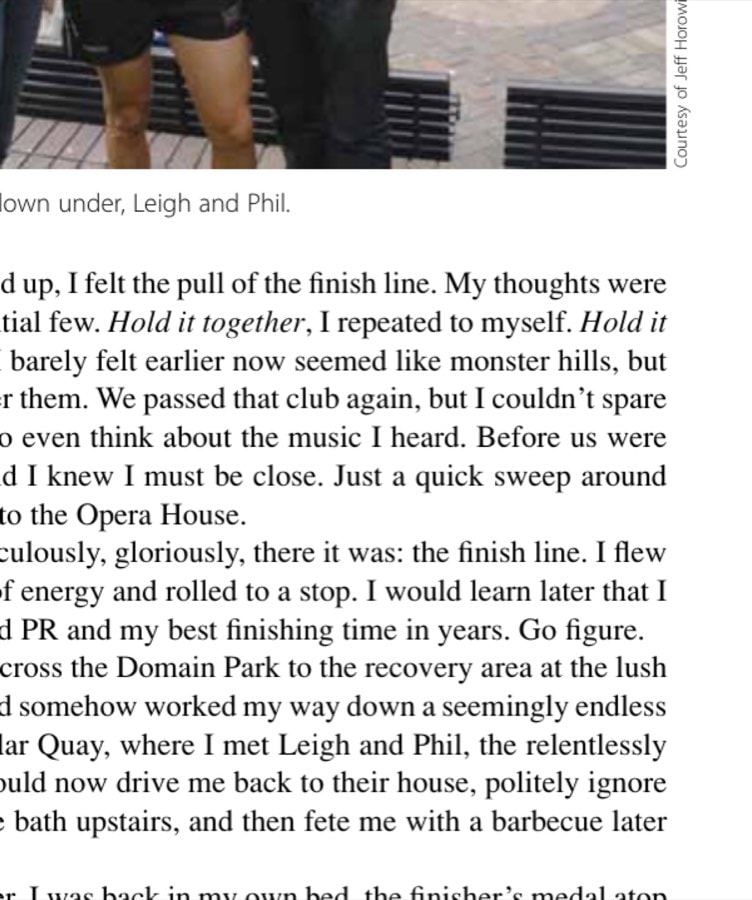
▲ The author with his hosts down under, Leigh and Phil.
As the kilometers added up, I felt the pull of the finish line. My thoughts were stripped down to the essential few. Hold it together, I repeated to myself. Hold it together. The rollers that I barely felt earlier now seemed like monster hills, but I willed myself up and over them. We passed that club again, but I couldn’t spare the energy it would take to even think about the music I heard. Before us were The Rocks once again, and I knew I must be close. Just a quick sweep around the Circular Quay and on to the Opera House.
Then, thankfully, miraculously, gloriously, there it was: the finish line. I flew across it with my last bit of energy and rolled to a stop. I would learn later that I had earned an age-adjusted PR and my best finishing time in years. Go figure.
I followed the crowd across the Domain Park to the recovery area at the lush Royal Botanic Gardens and somehow worked my way down a seemingly endless set of stairs back to Circular Quay, where I met Leigh and Phil, the relentlessly supportive friends who would now drive me back to their house, politely ignore my groans as I took an ice bath upstairs, and then fete me with a barbecue later in the afternoon.
Less than two days later, I was back in my own bed, the finisher’s medal atop my dresser. I was badly jet-lagged—as I had predicted—as well as tired and sore, but thoroughly content. It was crazy, but I knew that I would do it all over again if given half a chance.
This article originally appeared in Marathon & Beyond, Vol. 16, No. 3 (2012).
← Browse the full M&B ArchiveMore like this
1,000+ stories from 19 years of Marathon & Beyond
The complete archive of the legendary long-distance journal — digitized and free to read.
